Hebrews 9:5
And over it the cherubims of glory shadowing the mercyseat; of which we can not now speak particularly.
Translations
And over it the cherubim of glory shadowing the mercy seat; of which we cannot now speak particularly.
And over it the cherubims of glory shadowing the mercyseat; of which we can not now speak particularly.
and over it the cherubims of glory shadowing the mercy seat; of which we cannot now speak particularly.
And over it the cherubim of glory shadowing the mercy-seat; of which we cannot now speak particularly.
Revised Version, American Standard Version
and above it cherubim of glory overshadowing the mercy-seat; of which things we cannot now speak severally.
and over it cherubim of the glory, overshadowing the mercy-seat, concerning which we are not now to speak particularly.
and above over it the cherubim of glory shadowing the mercy-seat; concerning which it is not now [ the time] to speak in detail.
But, over-above it, Cherubim of glory overshadowing the propitiatory:—concerning which things, it is not now [needful] to be speaking, particularly.
Berean Standard Bible, Majority Standard Bible
Above the ark were the cherubim of glory, overshadowing the mercy seat. But we cannot discuss these things in detail now.
and above it cherubim of glory overshadowing the mercy seat, of which things we can’ t speak now in detail.
And over it were the winged ones of glory with their wings covering the mercy-seat; about which it is not possible now to say anything in detail.
And ouer the Arke were the glorious Cherubims, shadowing the mercie seat: of which things we will not nowe speake particularly.
Douay-Rheims (Challoner revision)
And over it were the cherubims of glory overshadowing the propitiatory: of which it is not needful to speak now particularly.
Pictures
Cross-references 20 of 58
- Hebrews 8:1-2
Now of the things which we have spoken this is the sum: We have such an high priest, who is set on the right hand of the throne of the Majesty in the heavens;
Christ ministers as High Priest in the heavenly sanctuary.
- Exodus 25:17-22
And thou shalt make a mercy seat of pure gold: two cubits and a half shall be the length thereof, and a cubit and a half the breadth thereof.
Describes the mercy seat and cherubim overshadowing it.
- Leviticus 16:14-15
And he shall take of the blood of the bullock, and sprinkle it with his finger upon the mercy seat eastward; and before the mercy seat shall he sprinkle of the blood with his finger seven times.
Blood is sprinkled on the mercy seat to cleanse the sanctuary.
- Hebrews 9:23-24
It was therefore necessary that the patterns of things in the heavens should be purified with these; but the heavenly things themselves with better sacrifices than these.
The earthly sanctuary’s cleansing points to Christ’s ministry in the heavenly sanctuary.
- Revelation 11:19
And the temple of God was opened in heaven, and there was seen in his temple the ark of his testament: and there were lightnings, and voices, and thunderings, and an earthquake, and great hail.
The heavenly temple is opened, revealing the ark of God’s testament.
- Hebrews 8:5
Who serve unto the example and shadow of heavenly things, as Moses was admonished of God when he was about to make the tabernacle: for, See, saith he, that thou make all things according to the pattern shewed to thee in the mount.
The earthly sanctuary and its service are a pattern and shadow of heavenly things.
- Hebrews 9:11-12
But Christ being come an high priest of good things to come, by a greater and more perfect tabernacle, not made with hands, that is to say, not of this building;
Christ enters the greater heavenly sanctuary as High Priest by his own blood, obtaining redemption.
- Exodus 25:8
And let them make me a sanctuary; that I may dwell among them.
Gives the command to make the earthly sanctuary.
- Exodus 25:40
And look that thou make them after their pattern, which was shewed thee in the mount.
Moses was told to make the sanctuary according to the pattern shown on the mountain.
- Exodus 40:20-21
And he took and put the testimony into the ark, and set the staves on the ark, and put the mercy seat above upon the ark:
The testimony is placed in the ark, with the mercy seat above it, inside the tabernacle.
- Deuteronomy 10:5
And I turned myself and came down from the mount, and put the tables in the ark which I had made; and there they be, as the LORD commanded me.
The covenant tablets are placed inside the ark beneath the mercy seat.
- Hebrews 9:24
For Christ is not entered into the holy places made with hands, which are the figures of the true; but into heaven itself, now to appear in the presence of God for us:
Christ enters heaven itself to appear before God for humanity.
- Exodus 26:33-34
And thou shalt hang up the vail under the taches, that thou mayest bring in thither within the vail the ark of the testimony: and the vail shall divide unto you between the holy place and the most holy.
Places the ark and mercy seat in the most holy place, beyond the veil.
- Romans 3:25
Whom God hath set forth to be a propitiation through faith in his blood, to declare his righteousness for the remission of sins that are past, through the forbearance of God;
Both identify Christ as the mercy seat through his blood, bringing atonement and forgiveness.
- Leviticus 16:2
And the LORD said unto Moses, Speak unto Aaron thy brother, that he come not at all times into the holy place within the vail before the mercy seat, which is upon the ark; that he die not: for I will appear in the cloud upon the mercy seat.
God’s presence rests above the mercy seat, where the high priest may enter only as directed.
- Exodus 25:9
According to all that I shew thee, after the pattern of the tabernacle, and the pattern of all the instruments thereof, even so shall ye make it.
The earthly sanctuary was made according to the pattern God showed Moses.
- Revelation 15:5
And after that I looked, and, behold, the temple of the tabernacle of the testimony in heaven was opened:
John sees heaven’s tabernacle of testimony opened.
- Hebrews 10:1
For the law having a shadow of good things to come, and not the very image of the things, can never with those sacrifices which they offered year by year continually make the comers thereunto perfect.
The law’s sanctuary service was a shadow of good things fulfilled in Christ.
- Exodus 25:22
And there I will meet with thee, and I will commune with thee from above the mercy seat, from between the two cherubims which are upon the ark of the testimony, of all things which I will give thee in commandment unto the children of Israel.
God meets and speaks with Moses above the mercy seat between the cherubim.
- Leviticus 16:29-30
And this shall be a statute for ever unto you: that in the seventh month, on the tenth day of the month, ye shall afflict your souls, and do no work at all, whether it be one of your own country, or a stranger that sojourneth among you:
gives date and cleansing purpose
Commentary
Each commentary is drawn from primary sources: the writings of Ellen G. White and Adventist pioneers and periodicals. Each commentary is separate. Its own words are not a quotation; follow the references to read the source passages.
Ellen G. White
26 sources
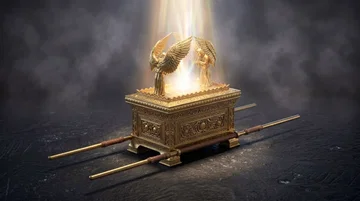
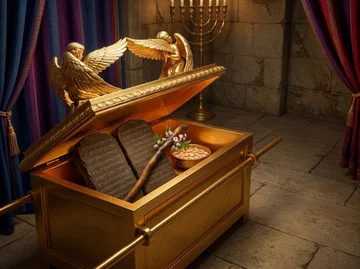
The mercy seat is the golden cover of the ark in the most holy place of the earthly sanctuary, with a cherub of glory at each end spreading its wings over it, their faces turned toward one another and looking downward.GC88 411.1–412.3GC 410.3–411.1WLF 18.3–4WLF 14.3–16.1RH Nov 8, 1915 Between the cherubim above the mercy seat is manifested God's glorious presence in a cloud of exceeding bright glory, as a throne where He dwells and makes His will known.GC88 411.1–412.3GC 410.3–411.1WLF 18.3–4 Beneath the mercy seat the ark holds God's law, the Ten Commandments forming the basis of His covenant, and over it justice and mercy are brought together as Christ pleads His blood for sinners so that God remains just while justifying the repentant.SG2 82.1SG1 164.1RH Jun 29, 19114SP 261.3 The place is sacred to God's presence and calls for reverent awe, while believers by faith direct their prayers toward Christ their Mediator before the mercy seat in the heavenly sanctuary, where He accepts confessions and pardons sins.EW 213.2–214.1SG4 8.38T 284.3–285.1EW 39.2 Of these things it cannot now be spoken particularly, for the mysteries belonging to the sanctuary and the heavenly day of atonement are not fully explained, yet the ministration in the heavenly sanctuary is present truth and a great pillar of faith to be earnestly sought and firmly held.SG1 158.1Lt 253, 1903, par. 174MR 249.1–2
Sanctuary Setting Described
The mercy seat is the golden cover of the ark standing in the most holy place of the earthly sanctuary, with a golden cherub of glory at each end overshadowing it.GC88 411.1–412.3GC 410.3–411.1RH Nov 8, 1915RH Nov 9, 1905 This arrangement belonged to the ordinances of divine service of the first covenant in its worldly sanctuary.RH Nov 8, 1915 The ark thus covered held the law of God, the two stone tablets of the Ten Commandments forming the basis of the covenant, kept close beneath the overshadowing angels.RH Nov 8, 1915RH Nov 9, 1905Lt 253, 1903, par. 17
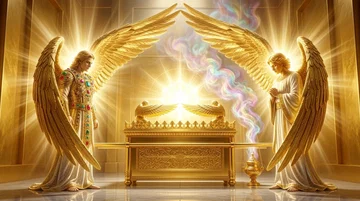
The cherubim stand with wings spread out over the mercy seat and ark, their faces turned toward one another and looking downward toward it.WLF 18.3–4WLF 14.3–16.1CET 91.2–3ExVEGW 15.3–17.1 Their wings are extended over the mercy seat, and their faces are turned toward the ark itself.EW 213.2–214.1LSEGW 100.1–3 God's glorious presence is manifested between the cherubim above the mercy seat in a cloud of exceeding bright glory.GC88 411.1–412.3GC 410.3–411.1SG1 158.1 That brightness above where the angels stand appears like a throne where God dwells, and from between the cherubim He makes His will known.WLF 18.3–4CET 91.2–3RH Nov 9, 1905 Its shining overshadows the mercy seat and fills the temple with light beyond description.SG1 158.1
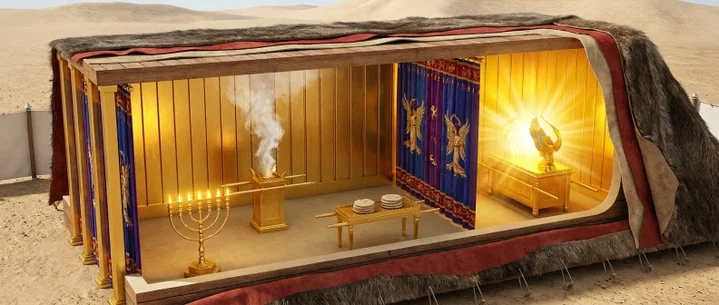
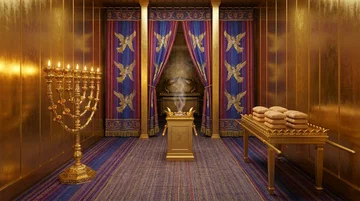
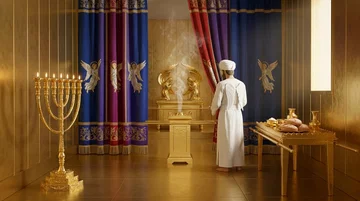
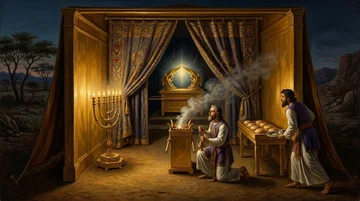
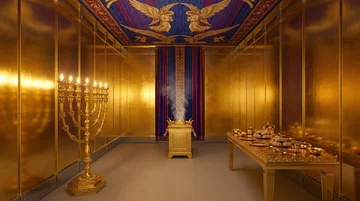
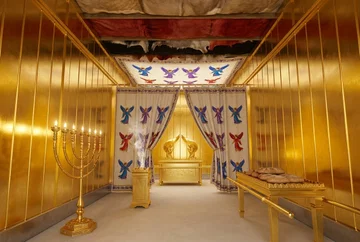
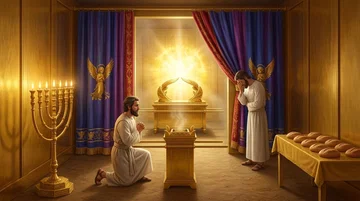
The tabernacle was made with two veiled apartments.RH Nov 8, 1915 The first apartment, called the sanctuary or holy place, contains the candlestick with seven lamps, the table with the showbread upon it, and the altar of incense.RH Jul 21, 1851RH Nov 8, 1915ExVEGW 15.3–17.1 After the second veil is the tabernacle called the holiest of all, containing the golden censer and the ark overlaid round about with gold.RH Nov 8, 1915 That ark holds the golden pot of manna, Aaron's rod that budded, and the tables of the covenant.RH Nov 8, 1915ExVEGW 15.3–17.1
The heavenly temple contains the real ark in its holy of holies, covered on top and sides with purest gold, with a golden censer standing between the cherubim.CET 91.2–3ExVEGW 15.3–17.1LSEGW 100.1–3 There Jesus stands by the ark, and as the prayers of the saints come up to Him the incense smokes and He offers them up with the smoke of the incense to the Father.CET 91.2–3ExVEGW 15.3–17.1LSEGW 100.1–3 Glory comes from the Father to Christ in that presentation and is shed upon those who pray in faith.EW 213.2–214.1 This is the sanctuary setting of the most holy place where Jesus ministers, which believers enter by faith to behold the ark and mercy seat, adding no further detail about the cherubim themselves.EW 216.1
Law, Justice and Mercy
Beneath the mercy seat the ark holds God's law, the Ten Commandments on tables of stone forming the basis of His covenant with Israel.SG2 82.1SG1 164.1RH Jun 29, 1911RH Nov 9, 1905EW 216.2 That law lies beneath the mercy seat within the most holy place, kept close to Jehovah and overshadowed and protected by His holiness.SG1 164.1RH Jun 29, 1911EW 216.2 Its light shines upon the world amid moral darkness.RH Jun 29, 1911
The cherubim above extend their wings over the mercy seat, with faces turned toward one another and looking downward toward the ark containing the Ten Commandments.SG1 158.1EW 213.2–214.1RH Nov 9, 1905 Their reverent posture represents the angelic host watching with reverent interest the law of God.SG1 158.1EW 213.2–214.1RH Nov 9, 1905 They watch with interest the plan of redemption.SG1 158.1EW 213.2–214.1RH Nov 9, 1905
The cherubim over the mercy seat show justice and mercy brought together as the heavenly host watches with reverent interest.4SP 261.3 The ark holds God's law as the rule by which humanity is tested, while Christ pleads His blood before the mercy seat for sinners.4SP 261.3 In this way God remains just while justifying the repentant sinner, restoring the broken relationship with Himself.4SP 261.3 The redeemed are clothed in Christ's righteousness so they may live in God's presence with the unfallen angels.4SP 261.3
The fourth commandment is surrounded by a halo of glory because it alone identifies the living God as the Maker of heaven and earth.ExVEGW 15.3–17.1SG2 82.1 Within the ark the ten commandments are written with four on one table and six on the other, the four shining brighter than the six and the fourth, the Sabbath commandment, shining above them all.ExVEGW 15.3–17.1 It remains among the commandments unchanged as written at Sinai, still reading, But the seventh day is the Sabbath of the Lord thy God, identifying the seventh day as the Lord's Sabbath.ExVEGW 15.3–17.1SG1 164.1EW 216.2 It has not been abolished or nailed to the cross and has not been changed by God who never changes, but the change from the seventh to the first day was made by the Pope, not changed to the first day of the week.ExVEGW 15.3–17.1SG1 164.1 It stands as the separating wall between the true Israel of God and unbelievers and the great question uniting the hearts of God's waiting saints.ExVEGW 15.3–17.1
Reverence and Heavenly Mediation
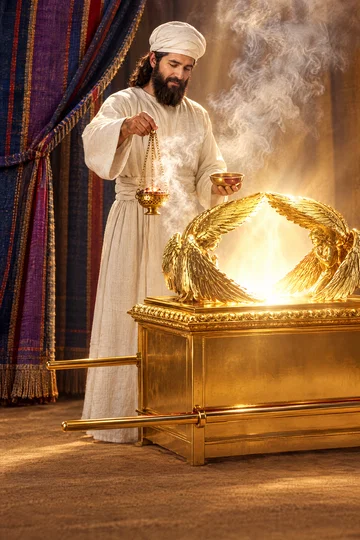
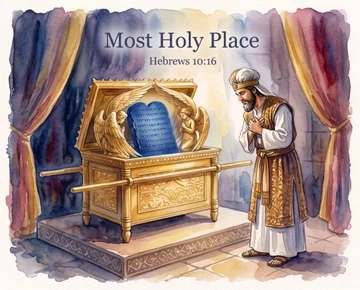
The most holy place is a symbol of God's dwelling-place, sacred to His presence.8T 284.3–285.1 Above the mercy seat and the bowed, worshiping angels dwelt the glory of the Holiest, glory upon which no man might look and live.8T 284.3–285.1 The veil inwrought with cherubim was not to be lifted by any hand save one, and to intrude unbidden into that sacred mystery was death.8T 284.3–285.1 On the one day of the year appointed for ministry there the high priest with trembling entered, while clouds of incense veiled the glory from his sight, and throughout the courts every sound was hushed while worshipers bowed in silent awe sending up petitions for mercy.8T 284.3–285.1 These things happened as example and were written for admonition upon whom the ends of the ages are come, calling for reverent silence before God.8T 284.3–285.1
Though the priest in the holy place could not see the mercy seat behind the curtain, he knew it was there and directed his prayer toward it by faith.SG4 8.3 This represents God's people directing their prayers to Christ, their Mediator before the mercy seat in the heavenly sanctuary.SG4 8.3 By faith they see Him and confidently claim the benefits of His mediation.SG4 8.3 While Jesus is there He accepts prayers, confessions, and sacrifices and pardons sins.EW 39.2 When He leaves, that ministry of intercession ends, and people's spiritual condition remains fixed.EW 39.2
The cherubim above the mercy seat have their wings extended over it, and their faces turned toward the ark containing the Ten Commandments.EW 213.2–214.1 They represent the angelic host watching with interest the law of God.EW 213.2–214.1 The bright glory above the mercy seat appears like the throne of God; as Christ presents the prayers of the saints with incense, glory comes from the Father to Christ and is shed upon those who pray in faith.EW 213.2–214.1 That ministry is nearly finished, and the short sealing time calls for preparation and continued attention to God's commandments and the testimony of Jesus.EW 48.3–49.1
Of these things it cannot now be spoken particularly: their details cannot be explained there.SG1 158.1 They belong to the sanctuary, to the heavenly sanctuary and the great day of atonement, and to the mysteries of heaven about which lips are closed with no inclination to try to describe them.Lt 253, 1903, par. 17 God's glory shines above the mercy seat, overshadows it, and fills the temple; its brightness is beyond description, with the cherubim above the ark, their faces turned toward one another and looking down at the law.SG1 158.1 Yet the ministration in the heavenly sanctuary is present truth and a great pillar of faith, with light given when the Lord is earnestly sought.4MR 249.1–2 It has been borne witness to and endorsed over and over in a marked manner by the Holy Spirit when preached, though for more than half a century questioned and opposed by new theories which are not truth and which deny the truths upon which the Spirit of God has placed His approval, and any teaching that would lead away from the light on it is not to be accepted.4MR 249.1–2 The mention of the mercy seat points to God's mercy as relevant to ministry for suffering people, with which believers should become acquainted in healing work.RH Dec 17, 1914
Sources
Pioneers and periodicals
133 sources
The verse belongs to the description of the earthly sanctuary of the first covenant, the tabernacle Moses built by command after the pattern shown on the mount.RH Jul 19, 1870ST May 20, 1880RH Sep 2, 1852 In its innermost room, beyond the second veil, stood the gold-covered ark holding the tables of the law, the pot of manna and Aaron's rod, with golden cherubim spreading their wings above to overshadow its cover, the mercy seat.ST Jun 4, 1885RH May 14, 1867RH Dec 24, 1908 That mercy seat is God's throne where His presence dwelt in glory between the cherubim and where He met with Moses to show grace and mercy.RH May 11, 1869ST Nov 14, 1892RH May 11, 1869 Beneath it lay the Ten Commandment law as the foundation of His government, while above it atoning blood was presented, so that mercy stands between the sinner and the broken law without setting the law aside.RH Feb 5, 1867ST Dec 23, 1897RH Oct 4, 1864ST The whole earthly arrangement was a figure and shadow of the true sanctuary in heaven, where Christ now ministers as High Priest by His own blood to pardon and finally to cleanse His people from sin.LDT 179.2RH Jul 18, 1854ST Aug 15, 1878RH Apr 5, 1864ST May 20, 1875
Earthly Sanctuary Described
Hebrews 9:5 belongs to the description of the sanctuary of the first covenant, the worldly tabernacle Moses erected by command according to the pattern shown on the mount.RH Jul 19, 1870ST May 20, 1880RH Sep 2, 1852RH Jan 6, 1853 That sanctuary lasted from Sinai to Christ and was later continued in Solomon's temple and Zerubbabel's temple.RH Jul 19, 1870ST Aug 30, 1877 It is God's tabernacle and dwelling and center of worship, not the earth, the land of Canaan, or the church.RH Jan 6, 1853 Together with the surrounding details the verse identifies the tabernacle and its sacred furnishings, with its two apartments and vessels used in ministry, as the sanctuary of the Lord during the period of the first covenant.RH Sep 2, 1852RH Aug 4, 1863ST Aug 30, 1877 Its closing words indicate that the details of these objects are not being discussed further there.ST Aug 30, 1877
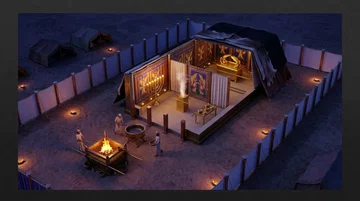
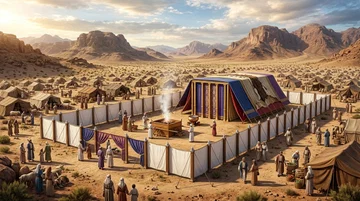
The sanctuary stood within a court containing the brazen altar of burnt offerings near the entrance and the laver between the altar and the tabernacle door where priests washed hands and feet.ST Jun 20, 1911 It was divided by veils into two apartments, an outer part called the sanctuary and an inner tabernacle beyond the second veil called the Holiest of all.RH Feb 11, 1858ST Jun 20, 1911ST Apr 1, 1886 The first apartment called the sanctuary or holy place held the seven-branched candlestick on the south side, the table with showbread on the north side, and the golden altar of incense just before the veil separating the holy from the most holy.RH Sep 21, 1905RH Feb 11, 1858ST Jun 20, 1911 Priests entered there daily to perform their official service of God by offering blood for themselves and for the errors of the people, while beyond the second veil the high priest entered alone once a year.RH Sep 21, 1905RH Aug 31, 1916RH Jan 24, 1856 The earthly tabernacle was longer than wide and divided by a veil into two rooms, the first where ministrations were offered every day and the second within and beyond the veil containing the mercy seat overshadowed by the cherubims of glory.RH Jan 24, 1856
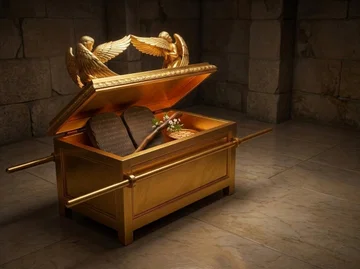
In the most holy place stood the gold-overlaid ark of the covenant holding the golden pot of manna, Aaron's rod that budded, and the tables of the covenant, with the golden censer belonging to its service.RH Feb 11, 1858RH Jan 6, 1853ST Apr 1, 1886 Above the ark were the glorious cherubim of glory spreading their wings to shadow the mercy seat, the innermost furnishing of the sanctuary.ST Jun 4, 1885RH May 14, 1867RH Dec 24, 1908ST Mar 20, 1879ST Dec 8, 1881 The mercy seat was the cover of the ark, and the cherubim stood over it as part of the sanctuary furnishings associated with the priests' service.RH May 14, 1867ST Mar 20, 1879 They were made with the mercy seat which formed the top of the ark as one solid work of beaten gold, and the ark with its contents was part of the tabernacle sanctuary as God's appointed dwelling among Israel.RH Mar 1, 1870 The verse names this feature but does not explain it in detail.RH Dec 24, 1908
The closing words state that these things cannot now be spoken particularly.ST Jan 27, 1890ST Feb 7, 1906RH Mar 10, 1874 The verse names the cherubim and mercy seat without explaining them in detail because that is not the present subject.ST Sep 18, 1884ST Oct 21, 1880 The arrangement was already familiar, and the earthly sanctuary and its holy places represented God's sanctuary in heaven, so these things were figures of heavenly realities.ST Feb 7, 1906 The sanctuary represented his dwelling place, the ark his throne, and the throne the place from which he gave grace, favor, and mercy.ST Jan 27, 1890 Hebrews 9 is thus connected with Christ's ministry as high priest in the true sanctuary, his atonement for sin through his own blood, and his later appearing to bring salvation.ST Sep 18, 1884
Mercy Seat and Cherubim
The mercy seat was the cover or lid of the ark resting upon it, beaten out of one solid piece of gold with the cherubim.ST Mar 21, 1911RH Nov 8, 1915ST Mar 11, 1886RH Jan 6, 1853 A cherub stood at each end of the cover, with faces turned toward each other and looking reverently downward toward the mercy seat, and with wings meeting above it.ST Mar 21, 1911RH Jan 6, 1916ST Oct 21, 1930 One wing of each angel was stretched forth on high to overshadow and spread over the mercy seat, while the other was folded to cover the form in token of reverence and humility.ST Mar 21, 1911ST Mar 11, 1886ST Oct 21, 1930 Beneath that golden covering the ark held the stone tablets of the Ten Commandments.RH Nov 8, 1915ST Mar 11, 1886
The mercy seat is God's throne where His presence abides and is manifested, with glory shining above it and between the cherubim as the Shekinah.RH May 11, 1869ST Nov 14, 1892RH May 11, 1869ST Nov 23, 1904 It was the place between the cherubim where He met and spoke with Moses, dwelt in the holy of holies in the most holy place, and dispensed grace, favor and mercy.ST Nov 14, 1892ST Mar 11, 1886ST Nov 23, 1904 The high priest approached it from beneath, entering there on the Day of Atonement to make atonement for the sins of the people.RH May 11, 1869RH May 11, 1869 That sacred scene was a dim reflection of the glories of God's temple in heaven, the center of the work for humanity's redemption, where God dwells between the cherubim.ST Nov 23, 1904
The cherubim are golden figures representing living angels near God's throne in heaven, with shining cherubim and seraphim where God and Christ dwell.RH Sep 19, 1912RH Jan 6, 1916ST Oct 21, 1930 Their high place of honor over the mercy seat shows the exalted position, power and reverent interest of the angelic host in God's law and the plan of redemption, looking with interest and reverence to the law deposited in the ark, regarding it as the foundation of everything worth having, and upholding it.ST Mar 21, 1911ST Jul 24, 1884ST Jul 17, 1879 The place of the covering cherub there illustrates how exalted Satan originally was before he rebelled against his Maker and led other angels into rebellion.ST Jul 24, 1884ST Jul 17, 1879 The law rested in the ark beneath as the foundation of God's government and rule of life, so that breaking it was an offense against God's rule, while the mercy seat stood between the sinner and the broken law as a type of Christ who paid at Calvary the penalty for transgression, showing that mercy and justice, mercy and pardon, meet in God's throne where God is both ruler and lawgiver and loving Father.RH Apr 24, 1913RH Jan 6, 1916
As part of the earthly pattern made according to the pattern shown to Moses, the verse points to corresponding realities in heaven, for the sanctuary and its furnishings were figures and patterns of the true sanctuary which the Lord pitched.RH May 27, 1852RH Jan 1851ST Oct 22, 1874ST Nov 23, 1904 The mercy seat has a heavenly counterpart in the present dispensation, and by the same reasoning the ark beneath it exists there as truly as Jesus exists, both existing together in the heavenly sanctuary where Christ ministers.ST Oct 22, 1874RH May 27, 1852RH Jan 1851RH May 27, 1852 The ark holds God's commandments as the rule of human life, while the mercy seat above it is where mercy and pardon for breaking that law are found through Christ's blood.ST Oct 22, 1874RH May 27, 1852 That heavenly sanctuary has a mercy seat, an ark containing God's law, and holy angels, and its cleansing is a priestly work performed with blood and completed before Christ's second coming.ST Oct 22, 1874RH Apr 30, 1857
Pattern of Heavenly Sanctuary
The earthly tabernacle with its apartments, vessels, priesthood and services was made only as a figure, shadow, example and exact pattern of the true tabernacle in heaven which the Lord pitched and not man.LDT 179.2ST Aug 15, 1878ST Jan 13, 1914ST Oct 22, 1874 Its objects were teaching symbols while heaven holds the real substance, and its whole round of service directed faith to the permanent plan of salvation through Christ and to His mediatorial work above.LDT 179.2RH Jul 18, 1854ST Jan 13, 1914 The worldly sanctuary and its furnishings described here belonged to the first covenant, being the tabernacle Moses erected, and pointed to Christ's ministry as High Priest who offered Himself once for the redemption of sin.RH Jul 18, 1854ST Aug 15, 1878ST Oct 22, 1874 While that first tabernacle stood it signified that the way into the holy places of the heavenly temple was not yet opened, but when Christ ascended on high He became a great High Priest and by His own blood entered the temple of God as the substance of the good things to come.ST Aug 15, 1878ST Jan 13, 1914 The cherubim and mercy seat are named here without further particular explanation because they are part of that identification of the pattern, not the present subject.RH Jul 18, 1854
The two apartments of the earthly service indicate the order of His ministration above, which can be traced in the two apartments of the temple above in the New Testament.ST Aug 15, 1878RH Aug 28, 1853RH Dec 30, 1873 The heavenly sanctuary has corresponding holy places, with furnishings corresponding to the earthly furnishings, so that the most holy place where cherubim of glory shaded the mercy seat over the ark has its counterpart above.RH Oct 2, 1856RH Aug 28, 1853ST Jul 2, 1896RH Dec 30, 1873 The term rendered holiest of all is plural in the original, meaning holy places, evidencing that Christ began His ministry in heaven's first apartment after His ascension according to the pattern of the Levitical priests.RH Oct 2, 1856RH Aug 28, 1853RH Aug 28, 1853 That scene with seven lamps marks ministry in the first apartment, distinct from later reaching the place before the ark in the most holy.ST Jul 2, 1896ST Jun 28, 1905 He entered upon that ministration in the first apartment at the day of Pentecost, and later closed His service in the first apartment and entered upon His service in the second, most holy, in 1844 with the judgment message, and knowing where He is ministering makes worship intelligent and true.ST Jun 28, 1905
The earthly divine service ended when the true Sacrifice died on the cross, when the type reached its antitype.ST Sep 20, 1899ST May 28, 1896 When the veil was torn it signified that God's presence had left the earthly sanctuary, where the ark had stood beneath the veil and the Shekinah had appeared as the symbol of His presence beheld only by the high priest, and that its hidden holy place was opened to view.ST May 28, 1896 Animal sacrifices then lost efficacy as expressions of faith, for the offerings of the former sanctuary were temporary shadows of Christ's one effective offering, and to renew those sacrifices would deny its finality and return from reality to shadow.ST Oct 1, 1896ST May 28, 1896 The Aaronic priesthood and its sanctuary service with its ritual therefore ceased at the crucifixion, and the ceremonies of the Mosaic law with its temple-related ceremonial law, the law contained in ordinances, and its Levitical priesthood were abolished, nailed to the cross, and replaced with a more perfect economy.ST Sep 20, 1899ST May 28, 1896RH Nov 18, 1862 Their meaning was fulfilled in Christ, who entered His priestly ministry in the heavenly sanctuary for the work of redemption, so the earthly sanctuary and its ritual service could pass away.
Law Beneath Mercy
Beneath the overshadowing cherubim the ark holds God's Ten Commandment law written by his own finger on tables of stone, the moral law and rule of human life and foundation of his government.RH Feb 5, 1867ST Aug 10, 1882ST Sep 21, 1876ST Jan 6, 1881 That law lay inside the ark in the most holy place of the earthly sanctuary, with the mercy seat as the ark's cover and top above it.ST Dec 23, 1897ST Aug 10, 1882ST Sep 21, 1876ST Jan 6, 1881 Its placement in the holiest part, sacredly guarded beneath the cherubim, shows the honor God places upon that law, including the Sabbath commandment.RH Feb 5, 1867ST Dec 23, 1897 The earthly arrangement points to the heavenly sanctuary, where the commandments remain while atonement is made for those who obey God, and their place within the sanctuary does not make the Ten Commandments themselves the first covenant.RH Feb 5, 1867ST Dec 23, 1897
Above that broken law the mercy seat is the place where atoning blood was presented and pardon extended to the penitent transgressor.ST Aug 10, 1882ST Sep 21, 1876ST Jan 6, 1881RH Apr 6, 1869 Only the high priest could approach it, bringing blood of the sin offering for transgressions of that law, and on the tenth day of the seventh month at the end of the ceremonial year he entered the second apartment with blood for himself and for the errors of the people.RH Sep 21, 1905ST Oct 25, 1883ST Dec 13, 1883 He sprinkled the goat's sin-offering blood upon and before the mercy seat seven times and cleansed holy place and altar because of uncleanness, thus finishing the yearly round, releasing sins lodged in the sanctuary, and transferring them to the scapegoat to be borne into an uninhabited wilderness.RH Sep 21, 1905ST Oct 25, 1883ST Nov 23, 1904 That animal blood in itself could not remove sin but pointed to Christ's blood, and the high priest typified Christ as the true High Priest offering his own blood for his people, satisfying justice without abolishing the holy law.RH Aug 30, 1864RH Apr 6, 1869ST Dec 13, 1883 The scene therefore shows God's law resting in the ark with the blood-sprinkled mercy seat standing between God and the broken law, where mercy intervenes against the law's just judgment and makes it possible for sinners to approach God, removing the sinner's guilt rather than the law, even for Sabbath-breaking.ST Jan 6, 1881RH Aug 30, 1864RH Apr 6, 1869ST Dec 13, 1883
The arrangement joins law and atonement, for the law rests beneath as pillars of eternal government whose transgression demands atonement and makes priesthood necessary, while mercy stands between the sinner and the broken law.RH Oct 4, 1864STST Nov 11, 1897 The law of God lay beneath the mercy seat, showing that justice and judgment underlie the throne where mercy is found, so mercy does not set aside the law.ST Dec 5, 1916ST Jun 17, 1889 The ark represents the center of God's worship on earth in ancient times and now in heaven where Christ ministers as great High Priest, and the mercy seat above the law expresses the meeting of mercy and truth and of righteousness and peace.RH Oct 4, 1864ST There the Lord rules between the cherubim upon a throne of grace delighting in mercy, where by faith believers see his throne and seek atonement, with remedy at hand wherever there is sin because Christ's sacrifice answers the transgression of the law kept within the ark.ST Nov 11, 1897ST Jun 17, 1889
That whole sanctuary system with its law, priesthood, sacrifices, and symbols of pardon pictured the plan of redemption, in which penitents confessed sins and the victim's blood and the priest's ministration represented sins being put away.RH Oct 15, 1901ST Feb 17, 1890ST Oct 10, 1906 Its yearly round of typical service expressed faith in the Redeemer to come and taught how atonement could be made and the way to God, identifying the temple-related ceremonial law as part of the typical system abolished by the gospel.ST Feb 17, 1890ST Mar 20, 1879ST Oct 10, 1906RH Jan 16, 1900 Those sacrifices could not take away sin nor make anyone perfect nor save by themselves, but depended on Christ's mediatorial work for salvation.ST Feb 17, 1890ST Oct 10, 1906ST Jun 3, 1913 The earthly sanctuary and Levitical priesthood were given to instruct concerning the heavenly sanctuary where Christ serves after the order of Melchisedec, meant only to lead to the full faith of the covenant with Abraham and not to be final or a way of salvation by its service.RH Oct 15, 1901RH Jan 16, 1900ST Jun 3, 1913
Heavenly Ministry and Cleansing
Christ ministers as merciful High Priest after the order of Melchizedek in the heavenly sanctuary by virtue of His own blood shed on the cross, the offering He presents to the Father, and His one effective offering fulfills the Levitical sacrifices.RH Apr 5, 1864ST May 1, 1879ST Nov 23, 1904 Hebrews 9 proves the sanctuary and priesthood of this dispensation are in heaven, where the sanctuary is cleansed by Christ's better sacrifice, the blood of the Lamb slain at Calvary, and that cleansing also purifies worshipers preparing them for the second advent.RH Apr 5, 1864ST May 20, 1875RH Sep 24, 1914 The sanctuary to be cleansed is in heaven, and Jesus has entered it to cleanse it, bearing sin into God's presence by the blood of the perfect sacrifice in contrast to animal sacrifices which could not take away sin.RH Sep 24, 1914ST May 1, 1879 Hebrews 9:1-7 shows priestly ministration in each apartment completed in one yearly round closing with the cleansing of the sanctuary on the tenth day of the seventh month, thus shadowing forth the complete priestly service of Christ.ST Nov 23, 1904RH May 18, 1869 While the form of Christ's service is typified by the Levitical round, its unchangeable continuance without passing from priest to priest by death is represented by His Melchizedek priesthood from Judah with no predecessor and no successor.ST Nov 23, 1904 The earthly high priest's atonement on the last day of the year was the type of Christ's real atonement, identified with the Judgment, in the heavenly sanctuary, and the daily ministration in the first apartment and the yearly service in the second typify in main features His work from ascension until His coming.RH May 18, 1869
On the tenth day of the seventh month at the end of the ceremonial year the high priest alone entered the second apartment with blood for himself and for the errors of the people.RH Jan 9, 1855ST Oct 21, 1880RH Feb 26, 1867 With cloud of incense covering the mercy seat he sprinkled the goat's sin-offering blood upon and before the mercy seat seven times to make atonement for the holy sanctuary, tabernacle, altar, priests and people because of uncleanness and transgressions.RH Jan 9, 1855 He thus finished the yearly round, released sins lodged in the sanctuary, cleansed holy place and altar, and transferred them to the scapegoat representing Satan to be borne into an uninhabited wilderness.RH Jan 9, 1855RH May 9, 1871 That yearly Day of Atonement when sin was put away was the cleansing of the sanctuary, a decisive work of cleansing and judgment that acquitted those who had accepted God's mercy.ST Oct 21, 1880ST Jul 24, 1893ST Jan 3, 1911 Light about the sanctuary in heaven revealed this as Christ's closing work as High Priest, which He likewise completes in the most holy place of the heavenly sanctuary, cleansing it from the remembrance of sin.RH Feb 26, 1867ST Jul 24, 1893ST Jan 3, 1911
The cleansing of the heavenly sanctuary with better sacrifices is Christ's concluding priestly work with blood that blots out confessed sins, acquits those who accepted mercy, and finishes the gospel work before the second advent.ST May 20, 1875ST Dec 12, 1916RH Feb 21, 1856 Hebrews 9 teaches the sanctuary is cleansed with blood removing sin and iniquity rather than physical uncleanness, the same cleansing described in Daniel 8:14, and with Leviticus 16 it relates the Day of Atonement ceremonies to the cleansing of heavenly things and to the judgment day.RH Feb 21, 1856ST Apr 20, 1904 It is the antitype of the atonement made with the slain goat as sin offering for the people, the final blotting out of confessed sins of those who by confession, repentance and faith placed their burden upon the sanctuary and its atoning blood and maintained confidence steadfast to the end.ST Dec 12, 1916 Only 490 years of the 2300 years belonged to the first covenant and earthly sanctuary while 1810 years remained to the cleansing, so the cleansing promised at the end of the 2300 days in 1844 applies to the second-covenant sanctuary, the only thing properly called God's sanctuary now where Christ ministers.RH Jun 9, 1851 That earthly tabernacle with its ordinances, two holies, furniture and yearly high-priestly service was made after the pattern of the true tabernacle which the Lord pitched and not man, making the type a perfect guide to the heavenly substance and to the sanctuary to be cleansed.RH Jun 9, 1851 Its completion is followed by His coming forth to bring the covenant of peace, ending probation with the seven last plagues, and whether this cleansing occurred at the beginning or conclusion of Christ's ministration was the point in dispute.RH Jul 28, 1868
The pattern required anointing of the earthly holy of holies before the sin offering was presented before the mercy seat.RH May 8, 1856 Correspondingly Christ as High Priest had to enter the heavenly sanctuary within the veil to fulfill the pattern, which He did after His ascension to anoint the heavenly most holy preparatory to His ministration.RH May 8, 1856 Jesus entered the holiest of the true tabernacle to cleanse the sanctuary only at the end of the 2300 days, and at that time He shut the door of the daily ministration and opened the door into the holiest, giving access by faith to His most-holy ministry and to the law and glory of God.RH The mercy seat rests upon the ark containing the commandments behind the second veil in the holiest of all, and there is no place for a priest upon it, for the high priest never got up upon it.RHRH Feb 17, 1852 Jesus as High Priest stands before the mercy seat in the heavenly sanctuary to plead His blood, and never was and never will be seated upon it.RHRH Feb 17, 1852
Disputed Word Meanings
The Greek noun in the verse is the neuter hilasterion, meaning the cover or lid of the ark over the law, and it is distinct from the masculine hilasterios meaning one who makes expiation, an expiatory sacrifice or propitiator.RH Dec 22, 1874ST Jan 14, 1875 Christ is therefore not the mercy seat itself but the High Priest distinct from that place, the antitype of the priests who sprinkled blood upon the mercy seat and before the mercy seat.RH Dec 22, 1874ST Jan 14, 1875ST Aug 12, 1875 He has entered heaven itself and by virtue of his own precious blood makes atonement on the mercy seat over God's violated law, since there is no figure, shadow, example or pattern in which the high priest sprinkles blood upon himself.RH Dec 22, 1874ST Jan 14, 1875 The use of hilasterion for the mercy seat of the tabernacle, though the same word is translated propitiation in Romans 3:25, does not make Christ identical with that place, which the high priest entered only once a year as one distinct from it.RH Dec 22, 1874ST Jan 14, 1875ST Aug 12, 1875
Those who held the opposite reading taught that this same Greek word, from which propitiation in Romans 3:25 comes, shows Christ is now our mercy seat.RH Dec 22, 1874 Since the mercy seat was in the holiest of all, Christ the great antitype has by this reckoning been in the holiest of all ever since he went to heaven to be our mercy seat, and did not first enter the holy of holies in 1844.RH Dec 22, 1874 In the same line the mercy seat over the ark, with cherubim at its ends and the Shekinah between them and the law resting in the ark beneath it, stood between the sinner and the broken law as a type of Christ who paid at Calvary the penalty for transgression, showing mercy and justice meeting in God's throne as both ruler and loving Father.RH Apr 24, 1913 The mercy seat is thus placed in the Most Holy Place of the heavenly true tabernacle with Christ identified as the mercy seat who will accompany the true tabernacle when it comes down from heaven to earth.ST Aug 12, 1875
Jesus as High Priest stands before the mercy seat and ark in the heavenly sanctuary to plead his blood for sinners and is never seated upon the mercy seat.ST Mar 14, 1878ST Jan 10, 1878RH May 27, 1852ST Aug 26, 1889RH Jan 21, 1858 The mercy seat is the ark's cover above the Ten Commandments overshadowed by the cherubim, and Christ stands before it as priest in the most holy place, before the ark containing God's law as the rule of life and judgment.ST Mar 14, 1878ST Jan 10, 1878RH Sep 16, 1852 There is no place for a priest upon it, for the high priest of the type never got up upon it but stood before it ready to plead for those who come sincerely and truthfully.RH May 27, 1852ST Aug 26, 1889RH Jan 21, 1858 Before the ark overshadowed by the cherubim he intercedes for fallen humanity and presents his own blood while sins are erased, with blood upon the mercy seat that can take away sin for those who turn from sin and obey.RH May 27, 1852ST Aug 26, 1889RH Jan 21, 1858RH Sep 16, 1852
The mercy seat is not separate from the ark that supports it but rests upon it and belongs together with it in the most holy place.RH May 27, 1852RH May 27, 1852RH Oct 7, 1873 The earthly mercy seat with its overshadowing cherubim is the pattern for a real mercy seat in the heavenly sanctuary, as truly as Jesus is real, and the same pattern gives equal evidence that the ark of the Ten Commandments is there beneath it holding God's holy precepts.RH May 27, 1852RH May 27, 1852RH Oct 7, 1873 Since the mercy seat exists in the heavenly sanctuary in the present dispensation, the ark exists there as well with its commandments remaining relevant, and where the merciful High Priest stands ready to plead.RH May 27, 1852RH May 27, 1852ST Oct 22, 1874
Reverent Personal Application
The mercy seat is a place of communion where Jesus receives burdens and gives forgiveness and grace for every need, and even those far from the sanctuary may be close to God there by faith and prayer.RH Jun 24, 1902RH Feb 11, 1915 It is a blood-bought refuge where the sin-sick and spiritually hungry may kneel and find comfort through Christ's redemption, where the troubled soul finds peace, protection from wrath and Satan's power and worldly snares, where the distressed are heard, the unclean sanctified, and mourners receive comfort and gladness.STRH Nov 11, 1873RH Feb 11, 1915 Guiding lights of love burn forever round it and call for turning toward it, and if feet bound by habit lack the will to turn the result is doom beyond the saddest guess as the long years of God unroll, leaving dreary selfishness as the prison of the soul.ST Oct 8, 1894 By it believers draw on God's abundant resources even when far apart in fellowship, and acquaintance with it belongs to ministry for suffering people through healing.RH Dec 17, 1914RH Feb 11, 1915
The sanctuary is not merely an idea but a real holy dwelling to be reverenced, whose inner compartment was the place of special manifestation of the divine presence.RH Jul 21, 1904RH Jan 12, 1864 Its temporary types of Christ's high-priestly ministry are not a counterpart of the human body or of an inner phase of human nature, nor a claim that divinity dwells naturally in every human heart.RH Jul 21, 1904 The cherubim over the mercy seat were images of heavenly angels made by God's command as sanctuary furnishings, so making a likeness is not in itself idolatry, since the second commandment forbids only images made as idols to be worshiped.RH Apr 5, 1864 That Most Holy Place with the cherubim of glory above the mercy seat held beneath them the ark containing the fourth commandment, central to Israel's religious system and a sign of its glory, upholding the Sabbath within the law safe beneath the mercy seat.RH Aug 13, 1857 That ancient sanctuary pointed to the Christian gospel service, yet a humble house of prayer made holy by Jesus' grace is not less holy than the old sanctuary.RH May 30, 1912 The same sanctuary teaching is the antidote to the claim that Christ is contained in a church tabernacle and controlled by a priest.RH May 21, 1908
The brief statement of tabernacle, furniture, and services is preserved even to the minutest details not so the same ritual will be performed but so the same benefit received from the visible forms will be received from the written word, making study of the tabernacle Scriptures full of interest and profit.RH May 20, 1902 The actual tabernacle and later the temple with its round of services was a continual object lesson to Israel and a witness to God before the world, which while Israel obeyed enabled faithful witness by God's power.RH May 20, 1902 The concise New Testament account of the sanctuary and its cleansing agrees with the fuller Old Testament account, presenting the matter in condensed form.ST Jan 16, 1907 Both earthly and heavenly sanctuaries with all their furniture and services are object lessons of how to build and help build a holy and undefiled temple fit for the Most High to dwell in, fulfilling through Christ the purpose symbolized by the glorious tabernacle with its walls of glistening gold, curtains inwrought with cherubim reflecting rainbow hues, ever-burning incense, and white-robed priests, in all of which is to be read God's purpose for the human soul.ST Jun 20, 1911 The deep mystery of the inner place above the mercy seat between the bowed worshiping angels where the glory of the Holiest dwells thus teaches the way to God and the knowledge of salvation and eternal life through Jesus Christ, since everything essential to life and salvation was given to ancient Israel largely wrapped up in the sanctuary service, whose daily and yearly priestly work had no power in itself to forgive sin yet taught that way.ST Jun 20, 1911ST Feb 25, 1897
The holy places described were entered through a veil, which helps explain that Christ entered within the veil as priest to minister, and that his flesh is the way of access, not the veil itself.ST Aug 18, 1881 The tabernacle built by Moses had its holiest place within the very heart, where the ark of the testimony was placed, teaching that the innermost center is the most holy part, so that what is best is within as a true character is best known at home.RH Nov 24, 1863
Heavenly Ministry and Cleansing
The mercy seat is a place of communion with God where burdens are brought and forgiveness, grace, gladness, peace, protection, sanctification and comfort are received through redemption purchased by Christ's blood.RH Jun 24, 1902 Even those far from any earthly sanctuary, the sin-sick, tempted, desolate and spiritually hungry, may kneel there by faith and prayer and draw upon abundant divine resources for every need.RH Jun 24, 1902 Jesus himself receives the burdens there and supplies grace, so distance does not separate the needy soul from closeness to God, and this provision extends to ministry for suffering people through healing.RH Jun 24, 1902 This communion belongs to Christ's closing work as High Priest in the heavenly sanctuary, represented by the high priest's atonement for the sanctuary on the Day of Atonement.RH Feb 26, 1867
Sources