Isaiah 5:6
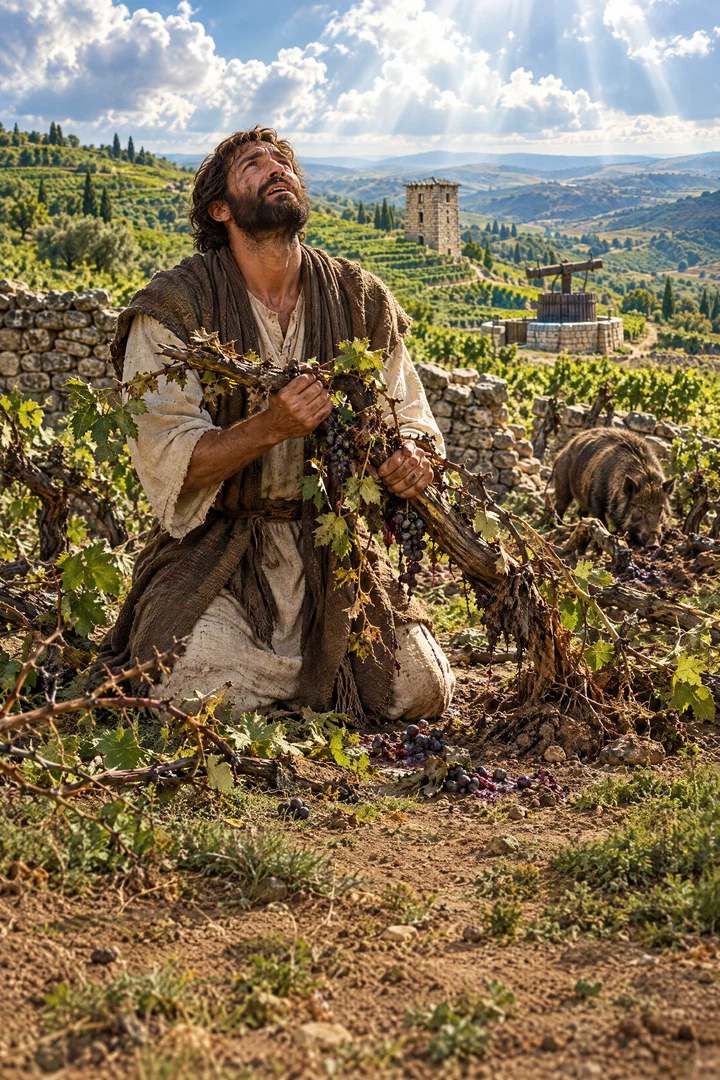
And I will lay it waste: it shall not be pruned, nor digged; but there shall come up briers and thorns: I will also command the clouds that they rain no rain upon it.
Translations
And I will lay it waste: it shall not be pruned, nor dig; but there shall come up briers and thorns: I will also command the clouds that they rain no rain on it.
King James Version, Webster Bible
And I will lay it waste: it shall not be pruned, nor digged; but there shall come up briers and thorns: I will also command the clouds that they rain no rain upon it.
And I will lay it waste:
It shall not be pruned, nor digged;
But there shall come up briers and thorns:
I will also command the clouds that they rain no rain upon it.Revised Version, American Standard Version
and I will lay it waste; it shall not be pruned nor hoed; but there shall come up briers and thorns: I will also command the clouds that they rain no rain upon it.
And I make it a waste, It is not pruned, nor arranged, And gone up have brier and thorn, And on the thick clouds I lay a charge, From raining upon it rain.
and I will make it a waste — it shall not be pruned nor cultivated, but there shall come up briars and thorns; and I will command the clouds that they rain no rain upon it.
And I will make it a waste;—It shall be neither pruned nor hoed, But there shall come up briars and thorns,—And upon the clouds, will I lay a charge, That they rain thereon no rain.
Berean Standard Bible, Majority Standard Bible
I will make it a wasteland,
neither pruned nor cultivated,
and thorns and briers will grow up.
I will command the clouds
that rain shall not fall on it.”I will lay it a wasteland.
It won’t be pruned or hoed,
but it will grow briers and thorns.
I will also command the clouds that they rain no rain on it.”And I will make it waste; its branches will not be touched with the knife, or the earth worked with the spade; but blackberries and thorns will come up in it: and I will give orders to the clouds not to send rain on it.
And I will laye it waste: it shall not be cut, nor digged, but briers, and thornes shall growe vp: I will also commande the cloudes that they raine no raine vpon it.
Douay-Rheims (Challoner revision)
And I will make it desolate: it shall not be pruned, and it shall not be digged: but briers and thorns shall come up: and I will command the clouds to rain no rain upon it.
Pictures
Cross-references
- Matthew 21:33-41
Hear another parable: There was a certain householder, which planted a vineyard, and hedged it round about, and digged a winepress in it, and built a tower, and let it out to husbandmen, and went into a far country:
Both portray God’s vineyard and its judgment under wicked husbandmen.
- Jeremiah 2:21
Yet I had planted thee a noble vine, wholly a right seed: how then art thou turned into the degenerate plant of a strange vine unto me?
Israel, planted as a noble vine, became degenerate and unfaithful.
- John 15:1-5
I am the true vine, and my Father is the husbandman.
Isaiah’s barren vineyard contrasts with Christ the true Vine, whose branches bear fruit by abiding in him.
- Psalms 80:8-16
Thou hast brought a vine out of Egypt: thou hast cast out the heathen, and planted it.
Both picture Israel as God’s planted vine, ravaged and broken down.
- Mark 12:1-12
And he began to speak unto them by parables. A certain man planted a vineyard, and set an hedge about it, and digged a place for the winefat, and built a tower, and let it out to husbandmen, and went into a far country.
The parable retells the vineyard’s rejection of God’s messengers and son.
- Luke 20:9-16
Then began he to speak to the people this parable; A certain man planted a vineyard, and let it forth to husbandmen, and went into a far country for a long time.
Jesus’ parable parallels Isaiah’s vineyard and its destruction.
- Hosea 10:1
Israel is an empty vine, he bringeth forth fruit unto himself: according to the multitude of his fruit he hath increased the altars; according to the goodness of his land they have made goodly images.
Both depict Israel as a vineyard that fails to bear faithful fruit and faces judgment.
- Isaiah 27:2-3
In that day sing ye unto her, A vineyard of red wine.
God’s keeping and watering contrasts with the vineyard’s rejection.
- Matthew 21:43
Therefore say I unto you, The kingdom of God shall be taken from you, and given to a nation bringing forth the fruits thereof.
The vineyard’s fruitlessness leads to its privileges passing to a fruit-bearing nation.
- Psalms 80:12-16
Why hast thou then broken down her hedges, so that all they which pass by the way do pluck her?
Both portray Israel as God’s vine, devastated under judgment.
- Isaiah 27:3
I the LORD do keep it; I will water it every moment: lest any hurt it, I will keep it night and day.
listed together on vineyard planting, failure, judgment
- Luke 13:6-9
He spake also this parable; A certain man had a fig tree planted in his vineyard; and he came and sought fruit thereon, and found none.
The fruitless tree faces a final opportunity before being cut down.
- Deuteronomy 28:23-24
And thy heaven that is over thy head shall be brass, and the earth that is under thee shall be iron.
Covenant disobedience brings drought and rainless skies.
- Matthew 21:39
And they caught him, and cast him out of the vineyard, and slew him.
The vineyard owner’s son is cast out and killed.
- Song of Solomon 1:6
Look not upon me, because I am black, because the sun hath looked upon me: my mother’s children were angry with me; they made me the keeper of the vineyards; but mine own vineyard have I not kept.
The speaker says she was made keeper of vineyards but failed to tend her own.
- Jeremiah 11:16
The LORD called thy name, A green olive tree, fair, and of goodly fruit: with the noise of a great tumult he hath kindled fire upon it, and the branches of it are broken.
Israel is described as a fruitful tree that God sets on fire.
- Matthew 21:37
But last of all he sent unto them his son, saying, They will reverence my son.
The son is sent last to the vineyard.
- Isaiah 32:15
Until the spirit be poured upon us from on high, and the wilderness be a fruitful field, and the fruitful field be counted for a forest.
The wilderness and fruitful field are reversed from Isaiah’s desolation.
- Ezekiel 22:30
And I sought for a man among them, that should make up the hedge, and stand in the gap before me for the land, that I should not destroy it: but I found none.
Making up the hedge echoes repairing the breach and standing in the gap.
- Luke 19:41-44
And when he was come near, he beheld the city, and wept over it,
Jesus weeps over Jerusalem as he sees its coming destruction.
Commentary
Each commentary is drawn from primary sources: the writings of Ellen G. White and Adventist pioneers and periodicals. Each commentary is separate. Its own words are not a quotation; follow the references to read the source passages.
Ellen G. White
34 sources
The vineyard is Israel, which God brought out of Egypt and planted in Canaan, hedged with His law and tended with great care to bear good fruit that would restore His image and bless the nations.ST Jan 6, 1909ST Oct 31, 19004SP 19.2–20.1 He looked for justice and righteousness and the fruits of the Spirit, but found oppression and suffering, formalism and pride, ingratitude and rebellion against the light and privileges He had given.AA 15.2–3Ms 141, 1899, par. 10–11PK 15.2COL 292.1–3ST Feb 27, 1896 His judgment is to withdraw His protection, care and blessing, leaving the vineyard unpruned and undigged for briers and thorns to overgrow it, and commanding the clouds to withhold heaven's rain so it lies desolate and unfruitful.AA 15.2–3Ms 149, 1904, par. 8–9COL 290.3–291.2 That laying waste began as national privileges were taken away for rejecting Christ, ending in the destruction of the temple and city and the scattering of the nation, showing that His mercy has a boundary.4SP 19.2–20.1Ms 41, 1886, par. 12–14ST Feb 17, 1898 The same warning rests on His church today, which has received great light and blessing and must return corresponding fruit in righteousness, lest by failing to use what God has given it be left without cultivation or rain.Ms 141, 1899, par. 10–11COL 296.2PK 22.1STMW7 61.1–2Ms 83, 1901, par. 2–4
Vineyard Meaning and Judgment
The vineyard is Israel, the Jewish nation, brought as a vine from Egypt and planted in Canaan, nourished, tended and cared for, hedged and guarded with His law, intended to take possession of the land according to His plan.ST Jan 6, 1909ST Oct 31, 1900ST Feb 27, 1896Ms 135, 1899, par. 13–14Ms 91, 1899, par. 17 Planted and cared for with expectation of good fruit, it was meant to restore His moral image in humanity and to show the nations the blessings of His law, but it produced wild grapes and became a hindrance rather than a blessing to the world.ST Jan 6, 1909ST Oct 31, 19004SP 19.2–20.1 Its failure to bear the character and spiritual fruit God intended made its destruction a judgment for failing to return fruit to God and for mistreating and killing His messengers and Son, so that the kingdom is taken from its unfaithful keepers and given to others who will bear fruit.ST Oct 31, 1900
The great vine of gold and silver with green leaves and massive clusters of grapes set over the entrance of the temple displayed Israel in character as a prosperous vine, favored and flourishing, wrought with great cost and skill to show her standing.2SP 389.1–390.14RED 121.1–122.1 The golden vine at the temple represented Israel as a prosperous vine belonging to this same vineyard picture.4RED 121.1–122.1
God looked for justice and righteousness but found oppression and suffering and heard a cry, the absence of justice and righteousness marking Israel's failure to produce the fruit He sought.AA 15.2–3PK 15.2 The missing grapes are the absence of the fruits of the Spirit — love, joy, peace, long-suffering, gentleness, goodness and faith.Ms 141, 1899, par. 10–11
The wild grapes were forgetting God and going into rebellion, abusing privileges from age to age, hollow formalism, Pharisaical pride, self-exaltation and cruel, Satanic attributes, ingratitude, resisted grace and refusal of the opportunities and privileges provided by a God of compassion and love.ST Feb 27, 1896 The people were unfaithful despite great light, blessings and prosperity, failing to care for the vineyard and give God its fruits, acting as though there were no God.Ms 73, 1901, par. 5–6 The priests, teachers and husbandmen were unfaithful to their trust, seeking their own honor and profit instead of teaching God's word faithfully, denying God the service He claimed, turning the people from His word and from Christ, misusing their office and spoiling the vineyard until it became fruitless.COL 292.1–3ST Feb 27, 1896COL 304.3–305.1 Their greed and misuse brought dishonor to God and gave the Gentiles reason to misjudge His character and kingdom, with responsibility for the nation's ruin resting on the Jewish religious leaders who withheld the fruit.COL 292.1–3COL 304.3–305.1
The judgment is that God withdraws His protection, care, favor and blessing, lays the vineyard waste and leaves it uncultivated, unpruned, undigged and untilled, so briers and thorns and briars come up.AA 15.2–3Ms 149, 1904, par. 8–9COL 290.3–291.2Ms 141, 1899, par. 10–11PK 15.2 His commanding the clouds to rain no rain means withholding divine blessing and heaven's rain, leaving the vineyard desolate, unproductive, ruined, overgrown and without rain.AA 15.2–3COL 290.3–291.2Ms 141, 1899, par. 10–11PK 16.1PK 15.2 When Israel broke its covenant and failed to bear the fruit required, the loss of rain as withheld blessing also cut the people off from God's life and blessing and withheld religious guidance and holy example from the world.COL 290.3–291.2PK 16.1
The laying waste is the removal of the goodly vine the divine Husbandman planted on the hills of Palestine after the men of Israel despised it, cast it over the vineyard wall, and bruised and trampled it in hope of destroying it forever.PK 17.3 The Husbandman took the vine out of their sight and planted it again on the other side of the wall where the stock is no longer visible and beyond the power of men to reach or harm, while the branches still hang over the wall so that grafts may be joined to it.PK 17.3
The laying waste is the taking away of national privileges, a work already commenced in Christ's day, pointing to the end of Israel's time as a favored nation after it rejected Christ, who had patiently ministered among the people and sought to save them.4SP 19.2–20.1ST Feb 17, 1898 Jerusalem's rejection of Christ brought this judgment of withdrawn care and blessings with the nation left to ruin, the sentence ending not only in destruction of the temple and city but in dispersion of the nation by invading armies, showing that God's mercy has a boundary.4SP 19.2–20.1Ms 41, 1886, par. 12–14ST Feb 17, 1898 The Pharisees themselves admit the justice of the coming punishment by their answer about the wicked husbandmen, in which the past and future history of the Jews and their true religious character are set forth.ST Feb 17, 1898
The gloomy, terrible appearance of the wilderness reflected Israel's degraded condition when made desolate as the Lord's fruitful vineyard and left uncared for.DA 102.3–4 The storm clouds over it were arched by the rainbow of promise: above Israel's degradation shone the promised glory of the Messiah's reign, and God's wrath was spanned by the rainbow of His covenant mercy.DA 102.3–4
The verse stands included in prophetic warning about sin and its consequences, as part of God's warning to His people that disregard of His law and rejection of His word bring judgment.Lt 14a, 1893, par. 2–5
Warning to Church Today
The parable of the vineyard belongs not to the Jewish nation alone but to the church in this generation, which has received great privileges and blessings and light and is expected to return fruit corresponding to what it has received.COL 296.2 The counsel and admonition given through the prophets concerning Israel's rejection of the Master of the vineyard has special value to the keepers of God's vineyard today.PK 22.1
Its destruction is judgment for failing to return fruit to God and for mistreating and killing His messengers and His Son, so that the kingdom is taken from its unfaithful keepers and given to others who will bear fruit.ST Oct 31, 1900 The vineyard left waste and uncultivated, overrun with briers and thorns and deprived of rain, is the judgment that follows failure to produce the fruit God expected, and the missing grapes are the absence of love, joy, peace, long-suffering, gentleness, goodness and faith.Ms 141, 1899, par. 10–11 This warns Christ's professed followers to examine whether their lives disappoint God, the owner of the vineyard.Ms 141, 1899, par. 10–11 God's people are meant to bear fruit unto righteousness, for a life unchanged by the gospel does not represent Christ, while Christian saintliness should distinguish believers from the world.Ms 83, 1901, par. 2–4 Failing to use the light and advantages God has given brings the judgment of being left waste, without cultivation or rain, and those who know the truth should share it rather than reject its blessing or condemn those who have not received it.STMW7 61.1–2
The desolation that comes when the vineyard fails to yield the fruit the owner sought, receiving no further tending or rain while thorns take its place, warns especially religious teachers who lead people to disregard God's law.COL 305.2–306.1 By doing so they prevent souls from bearing fruit to His glory and withhold the fruits of love, humility and self-sacrificing service.COL 305.2–306.1 The church on earth is greatly beloved as the fold for the sheep of His pasture, yet God will not serve with the sins of His people and cannot bless and sustain those who do not walk in His ways and keep all His commandments.ST Oct 31, 1900 He willingly forgives those who repent, but from those who go on sinning, exalting self and mingling the sacred with the common, He removes His favor, suffers calamity and defeat to come upon them, and at last brings terrible judgments that destroy those who misrepresent Him while claiming His temple.ST Oct 31, 1900
Israel's unfaithfulness cut the people off from God's life and blessing, and their failure to represent Him also withheld from the world the religious guidance, spiritual guidance and holy example it was meant to give other nations.COL 290.3–291.2PK 16.1 The withholding of rain is the withholding of divine blessing, leaving the vineyard untended, ruined and made waste.COL 290.3–291.2PK 16.1 A vine that once bore grapes now yielding wild grapes means people who once lived the faith but have departed from it into a sad, bitter experience, and the contrast between past fruitfulness and present apostasy brings grief and weariness of heart.7MR 196.4 The end is near when truth alone will triumph, so truth as it is in Jesus must be planted in the heart by the Holy Spirit and tended daily by the grace of God.7MR 196.4
The vineyard image calls for working neglected parts of the Lord's vineyard, for the Southern field is a neglected part where neglect must end and duty to care for it is urgent.SPBC 164.4 Neglected ground grows briers and thorns when too many people and resources are concentrated in one center such as Battle Creek instead of being spread to other fields.Lt 4, 1895, par. 2 The Lord's vineyard is His work in the world, to be worked throughout and judged by the fruit produced, so work in one place should not be overfunded at the expense of other parts.14MR 31.1–2 The vineyard is waiting to be worked, with workers and resources needed for the work.STB 291.1–2 The lack of rain explains ruined orchards and desolate properties, where costly places created by pleasure seekers stand empty while the Lord withholds heaven's rain.Ms 149, 1904, par. 8–9
This judgment connects with Jerusalem's long history of rejecting warnings and mistreating God's prophets and servants, over which Jesus wept as He saw the coming desolation without care, exposed to thorns, with rain withheld.Lt 20, 1892, par. 31–32 God did not withdraw His love but sent prophets to warn and instituted the sacrificial system to keep before their minds the one great Sacrifice, the one efficient Offering prefigured in their typical system.ST Feb 27, 1896 Israel would not accept His invitation of mercy, and from national apostasy came cruel persecution ending in killing the very messengers sent to warn them of the result of their evil course.ST Feb 27, 1896 For a thousand years they multiplied transgression upon transgression, abusing privileges from age to age in forgetting God and rebellion, hollow formalism, Pharisaical pride, self-exaltation, ingratitude, resisted grace and refusal of the opportunities of a God of compassion and love, until the vineyard was spoiled through cruel husbandmen and made fruitless, even rejecting the Son of God and being ready to put Him to death, so that the cloud of God's retributive judgment was about to burst upon them in unrestrained fury.ST Feb 27, 1896
Sources
Pioneers and periodicals
41 sources
The vineyard is Israel and Judah, the house of Israel planted as a choice vine brought out of Egypt into Canaan and tended with every care.STST Apr 18, 1878ST Feb 5, 1902ST Jan 18, 1916ST Apr 26, 1905 He fenced it, cleared it, planted it with the choicest vine, built a tower and winepress in it and kept it continually, looking for justice and righteousness and good spiritual fruit, but it bore only wild and sour grapes of oppression and rebellion.STST Apr 18, 1878ST Feb 5, 1902RH Nov 5, 1872ST Nov 8, 1905 He therefore lays it waste by withdrawing His care and protection, leaving it unpruned and undigged, overgrown with briers and thorns and without rain, its hedge taken away so it is eaten up and trodden down.ST Apr 18, 1878ST Feb 5, 1902RH Nov 5, 1872ST Nov 8, 1905ST Apr 8, 1889 This was fulfilled in the Babylonian captivity and in the taking away of national privileges, the destruction of temple and city and the scattering of the nation after long rebellion and the rejection of His prophets and at last His Son, showing the covenant was conditional and the kingdom given to others who would bear fruit.ST Oct 31, 1900ST Feb 27, 1896ST Feb 17, 1898ST Apr 8, 1889RH Jan 8, 1857 Jesus retells this parable in Matthew 21:33, and in contrast to the failed vine He stands as the True Vine with His Father as Husbandman, warning each person and the church today that after every provision for salvation those who still bear sour fruit are left to waste through their own fault.RH Nov 5, 1872ST Sep 24, 1894ST Apr 26, 1905ST Jul 7, 1909ST Oct 11, 1899
Vineyard And Setting
The vineyard is Israel and Judah, the house of Israel and the men of Judah, the Jewish nation as God's cultivated field.STST Apr 18, 1878ST Feb 5, 1902ST Apr 8, 1889ST Nov 20, 1901 The Lord had carefully prepared and protected it, yet it failed to produce the righteous judgment and upright character He sought, bringing forth oppression and a cry instead of justice and righteousness.ST Jan 6, 1909STST Apr 18, 1878 For that unfaithfulness God removes its protection and care, leaving it unpruned and untilled and uncultivated and barren, overgrown with briers and thorns and without rain.ST Apr 18, 1878ST Feb 5, 1902ST Apr 8, 1889 The taking away of the hedge is the loss of His special protection from enemies, so that without His intervention the vineyard is freely exposed to be eaten up and trodden down.ST Apr 18, 1878ST Feb 5, 1902 This picture of unfruitfulness carries the sure consequence of departing from God, and it applies especially to Israel's history before and through the Babylonian captivity, when failure to bear character and spiritual fruit made the people a hindrance rather than a blessing to the world.ST Jan 6, 1909ST Apr 8, 1889ST Nov 20, 1901
It was planted as a choice vine and pleasant plant, initially patterned after the Edenic tree.ST Jan 18, 1916 When it failed to continue bearing good fruit its branches were broken off so that other branches could take their place.ST Jan 18, 1916 The vine had been brought out of Egypt and planted in Palestine, in Canaan, where God nourished and cared for it.ST Feb 27, 1896ST Apr 26, 1905 Because it brought forth wild grapes the Lord laid it waste and permitted it to be burned and cut down, unpruned and undigged, with briers and thorns coming up, plucked by strangers and ravaged by wild beasts.ST Feb 27, 1896ST Apr 26, 1905
The wild grapes were forgetting God and going into rebellion, abusing privileges from age to age in hollow formalism and Pharisaical pride and self-exaltation, with cruel attributes and ingratitude and resisted grace and refusal of the opportunities of a compassionate God.ST Feb 27, 1896 God did not withdraw His love but sent prophets to warn and instituted the sacrificial system to keep before their minds the one great Sacrifice, the one efficient Offering prefigured in their typical system.ST Feb 27, 1896 They would not accept His invitation of mercy, and from national apostasy came persecution ending in killing the very messengers sent to warn them, until the vineyard was spoiled through cruel husbandmen and became fruitless.ST Feb 27, 1896 For a thousand years they multiplied transgression upon transgression, even rejecting the Son of God and being ready to put Him to death, so that the cloud of retributive judgment was about to burst upon them in unrestrained fury.ST Feb 27, 1896
The book belongs to Isaiah, the evangelistic prophet, a book filled with Gospel truth, written from 760 to 700 B.C. in the reigns of Uzziah, Jotham, Ahaz and Hezekiah as a prophet of Judah.ST Sep 22, 1909 The verse belongs to a section forcefully portraying the backsliding of God's people.ST May 30, 1911ST Sep 22, 1909 There it stands among warnings about the wealthy and the oppression of the poor in a time of severe economic injustice, when the land is laid waste and deprived of rain.ST That backsliding condition is a type of last-day apostasies.ST Sep 22, 1909
The vine by nature cannot stand alone but needs the support of trellis or tree, just as man can do nothing of himself but must be upheld by righteousness, by the right hand of His righteousness.ST Apr 8, 1903 God fenced His vineyard and gathered out the stones and planted it with the choicest vine and built a tower and winepress in it, watering it every moment and keeping it night and day, so that nothing more could be done for it.ST Apr 8, 1903 Yet when He looked for good grapes only wild grapes were found, and when He sought for righteousness He found oppression instead, and therefore He lays it waste.ST Apr 8, 1903 The desolation and drought imagery uses the vine and fig tree as symbols of government.RH Feb 21, 1856
Care And Failure
The Lord chose a very fruitful hill for His vineyard and prepared it with complete care, fencing it with hedge and wall, gathering out the stones and brush, planting it with the choicest vine, building a tower and a winepress in it, cultivating it year after year, watering it every moment and keeping it night and day.RH Nov 5, 1872ST Apr 8, 1903RH Apr 9, 1901 He established His temple among the people, made them custodians of His law and a light for the world, and set divine barriers about them so their fruit would be preserved to His acceptance and they would have no opportunity to mingle with the wild grapes of the wood.ST Nov 8, 1905RH Apr 9, 1901 In view of such abundant provision for salvation there was nothing more He could do for it.ST Dec 23, 1889ST Apr 8, 1903
He looked for well-developed grapes, for justice and righteousness and upright character and spiritual fruit to fulfill His purpose in planting it.ST Jan 6, 1909STST Apr 18, 1878ST Feb 5, 1902ST Apr 8, 1903 Instead He found only wild, little, sour grapes, oppression and a cry.STST Apr 18, 1878ST Feb 5, 1902RH Nov 5, 1872ST Apr 8, 1903 The neglected cultivation that should have borne good fruit grew evil in its place, and Israel's failure to bear the character and spiritual fruit God intended made them a hindrance rather than a blessing to the world.ST Jan 6, 1909ST Apr 18, 1878
The wild grapes meant that God had nourished and cared for His children and they rebelled against Him.ST Feb 27, 1896RH Jan 8, 1857 They forgot God and went into rebellion, abusing privileges from age to age with hollow formalism, Pharisaical pride, self-exaltation, and cruel attributes, with ingratitude, resisted grace, and refusal of the opportunities and compassionate provision the God of love provided.ST Feb 27, 1896RH Jan 8, 1857 Even complete loving provision can be met with such fruit, which raises the question whose fault it is.RH Apr 9, 1901
There is no fault in the husbandman, for God has done everything possible that man might be saved and bear good fruit.RH Nov 5, 1872 This supports the question what more could have been done for His people.ST Dec 23, 1889ST Apr 8, 1903 In view of this provision they should render fruit to Him, and if they remain unsaved and bring forth sour grapes the blame rests on themselves.RH Nov 5, 1872ST Dec 23, 1889ST Feb 5, 1902
Judgment Pronounced
God declares He will lay the vineyard waste by withdrawing its care and protection, leaving it unpruned and undigged and unworked, letting briers and thorns come up, and commanding the clouds to rain no rain upon it until it lies desolate and uncultivated and barren.ST Apr 18, 1878ST Feb 5, 1902ST Apr 8, 1889ST Sep 24, 1894ST Feb 5, 1902 This laying waste follows the vineyard's production of wild grapes instead of the justice and righteousness sought, with oppression and a cry found where fruit was expected after such tending.ST Apr 18, 1878ST Feb 5, 1902ST Feb 5, 1902 The removal of tending is the loss of special intervention, so without that care the vineyard is exposed rather than preserved to acceptance.ST Feb 5, 1902ST Feb 5, 1902ST Feb 5, 1902 The same waste belongs to the vineyard passage that parallels the later parable of the vineyard and its judgment for failing to return fruit.ST Apr 8, 1889ST Sep 24, 1894ST Feb 5, 1902
Taking away the hedge and breaking down the wall removes the fence placed around the people so their fruit would be preserved, so that the vineyard shall be eaten up and trodden down, freely entered and destroyed.ST Feb 5, 1902RH Nov 5, 1872ST Nov 8, 1905RH Jan 8, 1857ST Feb 5, 1902 The hedge is God's protection, and while it remains unbroken His people are safe from every outward foe, with harm coming only when they fail to keep God in mind as Creator and Benefactor and blessing is withdrawn.ST Feb 5, 1902RH Nov 5, 1872ST Nov 8, 1905 That withdrawing follows complete work on a very fruitful hill — fencing, gathering out stones and brush, planting with the choicest vine, building tower and winepress, and cultivating year after year — which leaves no fault in the husbandman when only wild, little, sour grapes appear.RH Nov 5, 1872RH Jan 8, 1857 The breaking of the wall therefore withdraws both protection and blessing as punishment for nourished children rebelling against care.RH Nov 5, 1872ST Nov 8, 1905RH Jan 8, 1857
The broken-down hedge also applies to God's law as a protection for His people, so that rejecting that law leaves them exposed to judgment.ST Aug 9, 1905ST Nov 8, 1905 The breach is caused by abandoning the Sabbath, and restoring the Sabbath repairs that protective hedge in preparation for the day of the Lord.ST Aug 9, 1905ST Nov 8, 1905 The judgment that leaves the vineyard untended, overgrown with thorns, and deprived of rain is just when transgression continues until there is no remedy.ST Aug 9, 1905ST Nov 8, 1905ST Feb 5, 1902
Because it brought forth wild grapes the Lord laid the vine waste and permitted its burning and cutting down, unpruned and undigged, plucked by strangers and ravaged by wild beasts with briers and thorns coming up.ST Apr 26, 1905 The vine so judged is the one brought out of Egypt and planted in Palestine, in contrast to the true Vine whose fruit is unto life eternal.ST Apr 26, 1905
Fulfilment In History
The laying waste is God's judgment withdrawing protection and care from the house of Israel and the men of Judah, leaving the vineyard uncultivated and barren with briers and thorns growing and no rain, and these words apply especially to Israel's history before and through the Babylonian captivity.ST Apr 8, 1889 Judah and Jerusalem were the last plant of the Lord's vineyard, tended and pruned with great care in hope of fruit.ST Jun 3, 1897 That tending was God's special providence preserving the tribe of Judah and the scepter of its kingdom until Messiah should appear, and preserving Jerusalem as capital of the last of the people called out of Egypt and placed by divine power in the land of promise.ST Jun 3, 1897 God bore long with their sin and rebellion, sent prophets to them, and last of all sent His Son joined to them as one of them, but when Jerusalem rejected the Son and His message of love the time of care ended in weeping over the unrepentant city and in its coming destruction.ST Jun 3, 1897
The laying waste is the taking away of national privileges, a work already commenced in Christ's day.ST Feb 17, 1898 God did not withdraw His love but sent prophets to warn them and instituted the sacrificial system to keep before their minds the one great Sacrifice, the one efficient Offering prefigured in their typical system.ST Feb 27, 1896 Israel would not accept His invitation of mercy, and from national apostasy came cruel persecution ending in killing the very messengers sent to warn them of the result of their evil course.ST Feb 27, 1896 The wild grapes were forgetting God and going into rebellion, abusing privileges from age to age, hollow formalism, Pharisaical pride, self-exaltation, and cruel attributes, ingratitude, resisted grace, and refusal of the opportunities and privileges provided by compassion and love.ST Feb 27, 1896 The vineyard was spoiled through cruel husbandmen until it became fruitless, and for a thousand years they multiplied transgression upon transgression, even rejected the Son of God and were ready to put Him to death, so the cloud of retributive judgment was about to burst upon them in unrestrained fury.ST Oct 31, 1900ST Feb 27, 1896 That sentence would end not only in destruction of temple and city but in dispersion of the nation, whose justice even the Pharisees admit by their answer about the wicked husbandmen.ST Oct 31, 1900ST Feb 17, 1898
Israel was planted as a choice vine and pleasant plant initially patterned after the Edenic tree, but it failed to continue bearing good fruit, so its branches were broken off that other branches could take their place.ST Jan 18, 1916 The kingdom is taken from its unfaithful keepers who failed to return fruit and mistreated and killed His messengers and Son, and given to others who will bear fruit.ST Oct 31, 1900 By rejecting Christ the Jews, once God's cultivated field, were to become a wilderness and waste, an uncultivated place like a forest in contrast to a fruitful field, while the Gentiles, previously like an uncultivated wilderness, were to become a fruitful field by receiving the gospel.RH Dec 8, 1874 The land promised to Abraham, represented by that vineyard once occupied by Judah, was prepared for Christ the true vine and is soon to be devoted to His use, when His believing people as branches joined to Him will be transplanted there to live forever.RH May 30, 1854
The well-attended vineyard that brought forth wild grapes means God nourished and cared for His children and they rebelled against Him, and He would punish that rebellion by breaking down the wall and letting it be trodden down and by commanding the clouds to rain no rain upon it, withdrawing protection and blessing.RH Jan 8, 1857 It proves the covenant made with Israel was conditional and was broken by them, so the threats of loss and scattering stand against any claim of unconditional inheritance of the land.RH Jan 8, 1857 The same dealing meets His once-chosen people when they break their trust, for the church on earth is greatly beloved as the fold for the sheep of His pasture, yet He will not serve with the sins of His people and cannot bless and sustain those who do not walk in His ways and keep all His commandments.ST Oct 31, 1900 He willingly forgives those who repent, but from those who go on sinning, exalting self and mingling the sacred with the common, He removes favor, suffers calamity and defeat to come upon them, and at last brings terrible judgments that destroy those who misrepresent Him while claiming His temple.ST Oct 31, 1900
Links To Other Scripture
The passage stands as the Old Testament vineyard parable that Jesus retells in Matthew 21:33, where a householder plants a vineyard, sets a hedge about it, digs a winepress in it, builds a tower, and lets it out to husbandmen.ST Oct 11, 1899 Left waste, the vineyard receives no pruning or digging, briars and thorns grow in it, and rain is withheld, forming the judgment that parallels the later parable.ST Sep 24, 1894 The earlier parable centers on a vineyard producing wild grapes instead of the fruit its owner expected, and the later parable repeats that picture through husbandmen whose spirit and actions are foreign to what the householder sought.ST Feb 5, 1902 That failure to return fruit, joined with mistreating and killing His messengers and Son, brings the judgment.ST Oct 11, 1899ST Feb 5, 1902
It is one of the Old Testament scriptures comparing God's people to a vineyard, well known to Jews living in Palestine where vineyards were abundant.ST Mar 18, 1897 That familiar picture forms the background for Jesus' teaching that He is the True Vine, His Father is the Husbandman, and His disciples are the branches.ST Mar 18, 1897 The same figure shows the vital connection between Christ and the church by a vine with its fruit-bearing branches, with the Father as the husbandman.ST Jul 7, 1909 In contrast to the failed vine stands the true Vine, whose fruit is unto life eternal.ST Apr 26, 1905
Israel was a vine brought out of Egypt and planted in Palestine, but because it brought forth wild grapes the Lord laid it waste and permitted its burning and cutting down.ST Apr 26, 1905 Unpruned and undigged, with briers and thorns coming up, it was plucked by strangers and ravaged by wild beasts.ST Apr 26, 1905 Its vineyard imagery thus connects the work of keeping vines with the Lord's vineyard and its spiritual care, since the Lord's vineyard when laid waste and left without care grows briers and thorns.ST Dec 20, 1910
Its righteousness is equivalent to salvation.RH Feb 18, 1873 By that equivalence it is identified with the prophecy of the gospel and eternal salvation, not with the ten commandments.RH Feb 18, 1873
Warning For Today
The verse shows how God deals with each person for salvation, for after He has done everything possible that a person might be saved and bear good fruit, if that person remains unsaved and brings forth only wild, little, sour grapes the blame rests on himself and he is left to waste.RH Nov 5, 1872 The complete work is choosing a very fruitful hill, fencing it, gathering out the stones and brush, planting it with the choicest vine, building a tower and winepress in it, and carefully cultivating it year after year, so that there is no fault in the husbandman when the fruit fails.RH Nov 5, 1872 The withdrawing of care is taking away the hedge and breaking down the wall so that it shall be eaten up and trodden down, laying it waste, leaving it unpruned and undigged and unworked, letting briers and thorns come up, and commanding the clouds to rain no rain upon it.RH Nov 5, 1872
The same question of whose fault the wild fruit is comforts mothers and fathers with sore and aching hearts over disobedient children.RH Apr 9, 1901 The Beloved had a vineyard in a good fruitful hill and made every provision to gather good fruit for His labor, planting the choicest vine, gathering out the stones, and making a wall around it so that it had no opportunity to mingle with the wild grapes in the wood.RH Apr 9, 1901 When the time came for fruit and for Him to rest and enjoy it, it brought forth only sour wild grapes, showing that even complete loving provision can be met with wild fruit, and that God knows and pities the burden parents carry.RH Apr 9, 1901
The vineyard left uncared for is neither pruned nor dug, briers and thorns grow, and rain is withheld, and this image belongs to the church as God's moral vineyard.ST Feb 3, 1909RH Jun 2, 1904 There pruning and purging remove what hinders its health and prepare it to receive new converts.RH Jun 2, 1904 The church as the Lord's vineyard is to be cultivated faithfully and extended throughout the earth, and those who receive God's instruction and grace are to help others care for it.ST Feb 3, 1909
The judgment that follows when the Lord's vineyard fails to produce the fruit He expects is to be left untended and without rain.ST Feb 5, 1902 The vineyard represents God's people, and the lesson remains relevant to spiritual Israel.ST Feb 5, 1902 Grieving the Holy Spirit and neglecting the prophets' lessons leads to failure to bear the Spirit's fruit and to being left in that untended and rainless state.ST Feb 5, 1902 The picture of the Lord's vineyard also applies to a worldwide work of proclaiming salvation, urging workers to fill it before the harvest and the last hour.RH Mar 19, 1914
Sources