John 19:29
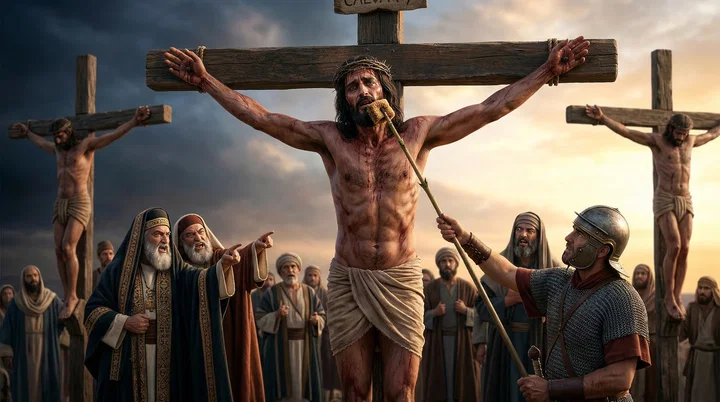
Now there was set a vessel full of vinegar: and they filled a spunge with vinegar, and put it upon hyssop, and put it to his mouth.
Translations
Now there was set a vessel full of vinegar: and they filled a sponge with vinegar, and put it on hyssop, and put it to his mouth.
King James Version, KJV Cambridge Paragraph Bible, Webster Bible
Now there was set a vessel full of vinegar: and they filled a spunge with vinegar, and put it upon hyssop, and put it to his mouth.
Revised Version, American Standard Version
There was set there a vessel full of vinegar: so they put a sponge full of the vinegar upon hyssop, and brought it to his mouth.
a vessel, therefore, was placed full of vinegar, and they having filled a sponge with vinegar, and having put [it] around a hyssop stalk, did put [it] to his mouth;
There was a vessel therefore there full of vinegar, and having filled a sponge with vinegar, and putting hyssop round it, they put it up to his mouth.
A vessel, was standing, full of vinegar. A sponge, therefore, full of the vinegar, put about, hyssop, brought they unto his mouth.
Berean Standard Bible, Majority Standard Bible
A jar of sour wine was sitting there. So they soaked a sponge in the wine, put it on a stalk of hyssop, and lifted it to His mouth.
Now a vessel full of vinegar was set there; so they put a sponge full of the vinegar on hyssop, and held it at his mouth.
Now there was a vessel ready, full of bitter wine, and they put a sponge full of it on a stick and put it to his mouth.
And there was set a vessell full of vineger: and they filled a spondge with vineger: and put it about an Hyssope stalke, and put it to his mouth.
Douay-Rheims (Challoner revision)
Now there was a vessel set there full of vinegar. And they, putting a sponge full of vinegar and hyssop, put it to his mouth.
Pictures
Cross-references
- Matthew 27:34
They gave him vinegar to drink mingled with gall: and when he had tasted thereof, he would not drink.
Both describe vinegar mixed with gall offered to Jesus.
- Psalms 69:21
They gave me also gall for my meat; and in my thirst they gave me vinegar to drink.
It foretells vinegar being given to the suffering Messiah.
- Mark 15:36
And one ran and filled a spunge full of vinegar, and put it on a reed, and gave him to drink, saying, Let alone; let us see whether Elias will come to take him down.
Jesus is given vinegar on the cross.
- Matthew 27:48
And straightway one of them ran, and took a spunge, and filled it with vinegar, and put it on a reed, and gave him to drink.
Both describe vinegar offered to Jesus on a sponge.
- John 19:34
But one of the soldiers with a spear pierced his side, and forthwith came there out blood and water.
Blood and water flow from Christ’s side after the spear wound.
- Luke 23:36
And the soldiers also mocked him, coming to him, and offering him vinegar,
Jesus is offered vinegar while suffering on the cross.
- Psalms 22:15
My strength is dried up like a potsherd; and my tongue cleaveth to my jaws; and thou hast brought me into the dust of death.
The suffering servant’s parched tongue matches Jesus’ thirst on the cross.
- Mark 15:23
And they gave him to drink wine mingled with myrrh: but he received it not.
A drink was offered to Jesus at the cross.
- Leviticus 14:6
As for the living bird, he shall take it, and the cedar wood, and the scarlet, and the hyssop, and shall dip them and the living bird in the blood of the bird that was killed over the running water:
The cleansing rite’s cedar, scarlet, and hyssop are linked to the hyssop at the cross.
- Luke 23:44-46
And it was about the sixth hour, and there was a darkness over all the earth until the ninth hour.
A parallel account of Jesus’ final hours and death.
- Hebrews 9:19
For when Moses had spoken every precept to all the people according to the law, he took the blood of calves and of goats, with water, and scarlet wool, and hyssop, and sprinkled both the book, and all the people,
Hyssop connects the crucifixion scene with the cleansing rite.
- Leviticus 23:5
In the fourteenth day of the first month at even is the LORD’s passover.
The Passover date is fulfilled at the cross.
- Matthew 27:46
And about the ninth hour Jesus cried with a loud voice, saying, Eli, Eli, lama sabachthani? that is to say, My God, my God, why hast thou forsaken me?
The cry of abandonment comes just before the vinegar is given.
- Matthew 27:50-51
Jesus, when he had cried again with a loud voice, yielded up the ghost.
Jesus’ death coincides with the tearing of the temple veil.
Commentary
Each commentary is drawn from primary sources: the writings of Ellen G. White and Adventist pioneers and periodicals. Each commentary is separate. Its own words are not a quotation; follow the references to read the source passages.
Ellen G. White
16 sources
At Calvary outside Jerusalem after betrayal, scourging and hours of agony on the cross had left Him weak and parched with thirst, a Roman soldier in pity filled a sponge from the vessel of vinegar and put it on hyssop to His mouth while the priests mocked and refused Him relief.DA 741.4–742.1DA 741.1–2DA 754.3SG1 60.1ST Jan 27, 1914 Having received the vinegar at the close of His suffering after bearing the hiding of His Father's favor and draining the cup of bitterness, He testified that His saving work was completed with It is finished and expired with a cry of broken heart, while those who held the drink to be mixed with gall teach that after tasting it He refused it.Ms 111, 1897, par. 22–26Ms 106, 1897, par. 11–1218MR 73.2ST Apr 14, 18985RED 81.2–82.1 In that death He suffered without the gate as substitute for fallen humanity, bearing the wrath of God with the sins of the world imputed to the innocent One so guilty sinners might receive His imputed righteousness and become God's children.DA 741.1–2ST Apr 14, 1898Ms 8, 1886, par. 8Lt 122, 1901, par. 15 His death reveals the love and character of God, vindicates His law and breaks the hearts of all who seek Him, calling their lives into conformity with His will and measuring what His church should be and do.18MR 73.2ST Apr 14, 1898Lt 122, 1901, par. 15Ms 56, 1901, par. 8
Setting and Final Drink
The vinegar belongs to the crucifixion at Calvary outside Jerusalem, the place where felons and murderers were executed.DA 741.4–742.1DA 741.1–2Lt 1a, 1861, par. 2–5 It followed betrayal, abuse, and scourging that left Him too weak to carry His cross.DA 741.4–742.1DA 741.1–2 Nailed to the cross, He hung there in agony for hours before His death.DA 741.4–742.1DA 741.1–2Lt 1a, 1861, par. 2–5
As His earthly mission neared its end and after the darkness lifted, He felt the pain of thirst and was parched.DA 754.35RED 81.2–82.1 From a vessel full of vinegar a sponge was filled and put upon hyssop, a stalk of hyssop, and put to His mouth.DA 754.3ST Jan 27, 1914 A Roman soldier offered it with pity, dipping the sponge in vinegar and lifting it to Him.DA 754.3ST Jan 27, 1914 The priests mocked, refused to relieve His suffering, and said to wait to see whether Elijah would come to save Him, adding insult to His suffering with vinegar and gall.DA 754.3SG1 60.1ST Jan 27, 1914
The drink came at the close of His suffering after bearing the hiding of the Father's favor and draining the last dregs of the cup of bitterness, when the sense of His Father's favor had returned.Ms 106, 1897, par. 11–12ST Apr 14, 1898 Having received the vinegar, He then testified that His saving work through death was completed, saying It is finished, and expired.Ms 111, 1897, par. 22–26Ms 106, 1897, par. 11–1218MR 73.2ST Apr 14, 1898 After tasting the drink mixed with gall, He refused it.5RED 81.2–82.1 He died not merely from crucifixion but from a broken heart caused by mental agony, expiring with a shrill agonizing shriek, proved when the spear thrust in His side brought forth blood and water.Ms 106, 1897, par. 11–1218MR 73.2ST Apr 14, 1898
Atonement Meaning and Response
He suffered outside the gate at Calvary, outside Jerusalem where felons and murderers were executed, as the substitute for Adam and Eve who were banished from Eden for transgression of the law of God, that He might sanctify the people with His own blood and redeem them from the curse of the law by being made a curse for them.DA 741.1–2 At the end of that suffering He bore the wrath of God with the hiding of the Father's countenance, the innocent One treated as a sinner with the sins of the world imputed to Him, so that guilty sinners might be treated as loyal and obedient and receive His imputed righteousness.ST Apr 14, 1898 Hanging as the bleeding victim, His death makes grace and power available to humanity.Ms 8, 1886, par. 8 His suffering and death at Calvary are the price of redemption by which people may become God's children and be kept by Him.Lt 122, 1901, par. 15
His death reveals the character and love of God, lifts the law of God to its eternal dignity, vindicates its holy requirements, and gives salvation to all who have an interest in the crucified One.ST Apr 14, 1898 Seeing the result of sin in that death, in the sponge soaked in vinegar lifted to His mouth on hyssop followed by His saying It is finished and expiring through a broken heart caused by mental agony, breaks the hearts of those who seek and find the Lord.18MR 73.2ST Apr 14, 1898 That sacrifice by which people may become God's children calls for lives to be brought into conformity with His will.Lt 122, 1901, par. 15
The taking away of the Bridegroom, when Jesus approached the cross and descended into the depths of humiliation and was lifted up dying as a malefactor in whom the disciples' hopes of eternal life were centered, became a ground of test and trial in gloom and darkness.ST Jul 7, 1898Ms 126, 1907, par. 9–10 That time when He was in the hands of wicked men was the time when the children of the bride-chamber had cause to mourn and fast, when their faith would be tried and their hope and courage would fail.ST Jul 7, 1898 Their faith failed as they beheld that death because, having been overcome with sleep instead of watching and praying, they had not received the light about His sufferings and the glory that should follow and had not shared His self-sacrifice.Ms 126, 1907, par. 9–10 Had they remained watching, some rays of hope would have lighted up the darkness and sustained their faith, but like Peter denying his Lord before His enemies they did not endure the proving.Ms 126, 1907, par. 9–10 The great sacrifice made on the cross of Calvary is the measure of what the church should be and do in the greatest work ever given to mortals, and measured against that sacrifice the advance the church has made in comparison with past years is small and she is far behind.Ms 56, 1901, par. 8
Sources
Pioneers and periodicals
38 sources
Near the end of the crucifixion a vessel full of vinegar stood by the cross, and after Jesus said I thirst a sponge soaked in it was lifted on hyssop to His mouth, and when He had received it He said It is finished and gave up His spirit.ST Jan 27, 1914ST May 17, 1905ST May 20, 1897ST Jun 14, 1905RH May 30, 1912 This was the exact and literal fulfillment of the prophecy that in His thirst they would give Him vinegar to drink, proving Jesus of Nazareth to be the promised Messiah.ST Jan 8, 1880RH Nov 18, 1862ST Oct 21, 1930RH Sep 28, 1905 He died thus as Christ our Passover on the fourteenth day of the first month at the very time the paschal lamb was slain, on Friday the sixth day of the week.RH Aug 15, 1854ST Apr 21, 1914RH Oct 30, 1855ST Aug 13, 1874 The One who died was not a mere man but the divine Creator made flesh, bearing human sin and its punishment as humanity's substitute and ransom until the atonement was finished.ST Jul 25, 1878RH Aug 20, 1908RH Nov 10, 1863RH Apr 14, 1874 By fulfilling every precept of the law and suffering its penalty He vindicated and magnified the law rather than abolishing it, and broke His heart under the hiding of the Father's face so that guilty sinners might receive His imputed righteousness.ST Apr 14, 1898RH Jul 21, 1868ST Aug 30, 1877
Narrative Details and Setting
A vessel full of vinegar was set near the cross, and a sponge soaked in it was raised to Jesus' mouth on hyssop as the crucifixion reached its completion.ST May 17, 1905ST Jun 14, 1905 After he knew all things were now finished and said I thirst, that the scripture might be accomplished, attendants put a sponge full of the vinegar upon hyssop and brought it to his mouth.ST May 20, 1897 When he had received the vinegar he said It is finished, and bowed his head and gave up his spirit.ST May 20, 1897
A Roman soldier dipped the sponge in vinegar and offered it to him on a small reed or stalk of hyssop to quench his thirst.ST Jan 27, 1914RH May 30, 1912 The priests mocked him and refused the final opportunity to relieve his suffering, telling onlookers to wait and see whether Elijah would save him.ST Jan 27, 1914 His cry expressed real bodily need and thirst, met with no loving care.ST Jun 18, 1902 He suffered that intense thirst on the cross amid hatred and the flight of his friends, without seeking shelter from pain or danger.ST May 7, 1902
His lips thirsted as he was dying, and the bitter drink offered on the sponge placed on hyssop is described as gall.ST Jul 25, 1878ST Aug 5, 1897 He tasted the drink and refused it.ST Jul 25, 1878 Vinegar thus brought to the mouth of a crucified man is also illustrated by another crucifixion in which vinegar was administered in hope it would cause immediate death.RH May 10, 1864 It did not, and he later died after his legs were broken and he was strangled.RH May 10, 1864
John's account of Jesus crucified and buried parallels Luke 23:35-53.ST Mar 20, 1901 That account covers the beholding people, the mocking rulers and soldiers offering vinegar, the superscription King of the Jews, the two malefactors, the darkness, the rent veil, Jesus commending his spirit to the Father and giving up the ghost, and Joseph of Arimathaea laying the body in a hewn tomb, showing Christ died for our sins according to the Scriptures.ST Mar 20, 1901 The crucifixion took place on Passover in the afternoon at three o'clock, on the day before the Sabbath commonly called Friday.ST Apr 21, 1914RH Sep 5, 1865
Prophecy Fulfilled at Cross
The verse shows the exact and literal accomplishment at the crucifixion of the prophecies describing the manner and circumstances of his death.ST Jan 8, 1880 This is seen especially in that in his thirst they gave him vinegar to drink.ST Jan 8, 1880 Its fulfillment before the eyes of the Jews stands as a sign of the first advent proving that Jesus of Nazareth is the promised Messiah.ST Jan 8, 1880 The offering of vinegar to Jesus while suffering on the cross fulfilled the prediction that the Messiah would be given gall and vinegar.RH Nov 18, 1862ST Oct 21, 1930
While on the cross Jesus referred to Scripture with the whole prophetic word passing before his mind.RH Sep 28, 1905 He held the conviction that he had fulfilled all that was written concerning him by the Holy Spirit.RH Sep 28, 1905 So after saying I thirst and being given the vinegar he uttered the word It is finished.RH Sep 28, 1905
Passover and Sanctuary Types
John 19:29 belongs to the record of the death of Christ on the cross as Christ our Passover sacrificed on the fourteenth day of the first month.RH Oct 30, 1855ST Aug 13, 1874RH Dec 15, 1868 The paschal lamb was slain on that day, and Christ the Lamb of God, the Passover sacrifice, died on that very day.RH Oct 30, 1855ST Aug 13, 1874RH Dec 15, 1868 His death met its antitype exactly as to time on the day appointed for the Passover.RH Oct 30, 1855ST Aug 13, 1874RH Dec 15, 1868 Mere preliminary and circumstantial offerings did not prevent the grand event of the day from meeting its fulfillment at the time pointed out in the type.RH Oct 30, 1855
The hyssop that carried the vinegar to the Saviour's mouth connects the cross with the cleansing rite for the leper.RH May 30, 1912 The cross itself was made from trees of the forest, corresponding to the cedar, scarlet, and hyssop used in that rite.RH May 30, 1912 Hyssop is a plant at one extreme of vegetation, and its use at the cross to bring vinegar to His mouth, together with the wood of the cross and the thorns that pierced His head, represents vegetation under the earth's curse. The blood shed at the cross paid the price to redeem the land and vegetation from that curse.
Atoning Death and Doctrine
The drink was brought to the mouth near the completion of the work, and after receiving it came the declaration that it is finished and then death, showing the atonement was finished when Jesus died on Friday, the sixth day of the week.RH Aug 15, 1854 At Calvary he gave himself as a sacrifice for humanity and for the sins of the world, and its benefit is received only by those who believe in him and obey the gospel.ST Jun 14, 1905 That suffering calls for trust in him and learning from him.RH Jun 23, 1910
The One who died on the cross was the sin-atoning sacrifice and not merely an ordinary human death, for the crucified One is the divine Creator made man.RH Nov 10, 1863RH Apr 14, 1874 He is the Word who was in the beginning, who was God and with God, by whom all things were made, who was made flesh and dwelt among men, who came from the Father and returned to him, who taught and worked miracles, was falsely accused, was buried, and rose again.RH Apr 14, 1874 His suffering was not chiefly fear of death or bodily pain but the agony of bearing human sin and its punishment as humanity's substitute and ransom.ST Jul 25, 1878 That death on the cross reveals God's suffering for human sin and stands as the culmination of his earthly steps of sacrifice for fallen humanity.RH Aug 20, 1908
At the end he bore the wrath of God and the hiding of the Father's countenance as the innocent One treated as a sinner, with the sins of the world imputed to him so guilty sinners might be treated as loyal and obedient and receive his imputed righteousness.ST Apr 14, 1898 When the sense of the loss of his Father's favor lifted he had drained the last dregs of the cup of bitterness, then received the vinegar on hyssop to his mouth, said it is finished, and expired with a shrill agonizing shriek of a heart broken by mental agony.ST Apr 14, 1898 That broken heart was proved when the spear thrust brought forth blood and water.ST Apr 14, 1898 His death breaks the hearts of seekers as they see the result of sin, reveals God's character and love, lifts the law to eternal dignity, vindicates its holy requirements, and gives salvation to all who have an interest in the crucified One.ST Apr 14, 1898
After fulfilling each jot and tittle of the law in its precept and its penalty, keeping all its precepts and meeting its penalties for sinners, he declared his work finished and gave up his life.RH Jul 21, 1868 That finishing vindicates and exalts the law, suffers its penalty to show its sacredness and perpetuity, enforces it anew to be written in the heart, and does not abolish any jot or tittle as a rule of life or condition of salvation.RH Jul 21, 1868 His cry that it was finished marks that completion, and his death magnified the law and upheld its sacredness and enduring claims rather than abolishing it.ST Aug 30, 1877 His going to Calvary gave his life in complete consecration, and his death rather than suffering without death answers to the sacrifice representing the offerer, where the flowing blood signifies the giving of life and the consumed offering signifies complete consecration.ST Sep 12, 1900
The taking away of the Bridegroom is shown when Jesus approached the cross, descended into humiliation, and was lifted up dying as a malefactor, he in whom the disciples' hopes of eternal life were centered.ST Jul 7, 1898 That time in the hands of wicked men was when the children of the bride-chamber had cause to mourn and fast, when faith would be tried and hope and courage would fail.ST Jul 7, 1898 Jesus hung dead upon a Roman cross and lay dead within the tomb, seen as dead by his crucifiers, yet power still remained in the name of Jesus to hold his followers and win believers to the truth.ST May 25, 1904
Example and Christian Response
The account of the sufferings at the cross subdues pride and casts out discontent in fretful or gloomy Christians.ST Apr 17, 1879 It shows one of the bitter depths of human woe suffered below, together with days of toil and nights of prayer in pitying love to share every burden and care, the heavy cross borne, the piercing crown of thorns worn, the nails, the spear, and the shed blood. Remembering such suffering leaves no room to murmur or complain in grief and pain, no room to ask a life of ease or to live one hour to please self, and makes pain sweet as bringing the sufferer lower at His feet in closer sympathy with Him. His cry expressed a real bodily thirst and bodily need, met with no loving care, and it prompts His followers to answer the needs of people who suffer, hunger, or thirst rather than turning them away.ST Jun 18, 1902 As He bore the cross and endured taunts silently and submissively, without calling attention to His burden, so His followers are to bear their own burdens with submission and bring them to God for help.RH Jun 28, 1870
He endured suffering and intense thirst rather than seeking shelter from danger or pain, amid hatred and the flight of His friends.ST Feb 11, 1903ST May 7, 1902 That endurance is a trial faced without seeking shelter, an example of resolute courage and service even in the face of death.ST Feb 11, 1903ST May 7, 1902 His suffering was part of the path to glory, for the Lord reached the throne for a redeemed world with pierced hands and feet and a brow scarred by thorns.RH Feb 4, 1904 The way to share His throne is the way of the cross.RH Feb 4, 1904 The crucifixion is the saddest tragedy in human history, where the Man of Galilee was put to death by a bloodthirsty, hardened mob. There in agony for souls His great heart of love broke under the weight of human woe while the Father beheld Him.RH Jan 16, 1908
Calvary, with Gethsemane as its other best exponent, shows unutterable compassion and affection in sleepless watchcare over people.RH Dec 23, 1873 That same compassion and affection will be seen gazing from His eyes when He comes at last in glorious majesty and beauty to those watching and yearning for His presence.RH Dec 23, 1873
Sources