Matthew 27:50
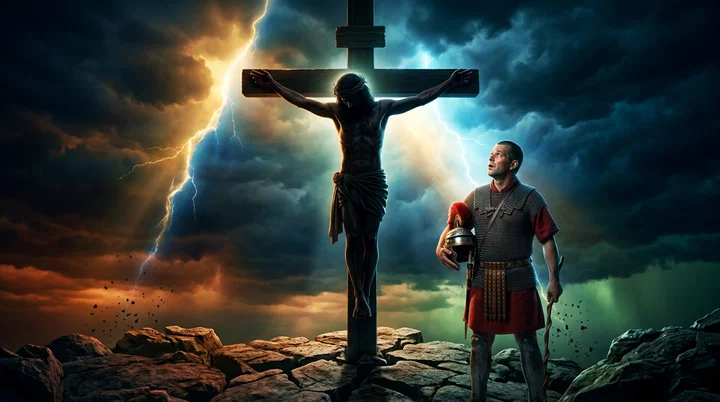
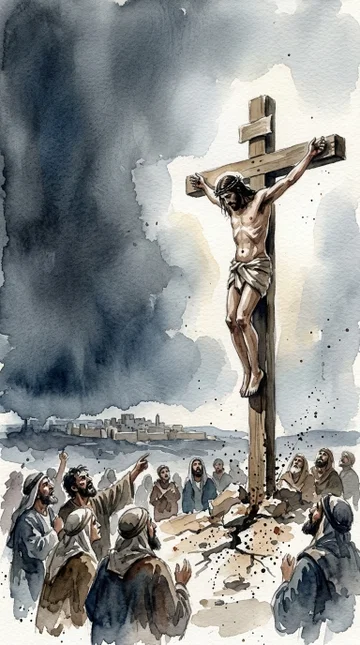
Jesus, when he had cried again with a loud voice, yielded up the ghost.
Translations
American King James Version, King James Version, KJV Cambridge Paragraph Bible
Jesus, when he had cried again with a loud voice, yielded up the ghost.
Jesus, when he had cried again with a loud voice, expired.
Revised Version, American Standard Version
And Jesus cried again with a loud voice, and yielded up his spirit.
And Jesus having again cried with a great voice, yielded the spirit;
And Jesus, having again cried with a loud voice, gave up the ghost.
And, Jesus, again crying out with a loud voice, dismissed the spirit.
Berean Standard Bible, Majority Standard Bible
When Jesus had cried out again in a loud voice, He yielded up His spirit.
Jesus cried again with a loud voice, and yielded up his spirit.
And Jesus gave another loud cry, and gave up his spirit.
Then Iesus cryed againe with a loude voyce, and yeelded vp the ghost.
Douay-Rheims (Challoner revision)
And Jesus again crying with a loud voice, yielded up the ghost.
Pictures
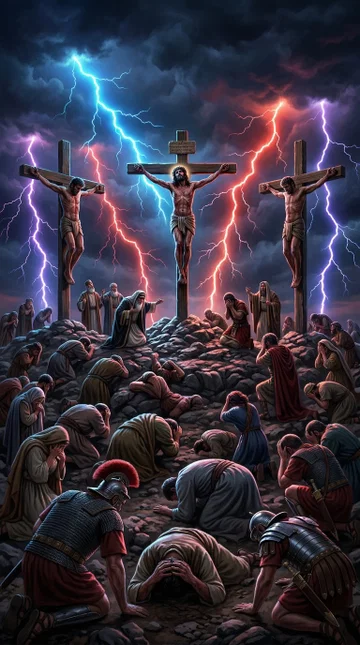
Cross-references 20 of 84
- John 19:30
When Jesus therefore had received the vinegar, he said, It is finished: and he bowed his head, and gave up the ghost.
Jesus declares his work finished before giving up his life.
- Luke 23:46
And when Jesus had cried with a loud voice, he said, Father, into thy hands I commend my spirit: and having said thus, he gave up the ghost.
Jesus commits his spirit to the Father before dying.
- Mark 15:37-38
And Jesus cried with a loud voice, and gave up the ghost.
Jesus’ loud cry and death are followed by the tearing of the temple veil.
- Matthew 28:6
He is not here: for he is risen, as he said. Come, see the place where the Lord lay.
The empty tomb confirms that Jesus rose victorious after his death.
- Matthew 27:59-60
And when Joseph had taken the body, he wrapped it in a clean linen cloth,
Joseph laid Jesus’ lifeless body in his own new tomb after his death.
- Matthew 27:46
And about the ninth hour Jesus cried with a loud voice, saying, Eli, Eli, lama sabachthani? that is to say, My God, my God, why hast thou forsaken me?
Jesus cries out in anguish at feeling forsaken before yielding up his life.
- Matthew 27:45
Now from the sixth hour there was darkness over all the land unto the ninth hour.
Jesus died as the darkness passed away.
- Matthew 26:39
And he went a little further, and fell on his face, and prayed, saying, O my Father, if it be possible, let this cup pass from me: nevertheless not as I will, but as thou wilt.
Jesus prays for the cup to pass before his death.
- John 19:31-34
The Jews therefore, because it was the preparation, that the bodies should not remain upon the cross on the sabbath day, ( for that sabbath day was an high day,) besought Pilate that their legs might be broken, and that they might be taken away.
Confirms Jesus’ death and records the spear thrust after he yielded up the ghost.
- Hebrews 10:19-20
Having therefore, brethren, boldness to enter into the holiest by the blood of Jesus,
Christ’s death opens the new and living way into God’s presence.
- Hebrews 2:14
Forasmuch then as the children are partakers of flesh and blood, he also himself likewise took part of the same; that through death he might destroy him that had the power of death, that is, the devil;
Jesus’ death defeats the devil, who holds the power of death.
- Mark 15:44
And Pilate marvelled if he were already dead: and calling unto him the centurion, he asked him whether he had been any while dead.
Pilate is surprised Jesus is already dead and verifies it with the centurion.
- Isaiah 53:6
All we like sheep have gone astray; we have turned every one to his own way; and the LORD hath laid on him the iniquity of us all.
God laid humanity’s iniquity upon Christ.
- Luke 23:45
And the sun was darkened, and the veil of the temple was rent in the midst.
It records the temple veil tearing as Jesus died.
- John 19:38-42
And after this Joseph of Arimathaea, being a disciple of Jesus, but secretly for fear of the Jews, besought Pilate that he might take away the body of Jesus: and Pilate gave him leave. He came therefore, and took the body of Jesus.
Jesus’ body is prepared and placed in a new tomb.
- 1 Corinthians 15:3
For I delivered unto you first of all that which I also received, how that Christ died for our sins according to the scriptures;
Christ died for our sins.
- Galatians 3:13
Christ hath redeemed us from the curse of the law, being made a curse for us: for it is written, Cursed is every one that hangeth on a tree:
Christ bears the law’s curse to redeem sinners.
- Matthew 27:38
Then were there two thieves crucified with him, one on the right hand, and another on the left.
Jesus is crucified between two thieves.
- Matthew 28:2-4
And, behold, there was a great earthquake: for the angel of the Lord descended from heaven, and came and rolled back the stone from the door, and sat upon it.
The earthquake and angel’s arrival at the tomb leave the guards as dead men.
- Psalms 22:1
My God, my God, why hast thou forsaken me? why art thou so far from helping me, and from the words of my roaring?
Jesus’ cry on the cross echoes this lament.
Commentary
Each commentary is drawn from primary sources: the writings of Ellen G. White and Adventist pioneers and periodicals. Each commentary is separate. Its own words are not a quotation; follow the references to read the source passages.
Ellen G. White
36 sources
After utter physical exhaustion from hours of agony on the cross, Jesus cried out again with a loud voice declaring His work finished and truly died.Lt 230, 1907, par. 12–16Ms 29, 1909, par. 18Ms 38, 1905, par. 4 He died in the afternoon at the time of the evening sacrifice, at the very moment the darkness passed away and the priests were officiating in the temple with the Passover lamb ready to be slain.Lt 230, 1907, par. 12–16Ms 111, 1897, par. 50–5212MR 416.2–3 His loud dying cry was a clear and triumphant proclamation that the covenant pledge was fulfilled to the letter, the redemption price paid and victory won.Ms 111, 1897, par. 27–3112MR 392.1–3EW 146.1 Type met antitype in the death of God's Son as the true Lamb, so the need for the Jewish system ended and sacrifices and offerings were no longer accepted.Ms 38, 1905, par. 4Ms 111, 1897, par. 50–52Ms 114, 1898, par. 1–2 At His expiring cry God's own unseen hand tore the temple veil from top to bottom, laying open a new and living way into the Holiest of all so all sinful humanity may come directly to God and find pardon and peace.Ms 38, 1905, par. 4Ms 111, 1897, par. 50–52Ms 111, 1897, par. 27–3112MR 416.2–3
Death on the Cross
After utter physical exhaustion Jesus cried out again with a loud voice declaring His work finished and died, truly dying after hours of agony on the cross in the afternoon.Lt 230, 1907, par. 12–16Ms 29, 1909, par. 18Ms 38, 1905, par. 4Ms 111, 1897, par. 50–521T 240.2 The expiring moment was the cry It is finished, by which He reached the prescribed limit as a sacrifice, conscious He had fulfilled to the letter the covenant pledge.Ms 38, 1905, par. 4Ms 111, 1897, par. 50–52Ms 111, 1897, par. 27–31 His path to death included taking neither food nor drink since the Passover supper, agonizing in Gethsemane in conflict with satanic agencies, betrayal and flight of disciples, examinations before Annas and Caiaphas and Pilate and Herod, insult upon insult and mockery upon mockery, and being twice scourged.DA 741.4–742.19T 101.3Lt 9a, 1891, par. 21–22 He was delivered to a murderous throng crying for His blood and led away pale and weak and fainting, with the cross prepared for Barabbas laid on His bruised and bleeding shoulders as He passed the gate of Pilate's court, while two companions of Barabbas also received crosses to suffer with Him, and human nature could bear no more so He fell fainting beneath the burden and could not carry it farther.DA 741.4–742.1Lt 1a, 1861, par. 2–5 He was stretched upon the wooden cross with nails driven through His tender hands and feet and hung there those dreadful hours in agony with mockery and reproach until He died, while angels veiled their faces from the horrid scene and the sun refused to behold and hid its light.Lt 9a, 1891, par. 21–22Lt 1a, 1861, par. 2–5
He suffered and died outside Jerusalem's gate where criminals were executed, as humanity's substitute to redeem people from the curse of the law.DA 741.3DA 741.1–2 A vast crowd from all classes followed Him from the judgment hall, including disciples and other believers from Jerusalem and nearby areas.DA 741.3 He died with a loud cry not because of the spear thrust or the physical pain of crucifixion but from a broken heart caused by mental anguish.DA 772.1–2 The blood and water flowing from His side confirmed that He was already dead and showed that He was slain by the sin of the world.DA 772.1–2 His death came in the afternoon at the time of the evening sacrifice, at the very moment the mysterious darkness that enshrouded the earth passed away.Lt 230, 1907, par. 12–165RED 93.2–3ST Aug 1, 1878
It was at the very moment the priests were officiating in the temple with the Passover lamb ready to be slain and the priest standing with lifted knife.Ms 111, 1897, par. 50–5212MR 416.2–3ST Aug 1, 1878 Though assurance of His Father's approval was withdrawn and He had no clear hope of the triumph to come, He trusted in His Father's known justice, mercy and love and commended His spirit into His hands.ST Feb 4, 1913 No command came from heaven for the angels to rescue Him, but He was left to suffer at the hands of opposers.ST Feb 4, 1913ST Apr 15, 1897 His death came surprisingly soon, since crucified persons frequently lingered days on the cross.5RED 93.2–3ST Aug 1, 1878
It was purposely kept from Pilate amid conflicting reports of the strange events attending the crucifixion, until Joseph of Arimathea first told him Jesus was really dead.5RED 93.2–3ST Aug 1, 1878 Then the centurion in command at the cross confirmed it for a certainty and recounted the fearful scenes of Calvary.5RED 93.2–3ST Aug 1, 1878 This made Pilate believe more firmly He was no ordinary man, left him strangely agitated and keenly regretting his part in condemning Him.5RED 93.2–3ST Aug 1, 1878 The hour He laid down His life was marked by supernatural signs of creation's response and heaven's sympathy: darkness covered the earth concealing the company of heavenly angels present, the earth quaked with the tread of the heavenly host, rocks split, and graves opened.SG1 69.15MR 353.1–354.1ST Feb 4, 1913GC88 666.2–667.2Ms 39, 1898, par. 21–22
The darkness concealed heaven's powerful agencies, whose presence showed heaven's sympathy with His suffering and humiliation, and nature itself shared in His sorrow and mourned His humiliation.5MR 353.1–354.1Ms 39, 1898, par. 21–22 That mourning contrasts with the triumph and glory of His second coming.5MR 353.1–354.1 Just as an earthquake marked the hour He laid down His life, another earthquake signaled the moment when He took His life up again in triumph at His resurrection.SG1 69.1ST Aug 15, 1878 The verse belongs to the history of professedly pious Jews given in Matthew 27 and 28, to be read together with His commission to His disciples in Matthew 28.Ms 150, 1906, par. 1–3
What His Death Accomplished
Jesus yielded up his life on the cross after hours of agony, and in that dying he completed his mission and his costly sacrifice for humanity and for sinners.Ms 29, 1909, par. 18Ms 114, 1898, par. 1–21T 240.2 That sacrifice was made to open the way for people to be saved, to show the way and to bring the divine help needed to overcome, so that the world would not perish and everlasting life could be given to all who live.Ms 29, 1909, par. 18STSE 45.1Lt 9a, 1891, par. 21–22 The crucifixion stands as the climax of his suffering and the decisive event of the plan of redemption, marked by supernatural darkness, earthquake, torn rocks, and opened graves.GC88 666.2–667.2
His loud dying cry was a clear and triumphant proclamation that his work was finished.12MR 392.1–3EW 146.1 In dying he reached the prescribed limit as a sacrifice but not as a Redeemer, conscious he had fulfilled to the letter the covenant pledge made with the Father, with the redemption price paid and victory won as more than conqueror.Ms 111, 1897, par. 27–31 Type met antitype in the death of God's Son as the Lamb slain from the foundation of the world to whom the Jewish offerings pointed.Ms 111, 1897, par. 50–52Ms 114, 1898, par. 1–212MR 416.2–3 Because the sacrificial type met its reality, the need for the Jewish system ended and all sacrifices and offerings and sacrificial offerings were no longer accepted.Ms 38, 1905, par. 4Ms 111, 1897, par. 50–52Ms 114, 1898, par. 1–212MR 416.2–3
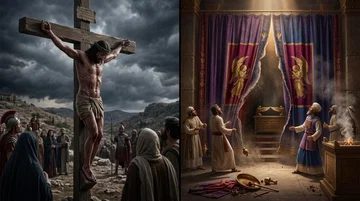
At his expiring cry of It is finished, uttered at the very moment the priests were officiating in the temple with the Passover lamb ready to be slain and the priest standing with lifted knife, the earth trembled, the priest's knife dropped from his nerveless hand and the unfettered lamb escaped.Ms 111, 1897, par. 50–5212MR 416.2–3 At that instant God's own unseen hand, not any priest, the same hand that wrote Belshazzar's doom, tore the strong and gorgeous fabric of the temple veil from top to bottom.Ms 111, 1897, par. 50–52Ms 111, 1897, par. 27–3112MR 416.2–312MR 392.1–3 That rending threw open the Most Holy Place where the Shekinah glory had dwelt above the mercy seat and which only the high priest entered once a year, ending all secrecy there so God would no longer reveal his presence in the Most Holy Place.Ms 111, 1897, par. 50–5212MR 416.2–3 By that act the Jewish nation was pronounced unchurched and its exclusive system ended.12MR 392.1–3
The rending laid open the way into the Holiest of all as a new and living way with no veil between and an open door before the human race.Ms 111, 1897, par. 50–52Ms 111, 1897, par. 27–3112MR 416.2–3 By it Jew and Gentile, free and bond, high and low, rich and poor, all sinful humanity may come directly to God without earthly priest or ruler and without waiting for the high priest, and find pardon and peace.Ms 38, 1905, par. 4Ms 111, 1897, par. 50–5212MR 416.2–312MR 392.1–3 God bowed his head satisfied, now able to blend justice and mercy and to be just yet the justifier of all who believe.Ms 111, 1897, par. 27–31 He declared the human race shall have another trial, answering the controversy over the rebellion, destroying him that had the power of death, making Satan fall like lightning from heaven, and opening the way whereby mercy and truth meet together and righteousness and peace kiss each other.Ms 111, 1897, par. 27–31
Through the eternal Spirit he offered himself without spot and by one offering perfected forever those sanctified, purging the conscience from dead works to serve the living God and obtaining eternal redemption.12MR 392.1–3 That offering qualified him to enter heaven itself as the pure, undefiled, sinless true High Priest in contrast to the false and corrupted Caiaphas whose rent official robes no longer had meaning, to ever live to make intercession and save to the uttermost those who come to God by him.12MR 392.1–3 His death was accompanied by a mighty earthquake that opened the graves of faithful people, with rocks split and the earth shaken.Ms 115, 1897, par. 17–20SG1 69.1 At his resurrection he summoned these saints from the grave as a chosen company coming forth glorified as the first fruits of his power and witnesses to his victory over death and the grave, who unlike those he raised during his ministry were raised to everlasting life and represent the final resurrection of the righteous.Ms 115, 1897, par. 17–20SG1 69.1
Responses and Application
The earthquake, the split rocks, the darkness, and the torn temple veil testified that the Son of God had died.EW 148.1ST Feb 4, 1913 Those signs troubled His enemies, and His murderers trembled at them.EW 148.1 Terror fell upon the executioners and spectators at the convulsions of nature that accompanied His loud dying cry.ST Feb 4, 1913
His followers grieved and lost hope at His death.EW 148.1EW 146.1 They had expected Him to reign as a temporal prince, to deliver Israel, to take an earthly kingdom and David's throne, with their hopes of eternal life centered in Him.EW 148.1EW 206.4Ms 80, 1886, par. 3–5ST Jul 7, 1898 In that grief they wondered whether He had deceived them, and even His mother's faith in Him as Messiah wavered.EW 148.1
The disciples witnessed His agonizing death and laid Him in the tomb.EW 206.4 They saw Him put in the hands of wicked men and a cruel mob, rejected by His own nation clamoring for His blood, crowned with thorns, clothed in the purple robe, mocked and struck with the reed, scourged as the worst of criminals while murderous Barabbas was chosen in His place, stretched upon Calvary's cross as a malefactor and dying as a criminal.Ms 80, 1886, par. 3–5ST Jul 7, 1898 That sight killed their hopes and tried their faith, so that hope and courage failed and gave them cause to mourn and fast.Ms 80, 1886, par. 3–5ST Jul 7, 1898 After He was taken from the cross and laid in Joseph's new tomb their affliction and anguish was beyond measure and terrible because they had lost their Lord, until hope revived when He rose and appeared to them.EW 206.4Ms 80, 1886, par. 3–5ST Jul 7, 1898
On the cross He stands as an example of one who trusted God's word against human power, when Jewish priests and rulers forced even the Roman governor to do their will.ED 254.2–3 His agony teaches self-sacrifice, patience under affliction, and solemn consecration to God.GW92 360.3 His death proves He demanded and gave all, so that nothing believers call self-denial compares with it and the narrow way is not too strait.Lt 1a, 1861, par. 2–5 That sacrifice on the cross is presented as the measure of the church's missionary work and devotion.RH Apr 11, 1912
Sources
Pioneers and periodicals
125 sources
He cried out once more with a loud voice and then breathed out the breath of life, voluntarily resigning his spirit into his Father's hands.ST May 26, 1898RH Sep 19, 1854ST Sep 29, 1914ST Mar 20, 1901RH Nov 10, 1863 His death was real and complete, the ordinary human experience of dying after bearing human sin and the withdrawal of his Father's favor, and he lay unconscious in the grave until his Father called him back.RH Feb 1, 1870RH Mar 24, 1863ST Apr 15, 1903RH Jan 16, 1908ST Dec 2, 1889 He died at the ninth hour, about three in the afternoon on Friday the sixth day, after darkness had covered the land from noon, leaving time for burial before the weekly Sabbath.RH Aug 15, 1854RH Apr 7, 1851RH Mar 10, 1859ST Jun 20, 1911ST Sep 12, 1900 His death was the offering of the spotless Lamb of God bearing the sin of the whole world, truly enduring the law's penalty to uphold its honor, and at that moment the temple veil was torn from top to bottom to show the earthly priestly service finished and the way into the heavenly sanctuary opened.RH Nov 8, 1915RH Jan 10, 1916ST Jul 25, 1878RH Jan 30, 1866 He did not enter the grave as a conquered victim but as a conqueror who through death destroys the one who has the power of death, sealing evil's doom and winning redemption with a triumphant cry that the battle was fought and victory won.ST Jun 10, 1908ST Oct 10, 1895ST Apr 3, 1901ST Feb 6, 1907RH Apr 12, 1915
Words and Rendering
The word rendered ghost means breath or life, the vital spirit or principle of life residing in the breath breathed into a person by God and returning to God.RH Sep 19, 1854ST Sep 29, 1914ST Feb 21, 1878 Giving up the ghost means breathing out the breath of life, yielding up breath and life at death.RH Sep 19, 1854ST Feb 21, 1878 That breath or spirit is the life God gives, not a deathless conscious spirit leaving the body and not a conscious being able to exist apart from the body.RH Sep 19, 1854ST Sep 29, 1914 Jesus truly gave up His life when He died and remained unconscious in the grave until His Father called Him back to life, like those for whom He died, and His real death is part of His sacrifice for humanity.ST Sep 29, 1914 The word is the Greek pneuma, which can mean breath, moving air, vital spirit, and spirit, and is better rendered Spirit, carrying the same meaning as in all its other New Testament uses as spirit, spiritual, and spiritually.ST Feb 13, 1912ST Feb 21, 1878
The wording signifies that Jesus yielded up His spirit, which is more than the ordinary expression for expiring or ceasing to breathe.RH Mar 1, 1860RH Apr 7, 1868 He cried out again with a loud voice and then died, where expired means He died, while gave up the ghost can convey the wrong idea.RH Mar 1, 1860RH Apr 7, 1868 The verse declares that man sleeps in death, proving that man is mortal.RH Feb 20, 1872
Hour Day and Witness
Jesus gave up his life at the ninth hour, about three o'clock in the afternoon on the sixth day identified as Friday.RH Aug 15, 1854RH Apr 7, 1851RH Mar 10, 1859 His death came after he declared his work finished and after he cried out loudly.RH Aug 15, 1854RH Apr 7, 1851RH Mar 10, 1859 There remained time for Joseph to take the body from the cross and bury it, and for the women to prepare spices before the weekly Sabbath began, which they then kept according to the commandment.RH Apr 7, 1851 The completion marked there is the completion of the atonement on Friday, not at the resurrection.RH Aug 15, 1854
The death came after supernatural darkness from noon until three o'clock, once the darkness had ended.ST Jun 20, 1911ST Sep 12, 1900 It fell in mid-afternoon during the time described as between the two evenings, cutting the day short like a swift-coming night.ST Jun 20, 1911ST May 27, 1897 The brightness of morning was veiled as he hung dying, with God placing a sign in the sun that darkened noon.ST Sep 12, 1900ST May 27, 1897 His earthly pilgrimage thus ended crying that his work was finished and bowing his head, the Creator at rest, and his body was taken down and prepared for burial before the Sabbath began.ST Sep 12, 1900
The narrative runs without break into Matthew 28:1, with no chapter division in the original.ST Jul 16, 1912 After the death and burial the going of the Jews to Pilate and the securing of the sepulcher by sealing the stone and setting a watch took place on the Sabbath day itself.ST Jul 16, 1912 That was in the end of the Sabbath, right down in its very closing part before sunset.ST Jul 16, 1912 Then, after the Sabbath closed, as it began to dawn toward the first day of the week, Mary Magdalene and the other Mary came to see the sepulcher in the light part of the day.ST Jul 16, 1912 This shows the Sabbath ends at sunset, not at daybreak.ST Jul 16, 1912
The day of crucifixion was the day on which he showed his love for humanity above all other days, suffering and dying for sinful people bearing the curse of the law.RH Feb 13, 1872 Yet the day of his death was not set apart as a sacred day.RH Feb 13, 1872 Its memorial is the Lord's Supper, not an annual or weekly observance of the date.RH Feb 13, 1872
Jesus died on Friday, and that death is called his passion and his crucifixion.RH Mar 25, 1862ST Oct 27, 1881ST Feb 24, 1887 Friday was kept as a voluntary remembrance of that death, with Wednesday kept for his betrayal and Sunday kept because he rose from the dead, while Saturday, the ancient Sabbath, was meanwhile retained in the eastern churches.ST Oct 27, 1881 The Friday observance was a voluntary festival for public religious assemblies, not a day of abstinence from ordinary labor, not resting on any divine command, and not set in place of the Sabbath.ST Oct 27, 1881 Some early Christians held Friday sacred because Jesus was crucified on it, and early Christians distinguished it with particular honors.RH Mar 25, 1862ST Feb 24, 1887
He was crucified at the last Passover he attended, in A.D. 31.ST Dec 23, 1897 That date ended a three-and-one-half-year public ministry begun at thirty years of age six months before his first Passover.ST Dec 23, 1897 This places the start of his ministry and his birth six months before Passover, about September in the month Tisri, in the season of fruitage.ST Dec 23, 1897 It proves he was not born on December 25.ST Dec 23, 1897
Jesus of Nazareth was crucified and died in the afternoon of the Passover at three o'clock.RH Sep 5, 1865 The crucifixion and its hour are expressly recorded even in hostile Jewish records in the Babylonian Talmud.RH Sep 5, 1865 That is enemy testimony to the event.RH Sep 5, 1865
He was hanged on a cross and slain after condemnation under the appearance of public justice, despite being declared innocent by his judge, completing his earthly ministry by suffering death.RH Nov 18, 1862RH Jan 28, 1862 This account agrees with the other Evangelists and with the Epistles and with Peter's preaching at the house of Cornelius recorded in Acts, where the same death is told, together with the testimony that the apostles were witnesses of these things.RH Jan 28, 1862 The agreement of the Gospels and Acts on his death establishes its truth.RH Jan 28, 1862 Its subordinate details agree with the customs, opinions, political events and circumstances of that time: Pilate was governor of Judea with power of life and death so his sentence was necessary before execution, derision before and during execution was customary, scourging before crucifixion was usual Roman practice, the accusation was written on the cross in three different languages as public notices at Jerusalem commonly were, condemned men bore their own cross, and the body was given up to be buried at the request of friends unless the criminal was infamous, as was law or custom with Roman governors.RH Feb 11, 1862 The account gives these details circumstantially in a natural and undesigned manner without forced introduction, with slight and distant allusions flowing from the progress of the narrative, so that minute accuracy and consistency with what is known about manners and institutions make invention unlikely and artful blending of truth with falsehood difficult to conceive.RH Feb 11, 1862 The crucifixion is also attested by non-Christian writers and records.RH Sep 11, 1860
Manner of Dying
After crying out once more in a loud voice Jesus gave up his life, and this was the final act of his suffering on the cross.ST May 26, 1898 It was the culmination of his love in a shameful death on the cross, after enduring suffering, the burden of human sin, and the withdrawal of his Father's favor.RH Feb 1, 1870 He gave his life after enduring profound agony and soul distress, burdened by love and concern for souls while the Father beheld him.RH Jan 16, 1908
After his earlier cry of forsakenness he cried out again and then yielded up his life, so his death followed that earlier cry.RH Mar 24, 1863 This order contradicts the claim that the separation of his divine and human natures was itself his death.RH Mar 24, 1863 He ended his life with a loud cry in resignation, commending his spirit into the Father's hands and giving up his life.ST Mar 20, 1901 His death was the voluntary giving of himself to be put to death, a sacrifice whose dignity and efficacy are central to the atonement.RH Nov 10, 1863 He willingly resigned his life in his darkest hour, and though he died amid darkness, anguish, and fear, his death did not extinguish his divine glory, for he remained the Light of men, eclipsed yet shining.RH Aug 26, 1875 His death was voluntary and part of a plan fixed beforehand, mercy toward sinners but not mercy toward him, for he suffered and died while the sinner's just due was death.RH Oct 20, 1863
He truly died, an ordinary human experience confirming his real humanity, which his sinlessness and supernatural conception do not make unreal.ST Dec 2, 1889 He remained unconscious in the grave until his Father called him back, like those for whom he died.ST Dec 2, 1889ST Apr 15, 1897 With the following verses this shows that a resurrected person leaves no body in the tomb, just as a translated person leaves no body to be buried, so one who dies and leaves a body to be buried has been neither translated into heaven nor resurrected.ST Apr 15, 1903 He is the same Jesus who was buried and rose triumphant over death and the grave, bringing that victory for himself and for us, and who is coming again.ST Apr 15, 1897
He cried out with a loud voice and then died suddenly while still vigorous, his heart broken under the weight of human sin in love for all humanity. The cry despite nailed hands and death while still vigorous are signs of sudden death from a ruptured heart brought on by mental agony, with the blood and water from his side explained as blood and clear fluid from the heart's surrounding sac.ST Nov 30, 1882 The cry at the moment of death signified that he died of a broken heart, not from the spear thrust or the physical pain of crucifixion.ST May 5, 1909 The weight of human sin and guilt broke his heart and crushed out his life, making his willing death the actual sacrifice for humanity's redemption, while the cross itself was only the means of execution, as with other martyrs.ST May 5, 1909
After awful darkness Satan wrung his heart so he could not see through the portals of the tomb.RH Jan 14, 1904 Hope did not present to him his coming forth from the grave a conqueror or tell him of the Father's acceptance of the sacrifice, and he feared that sin was so offensive to God that their separation was to be eternal.RH Jan 14, 1904 At the ninth hour the darkness lifted from the people but still enveloped him as a symbol of the agony and horror weighing his heart, with deeper gloom enshrouding his soul while onlookers called it God's vengeance and believers lost hope.RH Jan 14, 1904 Amid darkness apparently forsaken of God he drained the last dregs in the cup of human woe, relying on the evidence of his Father's acceptance heretofore given him.RH Jan 14, 1904 He knew his Father's character, his justice, mercy, and great love, and by faith rested in him whom it had ever been his joy to obey.ST Feb 4, 1913RH Jan 14, 1904 As in submission he committed himself to God, the sense of the loss of his Father's favor was withdrawn, and by faith he was victor, though he had no clear hope of the triumph to come.ST Feb 4, 1913RH Jan 14, 1904 His loud dying words were heard amid the darkness and convulsions of nature, and the earthquake, rent rocks, and torn temple veil testified that the Son of God had died and struck terror into executioners and spectators.ST Feb 4, 1913
After the darkness lifted from the cross he cried that his work was finished and entrusted his spirit to the Father, and surrounded by light and shining with glory he bowed his head and died.ST Jul 25, 1878 He died at the very moment the mysterious darkness that covered the earth passed away.ST Aug 1, 1878 His death was purposely kept from Pilate, though conflicting reports of the strange events reached him, until Joseph first told him Jesus was really dead.ST Aug 1, 1878 Pilate was surprised because crucified men often lingered days on the cross, and the account of Jesus dying so soon made Pilate believe more firmly that Jesus was no ordinary man, left him strangely agitated, and made him keenly regret his part in condemning him.ST Aug 1, 1878
Nicodemus witnessed his death after the darkness and upheaval at the crucifixion and later helped place him in the tomb, amid the Roman captain and soldiers recognizing him as the Son of God.ST Jul 8, 1913 After his death Joseph of Arimathea received permission to bury him, completing the sacrifice.RH Jul 16, 1861 His tomb was later found empty, and his disciples announced that he had risen as he had foretold.RH Jul 16, 1861 He had taken humanity upon himself to bear griefs, carry sorrows, and atone for sins, and his loud cry as he expired rang through the universe as a triumphant declaration that redemption is accomplished, its battle fought and its victory won, the foe vanquished and sin canceled, made an end of and known no more.RH Apr 12, 1915
Signs Surrounding Death
When he gave up his life the earth trembled in a great earthquake, the rocks split, the graves and tombs were opened, and the sun was darkened amid wonders and convulsions in heaven and earth.ST May 30, 1906ST May 2, 1906ST Apr 3, 1893RH Jun 13, 1854ST Feb 13, 1907 His death on the cross came amid an earthquake and awe-inspiring signs, and nature was affected in sympathy with its Creator.ST Apr 3, 1893RH Jun 13, 1854ST Feb 13, 1907 Nature showed mourning in creation at the death of him who tasted death alone for humanity after finishing his ministry on Calvary.ST Apr 3, 1893ST Feb 13, 1907
The earthquake that opened the graves occurred at the time of his death.ST May 27, 1908RH Oct 19, 1916 The saints whose graves were opened did not rise until after his resurrection.ST May 27, 1908RH Oct 19, 1916 His death precedes the temple signs and the opening of the graves, and the saints' resurrection that followed his resurrection was partial and not the general resurrection at the last day.ST May 27, 1908RH Oct 19, 1916 Those resurrected appeared to many in Jerusalem and later ascended with him.RH Oct 19, 1916
He brought his life to its close with a loud cry manifesting divine power that shook the earth, split rocks, and tore the temple veil from top to bottom.ST Sep 3, 1896RH Oct 14, 1862 These signs filled his enemies with terror and led honest witnesses including the centurion to declare him the Son of God.ST Sep 3, 1896RH Oct 14, 1862 The darkness, torn veil, earthquake, and split rocks testified to both his death and his superhuman nature.ST Sep 3, 1896RH Oct 14, 1862
The midday darkness from noon turned day to night as he hung dying.ST Apr 11, 1911ST May 27, 1897RH Aug 5, 1873 The brightness of morning was veiled as he hung dying and God placed a sign in the sun that darkened noon, cutting the day short like a swift-coming night in mid-afternoon.ST May 27, 1897RH Aug 5, 1873 That awful gloomy day was like the darkness of May 19, 1780, when thick clouds spread all around and darkened the light with no eclipse to take it away.ST May 27, 1897RH Aug 5, 1873 His death came after that darkness and amid the earthquake and the tearing of the temple veil as the climax of rejection, mockery, and cruelty endured before the Sabbath and the resurrection morning.ST Apr 11, 1911ST May 27, 1897RH Aug 5, 1873
The hour when he laid down his life was marked by an earthquake.ST Aug 15, 1878 Another earthquake signaled the moment when he took his life up again in triumph at his resurrection.ST Aug 15, 1878 Still the divine Son of God and truly human, all creation responded to his agony in the great earthquake that took place at his death on the cross.ST Aug 15, 1878ST Nov 24, 1914
Atonement Sanctuary and Victory
Jesus gave up his life on the cross at Calvary on the skull-like hill outside the city.ST Jul 25, 1878ST Apr 8, 1903ST Jun 13, 1906 He died there after being taunted, mocked, spit upon, smitten and thorn-crowned, and after being made to bear his own instrument of death until exhaustion caused him to sink and a strong countryman was pressed to carry it.ST Apr 8, 1903RH Feb 21, 1865 Nailed to the cross set in the earth, he died amid wonders and convulsions in heaven and earth in the glorious triumph of the principle of eternal righteousness.ST Apr 3, 1893ST Apr 8, 1903 His death was the death of a spotless victim and priceless sacrifice, the Lamb of God and great sin-offering given because all have sinned against God's law.ST Jul 25, 1878ST Jun 13, 1906 He bore the sin of the whole world and died the death of a condemned criminal, as victim to hellish hate, to Jewish blindness and to Roman ignorance, and by that death became the mighty Conqueror over sin and death.ST Apr 8, 1903RH Feb 21, 1865
His death was the unique death of an atoning victim for human sin, not merely the death of a patient martyr.RH Jan 30, 1866 The extraordinary events accompanying it — the earth splitting, rocks breaking, the dead rising, and angels coming and returning — marked its significance as a ransom for sinners.RH Jan 30, 1866 He completed his sacrifice by truly dying the death that is the law's penalty and the sinner's just due.ST Dec 6, 1883 His death was not only mercy toward sinners but answered the demand of divine justice and upheld the honor and integrity of God's law, so that God could remain just while justifying those who believe in Jesus.ST Dec 6, 1883
He did not enter the grave as a conquered victim but as a conqueror who through death destroys the devil who has the power of death.ST Jun 10, 1908ST Oct 10, 1895 His death with a loud cry was the darkest experience immediately preceding the dawning of his greatest victory over the adversary.ST Apr 3, 1901 Though the enemy supposed the voice of Jesus of Nazareth was forever silenced in death, he came forth from the tomb in resurrection triumph bringing with him a multitude of captives as trophies of his signal victory.ST Oct 10, 1895ST Apr 3, 1901 His death shook the earth, split the rocks and opened the graves, and after his resurrection many sleeping saints arose and went into the holy city and appeared to many, testifying that victory had been gained in death itself.ST Jun 10, 1908ST Oct 10, 1895 Death could hold the Man of Galilee only briefly, for he rose victorious breaking the power of darkness, so that even in death believers are more than conquerors through him who loved them.ST Oct 10, 1895ST Jun 30, 1909
He gave up his life under pagan Roman rule, after which he was placed in a rock tomb and sealed inside, but God's power broke the seal and the Prince of Light conquered even in death.ST Nov 7, 1906 This was Satan's final effort to destroy him, with Pilate the Roman governor using Roman authority to have him crucified on a Roman cross and buried in a tomb sealed with the Roman seal, yet it did not accomplish Satan's purpose for he was raised from death and caught up to God and his throne.ST Nov 7, 1906ST Oct 25, 1905 He meekly yielded his life under the oppression of Babylon's creed, and his death displayed divine love stronger than the creed that condemned him and stronger than death itself.ST Nov 8, 1905 The earthquake that followed showed the earth giving him up as conqueror over death and marked the fate of his impenitent oppressors.ST Nov 8, 1905
That death sealed the doom of evil and its king.ST Mar 11, 1903 It forever showed what cherishing selfish thoughts produces, transforming one endowed with glory, beauty and wisdom and familiar with the love and peace of heaven from a cherub into a malignant fiend warring ever against God.ST Mar 11, 1903 Seeing this inspires dread of evil and causes hearts to loathe and fear transgressing the perfect law of love even by a thought, placing eternal safeguards against renewed rebellion.ST Mar 11, 1903 His death at Calvary was the crucifixion of the promised Christ, the central Person to whom the Bible's prophecies and sacred symbols point, and belongs to the saving work continuing through triumph over death, ascension and coming reign as King and judge.ST Feb 6, 1907 The scene of hanging on the cross is the central event in the divine plan of redemption, pointing back through human history to the first sin and the fall, reaching even to Eden and showing the gospel provision made for humanity.ST Jul 22, 1886
When he died the temple veil was torn from top to bottom by unseen hands.RH Jan 10, 1916 The tearing signified that the priestly service of the earthly sanctuary was finished and that its services had given place to the true sanctuary in heaven.RH Nov 8, 1915RH Jan 20, 1853RH Mar 1, 1870 The typical system ended because what had before been done only in type then took place in fact, the offering up of the body of Jesus Christ once for all.ST Nov 11, 1897 In this way the veil of the earthly sanctuary was a figure of Christ, for as the priest anciently, and the people in the priest, entered the holies through the veil, so believers now enter God's presence through Christ Jesus their Advocate.ST Nov 11, 1897 The way into the heavenly sanctuary was made manifest, Jewish sacrifices and earthly priestly services were superseded, and after his death he as the great sacrifice was about to begin his final work as high priest in the heavenly sanctuary, with his shed blood availing for sin.RH Nov 8, 1915
He died in the middle of the seventieth week of Daniel's prophecy, when sacrifices and offerings were to cease.RH Aug 24, 1916 The tearing of the temple veil at his death testified that the divine Sacrifice had brought those offerings which had pointed to him to an end.RH Aug 24, 1916 The prophetic midst of the week had fully come when he as the Crucified One was laid peacefully in a new tomb.ST Jan 31, 1911
His suffering at Calvary shows the dreadful evil of sin and the cost of redeeming the human race, and his cry of abandonment expresses the suffering he endured beneath the burden of sin.RH May 27, 1873 He died bearing the burden of the world's transgression amid darkness and trembling, the supreme measure of God's love for humanity.ST Aug 19, 1886 The anguish, mockery and desolation of the cross were brought upon him by human sin and guilt, for his sorrows arose from bearing our sins and its agonies were caused by sin.ST Oct 22, 1885RH Sep 8, 1863 Through the trials and death of Christ God's mercy is most wondrously displayed in his work to win rebellious humanity.RH Oct 23, 1860
His shame and death make cleansing from sin, freedom and redemption possible, and through his righteousness the sinner may be made pure.ST Jun 7, 1899 Those who turn from evil and seek his mercy find his love, and Christ pleads for them before God.ST Jun 7, 1899 He tasted death alone for humanity amid split rocks, trembling earth, darkened sun and opened tombs.ST Apr 3, 1893 Through his death as Lamb of God and great sin-offering people may receive everlasting life and become loyal subjects of God's government, and his death makes it possible to know and enjoy the blessings celebrated in Israel's songs of praise.ST Jun 13, 1906ST Sep 3, 1912
Saints Raised and Exalted
His death set in motion the raising of a multitude of holy people at his resurrection, who after he rose came out of their graves, entered the holy city, and appeared to many.RH Nov 13, 1900 They ascended with him as trophies of his victory over death and the grave, and as a sample and first sample of the whole harvest in the general resurrection of the righteous.RH Nov 13, 1900 Their resurrection shows believers that death is a small matter.RH Nov 13, 1900
Their rising followed his own resurrection and was partial, not the general resurrection at the last day.RH Oct 19, 1916 After he yielded up his life and then rose, those who came out of their graves after his resurrection became his trophies.RH Oct 19, 1916 They appeared to many in Jerusalem and were taken with him in his victorious return to the heavenly courts together with the company of angels that came to escort their Commander.RH Oct 19, 1916
What came out were the bodies of certain saints, not disembodied spirits, and they were seen by many following his resurrection.RH Sep 13, 1864 These risen saints are the captives he led to heaven when he ascended.RH Sep 13, 1864
At his death and resurrection many of the sleeping saints arose and came out of their graves, showing that a number of saints have already been redeemed from the earth.RH Nov 26, 1861ST Jun 9, 1890ST Feb 3, 1904 Led up on high as a multitude of captives at his ascension, they were men redeemed unto God out of every kindred and tongue and people and nation, made unto God kings and priests.RH Nov 26, 1861ST Jun 9, 1890 This company is most naturally identified as including the twenty-four elders and those associated with them who sing in heaven that they have been redeemed to God by his blood.RH Nov 26, 1861ST Jun 9, 1890ST Feb 3, 1904 They are now the elders around the throne in the temple in the heavenly sanctuary, representatives of the human family who assist his priestly work as mediator of the new covenant in behalf of sinners with his own blood.ST Jun 9, 1890
Prophecy Doctrine and Life
At the crucifixion the majority was wrong in religion, proving truth is not found by sincerity, majority, and antiquity, as seen when Noah built the ark, Abraham left Ur of the Chaldees, Lot left Sodom, Moses left Egypt, Elijah witnessed against Ahab, Daniel and his companions were captive in Babylon, Malachi wrote, the Baptist preached, and the apostles and first Christians were persecuted, for majorities from Enoch till now have generally been wrong.RH Sep 10, 1872 His bitter cry on the cross parallels the anguish God's people will feel during the time of trouble and the pouring out of the seven last plagues.RH Apr 3, 1866 That same anguished cry stands in contrast to the shout of triumph that will accompany his return and awaken the dead.
As he was crucified and buried, so God's seventh-day Sabbath may be trampled, vilified, and treated as dead, yet it lives because founded in God's eternal Word and not dependent on human support or religious popularity.ST Oct 11, 1899 Facing Calvary and yielding up life and entering the prison-house of the tomb and coming forth conqueror, the same conquering Jesus is on board today not as passenger but as Pilot with hand on the helm, the same God who was with Daniel and steadied the ark through the deluge, able to guide through coming days without sun, moon, or stars and keep the ship sailing on by God's providence so long as one Paul remains on board with the Pauline message burning in the heart.RH Feb 4, 1915 The account of his sufferings and death reveals the gospel's power to subdue pride and cast out discontent, so that reading it can help a fretful, gloomy, or discontented Christian become more patient and content.ST Apr 17, 1879 His death at Calvary belongs within suffering through which God brings about purposes, where what looks like a hopeless tangle of dark events is under God's wisdom and love the means to produce good, and his suffering is the pattern for trials forming people into Christlike righteousness.ST Aug 22, 1900
He bore the sin of the world to the full and remained a forgiving, saving friend to the end, showing pity for persecutors, praying for executioners, and saving a condemned criminal.ST Jun 9, 1898 He died in anguish on Calvary where guilty sinners crucified him despite his love for them.RH Feb 6, 1879 The Son suffered on the cross though the Father loved him and was well pleased with him, showing affliction is not evidence God has forsaken him, that suffering may come to God's people without showing God does not love them and may benefit them.RH Mar 21, 1912 Even where his appearance was terribly marred and darkness surrounded him at Calvary, God's love for his Son had not lessened.ST Oct 7, 1897 As the Lamb of God's sacrifice after enduring the cross and crying out and giving up life, he calls people to give up pride, vanity, and appetite for his sake.RH Mar 25, 1873 The Lord of life and glory expired on Calvary after drinking the cup of anguish, after bowing beneath woe in Gethsemane and after crown of thorns, scourge, and cruel mockings in the judgment-hall, and remembered in the ordinances of the Lord's house his death reveals love so amazing and divine in mingled agony and love that it demands heart, life, and all.RH Sep 11, 1866
His mangled, bleeding form on the cross with his suffering in Gethsemane, recalled with his love for the afflicted, brought comfort to the injured.RH Apr 10, 1900 The suffering of that hour of death on the cross was the culmination of a life marked by cruel crosses and crowns of thorns.ST Jul 22, 1908 His death at Calvary belongs to a life revealing unselfishness in contrast with self-serving.RH Dec 19, 1912 His sacrifice on the cross is the measure of the church's missionary work and devotion.RH Apr 11, 1912 The darkness surrounding his death brought many in the crowd to recognize they had done great wrong and to be convinced accusations against him were false and he was no pretender, and after Peter explained the cross at Pentecost many became converts.ST Jul 25, 1878
His death on Calvary after being hailed as coming king yet crucified instead of crowned and seated on Israel's throne was bitter disappointment to disciples expecting an earthly king, after escorting him into Jerusalem in triumph only days before.ST Aug 13, 1902RH Jul 6, 1869 The throne to which he went was the cross, and afterward his lifeless body was laid in Joseph's new tomb, after followers welcomed him expecting him to take the kingdom rather than be received as king in a royal palace.ST Jul 27, 1882 His death brought bitter disappointment showing how disappointment and trial shape God's people.ST Mar 24, 1887 Though his life ended on the cross it was not failure but the most influential life, and though his death appeared to mark failure of mission it was part of success, for earthly defeat does not determine true outcome.RH Jan 18, 1912ST Feb 4, 1913 On the cross he endured crushing pressure with powers of darkness pressing and none standing by, with Satan hurling fiercest attacks yet remaining without sin.RH Jul 19, 1864 Left to suffer at opponents' hands in shame and agony, no command came from heaven for angels to rescue him.ST Apr 15, 1897 On the cross he is an example of calm self-possession under extreme pressure, a repose not of inaction but of steady mind sustained by faith in the heavenly Father and confidence in promises.ST Jul 29, 1886
The trial and crucifixion at Calvary with cruel mockery and terrible scenes can be pictured as if standing present to witness them.ST Feb 16, 1882 To personate him and act out his death in a public Good Friday procession is a blasphemous prostitution of Christianity, which those with Christ enshrined in the heart would never consent to do.ST Jul 12, 1899 He died alone on the cross rejected by people and leaders yet right against the world.RH Apr 21, 1863 Even though he was the Son sent as Saviour, suffering and death came to him as predicted, lifted up dying as the Bridegroom taken after descending into humiliation into wicked hands.ST May 8, 1879 His death on the cross after midday darkness and amid earthquake and tearing of the temple veil was the climax of rejection, mockery, and cruelty endured, and the event preceding the Sabbath and resurrection morning.ST Apr 11, 1911 Breathless when later thrust with a spear, his death came as the Sabbath drew near with the veil torn in connection with surrounding events.RH Dec 12, 1912 His suffering and death belong after garden agony and crucifixion darkness and before resurrection triumph.ST May 8, 1901 Completing his sacrifice after declaring work finished, bowing his head and dying, his death is victory and death suffered for others.RH Nov 6, 1860
Sources