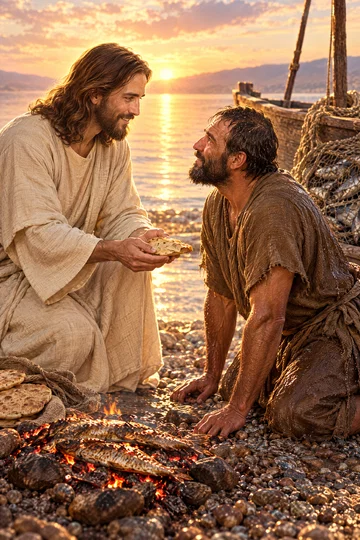
John 21:17
He saith unto him the third time, Simon, son of Jonas, lovest thou me? Peter was grieved because he said unto him the third time, Lovest thou me? And he said unto him, Lord, thou knowest all things; thou knowest that I love thee. Jesus saith unto him, Feed my sheep.
Translations
He says to him the third time, Simon, son of Jonas, love you me? Peter was grieved because he said to him the third time, Love you me? And he said to him, Lord, you know all things; you know that I love you. Jesus says to him, Feed my sheep.
King James Version, KJV Cambridge Paragraph Bible
He saith unto him the third time, Simon, son of Jonas, lovest thou me? Peter was grieved because he said unto him the third time, Lovest thou me? And he said unto him, Lord, thou knowest all things; thou knowest that I love thee. Jesus saith unto him, Feed my sheep.
He saith to him the third time, Simon son of Jonas, lovest thou me? Peter was grieved, because he said to him the third time, Lovest thou me? And he said to him, Lord, thou knowest all things; thou knowest that I love thee. Jesus saith to him, Feed my sheep.
Revised Version, American Standard Version
He saith unto him the third time, Simon, son of John, lovest thou me? Peter was grieved because he said unto him the third time, Lovest thou me? And he said unto him, Lord, thou knowest all things; thou knowest that I love thee. Jesus saith unto him, Feed my sheep.
He saith to him the third time, 'Simon, [son] of Jonas, dost thou dearly love me?' Peter was grieved that he said to him the third time, 'Dost thou dearly love me?' and he said to him, 'Lord, thou hast known all things; thou dost know that I dearly love thee.' Jesus saith to him, 'Feed my sheep;
He says to him the third time, Simon, [son] of Jonas, art thou attached to me? Peter was grieved because he said to him the third time, Art thou attached to me? and said to him, Lord, thou knowest all things; thou knowest that I am attached to thee. Jesus says to him, Feed my sheep.
He saith unto him, the third time—Simon, son of John! art thou fond of me? Peter was grieved, that he said unto him, the third time, Art thou fond of me? and he said unto him—Lord! all things, thou, knowest: thou perceivest that I am fond of thee. Jesus saith unto him—Be feeding my sheep.
Jesus asked a third time, “ Simon son of John, do you love Me?”Peter was deeply hurt that Jesus had asked him a third time, “ Do you love Me?”“ Lord, You know all things,” he replied. “ You know I love You.”Jesus said to him, “ Feed My sheep.
Jesus asked a third time, “ Simon son of Jonah, do you love Me?” Peter was deeply hurt that Jesus had asked him a third time, “ Do you love Me?” “ Lord, You know all things,” he replied. “ You know I love You.” Jesus said to him, “ Feed My sheep.
He said to him the third time, “ Simon, son of Jonah, do you have affection for me?”Peter was grieved because he asked him the third time, “ Do you have affection for me?” He said to him, “ Lord, you know everything. You know that I have affection for you.”Jesus said to him, “ Feed my sheep.
He said to him a third time, Simon, son of John, am I dear to you? Now Peter was troubled in his heart because he put the question a third time, Am I dear to you? And he said to him, Lord, you have knowledge of all things; you see that you are dear to me. Jesus said to him, Then give my sheep food.
He said vnto him the third time, Simon the sonne of Iona, louest thou me? Peter was sorie because he said to him the third time, Louest thou me? and said vnto him, Lord, thou knowest all things: thou knowest that I loue thee. Iesus saide vnto him, Feede my sheepe.
Douay-Rheims (Challoner revision)
He said to him the third time: Simon, son of John, lovest thou me? Peter was grieved, because he had said to him the third time: Lovest thou me? And he said to him: Lord, thou knowest all things: thou knowest that I love thee. He said to him: Feed my sheep.
Pictures






Cross-references 20 of 51
- Luke 22:32
But I have prayed for thee, that thy faith fail not: and when thou art converted, strengthen thy brethren.
Jesus foretold Peter’s return and charged him to strengthen his brethren.
- 1 Peter 5:2
Feed the flock of God which is among you, taking the oversight thereof, not by constraint, but willingly; not for filthy lucre, but of a ready mind;
Both charge Peter to feed and care for Christ’s flock.
- Luke 22:61-62
And the Lord turned, and looked upon Peter. And Peter remembered the word of the Lord, how he had said unto him, Before the cock crow, thou shalt deny me thrice.
Peter remembers his denial, weeps bitterly, and is later restored to service.
- Matthew 26:33-35
Peter answered and said unto him, Though all men shall be offended because of thee, yet will I never be offended.
Peter recalls his earlier boast that he would remain loyal even if others failed.
- John 10:11-16
I am the good shepherd: the good shepherd giveth his life for the sheep.
Jesus’ sheep are the flock Peter is told to feed, and Christ models their care.
- Matthew 26:69-75
Now Peter sat without in the palace: and a damsel came unto him, saying, Thou also wast with Jesus of Galilee.
Peter’s three denials are answered by three affirmations as Jesus restores him.
- Acts 20:28
Take heed therefore unto yourselves, and to all the flock, over the which the Holy Ghost hath made you overseers, to feed the church of God, which he hath purchased with his own blood.
Both charge leaders to feed and care for God’s flock.
- John 18:17-27
Then saith the damsel that kept the door unto Peter, Art not thou also one of this man’s disciples? He saith, I am not.
Peter’s three denials are answered by three declarations of love.
- Luke 22:33
And he said unto him, Lord, I am ready to go with thee, both into prison, and to death.
Peter’s boastful pledge contrasts with the humble service Jesus later entrusts to him.
- Mark 14:29-31
But Peter said unto him, Although all shall be offended, yet will not I.
Peter’s confident claim of loyalty contrasts with his humbled answer.
- John 14:15
If ye love me, keep my commandments.
Christ’s command to feed his sheep shows love for him through obedience.
- John 21:22
Jesus saith unto him, If I will that he tarry till I come, what is that to thee? follow thou me.
Jesus tells Peter to follow Him rather than concern himself with John’s future.
- Mark 16:7
But go your way, tell his disciples and Peter that he goeth before you into Galilee: there shall ye see him, as he said unto you.
Peter is specially included in the message to meet the risen Jesus.
- Matthew 9:36
But when he saw the multitudes, he was moved with compassion on them, because they fainted, and were scattered abroad, as sheep having no shepherd.
Jesus’ compassion for sheep without a shepherd models care for His sheep.
- Matthew 16:22
Then Peter took him, and began to rebuke him, saying, Be it far from thee, Lord: this shall not be unto thee.
Peter’s former presumption contrasts with his humble answer to Jesus.
- John 10:27
My sheep hear my voice, and I know them, and they follow me:
Jesus’ sheep hear his voice and follow him.
- Ezekiel 34:4
The diseased have ye not strengthened, neither have ye healed that which was sick, neither have ye bound up that which was broken, neither have ye brought again that which was driven away, neither have ye sought that which was lost; but with force and with cruelty have ye ruled them.
Shepherds are condemned for failing to strengthen and care for the flock.
- 1 Peter 5:4
And when the chief Shepherd shall appear, ye shall receive a crown of glory that fadeth not away.
Faithful under-shepherds serve under Christ, the chief Shepherd, and await their promised crown.
- Luke 15:4-7
What man of you, having an hundred sheep, if he lose one of them, doth not leave the ninety and nine in the wilderness, and go after that which is lost, until he find it?
Both portray a shepherd caring for sheep, including seeking the lost.
- John 18:25-27
And Simon Peter stood and warmed himself. They said therefore unto him, Art not thou also one of his disciples? He denied it, and said, I am not.
Peter’s three denials lead to his humbled, public restoration.
Commentary part 1 of 2
Each commentary is drawn from primary sources: the writings of Ellen G. White and Adventist pioneers and periodicals. Each commentary is separate. Its own words are not a quotation; follow the references to read the source passages.
Ellen G. White
126 sources
By the Sea of Galilee just before His ascension Jesus three times asks Peter whether he loves Him, answering his three denials and restoring him to his place among the twelve with the commission to care for His followers.DA 809.16RED 47.2–48.26RED 67.1–68.2ED 90.3–4TSSW 114.6 Grieved by the repeated probing, Peter makes no boast or claim above his brethren but appeals to Jesus who knows all hearts as witness that he loves Him, showing his self-confidence broken and his repentance sincere.6RED 47.2–48.26RED 67.1–68.2COL 154.1–3ED 90.3–4Ms 109, 1898, par. 14–16 Love for Christ is the essential and abiding qualification for discipleship and service, without which all other gifts of knowledge, eloquence, zeal and kindness profit nothing.AA 515.3–516.16RED 47.2–48.2DA 815.26RED 47.1GW 182.4–183.2 To feed His sheep and lambs is to shepherd both mature believers and those young in faith with spiritual nourishment from the Scriptures, seeking the lost and straying, guarding from danger, healing the wounded, and laboring personally beyond mere preaching.Lt 17, 1902, par. 9–11GW92 405.3SLP 329.1ST Mar 16, 1882ASCOP 17.2 Thus humbled, converted and prepared by his own fall and forgiveness, Peter is to deal with the weak and erring as tenderly as Christ dealt with him, a charge that belongs to every minister and worker to love those for whom Christ died and lead them to holiness.AA 515.1–2RH Feb 6, 1913AA 516.2–36RED 69.2TSSW 114.6
Setting in Galilee
The words belong to the meeting He had appointed with His disciples in Galilee.DA 809.1 They remained in Jerusalem until the Passover week ended, since leaving during the feast could have been taken as disaffection and heresy, and afterward they went to Galilee to meet Him.DA 809.1 It was spoken near the Sea of Galilee where much of His ministry had been spent, when the disciples were gathered in a secluded place not likely to be disturbed.DA 809.3 The place was surrounded by reminders of Him and His mighty works, with their minds full of His words and deeds.DA 809.3
It was the same sea where He had walked on the waves to rescue them in terror in the fierce storm and hushed the tempest by His word, within sight of the beach where He had fed more than ten thousand from a few small loaves and fishes, and not far from Capernaum with its many miracles.DA 809.3 The charge to feed the lambs and feed the sheep was given just before His ascension.TSSW 114.6
Threefold Question and Answer
For the third time Jesus asks Simon son of Jonas whether he loves Him, and this time as the time before He no longer asks whether Peter loves Him more than his brethren.6RED 67.1–68.2DA 811.4 The three questions answer Peter's three open denials, drawing from him three assurances of love and loyalty and recalling his fall.6RED 47.2–48.26RED 67.1–68.2ST Oct 3, 18783SP 229.2–230.13SP 230.2–232.1 Peter was grieved because He said it the third time, the pointed repeated question pressing like a barbed arrow into his wounded heart.6RED 47.2–48.26RED 67.1–68.2ED 90.3–4RH Feb 6, 1913DA 812.1–2 He thinks the repetition means Jesus doubts his answer and does not believe him.6RED 47.2–48.26RED 67.1–68.23SP 229.2–230.1DA 811.46RED 47.1
He answers with an aching heart, knowing the Lord had cause to distrust him.6RED 67.1–68.2DA 811.4 He makes no boast, no extravagant assurance, no self-confident comparison with or exaltation above the other disciples.6RED 47.2–48.2COL 154.1–3ST Mar 23, 1915Lt 89, 1897, par. 11–13DA 811.4 He appeals to Jesus who knows all things, reads the heart and all motives, as witness to judge the sincerity of his love, that the Lord knows that he loves Him.6RED 47.2–48.26RED 67.1–68.2ST Oct 3, 18783SP 229.2–230.1DA 811.4
Jesus asked before the assembled disciples to bring out the depth of Peter's penitence and show how thoroughly humbled the once-boasting disciple was.6RED 67.1–68.2DA 812.1–2ST Oct 3, 1878 The close, testing question calls out no forward, self-sufficient reply.6RED 67.1–68.2DA 812.1–26RED 69.1 Peter gives evidence of sincere repentance.6RED 67.1–68.26RED 69.1ST Oct 3, 1878
The probing reaches the root of Peter's failure and breaks his self-confidence and self-trust, after his self-confidence and boastful claims had been broken.COL 154.1–3Ms 109, 1898, par. 14–16 Peter no longer trusts his own confidence but rests on Christ's knowledge of all things.COL 154.1–3Ms 109, 1898, par. 14–16 When self does not rise up hurt and abused under such testing, the soul is dead to self and alive to God.Ms 109, 1898, par. 14–16
Peter Restored and Converted
Jesus forgives Peter's denial and apostasy, receives him again into divine confidence and affection, restores him to his place among the twelve, and appoints him again to serve with the commission to feed the sheep.ED 90.3–4ST Nov 23, 1915AA 515.1–2RH May 19, 1910RH Jul 25, 1912 The testing with the same question three times draws from him confession of love and trust in the all-knowing judgment of his heart, and the charge to care for flock and lambs with direction to follow on completes the personal commission.ED 90.3–4ST Nov 23, 1915RH May 19, 1910SLP 329.1 His experience of sin, suffering, and repentance prepared him for this work, and having sincerely repented though unable to forgive himself, he was to serve in self-distrust and reliance on Christ, shepherding believers as well as seeking those outside the fold.AA 515.1–2RH Jul 25, 1912SLP 329.1
The restoration is strong proof that Peter is accepted and trusted again, and the trust itself is evidence that his restoration is genuine.6RED 67.1–68.2Ms 109, 1898, par. 17–18ST Mar 23, 1915 Before the assembled disciples the depth of his penitence is brought out to show how thoroughly the once-boasting disciple is humbled, so that he gives evidence of sincere repentance, regains the entire confidence of his brethren, and resumes his apostolic work.6RED 67.1–68.2 He is given a broader and more delicate work than before: to share the Word of life and shepherd those for whom Christ gave His life, caring for the people at the cost of self-denial and self-sacrifice.Ms 109, 1898, par. 17–18ST Mar 23, 1915
The exchange completes Peter's conversion, and transforming grace takes possession of his heart.RH Feb 6, 1913GW92 365.6–366.16RED 69.1 He becomes a converted man in a different spirit from his boastful assurances before the crucifixion, with the close testing question calling out no forward, self-sufficient reply but a humbled appeal.RH Feb 6, 1913DA 812.1–26RED 69.1 Because of this humiliation and repentance he is better prepared than ever before to act as shepherd to the flock, and the time has come when, being converted, he should strengthen his brethren.DA 812.1–2GW92 401.16RED 69.1 Only a converted man can fulfill the charge to feed lambs and sheep, and his sincere sorrow with broken and contrite heart being accepted, he is fitted to sympathize with the weak and tempted and to care also for young converts.GW92 365.6–366.1ST Feb 4, 1897GW92 401.1
His experience of suffering and repentance prepared him for work he had before been unfitted for and unable even to understand in its importance, demanding great care and tenderness with much patience and perseverance.AA 515.1–2DA 812.3–4 Having learned his weakness, he serves in self-distrust and reliance on Christ, no longer impetuous, self-confident and self-exalted but calm, self-possessed, teachable, meek and lowly in heart.AA 515.1–2DA 812.3–4GW92 365.6–366.15T 334.2 He keeps his former fervor, but with zeal regulated by grace, subdued and contrite, following on through self-denial and self-sacrifice to share in suffering and ultimately glory.DA 812.3–4GW92 365.6–366.1ST Mar 23, 1915
After reinstatement he is firm as a rock and never again wavers from allegiance, though called to severe trials and to prison and to death for Christ's sake.RH Feb 6, 1913 After restoration he faces danger with courage and is not intimidated, bravely preaching the crucified, risen, and ascended Saviour and going on to a life of service and sacrifice through preaching and teaching the Word.MH 493.3–4AA 199.2AC1 70.33SP 337.3 Despite his faults and repeated reproofs he bears witness to the power of grace, his sin forgiven, becoming a faithful minister who helps build the church, honored with divine light and power.MH 493.3–4AA 199.2COL 160.1
He never forgets his humiliation and knows only Christ's grace could overcome the weakness of character that caused his fall, finding nothing in himself to boast of.COL 160.1 Though charged to feed the sheep and lambs, he continues to grieve over his sin, and his conversion leads to a life of repentance and humility.AA 537.34T 342.1COL 160.1 He later accepts suffering for his faith, feeling unworthy to die in the same manner as Christ and asking to be crucified upside down.4T 342.1
Even a person with great knowledge, influence, and experience cannot safely rely on himself, and Christ's grace is needed each day to keep him from falling.Ms 122, 1897, par. 14–15 Peter's ardor and zeal still need the mild caution of John's patient forbearance and devotion, and their complementary strengths of boldness and energy with forbearance and devotion help advance the cause.EW 188.1–2Ms 122, 1897, par. 14–15
The commission brings Peter honor, authority, influence, and veneration in the church as one of Christ's closest daily followers in life, placing him in a position of trust to care for the flock patiently and tenderly.3SP 233.16RED 51.16RED 71.1ST Oct 3, 1878 His standing comes from favor in being forgiven, from being entrusted with feeding the flock, and from remaining near in daily life, yet it does not give him supremacy over his fellow believers or make him supreme over his brethren.3SP 233.16RED 51.16RED 71.1 Peter faithfully carries out the responsibility afterward by caring for the flock entrusted to him and preparing believers for service.AA 516.4
Love Required for Service
Love for Christ is the essential qualification for discipleship and service, the one condition laid down by the repeated question, and feeding His sheep depends on that love, so that without the love of Jesus in the heart the Christian minister's work will fail.DA 815.26RED 47.1GW 182.4–183.2 Peter's claim that he loved Jesus did not make other qualities unnecessary, yet they could not make him a faithful shepherd without Christ's love in his heart.DA 815.2 The exchange brings his repentance and humility into view after his three denials, restoring him to responsibility for the flock and showing that love is essential to faithfully shepherding it.6RED 47.1
Knowledge, kindness, eloquence, benevolence, gratitude, and zeal help in the good work, but they cannot make ministry faithful or make it succeed without that love.AA 515.3–516.16RED 47.2–48.26RED 67.1–68.2DA 815.23SP 230.2–232.1 Love must be the abiding principle, for wherever there is union with Christ there is love, and whatever other qualifications are possessed profit nothing without it.Ms 13a, 1891, par. 46–49 This love is not a passing feeling but a lasting, abiding power in the heart, shown in a shepherd's character and conduct as he lives out the truth he teaches.AA 515.3–516.1RH Jul 25, 1912 Christ's approval rests on such service, and shepherd and flock are united by their shared hope in Him.AA 515.3–516.1RH Jul 25, 1912
If Jesus is loved, His brethren will most assuredly be loved, with a wish for them to be more holy and more righteous and earnest endeavor to make them so, to uplift, to ennoble, to elevate.Ms 13a, 1891, par. 46–49 Love for Jesus is shown by loving the people for whom He died, leading to honest, trustworthy conduct and willingness to deny self to benefit others.4T 353.2–3 Trials and afflictions test whether a person loves God, for difficulties on the path are questions from God calling for faithfulness.Lt 32, 1875, par. 57–62
Peter's answer is the answer every believer can give when others speak against him or judge him.Lt 106, 1896, par. 26–27 To declare that Jesus knows one's love for Him is to hold fast under sneers and scorn without anger or discouragement, valuing eternal life above human approval.Lt 106, 1896, par. 26–27 That love is grounded in Jesus giving His life and is proved by faithful service, and faithful service brings cleansing from every stain of sin because Christ abides in the heart.Lt 106, 1896, par. 26–27 The words express personal devotion to the Savior, loved as Redeemer for giving His life to save.LSEGW 339.2
They can be made into a prayer and a fitting confession for one who seeks to follow Jesus: Lord, Thou knowest all things and knowest whether I love Thee; Lord Jesus, Thou knowest that I love Thee.Lt 101, 1895, par. 6–109MR 109.2–3Lt 11, 1876, par. 10–11 Love for Christ is shown by cheerful, genuine obedience to His commandments and by following His example, and by faithful service.Lt 101, 1895, par. 6–109MR 109.2–3 Christ's love is shown in giving His life, bearing human sin, and offering His righteousness to those who receive it by faith.Lt 101, 1895, par. 6–10 His presence in the heart purifies from sin, and His complete knowledge gives confidence that He will direct the path.9MR 109.2–3Lt 11, 1876, par. 10–11
Meaning of Feed My Sheep
"Feed my sheep" entrusts Peter with caring for Christ's followers as a shepherd cares for sheep, pictured as sheep and lambs, tending and feeding them as a shepherd's work.GW92 405.3SLP 329.19MR 334.1 That charge was laid not on Peter alone but on those who work with Him.ST Sep 15, 1909 It was given as proof that his denial was forgiven and he was received again into confidence, for he had sincerely repented though he could not forgive himself.SLP 329.1
Feeding is giving spiritual nourishment and instruction, teaching the ignorant, opening the Scriptures to them, and training them for usefulness in Christ's service.Lt 17, 1902, par. 9–11DA 812.3–4GW 182.4–183.2 It is presenting the gospel simply so that it becomes the power of God unto salvation and leads people to Christ and wins them to Him.Lt 103, 1902, par. 7–8RH Sep 9, 1902 It is giving present truth as meat in due season, feeding with pure provender and healthful food, requiring fruit-bearing branches rather than mere profession to meet the needs of the world and fulfill God's will, with provision made that the saving power of the gospel shall be represented in all places.RH Feb 18, 1909STM2 29.5ST2 45.5 Peter had before been unfitted for this work and unable even to understand its importance, but his experience of suffering and repentance prepared him for it, so that converted he kept his former fervor with zeal regulated by grace, no longer impetuous, self-confident and self-exalted but calm, self-possessed, teachable, meek and lowly, and so was able to feed the lambs as well as the sheep.DA 812.3–4GW 182.4–183.2
Feeding hungry, starving, perishing sheep means giving pure wheat thoroughly winnowed from all chaff, manna from heaven, the truth as it is in Jesus in its simplicity.Lt 94, 1896, par. 5–8 It is done by dwelling decidedly on a few important vital points in short discourses that come right to the point, not by long discourses or wandering to bring in unimportant, foreign ideas that weaken solid argument and detract from force and interest.Lt 94, 1896, par. 5–8 It is done with a constant sense of the Divine Watcher, as speaking not only to an unenlightened assembly but to God, as though heaven were before the speaker, with the Holy Spirit speaking through yielded lips and bearing witness that God speaks through the teacher.Lt 94, 1896, par. 5–8 That feeding is done by speeding messengers on their way with truth, which requires God's people to cut loose from love of the world and attachment to possessions and to sacrifice earthly goods and give means liberally so the sheep are fed and not left to die, for the time is urgent and destruction comes like a mighty whirlwind.STM2 29.5ST2 45.5
No one can do this work without first feeling the converting power of God, becoming imbued with His Spirit, and drinking deeply of the water of life himself, first receiving fresh manna from the Lord's storehouse and then communicating the bread of life to others.Ms 20, 1891, par. 29–32Lt 2a, 1896, par. 25–27 It requires studying the Saviour's life and example and His manner of teaching, meeting people just where they are and helping them just where they are with a great heart of love touched by human woe.Ms 20, 1891, par. 29–32 Even those with strong prejudices can be reached by this feeding, but it demands zealous effort and the vitalizing influence of the Spirit to overcome a slow, tame manner of work.Lt 2a, 1896, par. 25–27
"Feed the sheep" and "feed the lambs" together charge care for both the mature and those young in the faith.Lt 3, 1892, par. 34–38Ms 5, 1883, par. 33–34Lt 103, 1902, par. 7–8 The lambs are children, youth, young converts, and new believers, tender and vulnerable, who need patient, tender instruction, protection, and food they can receive, telling them of Jesus' love whenever suitable and including them in preaching.Ms 5, 1883, par. 33–34TSSW 113.1GW92 405.3 Feeding the sheep may mean teaching the mature, while feeding the lambs is the harder, more difficult task requiring special care, great care and tenderness with much patience and perseverance to give suitable teaching, open the Scriptures, and educate new believers for usefulness and duty.Lt 3, 1892, par. 34–38Lt 89, 1897, par. 11–13DA 812.3–4 No Christian life is complete without learning this work, and without it believers will have a dwarfed experience and be exposed to temptation and deception.Lt 3, 1892, par. 34–38
The charge expresses God's great love for every soul for whom Christ died, His watchful care over the flock day and night, and His desire that none be lost and not even one little one perish.Ms 31, 1898, par. 5–6Ms 59, 1900, par. 19–2019MR 319.1–2 Feeding therefore includes tending the members of the flock, seeking those who are lost or straying and bringing them back to the fold, and guarding them, especially the young, from dangers that could lead them astray.ST Mar 16, 1882STB 295.4TSSW 82.1YGBCOEP 16.3–4 It means caring for those straying or in fault and helping bring them back with kindness, love, and desire to restore them, rather than criticizing or pushing them away or abandoning them.ST Apr 1, 1889TSSW 82.1 It means tending the spiritually sick, wounded, and discouraged, healing broken hearts and binding up hurts, seeking them out to help them and not harming them with suspicion, criticism, or faultfinding, for unfaithful care poisons the flock, damages the church, and makes its work harder.Lt 199, 1900, par. 4–5YGBCOEP 16.3–4
Feeding is more than preaching: it requires personal labor, visiting members in their families, watching for souls as those who must give an account, attending to their spiritual needs, and building up and keeping churches in prosperous condition.ASCOP 17.2Lt 18, 1893, par. 5–7Lt 50, 1892, par. 6 Ministers must personally visit and care for the people entrusted to them, not leave that work to others or replace it with preaching alone, and neglecting the flock makes a shepherd unfaithful and brings rebuke.Lt 18, 1893, par. 5–7Lt 50, 1892, par. 5 Personal care binds the messenger to the flock, and timely words strengthen the weak so they become established in the faith.Lt 18, 1893, par. 5–7 Ministers should balance preaching with personal ministry and preserve their strength so they can continue to serve well and give the flock fresh spiritual food.20MR 133.5Lt 39, 1887, par. 6–7 Men who can only sermonize and excuse themselves from visiting do not fulfill the charge and should not be given credentials or sent into foreign fields as missionaries until they educate themselves to do a shepherd's work and give full proof of ministry, for one thorough faithful shepherd who cares for the flock is better than twenty sermonizers, and work that leaves personal care undone is only half the ministry.Lt 50, 1892, par. 5Lt 50, 1892, par. 6
Christ's own example defines the work: He left the royal courts, His honor, glory, and high command, humbled Himself to become one with humanity, and came not to unfallen worlds but to this world scarred and marred with the curse because its people needed Him most, reaching to the very depths of human woe to rescue them.Ms 18, 1896, par. 14 Feeding His sheep and lambs therefore means copying Him by leaving convenient places to spread the knowledge of the truth in localities where it is not known.Ms 18, 1896, par. 14 It means doing practical good more than preaching sermons, meeting people where they are, and not putting truth too high for weak ones to reach so they receive food they can take in and gain a deeper knowledge of Him.Ms 20, 1891, par. 29–32 To feed with poison instead of healthful food is a terrible thing, and poison is creating dissension and strife and working in a spirit of suspicion that others are drawn to sympathize with.Lt 48, 1900, par. 7
Shepherd Manner and Example
Even while Peter was denying his Lord, the love Jesus bore him never faltered.AA 516.2–36RED 69.2DA 815.1 His patient, sympathetic, forgiving treatment after the denial is the model for caring for others, especially the tempted and erring, with patience, sympathy, tenderness, and forgiving love.RH Jul 25, 1912AA 516.2–36RED 69.2DA 815.1 Remembering his own weakness and failure, Peter was to deal with his flock as tenderly as Christ had dealt with him.AA 516.2–36RED 69.2DA 815.16RED 49.1–2
Having himself fallen, repented, and been restored, he could sympathize with weak and tempted people and strengthen his fellow believers.AA 516.2–3GW92 401.1Ms 16, 1894, par. 33–34 Repentance and conversion humbled him and fitted him to go to the most tempted and tried disciple and know how to help him.GW92 401.1Ms 16, 1894, par. 33–34 The way Jesus dealt with Peter in his fall and restoration is a lesson for Peter and for the other disciples on how to deal with a transgressor and with those who sin.6RED 69.26RED 49.1–2 The lesson taught by the Sea of Galilee stayed with Peter for life, and he later passed it on in his charge to the elders to feed the flock of God willingly and by example for a crown of glory when the Chief Shepherd appears.GW 182.4–183.2
Overseers appointed by the Holy Ghost must take heed to themselves and to all the flock and feed the church of God.Lt 9, 1892, par. 25–29 They are to take the oversight willingly and not by constraint, not for filthy lucre but of a ready mind, not as lords over God's heritage but as ensamples to the flock.Lt 9, 1892, par. 25–29 A shepherd must seek out those who are spiritually sick and help them, not harm them with suspicion, criticism, or faultfinding.Lt 199, 1900, par. 4–5 Unfaithful care poisons the flock, damages the church, and makes its work harder.Lt 199, 1900, par. 4–5 When a shepherd withdraws his labor and interest or neglects the work, the sheep and lambs suffer, lack spiritual food, and may die spiritually or perish.21MR 246.4–248.321MR 209.1–4
Faithful ministers must take their shepherding duties seriously and live in a manner worthy of the trust of caring for the flock.GW92 250.2–251.3 One who neglects that care and treats the work lightly is not fit to be entrusted with the sheep and lambs until converted, for a minister must be fit to care for Christ's sheep and lambs, not merely bear a message.GW92 250.2–251.3GW 131.3 A combative debating spirit unfits men for that pastoral work.9MR 218.2–220.2 Those who reject the Lord's plain counsel and guidance and resist the Holy Spirit's warnings and reproof should not be given that responsibility.RH Sep 24, 1908Ms 79, 1908, par. 16–17 Love to God requires feeding both the sheep and the lambs by looking carefully after the sheep of His pasture, showing personal interest in the oppressed, caring for people especially neglected young people, and feeding the hungry with food and clothing where there is real want.Ms 62, 1894, par. 2Ms 52, 1896, par. 43–44
Shepherds are God's agents for this work, laboring with busy hands, sensitive hearts, and ready speech to win the unconcerned and unbelieving and to inspire fellow believers with a missionary spirit.Ms 52, 1896, par. 43–44 They lead by example saying come on rather than go on, working by active, personal encouragement and inviting others to join in rather than merely telling them to go.Ms 62, 1894, par. 2Ms 52, 1896, par. 43–44 Neglect of known need brings God's requital and no blessing, while this personal labor for the poor deepens love to God.Ms 52, 1896, par. 43–44
Charge to Church Workers
The same charge to tend the flock by giving spiritual instruction rests on gospel ministers as undershepherds, on physicians and evangelists as shepherds, on pastors, on teachers of salvation, and on Bible teachers.Lt 17, 1902, par. 9–11RH Feb 18, 1909CT 433.4GW92 70.1Lt 202, 1908, par. 3–4 They are to feed with pure, clear truth from the Word, to seek the lost sheep, and to labor personally to bring the unconverted to conviction and conversion.Lt 17, 1902, par. 9–11RH Feb 18, 1909CT 433.4Lt 202, 1908, par. 3–4 The call looks for fruitful lives and ministries that represent the saving power of the gospel in every place, not mere profession of righteousness.RH Feb 18, 1909Lt 202, 1908, par. 3–4 Christ's voice repeats the charge again and again to nearly every minister who has charge of the flock.Lt 3, 1892, par. 34–38
The commission belongs to every minister and worker and to the whole church, not to ministers alone.TSSW 114.611MR 80.3Lt 1, 1898, par. 9–10 Churches are to gather sheep and lambs into the fold, to train members to use their gifts in carrying truth to others and establishing new churches, and to tend newly converted people with sound instruction and training for service.TSSW 114.63T 204.3–205.1TBC1872 101.1–211MR 80.3 Members must not from selfishness or indolence hold the shepherds to ministering only to the flock while thousands remain unconvicted, unconverted and lost, but must arouse, search for those outside, labor and pray for them, and open the Scriptures to them.Lt 1, 1898, par. 9–10 Doing this keeps their own hearts warm with love, brings blessing upon them, and increases their light as they diffuse what they have received.Lt 82, 1892, par. 1–3Lt 1, 1898, par. 9–10
No Christian life is complete without learning to feed the lambs, those young in the faith, as well as the sheep, and without this work believers have a dwarfed experience and are exposed to temptation and deception.Lt 3, 1892, par. 34–38DA 812.3–4 The work begins with the lambs and means teaching the ignorant, opening the Scriptures, and educating new believers for usefulness and duty in service.Lt 3, 1892, par. 34–38DA 812.3–4 It demands great care and tenderness with much patience and perseverance.Lt 3, 1892, par. 34–38DA 812.3–4
Caring for the lambs calls all servants to care for children and youth as lambs of the flock.TSSW 113.1GW92 405.3YCDCP 1.1 They are to tell children of Jesus' love whenever suitable, include them in preaching, make instruction accessible to little ones, and give them patient, tender, sympathetic and loving teaching with encouragement.TSSW 113.1GW92 405.3ST Jul 15, 18896T 205.2 Such care guards them amid inherited and cultivated tendencies to evil and Satan's efforts to lead them astray, and Sabbath-school teachers who love them can lead more of them to Christ.TSSW 113.1YCDCP 1.1ST Jul 15, 1889 Feeding in this way is the solemn work of saving the youth through education and religious training by personal labor, encouragement and help, and neglect through indifference is failure in duty for which members as well as ministers must settle with the Master.TSSW 114.6
Parents must not neglect the Lord's lambs entrusted to them.RH Jul 15, 1902Ms 195, 1901, par. 17 They are to regard their children as younger members of God's family, guide them in holiness, lead them to God, and teach them by both example and teaching, by words as well as by life.RH Jul 15, 1902Ms 195, 1901, par. 17 By responding themselves to the Holy Spirit's work they prepare the way for the Spirit to work in their children.RH Jul 15, 1902Ms 195, 1901, par. 17 A tender, loving spirit softens character and helps nurture Christ's people.Lt 16, 1879, par. 6–9
The charge was laid on Brother Baker to care for spiritually starving people and strengthen them rather than give his teaching to those portrayed as dogs.Lt 8, 1851, par. 19–22 The repeated call to feed the sheep emphasized the work God had for him to do.Lt 8, 1851, par. 19–22 He was not to give up but to do God's work by ministering to the hungry.6MR 253.2
Feeding hungry sheep perishing for want of spiritual food, which is present truth, is done by speeding messengers on their way with truth.STM2 29.5ST2 45.5 God's people must cut loose from love of the world and attachment to possessions, sacrifice earthly goods, and give means liberally so the sheep are fed and not left to die.STM2 29.5ST2 45.5 The time is urgent, with destruction coming like a mighty whirlwind.ST2 45.5
The command lays solemn duties on a specific frontier, to feed poor, hungry, starving sheep and lambs on the islands of the sea with Bible truth as meat in due season and as it is in Jesus.Lt 32a, 1891, par. 27 It requires coming with a sanctified heart, surmounting obstacles long obstructing the way, surrendering all to God, and making an offering of self to do the Lord's work and follow His will and way.Lt 32a, 1891, par. 27 Whoever so surrenders receives strength and grace and power, a tongue as the pen of a ready writer, and understanding of the Spirit's inspiration to bear the needed testimony.Lt 32a, 1891, par. 27
The duty to feed remains even when the servant is physically weak.21MR 359.1–3Lt 137, 1898, par. 19–20 It means speaking spiritual food to poor, hungry souls even when sick, weak, and unable to eat or sleep under soul burden, and crying to the Lord for strength with intercession brings His blessing so the worker is strengthened, sustained without weariness, and the enemy's power is broken.Lt 137, 1898, par. 19–20 Feeding means first receiving fresh manna from the Lord's storehouse and drinking deeply for oneself, then communicating the bread of life to others.Lt 2a, 1896, par. 25–27 Those responsible must teach people to prepare for Christ's coming and to share truth with vital piety and practical godliness, tend flocks in destitute fields with practical support for workers there, and reach even strongly prejudiced people by zealous effort and the Spirit's vitalizing influence rather than a slow, tame manner of work.Lt 2a, 1896, par. 25–27Lt 8, 1881, par. 31–33Lt 142, 1899, par. 10–12
Christ's lambs are put in ministers' care to feed and keep them, not to corrupt them.Lt 106a, 1896, par. 5 Leading them into wicked, defiling practices breaks that charge, destroys souls for whom Christ died to give everlasting life, insults Christ who gave His life that they should not perish but have everlasting life, and ruins the minister's own soul while it may ruin forever those for whom Christ died.Lt 106a, 1896, par. 5 James was described as feeding hungry sheep, reflecting the charge to care for and nourish God's people through spiritual ministry.Lt 8, 1849, par. 1–4
Sources