John 6:7
Philip answered him, Two hundred pennyworth of bread is not sufficient for them, that every one of them may take a little.
Translations
American King James Version, King James Version, KJV Cambridge Paragraph Bible
Philip answered him, Two hundred pennyworth of bread is not sufficient for them, that every one of them may take a little.
Philip answered him, Two hundred penny-worth of bread is not sufficient for them, that every one of them make take a little:
Philip answered him, Two hundred pennyworth of bread is not sufficient for them, that every one may take a little.
Philip answered him, Two hundred shillings’ worth of bread is not sufficient for them, that every one may take a little.
Philip answered him, 'Two hundred denaries' worth of loaves are not sufficient to them, that each of them may receive some little;'
Philip answered him, Loaves for two hundred denarii are not sufficient for them, that each may have some little [portion].
Philip answered him—Two hundred denaries-worth of loaves, are not sufficient for them, that, each one, may take, a little.
Berean Standard Bible, Majority Standard Bible
Philip answered, “ Two hundred denarii would not buy enough bread for each of them to have a small piece.”
Philip answered him, “ Two hundred denarii worth of bread is not sufficient for them, that every one of them may receive a little.”
Philip made answer, Bread to the value of two hundred pence would not be enough even to give everyone a little.
Philippe answered him, Two hundreth penie worth of bread is not sufficient for them, that euery one of them may take a litle.
Douay-Rheims (Challoner revision)
Philip answered him: Two hundred pennyworth of bread is not sufficient for them, that every one may take a little.
Pictures
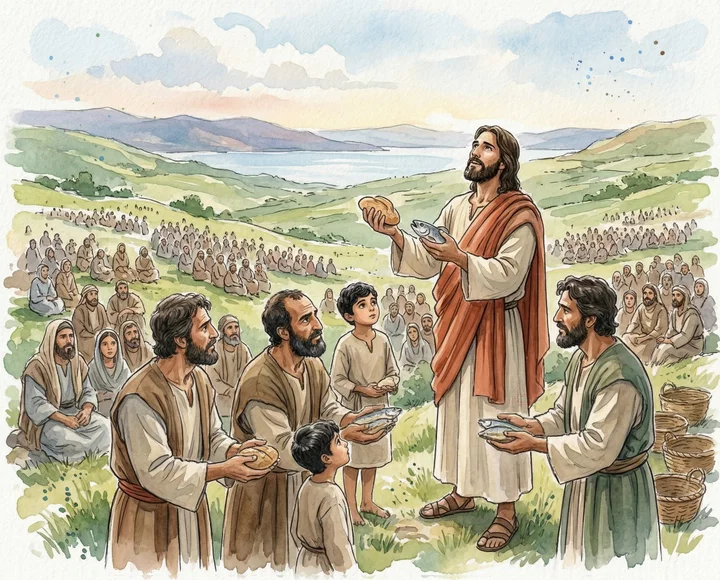
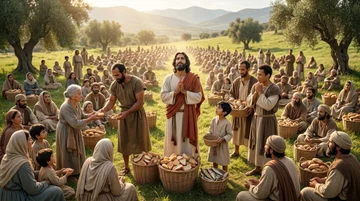
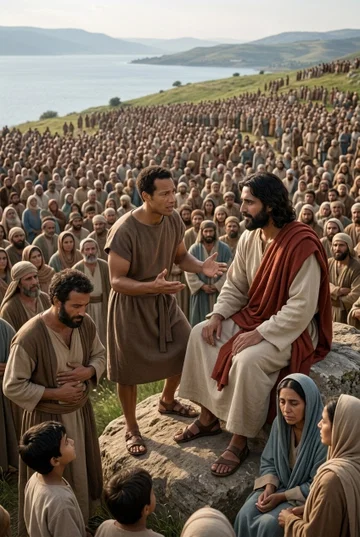
Cross-references 20 of 26
- Matthew 14:13-21
When Jesus heard of it, he departed thence by ship into a desert place apart: and when the people had heard thereof, they followed him on foot out of the cities.
A parallel account of the same feeding.
- Mark 6:30-44
And the apostles gathered themselves together unto Jesus, and told him all things, both what they had done, and what they had taught.
A parallel account of the same feeding.
- Luke 9:10-17
And the apostles, when they were returned, told him all that they had done. And he took them, and went aside privately into a desert place belonging to the city called Bethsaida.
A parallel account of the same event.
- John 6:12
When they were filled, he said unto his disciples, Gather up the fragments that remain, that nothing be lost.
Jesus tells the disciples to gather the leftover fragments so none are lost.
- John 6:35
And Jesus said unto them, I am the bread of life: he that cometh to me shall never hunger; and he that believeth on me shall never thirst.
same discourse declares Christ the bread of life
- John 6:51
I am the living bread which came down from heaven: if any man eat of this bread, he shall live for ever: and the bread that I will give is my flesh, which I will give for the life of the world.
Christ identifies himself as the living bread from heaven who gives life.
- Exodus 16:14-18
And when the dew that lay was gone up, behold, upon the face of the wilderness there lay a small round thing, as small as the hoar frost on the ground.
Jesus’ feeding is compared with God’s provision of manna in the wilderness.
- Matthew 14:21
And they that had eaten were about five thousand men, beside women and children.
same crowd of five thousand men besides women and children
- John 6:26
Jesus answered them and said, Verily, verily, I say unto you, Ye seek me, not because ye saw the miracles, but because ye did eat of the loaves, and were filled.
The crowd sought Jesus because they had eaten the loaves.
- John 6:33
For the bread of God is he which cometh down from heaven, and giveth life unto the world.
Christ identifies himself as the true bread from heaven who gives life to the world.
- John 21:12-13
Jesus saith unto them, Come and dine. And none of the disciples durst ask him, Who art thou? knowing that it was the Lord.
Jesus gives bread and fish to his disciples, recalling his feeding of the multitude.
- Mark 6:41-44
And when he had taken the five loaves and the two fishes, he looked up to heaven, and blessed, and brake the loaves, and gave them to his disciples to set before them; and the two fishes divided he among them all.
Parallel account describes the disciples distributing Christ’s provision.
- Luke 9:16-17
Then he took the five loaves and the two fishes, and looking up to heaven, he blessed them, and brake, and gave to the disciples to set before the multitude.
Parallel account presents the disciples passing on the food Jesus provided.
- Matthew 16:9
Do ye not yet understand, neither remember the five loaves of the five thousand, and how many baskets ye took up?
Recalls the feeding of the five thousand and the baskets of fragments.
- 2 Kings 4:43-44
And his servitor said, What, should I set this before an hundred men? He said again, Give the people, that they may eat: for thus saith the LORD, They shall eat, and shall leave thereof.
Both accounts show God providing food beyond what seemed sufficient.
- Psalms 78:19
Yea, they spake against God; they said, Can God furnish a table in the wilderness?
God spreads a table in the wilderness
- Psalms 78:25
Man did eat angels’ food: he sent them meat to the full.
The crowd’s need for food recalls Israel receiving manna in the wilderness.
- Mark 6:37
He answered and said unto them, Give ye them to eat. And they say unto him, Shall we go and buy two hundred pennyworth of bread, and give them to eat?
Jesus tells the disciples to feed the crowd.
- John 1:44
Now Philip was of Bethsaida, the city of Andrew and Peter.
identifies Philip as from Bethsaida, explaining the question to him
- Exodus 16:4
Then said the LORD unto Moses, Behold, I will rain bread from heaven for you; and the people shall go out and gather a certain rate every day, that I may prove them, whether they will walk in my law, or no.
Both texts concern hunger and the provision of bread in the wilderness.
Commentary
Each commentary is drawn from primary sources: the writings of Ellen G. White and Adventist pioneers and periodicals. Each commentary is separate. Its own words are not a quotation; follow the references to read the source passages.
Ellen G. White
113 sources
Philip's answer was given when Jesus tested him with the question where bread could be bought for the hungry multitude, though Jesus already knew how He would provide.Ms 156, 1902, par. 1–5Lt 304, 1906, par. 6–13DA 291.3–292.3 Looking at the vast crowd in a desert place by ordinary means, Philip judged that two hundred pennyworth of bread could give each only a little and could not be sufficient.Lt 302, 1907, par. 3–6Lt 263, 1903, par. 27–28ST May 10, 1883 His calculation was on the side of unbelief, measuring need by money and resources though he had seen Christ's works, and it calls believers to depend on Christ as sufficiency rather than human strength.Lt 304, 1906, par. 6–13Ms 78, 1902, par. 5–7DA 291.3–292.3 Christ took the meager store, blessed and broke it, and multiplied it in the hands of those who distributed it until all ate and were filled.Lt 252, 1906, par. 2–63RED 55.2Ms 64, 1910, par. 10–11 The feeding points beyond temporal food to Christ as the Bread of life sent down from heaven, whose words are to be received and shared as spiritual food for eternal life.FE 455.3–456.1Lt 9, 1902, par. 1–7Lt 88, 1900, par. 2
Feeding Setting and Crowd
Philip's answer belongs to the feeding of the multitude after Jesus went over the Sea of Galilee and sat with His disciples on a mountain with the Passover nigh, when a great multitude followed Him because they saw His miracles on the diseased.Ms 156, 1902, par. 1–5DA 364.2DA 364.1 The question Whence shall we buy bread that these may eat was followed by Andrew pointing to a lad with five barley loaves and two small fishes, after which Jesus had the men, about five thousand, sit down and fed them with thanksgiving as much as they would.Ms 156, 1902, par. 1–5 The crowd was five thousand men besides women and children, near the time of Passover.DA 364.2DA 364.1 It is described as about ten thousand persons including five thousand children, and as above ten thousand persons fed from a few small loaves and fishes.9MR 31.1–2Lt 9, 1876, par. 1–4DA 809.3 They were gathered on a mountain-side and on a beach by the Sea of Galilee near Capernaum, where much of His ministry was passed and many miracles were done, within sight of where the disciples later gathered.DA 809.3
Jesus had retired to a secluded place for rest with His disciples, but the people came and still came by land and boat until a great multitude waited.DA 364.2 Though interrupted and robbed of His rest He was not impatient but was moved with compassion toward them because they were as sheep not having a shepherd, receiving no help from the priests and rulers.DA 364.2 Leaving His retreat for a convenient place, He ministered to their greater necessity, teaching them the way of salvation as the healing waters of life flowed from Him.DA 364.2 They had followed Him on foot from place to place until weary and hungry.Ms 124, 1909, par. 21
The people were faint and hungry after following and listening all day in a desert place until sunset, without food all day.Ms 188, 1907, par. 10ST May 10, 1883ST May 20, 1886ST Jesus pitied the weary and hungry thousands who followed to hear His teaching, and He knew their hunger.Ms 130, 1909, par. 4–6Ms 124, 1909, par. 21 He had compassion on them and would not let them go home hungry or faint on the way.Ms 188, 1907, par. 10ST May 10, 1883ST May 20, 1886ST Hungry listeners could not fully benefit from His teaching, for their physical needs mattered to Him while they gathered to hear Him.Lt 9, 1902, par. 1–717MR 252.1 His care for their practical needs was shown in miraculous power that supplied food until everyone was satisfied and all were fed.Lt 9, 1902, par. 1–7Ms 188, 1907, par. 1017MR 252.1Ms 130, 1909, par. 4–6RH Jan 21, 1909 He would not send them away hungry to return home unrefreshed, unlike His refusal in the wilderness to work a miracle to satisfy His own hunger.ST May 10, 1883ST May 20, 1886STST Mar 1, 1877
The feeding stands together with Christ walking on the water and His declaration to His hearers that He is the Bread of life, a saying and teaching that caused some of His disciples to turn from Him and walk no more with Him.14MR 335.1–39MR 242.19MR 32.3–5Lt 13, 1876, par. 1–3 It was a wonderful miracle wrought on the barren shore, and the multitude fed there left Him on that shore knowing no boat was left for Him to depart.ST Dec 29, 1887 On the following morning they returned to the spot where they had last seen Him, the miracle having taken place the preceding day.ST Dec 29, 18873RED 63.2 News of it spread far and near and people arrived in large numbers by land and water, coming looking for Jesus the next morning.ST Dec 29, 18873RED 63.2
The same breaking and dividing of bread and fish on the mountainside identified Jesus when after His resurrection He fed the seven disciples on the shore.6RED 46.1–2DA 810.4 With fire and food already present, He bade them bring some of the fish just caught and come and dine, then broke the food and divided it among them.DA 810.4 That manner and action brought the earlier feeding distinctly to their minds and made Him known and acknowledged by all seven.6RED 46.1–2DA 810.4 They were left in silent and mysterious awe as they gazed upon the risen Saviour, a meal also recalled when He later shared bread and fish after His resurrection.6RED 65.3–66.1ST Oct 3, 18786RED 46.1–2DA 810.4 The later miraculous draught of fishes made the earlier feeding more impressive to teach that, though deprived of His personal companionship and of sustenance from their own fishing, the resurrected Saviour still cares for and provides for them while they do His work.6RED 46.1–2
Philip's Tested Calculation
Jesus asked where bread could be bought to feed the crowd in order to prove and test Philip and the disciples, though He Himself already knew what He would do and how He would provide.Ms 156, 1902, par. 1–5Lt 304, 1906, par. 6–13DA 291.3–292.3ST May 10, 18832SP 261.2–262.2 The question came after going over the Sea of Galilee and sitting with the disciples on a mountain with the Passover near, when a great multitude followed because they saw miracles on the diseased, and it was followed by Andrew pointing to a lad with five barley loaves and two small fishes and then by seating about five thousand men and feeding them with thanksgiving as much as they would.Ms 156, 1902, par. 1–5 Philip answered that two hundred pennyworth of bread is not sufficient for the great company, that every one might take only a little, judging the need by ordinary means, available money, and the size of the vast crowd in a desert place where bread could not be obtained.Lt 302, 1907, par. 3–6ST May 10, 18832SP 261.2–262.2ST May 10, 18833RED 54.2 His answer measured the need by the money available and focused on the size of the crowd and the apparent impossibility of providing enough.Lt 304, 1906, par. 6–13ST May 10, 1883ST May 10, 1883
His answer highlights the apparent insufficiency and practical impossibility before the miracle, with only a few loaves and two small fishes available and no possibility of buying enough for each to have even a little.Lt 302, 1907, par. 3–6Ms 130, 1909, par. 4–6Lt 263, 1903, par. 27–28Ms 124, 1909, par. 216T 263.1 The contrast stands between the meager store and the vast assembly, the small supply that could not feed the multitude set against the food that afterward did not diminish but increased as it was distributed until all were satisfied.Ms 130, 1909, par. 4–63RED 55.26T 263.1 Human calculation counts feeding the multitude impossible, measuring need by money and resources and looking over the sea of heads to judge it beyond their means.ST May 20, 1886ST May 10, 1883ST May 20, 1886 No human power could create from five barley loaves and two small fishes food sufficient to feed thousands of hungry people at sunset in a desert place after they had been all day without food.ST May 20, 1886ST May 20, 1886
Philip answered on the side of unbelief with no faith to meet the need, though he had seen Christ's works and felt His power.DA 291.3–292.3 Sincere yet slow of heart to believe and weak in faith, his failure to trust fully grieved Jesus.Lt 304, 1906, par. 6–13DA 291.3–292.3 The chapter to which the estimate belongs calls believers to depend on Christ rather than on human strength or wisdom and to look to Jesus as their sufficiency.Lt 304, 1906, par. 6–13Ms 78, 1902, par. 5–7 The shortage placed Jesus where provision depended on God and illustrates dependence on God in need.DA 368.2–3DA 369.1 People lose heart when they see great need and scant resources, while Christ's command to provide is backed by divine power.DA 368.2–3DA 369.1
Christ's Compassionate Provision
The small supply was brought to Him, and He commanded the men numbering about five thousand to sit down on the grass, gave thanks, blessed and broke the bread, and placed pieces of bread and fish in the disciples' hands to carry to the hungry and return for more until all ate and were filled.Lt 252, 1906, par. 2–6Ms 156, 1902, par. 1–5Ms 197, 1907, par. 1–4Ms 130, 1909, par. 4–6Ms 124, 1909, par. 21 A hymn was sung as He commanded the people to sit down, and the food was divided and scattered to the multitudes until all were satisfied.Ms 197, 1907, par. 1–4Ms 130, 1909, par. 4–6Ms 124, 1909, par. 21 He then commanded gathering up the fragments so nothing would be lost, and twelve baskets full were taken up, amounting to five or seven bushels.Lt 252, 1906, par. 2–6Ms 188, 1907, par. 10Ms 197, 1907, par. 1–4Ms 130, 1909, par. 4–6Ms 124, 1909, par. 21
The food did not diminish as it was distributed but multiplied in distribution, the loaves multiplying and the fish increasing in the hands of those who distributed them.Lt 252, 1906, par. 2–63RED 55.2Ms 64, 1910, par. 10–11ST Aug 19, 1897Ms 71, 1911, par. 5–8 What looked by human means a meager store far too little for the vast assembly became in His hands enough for all, with supply continuing as He kept giving until everyone was satisfied.3RED 55.2Ms 64, 1910, par. 10–11ST Aug 19, 1897Ms 71, 1911, par. 5–8Ms 182, 1907, par. 21–23
He who would not work a miracle to satisfy His own hunger in the wilderness would not allow the multitude, faint after a day without food, to suffer for lack of food or return home unrefreshed to faint by the way.Lt 252, 1906, par. 2–6ST May 20, 1886ST Mar 1, 1877 He works intelligently to meet necessity and satisfy hunger, never to exalt His power or to add glory to His disciples, and in providing what was needed He depended on His heavenly Father.Lt 252, 1906, par. 2–6ST Aug 19, 1897
This mighty miracle proved He is indeed the Messiah and divine, no human power being able to create from five barley loaves and two small fishes food sufficient to feed thousands bounteously.ST May 20, 18863RED 56.1Ms 41, 1897, par. 14–20 It showed omnipotent power and beneficence, the Father's works done through Him, and Jesus as the world's Redeemer with power to provide abundantly.ST May 20, 1886RH Jan 7, 1909ST Aug 12, 1897Ms 41, 1897, par. 14–20 It was evidence heaped upon evidence sufficient to convince any mind open to evidence, crowning growing conviction from His pure doctrine, healing, comforting and tender benevolence with entire belief, so that thoughtful and candid witnesses took exalted views of His character and office while those whose understanding was closed heard only with their ears and had no faith.ST May 20, 1886Ms 57, 1898, par. 22–25
He is the same One who supplied bread and clear flowing streams in the wilderness and who fed one hundred men in Old Testament times, the Coming One who declared Before Abraham was, I AM, who walked earth in lowliness and poverty yet is greater than Moses.Ms 114, 1899, par. 1–3 By the grace of God upon it and the touch of His hand the small portion that looked insufficient becomes all-sufficient, for God's hand multiplies it an hundredfold and increases scanty provision until sufficient for all, able from His resources to spread a table in the wilderness for more than a million people.Ms 114, 1899, par. 1–3
The power that multiplied the loaves and supplied bread for the multitude works continually for human good in the growth of seed and the harvest, through rain, air, sunshine, and human labor to feed millions.ED 107.3DA 367.3 Human work in tending grain and making bread does not replace this divine agency.ED 107.3 People should recognize God's agency in their daily food, give Him the glory, and use His gifts as blessings rather than for selfish ends.ED 107.3DA 367.3
Bread of Life Doctrine
John 6 reveals Christ as the Bread of life and the living bread sent down from heaven who gives life to the world, and the feeding of the great multitude points beyond temporal food to His greater gift of spiritual food for eternal life.FE 455.3–456.1Lt 9, 1902, par. 1–7Lt 88, 1900, par. 2Ms 68, 1897, par. 9 In that chapter Christ's words are spirit and life, and believers find lasting satisfaction in Him.FE 455.3–456.1Ms 68, 1897, par. 9 The whole chapter is very instructive yet only faintly understood, containing most precious and important lessons for all being educated in schools and wonderful truths to be brought into practical life by those who want an education that will endure through time and eternity, that students may take in Christ's words to understand their privileges and what He is to them individually and what advantage it is to eat His words, realizing He Himself is the great center of life.Ms 68, 1897, par. 9
The miracle serves as a figure and forceful picture of His work: as ordinary bread gives the body health and strength, so faith in Christ and obedience to His teaching give the soul spiritual vigor, strength, and everlasting life.2SP 282.1–283.24RED 95.1 Studying the Word means eating it by receiving and assimilating Christ's words until they become part of oneself, bringing revealed principles home to the soul, keeping the precepts, bringing truths into daily life, grasping the mysteries of godliness, and exercising the whole life in understanding and practice.CH 400.4–401.1Lt 241, 1903, par. 9–10Lt 93, 1901, par. 11Ms 63, 1890, par. 5–7Ms 68, 1897, par. 9 That eating is eating the flesh and drinking the blood of the Son of God, and it requires being diligent students of the Word and making its divine principles a part of the life, with continual growth in grace and with the nourishment becoming part of daily life in order to understand and value truth.Lt 241, 1903, par. 9–10Lt 93, 1901, par. 11Lt 99, 1904, par. 4–5
God has revealed in His Word what is necessary for salvation, and life comes by living by every word He has revealed rather than leaving it for human suppositions, with His revealed Word guiding life.CH 400.4–401.1Lt 241, 1903, par. 9–10 The Bible contains the heavenly bread by which mind and spirit are built up, for men and women are built up spiritually from the food they give the mind, so time must not be spent on books and magazines that lead the mind astray and hinder growth, and God must be asked for clearness of understanding to comprehend the chapter and its important statements about the bread sent down from heaven.CH 400.4–401.1Lt 43, 1905, par. 4 As the bread of life the Word of God represents the body and blood of the Son of God, not addressing the understanding alone as a book of mathematical formulas addresses the intellect, but aiming at the heart, addressing the moral nature, taking possession of the will, casting down imaginations and every high thing exalting itself against the knowledge of God, and bringing every thought into captivity to obedience.Lt 5, 1898, par. 13–15
Eating Christ's flesh and drinking His blood is the divine antidote for the sin of the whole world plainly expressed in the chapter as God's will for His people, by which a believer has eternal life and will be raised up at the last day.RH Jun 18, 1901 Even if he dies as Christ died the Saviour's life is in him, for his life is hid with Christ in God, made one with Him in this present life to be one with Him throughout all eternity with life more abundantly, and faith in the Son and the efficacy of His blood are the means of eternal life and protection from Satan's power through receiving and obeying His life-giving words.RH Jun 18, 1901Lt 263, 1903, par. 27–28 The bread points to the living Word and Christ's living oracles as life-giving spiritual nourishment and spiritual food, which brings no one who receives it into spiritual hunger, while the insufficiency of ordinary bread belongs to this teaching about the need for the bread of life.21MR 44.1–2Lt 40, 1899, par. 17–18
Eating and drinking Christ is tasting that the Lord is gracious, an actual experience belonging to everyone who names Christ, meaning true conversion and the new birth learned like newborn babes desiring the sincere milk of the Word that they may grow thereby, obtained by opening the mind to the entrance of God's Word with determination to practice it, which brings light because the Word gives understanding to the simple.Ms 68, 1897, par. 19 The chapter also defines the righteousness of Christ necessary to be clothed with the wedding garment and made fit for the marriage of humanity with divinity.Ms 13, 1899, par. 1–2 The education of the chapter shows the importance of feeding upon Christ's words as His very flesh and blood, and teaches youth about the law of Jehovah and the penalty of transgression, and that God accepts the ransom made by the Saviour in their behalf if they are obedient to that law.Ms 202, 1898, par. 2 Feeding on the rich manna of heaven gives spiritual strength and comfort, creates soul hunger for God, and presses the choice of whom to serve as a question of life or death requiring an undivided heart, while keeping the transactions of the theater before eyes and ears takes away that hunger, closes the heart to rays of light from God's throne, and leaves no peace, no joy, no hope, with dying assurance and dying love for Bible religion.11MR 340.3
Receiving to Impart
Christ used the circumstances of the hungry multitude to become a field preacher, at times sitting on a hill in the chair of state as a teacher having authority, not sitting at ease, to give the people the Word which is the bread of life.21MR 138.2–3Lt 252, 1906, par. 2–6 He fed them not by giving the Scriptures but by a miracle enlarging a small substance of temporal food after giving thanks, until the loaves multiplied in distribution and the fish increased in the hands of those who distributed them and five thousand were satisfied and the fragments were gathered up.21MR 138.2–3Lt 252, 1906, par. 2–6 Temporal food supplied to the hungry opens the way to place Him in the chair of instruction, and that occasion would be long remembered, with the distribution of grace in words and the free-will offering of enlarged food preparing His way in many places.21MR 138.2–3Lt 252, 1906, par. 2–6
He brought His disciples forward before the large numbers to give them reputation, so that many would recognize in their workings that they worked as Christ had worked, and His deeds of mercy open a door for His disciples.21MR 138.2–3Lt 252, 1906, par. 2–6 God's blessing rests on the food and on the disciples as they break the bread of life to the necessities of hungry souls.Lt 252, 1906, par. 2–6 The disciples received food from Christ and distributed it to the people, showing that Christ is the source of what His followers need and that they are channels and appointed means of communication between Him and the people, receiving from the Father through Him to pass on.ST Aug 19, 1897ST Jan 22, 1902MH 49.1Lt 7, 1901, par. 1–3ST Apr 24, 1901 They are to rely fully on Him for their supplies, for they can impart spiritual nourishment only as they receive it from Him.ST Aug 19, 1897ST Jan 22, 1902
They can give only what they receive from Christ, and as they continue to share they continue to receive, with the gift increasing as it is shared.Lt 252, 1906, par. 2–6DA 369.2–4ST Jan 22, 1902Lt 7, 1901, par. 1–3 All however weak are to feed souls needy of instruction, speak the truth in love, retain the impression made on the heart to repeat to others, and gather all Christ's words as the bread of life and give them to the multitude.Lt 252, 1906, par. 2–6 Christ never wrought a miracle to exalt His power or to add glory to His disciples, but works intelligently to meet necessity and satisfy hunger.Lt 252, 1906, par. 2–6
The feeding showed the disciples their work as His representatives to give the people the bread of life, and they were not to send anyone away unfed.RH Aug 11, 1910COL 140.4–5 Their human resources would often prove insufficient when facing people hungry for spiritual food and feeling helpless, so they must seek spiritual food from God in order to have something to give.RH Aug 11, 1910COL 140.4–5 They should make it possible for seekers to hear the Word of life and should not neglect them when they are weary or hungry, finding practical ways to help and remove obstacles that make the way burdensome.ST Aug 12, 1897 Those united to Christ receive the bread of life from Him to share with others, to the glory of Him rather than the instruments, trusting Him fully to provide and sustain those who serve.MH 49.1ST Apr 24, 1901ST Aug 19, 1897
Judas assisted in distributing the food to the hungry multitude and helped bring the sick and suffering to Christ, seeing the benefit it was in his power to impart to others and feeling the satisfaction that comes in service and in seeing the relief, joy and gladness that come to human hearts through healing power, which might have taught him Christ's methods.DA 718.2Ms 106, 1903, par. 46 But blinded by his own selfish desires and his fixed idea that Christ would reign as king in Jerusalem, he was first to take advantage of the enthusiasm excited by the miracle of the loaves and set on foot the project to take Christ by force and make Him king, with high hopes and bitter disappointment.DA 718.2Ms 106, 1903, par. 46Ms 28, 1897, par. 10–12 Christ rebuked that move with greater authority than He usually used, and that rebuke provoked Judas and left him dissatisfied and more separated in feeling and love from Jesus.Ms 28, 1897, par. 10–12
Stewardship and Human Response
Though He had all the resources of infinity at command and could make such a feast whenever He chose, Christ would not waste a fragment but commanded that the fragments be gathered up so nothing was lost, teaching economy, thrift and faithful stewardship for all time.Lt 252, 1906, par. 2–6STB 772.1–2ST Dec 15, 1909CH 283.1–2Ms 3, 1912, par. 4–5 The careful gathering of what remained after five thousand were satisfied shows that God's gifts are not to be wasted, that careful use of provisions belongs to faithful stewardship, and that what remains is to be shared with others in need.ST Dec 15, 1909CH 283.1–22T 292.1 Even when He miraculously provides for great need, the food left over is not to be wasted, a lesson in economy and thrift in difficult times and in times of need.STB 772.1–2Ms 3, 1912, par. 4–5
The lesson means more than saving food and teaches no extravagance in anything, requiring all, and especially those in leading positions and in institutions, to waste nothing and gather up what remains that nothing be lost.Ms 197, 1907, par. 1–4CH 283.1–2 It calls for making sanitariums plain and simple yet with room to care for people and impress them, so that every act of giving leaves a lasting impression of truth on human minds, especially on those healed and seeing the miracle.Ms 197, 1907, par. 1–4 Studied as the method for food work, the example calls for economical work with simple, inexpensive preparations and warns against letting selfish private interests obstruct it.Lt 302, 1906, par. 5
As the food multiplied in passing from Christ to those who received it and the remaining fragments were gathered at His direction so nothing would be lost, so truth multiplies as it is shared, which is why even small pieces of literature carrying truth should be preserved and distributed.Ms 127, 1903, par. 10 Gifts that provide food for people in need also carry the bread of life for their souls, joining economy and care for the hungry.Ms 139, 1898, par. 21
Connection with Christ calls a person to do his best however small it is and then to cast the helpless soul upon Jesus as Saviour and Redeemer with a faith that works by love and purifies the soul.Ms 130, 1909, par. 4–6 When human helplessness is exposed, with only a few loaves and two small fishes and no possibility of buying enough for each to have even a little, Christ has the little brought to Him, divides it, commands it to be given until all are satisfied, and then commands the fragments amounting to five or seven bushels to be gathered so nothing is lost.Ms 130, 1909, par. 4–6 People should share what they have, considering those who lack the truth, and those who dedicate themselves to God may receive the Holy Spirit to share with others in need.Ms 180, 1907, par. 27–28Ms 186, 1907, par. 8–9
Means at hand are not the measure of advance in the work, for a very meager supply measured against the need of the great multitude still fed the multitude until all ate and were filled.Ms 38, 1895, par. 58–60 Scattered supply placed in missionary work will be multiplied by God as it is imparted to others, so faith must lay hold upon God and expect success, doing what the hands find to do, practicing economy, binding about wants, saving something from a meager store to sustain God's cause, and planning and working in faith to diffuse the gospel over the whole earth instead of stopping work for lack of means.Ms 38, 1895, par. 58–60
What appears insufficient and far too little by human judgment can become more than sufficient and abundant in the Lord's hands, for Jesus can bless and multiply what is scanty until it meets great needs and leaves something to share with others.6T 467.1Ms 66a, 1900, par. 30–31Lt 121, 1904, par. 14–16 Offerings used in faith He will enlarge so many can be reached with the bread of life, and money gifts for soul-saving medical missionary work at Glendale and Paradise Valley, sent in with thanksgiving and prayer and put to the best use, will be multiplied and blessed so God enables His people to feed multitudes starving for the bread of life.6T 467.1STB 148.2–3STB 119.3–4 The same provision gives wisdom, skill, talent and ingenuity to those unselfishly in line with Him to devise means to feed the hungry, clothe the naked, teach the ignorant, and experiment with the wholesome productions of the earth to manufacture necessary, wholesome, inexpensive foods to be sold to the poor at as low a rate as possible, a provision more needed in the Southern states than in any other part of America and to be sought by earnest prayer, with like blessing on gifts for Denmark and Norway and for European institutions.STB 148.2–3Ms 66a, 1900, par. 30–31Lt 27, 1902, par. 17–19
What people possess, like food distributed among a multitude, is entrusted to them by God, and Jesus as heavenly Provider of all foods shows that the food business to supply necessity is one of the Lord's own instrumentalities.Ms 81, 1902, par. 14Ms 156, 1902, par. 12 He will not leave His people in ignorance but will teach them how to prepare the best foods for all times and occasions.Ms 81, 1902, par. 14 As source of power and blessing who provides food for the crowd that followed Him to hear instruction, Christ's example guides those carrying out God's work.Lt 90, 1900, par. 6–7
The miracle acted out before them, when weary and hungry thousands who had followed on foot were fed from a few loaves and fishes and many baskets full were taken up, gives an example of the simplicity of true godliness for leading children along and educating them to know God.Ms 124, 1909, par. 21
His pure and simple doctrine sinking into hearts, His healing of the sick and comforting of sorrow, and His tender benevolence winning hearts had nearly convinced the people of His divinity, and feeding them bounteously rather than sending them away hungering crowned their growing conviction with entire belief.ST May 20, 1886 Thoughtful and candid witnesses took exalted views of His character and office from evidence heaped upon evidence sufficient to convince any mind open to evidence, while those whose understanding was closed heard only with their ears and had no faith.Ms 57, 1898, par. 22–25 Yet such display of compassion, love and benevolence did not ensure belief, for Jewish rabbis and priests closed their eyes to the light and in unbelief still demanded a sign.ST Jan 11, 1899Ms 112, 1898, par. 7 Those miraculously fed who later asked for a sign wanted Him to repeat the miracle so they could see how the food was increased and learn a method for their own benefit, treating the feeding as a wonder to reproduce rather than accepting its lesson and believing in Jesus as the Son of God and the Bread of life.Lt 73, 1901, par. 16–1813MR 219.4–220.1
Many sought Him not because they saw the miracles but because they did eat of the loaves and were filled, coming only for temporal advantages and hoping for further material benefit without understanding the spiritual meaning.Lt 17, 1897, par. 6–8DA 383.2–384.1 Fresh evidence of power did not persuade those who wanted an excuse to avoid the self-denial involved in following Him.Ms 50, 1898, par. 4–8 Christ made the miracle the occasion of His sermon on the bread of life, and when they heard the conditions of eternal life and entrance into the kingdom of God many went back and walked no more with Him, His popularity began to wane, and He refused to become their king.Ms 9, 1898, par. 31–32Lt 17, 1897, par. 6–8
Sources
Pioneers and periodicals
85 sources
Philip answered Jesus that even bread costing two hundred pence would not give so great a crowd more than a small portion each, judging the need by the money and means at hand as an overwhelming impossibility.ST Mar 15, 1905ST Jun 6, 1900 Two hundred pence was a large sum of about thirty-two dollars, likely all the money the disciples had together.ST May 20, 1886ST Jul 26, 1905 Jesus had asked where bread could be bought not for counsel but to prove Philip and to give the disciples opportunity to exercise faith, for He already knew what He would do.ST Jun 6, 1900RH May 29, 1900ST Jun 6, 1900 From the standpoint of human reckoning the estimate was correct, for no human power could make five barley loaves and two small fishes feed thousands, yet in Christ's hands the scant supply multiplied as it was broken and distributed until more than ten thousand were fed to fullness with twelve baskets left over.ST May 20, 1886ST May 20, 1886ST Dec 22, 1887ST Mar 30, 1904 The lack of earthly bread thus points beyond itself to Jesus as the Bread of Life, whose flesh given for the life of the world must be received daily by faith for eternal life.RH Jun 18, 1901ST Sep 1, 1881ST Sep 17, 1912ST Nov 3, 1898
Words and Setting
The word rendered penny denotes a Greek coin worth about eight and a half pence, or nearly seventeen cents.ST Apr 5, 1905ST Feb 15, 1905 Two hundred pennyworth is therefore about thirty-two dollars' worth of bread, stated as two hundred shillings' worth, probably all the money in the disciples' treasury, yet still a large sum whose size adds magnitude to what followed.ST May 20, 1886ST Jul 26, 1905ST Feb 15, 1905 Philip calculated that even that amount could not give everyone in the crowd more than a little, a small portion or meager morsel for each.ST May 20, 1886ST Jul 26, 1905ST Feb 15, 1905
The event took place with Jesus seated with His disciples on a mountain or hillside in Galilee near Bethsaida by the Sea of Galilee, in a desert place away from towns where food could be bought.ST Feb 15, 1905STST May 13, 1880RH May 27, 1858 The Passover was at hand in the springtime, when the land was at peace so that a quiet gathering of five thousand men besides women and children was possible.ST Feb 15, 1905ST Aug 13, 1902ST Jan 13, 1914 The bread afterward multiplied on that hillside from a boy's basket by miracle.STST May 13, 1880
A great multitude, five thousand men besides women and children, more than ten thousand people in all, had followed Him because of His signs upon the sick.RH Jan 21, 1909ST May 20, 1886ST Feb 15, 1905 They had been with Him all day without food until sunset, forgetting their own comfort in their desire to hear Him.ST May 20, 1886STST Mar 1, 1877ST Mar 22, 1899 Jesus would not have them return home unrefreshed or faint by the way, and compassionately provided for those who sought Him even when they saw no earthly support.ST May 20, 1886STST Mar 22, 1899 Human reckoning counted the provision insufficient to give even a little to each of the hungry thousands on the verdant hill.ST May 20, 1886ST
Jesus asked Philip where bread could be bought to prove him and to test the disciples' faith and give opportunity to exercise faith.ST Jun 6, 1900RH May 29, 1900ST Jun 6, 1900ST May 20, 1886ST Feb 15, 1905 He Himself already knew what He would do, was directed from heaven in all His words and work, and did not need human counsel.ST May 10, 1883ST May 20, 1886ST Feb 15, 1905ST Feb 15, 1905 The shortage presented as an overwhelming obstacle did not limit Him.ST Jun 6, 1900RH May 29, 1900ST Jun 6, 1900
Jesus properly turned to Philip because Philip's home was in Bethsaida, near where they were.ST Feb 15, 1905 The account is told with public minuteness of detail about time, place, and circumstances, with the time of year and the place where it was done and many other circumstances connected with it, not done in a corner but in public and in a public manner.RH Feb 4, 1862 That minuteness put it into the power of the five thousand men and myriads of their contemporaries to have exposed the fraud if it had been one, and bears every mark of truthfulness.RH Feb 4, 1862 Even hostile scribes who came to Bethsaida to catch Him tarried and ate of the bread and fishes, and five thousand men bear witness to the astonishing miracle from His bounty.ST Nov 1, 1910 The multitude fed on the barren shore left Him there knowing no boat was left for Him to depart, and on the following morning returned to the spot where they had last seen Him while news spread far and near, and the beach where more than ten thousand were fed with a few small loaves and fishes remained within sight of the disciples.ST Dec 29, 1887ST Nov 4, 1886
Human Estimate of Need
Philip looked at the size of the crowd and judged by the money and resources at hand that even bread costing two hundred pennyworth would not give each person more than a little or small portion.ST Mar 15, 1905ST Jun 6, 1900RH May 29, 1900ST Jun 6, 1900 His calculation that two hundred shillings' or denarii worth of bread could not supply even a small portion to everyone presented the need as an overwhelming obstacle and a practical impossibility.ST Mar 15, 1905ST Jun 6, 1900RH May 29, 1900ST Jun 6, 1900ST May 20, 1886 Jesus had asked where bread could be bought in order to test Philip and give him opportunity to exercise faith and trust, while He Himself already knew what He would do and the shortage did not limit Him.ST Mar 15, 1905ST Jun 6, 1900RH May 29, 1900ST Jun 6, 1900ST May 20, 1886 The answer sets this human limit over against Christ's limitless ability to provide, and makes the disciples His co-laborers in the work.ST Mar 15, 1905RH May 29, 1900
Philip's estimate was quite correct from the standpoint of human reckoning, and the largeness of the sum of two hundred pennyworth, or thirty-two dollars' worth, adds magnitude to the miracle.ST May 20, 1886ST May 20, 1886ST Dec 22, 1887ST Feb 15, 1905 No human power could create from five barley loaves and two small fishes food sufficient to feed thousands of hungry people, for the small store could scarcely have fed twenty people, let alone five thousand.ST May 20, 1886ST May 20, 1886ST Dec 22, 1887ST Dec 22, 1887 Jesus did not ask because He needed human counsel, for He was directed from heaven in all His words and work, but to give opportunity for the disciples to realize that spiritual possibilities cannot be reckoned by physical quantity or temporal values, using the people's physical needs to draw their attention to the spiritual food He desired to give.ST May 20, 1886ST Feb 15, 1905 Human calculation counts feeding the multitude impossible, yet Christ, who would not work a miracle to satisfy His own hunger in the wilderness, would not send them away hungering or allow them to suffer for lack of food and faint by the way.ST May 20, 1886ST May 20, 1886
His response represents the discouragement that can arise before a great need and the powerlessness felt with only five loaves and two fishes in a deserted place.RH Feb 26, 1901ST Sep 18, 1893RH Dec 23, 1902 It shows human absolute incompetence and nothingness, the small sum Philip named being all that people can produce toward the need.ST Sep 18, 1893RH Dec 23, 1902RH Dec 23, 1902 God always brings people face to face with their own incompetence and with almost insuperable difficulty before He shows what He is going to do, so that they learn to trust Him more and He has opportunity to reveal Himself and the Father.RH Dec 23, 1902RH Dec 23, 1902 Philip's reckoning means taking out pencil and paper to figure human resources, going round with a hat for a collection, running to strong and wealthy friends, sitting in despondency wringing the hands, murmuring against Christ for bringing the need, or complaining with Moses about carrying the people as a nursing father, instead of turning a sunny face back to Christ saying He has a plan and the business and responsibility are His and He must tell what to do.RH Dec 23, 1902RH Dec 23, 1902 The teaching is to stand still hand in hand with Christ before difficulty, because He has a reserve and will do what is infinitely satisfactory and make a way by His outstretched hand, so that gladness follows having come into the difficulty, and when the world sees how Christ can use such poor resources as children with barley loaves and fishes it gains greater and more adoring conceptions of what Jesus is.RH Feb 26, 1901ST Sep 18, 1893RH Dec 23, 1902RH Dec 23, 1902
Judas of Kerioth estimated in shekels what the food was worth at Bethsaida where five thousand men besides women and children were fed with bread and fishes coming from the hands of Jesus.ST Oct 25, 1910 He worked furiously helping supply the multitude, then reckoned how much money would have come to them if they had sold the food to the people.ST Oct 25, 1910 He took the miracle as proof that Jesus could create food for an army to go up against the Romans, and on that very day he headed the turbulent throng that sought to crown Jesus at Jerusalem.ST Oct 25, 1910
Christ's Miraculous Provision
Jesus would not send the hungry crowd away unrefreshed or let them faint on the way home after they had been all day without food, but took action to feed them rather than dismiss them hungry.ST May 10, 1883ST May 20, 1886STST Mar 1, 1877 He took the five thin barley loaves and two little fishes brought by a lad, a lunch prepared by his mother, the woman who made the loaves serving a far greater purpose than she could have known.ST May 29, 1884 He commanded the people to be arranged in groups of fifties on the grass, looked up to heaven, invoked God's favor upon the coarse food, broke it and gave it to the disciples and they to the multitude. Unlike His refusal to work a miracle to satisfy His own hunger in the wilderness, He would not allow the multitude to suffer for lack of food or return home unrefreshed.ST May 20, 1886ST Mar 1, 1877
The food multiplied as He broke, multiplied as the disciples broke from the pieces they held, and multiplied as the people received and ate, till five thousand men plus unnumbered women and children out in the Syrian country away from towns were fed to fullness. Human reckoning had counted the provision insufficient for giving even a little to each, yet the five barley loaves and two small fishes were amply spread so the hungry thousands ate their fill.ST Aug 19, 1897 The exact way the loaves were multiplied is hidden, as all creative acts are, but the meaning is plain that He satisfies desire.ST Mar 30, 1904ST Apr 29, 1908RH Jan 4, 1912 He created bread to feed the hungry multitude, showing His power to provide for their needs and that He could feed an army with bread.ST Apr 29, 1908RH Jan 4, 1912
The event is a true miracle of creation by the creative word, not to be denied or explained away, revealing Christ's creative power by which the small amount of bread was multiplied until the multitude was satisfied. It shows Christ is the source of ordinary food as well as miraculous provision, for the food produced through sunshine, rain, planting, and harvest ultimately comes from Him, and the bread multiplied at His command shows His power over its substance.RH Feb 8, 1906 Bread made instantly by Christ and bread produced over time are alike miracles displaying the same divine power working by different methods, though one is unusual and the other commonly overlooked.RH Apr 9, 1901ST Mar 31, 1898 The multiplying of the loaves thus explains the continuing yearly provision of food for the world as God's provision.ST Dec 24, 1902
Blessings in His hands increase, for Jesus took what was barely enough for the twelve and fed everyone abundantly, with more left over, showing God's power multiplies responsive human effort.ST Oct 12, 1904 The multitude ate abundantly with the last of the five thousand fed as fully as the first, and the fountain as full after millions have drunk as at the first.ST Mar 30, 1904 Twelve baskets of fragments remained for the twelve disciples, more than twelve times the original quantity and far more than the original store, which could scarcely have fed twenty people.ST Dec 22, 1887 The boy's provisions would have filled only a corner of one of the twelve baskets of remnants, and their gathering was a lesson in economy that nothing be lost, teaching that even plain-food scraps should not be wasted.RH Mar 16, 1905ST Mar 30, 1904
This mighty miracle proved He is indeed the Messiah and divine, since no human power could create from five barley loaves and two small fishes food sufficient to feed thousands of hungry people.ST May 20, 1886ST Dec 22, 1887 It showed omnipotent power with beneficence and the Father's works being done through Christ with humanity and divinity combined, His godlike benevolence sealing His divine mission and His power to provide abundantly and care for practical needs.RH Jan 21, 1909RH Jan 7, 1909 His pure and simple doctrine that sank into hearts, His healing of the sick and comforting of sorrow, and His tender benevolence and pity that won hearts had already nearly convinced the people of His divinity, and the feeding crowned their growing conviction with entire belief.ST May 20, 1886 Yet the crowd focused chiefly on being fed and satisfied rather than on the kindness, pity, and power shown, and Jesus cared that the hungry crowd could not benefit fully from His teaching unless He miraculously provided food for them.RH May 30, 1871ST Mar 14, 1911
Bread of Life Teaching
The lack of earthly bread points to Jesus in His Passover teaching as the Bread of Life, given when the Jews assembled to celebrate the Passover by eating the flesh of the lamb to remember the Lamb of God and their protection when the firstborn of their enemies were slain in Egypt, with the blood commanded upon their doorposts as a sign of safety representing the blood of Christ shed for the sins of the world.ST Sep 1, 1881 The bread He gives is His flesh given for the life of the world, and eating His flesh and drinking His blood is the divine antidote for the sin of the whole world by which a believer has eternal life and will be raised up at the last day.RH Jun 18, 1901ST Sep 1, 1881 All who by faith so eat and drink He has power to finally raise from the dead, giving a well-founded hope of the resurrection to immortal life in the kingdom of God, and even if he dies as Christ died the Saviour's life is in him, for his life is hid with Christ in God.RH Jun 18, 1901ST Sep 1, 1881 He offers His salvation to all who accept Him clothed in humanity as their Redeemer, having access to the Father and being invested by Him with divine authority, and He came that believers might have life more abundantly, carrying on the great process by which they are made one with Him in this present life to be one with Him throughout all eternity.RH Jun 18, 1901ST Sep 1, 1881
The chapter teaches the necessity of eating the bread from heaven in order to live, and gives the spiritual bread that came down from heaven of which if a man eats he shall never hunger.ST Sep 17, 1912ST Nov 3, 1898 The life is not in the mere material that is eaten, but is received from the living, eternal Word of God, whose words are spirit and life.ST Sep 17, 1912 That bread is for the keeping of the soul, and it must be eaten daily, fresh morning by morning as a daily living experience, as asked in Give us this day our daily bread, because old manna turned to corruption.ST Nov 3, 1898
Jesus used the people's physical needs to draw their attention to the spiritual food He desired to give them, showing that spiritual possibilities cannot be reckoned by physical quantity or temporal values.ST Feb 15, 1905 He properly turned to Philip because Philip's home was in Bethsaida near where they were, and Philip's ready answer that two hundred pennyworth, thirty-two dollars' worth, of bread was not sufficient for every one to take a little was quite correct from the standpoint of human estimate, with the size of the amount adding magnitude to the miracle.ST Feb 15, 1905 He did not ask because He needed human counsel, for He was directed from heaven in all His words and work, but He gave opportunity for the disciples to realize this truth and He supplied what they could not provide from their own resources.ST Feb 15, 1905 The physical bread also teaches that those united to Christ receive the bread of life and share it with others, for Jesus can work through His disciples as they receive from Him and pass His gifts on to others. The multiplied meal thus becomes a picture of spiritual food multiplying through God's Word, in that those who feed on Christ through God's Word are changed by it and share it with others, so others may live. This event is connected with the manna in the wilderness, for both point beyond physical food to God as the source of life, and Christ identifies Himself as the true bread from heaven that gives life to the world.ST Nov 21, 1892
The feeding was a real bodily feeding with accustomed food, not merely a symbolic feeding of the soul with the bread of life.ST Jul 25, 1911ST Philip says that even two hundred pennyworth of bread would not give each person more than a little, and the account is identified as a feeding of the people's bodies.ST Christ gave the people bread and fish, using the food they had and multiplying it to feed them their accustomed food, and the miracle honored barley bread.ST Jan 24, 1878RH Dec 21, 1905 The meal provided contained no delicacies merely to please or tempt the appetite, showing simplicity rather than luxury, and the miracle had one effect upon the people and a different effect upon the rulers.ST Sep 3, 1896
Disciples as Channels
The verse belongs to the feeding of the five thousand, where Philip judged the resources at hand to be inadequate, since even bread worth two hundred denarii would give each person in the crowd only a little.ST Aug 19, 1897ST Jan 22, 1902ST Mar 15, 1905RH Dec 8, 1904 That human reckoning of limit stands against Christ's ability to provide without limit, and He makes His disciples co-laborers in His work.ST Mar 15, 1905 The food came from Christ to the disciples and through them to the multitude, for they received from Him and passed His gifts on to others.ST Aug 19, 1897ST Jan 22, 1902ST Apr 11, 1906 Christ is therefore the source of what His followers need, and they are channels for giving it to others, to rely fully on Him for supplies and to impart spiritual nourishment only as they receive it from Him.ST Aug 19, 1897ST Jan 22, 1902 As His representatives they were to give the people the bread of life, so when human resources prove insufficient they must seek spiritual food from God in order to have something to give, and they are not to send anyone away unfed.RH Aug 11, 1910ST Apr 11, 1906
Human resources alone cannot meet so great a need, for the available food and money were far too little to give even a small portion to each person.RH Dec 8, 1904RH Apr 10, 1900RH Jul 11, 1912ST Aug 5, 1913 Philip's answer expresses the discouragement that arises when a great need is measured against limited resources.RH Feb 26, 1901RH Jul 14, 1910 The people were fed only when the scant supply of a few loaves and fishes was placed and yielded in Jesus' hands, and once blessed and broken by Christ it was enough for the multitude with food left over.RH Feb 26, 1901RH Dec 8, 1904RH Jul 14, 1910RH Jul 11, 1912 God's blessing made what was offered sufficient and accomplished far more than its natural limits allowed.RH Dec 8, 1904RH Jul 11, 1912 His choice to use what was at hand rather than ignore the small supply teaches hope and trust in His power instead of despair over limited resources, and shows what He can bring from little beginnings.RH Feb 26, 1901RH Apr 10, 1900ST Aug 5, 1913
God miraculously supplies food that people cannot provide for themselves, while still expecting them to do what they can, for the disciples distributed the food and gathered the fragments.ST Oct 12, 1904RH Jul 23, 1901 What they had was barely enough for the twelve, yet Jesus took it and fed everyone abundantly with more left over, showing that His power multiplies responsive human effort.ST Oct 12, 1904RH Jul 23, 1901 His work is not accomplished by human might or power, and men are strong only as they work in harmony with His purposes and follow His directions.RH Mar 17, 1903RH Jul 23, 1901 Had Philip brought the loaves and fishes to Jesus, the multitude would still have been fed and Philip would have been God's honored instrument in feeding them.RH Mar 17, 1903
Unassuming contributions serve a far greater purpose through Christ, as seen when a lad brought barley loaves that Jesus used to feed the gathered people.ST May 29, 1884ST Jul 10, 1893 Those five barley cakes were a boy's lunch prepared by his mother, and the woman who made the loaves could not have known that her small ordinary work would help provide that meal.ST May 29, 1884ST Jul 10, 1893 A great work thus grows out of a mere moment in the life of one of God's servants, when a moment spent uttering fine words feeds five thousand and even five hundred thousand.ST May 29, 1884 On the hillside in Galilee the bread became a treasure that multiplied as it was shared and distributed rather than hoarded.ST May 13, 1880
Trust and Practical Application
Those who seek Jesus, forgetting their own comfort in their desire to hear Him, can trust Him to provide even when they see no earthly support, for He compassionately provides in the wilderness, does not forget them, and remains the same today.STST Mar 22, 1899ST Aug 5, 1913 In emergencies they are to depend on God, who has resources to meet need, and to stand still hand in hand with Christ before difficulty, because He has a reserve and will make a way by His outstretched hand so that gladness follows having come into the difficulty.STRH Dec 23, 1902 The question put to Philip was to scrutinize the heart and try faith, which is more precious than silver or gold, though He already knew what He would do and did not ask for advice.RH Dec 23, 1902 Philip's reckoning of two hundred pennyworth was taking out pencil and paper to figure human resources, going round with a hat for a collection, running to strong and wealthy friends, sitting in despondency wringing the hands, murmuring against Christ for bringing the need, or complaining with Moses about carrying the people as a nursing father.RH Dec 23, 1902 Instead of turning a sunny face back to Christ saying He has a plan and the business and responsibility are His and He must tell what to do, theirs was the averted face with the shadow of evening upon it instead of the bright hue of dawn, yet what He does is infinitely satisfactory.RH Dec 23, 1902
Jesus cared that the hungry crowd of five thousand men besides women and children could not benefit fully from His teaching, pitied them as sheep having no shepherd, and spread a table in the wilderness by His own hand, feeding them physically as His teaching fed them spiritually and showing Himself a whole Saviour.RH Jan 21, 1909RH May 30, 1871ST Mar 8, 1899RH May 29, 1900 He depended on His heavenly Father to provide what was needed when food was not readily available and need appeared beyond means at hand, and His simple provision showed both power and tender care for everyday needs.ST Aug 19, 1897ST His followers are therefore to care for weary and hungry seekers, make it possible for them to hear the Word, find practical ways to help, and not neglect them, feeding them rather than leaving the task to others and serving without stopping to glorify self.RH Jan 21, 1909 They are not promised worldly luxuries, though their needs are supplied and His presence brings abiding comfort, for He honored simplicity rather than luxury and did not use food merely to gratify appetite.ST
Christ's command to gather the leftover food after feeding thousands with the few loaves and fishes supplied by a boy shows that God's gifts are not to be wasted and teaches a lesson in economy that nothing be lost.ST Dec 15, 1909RH Mar 16, 1905 Even plain-food scraps are to be saved, calling for careful use of provisions as part of faithful stewardship and for restraint rather than extravagant spending on luxuries.ST Dec 15, 1909STRH Mar 16, 1905 What remains can be shared with others in need, and the twelve baskets gathered were more than twelve times the original quantity.ST Dec 15, 1909
When the little supply that seemed insufficient is brought to Jesus He multiplies it to feed the multitude, so believers must bring the little light, truth, and means they have to Jesus and pass on the bread of life to souls hungering in the famine for the word of God.RH Jun 24, 1902 They are to be willing to share all their worldly goods and even give their last dollar to the Lord's cause in trust, after the example of the widow of Zarephath sustained by Elijah's God, for what is given away is kept and increased by the Lord while what is selfishly held for a rainy day is lost.RH Jun 24, 1902 Workers for Christ must give just as good instruction to an audience of five thousand as to an audience of one.ST Sep 10, 1896 That public feeding of a crowd with five loaves and two fishes is contrasted with the Lord's Supper, which was instituted privately for Christ's chosen disciples as a memorial of His death.RH May 27, 1873
Joined to His wonderful teachings, the miracle convinced the people that the promised King had come who could supply all their needs in the desert and furnish everything necessary to make them the first kingdom in the world, freed forever from the yoke of intolerance and oppression and from Rome.ST Mar 5, 1896 From selfish and patriotic motives they determined to force the kingdom upon Him, proclaim Him king, rouse the Jews, and under such a mighty Leader throw off the Roman yoke, and the disciples shared the mistaken hope that the time for an earthly kingship had come.ST Mar 5, 1896RH Jul 19, 1906 Whatever selfish or patriotic motives moved the people, Satan shaped the movement, and it was temptation in another form to avoid Gethsemane and Calvary.ST Mar 5, 1896 They desired Him for material bread and not for His character, so He refused to be their king, for His kingdom requires willing subjects who have chosen Him and His reign of love, and the time of His kingdom had not come because the people were not ready.ST Sep 5, 1895 He therefore sent the disciples across the sea and dismissed the multitude while He went alone to pray, in the springtime Passover setting.ST Aug 13, 1902 That miracle was sufficient evidence for Christ, but the Jewish rabbis and priests closed their eyes to the light and in unbelief still demanded a sign.ST Jan 11, 1899
The feeding with a few barley loaves and little fishes shows the same Jesus who shared human hunger also fed the crowd, and belongs to the full account in John 6:1-13.ST Apr 15, 1897ST May 7, 1912 The disciples remembered it when Jesus later provided a meal for them after His resurrection.ST Oct 3, 1878 It pictures a time when everyone will have ample food.RH Mar 9, 1916 Many followed Him afterward because the miracle seemed an easier way to gain daily bread, yet God's plan remains that man earn his bread by the sweat of his brow, and that ordinary way is better and was not replaced by the miracle.RH Jun 22, 1916
Sources