Leviticus 1:8
And the priests, Aaron’s sons, shall lay the parts, the head, and the fat, in order upon the wood that is on the fire which is upon the altar:
Translations
And the priests, Aaron’s sons, shall lay the parts, the head, and the fat, in order on the wood that is on the fire which is on the altar:
And the priests, Aaron’s sons, shall lay the parts, the head, and the fat, in order upon the wood that is on the fire which is upon the altar:
and the priests, Aaron’s sons, shall lay the parts, the head, and the fat, in order upon the wood that is on the fire which is upon the altar:
And the priests, Aaron's sons, shall lay the parts, the head, and the fat, in order upon the wood that is on the fire which is upon the altar.
Revised Version, American Standard Version
and Aaron’s sons, the priests, shall lay the pieces, the head, and the fat, in order upon the wood that is on the fire which is upon the altar:
and sons of Aaron, the priests, have arranged the pieces, with the head and the fat, on the wood, which [is] on the fire, which [is] on the altar;
and Aaron's sons, the priests, shall lay the pieces, the head, and the fat, in order on the wood that is on the fire which is on the altar;
And the sons of Aaron, the priests, shall arrange the pieces, the head and the fat,—upon the wood, that is on the fire, that is on the altar.
Berean Standard Bible, Majority Standard Bible
Then Aaron’s sons the priests are to arrange the pieces, including the head and the fat, atop the burning wood on the altar.
and Aaron’s sons, the priests, shall lay the pieces, the head, and the fat in order on the wood that is on the fire which is on the altar;
And Aaron's sons, the priests, are to put the parts, the head and the fat, in order on the wood which is on the fire on the altar:
Then the Priestes Aarons sonnes shall lay the parts in order, the head and the kall vpon the wood that is in the fire which is vpon the altar.
Douay-Rheims (Challoner revision)
And they shall lay the parts that are cut out in order thereupon, to wit, the head, and all things that cleave to the liver,
Pictures
Cross-references
- Hebrews 8:5
Who serve unto the example and shadow of heavenly things, as Moses was admonished of God when he was about to make the tabernacle: for, See, saith he, that thou make all things according to the pattern shewed to thee in the mount.
Earthly priestly service is a pattern and shadow of heavenly things.
- Leviticus 3
And if his oblation be a sacrifice of peace offering, if he offer it of the herd; whether it be a male or female, he shall offer it without blemish before the LORD.
Gives further directions for offerings in the same ceremonial system.
- Leviticus 1:3-4
If his offering be a burnt sacrifice of the herd, let him offer a male without blemish: he shall offer it of his own voluntary will at the door of the tabernacle of the congregation before the LORD.
The burnt offering is presented voluntarily and accepted to make atonement.
- Hebrews 10:5-10
Wherefore when he cometh into the world, he saith, Sacrifice and offering thou wouldest not, but a body hast thou prepared me:
The sacrificial offerings foreshadow Christ’s once-for-all offering of his body.
- Leviticus 10:1-2
And Nadab and Abihu, the sons of Aaron, took either of them his censer, and put fire therein, and put incense thereon, and offered strange fire before the LORD, which he commanded them not.
only consecrated fire allowed, strange fire brings death
- John 1:29
The next day John seeth Jesus coming unto him, and saith, Behold the Lamb of God, which taketh away the sin of the world.
Jesus is identified as the Lamb who takes away the world’s sin.
- Leviticus 1:4
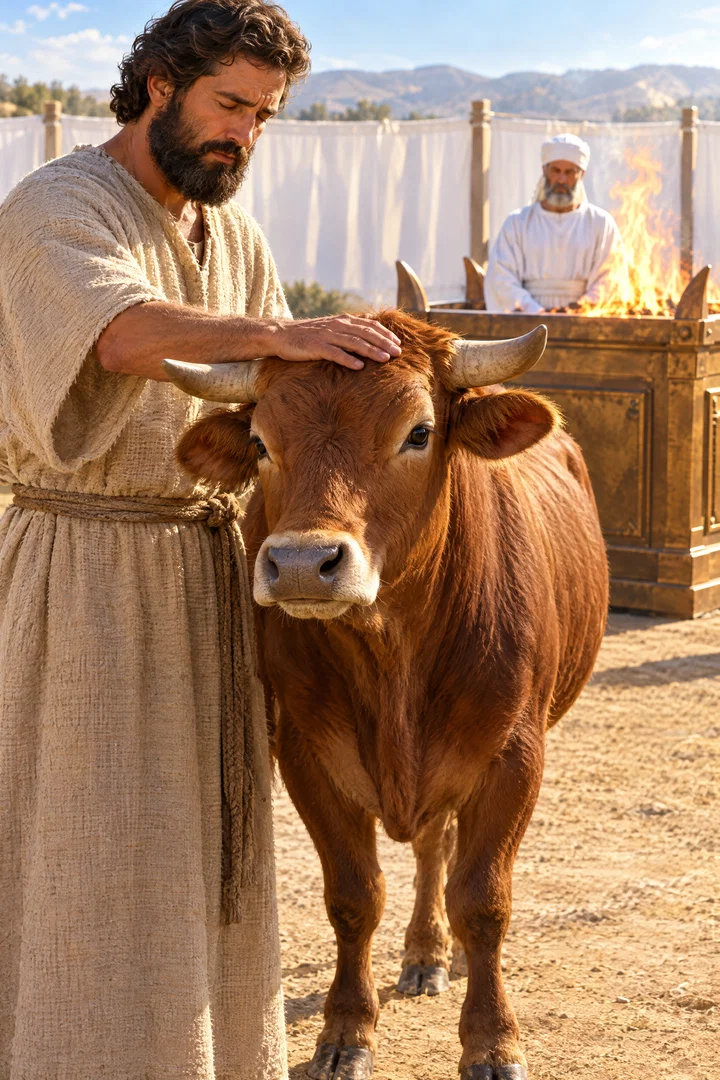
And he shall put his hand upon the head of the burnt offering; and it shall be accepted for him to make atonement for him.
The sinner’s hand identifies the victim as an accepted substitute for atonement.
- 1 Kings 18:38
Then the fire of the LORD fell, and consumed the burnt sacrifice, and the wood, and the stones, and the dust, and licked up the water that was in the trench.
Fire consumes the sacrifice, showing divine acceptance and true worship.
- Hebrews 9:23-24
It was therefore necessary that the patterns of things in the heavens should be purified with these; but the heavenly things themselves with better sacrifices than these.
Earthly altar service teaches the pattern of heavenly worship.
- Leviticus 1:17
And he shall cleave it with the wings thereof, but shall not divide it asunder: and the priest shall burn it upon the altar, upon the wood that is upon the fire: it is a burnt sacrifice, an offering made by fire, of a sweet savour unto the LORD.
The bird offering remained undivided, unlike the animal parts arranged on the altar.
- Hebrews 8:1-2
Now of the things which we have spoken this is the sum: We have such an high priest, who is set on the right hand of the throne of the Majesty in the heavens;
Earthly service points to Christ’s ministry.
- Hebrews 4:14
Seeing then that we have a great high priest, that is passed into the heavens, Jesus the Son of God, let us hold fast our profession.
The altar service connects with Christ as the great high priest.
- Hebrews 9:12
Neither by the blood of goats and calves, but by his own blood he entered in once into the holy place, having obtained eternal redemption for us.
Christ’s once-for-all ministry contrasts with the repeated sacrificial pattern.
- Hebrews 9:6-7
Now when these things were thus ordained, the priests went always into the first tabernacle, accomplishing the service of God.
The priests’ altar service foreshadows the daily and yearly sanctuary ministration.
- Romans 12:1
I beseech you therefore, brethren, by the mercies of God, that ye present your bodies a living sacrifice, holy, acceptable unto God, which is your reasonable service.
Both call for presenting the whole being as a sacrifice.
Commentary
Each commentary is drawn from primary sources: the writings of Ellen G. White and Adventist pioneers and periodicals. Each commentary is separate. Its own words are not a quotation; follow the references to read the source passages.
Ellen G. White
1 source
The priests, Aaron's sons, were to place the head and the fat together with the remaining pieces of the sacrificial animal in orderly arrangement on the wood over the fire on the altar.ST Jul 15, 1880 This laying on of the offering was not mere outward ritual, for it represented the ministry and death of Christ as the Savior who would bear the sins of the world.ST Jul 15, 1880 The whole ceremonial system was appointed to point forward to Christ, with its forms to find fulfillment when type met antitype in His death.ST Jul 15, 1880
Sources
Pioneers and periodicals
27 sources
The verse describes the priests laying the cut pieces with the head and the fat in careful order on the wood burning on the altar, after the sinner had identified with the victim and it had been slain, skinned and divided, so the accepted substitute was ready to be consumed.ST May 29, 1901ST May 29, 1901ST May 17, 1877 It was to be burned wholly and entirely as a sound and clean offering, with nothing withheld or turned aside, pleasing to the Lord.ST May 29, 1901ST Sep 12, 1900ST May 28, 1902 The whole ceremony was not mere outward ritual but pointed forward to Christ's ministry and death as the Savior who would bear the sins of the world and bring freedom from sin through His once-for-all sacrifice.ST Jul 15, 1880ST Feb 3, 1909RH Mar 28, 1854 The burnt offering therefore represents the surrender of every power of the renewed being to God, to be consecrated to His service and consumed by the sacred fire of divine love, even as the whole life of Jesus was daily poured out in service until it ended at Calvary.ST Jan 20, 1914ST Sep 12, 1900 Since the offerer entrusted the pieces to the priest to lay on the altar, so sinners must entrust their weaknesses to Christ their High Priest, for the slaying and burning of the victim means complete consecration through death, because without the shedding of blood, which is the giving of the life, there is no remission.ST Jan 20, 1914ST Jan 20, 1914ST Sep 12, 1900
Ritual Procedure Described
The laying in order belongs to the priests, Aaron's sons, who set the cut parts with the head and the fat upon the wood that was on the fire upon the altar.ST May 29, 1901ST May 29, 1901ST May 17, 1877ST It came after the offerer had identified himself with the victim, after its death and skinning and cutting, and it prepared the accepted substitute to be consumed by fire.ST May 29, 1901ST May 17, 1877 The pieces, head, and fat were thus arranged on the wood over the altar fire as part of the burnt offering that was burned wholly there as an offering pleasing to the Lord.ST May 29, 1901ST
That burnt offering was to be burned wholly and entirely upon the altar, a clean and sound offering laid in proper order.ST May 29, 1901ST Sep 12, 1900ST May 28, 1902 Nothing was to be withheld or divided away, but every part was to be consumed as a whole burnt offering for a sweet savor unto the Lord.ST Sep 12, 1900 The cutting and laying of the head, fat, and parts in order was only for convenience when the animal was too large to burn whole.ST Sep 12, 1900 The bird offering, by contrast, was not cut into pieces, and the distinction between the divided animal and the undivided bird is significant and is connected with the divided animals in Abraham's covenant sacrifice.ST Feb 9, 1915ST Sep 12, 1900
The fire that consumed the offering was sacred fire first kindled by God Himself and kept carefully and constantly burning.ST Sep 12, 1900 It was carried from the altar of incense to the altar of burnt offering, and no other fire could be used.ST Sep 12, 1900 To offer strange fire brings destruction, as when Nadab and Abihu were consumed by the Lord's displeasure.ST Sep 12, 1900 Only on special occasions, as with Elijah on Mount Carmel, did God kindle the sacrifice directly by fire from heaven.ST Sep 12, 1900
The instructions for burnt offerings allowed each person to bring according to means, down to meal or fine flour for those in extreme poverty.RH Jan 20, 1859 This provision made sacrificial worship accessible even to the poorest.RH Jan 20, 1859 Yet everyone was required to bring an offering, because everyone had sinned.RH Jan 20, 1859
Sanctuary Setting Explained
Leviticus 1-7 gives the instructions for individual offerings, the especial work for individuals as they presented their particular offerings during the year.RH Mar 8, 1870RH Feb 3, 1853ST Apr 2, 1912 This was part of the daily service in the holy place of the earthly sanctuary performed by the Levitical priesthood, which with the yearly work in the most holy place makes up the two grand divisions of earthly ministration that are the example and shadow of Christ's more excellent ministry in the true tabernacle.RH Mar 8, 1870RH Feb 3, 1853 It was the year-round service that preceded the yearly cleansing of the sanctuary.RH Feb 3, 1853 It belongs to the first of three general ministries connected with the earthly sanctuary, in which individuals who came burdened with their sins brought their offerings showing faith in the Redeemer who was to come.ST Apr 2, 1912
In that service a person who had sinned brought an unblemished animal as a substitute, confessed sin over it, and laid a hand on its head to signify the transfer of sin to the victim.RH Feb 25, 1858RH Feb 3, 1853ST Feb 17, 1890RH Mar 28, 1854 The victim was slain in the sinner's place as one whose life paid the penalty, and its blood, which represented its life, was carried by the priest into the sanctuary and sprinkled before the Lord.RH Feb 25, 1858ST Feb 17, 1890RH Mar 28, 1854 So guilt was represented as passing from the sinner to the victim and through its blood to the sanctuary.RH Feb 25, 1858RH Mar 28, 1854 The offering represented the transfer of the sinner's guilt first to the victim and then to the sanctuary, picturing sin being transferred there through the prescribed sanctuary service.ST Feb 17, 1890ST May 17, 1877
When offered in faith, such individual offerings in Leviticus 1-7 represented the transfer of the penitent's sins to the sanctuary through the sacrifice's blood or the priest.ST The burnt offering is described in Leviticus 1, while the sin offering in Leviticus 4 is the offering through which a sinner received forgiveness.RH Sep 16, 1852 That individual sin offering required confession and restitution where applicable, the offerer or the congregation's elders laid a hand on the victim and killed it, and the priest used its blood in the sanctuary to make atonement, after which the sin was forgiven.RH Sep 16, 1852
The instructions for burnt offerings in Leviticus 1:1-17 had already been given to the family of Adam immediately after the fall.ST Jul 16, 1894 Abel's offering of a lamb matched those instructions in all respects, because God had commanded a lamb for an offering, while Cain's offering of the fruit of the ground did not, because God had not commanded fruit.ST Jul 16, 1894 God accepted Abel and rejected Cain for this reason, since God accepts nothing but obedience and rejects only disobedience, and Cain's failure to do well was transgression of the law that barred his acceptance.ST Jul 16, 1894
Leviticus 1-7, 16 and 23 describe the main features of the service of the sanctuary built by Moses.ST Jun 19, 1907 These scriptures were written for learning, so that through patience and comfort of the Scriptures hope is gained, and are profitable for doctrine, reproof, correction, and instruction in righteousness to make the man of God perfect.ST Jun 19, 1907 The earthly sanctuary and its service are a pattern, shadow, and type, an impressive object-lesson teaching the temple of God in heaven and Christ's priestly service therein as High Priest and Minister of the heavenly sanctuary.ST Jun 19, 1907 Study of this arranging of the parts on the altar fire therefore gives clearer views of the Saviour and His work in behalf of men.ST Jun 19, 1907
Christ and Consecration Taught
The laying of the parts, the head, and the fat in order upon the altar wood was not merely outward ceremony but the appointed way of pointing forward to the ministry and death of the Savior who would bear the sins of the world, with the forms given to be fulfilled when sacrifice met reality in His death.ST Jul 15, 1880ST Feb 3, 1909RH Mar 28, 1854 As one of the special instructions about the various offerings in Leviticus 1 to 7, belonging to God's regulation of the priesthood connected with the tribe of Levi, it shows God's hatred of sin and that sin demands its penalty, like all these offerings and types which are a shadow of the great reality found in Jesus Christ.ST Oct 25, 1905ST Feb 3, 1909ST Feb 13, 1912 In the individual burnt-offering service the sinner brought a victim to the tabernacle, laid a hand on its head to signify the transfer of sin, and the victim was killed for the transgression, while the priest carried its blood, which is its life, into the sanctuary and sprinkled it there, so that sin was represented as passing from the sinner to the victim and through its blood to the sanctuary, pointing to Christ who bore human sin and gave Himself as the sacrifice for sin.ST Jul 15, 1880RH Mar 28, 1854 Each of the different sacrifices teaches in type about the work of Jesus Christ, and the yearly cycle of services in the Levitical sanctuary typified His priestly service offered once for all.ST Nov 28, 1895ST Feb 13, 1912 The distinction that the animal burnt offering was cut and arranged in pieces while the bird offering was not cut is significant and is connected with the divided animals in Abraham's covenant sacrifice, together representing Christ as the great sacrifice who brings freedom from sin.ST Feb 9, 1915
The altar of burnt offering and its victim's blood, in the fuller symbolism given after the Exodus from Egypt, was the only approach to God's Presence dwelling in the holy of holies, the second apartment of the sanctuary.ST Oct 25, 1905 Its purpose was cure for sin, healing of conscience, and peace with God, teaching the one great lesson learned on Egypt's darkest night that safety is alone in the blood of the Passover Lamb.ST Oct 25, 1905 The burnt offering represents surrendering every power of one's being to God after confessing sin.ST Jan 20, 1914 It is the sacrifice of consecration offered after the sinner has been accepted in Christ's merit, with the flesh crucified and the life renewed by divine power, when he voluntarily presents all his renewed being to God to be consecrated to His service and used as God alone directs, consumed as a sacrifice upon God's altar by the sacred love-fire that God alone can kindle in the soul.ST Sep 12, 1900
Its truest and fullest meaning is the life of Jesus, whose whole life was constantly given to be consumed in daily service under the inspiration of divine love burning on the altar of His heart, not only when His blood flowed on Calvary but constantly day by day poured out to be ignored and despised or received ungratefully, with only one returning thanks where ten were healed, and in the end to be hated and mocked and spit upon and crucified.ST Sep 12, 1900 The offering must be a whole burnt offering, and woe to him who brings to such a sacrifice a divided heart.ST Sep 12, 1900 The offerer entrusted the pieces to the priest to lay in order rather than laying them himself, and the priest's placing them on the altar illustrates that people cannot lay their own weaknesses on the altar but must entrust them to Christ, their High Priest, who can lay them there.ST Jan 20, 1914ST Jan 20, 1914
The killing of the animal and the laying of its parts, head, and fat in order on the altar fire means complete consecration through death and the giving of the whole life, since without shedding of blood, which is the giving of the life, there is no remission.ST Sep 12, 1900 The offering stood for the one who offered it, and only flowing blood and flesh consumed on the altar for a sweet savor could speak of consecration unto death.ST Sep 12, 1900 A bruised and beaten animal let go alive would speak only of partial willingness to go with Christ to Gethsemane and to Pilate's judgment hall, but not of willingness to go with Him in His strength to Calvary.ST Sep 12, 1900 The gore of the slain bullock torn into pieces, with head, inwards, legs, and fat laid out and afterward burned upon the altar while its blood is sprinkled over almost everything, called a sweet savor unto the Lord, is imaginative and picturesque object-teaching put into sensuous ceremonial form.ST Feb 8, 1883 It pictures a condemned sinner in process of restoration to divine favor and pardon by bloody sacrifice, holding a New Testament doctrine in a familiar Old Testament act.ST Feb 8, 1883
Sources