Leviticus 24:9
And it shall be Aaron’s and his sons’; and they shall eat it in the holy place: for it is most holy unto him of the offerings of the LORD made by fire by a perpetual statute.
Translations
And it shall be Aaron’s and his sons’; and they shall eat it in the holy place: for it is most holy to him of the offerings of the LORD made by fire by a perpetual statute.
And it shall be Aaron’s and his sons’; and they shall eat it in the holy place: for it is most holy unto him of the offerings of the LORD made by fire by a perpetual statute.
And it shall be Aaron’s and his sons’; and they shall eat it in the holy place: for it is most holy unto him of the offerings of the Lord made by fire, by a perpetual statute.
And it shall be Aaron's and his sons'; and they shall eat it in the holy place: for it is most holy to him of the offerings of the LORD made by fire by a perpetual statute.
And it shall be for Aaron and his sons; and they shall eat it in a holy place: for it is most holy unto him of the offerings of the LORD made by fire by a perpetual statute.
And it shall be for Aaron and his sons; and they shall eat it in a holy place: for it is most holy unto him of the offerings of Jehovah made by fire by a perpetual statute.
and it hath been to Aaron, and to his sons, and they have eaten it in the holy place, for it [is] most holy to him, from the fire-offerings of Jehovah — a statute age-during.'
And it shall be Aaron's and his sons'; and they shall eat it in a holy place; for it is most holy unto him of Jehovah's offerings by fire: [ it is] an everlasting statute.
so shall it be for Aaron and for his sons, and they shall eat it in a holy place,—for most holy, shall it be unto him from among the altar-flames of Yahweh, a statute age-abiding.
It belongs to Aaron and his sons, who are to eat it in a holy place; for it is to him a most holy part of the offerings made by fire to the LORD— his portion forever.”
It belongs to Aaron and his sons, who are to eat it in a holy place; for it is to him a most holy part of the food offerings to the LORD— his portion forever.”
It shall be for Aaron and his sons. They shall eat it in a holy place; for it is most holy to him of the offerings of the LORD made by fire by a perpetual statute.”
And it will be for Aaron and his sons; they are to take it for food in a holy place: it is the most holy of all the offerings made by fire to the Lord, a rule for ever.
And the bread shalbe Aarons and his sonnes, and they shall eate it in the holie place: for it is most holie vnto him of the offrings of the Lord made by fire by a perpetuall ordinance.
Douay-Rheims (Challoner revision)
And they shall be Aaron’s and his sons’, that they may eat them in the holy place: because it is most holy of the sacrifices of the Lord by a perpetual right.
Pictures
Cross-references 20 of 24
- 1 Samuel 21:6
So the priest gave him hallowed bread: for there was no bread there but the shewbread, that was taken from before the LORD, to put hot bread in the day when it was taken away.
David receives the showbread reserved for priests.
- 1 Chronicles 9:32
And other of their brethren, of the sons of the Kohathites, were over the shewbread, to prepare it every sabbath.
The Kohathites prepared the showbread every Sabbath.
- John 6:35
And Jesus said unto them, I am the bread of life: he that cometh to me shall never hunger; and he that believeth on me shall never thirst.
Christ is the bread of life represented by the showbread.
- John 6:51
I am the living bread which came down from heaven: if any man eat of this bread, he shall live for ever: and the bread that I will give is my flesh, which I will give for the life of the world.
Christ is the living bread prefigured by the showbread.
- Mark 2:25-26
And he said unto them, Have ye never read what David did, when he had need, and was an hungred, he, and they that were with him?
Jesus cites David eating the holy bread to defend his hungry disciples.
- Matthew 12:3-4
But he said unto them, Have ye not read what David did, when he was an hungred, and they that were with him;
Jesus cites David eating the consecrated bread to defend meeting need.
- Exodus 25:30
And thou shalt set upon the table shewbread before me alway.
Commands that bread be set continually before the Lord.
- Leviticus 2:3
And the remnant of the meat offering shall be Aaron’s and his sons’: it is a thing most holy of the offerings of the LORD made by fire.
Both describe the priests’ portion as most holy among the offerings made by fire.
- Leviticus 6:17
It shall not be baken with leaven. I have given it unto them for their portion of my offerings made by fire; it is most holy, as is the sin offering, and as the trespass offering.
Both identify the offering as most holy and a portion of the offerings made by fire.
- Numbers 4:7
And upon the table of shewbread they shall spread a cloth of blue, and put thereon the dishes, and the spoons, and the bowls, and covers to cover withal: and the continual bread shall be thereon:
Both describe the showbread as continual bread belonging to sanctuary service.
- Numbers 18:9-10
This shall be thine of the most holy things, reserved from the fire: every oblation of theirs, every meat offering of theirs, and every sin offering of theirs, and every trespass offering of theirs, which they shall render unto me, shall be most holy for thee and for thy sons.
Both declare the priests’ offerings most holy and to be eaten in the holy place.
- Leviticus 6:18
All the males among the children of Aaron shall eat of it. It shall be a statute for ever in your generations concerning the offerings of the LORD made by fire: every one that toucheth them shall be holy.
Both describe a perpetual statute concerning offerings made by fire.
- Leviticus 21:22
He shall eat the bread of his God, both of the most holy, and of the holy.
Both describe priests eating holy and most holy bread.
- 1 Samuel 21:4
And the priest answered David, and said, There is no common bread under mine hand, but there is hallowed bread; if the young men have kept themselves at least from women.
Ahimelech gave David the priests’ hallowed bread.
- Leviticus 22:10-12
There shall no stranger eat of the holy thing: a sojourner of the priest, or an hired servant, shall not eat of the holy thing.
Both set rules for who may eat the holy offerings.
- Leviticus 7:1
Likewise this is the law of the trespass offering: it is most holy.
Both offerings are called most holy.
- Luke 6:4
How he went into the house of God, and did take and eat the shewbread, and gave also to them that were with him; which it is not lawful to eat but for the priests alone?
Jesus cites David eating the priests’ shewbread to defend his hungry disciples.
- John 6:56
He that eateth my flesh, and drinketh my blood, dwelleth in me, and I in him.
The holy bread points to Christ, the life-giving bread.
- Exodus 40:15
And thou shalt anoint them, as thou didst anoint their father, that they may minister unto me in the priest’s office: for their anointing shall surely be an everlasting priesthood throughout their generations.
Both describe Aaron’s priesthood as perpetual.
- John 6:48
I am that bread of life.
The showbread points to Christ as the living bread.
Commentary
Each commentary is drawn from primary sources: the writings of Ellen G. White and Adventist pioneers and periodicals. Each commentary is separate. Its own words are not a quotation; follow the references to read the source passages.
Ellen G. White
1 source
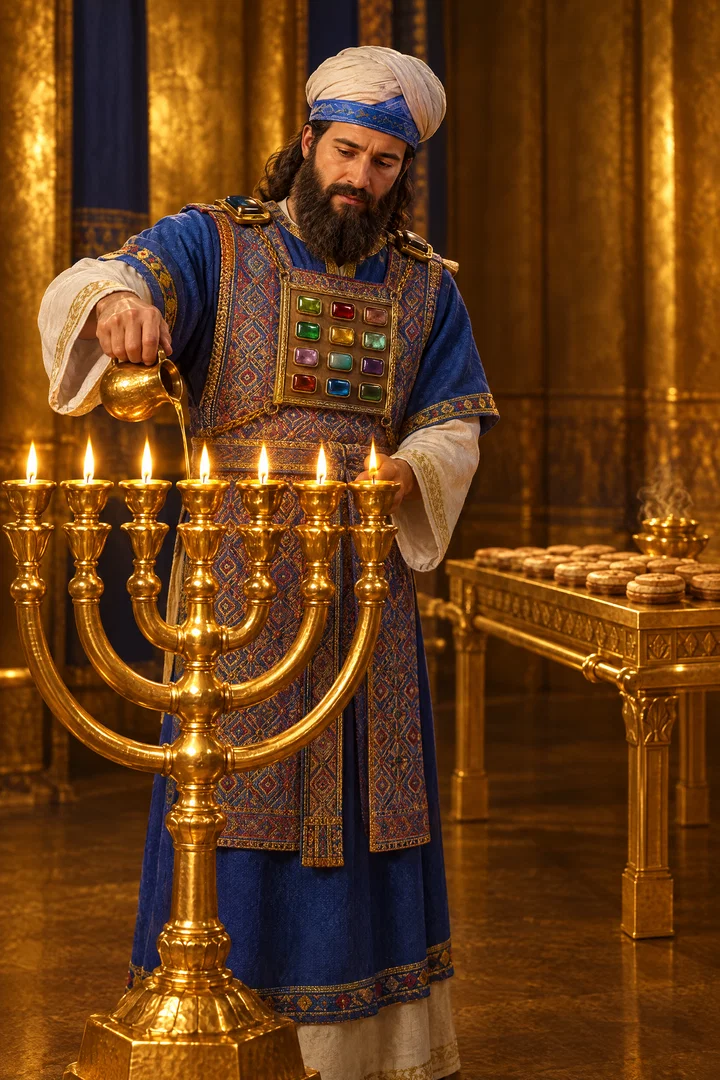
The consecrated loaves were set apart for Aaron and his sons to eat in a holy place, as a most holy share of the offerings presented to the Lord by fire under a lasting ordinance.2SP 195.2–197.1 Since eating was limited to the priests, partaking by anyone else was ordinarily unlawful, so David's taking of the bread together with his hungry companions fell outside the normal rule.2SP 195.2–197.1 That emergency is held up as precedent that urgent human need could make eating the consecrated bread guiltless.2SP 195.2–197.1 By that precedent, the disciples' rubbing out grain to sustain themselves when hungry was even more excusable.2SP 195.2–197.1
Sources
Pioneers and periodicals
43 sources
The verse sets apart the bread of the presence for Aaron and his sons to eat in the holy place as most holy among the offerings made by fire under a lasting ordinance.ST May 6, 1897RH Dec 25, 1900ST Mar 12, 1912 It was kept before the Lord through the week and renewed with fresh loaves every Sabbath, when the priests ate the bread that was removed.ST May 6, 1897RH Dec 25, 1900RH Jan 26, 1905 Its eating by David and his hungry men shows that need for food takes precedence over the ceremonial restriction, and Jesus used it with the priests' Sabbath service to show that meeting hunger and doing works of mercy on the Sabbath is lawful.RH Jan 21, 1862ST Feb 10, 1904RH Apr 5, 1860ST Oct 22, 1894 The bread represents Christ, the true bread from heaven and bread of life who satisfies the hungry soul and continually sustains life by God's grace.RH Sep 8, 1874ST May 8, 1901ST May 6, 1897RH Dec 25, 1900 The twelve loaves memorialized God's care for every tribe and pledged renewed blessing each week, teaching believers to personally receive Christ and His word as spiritual food until it becomes part of their being and strength for daily duty.RH Jan 26, 1905ST May 8, 1901ST Sep 8, 1909ST Nov 19, 1912ST Nov 19, 1912
Words and Sanctuary Setting
The verse assigns the showbread to Aaron and his sons, who were to eat it in the holy place, for it was most holy among the offerings of the Lord made by fire by a perpetual statute.ST May 6, 1897RH Dec 25, 1900ST Mar 12, 1912ST Sep 8, 1909 The bread thus belonged to the priests alone, and only they were permitted to eat the bread removed from the table when it was renewed every Sabbath.ST May 6, 1897RH Dec 25, 1900 Its presentation belongs to the broader meaning of the continual or perpetual service of worship, not merely to the daily sacrifices.ST Mar 12, 1912 The weekly changing of the bread was a Sabbath practice, and the setting out of the holy bread was part of the prescribed Sabbath worship.ST Sep 8, 1909 The verse is thus evidence that priests ministered in the earthly sanctuary, eating the holy bread in its holy place.ST Nov 1, 1877
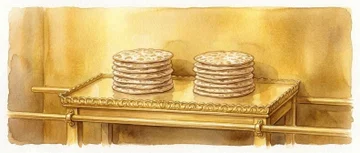
The table held twelve loaves, placed there and renewed every Sabbath. That table of showbread is among the sacred vessels from the Jerusalem temple carried away as spoils and represented on the Arch of Titus.RH Dec 8, 1859ST May 14, 1902 It is thereby marked as a sacred furnishing from the holy place, described with its sacred use and with the rule that its bread belonged to Aaron and his sons to eat in the holy place because it was most holy.ST May 14, 1902
No bread pertained to or was offered in the most holy place apartment, so holy and most holy there describe grades of the bread itself and not the two apartments of the tabernacle.RH Aug 28, 1853 The bread that Aaron and his sons eat in the holy place is shown as both holy and most holy of the offerings made by fire.RH Aug 28, 1853
The name means literally bread of the face or faces, or bread of God's presence, because it was continually before God and in His presence.RH Sep 8, 1874ST Feb 7, 1906 The fresh bread was put on the table in the holy place every Sabbath and left there during the week, and the bread taken away each week to make room for the fresh was eaten by the priests.RH Sep 8, 1874 The English name comes from the German schau-brote used in Luther's translation.RH Sep 8, 1874 As hallowed bread it is literally the bread of God's presence.ST Feb 7, 1906
The Levites made the bread while the priests received and cared for it in the sanctuary.ST May 6, 1897 The bread was unleavened, so it did not become stale while it remained through the week.RH Dec 25, 1900 The priests replaced it with fresh bread and ate the bread that had been removed.RH Dec 25, 1900ST May 6, 1897
Sabbath Renewal and Service
The loaves remained before the Lord through the week and were renewed with fresh loaves every Sabbath, and the old bread removed to make room for the fresh was eaten by the priests alone in the holy place on the Sabbath.ST May 6, 1897RH Dec 25, 1900RH Jan 26, 1905RH Sep 8, 1874ST Feb 10, 1904 The twelve loaves were kept in the sanctuary and replaced each Sabbath, with the fresh loaves set out and the old loaves then eaten, and the bread taken from the table after a week was eaten when fresh bread was set in its place.ST May 6, 1897RH Dec 25, 1900RH Jan 26, 1905RH Sep 8, 1874ST Feb 10, 1904 Preparing the bread and removing the old bread were duties performed for temple worship on the Sabbath, since the removed showbread was the priests' portion of an offering to the Lord.RH Feb 4, 1862 The requirement to set out the showbread on the Sabbath is a ceremonial law given to Israel after Moses set up the tabernacle, no part of the original Sabbath institution itself but growing out of the Sabbath being entrusted to the Hebrews and according with the times in which it was observed.RH Jan 7, 1862ST Jul 17, 1879RH Mar 21, 1865 That law was peculiar to that nation rather than part of the original Sabbath law, and the prescribed Sabbath worship including the setting out of the holy bread accords with the times in which it was observed.RH Jan 7, 1862 Unlike the prohibition of kindling fire on the Sabbath, it is called a perpetual statute to be kept after Israel should enter the promised land.RH Jan 7, 1862
The command to set forth the showbread every Sabbath means Moses setting the table and the showbread in the tabernacle on the first day of the first month shows that Abib 1, and therefore Abib 15, was the weekly Sabbath.ST Jul 17, 1879 The hallowed bread given to David was the old showbread taken from before the Lord that day to put hot bread in its place, so his eating took place on the Sabbath.RH Jan 21, 1862ST Nov 19, 1912 Twelve loaves were to be set forth on the pure table before the Lord every Sabbath, and when new hot bread was put before the Lord each Sabbath the old bread taken from before the Lord was to be eaten by the priests.RH Jan 21, 1862 This explains why Ahimelech had no common bread to give, since the priests were accustomed to eat the showbread then and no common bread was at hand on that day.RH Jan 21, 1862ST Nov 19, 1912
David, Necessity and Sabbath
On ordinary occasions none but the priests could taste the showbread, for it was ordinarily lawful for priests alone to eat it in the holy place as most holy and theirs by perpetual statute and not for anyone else.ST May 6, 1897RH Apr 5, 1860ST Oct 22, 1894ST Oct 22, 1894 The old loaves removed when fresh loaves were set out were eaten by the priests, with the Levites making the bread while the priests received and cared for it in the sanctuary.ST Feb 10, 1904ST May 6, 1897 The bread was given to David and his hungry men at the sanctuary in Nob, though ordinarily reserved for the priests, because their hunger made the act one of necessity and mercy.ST Feb 10, 1904ST Oct 22, 1894ST Oct 22, 1894 When David was famishing in his flight from persecuting Saul he could eat without condemnation, for need for food took precedence over the ceremonial restriction, showing that God's laws are not meant to bring about people's destruction.RH Apr 5, 1860ST Oct 22, 1894
Twelve loaves of showbread were to be set forth in the sanctuary on the pure table before the Lord every Sabbath, and when new hot bread was put before the Lord each Sabbath the old bread taken from before the Lord was to be eaten by the priests.RH Jan 21, 1862 The hallowed bread given to David was that old showbread taken from before the Lord that day to put hot bread in its place, so his eating took place on the Sabbath when no common bread was at hand.RH Jan 21, 1862 Jesus cited David's eating together with the priests' offering of sacrifices in the temple on the Sabbath to justify His disciples plucking and eating ears of corn on the Sabbath to satisfy hunger, showing that eating to meet hunger on the Sabbath is lawful.RH Jan 21, 1862 This distinguishes the right use of the Sabbath from its superstitious abuse, showing that for merciful purposes it is allowable to do what on ordinary occasions would not be lawful, so that wants may be supplied on the Sabbath, the sick visited, and the gospel preached and heard even with considerable journeys or bodily toil, with nothing incompatible with the law.RH Apr 5, 1860
By contrast, those who held the stricter view taught that David's eating violated the law's letter and did not keep its spirit, and that need or natural desire did not make the violation obedience.ST Jan 16, 1879 The twelve loaves set on the table in the holy place remained for seven days and were consumed on the eighth day.RH Apr 17, 1879ST Apr 24, 1879 This pattern was used to explain the claim that consecrated eucharistic bread remaining from one first-day service should be kept and consumed at the next first-day service.RH Apr 17, 1879ST Apr 24, 1879 The loaves so kept represented Christ, the bread of life, and were eaten by Aaron and his sons in the holy place because they were most holy.RH Apr 17, 1879
Perpetual Statute and Holiness
Perpetual translates the Hebrew goh-lahm, elsewhere rendered forever, and does not necessarily mean continuing without end.ST Mar 4, 1880RH Apr 15, 1873 It means continuing for the longest period that the nature and circumstances of the persons or things concerned allow, so its stated duration can expire just as the duration of other rites and institutions described in similar terms can expire.ST Mar 4, 1880RH Apr 15, 1873 Although the same word describes the endless existence of God, who is immortal, here it is applied to a ceremonial ordinance that was a shadow with no permanent value, able to endure only a limited period and abolished at the death of Christ.ST Mar 4, 1880
The bread is called most holy in the superlative degree, while the seventh-day Sabbath is called holy in the positive degree, yet that difference in wording does not make the bread or the other offerings made by fire more holy than the Sabbath.RH Jun 10, 1862 The offerings and the Sabbath are never compared with each other.RH Jun 10, 1862 The Sabbath does not take the superlative because God has only one Sabbath, the seventh day which He blessed and sanctified and commanded to be kept holy, so it is not susceptible of degrees of comparison.RH Jun 10, 1862 It is therefore to be regarded as much more holy than the various things called most holy.RH Jun 10, 1862
Christ and Spiritual Meaning
The loaves set before the Lord and eaten by Aaron and his sons in the holy place represented Christ, the bread of life, the true bread from heaven and the promised Bread of God's life who would come to restore all things.ST May 8, 1901RH Dec 25, 1900ST May 6, 1897RH Apr 17, 1879RH Aug 27, 1908 He is the bread already prepared, to be received and partaken of and made one's own for spiritual nourishment, the heavenly manna on which spiritual life is renewed and by which the hungry soul is satisfied.ST May 6, 1897RH Dec 25, 1900ST May 6, 1897ST Nov 21, 1892RH Apr 17, 1879 He is the Angel of God's presence because God dwells in Him.ST May 8, 1901RH Dec 25, 1900ST May 6, 1897ST Nov 21, 1892RH Apr 17, 1879
The bread is a symbol of the life for which men are continually dependent on God, representing His words, grace and favor which continually sustain human life.RH Sep 8, 1874 It represented His manifold grace received through Christ, the heavenly manna.RH Sep 8, 1874ST Nov 21, 1892 The twelve loaves memorialized His care for every tribe, and as fresh loaves were set out each Sabbath they pledged renewed blessings from heaven through the week.ST May 8, 1901ST Sep 8, 1909 That weekly changing taught that Jesus gives Himself with renewed strength and warmth to His chosen people.ST May 8, 1901ST Sep 8, 1909
The showbread also typified Christ's continuous presence with His people, for as God was present with Israel in the wilderness in the pillar of cloud so Christ is present by His Spirit with those who do His will.ST May 8, 1901 The sanctuary rituals were planned as symbols of the Son of God's work for the redemption of the lost, and through this bread God was revealed to Israel with the gospel lesson of the true Bread from heaven.ST May 8, 1901ST Nov 5, 1912RH Aug 27, 1908 It is literally the bread of the presence because God sanctifies and blesses by placing His own presence within what He sanctifies, and as the bread held God's presence so the Sabbath is holy to the Lord because Christ's presence is in it.ST Jan 30, 1896 Its Sabbath preparation, placement, removal and eating were connected with the Sabbath blessing, presenting a picture of the special spiritual food God gives on the Sabbath that brings added strength and blessing to the soul.RH Jan 26, 1905RH Dec 25, 1900RH Mar 23, 1916
Personal and Practical Application
The old loaves had stood before the Lord through the week before they were replaced on the Sabbath and eaten in the holy place, and that eating represented the people more fully appropriating the Sabbath blessing so that it became part of their being and abided while a fresh supply was added.RH Jan 26, 1905 The bread set out on the Sabbath was eaten afterward, and its becoming part of the priests illustrates how God's people are to take His Word into their lives until it gives abiding strength for daily duties and prepares them for the week's temptations.ST Nov 19, 1912 This receiving is not merely reading as a form or for others, but personally receiving the Word as spiritual food and life, with the Sabbath a fitting time for this fresh experience.ST Nov 19, 1912ST Nov 19, 1912 The bread taken from before God and eaten points to Christ the true bread from heaven.ST Nov 19, 1912
As the priests received the prepared bread and ate it in the holy place, Christians are to receive Christ as the bread already prepared for them.ST May 6, 1897 They are to partake of Him, make Him their own, and gain spiritual nourishment.ST May 6, 1897 The priests replaced the showbread with fresh bread and ate what had been removed, and the bread was unleavened so it did not become stale.RH Dec 25, 1900 They shared in the bread they had set before God, and as they ate it, it became part of them.RH Dec 25, 1900RH Dec 25, 1900 This illustrates how parents should study the Scriptures themselves and then offer their households fresh spiritual instruction which shapes lives and strengthens them.RH Dec 25, 1900 Those who serve and teach should likewise share living, fresh, holy and not stale spiritual nourishment with others while partaking of that same truth themselves.RH Dec 25, 1900
The showbread was more than a display because it was to be consumed, and thus serves as an image of service wholly yielded to God.RH Dec 3, 1901 The Christian is to offer the whole self to the Lord willingly and without reserving control over how God uses that life.RH Dec 3, 1901 It conveyed the gospel lesson of Christ the true Bread from heaven, and its place within the continual temple service also teaches that those who become temples of the living God are to serve Him continually and Him alone.RH Aug 27, 1908
Sources