Leviticus 25:9
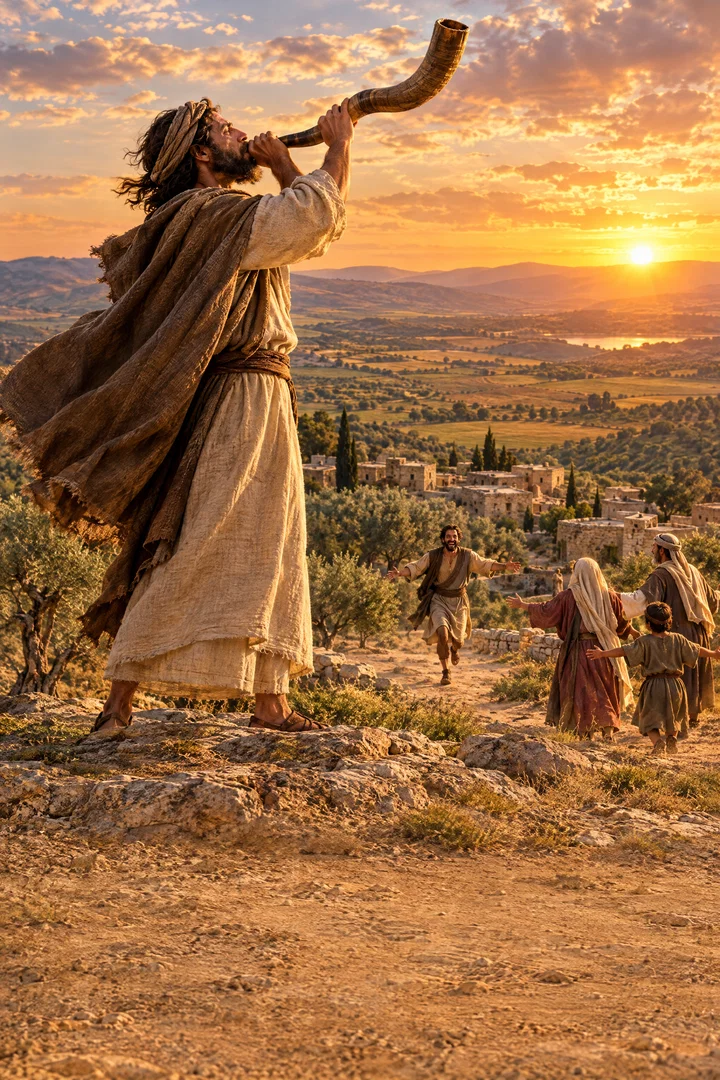
Then shalt thou cause the trumpet of the jubile to sound on the tenth day of the seventh month, in the day of atonement shall ye make the trumpet sound throughout all your land.
Translations
Then shall you cause the trumpet of the jubilee to sound on the tenth day of the seventh month, in the day of atonement shall you make the trumpet sound throughout all your land.
King James Version, KJV Cambridge Paragraph Bible
Then shalt thou cause the trumpet of the jubile to sound on the tenth day of the seventh month, in the day of atonement shall ye make the trumpet sound throughout all your land.
Then shalt thou cause the trumpet of the jubilee to sound, on the tenth day of the seventh month, in the day of atonement shall ye make the trumpet sound throughout all your land.
Revised Version, American Standard Version
Then shalt thou send abroad the loud trumpet on the tenth day of the seventh month; in the day of atonement shall ye send abroad the trumpet throughout all your land.
and thou hast caused a trumpet of shouting to pass over in the seventh month, in the tenth of the month; in the day of the atonements ye do cause a trumpet to pass over through all your land;
Then shalt thou cause the loud sound of the trumpet to go forth in the seventh month, on the tenth of the month; on the day of atonement shall ye cause the trumpet to go forth throughout your land.
Then shalt thou cause a signal-horn to pass through in the seventh month, on the tenth of the month: on the Day of Propitiation, shall ye cause a horn to pass throughout all your land.
Berean Standard Bible, Majority Standard Bible
Then you are to sound the horn far and wide on the tenth day of the seventh month, the Day of Atonement. You shall sound it throughout your land.
Then you shall sound the loud trumpet on the tenth day of the seventh month. On the Day of Atonement you shall sound the trumpet throughout all your land.
Then let the loud horn be sounded far and wide on the tenth day of the seventh month; on the day of taking away sin let the horn be sounded through all your land.
Then thou shalt cause to blow the trumpet of the Iubile in the tenth day of the seuenth moneth: euen in the day of the reconciliation shall ye make the trumpet blowe, throughout all your lande.
Douay-Rheims (Challoner revision)
And thou shalt sound the trumpet in the seventh month, the tenth day of the month, in the time of the expiation in all your land.
Pictures
Cross-references
- Leviticus 16:30
For on that day shall the priest make an atonement for you, to cleanse you, that ye may be clean from all your sins before the LORD.
The Day of Atonement is when the priest cleanses Israel from sin.
- 1 Corinthians 15:52
In a moment, in the twinkling of an eye, at the last trump: for the trumpet shall sound, and the dead shall be raised incorruptible, and we shall be changed.
The Jubilee trumpet is compared with the Lord’s final trumpet.
- Leviticus 23:27
Also on the tenth day of this seventh month there shall be a day of atonement: it shall be an holy convocation unto you; and ye shall afflict your souls, and offer an offering made by fire unto the LORD.
Describes the Day of Atonement on the tenth day of the seventh month.
- Leviticus 25:4
But in the seventh year shall be a sabbath of rest unto the land, a sabbath for the LORD: thou shalt neither sow thy field, nor prune thy vineyard.
The seventh-year rest grounds the seven-times-seven count to Jubilee.
- Leviticus 25:16
According to the multitude of years thou shalt increase the price thereof, and according to the fewness of years thou shalt diminish the price of it: for according to the number of the years of the fruits doth he sell unto thee.
Land prices vary according to the years remaining until Jubilee.
- 2 Chronicles 36:21
To fulfil the word of the LORD by the mouth of Jeremiah, until the land had enjoyed her sabbaths: for as long as she lay desolate she kept sabbath, to fulfil threescore and ten years.
The desolate land rests for the Sabbatical years Israel failed to observe.
- Leviticus 25:13
In the year of this jubile ye shall return every man unto his possession.
In the Jubilee, each person returns to his possession.
- Leviticus 16:15-22
Then shall he kill the goat of the sin offering, that is for the people, and bring his blood within the vail, and do with that blood as he did with the blood of the bullock, and sprinkle it upon the mercy seat, and before the mercy seat:
shares tenth day of seventh month
- Leviticus 25:28
But if he be not able to restore it to him, then that which is sold shall remain in the hand of him that hath bought it until the year of jubile: and in the jubile it shall go out, and he shall return unto his possession.
Sold land returns to its owner at the Jubilee.
- Acts 27:9
Now when much time was spent, and when sailing was now dangerous, because the fast was now already past, Paul admonished them,
identifies the fast as tenth day of seventh month
- 1 Thessalonians 4:16
For the Lord himself shall descend from heaven with a shout, with the voice of the archangel, and with the trump of God: and the dead in Christ shall rise first:
jubilee trumpet typifies the trump of God
- Leviticus 16:31
It shall be a sabbath of rest unto you, and ye shall afflict your souls, by a statute for ever.
The Day of Atonement is called a Sabbath of Sabbaths.
- Colossians 2:16-17
Let no man therefore judge you in meat, or in drink, or in respect of an holyday, or of the new moon, or of the sabbath days:
Ceremonial observances are shadows fulfilled in Christ, not grounds for judgment.
Commentary
Each commentary is drawn from primary sources: the writings of Ellen G. White and Adventist pioneers and periodicals. Each commentary is separate. Its own words are not a quotation; follow the references to read the source passages.
Ellen G. White
6 sources
The trumpet blast commanded here announces the jubilee, the great year of release, which came in the fiftieth year after seven sabbaths of years, seven times seven years.13MR 135.3Lt 221, 1899, par. 2–5PP 533.2–413MR 136.1 On the tenth day of the seventh month, in the day of atonement, the trumpet of the jubilee was to sound throughout all the land, wherever the Jewish people dwelt, calling upon all the children of Jacob to welcome the year of release.PP 533.2–4 Because satisfaction was made for the sins of Israel on that great day of atonement, the people would welcome the jubilee with gladness of heart.PP 533.2–4
The command teaches that the land belongs to the Lord, who is over the whole earth and is its owner, Householder, and caretaker, while the people are His tenants.13MR 135.3Lt 221, 1899, par. 2–513MR 136.1 He makes the land productive and blesses it when obeyed, and its produce and its abundance under His blessing serve as lessons of His ownership and care.Lt 221, 1899, par. 2–513MR 136.1 In this the Lord shows that He cares for the poor and provides for them, making special provision for them by His own interposition.13MR 135.3Lt 221, 1899, par. 2–513MR 136.1
As part of the laws governing land and property, the command embodies principles that would restrain oppression of the poor and the concentration of great wealth, and help prevent the ignorance and degradation caused by ill-paid servitude.ED 44.1 It gives practical directions for duties to one another, the gospel of the Old Testament to be worked out intelligently in actual missionary work.Lt 221, 1899, par. 2–5 It teaches liberality and requires overcoming stinginess and selfishness, opening the heart to help brethren working in hard, poverty-stricken fields instead of closing the door of the heart and saying No.13MR 135.3Lt 221, 1899, par. 2–513MR 136.1
The command does teach a jubilee rest for the land, but it is error to use it to say that it is a sin to labor, that the time of jubilee has come so work must cease and the land must rest, and that possessions must be sold so the poor can be supported without labor.LS 231.1–232.1 Such teaching is dishonest, confuses and distracts, deceives some, cannot prosper, and will be brought down and left in darkness while truth triumphs in the end.LS 231.1–232.1
Sources
Pioneers and periodicals
44 sources
The trumpet was to sound throughout all the land on the tenth day of the seventh month, the Day of Atonement, to hallow and begin the fiftieth year after numbering seven sabbaths of years.RH Apr 24, 1900ST Sep 26, 1911RH Mar 12, 1901ST Feb 10, 1914ST Feb 10, 1914 Its sounding proclaimed liberty, with debts blotted out, bondservants freed, and every man restored to his ancestral possession and family.RH Apr 24, 1900ST Sep 26, 1911RH Mar 12, 1901 Its timing joins two blottings together, the Day of Atonement's blotting out of sins with the jubilee's blotting out of debts and release from servitude.RH Apr 24, 1900RH Jul 24, 1900RH Mar 12, 1901 The fiftieth year is a type of the great final jubilee, when God will free His children from death and the bondage of this world into eternal freedom and the liberty and glory of His kingdom. The jubilee trumpet is a type of the trump of God, the last trump at Christ's second advent, with release of captives, canceling of debts, restoration to possessions, and rising of the sleeping saints in immortality.RH Aug 27, 1857RH Apr 23, 1861RH Dec 16, 1873
Trumpet Time and Sounding
The trumpet is to sound on the tenth day of the seventh month, which is the Day of Atonement, to hallow and begin the fiftieth year.RH Apr 24, 1900ST Sep 26, 1911RH Mar 12, 1901SMV 22.1–24.1ST Feb 10, 1914 That fiftieth year comes after numbering seven sabbaths of years, seven times seven years, forty and nine years.RH Mar 12, 1901SMV 22.1–24.1RH Jan 14, 1862 In every fiftieth year that day ushered in the jubilee, with the trumpet sounded throughout all the land to proclaim it.RH Apr 24, 1900ST Sep 26, 1911ST Feb 10, 1914 The trumpet of jubilee means loud of sounds, to be made to sound throughout all the land.RH Mar 12, 1901
At the close of the Day of Atonement every Israelite blew nine blasts, announcing the jubilee and the freeing of those in bondage and return to land.ST Feb 10, 1914 The sounding stood at the close of the day after sins had been forgiven and borne away by the scapegoat, when the people were ready to release others from debts and servitude and restore them to their land.ST Feb 10, 1914ST Feb 10, 1914 The antitypical jubilee with its reminder of the New Jerusalem follows the antitypical Day of Atonement.ST Feb 10, 1914
By the true Mosaic year beginning with the new moon in April when barley ripens, the seventh month begins with the new moon in October, the time of ingathering and changing weather toward winter when sailing becomes dangerous.RH Sep 3, 1857 In A.D. 1844 the seventh month commenced with the appearance of the moon on October 13, so the tenth day of the seventh month synchronized with October 22.RH Sep 3, 1857 The ancient year beginning and ending in the fall with Tisri, or October, marking years from creation, was not discontinued when the sacred year reckoned from Abib, or April, was established, but God kept the civil year in force and added beside it the sacred year beginning in spring, which is the seventh month of the ancient civil year, so Israel thenceforward had two years.ST Jun 26, 1879
The proclamation was made with silver trumpets sounded by priests to proclaim the year throughout the land.RH Dec 8, 1859 The form of these trumpets is preserved on the triumphal arch of Titus in Rome, which depicts the spoils carried from the temple at Jerusalem after its conquest, including the table of showbread, the seven-branched golden candlestick, and the silver trumpets, and these sculptures are the only representations in existence of those vessels.RH Dec 8, 1859
After seven sabbaths of the land, that is seven seven-year cycles in which tilling was forbidden every seventh year, the following fiftieth year was to be the year of jubilee with restoration to inheritance.RH Jan 14, 1862 The trumpet of the jubilee was to sound throughout the land on the tenth day of the seventh month, on the Day of Atonement, which with its work in the holy places was the most important service of the earthly sanctuary and with the jubilee occupied a very prominent place in the typical system.RH Dec 10, 1861 Yet the Bible records not a single instance of keeping either the jubilee or the Day of Atonement, while the other and less important festivals of the seventh month, the one ten days before and the other five days after the Day of Atonement, are repeatedly and particularly recorded. This silence does not prove the jubilee and the Day of Atonement were never observed, any more than silence about the Sabbath proves it was not observed, and no instance of jubilee observance being recorded therefore does not show it was not observed.RH Dec 10, 1861ST Dec 7, 1915 There is no evidence that the jubilee was ever observed, and the sabbatical year was almost entirely disregarded.RH Jan 14, 1862
Liberty and Restoration
The trumpet was to sound throughout all the land on the tenth day of the seventh month, the Day of Atonement, to hallow the fiftieth year and proclaim liberty throughout all the land unto all its inhabitants.RH Apr 24, 1900ST Sep 26, 1911RH Mar 12, 1901RH Aug 27, 1857 That proclamation announced debts blotted out, with every man returning to his possession and to his family.RH Apr 24, 1900RH Mar 12, 1901 Israelites who had sold their service were freed, bondservants were released, and people returned to their ancestral possessions.ST Sep 26, 1911RH Aug 27, 1857 Each family and tribe thus returned to its own land, so that land could not be monopolized.ST Jun 18, 1885
In that holy jubilee year the people were to sow nothing and reap nothing, to leave the vine undressed, to let the land rest, and to eat the increase out of the field.LS 231.1–232.1SMV 22.1–24.1
The provision was given to offset the inclination covetously to increase houses and lands and to accumulate great holdings through sharp dealing.ST Nov 20, 1901 It was the happiest of all the years to Israel, giving more joy than any service or sacrifice.RH Mar 12, 1901 Hence jubilee has come into common use as the expression for the acme of happiness.RH Mar 12, 1901
Type and Antitype
The fiftieth year is a type of the great final jubilee when God will free His children from the bonds of death into eternal freedom. It is the time when God's people pass from the bondage and slavery of this world into the liberty and glory of His kingdom. Its proclamation is already underway and drawing near to fulfillment when the faithful rise to join Christ.RH Jun 26, 1860
Its sounding on the tenth day of the seventh month joins release from debt with the Day of Atonement's blotting out of sins.RH Apr 24, 1900 The annual day when sins were forgiven and wiped away coincides with the fiftieth-year release of debts and return to possessions and family.RH Jul 24, 1900 The jubilee began when Israel awaited the sign that God had blotted out their sins, so forgiveness of sin and release from debt meet together.RH Mar 12, 1901 The trumpet announced the jubilee after sins had been forgiven and borne away by the scapegoat, when the people were ready to release others from debts and servitude and restore them to their land.ST Feb 10, 1914 Together the Day of Atonement when sins were blotted out and the jubilee when debts were blotted out picture freedom from sin and debt.RH Apr 24, 1900
The Day of Atonement was the yearly close of the sanctuary service, when the people's sins were brought out and placed on the scapegoat, a type of the final judgment day. The jubilee regulations were a reminder of the New Jerusalem promised to God's people, and the antitypical Jubilee will follow the antitypical Day of Atonement.ST Feb 10, 1914
The blowing of the great trumpet of jubilee on the tenth day of the seventh month is a type of the trump of God, the last trump at Christ's second advent.RH Aug 27, 1857 To that same day belong the release of all captives, the canceling of all debts, and the restoration of every man to his possessions as the great release at the advent.RH Aug 27, 1857 The Jubilee trumpet sounded throughout the land is connected with the awakening of God's sleeping saints, who rise clothed in immortality.RH Apr 23, 1861 It foreshadows the jubilee of heaven and earth, the grand Sabbatic year at the coming of Jesus Christ to claim the kingdoms of this world as the one whose right it is to reign.RH Dec 16, 1873
The antitypical year of jubilee is just at hand when the redemption of God's people draws nigh and liberty is proclaimed throughout all the land and the earth is given to Him whose right it is.ST Apr 3, 1884 The great antitypical Jubilee is nearing, and as it draws near earthly property grows less valuable.RH May 16, 1907 After nearly two thousand years of His absence that jubilee is about to break upon the world.RH Dec 16, 1873 The Jubilee serves as a type of the new creation: as the seventh millennium ends and the eighth begins, the earth is made new as the home of the redeemed.RH Jan 26, 1905
The Jubilee was potentially fulfilled in Christ when He rose victorious from the grave.ST Nov 11, 1908 Freedom from sin is its present earnest, while the full Jubilee comes when believers enter their eternal inheritance.ST Nov 11, 1908 Every jubilee trumpet was a shadow of the cross and a compacted prophecy of the gospel.RH Nov 8, 1915
Prophetic Time Calculations
The jubilee is the sixth of seven kinds of sabbaths, completed by the seventh, the great Jubilee of Jubilees, which is seven times seven jubilees, 49 times 50 years, or 2450 years.SMV 22.1–24.1 No year of release or jubilee was kept after the reign of Josiah ended in B.C. 607, when only 21 jubilees had been kept and 23 were still lacking of the great Jubilee, so that the land was to lie desolate while they were in their enemies' land.SMV 22.1–24.1 Counting the 2450 years from B.C. 607 brings the Jubilee of Jubilees in A.D. 1843.SMV 22.1–24.1 The typical jubilee trumpet sounded on the tenth day of the seventh month, the day of atonement, throughout all the land to hallow the fiftieth year and proclaim liberty to all inhabitants, when every man returns to his possession and to his family, sows and reaps nothing, leaves the vine undressed, and eats the increase out of the field because the jubilee is holy.SMV 22.1–24.1 The antitypical trumpet of jubilee will proclaim glorious liberty through all the land when the people of God come into the inheritance of the purchased possession and the redemption of their bodies.SMV 22.1–24.1
The sounding of the jubilee trumpet on the tenth day of the seventh month establishes a Great Jubilee of 2460 years reckoned from the captivity of Jehoiakim in the fourth year of his reign.RH Sep 10, 1857 That beginning is dated B.C. 607 with disputed dates of B.C. 606 and B.C. 605, so that with the other prophetic periods it terminates in A.D. 1844 with allowance for extension to A.D. 1847 on later chronologies.RH Sep 10, 1857
The blowing of the great trumpet of jubilee on the tenth day of the seventh month is the type of the trump of God, the last trump at the second advent, with release of all captives, canceling of all debts, and restoration of every man to his possessions belonging to that same day as the great release.RH Aug 27, 1857 As the Passover, the wave sheaf of firstfruits, and Pentecost were fulfilled chronologically at the first advent on their exact calendar days, so this trumpet must be fulfilled chronologically on its exact calendar day.RH Aug 27, 1857 This requires the second advent to occur on the tenth day of the seventh month of the sacred year, when all prophetic periods center, to honor a day set apart for so many ceremonials typical of the completion of salvation.RH Aug 27, 1857
Because the types shadowing the second advent were observed at different seasons of the year, they cannot all be chronologically fulfilled, so no certain day for the coming can be fixed from them and continual watching is required.RH Sep 10, 1857 The anniversaries of those days may nevertheless be regarded with peculiar interest.RH Sep 10, 1857 Approaching that Jubilee means the judgment is one year nearer, since the blowing of the jubilee trumpet and the deliverance of captives belonged to the seventh month, on the tenth day, the day of atonement, as a type shadowing forth the second advent.RH Sep 10, 1857
Sabbaths and Ceremonial Law
The trumpet to sound on the tenth day of the seventh month, the Day of Atonement, throughout all the land concerns the jubilee among the sabbaths relating to the land.RH Mar 31, 1863RH Jan 14, 1862 The jubilee followed seven sabbatical years and brought the restoration of each person to his inheritance, and this land Sabbath with the annual festival sabbaths was tied to Israel's possession and cultivation of Canaan, unlike the weekly Sabbath.RH Jan 14, 1862
The year of jubilee, proclaimed by trumpet on the tenth day of the seventh month, belongs with the seventh year as a sabbath distinct from the weekly seventh-day Sabbath. The distinction itself is divinely made, authorizing the keeping of the seventh day without keeping them, for these with the seven annual sabbaths are ceremonial sabbaths not commanded in the decalogue but set beside the Sabbaths of the Lord. The fiftieth-year sabbath so ordered was peculiarly Jewish, distinct from the weekly seventh-day Sabbath of the Lord and distinct from the seven annual feast sabbaths.ST Dec 18, 1893 It was one of the sabbaths of the ceremonial code, a national Sabbath observance for Israel belonging to a specific time and purpose, and like other local and national ceremonial observances it was ended at the cross and is not a Christian-dispensation observance.RH Aug 29, 1871ST Jun 9, 1914
The jubilee law was a national law for Israel and its land, pertaining to the earthly Canaan inheritance and cultivation.RH Aug 29, 1871RH Jan 14, 1862 The sabbath of the land, the seventh year, distinguished from the Lord's weekly Sabbath and from the feast-day sabbaths, depended on the law of commandments in ordinances and ceased when that law was abolished.RH Aug 31, 1905 It was not binding after Christ's death, when Israel ceased to be God's special people. When that inheritance came to be trodden down of the Gentiles after the dispersion so that these sabbaths could not be kept, the weekly Sabbath remained unaffected, because it belonged to a higher order of institutions.RH Aug 29, 1871
The institution served a practical and beneficial purpose and also symbolized heavenly things.RH Mar 12, 1908 In that law given to Israel the right to redeem lay with him who was nearest of kin, beautifully foreshadowing the true position of Christ as Redeemer, who to redeem mankind became Son of Man, taking man's flesh and blood.ST Nov 1, 1910
Practical Present Application
The price of land under the law depended on how near the year of jubilee stood, because all sold land was to return to its original owner, so ground bought long before the jubilee cost nearly full value while ground bought just before it cost only a small sum.ST Apr 3, 1884 The antitypical year of jubilee is just at hand, when the redemption of God's people draws nigh and liberty is proclaimed throughout all the land and the earth is given to Him whose right it is.ST Apr 3, 1884RH May 16, 1907 Earthly houses and lands are therefore depreciating in value every day and will be worth nothing to their owners when the jubilee is proclaimed, growing less valuable in the sight of God and of those who truly love His closing message.ST Apr 3, 1884RH May 16, 1907 To put money into them now is to be deceived and to pay full price for what will soon be worthless.ST Apr 3, 1884 Those who still cling to their possessions then will cast their silver and gold away as trash, while those who have laid up all their treasure in heaven will hail the coming Lord with joy and receive an inheritance incorruptible and undefiled that never fades.ST Apr 3, 1884
The trumpet of jubilee means a loud sound, to be sounded throughout all the land on the tenth day of the seventh month, in the day of atonement, after numbering seven sabbaths of years, seven times seven years, forty and nine years, to hallow the fiftieth year and proclaim liberty throughout all the land unto all the inhabitants thereof, with every man returning unto his possession and unto his family.RH Mar 12, 1901RH Jul 24, 1900RH Mar 12, 1901 It was the happiest of all the years, giving more joy than any service or sacrifice, so that jubilee has become the expression for the acme of happiness.RH Mar 12, 1901 Its beginning joined two releases, for the annual day was when sins were forgiven and wiped away and the fiftieth year was when debts were blotted out with return to possessions and family.RH Jul 24, 1900RH Mar 12, 1901RH Apr 24, 1900 The remnant lives in the antitypical Day of Atonement and year of jubilee, when sins are to be blotted out by Jesus for those seeking pardon and debts burdening God's cause are to be wiped away, requiring a real experience of sins forgiven and debts wiped out.RH Jul 24, 1900RH Mar 12, 1901RH Apr 24, 1900 The jubilee song of freedom is to be sung when, in the spirit of self-sacrifice for Christ's sake and for the truth's sake as a fundamental part of the gospel and the Third Angel's Message, the reproach of debt is rolled back from the schools through free and generous giving to suffering schools, and giving a part in sustaining God's schools on earth hastens the glad day when givers will enjoy studying in the schools above.RH Mar 12, 1901RH Jul 24, 1900RH Nov 6, 1900
The jubilee proclamation is already underway and drawing near to its fulfillment when the faithful rise to join Christ, foreshadowing the jubilee of heaven and earth, the grand Sabbatic year at the coming of Jesus Christ to claim the kingdoms of this world as the one whose right it is to reign.RH Jun 26, 1860RH Dec 16, 1873 After nearly two thousand years of His absence and nearly six thousand years of His standing as the Lamb newly slain, that jubilee is about to break upon the world.RH Dec 16, 1873 Its nearness calls for trimmed and brightly burning lamps, for looking for and hastening the coming, and for preparation of His people through a great crisis and short sharp conflict with the man of sin, even through seas of blood, that only quickens the cry for His quick return.RH Dec 16, 1873 The song of jubilee is soon to be sung, which shows that the time of probation is about to end and calls young people to arise and prepare to enter God's work, with angels ready to cooperate with every soul who prepares.RH Dec 4, 1900 The hope of singing that jubilee song expresses the joy of that announcement when the work is completed, heard throughout the borders of the land.RH Apr 13, 1905RH Apr 8, 1902
To use the jubilee with its rest for the land to say it is a sin to labor, that the time of jubilee has come so the land must rest and work must cease, and that possessions must be sold so the poor can be supported without labor, is error.LS 231.1–232.1 That teaching is dishonest, confuses and distracts, and deceives some.LS 231.1–232.1 It cannot prosper, but will be brought down and left in darkness while truth triumphs in the end.LS 231.1–232.1
Sources