Luke 10:37
And he said, He that shewed mercy on him. Then said Jesus unto him, Go, and do thou likewise.
Translations
And he said, He that showed mercy on him. Then said Jesus to him, Go, and do you likewise.
King James Version, KJV Cambridge Paragraph Bible
And he said, He that shewed mercy on him. Then said Jesus unto him, Go, and do thou likewise.
And he said, He that showed mercy on him. Then said Jesus to him, Go, and do thou likewise.
And he said, He that shewed mercy on him. And Jesus said unto him, Go, and do thou likewise.
And he said, He that showed mercy on him. And Jesus said unto him, Go, and do thou likewise.
and he said, 'He who did the kindness with him,' then Jesus said to him, 'Be going on, and thou be doing in like manner.'
And he said, He that shewed him mercy. And Jesus said to him, Go, and do thou likewise.
And, he, said—He who dealt mercifully with him. And Jesus said unto him—Be taking thy journey, and, thou, be doing, in like manner.
Berean Standard Bible, Majority Standard Bible
“ The one who showed him mercy,” replied the expert in the law.Then Jesus told him, “ Go and do likewise.”
He said, “ He who showed mercy on him.”Then Jesus said to him, “ Go and do likewise.”
And he said, The one who had mercy on him. And Jesus said, Go and do the same.
And he saide, He that shewed mercie on him. Then said Iesus vnto him, Goe, and do thou likewise.
Douay-Rheims (Challoner revision)
But he said: He that shewed mercy to him. And Jesus said to him: Go, and do thou in like manner.
Pictures

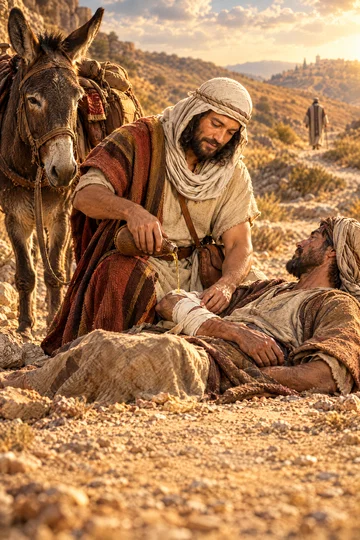

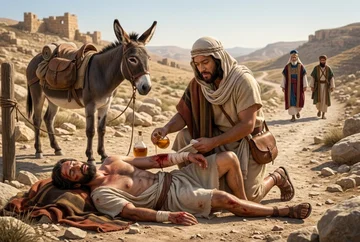

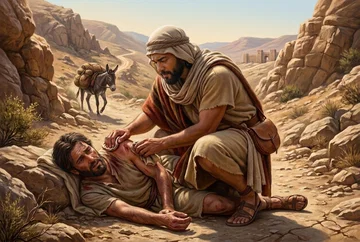


Cross-references 20 of 44
- Luke 10:27-28
And he answering said, Thou shalt love the Lord thy God with all thy heart, and with all thy soul, and with all thy strength, and with all thy mind; and thy neighbour as thyself.
The command to love God and neighbor grounds the call to act mercifully.
- Leviticus 19:18
Thou shalt not avenge, nor bear any grudge against the children of thy people, but thou shalt love thy neighbour as thyself: I am the LORD.
The Samaritan’s mercy puts the command to love one’s neighbor into practice.
- Matthew 25:40
And the King shall answer and say unto them, Verily I say unto you, Inasmuch as ye have done it unto one of the least of these my brethren, ye have done it unto me.
Helping people in need is counted as service to Christ.
- Matthew 22:37-40
Jesus said unto him, Thou shalt love the Lord thy God with all thy heart, and with all thy soul, and with all thy mind.
The Samaritan’s help exemplifies love of neighbor, joined with love of God as the law’s central command.
- Luke 10:29
But he, willing to justify himself, said unto Jesus, And who is my neighbour?
The lawyer asks who counts as a neighbor, and the parable answers with a call to show mercy.
- Matthew 7:12
Therefore all things whatsoever ye would that men should do to you, do ye even so to them: for this is the law and the prophets.
The Good Samaritan’s mercy puts the Golden Rule into practice.
- Luke 10:25-26
And, behold, a certain lawyer stood up, and tempted him, saying, Master, what shall I do to inherit eternal life?
The lawyer’s question and Jesus’ appeal to the law frame the parable, whose concluding command answers him.
- Luke 10:31-32
And by chance there came down a certain priest that way: and when he saw him, he passed by on the other side.
The priest and Levite pass by the distressed man, contrasting neglect with commanded mercy.
- Matthew 5:44
But I say unto you, Love your enemies, bless them that curse you, do good to them that hate you, and pray for them which despitefully use you, and persecute you;
Jesus commands kindness toward enemies, as the Samaritan showed.
- Isaiah 58:7
Is it not to deal thy bread to the hungry, and that thou bring the poor that are cast out to thy house? when thou seest the naked, that thou cover him; and that thou hide not thyself from thine own flesh?
Both call for compassionate care of people in need.
- James 2:15-17
If a brother or sister be naked, and destitute of daily food,
Real love meets a needy person’s needs through practical action.
- John 13:34
A new commandment I give unto you, That ye love one another; as I have loved you, that ye also love one another.
Christ’s command to love as he loved grounds practical mercy toward others.
- John 15:17
These things I command you, that ye love one another.
Jesus commands his followers to love one another, as the Samaritan showed mercy.
- Matthew 25:35-36
For I was an hungred, and ye gave me meat: I was thirsty, and ye gave me drink: I was a stranger, and ye took me in:
Both call for practical mercy toward people in need.
- Luke 10:28
And he said unto him, Thou hast answered right: this do, and thou shalt live.
Jesus connects doing what the law requires with life.
- Mark 12:31
And the second is like, namely this, Thou shalt love thy neighbour as thyself. There is none other commandment greater than these.
Samaritan command illustrates loving neighbor as self
- Leviticus 19:34
But the stranger that dwelleth with you shall be unto you as one born among you, and thou shalt love him as thyself; for ye were strangers in the land of Egypt: I am the LORD your God.
Commands love for the stranger as for oneself.
- Matthew 9:13
But go ye and learn what that meaneth, I will have mercy, and not sacrifice: for I am not come to call the righteous, but sinners to repentance.
Both present showing mercy as what God requires.
- Micah 6:8
He hath shewed thee, O man, what is good; and what doth the LORD require of thee, but to do justly, and to love mercy, and to walk humbly with thy God?
Both call for loving mercy and putting it into practice.
- Deuteronomy 10:18-19
He doth execute the judgment of the fatherless and widow, and loveth the stranger, in giving him food and raiment.
God’s care for the stranger grounds the duty to love them.
Commentary part 1 of 2
Each commentary is drawn from primary sources: the writings of Ellen G. White and Adventist pioneers and periodicals. Each commentary is separate. Its own words are not a quotation; follow the references to read the source passages.
Ellen G. White
134 sources
The lawyer himself named the neighbor as the one who showed mercy to the man robbed and wounded on the road to Jericho, and he was then told to go and act in the same way.ST Jul 23, 1894Ms 87, 1894, par. 28–31Lt 98, 1896, par. 8–10Ms 71, 1897, par. 29–32 A neighbor is both the one who acts with mercy and anyone in need of mercy and help, whether in body or in soul at home or abroad.COL 376COS 69.1–70.3Lt 52, 1906, par. 29–31Lt 81, 1901, par. 7–10Ms 101, 1901, par. 42–46 No difference of faith, race, color, class, nationality, friendship or enmity limits who counts as neighbor, for every needy person is to be treated as neighbor, brother and self.COL 376.1–2Ms 45, 1900, par. 7–9Ms 160, 1904, par. 27–32ST Jul 23, 18944T 226.3 Acting in the same way means practical, costly, compassionate care that comes to the sufferer, relieves temporal and spiritual need, and refuses to pass by on the other side like the priest and the Levite.COS 69.1–70.3ST Jul 23, 1894ST Jul 23, 1894ST Jul 23, 18946T 294.3 In this command are summed up supreme love to God and unselfish love to neighbor on which hang all the law and the prophets, so that eternal life comes by loving in deed and not by creeds, ceremonies or knowledge alone.DA 497.13T 523.2–3Lt 134, 1902, par. 17–19Ms 87, 1894, par. 28–31Ms 101, 1901, par. 42–46 The Samaritan pictures Christ Himself, who had compassion on humanity bruised and ruined by Satan, came to rescue at His own cost and died to redeem, and His followers are to meet the perishing with that same pitying love.Lt 45, 1894, par. 25–27ST Jul 7, 1890RH Sep 13, 1906ST Jul 23, 1894
Parable Setting and Answer
The verse closes the lawyer's questions about what to do to inherit eternal life, which he had himself answered from the law that life comes by loving the Lord God with all heart and soul and strength and mind and loving neighbor as self, to which Jesus had said do this and live, with live meaning eternal life.Lt 134, 1902, par. 17–19Ms 97, 1901, par. 15–18Ms 71, 1897, par. 29–32Ms 150, 1899, par. 17–19Lt 70, 1906, par. 6–8 Doing likewise fulfills that twofold love on which hang all the law and the prophets, outlining the whole duty of man and summing up all the principles contained in the law of God, and those tested and proved in loving others as themselves will be pronounced fit for an inheritance with the saints in light.Lt 134, 1902, par. 17–19Ms 97, 1901, par. 15–18ST Jul 2, 1894 Willing to justify himself, the lawyer asked who is his neighbor, and Jesus answered with a man going down from Jerusalem to Jericho who fell among thieves who stripped and wounded him and left him half dead.3T 523.2–3Lt 134, 1902, par. 17–19Ms 71, 1897, par. 29–32 A priest coming down that way saw him and passed by on the other side, and likewise a Levite looked on him and passed by on the other side, whose business it was to attend to such need, while a Samaritan as he journeyed came where he was and had compassion.3T 523.2–3Ms 71, 1897, par. 29–32Ms 153, 1904, par. 15–19Lt 79, 1898, par. 4–53T 511.2–3 He went to him and bound up his wounds pouring in oil and wine, set him on his own beast, brought him to an inn and took care of him, and on the morrow paid the host two pence to take care of him with promise to repay whatever more was spent on his return.ST Jul 23, 18943T 523.2–3Ms 97, 1901, par. 15–18Ms 71, 1897, par. 29–32Ms 153, 1904, par. 15–19
The parable relates an incident that had actually taken place, recounting a real event, and Christ drew the lesson from events that had recently taken place.Lt 134, 1902, par. 17–19Ms 45, 1900, par. 7–9Ms 87, 1894, par. 38–3921MR 190.2–4 The lawyer had tempted Jesus concerning the law at the suggestion of disappointed Pharisees, Herodians and Sadducees who had been silenced and were filled with bitter hatred, asking to catch something from Christ's lips to condemn Him and take His life, which Christ turned back with what is written in the law and the lawyer's own answer.Ms 71, 1897, par. 29–32Ms 153, 1904, par. 15–19 Jesus arranged for the decision about who was neighbor to come from the lawyer's own lips by asking which of the three was neighbor to him that fell among thieves, and the lawyer was convinced and answered he that showed mercy on him.ST Jul 23, 1894Lt 98, 1896, par. 8–10Ms 100, 1904, par. 5–11Ms 153, 1904, par. 15–19Ms 66, 1890, par. 2–4 Moved by the parable so that they forgot prejudice, many voices joined in crying out that the one who had mercy was the neighbor.Ms 153, 1904, par. 15–19
That answer condemned his own practice and that of the scribes and Pharisees who were listening as spies to trap Him, exposing men who were strict for the letter of the law with knowledge, ceremonies and explanations yet did not keep it in spirit or letter, and exposing the lawyer's idea that the law requires only forms and ceremonies which the priest's and Levite's treatment of the wounded man had left undisturbed.ST Jul 23, 1894Ms 87, 1894, par. 28–31Lt 98, 1896, par. 8–10 Knowing the law is not enough, for its command must be lived out by showing mercy, and religious ceremonies and explaining the law cannot make up for failing to love others impartially.Ms 87, 1894, par. 28–31 Though prejudice against Christ was removed and he found nothing in the lesson to criticize, with words so definite and pointed that listeners could find no opportunity to cavil or object, his national dislike and prejudice remained.Lt 98, 1896, par. 8–10ST Jul 6, 1915Lt 304, 1908, par. 16–17Ms 167, 1898, par. 8–10 He would not credit the Samaritan by name but called him only the one who showed mercy, unwilling even to say the word Samaritan.Lt 98, 1896, par. 8–10ST Jul 6, 1915Lt 304, 1908, par. 16–17Ms 167, 1898, par. 8–10
Meaning of Neighbor
The neighbor to the man who fell among thieves was the one who showed mercy on him, the one who acted with mercy toward the wounded man, and the command is to go and do likewise with the same mercy.COL 376Lt 52, 1906, par. 29–31Lt 42, 1907, par. 14–16 The lawyer was convinced by the parable to answer from his own lips that this merciful work was the neighbor's duty, making the Samaritan's work the hearer's own duty.Ms 100, 1904, par. 5–11 Being a neighbor means showing mercy through practical care for someone in need, with compassionate help and not a person's status or group as the measure of neighborly love.Lt 217, 1905, par. 6–11 Loving one's neighbor means doing likewise, responding with compassion and practical care as the Samaritan did for the wounded man, and this outlines the work people are to do.Lt 107, 1902, par. 4–6
A neighbor is also anyone who needs help and mercy, the wounded, suffering, destitute and helpless person in need, whether physically or spiritually, at home and abroad, with the world as the field of labor.COS 69.1–70.3Lt 81, 1901, par. 7–10Ms 101, 1901, par. 42–46 The lesson concludes that a neighbor is anyone in need of mercy, not only someone belonging to one's own group, and requires the same practical, unselfish compassion shown to the injured man, putting love of neighbor into practice.Ms 40, 1889, par. 1–2 The one who acted as neighbor was the person who showed mercy, and hearers must act likewise by showing practical love to those who suffer rather than passing them by.Ms 77, 1901, par. 6–7Ms 96, 1899, par. 10–12 The command still sounds down to the present time and means to act toward the needy as the good Samaritan acted, for neighbor means everyone who needs the help you can give.Ms 101, 1901, par. 42–46 Obeying it is genuine medical missionary work and practicing the law of God, requiring Christians to learn how to restore brethren fallen into decay by taking interest in them, speaking and acting kindly toward them, encouraging those who need encouragement, being the Lord's helping hand to them, and never passing them by on the other side.Ms 101, 1901, par. 42–46 It dishonors God to pass by a needy brother to favor those who do not love or fear God, for a Christian is Christlike and Christlike love is the best gift of God, to be sought earnestly and revealed in the life.Ms 101, 1901, par. 42–46 Supreme love for God and unselfish love for one another are the two great principles on which hang all the law and the prophets, and obeying them gains eternal life, even when helping is not inviting and brings inconvenience, cost, care and anxiety.Ms 101, 1901, par. 42–46
No distinction limits who counts as neighbor, not faith, race, color, social class, caste, territorial lines, nationality, social distinction, friendship or enmity, whether pleasant or disagreeable, Jew or Gentile.COL 376.1–2ST Jul 23, 18946T 294.1–2 Every needy person is a neighbor and must be treated as a stranger, a neighbor, a brother in suffering and as oneself, with even greater compassion than for a beast of burden, recognizing every person as belonging to God.COL 376.1–2DA 500.3–503.1 Neighbor does not mean one of the church or faith to which a person belongs, but any man in need of help from humanity, so those whose names are upon the church book must represent the mercy, compassion and tenderness of Jesus Christ with no thought as to race, color or class distinction.ST Jul 23, 1894 As soon as the need is seen there is to be compassion upon the human being in need and suffering, thereby showing true humanity, and everyone who claims to be a child of God must note and copy every detail of the Samaritan's mercy.ST Jul 23, 1894 A neighbor is any person in need of sympathy and practical help whatever their class, and showing the same mercy as the Samaritan means relieving temporal needs and physical suffering as far as possible, which opens the way to reach hearts with virtue and religion.4T 226.3 Help is to be given to a suffering person without regard to nation or hostility, even when helping costs time, safety and resources, and care is to continue until needs are met.DA 503.4DA 500.3–503.1
Neighbor is not to be narrowed to a few that are taken in, but is whoever needs mercy.Ms 160, 1904, par. 27–32 It is not limited to relatives, friends, church members, church or faith members, or people who think alike or share beliefs, but is the whole human family and whoever needs the help that can be given.ST Jul 23, 1894Ms 87, 1894, par. 40–41Ms 87, 1894, par. 8–10 The command to act likewise means to love one's neighbor as oneself by showing mercy, and it applies just as much to church members and non-members now as to those who first heard it, because sowing the gospel seed and practically doing the truth decides the salvation of the soul and gives eternal life.Ms 45, 1900, par. 7–9 It gives the solid foundation for eternal life, not wonderful higher education in sophistries and spiritualistic ideas, a foundation Christ Himself created by giving His own life for the life of the world.Ms 160, 1904, par. 27–32 The duty is settled to care for every suffering person and to relieve the needy as far as one is able, acting as God's agent, doing good to all, especially to fellow believers, and showing through conduct what it means to keep God's law by loving God supremely and neighbors as self.Ms 87, 1894, par. 40–41 Keeping God's law means more than performing formal religious services, for it requires unselfish acts of mercy and love toward people in need, including those regarded as outsiders, and separating from people who are not like-minded can lead to neglecting the very principles of the law.Ms 40, 1889, par. 3
The example includes the despised and rejected, the stranger, the hostile, the unkind and difficult who may not appreciate or repay kindness, and even bitter opponents, to be treated with respect while sharing truth.Ms 45, 1900, par. 7–9ST Feb 24, 189818MR 114.3–115.1 Though the Samaritan belonged to a despised and rejected class, gospel ministry stops to pity and relieve the sufferer instead of passing by like the priest and Levite.Ms 45, 1900, par. 7–9 The Samaritan's conduct fulfills the command to love one's neighbor as oneself even across hostility and social contempt, and presents true mercy and obedience to the law of human kindness as the duty to show compassion, mercy and benevolence to anyone in need even across hostility and social division.RH Sep 13, 190618MR 114.3–115.1Ms 132, 1902, par. 12 The command applies to everyone in need of Christ's grace and patience, including people who are unkind or difficult and may not appreciate or repay kindness, for loving one's neighbor is a requirement of obedience to God and true obedience springs from love in the heart.ST Feb 24, 1898 A person proves harmony with God through practical mercy toward a suffering fellow human being even when helping is difficult, for kind generous care shows true conversion while religious profession without compassion does not, and because the despised are among those God loves believers must value people as God does and overcome criticism and contempt.Lt 139, 1898, par. 4–8
Law, Obedience, and Life
Supreme love to God and unselfish love to neighbor are the two great principles running through the whole law, on which hang all the law and the prophets.Ms 101, 1901, par. 42–46DA 497.4–498.1ST Jul 2, 18943T 511.2–3 The first four commandments grow out of love to God and the last six grow out of love to neighbor, and the law is a unity so that obeying one command while breaking another is not keeping it and to offend in one point is guilt of all.DA 497.4–498.1ST Jul 2, 18943T 511.2–33T 524.1 Obeying these two principles gains eternal life, and those so tested and proved will be pronounced fit for an inheritance with the saints in light.Ms 101, 1901, par. 42–46ST Jul 2, 1894
Eternal life comes by doing what is written in the law, loving God supremely with all heart, soul, strength and mind and loving neighbor as self in practical merciful action.3T 523.2–3Lt 134, 1902, par. 17–19Lt 22, 1901, par. 16–19Ms 97, 1901, par. 15–18Ms 153, 1904, par. 15–19 In Go, and do thou likewise are summed up all the principles contained in the law of God, including justice and mercy.3T 523.2–3Lt 134, 1902, par. 17–19 This outlines the whole duty of man and is the true science of Christianity and higher education, engaging the whole person and every God-given talent and giving the solid foundation for eternal life created by Christ giving His own life, not wonderful higher education in sophistries and spiritualistic ideas.Ms 97, 1901, par. 15–18Ms 101, 1901, par. 42–46 The command still sounds down to the present time and applies personally, requiring a whole-hearted life of love shown in practical acts of mercy rather than merely professed, so that neglecting or harming others spiritually or financially fails the terms of salvation.Lt 22, 1901, par. 16–19Ms 101, 1901, par. 42–46 Doing this merciful work like the Samaritan — who had compassion, bound wounds pouring in oil and wine, set the man on his own beast, brought him to an inn, cared for him and paid for further care, unlike the priest and Levite who passed by — is keeping the law and the way to live.3T 523.2–3Lt 134, 1902, par. 17–19
True religion is shown by doing loving deeds, seeking others' greatest good and practicing genuine goodness and benevolence, with faith active in works and love proved by unselfish action under Isaiah 58.DA 497.1Lt 8, 1895, par. 22–25Ms 21, 1889, par. 36–38 Mere systems, creeds, rites, ceremonies, churches, traditions, outward observances, profession, religious dignity, important work, formal services, knowledge of the law or explaining it cannot make up for failing to love impartially.DA 497.1Ms 87, 1894, par. 28–31Ms 150, 1899, par. 17–19ST Mar 3, 1887 The priest and Levite had only a religion of ceremonies and rested in outward observances without keeping the law in the heart, and the lawyer's right answer exposed his own failure to keep its demand for mercy.Ms 87, 1894, par. 28–31Ms 150, 1899, par. 17–19 Keeping the two great binding principles underlying God's far-reaching law for every member of the human family is human nature brought to the perfection of Christ's character in purity of heart and lowliness of life, not outward show.Lt 8, 1895, par. 22–25Ms 150, 1899, par. 17–19
Showing the same tender kindness and regard to those in need that the Samaritan showed the wounded traveler gives evidence of keeping the whole law and fulfills Thou shalt love thy neighbor as thyself.Ms 109, 1906, par. 8–14ST Jul 6, 1915Ms 117, 1903, par. 8–13Lt 304, 1908, par. 16–17Ms 167, 1898, par. 8–10 The command presents the principles of the law in a direct, forcible, plain and decided way that exposes neglect to carry them out and the failure to put them into practice, with words so definite and pointed that listeners could find no opportunity to cavil.Lt 304, 1908, par. 16–17Ms 167, 1898, par. 8–10RH Sep 13, 1906 Treating the wounded stranger as a brother even at risk to one's own life made the despised Samaritan more righteous than those who denounced him.ST Jul 6, 1915
Neglecting cases brought under notice, whatever the person's identity as kith or kin, leaves no assurance of eternal life because it fails to answer the claim God has, and passing by suffering can result in its loss.3T 524.14T 56.3–57.13T 533.1–3 Lack of compassion and pity to humanity transgresses the second great commandment on which the last six commandments depend.3T 524.14T 56.3–57.1 A heart not opened to the wants and sufferings of humanity will not be opened to the claims of God stated in the first four precepts of the decalogue, where idols claim the heart and affections and God is not honored and does not reign supreme.3T 524.1 Neglecting people in need will be judged by God and is not excused by the way responsible people view actions, whatever piety is professed, for mercy is a moral duty and practical kindness is the true measure of being neighbor.4T 56.3–57.1Ms 90, 1899, par. 8–9
Those tested and proved in loving others as themselves will not exalt self as Lucifer did in heaven nor rebel over another having a brighter crown, and will dwell in heaven as the pure undefiled home of joy feeling rich in receiving an undeserved reward.ST Jul 2, 1894 Doing merciful work brings entrance into the kingdom of heaven, a crown, the welcome into the joy of the Lord, and joining in singing worthy is the Lamb who died that we might live.Ms 153, 1904, par. 15–19 The command holds up the perfect standard of righteousness as the only test of human character.ST Jul 7, 1890 The law reveals the deformity of the heart and by deeds of the law no flesh is justified, with not one jot or tittle passing, and sinful people can obey only through the merit and grace of Christ who died to save them and covers the soul with His robe of righteousness, while the gospel enforces the law by presenting Christ in contrast to man and allowing no feeling of superiority, contempt or indifference toward others.ST Jul 23, 1894ST Jul 7, 1890
Christ Pictured in Samaritan
The Samaritan is Christ Himself and His work is His mission, while the wounded traveler is humanity deceived, bruised, robbed and ruined by Satan, the sinful lost family left helpless and near death to perish.ST Jul 7, 1890ST Jul 23, 1894DA 503.5 He had compassion on helpless humanity, left His glory to come to the rescue, found men ready to die, took up their case, healed their wounds, opened a refuge of safety, and made complete provision for their needs at His own cost even unto death to redeem them.ST Jul 7, 1890DA 503.5 He covered the soul with His robe of righteousness, humbled Himself to serve, took humanity upon Himself, lived in poverty and self-denial, and became poor so that others might become rich.RH Sep 13, 1906ST Jul 23, 1894DA 503.5 His mercy in the parable is a picture of His compassion and saving character that allows no feeling of superiority, contempt, or indifference toward others.ST Jul 23, 1894DA 503.5
To act like the Samaritan is to look to Christ's life and see His Spirit and work, and in the light reflected from Christ to view one's own life and work.ST Jul 7, 1890 In that light is seen how far short one comes of keeping God's commandments and of loving one's neighbor as oneself.ST Jul 7, 1890 He met the perishing with infinite love, encircled the wandering soul with His human arm, joined sinful man to His divine nature, and adopted humanity into His family, and He commands His followers to do as He has done toward lost humanity.Lt 45, 1894, par. 25–27 Doing likewise is meeting suffering, misery and repentance with compassion and sympathy and not with censure, reproach, suspicion, distrust and jealousy like the elder brother.Lt 45, 1894, par. 25–27 It is showing personal interest with sympathy and acts of mercy and love so that misery meets compassion, going out in search of the lost sheep, and helping with a tender pitying Christlike heart every soul that tries to turn from wandering and return to God, and this doing of His words and works creates joy throughout the unfallen universe with songs of rejoicing through all the heavenly worlds.Lt 45, 1894, par. 25–27
Even hanging in agony on the cross in His own distress He looked with pity on others and provided for His mother by entrusting her to John, and John took her into his own home from that hour.Ms 2, 1867, par. 8–9 That act shows unbounded compassion and unsurpassed pity, given as a lesson for all to learn and practice by doing the same.Ms 2, 1867, par. 8–9 His love in the Samaritan also extended to Samaritans despite their rejection of Him, preparing His disciples to carry the gospel to them and to welcome them as recipients of mercy.DA 488.4–6 The one who has received mercy must show mercy in turn, and those robbed, wounded and left without help must not be passed by but reached with practical care, including humble work and medical missionary work to save the perishing.Ms 33, 1899, par. 1DA 488.4–6Lt 4, 1901, par. 12–13
Mercy in Practical Action
Go and do likewise makes the Samaritan's compassionate, practical care the pattern to copy, coming to the wounded man, binding his wounds with oil and wine, setting him on his own beast, carrying him to an inn, staying to care for him, and paying the host for further care with promise to repay more, all at personal trouble, cost, inconvenience, care and anxiety, using one's own possessions and money and treating him as one would wish to be treated.COS 69.1–70.3ST Jul 23, 1894Lt 98, 1896, par. 8–10Lt 105, 1902, par. 2–5Ms 101, 1901, par. 42–46 Real love does what the needy require rather than merely feeling sorrow or expressing sentiment, for selfishness and cold formality extinguish love and weaken character.ST Jul 23, 1894 The command still sounds to the present time as genuine medical missionary work and practicing the law of God, requiring learning how to restore brethren fallen into decay by taking interest, speaking and acting kindly, encouraging those needing encouragement, and being the Lord's helping hand without passing by, even when helping is not inviting.Ms 101, 1901, par. 42–46
Obedience means not withholding pity and help and not passing by on the other side like the priest and Levite, whose indifference, cruelty, selfishness and lack of compassion stand rebuked by the Samaritan's disinterested, noble love and must not be repeated.ST Jul 23, 18946T 294.3 Every detail is to be noted and copied, going to those who need help, quickly seeing need and quickly helping, acting as God's helping hand and agent to relieve suffering humanity whatever their belief, without first asking belief or doctrine.RH Apr 9, 1908ST Jul 23, 1894Ms 31, 1902, par. 17 Help is to use wisdom and careful judgment rather than only impulse or preference, yet caution is not a virtue when duty is plain by God's Word, and no one responsible for others must abandon them.Lt 31b, 1895, par. 11Lt 69, 1895, par. 3–4Ms 31, 1902, par. 17
The command applies personally to everyone claiming to be a child of God and to church members and non-members alike, presenting truth as in Jesus and calling hearers to walk in the commandments, enlisting the whole being, heart, mind, soul and strength in self-denying, self-sacrificing service like Christ who left heaven and gave His life, calling for the whole person and every talent in loving service.Lt 22, 1901, par. 16–19Ms 101, 1901, par. 42–46Lt 82, 1895, par. 23Lt 148, 1902, par. 5–621MR 414.3–5 It must be begun as light makes duty clear, for sowing gospel seed and practically doing truth decides salvation, neglecting or harming others spiritually or financially fails the terms of salvation, and all heaven watches whether pity or neglect and false reasoning is shown.Lt 22, 1901, par. 16–19 Such service fulfills God's law, responds promptly without asking whether the person shares one's beliefs, and reveals Christlike character by righteous actions rather than religious claims or profession.RH Apr 9, 1908
Relieving temporal needs and physical suffering as far as able opens the way to reach hearts with virtue, religion and spiritual truth, serving with humble, pitying tenderness and self-sacrificing help without selfishness.4T 226.3ST Feb 25, 1886Ms 25, 1897, par. 5 This means supplying physical necessities, feeding the hungry, bringing the poor cast out into homes, giving drink, clothing, shelter and comfort, lifting, carrying, warming and restoring the perishing, daily gathering grace and strength from God to reach misery's depths, helping those who cannot help themselves, uplifting those ready to perish, and thereby setting forth Christ crucified.6T 275.2–276.1Ms 14a, 1897, par. 1–4Ms 133, 1897, par. 6–9 Every church and every member according to strength and opportunity must give personal service and not think giving money is enough, taking up neglected work for the destitute, wounded and dying.6T 275.2–276.1Lt 113, 1901, par. 8–12
Medical and health service must follow the example, with medical missionaries putting practical care into daily practice, going vigorously to relieve suffering as the Great Physician's representatives with Bible religion as motive, and relieving sickness when possible.Ms 126, 1905, par. 8–12Ms 141, 1906, par. 43–46 Sanitariums are to receive suffering people with sympathy rather than merely performing tasks, resisting forces that cause suffering, making patients as comfortable as possible and bearing the cost, since caring for a suffering disciple is caring for Jesus.Ms 141, 1906, par. 47–4813MR 285.2–286.1 The sick and vulnerable are to be helped to travel safely and comfortably even at personal expense, and on the Sabbath necessary work to relieve suffering may be done while unnecessary work is avoided.Ms 141, 1906, par. 54–55Lt 40, 1897, par. 13–16 Merely speaking a few words, charging excessive or exorbitant fees for slight work or services never rendered, and profiting without service is robbery, fraud and dishonesty before God who gives skill and alone saves life.Lt 40, 1897, par. 13–16
Toward the intemperate, the morally weak, backsliders and straying souls the part of the priest and Levite must not be acted, but the part of the good Samaritan with self-denying, self-sacrificing effort to seek the lost.MH 172.2Lt 23, 1894, par. 8–9Ms 87, 1898, par. 20–23Lt 69, 1893, par. 11–13 First attention is to be given to physical condition with wholesome unstimulating food and drink, clean clothing, opportunity for physical cleanliness, and a helpful, uplifting Christian influence, with a place in every city where slaves of evil habit may break chains so drink is no longer the only solace.MH 172.2 Labor is due victims of liquor, tobacco and fiery stimulants ruining themselves and families on the road to perdition, for Christ died for that soul and the heavy ransom must not be of no account, and it is not lost time to work for one weak in moral power.Ms 87, 1898, par. 20–23 The strong are to support the weak with interest, words encouraging faith, friendship without blame when the drunk man comes to his senses, help to rise and sense it is not too late to be a man, lest he go over the same ground again, while straying backsliders in Satan's snare, spiritually ready to perish or dead, are to be sought with tender broken hearts and sacred sympathy, pouring oil into wounds rather than vitriol that disheartens and discourages.Lt 23, 1894, par. 8–9Ms 87, 1898, par. 20–23Lt 69, 1893, par. 11–13
In family, church and daily relations compassion must overflow self and family walls, for life can be passed through but once with no return to repair errors, and love of neighbor is a principle to cultivate in children.Ms 189, 1907, par. 19–203T 531.1 Those blessed with health must favor the sick, pitying, sympathizing with and lending a helping hand to a crippled afflicted brother even when he erred, supplying his lack, comforting and cheering his heart with all helping a little, and doing to him as they would wish done by.Ms 1, 1856, par. 51T 150.3–4 Being neighbor means feeling sorry for a distressed brother and carrying needed work straight through oneself instead of laying burden on another, making a struggling canvasser's condition one's own and opening honest labor to sustain his family rather than looking indifferently or imposing impossible conditions.Ms 152, 1904, par. 14–16Lt 22, 1901, par. 23–24 Unknown needs are to be actively searched out, bruised souls with no helper relieved, brethren in debt and distress aided especially those whose money went to God's cause, and houses opened to shelter strangers in trouble free of cost after Anna's care for the tent company.Lt 22, 1901, par. 23–24
Spiritual mercy must rescue souls in peril of sin and death all around with sympathy and tenderness instead of passing by and leaving them to die, for every man needing help physically or spiritually is neighbor and the field of labor is the world.Lt 26, 1894, par. 16Ms 133, 1897, par. 6–9 This means not giving all attention to the ninety and nine while never warning the stray, but sharing grace and light so none are left unwarned, seeking wounded struggling people of whatever standing and leading them to Him.Ms 133, 1897, par. 6–9ST Mar 24, 1898Lt 74, 1892, par. 17 Every suffering man is God's child with possibilities of immortal life so to lose heaven is to lose everything, and passing by without pity provokes God's grievous anger, righteous thunders, vivid lightnings and wrath of the Lamb as surely as parents burn against those leaving their child to die.Ms 133, 1897, par. 6–9
Such ministry has heaven's cooperation and marks God's working, with tenderness and pity putting God's power to work through human service as the Holy Spirit moves tender hearts to meet duty.6T 303.2 Compassionate action evidences the Spirit's guidance and Christ dwelling within, moving the helper at sight of suffering to serve.Ms 115, 1899, par. 18Ms 115a, 1899, par. 12 With humble contrite heart tender and sensitive to woe, ministering constantly in charity and godliness rather than shunning duty, God's power is magnified and angels stand beside and work with the human helper in restorative service that can bring great results.10MR 96.1–2 Remembering one's own weakness and comfort received moves sharing of comfort with suffering spirits, strengthening and saving those others passed by so truth may reach them.STMW11 32.2
Calling to Neglected People
The Southern field is the wounded traveler left by the wayside, and the colored people of the South are that bruised, beaten, forsaken man, wounded by a so-called Christian nation, treated as though they had no souls, left in ignorance of present truth and hungering for sympathy and help.RH Aug 27, 1901SW 27.1Ms 21a, 1895, par. 4Ms 21a, 1895, par. 16 The priest and the Levite passing by the robbed, beaten man is the neglect of the colored race since gaining freedom from slavery, seeing their wretchedness and being able to help yet passing by on the other side with indifference and cruel neglect and leaving degraded humanity to perish without spiritual freedom.8T 59.1–2SW 27.1Ms 21a, 1895, par. 4Ms 21a, 1895, par. 16 To go and do likewise is to manifest divine compassion as the Samaritan did in seeing, having compassion, binding wounds, setting him on his own beast, bringing him to an inn and taking care of him, making decided efforts to counteract the wrong, diffusing light into darkened minds, educating and uplifting, freeing from sin, bridging the gulf sin made between man and God, and putting forth the very labor their circumstances require that they may be saved and helped in their low estate.RH Aug 27, 1901SBAWP 63.1–64.1SW 27.1Ms 21a, 1895, par. 4Ms 21a, 1895, par. 16 Souls thus converted become partakers of the divine nature and go forth to rescue their fellow men and lead those in darkness into light.SW 27.1Ms 21a, 1895, par. 16
Following the Samaritan's work means loving as Christ loved, which lifts the mind into a pure, heavenly, unselfish atmosphere and lifts one closely connected with Christ above prejudice of color or caste.9T 209.1–2Ms 103, 1908, par. 18–19 The color line is then regarded very differently, with triumph of humanity over prejudice in seeking salvation, when the Holy Spirit is poured out and the loud cry is given in the Southern field and God controls minds and human hearts love as Christ loved.9T 209.1–2Ms 103, 1908, par. 18–19 That life takes hold of eternal realities by faith, uplifts the divine Author of truth, and fills the heart with faith that works by love and purifies the soul, including talented colored believers laboring together with God for their own people and bearing testimony in tent-meetings and large assemblies reaching many souls.9T 209.1–2Ms 103, 1908, par. 18–19 The despised are among those God loves, so harmony with God is proved by practical mercy toward a suffering fellow being even when helping is difficult, valuing people as God does and overcoming criticism and contempt, since kind generous care shows true conversion while religious profession without compassion does not.Lt 139, 1898, par. 4–8
Looking on helpless, forsaken people without helping is failure of mercy, and the priest and Levite represent those who have every advantage, see great necessity, yet lock up the sympathies of the soul, gratify pride and love of display, spend lavishly on themselves, and pass by.SPBC 164.1Lt 205, 1901, par. 14–16Lt 5, 1895, par. 12–13 Applied to Battle Creek, this warns against concentration of means and advantages and spending for convenience while the destitute, ignorant, wretched Southern field, the unfinished work at Nashville, the Huntsville school destitute of necessities, and cities and places in the Southern field left in darkness without warning go unaided, making God's people accountable for partiality and selfish use of what belongs to Him.8T 59.1–2SPBC 164.1Lt 205, 1901, par. 14–16Ms 152, 1904, par. 21–24 Going and doing likewise requires established, well-furnished institutions to bind about supposed necessities, stay the hand from adding presses, buildings and conveniences for themselves, refuse to enlarge already large overgrown centers, divide and subdivide the work into properly proportioned interests in many places, and equally distribute entrusted money to extend truth and relieve needy fields.Lt 205, 1901, par. 14–16Lt 205, 1901, par. 10–13 It requires sending not merely a few hundred dollars but larger gifts and a just proportion of the Lord's money to create buildings, supply great need, sustain by liberal gifts from North to South, and put the sister enterprise in running order until on a foundation to work, redeeming the time by unselfish effort, going personally if possible, and if unable to go keeping the foot off the brake so the carriage moves rather than holding back by unbelief, discouragement, criticism and objectionable points that give the enemy advantage through years of delay.Lt 205, 1901, par. 14–16Ms 152, 1904, par. 21–24
The neighbor demanding help includes cities of the South and nearby cities and fields, unentered and unworked places left in darkness, the down-trodden African race, the Lord's service workers, poor souls Satan has discouraged, precious souls even in cities like Melbourne living up to all the light they have, unbelievers, and neglected people near at hand whom others overlook.Lt 148, 1902, par. 5–6Lt 6, 1901, par. 1–4Lt 80a, 1895, par. 11–1511MR 355.2Lt 187, 1905, par. 6 The command enlists the whole being, heart, mind, soul and strength, not confining labor to believers but becoming acquainted with unbelievers and placing truth before them, because Christ died to redeem human beings from sin and opened a door into fellowship with the saints.Lt 148, 1902, par. 5–6 Every church member must be a laborer together with God in self-denying, self-sacrificing service like Christ who left heaven and gave His life, showing the Saviour's Spirit as the Samaritan did in pitying helpless suffering, relieving pain, dressing wounds, providing shelter and paying the cost, instead of repeating the priest and Levite who saw the wounded man and passed by refusing inconvenience.Lt 64, 1909, par. 6–7 Those with better advantages and responsible positions are tested by yoking with Christ in showing most tender pitying love to the colored race and discouraged souls, encouraging them, setting them to work, giving practical help to clear their path, and taking up neglected city work wholeheartedly, intelligently and unselfishly with united practical service rather than mere pity, while all heaven watches whether pity or neglect and false reasoning is shown.Lt 64, 1909, par. 6–7Lt 6, 1901, par. 1–4Lt 80a, 1895, par. 11–1511MR 355.2
Possessions are talents entrusted by God to be used wisely and kept subordinate to eternal interests, with sound judgment how best to advance His glory and minister rather than reap all advantage for self.16MR 260.4–261.1Ms 25, 1896, par. 20–22SW 41.1 Love of worldly things, name, position, wealth or anything thrusting God from the mind is idolatry, while supreme love sanctifies affections to love mankind, and separating society into classes with alienation between rich and poor, high and low, learned and unlearned violates the relation God designed between a person and fellow beings.Ms 25, 1896, par. 20–22SW 41.1 God does not measure a person by wealth, talent or education but values him in proportion as he becomes a good steward of mercy and love, relieving the destitute with hearts of flesh tender, kind and courteous, feeling the woes of others, giving money for real relief and calling on compassionate hearts to supply means, rather than remaining blind and deaf and dumb, withholding sympathy and cooperation except for wages, offering only cast-off clothing or refusing simple advantages when asked.SW 41.1Lt 221, 1899, par. 6–8 Those entrusted with wealth are accountable to relieve temporal and spiritual distress, for selfishly hoarding or spending dishonors God and harms both the needy and the steward, and knowing dire necessity yet passing by on the other side disappoints the Lord, especially toward workers cultivating the hardest part of the vineyard where the poor must be helped to help themselves.Ms 11, 1892, par. 9–11Lt 221, 1899, par. 6–8
The same duty applies to supporting the struggling work and institutions in Scandinavia with practical help and encouragement instead of passing by as the priest and Levite did.7MR 316.1–2 It applies to finding work for a capable man so he can support his family rather than neglecting him or leaving him to ask, with medical missionary work providing opportunity and support to care for his family.Lt 105, 1902, par. 2–5Lt 105, 1902, par. 6–8 It applies to helping a sick vulnerable disciple travel safely and comfortably even at personal expense, since neglecting such care toward a disciple is neglect toward Jesus.Lt 40, 1897, par. 13–16
Sources