Matthew 27:25
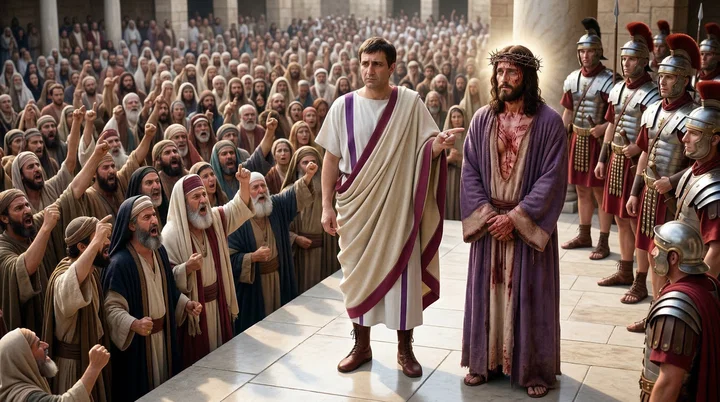
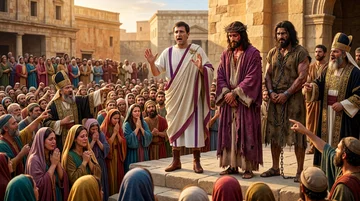
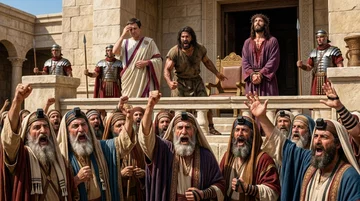
Then answered all the people, and said, His blood be on us, and on our children.
Translations
American King James Version, King James Version, KJV Cambridge Paragraph Bible, Webster Bible
Then answered all the people, and said, His blood be on us, and on our children.
Revised Version, American Standard Version
And all the people answered and said, His blood be on us, and on our children.
and all the people answering said, 'His blood [is] upon us, and upon our children!'
And all the people answering said, His blood [ be] on us and on our children.
And all the people, answering, said—His blood be upon us and upon our children!
Berean Standard Bible, Majority Standard Bible
All the people answered, “ His blood be on us and on our children!”
All the people answered, “ May his blood be on us and on our children!”
And all the people made answer and said, Let his blood be on us, and on our children.
Then answered all the people, and saide, His bloud be on vs, and on our children.
Douay-Rheims (Challoner revision)
And the whole people answering, said: His blood be upon us and our children.
Pictures
Cross-references 20 of 39
- Luke 23:18-25
And they cried out all at once, saying, Away with this man, and release unto us Barabbas:
The crowd demands Jesus’ crucifixion and chooses Barabbas instead.
- John 19:15
But they cried out, Away with him, away with him, crucify him. Pilate saith unto them, Shall I crucify your King? The chief priests answered, We have no king but Cæsar.
The people reject Jesus as king, demand his crucifixion, and declare allegiance to Caesar.
- Mark 15:11-15
But the chief priests moved the people, that he should rather release Barabbas unto them.
The crowd chooses Barabbas and demands Jesus’ death.
- Acts 5:28
Saying, Did not we straitly command you that ye should not teach in this name? and, behold, ye have filled Jerusalem with your doctrine, and intend to bring this man’s blood upon us.
The rulers object to being held responsible for Jesus’ blood.
- John 19:6
When the chief priests therefore and officers saw him, they cried out, saying, Crucify him, crucify him. Pilate saith unto them, Take ye him, and crucify him: for I find no fault in him.
Pilate finds Jesus innocent, but the crowd demands his crucifixion.
- Luke 23:4
Then said Pilate to the chief priests and to the people, I find no fault in this man.
Pilate declares Jesus innocent before the crowd condemns him.
- Revelation 1:7
Behold, he cometh with clouds; and every eye shall see him, and they also which pierced him: and all kindreds of the earth shall wail because of him. Even so, Amen.
Those who pierced Christ will see him coming in glory and mourn.
- Matthew 27:19
When he was set down on the judgment seat, his wife sent unto him, saying, Have thou nothing to do with that just man: for I have suffered many things this day in a dream because of him.
Pilate’s wife warns him against condemning Jesus, the just man.
- John 18:28-40
Then led they Jesus from Caiaphas unto the hall of judgment: and it was early; and they themselves went not into the judgment hall, lest they should be defiled; but that they might eat the passover.
The leaders reject Jesus and press Pilate during his hearing.
- Acts 3:13-15
The God of Abraham, and of Isaac, and of Jacob, the God of our fathers, hath glorified his Son Jesus; whom ye delivered up, and denied him in the presence of Pilate, when he was determined to let him go.
Peter recalls the people rejecting Jesus and choosing a murderer, leading to his death.
- Matthew 27:20
But the chief priests and elders persuaded the multitude that they should ask Barabbas, and destroy Jesus.
The chief priests and elders persuaded the people to choose Barabbas and reject Jesus.
- Luke 23:24-25
And Pilate gave sentence that it should be as they required.
Pilate grants the crowd’s demand and delivers Jesus to their will.
- Matthew 27:21
The governor answered and said unto them, Whether of the twain will ye that I release unto you? They said, Barabbas.
The people choose Barabbas over Christ.
- Luke 23:14
Said unto them, Ye have brought this man unto me, as one that perverteth the people: and, behold, I, having examined him before you, have found no fault in this man touching those things whereof ye accuse him:
Pilate declares Jesus innocent while the people press for his death.
- John 18:39-40
But ye have a custom, that I should release unto you one at the passover: will ye therefore that I release unto you the King of the Jews?
Records the crowd choosing Barabbas instead of Jesus.
- Matthew 23:35-36
That upon you may come all the righteous blood shed upon the earth, from the blood of righteous Abel unto the blood of Zacharias son of Barachias, whom ye slew between the temple and the altar.
The generation will answer for the righteous bloodshed.
- Acts 2:23
Him, being delivered by the determinate counsel and foreknowledge of God, ye have taken, and by wicked hands have crucified and slain:
Peter charges his hearers with taking part in Jesus’ death.
- Luke 23:18
And they cried out all at once, saying, Away with this man, and release unto us Barabbas:
The crowd demands Barabbas’s release and calls for Jesus’ death.
- Matthew 27:3-4
Then Judas, which had betrayed him, when he saw that he was condemned, repented himself, and brought again the thirty pieces of silver to the chief priests and elders,
Judas confesses that he betrayed Jesus, the innocent one.
- Acts 5:30
The God of our fathers raised up Jesus, whom ye slew and hanged on a tree.
Peter declares that the rulers killed Jesus and hanged him on a tree.
Commentary part 1 of 2
Each commentary is drawn from primary sources: the writings of Ellen G. White and Adventist pioneers and periodicals. Each commentary is separate. Its own words are not a quotation; follow the references to read the source passages.
Ellen G. White
85 sources
The cry was the people's answer to Pilate's declaration that Jesus was just and innocent and to his washing of his hands, taking the guilt of His blood upon themselves and their children, yet Pilate still delivered Him to be crucified.COS 154.1–33SP 146.2–3Ms 29, 1909, par. 18 It was raised when Jesus and Barabbas stood before them and they chose Barabbas to be released and repeatedly demanded that Jesus be crucified, though Pilate repeatedly found no fault in Him.AA 42.3DA 739.1–5 The words were a terrible sentence upon themselves and an awful heritage for their descendants, a prayer that was heard and fulfilled about forty years later in the destruction of Jerusalem and its temple with not one stone left upon another.COS 154.1–34SP 32.2–33.2Ms 112, 1897, par. 48 That sentence became a living curse in the scattered, despised and oppressed condition of their children among the nations, and its fulfillment will be complete at the last judgment when those who made the cry see Christ return as King and answer for rejecting Him.COS 154.1–3Ms 112, 1897, par. 48COS 154.6–7COS 154.4–5DA 739.1–5 The judgment-hall choice between Barabbas and Christ still stands before every person, to accept Christ and truth or to reject Him, for to rejectors His death brings the wrath of God unmixed with mercy while to all who receive Him it is hope and eternal life.16MR 259.3–260.1Lt 31, 1898, par. 33–35
Trial Words and Setting
The cry was the people's answer to Pilate's declaration that Jesus was just and innocent and to his washing of his hands to disclaim responsibility, accepting the guilt of His blood upon themselves and upon their children, yet Pilate still delivered Jesus to be crucified.COS 154.1–33SP 146.2–3Ms 29, 1909, par. 18Ms 40, 1897, par. 7–10RH Jan 23, 1900 It followed Pilate's attempt to disclaim guilt for condemning Jesus, but his handwashing did not make him guiltless, and the people's acceptance did not clear him.3SP 146.2–3Ms 40, 1897, par. 7–10 Their words were spoken as they demanded His crucifixion, after Pilate had declared Him innocent yet handed Him over to be killed.RH Jan 23, 1900GC 32.2
Caiaphas first voiced the defiant declaration, the priests and rulers echoed it, and all the people and the crowd took it up together.COS 154.1–33SP 146.2–35RED 66.2ST Jun 3, 1889ST Jul 11, 1878 The priests and rulers called the death-guilt upon themselves and their children in the judgment hall, and the crowd joined in with deliberate defiance.3SP 146.2–3ST Jul 11, 1878DA 785.1 Taken up together it swelled into a loud, inhuman roar.COS 154.1–33SP 146.2–35RED 66.2
The cry was made when Jesus and Barabbas stood before the people, when they chose Barabbas to be released and repeatedly demanded that Jesus be crucified.AA 42.3DA 739.1–5ST Jun 3, 1889 The same voices that had mingled with the rabble calling for His crucifixion shouted for Barabbas instead of Jesus, persisting despite Pilate's appeal that they had proved no wrongdoing against Him.AA 42.35RED 62.3 Pilate repeatedly found no fault in Him and declared himself innocent of the blood of this just person, saying to take Him and crucify Him, and still delivered Christ to be crucified.AA 42.3DA 735.1–5
Pilate knew Jesus was innocent, knew He had been brought to the judgment hall for envy, and knew even while bound and under accusation that His power was the power of God and not of a common man.Ms 112, 1897, par. 33–34 Yet he sought to save Him by the unjust pagan invention and custom of setting free one prisoner condemned to death at the great national festival.Ms 112, 1897, par. 33–34 He presented the true and innocent Christ side by side with the notable Barabbas in hope the contrast between innocence and guilt would be so convincing the people would choose Jesus of Nazareth.Ms 112, 1897, par. 33–34
Barabbas stood as the opposite of Christ, a notorious guilty character who pretended to be Christ and had done great wickedness and wonderful things through satanic agencies.Ms 112, 1897, par. 33–34 Under satanic delusion he claimed whatever he could obtain by theft and robbery and murder was his own.Ms 112, 1897, par. 33–34 He claimed religious power and a right to establish a different order of things and to set the world right.Ms 112, 1897, par. 33–34
The cry was uttered with hasty, awful recklessness by a Satan-inspired multitude, swelling louder and louder until it reached up to the throne of God, calling for Christ's blood to rest on them and their children.Ms 112, 1897, par. 475RED 66.3 It was a display of cruel, reckless presumption that sharpened Pilate's conviction that Jesus is just.5RED 66.3 In response Pilate disclaimed responsibility for Jesus' blood, warned the priests and rulers that God may judge them for their act, and asked Jesus to forgive him for failing to save Him.5RED 66.3
The verse belongs to the trial before Pilate where the Jewish officials and the crowd sought His condemnation.DA 723.1–724.1 By rejecting Christ, the true Passover Lamb, the feast was left without its significance.DA 723.1–724.1
Defiant Rejection of Christ
The words were a deliberate choice against Christ, made in vindictive defiance of His claim and teaching when responsibility for His blood was accepted, and that decision stands recorded for judgment.Ms 23, 1900, par. 7–9COL 293.1–3 It was rash presumption and heartless cruelty, an outburst of uncontrolled passion and satanic madness against the dignified, innocent, suffering Jesus.ST Jun 3, 1889ST Jul 11, 1878ST Nov 2, 1882 It was cruel, reckless presumption that revealed to what lengths religious prejudice, envy, and malice will lead humanity, what enmity and hatred develop in minds turned from the light, and the power of deception upon the human mind.Ms 23, 1885, par. 105RED 66.3ST Nov 25, 1889
Satan stirred the priests, rulers, and crowd, stood at the head of those reviling and crucifying Christ, and inspired the cry to crucify Jesus despite His mercy, love, and compassion.ST Mar 26, 1894ST Mar 12, 1885Lt 132, 1910, par. 4–9 That working shows how Satan's power over the human mind can make people liars and murderers.ST Mar 26, 1894ST Mar 12, 1885 It was done under Satan's delusive power by scribes and elders who professed great zeal for God's honor and deceived themselves that they served God, when rejection of God's chosen instrument was rejection of Christ and insult to the Spirit, from following own will against God's will.ST Feb 27, 1896PP 635.2
In choosing Barabbas over Christ the people chose Satan's rule, yoking with Satan and giving him exaltation.DA 739.1–516MR 259.3–260.1Ms 106, 1897, par. 5 Barabbas placed beside Jesus stood as Satan personified, while Jesus was the Son of God who made the world and all things therein.16MR 259.3–260.1Lt 98, 1900, par. 31–33 In that choosing they fixed Barabbas's character as their own character forever, and as long as time shall last they would feel his cruelty.Ms 112, 1897, par. 48Ms 111, 1897, par. 37 The character chosen in rejecting Christ became their everlasting character, shown in selfish, fraudulent, discontented, unholy lives contradicting their Passover ceremonies.Ms 111, 1897, par. 3712MR 411.3–4
The demand formed under the priests' influence, for the priests inflamed the crowd, persuaded them through envy, instructed them, and were determined Jesus not be released.Ms 40, 1897, par. 7–10ST Jun 3, 1889DA 735.1–5Ms 56, 1894, par. 3–4 The crowd that had hailed Jesus as king turned fickle, hissed, reviled, and demanded His death though He was innocent, pure, and undefiled.DA 394.2–34RED 102.2–103.1Ms 56, 1894, par. 3–4 This was the final climax of rebellion after God sent message after message by His prophets who were persecuted and put to death, when last of all God sent His only begotten Son, the Word made flesh full of grace and truth, and the people He came to save refused Him and condemned Him to crucifixion in Pilate's judgment hall.RH Apr 23, 1901
Guilt and Heavenly Record
Pilate washed his hands to disclaim guilt after declaring Jesus innocent, and the people answered by taking responsibility for his blood upon themselves and their children, but that exchange cleared neither side, for his washing did not make him guiltless and their acceptance did not clear him, and he still delivered Jesus to be crucified in the rejection and condemnation of an innocent Christ driven by the leaders’ envy and persuasion.Ms 40, 1897, par. 7–10SG1 56.1EW 142.3 Tempted by Satan to fear losing power and worldly honor and to fear being denounced as a believer, he acted through fear and for selfish interest and love of honor from great men, consenting to the death of Jesus to protect his position and life when following his own conviction would have left him with nothing to do in condemning Jesus.SG1 56.1EW 142.3SG1 70.2 His choice to deliver an innocent man to die despite recognizing his innocence left him bearing guilt for the blood of the Son of God in lasting despair and anguish.SG1 56.1SG1 70.2
Pilate cannot be represented as the scapegoat, and Satan cannot be the scapegoat because he cannot bear even his own sins.Ms 112, 1897, par. 47 Christ alone is the Scapegoat represented by the goat borne into the wilderness, because he alone, over whom death had no power, was able to bear human sins.Ms 112, 1897, par. 47 The awful cry was uttered with hasty, awful recklessness by a Satan-inspired multitude at the choosing of Barabbas when Pilate washed his hands, swelling louder and louder until it reached up to the throne of God.Ms 112, 1897, par. 47
God was present unseen as a witness who reads hearts, recording the words and acts with unerring accuracy before God and angels, so the cry in the judgment hall reached heaven, stands on record, was written in heaven, and will be met again in the judgment.Ms 23, 1885, par. 10DA 739.1–5ST Mar 26, 1894 That record reveals to what lengths religious prejudice, envy, malice, enmity, and hatred will lead humanity in minds turned from the light, and the power of deception and of Satan over the human mind to make people liars and murderers at the trial and crucifixion.Ms 23, 1885, par. 10ST Mar 26, 1894 Those who stirred and instigated his suffering will see him in glory as King of kings and Lord of lords and answer for rejecting him when he returns as King.DA 739.1–5ST Mar 26, 1894
The blood that could forgive repentant sinners, save the world, and cleanse and save the Jewish nation becomes through rejection the final guilt in their sin, and the guilt with its retribution already began to fall on those responsible for his death.DA 722.5Ms 13, 1892, par. 32–34 Jerusalem’s people called judgment upon themselves when they rejected Jesus and demanded his death, and Jesus foresaw the city’s ruin under the Roman armies and the suffering of its people.Ms 13, 1892, par. 32–34 God providentially used the crucifixion so that Jesus became the Redeemer and Saviour of the world through the very rejection meant to prevent it, but that good outcome did not lessen the guilt of those who caused it.ST Feb 5, 1880
Innocence did not save Jesus from persecution when evil controlled the minds of his tormentors, for after he was dragged from tribunal to tribunal and mocked, derided, spit upon, scourged, and maltreated, Pilate publicly declared he found no fault in him yet the people demanded his crucifixion and invoked responsibility for his death upon themselves and their children.ST Nov 25, 1889 He who so suffered was the divine Son foretold as Wonderful, Counselor, the mighty God, the everlasting Father, the Prince of Peace.ST Nov 25, 1889 In enduring such unjust judgment he is a pattern for his followers, many of whom will have to pass through similar scenes.ST Nov 25, 1889
Doom on Jerusalem Fulfilled
The cry was a terrible sentence upon themselves and an awful heritage for their descendants, a prayer that was heard and the nation's own pronounced doom.COS 154.1–3Ms 112, 1897, par. 48Ms 7a, 1886, par. 17–18 It was fulfilled about forty years later in the destruction of Jerusalem and its beautiful costly temple, with not one stone left upon another despite Titus trying his best to save it, because they knew not the time of visitation.COS 154.1–34SP 32.2–33.2Ms 7a, 1886, par. 17–18 The blood of the Son of God thus rested upon their children and their children's children.Ms 112, 1897, par. 48
That imprecation was fulfilled in the suffering and deaths of Jews during the Roman siege and destruction of Jerusalem.GC 32.2GC88 32.24SP 32.2–33.2 Prisoners were scourged, tortured, and crucified in great numbers, with crosses crowded in the valley of Jehoshaphat and on Calvary, many nailed on crosses planted as thick as forest trees.GC88 32.24SP 32.2–33.2DA 840.5ST Feb 27, 1896 The retribution came in the besieging army, the temple in ruins, and famine and distress in the city.ST Feb 27, 1896 They blindly invoked a doom soon realized, for many of the very women mourning Jesus on the way to Calvary and weeping for him perished with their children in the siege.3SP 151.1–35RED 71.1–3ST Jul 18, 1878ST Nov 16, 1882 Christians who heeded Christ's instruction to flee to the mountains when Jerusalem was compassed with armies perished not.Ms 7a, 1886, par. 17–18
The call for his blood quickly returned as calamity and loss even before the siege.ST Aug 8, 1878 With Jesus dead in Joseph's tomb there was no healer for the crowds who had brought afflicted relatives to the Passover hoping for healing, no skill like his, no friendly hands that never refused the loathsome leper, and no lips to answer I will, be thou clean.ST Aug 8, 1878 There was only mourning in streets and temple courts, the sick dying for want of his touch, and those suspected of leprosy pronounced unclean and driven away crying Unclean, unclean.ST Aug 8, 1878 Thousands felt a great light had gone out leaving an unsupplied blank, while priests and rulers were ill at ease and avoided those calling for Jesus of Nazareth.ST Aug 8, 1878
The national sin brought national ruin, and that ruin was due to the religious rulers.Ms 112, 1897, par. 48 By refusing Christ's offers of mercy Israel worked its own present and eternal ruin and as a nation divorced itself from God.Lt 98, 1900, par. 31–33ST Feb 27, 1896 In rejecting mercy they were left to the mercy of the leader they had chosen.ST Feb 27, 1896 Jerusalem's destruction illustrates the judgment that follows persistent rebellion.Lt 98, 1900, par. 31–33
Lasting Curse and Judgment
The self-invoked sentence became a living, perpetual curse resting on children and children's children, realized in long spiritual separation and fruitlessness and in the scattered, despised, oppressed, persecuted, killed and driven condition of descendants among the nations.COS 154.1–3Ms 112, 1897, par. 48COS 154.4–5EW 177.2–178.1DA 739.1–5 Their continued preservation made them widely regarded as under a curse, and the national sin that chose Barabbas in place of Christ brought national ruin through the religious rulers.Ms 112, 1897, par. 48EW 177.2–178.1 That blood-guilt was fulfilled in Jerusalem's destruction about forty years later and in the later oppression of descendants, yet it will have a further literal fulfillment at the final accounting.COS 154.1–3COS 154.6–7COS 154.4–5
Its fulfillment will be complete at the last judgment, when those who reject God face judgment and those who made the cry see Christ return as King and answer for rejecting Him.COS 154.6–7COS 154.4–5DA 739.1–5 Those who called for His blood will then behold Him honored as King in heavenly glory and will mourn and lament their part in His death instead of triumphing.DA 739.1–5EW 146.3SG1 61.2 The prayer calling His blood upon themselves and their children will be answered at the second coming, when those who pierced, scourged, crucified, mocked and despised Him, especially priests and rulers, will be raised in a special resurrection to behold Him coming in the clouds of heaven attended by the angelic host.
Then the judgment-hall scene will rise before them again with every circumstance plain as if written in letters of fire. They will know and understand as poor, feeble, finite beings that they warred against God, and will suffer in agony and horror the punishment they invoked. In that terror they will cry to the mountains and rocks to fall on them and hide them from the face of Him that sits on the throne and from the wrath of the Lamb.
At the final judgment and coronation those in the maddened throng who spoke the words, with priests and rulers, Satan, his angels and all his subjects, see the crucifixion again and recognize the enormity of their guilt as participants in condemnation and death.4SP 481.2–482.2GC88 666.2–667.2GC 666.1–667.2 Above the throne the cross is revealed, and the betrayal, trials before Annas, Caiaphas, Pilate and Herod, mocking, torture, condemnation, journey to Calvary, hanging, jeering, supernatural darkness, heaving earth, rent rocks and open graves all appear just as they were.GC 666.1–667.2 Those who made the cry have no power to turn from the picture of their own work.GC88 666.2–667.2GC 666.1–667.2
Each recalls the part he performed and is conscious of every sin, seeing where pride and rebellion carried him in violation of God's law.4SP 481.2–482.2GC 666.1–667.2 All behold the enormity of their guilt, and when compelled to look upon Him still wearing humanity in the garb of divinity these deeds are as fresh as when done.GC 666.1–667.221MR 349.6–350.3 They remember with indescribable confusion how love was slighted and compassion abused, and what they might have been had they received Christ and improved the opportunities granted them.GC 666.1–667.221MR 349.6–350.3 They vainly seek to hide from the divine majesty of Christ's countenance outshining the sun, while the redeemed cast their crowns at the Saviour's feet because He died for them.GC 666.1–667.2
Even before that end, after the resurrection that scene stood continually before the priests and rulers by day and by night, its memory never fading.DA 785.1ST Feb 3, 1914 It took peaceful sleep from them and left them no safety behind bolts and bars, filling them with continual dread of coming face to face with Christ in the streets or in their own homes.DA 785.1ST Feb 3, 1914 The blood they invoked came upon them as the blight of God's curse, and the words never ceased to torture the hearts of the speakers.DA 785.1Ms 111, 1897, par. 3712MR 411.3–4
Mercy Refused or Received
Christ prayed for forgiveness for those who called the guilt of his death down upon themselves and their children, yet those who had urged the release of Barabbas and demanded his crucifixion trembled when they realized they had shed the blood of the Son of God and made forgiveness impossible for themselves by refusing conviction, repentance and conversion.Ms 45, 1897, par. 19 They had answered the declaration of innocence with an angry acceptance of responsibility extending to their children, and afterward they turned from light and evidence and continued in rebellion.Ms 22, 1900, par. 17–20
God's rejection of the Jews as a nation did not rule out the conversion of individual Jews.EW 177.2–178.1SG1 106.1–107.1 Such ones may recognize that the prophecy concerning them has been fulfilled, see the nation's sin in rejecting and crucifying him, accept Jesus as the world's Saviour, and be converted.EW 177.2–178.1SG1 106.1–107.1 Those who had joined in the rejection later heard the apostles proclaim that they had crucified the Son of God, their hearts were pierced, and they were invited to repent and receive forgiveness and the gift of the Holy Spirit.ST May 17, 1899
The apostles charged that blood against those who had exercised power over Jesus, because they had willingly taken part and declared themselves answerable.SG1 85.2EW 162.2–163.1 Their guilt was that they had slain and rejected the Son of God.EW 162.2–163.1 The people had publicly and willingly accepted responsibility for his death and invoked its bloodguilt upon themselves and their children.3SP 289.1–27RED 25.2EW 162.1SLP 13.1–2
At the later trial of the apostles over the healed cripple and their preaching of his crucifixion, resurrection and ascension, the rulers who had joined that cry were unwilling to bear the blame for killing Jesus and resisted being charged with his death.3SP 289.1–27RED 25.2EW 162.1SLP 13.1–2 Their refusal to accept that guilt revealed hypocrisy and unwillingness to face their own part, for preaching about his crucifixion, resurrection and ascension angered them because it exposed them as his murderers.Ms 22, 1900, par. 17–20EW 162.1 Their continued rejection appeared in resisting the apostles' testimony about the risen Christ and the healing done in his name.Ms 22, 1900, par. 17–20 It appeared also in the priests' effort to suppress the soldiers' testimony that Jesus had risen, showing continued rejection of the truth about him after their defiant claim that responsibility for his blood would rest on them and their children.Ms 203, 1898, par. 3–6
Jesus never turns away the true penitent and never spurns him.Ms 111, 1897, par. 3712MR 411.3–4 But he hates hypocrisy cloaked by religious profession and by a garment of religion.Ms 111, 1897, par. 3712MR 411.3–4
Present Choice and Warning
The judgment-hall choice between Barabbas and Christ stands as the symbol of the choice facing the world in earth's closing history, still set before every person between Christ Jesus and Barabbas.Lt 31, 1898, par. 33–35 It is a choice to accept Christ and the truth, including the message concerning God's commandments and the faith of Jesus, or to reject Him and accept Satan's falsehoods. Beside Jesus, Barabbas stood as Satan personified, while Jesus was the Son of God who made the world and all things therein, yet the roar of voices like wild beasts demanded Barabbas and demanded that Christ be crucified, thereby choosing Satan before Christ and giving Satan exaltation.16MR 259.3–260.1
That same choosing of Barabbas and crucifying of Christ is being repeated in the world today, with each person individually showing by choice whom he chooses.16MR 259.3–260.1 Though no fault could be found against Christ, the people cast out the Prince of life and chose instead a thief and a murderer, refusing to have Christ rule over them.Lt 31, 1898, par. 33–35 Those who join that cry place themselves on the side of the world against Christ, casting away the Word of God and rejecting His mercy.Lt 31, 1898, par. 33–35
Rejecting the light of heaven is rejecting Christ, the only provision for cleansing from sin, and those who reject Him crucify the Son of God afresh and will answer to God for their choice at the final judgment.Lt 31, 1898, par. 33–35 To such rejectors the death of Christ brings the wrath and judgments of God unmixed with mercy, the wrath of the Lamb, and God will call the world to judgment to avenge the death of His Son.Lt 31, 1898, par. 33–35 To all who receive Him and believe in Him as personal Saviour, the same death is hope and eternal life.Lt 31, 1898, par. 33–35 The people in choosing Barabbas and rejecting Christ refused God's mercy and insisted on their own way, bringing humiliation and the withdrawal of God's protection, so that Jerusalem's destruction illustrates the judgment that follows persistent rebellion.Lt 98, 1900, par. 31–33 Christ's prediction of Jerusalem's destruction also pointed to the world's destruction, because people would continue to refuse God's mercy until the end of earth's history.Lt 98, 1900, par. 31–33
The clamoring for His blood belonged to Satan's effort to turn Jesus' own nation against Him and heap cruelty and scorn upon Him in order to provoke Him to abandon humility and meekness.EW 131.1SG1 39.1 Satan was at the head of those who reviled and crucified Him and led the cruel mob in its abuse, with the purpose to provoke Him to retaliation if possible or to drive Him to perform a miracle to release Himself and thus break up the plan of salvation, for one stain upon His human life, one failure to endure the terrible test, would have made the Lamb of God an imperfect offering and the redemption of man a failure.Lt 132, 1910, par. 4–9 Yet Jesus did not resent this treatment but remained humble and meek, and His suffering proceeded toward the purpose for which He came.SG1 39.1Lt 132, 1910, par. 4–9 He who by a command could bring the heavenly hosts to His aid and could have driven that mob in terror from His sight by the flashing forth of His divine majesty submitted with perfect calmness to the coarsest insults and outrage, and from the manger to the cross lived a sinless life never swerving from allegiance to His Father.Lt 132, 1910, par. 4–9 By His cruel death of shame on the cross of Calvary He proved false Satan's assertion that God's law could not be kept and proved false Satan's charges against God and vindicated God in the sight of the angels in heaven as One willing to make in man's behalf the greatest sacrifice that could be made.Lt 132, 1910, par. 4–9
Their course stands as a warning to those who condemn the Jews while assuming they themselves would never deny or crucify Christ, for God tests professed love for Jesus, and rejection of His message can expose that profession as false.SG1 170.1 The clamoring for Christ's blood is echoed when hostile crowds call for the death of a messenger of truth regarded as a threat, as in the Roman zealots demanding Luther's death as the Jews clamored for Christ's blood.GC 132.3ST Jun 21, 1883SG4 275.3–276.3 The demand for Jesus was insistent and murderous, seeking His life, and the same spirit appears when corrupt religious leaders cry for the blood of a fearless advocate of truth, showing how opposers of a work of truth may respond with hatred and cries for the death of its messenger.ST Jun 21, 1883GW92 57.2–61.1 That same hatred exercised against Jesus would be directed at people who followed their convictions, with those in authority thirsting for their blood.EW 178.3
The Jewish scribes and elders crucified Christ while professing great zeal for the honor of God and deceiving themselves with the belief that they were in the service of God.PP 635.2 Their act was done under Satan's delusive power and from the same spirit of following own will in opposition to the will of God, and rejection of God's chosen instrument was rejection of Christ and insult to the Spirit of God.PP 635.2 Those making the choice of Barabbas over Christ were yoking with Satan, and on the cross the Son of God bore the insults of Satan and his agencies through those men.Ms 106, 1897, par. 5 They kept an outward appearance of sanctity that deceived the people while reviling One who came from heaven to save a perishing world and whose highest object was zeal for right and justice and for the glory of God.Ms 106, 1897, par. 5 Their profession of piety and of love for God and their claim to know the Scriptures neither made them sons of God nor led them to represent His character, so that to spectators with true religion the triumphant shouting in blasphemy against the Commander of all heaven looked like Satan linked with men.Ms 106, 1897, par. 5
The nation's clamoring for His blood as He approached the cross belonged to the trials that would give the disciples cause to mourn and fast amid the rejection and suffering of Jesus, whom they had hoped would reign on David's throne.ST Jul 7, 1898
Sources