Luke 6:8
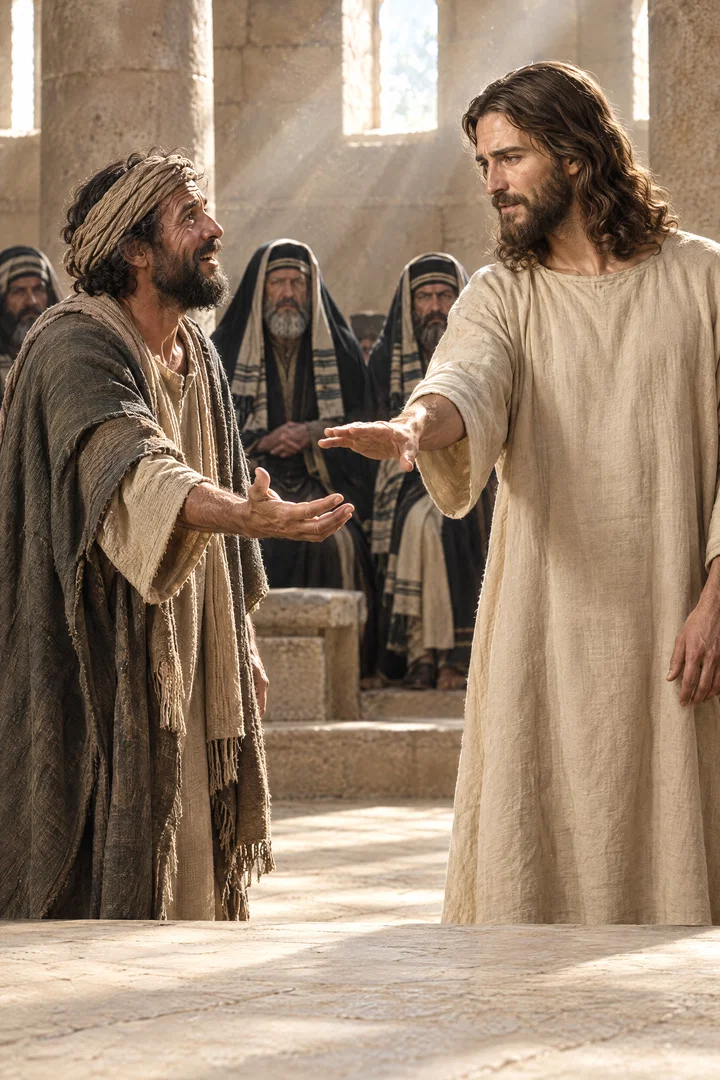
But he knew their thoughts, and said to the man which had the withered hand, Rise up, and stand forth in the midst. And he arose and stood forth.
Translations
But he knew their thoughts, and said to the man which had the withered hand, Rise up, and stand forth in the middle. And he arose and stood forth.
King James Version, KJV Cambridge Paragraph Bible
But he knew their thoughts, and said to the man which had the withered hand, Rise up, and stand forth in the midst. And he arose and stood forth.
But he knew their thoughts, and said to the man who had the withered hand, Rise, and stand forth in the midst. And he arose, and stood forth.
Revised Version, American Standard Version
But he knew their thoughts; and he said to the man that had his hand withered, Rise up, and stand forth in the midst. And he arose and stood forth.
And he himself had known their reasonings, and said to the man having the withered hand, 'Rise, and stand in the midst;' and he having risen, stood.
But he knew their thoughts, and said to the man who had the withered hand, Get up, and stand in the midst. And having risen up he stood [ there].
But, he, knew their reasonings, and said to the man who had the, withered, hand—Arise, and stand forward in the midst! And, arising, he stood forward.
Berean Standard Bible, Majority Standard Bible
But Jesus knew their thoughts and said to the man with the withered hand, “ Get up and stand among us.” So he got up and stood there.
But he knew their thoughts; and he said to the man who had the withered hand, “ Rise up and stand in the middle.” He arose and stood.
But he had knowledge of their thoughts; and he said to the man whose hand was dead, Get up and come into the middle. And he got up and came forward.
But he knew their thoughts, and sayd to the man which had the withered hand, Arise, and stand vp in the middes. And hee arose, and stoode vp.
Douay-Rheims (Challoner revision)
But he knew their thoughts; and said to the man who had the withered hand: Arise, and stand forth in the midst. And rising he stood forth.
Pictures
Cross-references
- Matthew 12:9-13
And when he was departed thence, he went into their synagogue:
Jesus heals a man’s withered hand on the Sabbath and teaches that doing good is lawful.
- Mark 3:1-6
And he entered again into the synagogue; and there was a man there which had a withered hand.
Parallel account of the Sabbath healing and the Pharisees’ response.
- John 5:8-9
Jesus saith unto him, Rise, take up thy bed, and walk.
Both accounts describe Jesus healing a man on the Sabbath.
- Exodus 20:8-11
Remember the sabbath day, to keep it holy.
Christ’s healing is presented as honoring the Sabbath commandment.
- Luke 14:1-5
And it came to pass, as he went into the house of one of the chief Pharisees to eat bread on the sabbath day, that they watched him.
Another Sabbath healing used to answer objections.
- John 9:13-16
They brought to the Pharisees him that aforetime was blind.
A Sabbath healing leads to dispute over Christ’s actions.
- Luke 13:15-16
The Lord then answered him, and said, Thou hypocrite, doth not each one of you on the sabbath loose his ox or his ass from the stall, and lead him away to watering?
Jesus defends healing on the Sabbath as proper mercy.
- Mark 3:5
And when he had looked round about on them with anger, being grieved for the hardness of their hearts, he saith unto the man, Stretch forth thine hand. And he stretched it out: and his hand was restored whole as the other.
The healing followed Jesus’ call for the man to stand forth.
- John 5:10-17
The Jews therefore said unto him that was cured, It is the sabbath day: it is not lawful for thee to carry thy bed.
A Sabbath healing prompts discussion of lawful work.
- Mark 2:23
And it came to pass, that he went through the corn fields on the sabbath day; and his disciples began, as they went, to pluck the ears of corn.
Both describe a Sabbath dispute involving Jesus and healing.
- Mark 3:6
And the Pharisees went forth, and straightway took counsel with the Herodians against him, how they might destroy him.
Pharisees and Herodians plot to destroy Jesus after his Sabbath healing.
Commentary
Each commentary is drawn from primary sources: the writings of Ellen G. White and Adventist pioneers and periodicals. Each commentary is separate. Its own words are not a quotation; follow the references to read the source passages.
Ellen G. White
15 sources
Jesus knew the thoughts of the scribes and Pharisees who were watching to see whether He would heal on the Sabbath so they might accuse Him.COS 73.5–74.7Ms 29a, 1885, par. 6–8 In answer He called the man whose right hand was withered to rise and stand openly in the midst before them all, and the man arose and stood forth.COS 73.5–74.72SP 201.14RED 51.2 The public healing was a good and merciful work to relieve the afflicted and save life, posing the test whether it is lawful on the Sabbath to do good and save life rather than to do evil and destroy it.COS 73.5–74.72SP 294.2ST Jun 13, 1878 It belongs to the controversy in which the scribes and Pharisees accused Jesus, the Lord of the Sabbath, of breaking the Sabbath for going through the cornfield and for this healing.14MR 335.1–39MR 242.118MR 155.1–3 The act sweeps away senseless restrictions and false teaching about the Sabbath while leaving the fourth commandment standing as God gave it, exalting and honoring the day by mercy and upholding its binding claims as the institution He Himself had given.4RED 51.2PK 183.1
Sabbath Confrontation and Healing
The verse belongs to the Sabbath controversy in which Jesus went through the cornfield, plucking ears of corn, and healed the man with the withered hand.14MR 335.1–39MR 242.1 It belongs to the account in which the scribes and Pharisees accused Jesus, the Lord of the Sabbath, of breaking the Sabbath.18MR 155.1–3
Jesus knew the thoughts of the scribes and Pharisees who were watching Him on the Sabbath to see whether He would heal so that they might accuse Him.COS 73.5–74.7Ms 29a, 1885, par. 6–8 In answer He deliberately called the man whose right hand was withered to rise up and stand forth openly in the midst before them all, and the man arose and stood forth.COS 73.5–74.72SP 201.14RED 51.2Ms 238, 1902, par. 7
The healing was a good and merciful work to relieve the afflicted and save life.COS 73.5–74.72SP 294.2ST Jun 13, 1878ST Oct 16, 1879 Making it public posed the test whether it is lawful on the Sabbath to do good and save life rather than to do evil and destroy it, making the healing a public exposure of their unreasonableness.COS 73.5–74.7 The Pharisees, scribes, doctors, and other Jewish religious leaders were furious, enraged, filled with anger and malice, and greatly hostile because they regarded this good work as wrong and improper on the Lord's day.2SP 294.22SP 201.14RED 53.13RED 70.1–2ST Oct 16, 1879
An examination of that healing work would have exposed the weakness and unreasonableness of accusing Him of Sabbath-breaking.COS 73.5–74.7ST Jun 13, 1878 If the Pharisees could have proved Him guilty of Sabbath-breaking they would not have needed false witnesses to testify against Him.Ms 29a, 1885, par. 6–8 After the Sabbath miracle stirred great malice, Jesus withdrew with His disciples to the seaside of Galilee for a more favorable field of labor.4RED 53.1 News of the miracle was noised abroad through all that region, and great multitudes followed Him there.4RED 53.1
True Sabbath Keeping Taught
The call to stand forth corrects false teaching about the Sabbath by establishing that deeds of mercy are lawful on that day.4RED 51.2 The healing breaks down Jewish custom while leaving the fourth commandment standing as God gave it to the world.4RED 51.2 It exalts the Sabbath by sweeping away the senseless restrictions that encumbered it and honors the day by mercy, whereas complaining against the healing and keeping useless rites and ceremonies dishonors the Sabbath.4RED 51.2
The command upholds the binding claims of the Sabbath as the institution He Himself had given and keeps it according to the law of God.PK 183.1 It exposes that Sabbath observance had been perverted to reflect the character of selfish and arbitrary men rather than the character of God.PK 183.1 In that command Christ sets aside the false teaching by which those claiming to know God misrepresented Him, and He goes straight forward in true Sabbathkeeping without even appearing to conform to rabbinical requirements despite their merciless hostility.PK 183.1 Sabbath healing was His regular practice and pattern for His followers, for every Sabbath He spoke words to comfort the sick and healed their disease and never grew weary in that work, and His healing work on the Sabbath was extensive and widespread, beyond computation, with the world as His practice.Ms 238, 1902, par. 7 The Sabbath healing gives warrant for fasting and prayer on the Sabbath in behalf of afflicted and dying ones, trusting the God of heaven to uphold them and raise them up, with the promise that when hearts are humbled before God He will come in and work abundantly.Ms 3, 1879, par. 9–10
Sources
Pioneers and periodicals
29 sources
Jesus knew the unspoken intent of the scribes and Pharisees watching to accuse him for healing on the Sabbath, and openly told the man with the withered right hand to rise and stand in the midst where all could see.ST Mar 12, 1894ST Mar 19, 1894 The man arose in obedience, and Jesus asked whether it is lawful to do good and save life on the Sabbath, then restored his hand whole with new life.ST Mar 19, 1894ST Nov 14, 1900ST Apr 14, 1881 The healing teaches the true use of the Sabbath against burdensome rules, for works of mercy, necessity and charity that relieve suffering and preserve life do not break God's law.ST Apr 14, 1881RH Feb 4, 1862ST Jun 11, 1894ST Mar 4, 1889 As Lord of the Sabbath he kept and honored the commandment rather than abolishing or changing it, vindicating his act as lawful while his critics dishonored the day by plotting harm.ST Jun 11, 1894ST Feb 10, 1904ST Feb 10, 1904ST Nov 18, 1880ST The command carried power to obey, for the man by faith stretched out the hand he could not move and was restored to work and serve, proving Jesus the Messiah.ST Feb 11, 1897
Synagogue Healing Witnessed
He knew the unspoken thoughts and purpose of the scribes and Pharisees while he was teaching in the synagogue on the Sabbath.ST Mar 12, 1894ST Mar 19, 1894ST Mar 12, 1894 They were watching him to see whether he would heal, so they could find grounds to accuse him.ST Mar 19, 1894ST Mar 12, 1894 He knew they sought a charge against him even as the man with the withered hand was present.ST Mar 12, 1894
He publicly told the man whose hand, the right hand, was withered to rise up and stand forth in the midst of the synagogue where all could see him.ST Mar 12, 1894ST Mar 19, 1894 He called him to stand before everyone so the need and what happened would have clear evidence before everyone.ST Jun 11, 1894ST Nov 14, 1900 The man obeyed and arose and stood forth in the middle.ST Mar 12, 1894ST Apr 14, 1881 He also knew the disabled man's unspoken desire to be healed, and spoke the command with authority and tender love.
He then challenged the watchers whether it is lawful on the Sabbath to do good or evil and to save life or destroy it.ST Mar 19, 1894ST Nov 14, 1900ST Apr 14, 1881 He made the good he was about to do publicly visible before healing him.ST Apr 14, 1881ST Feb 10, 1904 He restored the hand whole, with new life and vigor coursing through its fibers.ST Mar 19, 1894ST Jul 21, 1898 The healing occurred on the Sabbath in the synagogue, on the next Sabbath after he and his disciples went through the cornfield where the hungry disciples plucked ears of corn and ate them and the Pharisees complained.ST Nov 26, 1894 This Sabbath-day setting identifies the day the Jews were observing as the true Sabbath known in Christ's time despite the much earlier event when Joshua commanded the sun to stand still.
The religious leaders were filled with madness and anger at the good work done on the Lord's day.ST Oct 16, 1879ST Mar 19, 1894 They conferred what to do to Jesus, persecuted and sought to slay and destroy him and counseled with the Herodians to do it, and fanatical rabbis sought to condemn and repeatedly anathematized him for healing on that day.ST Mar 19, 1894ST Oct 19, 1882 They did the same in condemning the eating of the standing corn.ST Oct 19, 1882 They professed Sabbath sacredness while keeping a man-made Sabbath loaded with human traditions that was identical with the divinely made Sabbath only in time, and by not resting till they crucified him they brought everlasting overthrow of their place and nation.ST Mar 19, 1894
Sabbath Law Honored
Luke 6:8 belongs to Christ's teaching of the true use of the Sabbath, correcting false Sabbath teaching in a dispute over Pharisaic rules that had burdened the Sabbath and made healing seem forbidden.ST Apr 14, 1881RH Feb 4, 1862ST Jun 11, 1894 The healing of the man with the withered hand was a public demonstration that doing good and showing mercy accords with the Sabbath's true purpose, upholding proper observance rather than abolishing it.ST Jun 11, 1894ST Mar 12, 1894 His teaching and practice upheld the Lord's Sabbath against oppressive man-made restrictions that forbade healing and other acts of mercy.ST Mar 12, 1894
Jewish observers regarded the healing as unlawful labor and a borderline violation of Sabbath practice.ST Mar 4, 1889 Yet the Sabbath conduct in view is governed by necessity and mercy, and doing works of mercy, necessity, and charity on the Sabbath did not break God's law.ST Mar 4, 1889RH Jun 18, 1861ST Feb 27, 1912
Jesus did not break the Sabbath law but interpreted it correctly and vindicated his actions as lawful, opposing Jewish traditions that restricted lawful conduct.ST May 17, 1910ST Jun 6, 1878 He publicly directed the man to act on the Sabbath, speaking himself while the man stretched out his arm, and neither act was forbidden by the Sabbath law.RH Feb 4, 1862 That public call to stand forth condemned the Jewish custom of restricting Sabbath activity, for doing good on the Sabbath is lawful and in harmony with God's law.ST Feb 10, 1904ST Mar 12, 1894 An examination of that relieving work to aid the afflicted would have exposed the weakness of accusing him of Sabbath-breaking.ST Jun 13, 1878
Sabbath rest permits works of mercy that relieve suffering and preserve life and comfort.ST Mar 3, 1914ST The Sabbath is a merciful institution designed as a boon to the human family, a day of delight for bringing joy and blessing and lightening burdens, for seeking and doing good through charity and mercy.ST Mar 19, 1894ST Jul 21, 1898 It is a day for unloosing the bands of sin, undoing heavy burdens, and letting the oppressed go free, a purpose proved when new life and vigor coursed through the fibers of the disabled hand.ST Jul 21, 1898
As Lord of the Sabbath Jesus kept the law of the Sabbath rather than rescinding, abolishing, or changing the commandment.ST Jun 11, 1894ST Nov 18, 1880ST Jun 6, 1878 Curing the withered hand was a work beneficial to life of the kind the law excepts from the sacredness of the Sabbath and proper for the day.ST Nov 18, 1880 By that beneficent action he maintained the Sabbath as his own institution and gave additional sanctity to the day consecrated from the beginning by the Father's blessing.ST Nov 18, 1880 He honored the Sabbath while his critics dishonored it, and declared by fact that he came not to destroy the law but to fulfill it.ST Feb 10, 1904ST Nov 18, 1880
The healing exposed the contrast between his work of healing and the watchers' murderous intent and hatred.ST Feb 10, 1904 It is better to do good, save life, and show mercy on the Sabbath than to harbor hatred or plan harm, and the Sabbath does not forbid deeds of mercy.ST Feb 10, 1904 God does not use the Sabbath to bring suffering on his children by forbidding what is necessary for life and comfort.ST For this reason the command to kindle no fire on the Sabbath belonged to the warm wilderness wanderings where fire was needed only to cook food, which was not to be done on that day, and does not forbid fire needed for life and comfort.ST
The healing did not make Jesus a transgressor of God's law or a sinner.ST Jun 13, 1878RH Nov 1, 1853 To call it a violation would make his sacrifice a sinner's sacrifice and undermine the basis for pardon and salvation.RH Nov 1, 1853
Messiah Proved and Obeyed
The command to the man whose right hand was withered to rise up and stand forth in the midst, followed by his healing, proves Jesus is the Messiah, the Shiloh of Jacob. The calling of the man forward before the others and his obedience and healing raises the question of whether Jesus is the Messiah called Shiloh.
Jesus brought the man with the withered hand into the midst of the synagogue, where his need and his healing would be seen by all, and healed him on the Sabbath despite the disapproval of onlookers. The man obeyed the command despite being unable to move his hand, and by faith relied on the power in the command, stretched it out, and was restored.ST Feb 11, 1897 God's commands carry the strength needed to obey them.ST Feb 11, 1897 The healing restored his ability to work and care for his family, and he offered his restored strength in service to God.
The telling of the man to step forward into the midst and his obeying is an example of acting in faith for others to follow.RH Jun 8, 1869 People should do what they can in response to God, trusting Him to sustain them and seeking to honor Him and advance His cause.RH Jun 8, 1869
The healing of the poor man with the withered hand in the synagogue took place on a Sabbath day, the next Sabbath after Jesus and His disciples went through the cornfield where the hungry disciples plucked ears of corn and ate them and the Pharisees complained.ST Nov 26, 1894 Both events happened on the Sabbath, giving no basis for keeping Sunday in place of the Sabbath.ST Nov 26, 1894 Luke 6:6-11 records a real healing by Christ, including the command to the man with the withered hand to stand forth. That healing did not take place on Sunday, and the Jewish leaders did not censure Christ for healing people on Sunday. To say so misstates the Biblical record, discredits the miracle, and falsely makes Christ a keeper of Sunday.
Sources