Luke 9:12
And when the day began to wear away, then came the twelve, and said unto him, Send the multitude away, that they may go into the towns and country round about, and lodge, and get victuals: for we are here in a desert place.
Translations
And when the day began to wear away, then came the twelve, and said to him, Send the multitude away, that they may go into the towns and country round about, and lodge, and get victuals: for we are here in a desert place.
King James Version, KJV Cambridge Paragraph Bible
And when the day began to wear away, then came the twelve, and said unto him, Send the multitude away, that they may go into the towns and country round about, and lodge, and get victuals: for we are here in a desert place.
And when the day began to decline, then came the twelve, and said to him, Send the multitude away, that they may go into the towns and country around, and lodge, and get victuals: for we are here in a desert place.
And the day began to wear away; and the twelve came, and said unto him, Send the multitude away, that they may go into the villages and country round about, and lodge, and get victuals: for we are here in a desert place.
And the day began to wear away; and the twelve came, and said unto him, Send the multitude away, that they may go into the villages and country round about, and lodge, and get provisions: for we are here in a desert place.
And the day began to decline, and the twelve having come near, said to him, 'Let away the multitude, that having gone to the villages and the fields round about, they may lodge and may find provision, because here we are in a desert place.'
But the day began to decline, and the twelve came and said to him, Send away the crowd that they may go into the villages around, and [ into] the fields, and lodge and find victuals, for here we are in a desert place.
And, the day, began to decline; and the twelve, coming near, said to him—Dismiss the multitude, that, going into the surrounding villages and hamlets, they may lodge, and find provisions; because, here, in a desert place, are we.
Berean Standard Bible, Majority Standard Bible
As the day neared its end, the Twelve came to Jesus and said, “Dismiss the crowd so they can go to the surrounding villages and countryside for lodging and provisions. For we are in a desolate place here.”
The day began to wear away; and the twelve came and said to him, “Send the multitude away, that they may go into the surrounding villages and farms and lodge and get food, for we are here in a deserted place.”
And the day went on; and the twelve came to him and said, Send these people away so that they may go into the towns and the country round about and get resting-places and food for themselves, for we are in a waste place.
And when the day began to weare away, the twelue came, and sayd vnto him, Sende the people away, that they may goe into the townes and villages round about, and lodge, and get meate: for we are here in a desart place.
Douay-Rheims (Challoner revision)
Now the day began to decline. And the twelve came and said to him: Send away the multitude, that going into the towns and villages round about, they may lodge and get victuals; for we are here in a desert place.
Pictures
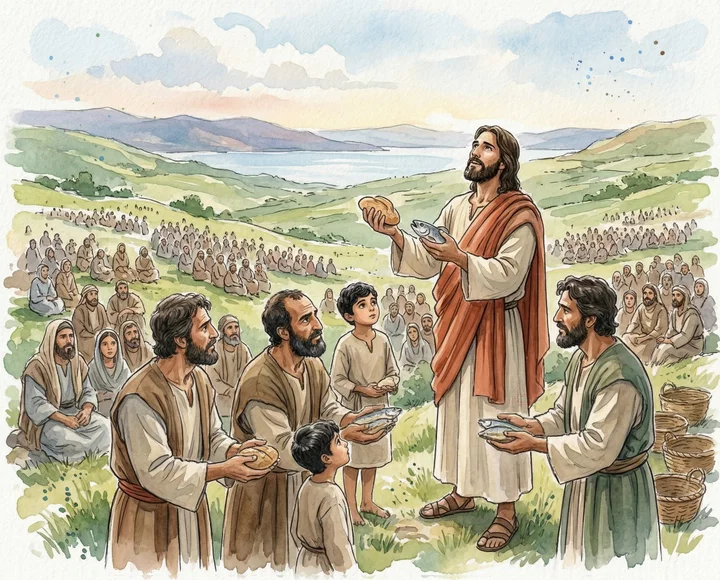
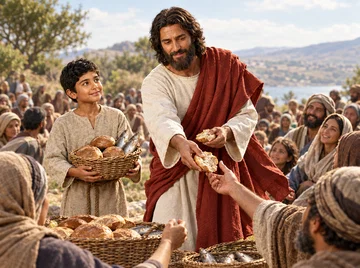
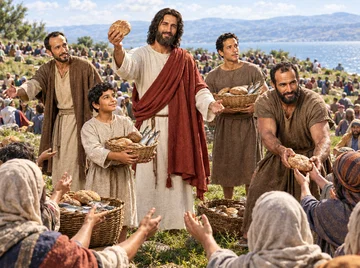
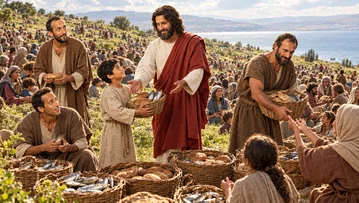
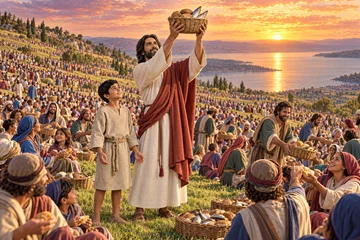
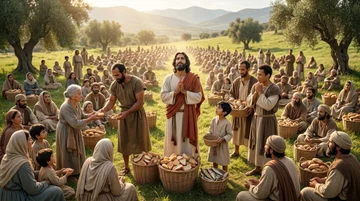
Cross-references
- Matthew 14:15-21
And when it was evening, his disciples came to him, saying, This is a desert place, and the time is now past; send the multitude away, that they may go into the villages, and buy themselves victuals.
The disciples urge Jesus to send the crowd away as evening approaches, but he feeds them.
- John 6:5-13
When Jesus then lifted up his eyes, and saw a great company come unto him, he saith unto Philip, Whence shall we buy bread, that these may eat?
Both recount Jesus feeding the hungry multitude with a small supply of loaves and fish.
- Mark 6:35-44
And when the day was now far spent, his disciples came unto him, and said, This is a desert place, and now the time is far passed:
The disciples ask to send the crowd away as evening approaches, before Jesus feeds them.
- Mark 6:39-44
And he commanded them to make all sit down by companies upon the green grass.
The parallel account describes the crowd sitting in groups and being fed.
- John 6:12
When they were filled, he said unto his disciples, Gather up the fragments that remain, that nothing be lost.
Jesus commands the disciples to gather the food remaining after the multitude is fed.
- Matthew 14:21
And they that had eaten were about five thousand men, beside women and children.
Gives the crowd as five thousand besides women and children.
- 2 Kings 4:42-44
And there came a man from Baal-shalisha, and brought the man of God bread of the firstfruits, twenty loaves of barley, and full ears of corn in the husk thereof. And he said, Give unto the people, that they may eat.
Both accounts show God miraculously multiplying food to feed a crowd.
- Matthew 15:32
Then Jesus called his disciples unto him, and said, I have compassion on the multitude, because they continue with me now three days, and have nothing to eat: and I will not send them away fasting, lest they faint in the way.
Both describe concern that hungry people in a wilderness will faint without food.
- John 6:7
Philip answered him, Two hundred pennyworth of bread is not sufficient for them, that every one of them may take a little.
Philip says two hundred pennyworth of bread would not feed the multitude.
- Luke 9:17
And they did eat, and were all filled: and there was taken up of fragments that remained to them twelve baskets.
filling of all and amount left
- Mark 8:1-9
In those days the multitude being very great, and having nothing to eat, Jesus called his disciples unto him, and saith unto them,
Parallel account of the other feeding miracle mentioned.
- Deuteronomy 8:3
And he humbled thee, and suffered thee to hunger, and fed thee with manna, which thou knewest not, neither did thy fathers know; that he might make thee know that man doth not live by bread only, but by every word that proceedeth out of the mouth of the LORD doth man live.
Both texts connect wilderness hunger with God’s provision of food.
- Matthew 14:22-33
And straightway Jesus constrained his disciples to get into a ship, and to go before him unto the other side, while he sent the multitudes away.
immediately followed feeding, Peter walked
- Mark 6:34
And Jesus, when he came out, saw much people, and was moved with compassion toward them, because they were as sheep not having a shepherd: and he began to teach them many things.
Jesus has compassion on the crowd, like sheep without a shepherd.
Commentary
Each commentary is drawn from primary sources: the writings of Ellen G. White and Adventist pioneers and periodicals. Each commentary is separate. Its own words are not a quotation; follow the references to read the source passages.
Ellen G. White
43 sources
As the day wore toward evening in a remote desert place far from towns where food and lodging could be found, the twelve urged Jesus to send the hungry multitude away to provide for themselves.Ms 197, 1907, par. 1–4ST May 10, 1883RH Apr 8, 19092T 435.3ST Aug 12, 1897 About five thousand men besides women and children had stayed with Him all day, hungry and faint, and though His rest was broken He pitied them as sheep without a shepherd, teaching and healing them, and would not send them away fasting lest they faint by the way.RH Jan 18, 1912DA 364.22SP 261.2–262.2ST May 20, 1886DA 368.2–3 Instead He had them sit in companies on the grass, blessed the only supply at hand of five barley loaves and two small fishes, and had the disciples distribute it until all were satisfied and twelve baskets of fragments were gathered.Ms 197, 1907, par. 1–43RED 55.2RH Apr 8, 1909Lt 121, 1904, par. 14–16Ms 186, 1907, par. 8–9 The increase of the food draws aside the veil from nature to reveal His creative power constantly feeding millions from earth's harvests, giving evidence that He is the world's Redeemer with omnipotent beneficence whom the people rightly recognized as the promised Messiah.ED 107.32SP 262.3–263.1Ms 114, 1899, par. 1–3ST Aug 12, 1897 The verse therefore teaches dependence on God in strait places after following His direction, for His command Give ye them to eat is both command and promise; His workers are to receive from Him and impart to needy seekers with compassion rather than sending them away faint, and to gather the fragments in faithful economy so that nothing is wasted.STB 772.1–2DA 368.2–36T 263.1DA 369.1ST Aug 12, 1897
Time, Place, and Crowd
The day was wearing away toward evening at the close of a full day in which a vast crowd had been taught and healed.RH Jan 18, 1912ST May 10, 1883RH Apr 8, 19092SP 261.2–262.2ST The disciples felt the lateness of the hour and the practical pressure of hunger, lodging, and failing light upon people who had been without food all day.2SP 261.2–262.2ST May 20, 1886STST May 10, 1883ST Mar 18, 1913 Their concern grew as evening approached because the crowd was in a deserted place without nearby supply.ST May 10, 1883RH Apr 8, 19092SP 261.2–262.2ST May 10, 1883
That place was a desert, remote and secluded beyond the towns and surrounding countryside, where food and lodging could not readily be obtained.ST May 10, 1883RH Apr 8, 1909STB 772.1–2ST May 10, 1883ST Aug 19, 1897 Food was not nigh at hand and no apparent means of provision was in sight.ST May 20, 1886DA 368.2–3ST Aug 19, 1897 About five thousand men besides women and children were present, including weary mothers and children who had followed through the day and were hungry and faint as the sun was setting.RH Jan 18, 1912ST May 20, 1886DA 368.2–3ST Mar 18, 1913
Jesus had withdrawn with His disciples to a secluded place for peaceful rest, expecting to be undisturbed there.DA 364.1 The multitude missed Him and followed the direction He had gone, many going by land and others following by boat across the water.DA 364.1 With Passover at hand, bands of pilgrims on their way to Jerusalem joined to see Him until they were assembled and waiting on the shore before He arrived, while He landed unobserved and spent a little time apart with the disciples.DA 364.1
Though His rest was interrupted, He saw the people as sheep without a shepherd and was moved with compassion.DA 364.2 He gave them the help their spiritual need required by teaching them the way of salvation.DA 364.2 That help was what the priests and rulers had not given, but which the people received from Him.DA 364.2 They stayed with Him away from the cities in a retired grassy place until their own food was used up, weary and hungry, described as being with Him three days.ST May 20, 1886DA 368.2–3Ms 64, 1910, par. 10–11
The feeding took place on a barren shore on the preceding day.ST Dec 29, 1887 After being fed, the multitude left Jesus there, knowing no boat had been left by which He could depart, and He watched their departure with compassionate eyes.ST Dec 29, 1887 News of the miracle spread far and near, so that on the following morning the people returned early in large numbers by land and water to the spot where they had last seen Him.ST Dec 29, 1887
Request and Meager Supply
As night drew near the twelve urged Jesus to send the multitude away into the surrounding towns and country to find lodging and get food, because they were in a desert place with no supply for so many.Ms 197, 1907, par. 1–42T 435.3ST Aug 12, 1897Lt 3, 1859, par. 4–5 Their counsel arose as the day was wearing away and evening approached, when eager listeners who had stayed through the day to hear truth would otherwise have to seek provision for themselves.2T 435.3ST Aug 12, 1897Lt 3, 1859, par. 4–5 Jesus rejected that course and would not send them away, but met their hunger with compassion by His divine power.Ms 197, 1907, par. 1–4ST Aug 12, 1897Lt 3, 1859, par. 4–5
All that could be found at hand was five barley loaves and two small fishes with a lad, which was nothing among so many.ST May 20, 1886ST Mar 18, 1913Ms 186, 1907, par. 8–9Ms 73, 1909, par. 20–21 Philip judged that two hundred pennyworth of bread would not give each even a little, and Andrew could point to no more than that small store.ST May 20, 1886ST Mar 18, 1913 The question of where food for so great a company could be found was raised as evening drew on, when five thousand men besides women and children had listened all day and some were fainting.ST Mar 18, 1913Ms 186, 1907, par. 8–9Ms 73, 1909, par. 20–21 Jesus Himself asked what food was on hand and how much they had, bringing to light those five loaves and few small fishes.Ms 186, 1907, par. 8–9Ms 73, 1909, par. 20–21
He would not send the people away unrefreshed to return home hungry or to faint by the way.2SP 261.2–262.2ST May 20, 1886STST Mar 1, 1877 Though He asked about obtaining bread, He already knew how He would provide, and He asked to test the faith of the disciples.ST May 20, 1886STST Mar 1, 1877 The disciples saw only the difficulty of caring for so large a multitude in a deserted place without nearby food, yet Jesus did not want them to go home fasting.2SP 261.2–262.2STST Mar 1, 1877
He was one with them in their need of food and would not suffer them to return fasting to their homes.ST May 20, 1886DA 368.2–3 He who for their sake had fasted forty days in the wilderness would not allow the multitude to suffer for lack of food.ST May 20, 1886DA 368.2–3 He who had refused to work a miracle to satisfy His own hunger in the wilderness depended on His heavenly Father for means to relieve their necessity, providence having placed Him there with them.ST May 20, 1886DA 368.2–3
Miracle of Satisfying Thousands
Instead of dismissing the crowd to find lodging and food, He kept them with Him and had them seated in companies on the grassy ground. Ms 197, 1907, par. 1–4Ms 186, 1907, par. 8–9Ms 64, 1910, par. 10–11Ms 182, 1907, par. 21–23Ms 73, 1909, par. 20–21 A hymn was sung, and He took the five barley loaves and few small fishes, pronounced blessing upon them, broke the bread and divided the fishes, and placed them in the hands of the disciples to carry to the people. Ms 197, 1907, par. 1–4Ms 186, 1907, par. 8–9Ms 64, 1910, par. 10–11Ms 182, 1907, par. 21–23Ms 73, 1909, par. 20–21 He first asked what food was on hand, and when the small store was brought He commanded the multitude to sit down so He could break and distribute through the disciples. Ms 186, 1907, par. 8–9Ms 64, 1910, par. 10–11Ms 73, 1909, par. 20–21
The supply did not diminish in the giving but increased as the disciples distributed it, and as they emptied their hands they returned to Him for more and kept imparting what they received. Ms 197, 1907, par. 1–43RED 55.26T 263.1Ms 64, 1910, par. 10–11Ms 182, 1907, par. 21–23 In this way all five thousand men besides women and children ate until their hunger was fully satisfied, with food still remaining in His hands as He kept giving. 3RED 55.2RH Apr 8, 19096T 263.1Ms 64, 1910, par. 10–11Ms 182, 1907, par. 21–23 The disciples themselves also ate from what He provided, and the provision illustrates how gifts given in faith and used to meet the needs of others are multiplied by God. 6T 263.1STB 119.3–4
When all were filled twelve baskets of fragments remained over from the five loaves and two fishes. 3RED 55.2RH Apr 8, 1909Lt 121, 1904, par. 14–16 He then commanded that the fragments be gathered up so that nothing would be lost and no gift capable of benefiting others would be squandered. Ms 197, 1907, par. 1–4ST Dec 15, 1909Ms 64, 1910, par. 10–11Ms 182, 1907, par. 21–23 What seemed a meager store thus became enough for the eater and something to share beyond those who had eaten. Lt 121, 1904, par. 14–16ST Dec 15, 1909
Divine Power and Identity
The feeding that follows the request to send the crowd away draws aside the veil from nature and reveals the creative energy constantly exercised for human good.ED 107.3 The same One who multiplied the loaves multiplies the seed cast into the ground, and by that daily miracle millions are fed from earth's harvest fields.ED 107.3 Men are called to cooperate with Him in caring for the grain and preparing the loaf.ED 107.3 That cooperation makes them lose sight of the divine agency, crediting His working to natural causes or to human instrumentality.ED 107.3 Too often they pervert His gifts to selfish uses until they become a curse instead of a blessing, and God seeks to quicken dull senses to discern His merciful kindness so His gifts become the blessing He intended.ED 107.3
The One who fed the multitude in lowliness and poverty where provision was scanty is the same One who had worked the same wonder for one hundred men in Old Testament times.Ms 114, 1899, par. 1–3 He is the same One who supplied His people in the wilderness with bread and with clear flowing streams, the Coming One who declared Before Abraham was, I AM, and who is greater than Moses.Ms 114, 1899, par. 1–3 His grace upon the small portion makes it all-sufficient, His hand can multiply it a hundredfold, and from His resources He can spread a table in the wilderness for more than a million people, increasing scanty provision by His touch until it is sufficient for all.Ms 114, 1899, par. 1–3 By feeding them there instead of sending them away Jesus gave evidence that He is the world's Redeemer possessing omnipotent power and beneficence.2SP 262.3–263.1ST Aug 12, 1897 The people recognized the abundance as evidence of His divine power and concluded that He is the promised Messiah and Deliverer.2SP 262.3–263.1
Their response led them to plan to make Him king by force, a purpose He rejected because it would obstruct His work of mercy and teaching.2SP 262.3–263.1 The account showed His love for people and was part of His mission.Ms 18, 1898, par. 11 It belongs to the larger teaching that preaching and healing belong together, and that each person must take up the cross and follow Christ.Ms 72, 1911, par. 1–5
Faith in Strait Places
The multitude of five thousand men besides women and children were in the wilderness far from home as night was close at hand, having come without invitation or command to hear instruction, and after listening so long they were hungry and faint, many without means to purchase food.DA 368.2–3 Jesus was one with them in their need of food and would not suffer them to return fasting to their homes, He who for their sake had fasted forty days in the wilderness.DA 368.2–3 Though food was not nigh at hand and apparently He had no means at His command, the providence of God had placed Him there and He depended on His Heavenly Father for the means to relieve the necessity.DA 368.2–3 Dependence upon God when brought into strait places after following His directions is the teaching here; in every emergency help is to be sought from Him who has infinite resources at His command, and He will deliver and keep every soul brought into perplexity through trying to keep the way of the Lord.DA 368.2–3
When difficulties arise despite following the best knowledge and using the means God provides, with food not readily available and no apparent means, people should seek God's wisdom, depend on Him, and not give up in discouragement.ST Aug 19, 1897 The disciples saw how great the need was and how small the means in their hands, so that their hearts sank and their faith failed and they wanted the multitude sent away to provide for themselves.DA 369.1 The same condition comes when the need is great and the means are small, bringing hesitation and unwillingness to give all that is had for fear of spending and being spent for others.DA 369.1 Against that fear stands the command Give ye them to eat, which is both a command and a promise, and behind it is the same power that fed the multitude beside the sea.DA 369.1
Disciples receive from Christ what they are to give to people in need, and as they distribute the gift it increases.6T 263.1STB 148.2–3STB 119.3–4Lt 7, 1901, par. 1–3 Those who labor together with God carry out Christ's purposes.Lt 7, 1901, par. 1–3 The five loaves and two fishes distributed to the tired, hungry five thousand increased as they were given out, and the disciples themselves also ate from what was provided.6T 263.1 God can bless the means people give and enable them to feed those who hunger for the bread of life, multiplying gifts given in faith and used to meet the needs of others.STB 148.2–3STB 119.3–4 The work is not to be stopped and measured by the means at hand, for to do so shows very limited faith.2MR 283.1–284.2 Whether means are large or small, the duty is to plan and work in faith and go forward to diffuse the gospel over the whole earth, for the scattered meager supply placed into missionary work will be multiplied by God as it is imparted until all eat and are filled.2MR 283.1–284.2
What seems like a meager supply can become enough for oneself and something to share with others.Lt 121, 1904, par. 14–16Ms 66, 1900, par. 11–12 The feeding from five loaves and two fishes satisfied the crowd and left twelve baskets of fragments, showing He can provide abundantly even when the available means appear far too small.Lt 121, 1904, par. 14–16Ms 66, 1900, par. 11–12 It is an object lesson that encourages faith and giving to meet urgent needs, for what seems insufficient can become more than enough in the Lord's hands.Ms 66, 1900, par. 11–12 Those who work with Him can seek and receive the tact, skill, and understanding needed for their work.Ms 14, 1902, par. 4
Compassionate Ministry to Seekers
As evening approached and the day wore away, the disciples saw the crowd's practical need for food and lodging and urged sending them to the nearby towns and country because they were in a remote desert place.RH Jan 18, 1912Ms 182, 1907, par. 21–23Lt 3, 1859, par. 4–5 That crowd had followed throughout the day, including weary mothers and children, staying through the day to hear truth and refusing to leave until hungry and fainting in the desert.RH Jan 18, 1912Ms 182, 1907, par. 21–23Lt 3, 1859, par. 4–5 Concern for teaching them all day did not make Him indifferent to their physical needs, for He Himself noticed their weariness and hunger and determined to feed them rather than send them away.RH Jan 18, 1912Ms 182, 1907, par. 21–2317MR 252.3Lt 3, 1859, par. 4–5 He met that need with compassion by His divine power, taking five loaves and a few fishes, having the people sit down in companies, blessing and multiplying the food and giving it through the disciples to five thousand men besides women and children until hunger was satisfied and food still remained in His hands as He kept imparting it.Ms 182, 1907, par. 21–2317MR 252.3Lt 3, 1859, par. 4–5 After all were satisfied He required gathering the fragments so nothing would be lost, which means God gives means to be imparted to the needy and not wasted, gambled away, or taken from others by scheming, and He can still provide for His people by imparting knowledge that enables them to find food in different places, for His benevolence continues.Ms 182, 1907, par. 21–2317MR 252.3
The verse teaches the compassion and interest to be felt for fellow men who are seeking to know the way of salvation.ST Aug 12, 1897 Those anxious to hear the word of life must be given opportunity, and when weary and hungry they must not be neglected or sent away faint, weary, and discouraged.ST Aug 12, 1897 It is Christian duty to do all that is possible by brethren to help such people, to study the best ways of helping them, to never make the way to Christ wearisome and objectionable, and to remove everything that would obstruct the path.ST Aug 12, 1897
Dedicated workers receive the Holy Spirit so they can communicate supply to those in necessity instead of sending them away.Ms 186, 1907, par. 8–9 Christ remains attentive to those who come to Him for help as their sanctuary, helper, and great leading Physician, leading the crowd to a grassy plot to be seated, asking what food is on hand, taking the five loaves and few small fishes, giving them to the disciples to distribute, and supplying enough for five thousand besides women and children, with some fainting yet none sent away.Ms 186, 1907, par. 8–9 The lesson is to care for those who lack, including those who have not received the truth, and to give and work so the truth can reach people everywhere, the five loaves and two small fish being passed around to feed them as an example of sharing what is had.Ms 180, 1907, par. 27–28
God can bless the means people give and enable them to feed those who hunger for the bread of life.STB 148.2–3Ms 66a, 1900, par. 30–31 Jesus' blessing multiplied a scanty provision of five loaves and two small fish until it supplied the need of five thousand men besides women and children in a deserted place, showing that God can likewise bless unselfish gifts and increase limited resources to support His work.STB 148.2–3Ms 66a, 1900, par. 30–31 His example in feeding the multitude provides lessons for carrying out food work, including using simple, inexpensive methods.Ms 197, 1907, par. 1–4Lt 302, 1906, par. 517MR 252.3 Instead of sending them away He bade the people sit down, a hymn was sung, He broke the bread with blessing upon it and placed pieces of the fishes in the hands of His disciples, and as they put them in the hands of the hungry ones they came back to get more, kept imparting what they received until all were satisfied.Ms 197, 1907, par. 1–4 His workers learn from this to build sanitariums plain and simple with no extravagance in anything, yet with room to take care of people and impress them, while every action of like character is to make an impression on human minds that is never lost, so that all who are healed and see His miracles keep the impression of truth in their minds.Ms 197, 1907, par. 1–4
Economy and Faithful Stewardship
The request in Luke 9:12 arose as the day was ending in a remote place where the hungry multitude needed food and lodging, yet instead of sending them away Christ fed them and required that what remained be gathered so nothing would be wasted.STB 772.1–2ST Dec 15, 19092T 435.3 That gathering shows God's gifts are not to be wasted, and careful use of food and money is part of faithful stewardship, with nothing that can benefit others to be squandered.STB 772.1–2ST Dec 15, 19092T 435.3 The lesson illustrates the value of economy and thrift, especially in trying circumstances.STB 772.1–2ST Dec 15, 19092T 435.3
The surplus bread was shared with people beyond those who had eaten, illustrating that those who receive spiritual blessings should pass on the bread of life and what they have learned of God.ST Dec 15, 1909 The command to gather the fragments and let nothing be lost means more than saving little pieces of food.Ms 197, 1907, par. 1–4Ms 64, 1910, par. 10–11 Every action of like character is to make an impression on human minds that is never lost, so that all who are healed and see His miracles keep the impression of truth in their minds.Ms 197, 1907, par. 1–4Ms 64, 1910, par. 10–11 All the works of Christ manifested in the present day by message or by any helpfulness are to be held as a credit.Ms 197, 1907, par. 1–4Ms 64, 1910, par. 10–11 His workers learn from this to build sanitariums plain and simple with no extravagance in anything, yet with room to take care of people and impress them.Ms 197, 1907, par. 1–4
God gives means to be imparted to the needy, and after all were satisfied He required the gathering of the fragments so nothing was lost.Ms 182, 1907, par. 21–23 That means is not to be wasted, gambled away, or taken from others by scheming.Ms 182, 1907, par. 21–23
Sources
Pioneers and periodicals
45 sources
Late in the day as evening drew near the great crowd was with Jesus in a deserted place far from food and lodging, hungry and faint after a whole day without eating.ST May 20, 1886ST May 7, 1894ST Jul 26, 1905ST Sep 18, 1893 The disciples were concerned at the need and urged him to send the people away into the surrounding towns and country to find lodging and buy victuals.RH Jan 18, 1912STRH May 29, 1900ST Oct 12, 1904 He would not send them away to faint by the way, but refused their plan and told them to feed the multitude themselves.ST May 20, 1886STSTST Mar 1, 1877ST From only five barley loaves and two small fishes he gave thanks and multiplied the food through the disciples until all ate to full satisfaction and twelve baskets remained.ST May 20, 1886ST Apr 11, 1906ST May 7, 1894ST Sep 18, 1893ST Dec 22, 1887 His care shows he receives all who come and is not indifferent to bodily need, so those who follow him must not send the weary hungry away discouraged but do all possible to help them, trusting the same Christ who gives spiritual truth to give daily bread.RH Jan 18, 1912ST Aug 12, 1897RH May 29, 1900RH May 29, 1900
Words and Timing
The day beginning to wear away marks the first evening, when the request to send the crowd away for food and lodging was made and the feeding of the five thousand began.RH Apr 20, 1876 That feeding took considerable time, and the later evening after the dismissal of the crowd was a distinct evening.RH Apr 20, 1876 The two are separate evenings in the same day.RH Apr 20, 1876 The wearing away of the day means evening was drawing near before sunset, not an evening beginning at three o'clock.ST Sep 21, 1915
The word rendered lodge means finding lodging or being received as a guest, not destroying.RH Jul 16, 1857 The same Greek word therefore carries different meanings in different contexts.RH Jul 16, 1857 The verse is also an example of the Greek word broma meaning food, as the crowd in the desert place needed to be sent to find food as the day wore on.ST Dec 16, 1897
Place and Setting
Late in the day as evening approached the crowd was in a deserted, remote place far from where food and lodging could be obtained, so lodging and victuals would have to be sought in the surrounding towns, villages and countryside.ST May 10, 1883ST May 7, 1894ST Jul 26, 1905ST Feb 1, 1899 The disciples were concerned at the close of the day because the crowd was far from places where food could readily be obtained, and their request to dismiss the people reflected the practical need for food and the difficulty of meeting it there.ST Jul 26, 1905RH Jul 28, 1903 After the apostles returned from their missionary tour, Jesus had taken them aside privately into a desert place belonging to Bethsaida for quiet rest from the busy life they lived.RH May 29, 1900ST May 20, 1886 The people found out and followed and intruded upon that quiet, and though weary he showed no impatience but received them, spoke to them of the kingdom of God, and healed those needing healing.RH May 29, 1900ST May 7, 1894ST May 20, 1886
The place was a desert near Bethsaida, described as a grassy hill beyond the sea from Capernaum where Jesus taught and healed through the full day.ST May 20, 1886STST Oct 25, 1910 It is described as a plain a few miles in extent near Bethsaida Julia just across the Jordan a short distance inland about two miles east of Capernaum at the head of the Sea of Galilee, and as a barren shore.ST Dec 29, 1887ST Jul 7, 1898 About five thousand men besides women and children, including weary mothers and children, had been with Jesus all day without food as the sun was setting.ST May 20, 1886ST May 10, 1883ST Sep 18, 1893 They were hungry, tired and faint, many with no means to buy food, and with no more to be obtained in the desert.ST May 20, 1886ST May 10, 1883STST Mar 1, 1877ST
The disciples' word stands between that reception and healing and Jesus' command to feed the multitude, the reckoning of the food on hand and the number to be fed, the miracle of feeding them all, and the amount remaining after all were filled.ST May 7, 1894 The feeding of the five thousand is recorded by all four evangelists as a literal bodily feeding, not merely spiritual nourishment.ST Jul 25, 1911 The feeding account in Luke comes before the sayings that the Son of man must suffer many things and be rejected and slain and be raised the third day and that some standing there would not taste death till they see the kingdom of God, which themselves were spoken about eight days before the transfiguration.ST May 12, 1890 After the feeding Jesus sent the multitudes away and went into the mountain to pray while the disciples crossed toward Bethsaida, were caught in a storm, and Jesus came walking on the water and stilled it, when Peter also walked on the water.ST Jul 7, 1898 After being fed the multitude left Jesus knowing no boat had been left by which he could depart, news of the miracle spread far and near, and the following morning people returned early in large numbers by land and water to where they had last seen him.ST Dec 29, 1887
Disciples' Urgent Request
As evening approached and the day wore away, the disciples saw the crowd's practical need for food and lodging and urged that they be sent into the surrounding towns and countryside to obtain them, because they were in a remote, deserted place far from habitation and provision.RH Jan 18, 1912ST Oct 12, 1904 They were focused on the apparent lack of provisions where they were, after the people had followed and listened through the day without food.RH Jan 18, 1912ST Oct 12, 1904 Among them were weary mothers and children as well as tired, hungry people who had stayed to hear teaching and to be healed.RH Jan 18, 1912ST
Their request to send the multitude away to get lodging and physical food after being fed spiritually all day meant they thought spiritual feeding was enough and that physical provision lay outside their work.RH May 29, 1900 It revealed narrow-mindedness and lack of faith, trust, and confidence in Christ and in his willingness to provide physically.RH May 29, 1900 It showed failure to learn that daily bread is a daily miracle and that the same Christ who gives spiritual truth also gives physical food, for they believed they could in a measure give spiritual food but were unable to feed so great a company with the food of this world.RH May 29, 1900
Jesus would not send them away unrefreshed to faint by the way or to return home fasting, for he did not want the hungry crowd that had gone without food all day to suffer for lack of food.ST May 20, 1886STSTST Mar 1, 1877 He who had refused to work a miracle to satisfy his own hunger in the wilderness would not allow the multitude to suffer.ST May 20, 1886 He asked about obtaining bread, putting the question to Philip, to test the disciples' faith, though he already knew how he would provide despite their seeing no way to obtain enough there.ST May 20, 1886STST Mar 1, 1877ST Mar 18, 1913 Philip judged that two hundred pennyworth of bread would not give each even a little, and Andrew found only a lad with five barley loaves and two small fishes, which was nothing among so many.ST May 20, 1886ST Mar 18, 1913
Jesus knew the hungry, faint crowd's needs, rejected the course of sending them away, and instead told the disciples to feed them.STST Aug 12, 1897ST Many had no means to buy food and were far from home in the wilderness as the day waned, yet in such emergency and strait places dependence is to be placed on God whose resources can meet need.STST By feeding them instead of dismissing them he gave evidence of omnipotent power and beneficence as the world's Redeemer.ST Aug 12, 1897
Miracle of Provision
Luke 9:12 belongs to the feeding of the five thousand.ST May 7, 1912 The only food on hand was five loaves, barley loaves in a boy's basket found by Andrew through a lad, and two small fishes.ST May 20, 1886STST That meager store was scarcely sufficient for about twenty persons and was nothing among so many, not enough for each to have even a mouthful or a taste.ST May 7, 1894ST Dec 22, 1887 Philip judged that two hundred pennyworth of bread would not give each even a little.ST May 20, 1886ST May 7, 1894
Jesus had the small supply brought to him rather than sending the multitude into the towns and country.ST Dec 22, 1887 He directed the disciples to seat the people upon the grass in parties of fifty and one hundred to preserve order and that all might witness the miracle.ST Dec 22, 1887 He took the loaves and fishes, gave thanks, and with blessing distributed them through the disciples as channels to the multitudes.ST Apr 11, 1906ST Dec 22, 1887RH Jul 11, 1912 The food did not diminish as he handed it out, but a fresh supply was furnished as often as the disciples returned to him, in quantities sufficient to satisfy appetite.ST Dec 22, 1887 With God's blessing upon what they had, the disciples were thus enabled to feed the entire multitude.RH Jul 11, 1912
All ate and were filled to full satisfaction.ST May 7, 1894ST Dec 22, 1887 Much more food was left after all were satisfied than there was at the beginning.ST May 7, 1894 Twelve baskets of fragments were gathered at his direction that nothing might be lost.RH Apr 8, 1909ST Dec 15, 1909ST Dec 22, 1887
The miracle was witnessed by the crowd, and even Jazer ate the food provided.ST Nov 1, 1910 The disciples supplied the multitude with food from their Master's hands, and Judas took part while calculating how much money the food might have brought if it had been sold.ST Oct 25, 1910 The crowd sought to crown Jesus, and Judas viewed the food as evidence that Jesus could provide for an army against the Romans.ST Oct 25, 1910
Doctrine and Christian Duty
The feeding of five thousand men besides women and children with only five loaves and two fishes, so scant that there was not enough for each to have even a mouthful or a taste, yet all ate and were filled to full satisfaction with much more food left afterward than there was at the beginning, is a striking illustration that Christ is able to do exceeding abundantly above all that is asked or thought.ST May 7, 1894 That feeding instead of sending away gives evidence that he is the world's Redeemer possessing omnipotent power and beneficence.ST Aug 12, 1897 He could work such miracles because humanity and divinity were combined in him, and the same union is required of believers, that humanity must lay hold of his divinity through living faith that lays hold upon Christ and unites with him as one with him, otherwise missing the life which measures with the life of God.RH May 20, 1909 That faith takes up the cross of self-denial and self-sacrifice, with complete consecration to God and constant abiding in Christ, cutting away wrong habits and practices and cutting loose from the customs, practices, and ideals of the world without regard to what the world thinks, in order to rightly represent Christ in speech, character, and dealings with fellow men and bear the fruit of the Christian and not be found fruitless in the great day of harvest, a union especially needed in sanitarium work.RH May 20, 1909
The wonder the crowd noticed stands beside the daily multiplication of seed into grain which goes unnoticed.ST Aug 26, 1880 The disciples' urging to send the crowd away, as if having fed them spiritually all day was enough and physical provision was outside their work, revealed narrow-mindedness and lack of faith, trust, and confidence in Christ and his willingness to provide physically, for they believed they could in a measure give spiritual food but were unable to feed so great a company with the food of this world.RH May 29, 1900 They had failed to learn that daily bread is a daily miracle and that the same Christ who gives spiritual truth also gives physical food.RH May 29, 1900 The bread eaten came from the Lord in the same way daily food comes from him, only the bread-making process was shortened.ST May 7, 1894 Just as God fills the growing plant with life and power through his word and stores that same life in the seed that forms human food, so he fills with his own life of righteousness those who receive him by faith through his word, neither work being understood, and it is no more difficult to believe God can work perfection in a person than in a plant.ST May 7, 1894
People depend entirely on Christ for life and strength, and as they receive physical nourishment from food provided for them, they must receive righteousness — real life — from Christ alone, whose life satisfies the hungry soul.ST May 7, 1894 In the deserted place at the ending day, with the disciples focused on practical need and apparent lack of provisions, Jesus instead supplied the multitude, teaching that he can meet temporal needs and that those united to him receive the bread of life and pass it on to others. As Christ blessing the few loaves and fishes enabled his disciples to feed the entire five thousand, so with God's blessing upon what they have and what they do his people can carry this bread of life to all the world.RH Jul 11, 1912
What is shared can multiply in the act of distribution, as the bread broken on the Galilean hillside shows.ST May 13, 1880 God's power can multiply responsive human effort and increase what is given for others' good, and the miracle shows what the Lord brings from little beginnings and teaches hope and trust, for Christ makes much from little, though having power to provide otherwise he used what was available.ST May 13, 1880 The boy's barley loaves becoming food for the gathered crowds depended on a woman's ordinary work behind them, showing that small, unseen acts can have far-reaching effect.ST May 29, 1884 In emergencies and strait places, with the crowd in the wilderness far from home as day waned, many with no means to buy food and with food not readily available, Jesus knew they were hungry and faint and would not send them home fasting, teaching that people are to depend on God whose resources can meet their needs.ST When difficulties arise despite following the best knowledge and using the means God provides, with Jesus depending on his Father to supply what was needed, people should seek God's wisdom, depend on him, and not give up in discouragement.ST Aug 19, 1897 The gathering of fragments after feeding the multitude with five loaves and a few small fish shows that God's gifts are not to be wasted, that careful use of food and money is part of faithful stewardship and nothing that can benefit others should be squandered, and the surplus bread shared beyond those who had eaten illustrates that those who receive spiritual blessings should pass on the bread of life and what they have learned of God.ST Dec 15, 1909 The feeding in the wilderness is pictured as heaven's abundance, where everyone is sure to have ample food.RH Mar 9, 1916
After the apostles returned from their missionary tour Jesus took them aside privately for quiet rest, but the people found out and followed and intruded, and though weary he showed no impatience but received them, spoke to them of the kingdom of God, and healed those needing healing, showing that Jesus never does anything else with fallen humanity but receive them, whether one coming alone at night like Nicodemus or multitudes of five thousand.RH May 29, 1900 His concern for teaching the crowd that followed throughout the day, including weary mothers and children, did not make him indifferent to their physical needs as evening approached.RH Jan 18, 1912 Those anxious to hear the word of life must be given opportunity, and when weary and hungry they must not be neglected or sent away faint, weary, and discouraged.ST Aug 12, 1897 It is Christian duty to feel compassion and interest for fellow men seeking the way of salvation, to do all that is possible to help them, to study the best ways of helping them, to never make the way to Christ wearisome and objectionable, and to remove everything that would obstruct the path.ST Aug 12, 1897 A moment spent speaking and acting for God in that fading day in the deserted place could become a blessing to many, as the feeding of the five thousand shows.
Sources