Luke 9:13
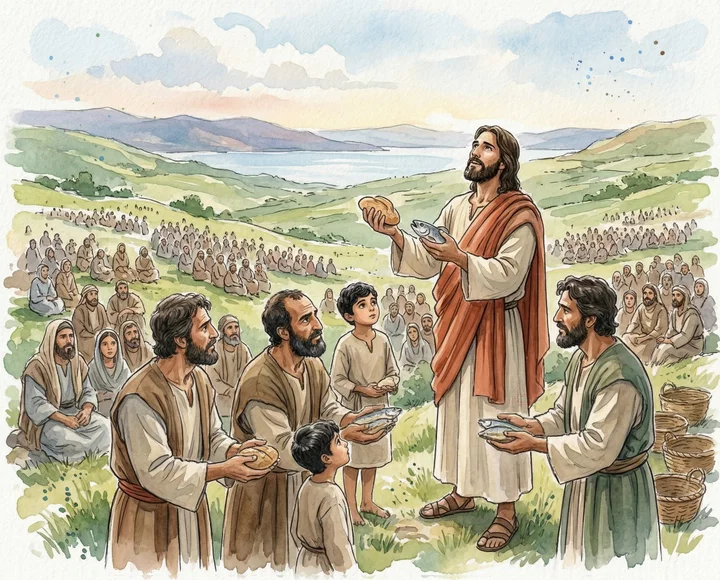
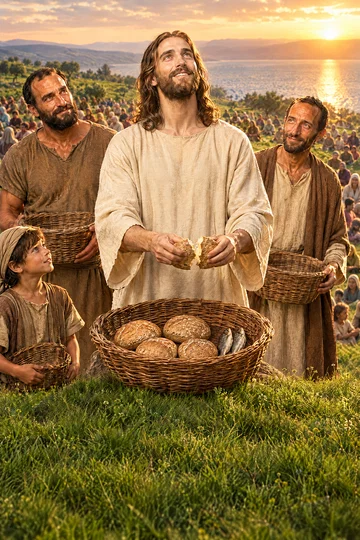
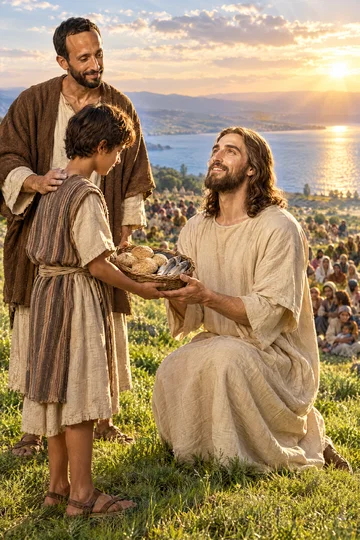
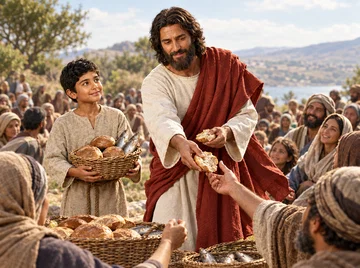
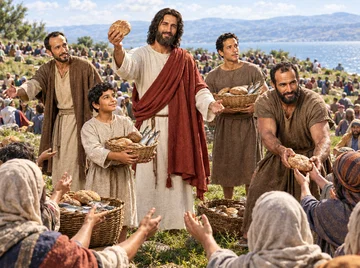
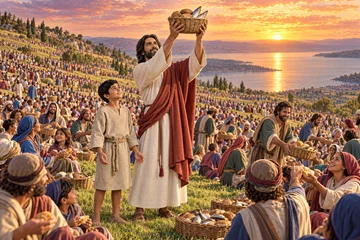
But he said unto them, Give ye them to eat. And they said, We have no more but five loaves and two fishes; except we should go and buy meat for all this people.
Translations
But he said to them, Give you them to eat. And they said, We have no more but five loaves and two fishes; except we should go and buy meat for all this people.
King James Version, KJV Cambridge Paragraph Bible
But he said unto them, Give ye them to eat. And they said, We have no more but five loaves and two fishes; except we should go and buy meat for all this people.
But he said to them, Give ye them to eat. And they said, We have no more than five loaves and two fishes; except we should go and buy provisions for all this people.
Revised Version, American Standard Version
But he said unto them, Give ye them to eat. And they said, We have no more than five loaves and two fishes; except we should go and buy food for all this people.
And he said unto them, 'Give ye them to eat;' and they said, 'We have no more than five loaves, and two fishes: except, having gone, we may buy for all this people victuals;'
And he said to them, Give ye them to eat. And they said, We have not more than five loaves and two fishes, unless we should go and buy food for all this people;
But he said unto them—Give, ye, them to eat. They, however, said—We have not more than five loaves, and two fishes,—unless perhaps, we, should go, and buy food, for all this people.
Berean Standard Bible, Majority Standard Bible
But Jesus told them, “ You give them something to eat.”“ We have only five loaves of bread and two fish,” they answered, “ unless we go and buy food for all these people.”
But he said to them, “ You give them something to eat.”They said, “ We have no more than five loaves and two fish, unless we should go and buy food for all these people.”
But he said, Give them food yourselves. And they said, We have only five cakes of bread and two fishes, if we do not go and get food for all these people.
But he sayd vnto them, Giue ye them to eate. And they sayd, We haue no more but fiue loaues and two fishes, except we should go and buy meate for all this people.
Douay-Rheims (Challoner revision)
But he said to them: Give you them to eat. And they said: We have no more than five loaves and two fishes; unless perhaps we should go and buy food for all this multitude.
Pictures

Cross-references
- John 6:5-13
When Jesus then lifted up his eyes, and saw a great company come unto him, he saith unto Philip, Whence shall we buy bread, that these may eat?
Jesus feeds the crowd after the disciples present five loaves and two fishes.
- Matthew 14:16-21
But Jesus said unto them, They need not depart; give ye them to eat.
Jesus commands the disciples to feed the crowd, then multiplies the loaves and fish.
- Mark 6:35-44
And when the day was now far spent, his disciples came unto him, and said, This is a desert place, and now the time is far passed:
Mark records the same command and the disciples’ question about buying food.
- John 6:11-13
And Jesus took the loaves; and when he had given thanks, he distributed to the disciples, and the disciples to them that were set down; and likewise of the fishes as much as they would.
Jesus provides food for the crowd and directs the disciples to gather the leftovers.
- John 6:35
And Jesus said unto them, I am the bread of life: he that cometh to me shall never hunger; and he that believeth on me shall never thirst.
Jesus connects the feeding’s bread with himself as the bread of life.
- Matthew 14:19-21
And he commanded the multitude to sit down on the grass, and took the five loaves, and the two fishes, and looking up to heaven, he blessed, and brake, and gave the loaves to his disciples, and the disciples to the multitude.
Parallel account of Jesus feeding the crowd through the disciples, numbering five thousand men besides women and children.
- 2 Kings 4:42-44
And there came a man from Baal-shalisha, and brought the man of God bread of the firstfruits, twenty loaves of barley, and full ears of corn in the husk thereof. And he said, Give unto the people, that they may eat.
A small supply of loaves is multiplied to feed a crowd.
- Mark 6:41-44
And when he had taken the five loaves and the two fishes, he looked up to heaven, and blessed, and brake the loaves, and gave them to his disciples to set before them; and the two fishes divided he among them all.
Parallel account of the disciples distributing the multiplied bread to the crowd.
- John 6:5-7
When Jesus then lifted up his eyes, and saw a great company come unto him, he saith unto Philip, Whence shall we buy bread, that these may eat?
Jesus tests the disciples about feeding the crowd and buying bread.
- Matthew 15:32-39
Then Jesus called his disciples unto him, and said, I have compassion on the multitude, because they continue with me now three days, and have nothing to eat: and I will not send them away fasting, lest they faint in the way.
Both recount Christ feeding a hungry multitude after they had stayed with him for three days.
- Exodus 16:14-21
And when the dew that lay was gone up, behold, upon the face of the wilderness there lay a small round thing, as small as the hoar frost on the ground.
Manna’s provision illustrates contentment with what God supplies.
- John 6:7
Philip answered him, Two hundred pennyworth of bread is not sufficient for them, that every one of them may take a little.
disciples say two hundred pennyworth is not enough
- Exodus 16:4
Then said the LORD unto Moses, Behold, I will rain bread from heaven for you; and the people shall go out and gather a certain rate every day, that I may prove them, whether they will walk in my law, or no.
The wilderness feeding recalls God’s provision of manna.
- Psalms 78:19
Yea, they spake against God; they said, Can God furnish a table in the wilderness?
God spreads table in wilderness
- 1 Kings 17:9-16
Arise, get thee to Zarephath, which belongeth to Zidon, and dwell there: behold, I have commanded a widow woman there to sustain thee.
A related account of the widow's meal and oil increasing.
- Mark 8:1-9
In those days the multitude being very great, and having nothing to eat, Jesus called his disciples unto him, and saith unto them,
Parallel account of Christ feeding the other multitude mentioned.
- 1 Kings 17:6
And the ravens brought him bread and flesh in the morning, and bread and flesh in the evening; and he drank of the brook.
A related account of Elijah being fed by ravens.
Commentary
Each commentary is drawn from primary sources: the writings of Ellen G. White and Adventist pioneers and periodicals. Each commentary is separate. Its own words are not a quotation; follow the references to read the source passages.
Ellen G. White
47 sources
Christ commanded His disciples to feed the hungry multitude in the desert place rather than send them away fainting, and they answered that they had no more but five barley loaves and two small fishes, scarcely enough for a score, unless they should go and buy food for all the people.RH Jan 18, 1912PK 242.1–243.2ST May 10, 1883ST May 20, 1886ST May 10, 1883 He already knew how He would provide, and His command tested their faith, which faltered as they fixed on the meager supply like Elisha's servant before the hundred men.PK 242.1–243.2ST2SP 261.2–262.2ST May 10, 1883 Having the people seated in orderly companies, He gave thanks, broke the food, and placed it in the disciples' hands, and it increased as they imparted what they received until all were satisfied and twelve baskets of fragments were gathered that nothing be lost.RH Jan 18, 1912Ms 197, 1907, par. 1–4ST May 10, 1883MH 49.2–4ST May 20, 1886 His followers are therefore to obey the work He gives without judging whether means seem adequate, bringing what little they have to Him to be blessed and then passing on to the needy both temporal help and the bread of life, receiving more as they give.RH Jan 18, 1912PK 242.1–243.2MH 49.2–4DA 369.1Lt 7, 1901, par. 1–3 The same miracle reveals the creative power that daily multiplies seed into harvest, and calls for compassionate care for bodily needs with thrift and economy that wastes no resource or opportunity to bless others.STB 772.1–2ED 107.3ST Dec 15, 19092T 435.3ST Aug 12, 1897
Setting and Circumstances
Luke 9:13 belongs to the feeding of five thousand men besides women and children in a secluded desert place beyond the sea from Capernaum, where Christ had withdrawn with His disciples for quiet rest.DA 364.1ST May 20, 1886 The multitude pursued Him there after learning His direction, following by land and by boat, and the crowd was swelled by bands of pilgrims from far and near on their way to Jerusalem because the Passover was at hand.DA 364.1 Christ landed unobserved and spent a little time apart with the disciples before meeting the multitude waiting on the shore.DA 364.1
The crowd had listened all day to His teaching from the Old Testament Scriptures, with healing joined to preaching as part of His mission of love and compassion exercised by divine power.Ms 72, 1911, par. 1–5Ms 73, 1909, par. 20–21Ms 18, 1898, par. 11Lt 3, 1859, par. 4–5 As evening drew on and sunset and night came near, the people were far from home, weary and needing rest and food, hungry and fainting.ST May 20, 1886DA 368.2–3Ms 73, 1909, par. 20–21 Many were unable to buy food, and in that desert place nothing more could be obtained.ST May 20, 1886DA 368.2–3 On one occasion described, Jesus had led about five thousand on foot away from the cities to a retired grassy place, where after three days they were weary and hungry and had used up their food.Ms 64, 1910, par. 10–11
The feeding took place on the preceding day on the barren shore.ST Dec 29, 1887 Afterward the fed multitude left Jesus there knowing no boat remained for Him to depart, while He watched their departure with compassionate eyes.ST Dec 29, 1887 News of the miracle spread far and near, so that on the following morning people returned in large numbers at an early hour to the spot where they had last seen Him, coming both by land and by water.ST Dec 29, 1887
Command and Disciples Response
His command to give the crowd something to eat directed the disciples themselves to feed the hungry multitude rather than sending them away.RH Jan 18, 1912ST May 10, 1883ST May 10, 1883ST Mar 1, 1877ST Aug 12, 1897 He would not send them home unrefreshed nor let them faint by the way, and His direction shows He cares for bodily needs as well as spiritual instruction.RH Jan 18, 1912ST May 20, 1886ST May 10, 1883ST Mar 1, 1877ST Aug 12, 1897 That care points to the compassion and practical concern His followers are to show toward those seeking salvation, not neglecting or discouraging the weary and hungry but finding ways to help without making the way burdensome.ST Aug 12, 1897
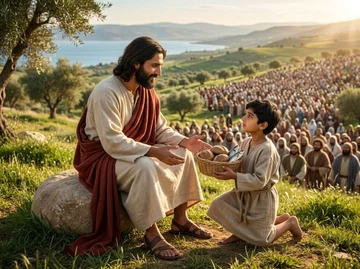
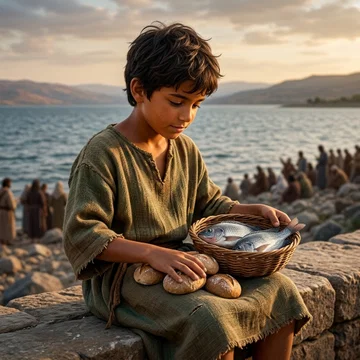
They answered that they had no more but five barley loaves belonging to a lad and two small fishes.PK 242.1–243.2ST May 20, 1886STST Mar 18, 1913Ms 73, 1909, par. 20–21 It was a slender store scarcely sufficient for a score of persons, with Philip adding that two hundred pennyworth of bread would not give each even a little.ST May 20, 1886 Except they should go and buy food for all this people, nothing could be done in the desert place where nothing more could be obtained.PK 242.1–243.2ST May 20, 1886STST Mar 18, 1913
Jesus already knew how He would provide, and His question about the available food and His command tested the disciples' faith.ST2SP 261.2–262.2ST May 10, 1883ST Mar 1, 1877ST Mar 18, 1913 Their focus on the meager supply and on the need to buy food displayed unbelief, the same unbelief as Elisha's servant when he questioned whether a small provision could feed a hundred men.PK 242.1–243.2 God's people are therefore to obey the work He gives without stopping to judge whether resources or likely results seem adequate, for what appears insufficient in human hands can become more than enough in the Lord's hands.PK 242.1–243.2DA 369.1
His command is also a promise backed by the power that supplied food for the crowd.DA 368.2–3DA 369.1 Jesus depended on His Father to provide, though food was not nearby and He appeared to have no means, and the need was real with the people far from home, many unable to buy food, and night near.DA 368.2–3ST Aug 19, 1897 In difficulty God's workers must follow His instructions and depend on God's resources, while using wisdom and the means and abilities He has provided rather than acting recklessly.DA 368.2–3 When brought into difficulty while following the Lord's direction they are not to give up but to seek help from God who can deliver them.DA 368.2–3
Miracle of Multiplication
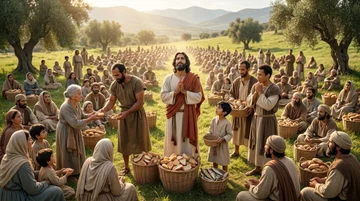
The small store was brought to Him, and He had the multitude seated on the grass in orderly companies of fifty and one hundred to preserve order and that all might witness what was done, a hymn being sung, before He gave thanks and asked blessing upon the bread and the fishes and broke them.Ms 197, 1907, par. 1–4ST May 20, 1886Ms 182, 1907, par. 21–23 He placed the broken pieces in the disciples' hands and worked through them to distribute the loaves and fishes to the multitudes in quantities sufficient to satisfy appetite.RH Jan 18, 1912RH Apr 8, 1909ST May 20, 1886 The food did not diminish as He handed it to them, and their hands were supplied as they reached out to Him, so that every time they gave out all they had and came back for more there was more supply furnished.MH 49.2–43RED 55.2ST May 20, 1886 The supply kept increasing as they imparted what they received until all were satisfied, and the disciples themselves also ate.RH Jan 18, 1912Ms 197, 1907, par. 1–4RH Apr 8, 1909
After all had eaten and were satisfied He commanded that the broken fragments be gathered so nothing would be lost, and twelve baskets were filled, showing that none of the food was wasted.ST May 10, 18833RED 55.2RH Apr 8, 1909ST May 20, 1886Lt 121, 1904, par. 14–16 What seemed meager in His hands became abundant, satisfying those who trusted Him and leaving something to share.ST May 10, 1883Lt 121, 1904, par. 14–16 The feast displayed power and benevolence that no human power could provide, and it convinced the people and strengthened their belief that He was the Messiah with divine power.ST2SP 262.3–263.1ST Mar 18, 1913
The power by which He fed the five thousand was the same power He possessed while working to support His family in daily labor, yet He did not use it to lessen His own burdens.ST May 20, 1886RP 26.5–6CT 276.3–4 Just so, He had refused to work a miracle to satisfy His own hunger in the wilderness, though He would not send the crowd home unrefreshed nor let them faint by the way.ST May 20, 1886 The multiplying of the loaves draws aside the veil from nature and reveals the creative energy constantly exercised for human good.ED 107.3 He who multiplied the loaves multiplies the seed cast into the ground every day, and by a miracle constantly feeds millions from earth's harvest fields.ED 107.3
Men are called to cooperate with Him in the care of the grain and the preparation of the loaf, yet this cooperation makes them lose sight of the divine agency.ED 107.3 They ascribe His working to natural causes or human instrumentality and pervert His gifts to selfish uses, so that they become a curse instead of a blessing.ED 107.3 Dull senses must be quickened to discern His merciful kindness, so His gifts may be the blessing He intended.ED 107.3 As a man preaching the gospel He worked the same wonder He had worked in Old Testament times for one hundred men, feeding five thousand in the wilderness from a small portion.Ms 114, 1899, par. 1–3 In the wilderness He supplied His people not only with bread but with clear flowing streams, casting His glory on those He guided as on those He taught in His humanity, though He walked the earth in lowliness and poverty and was greater than Moses.Ms 114, 1899, par. 1–3 It is the grace of God on the small portion that makes it all-sufficient, His hand can multiply it an hundredfold, and from His resources He is able to spread a table in the wilderness for more than a million people.Ms 114, 1899, par. 1–3
Giving What Is Received
The disciples were able to give to the crowd only what they had first received from Christ, for they brought the five loaves and two fishes to Him to be blessed and multiplied, and as they imparted what they received they continued to receive until all were satisfied and more remained than at the first.RH Jan 18, 1912MH 49.2–4Lt 7, 1901, par. 1–3 Their hands were supplied as they reached out to Him, and in the giving the gift was increased.MH 49.2–4Lt 7, 1901, par. 1–3 Those who work together with God in this way carry out His purpose to lift up, encourage, and restore others.Lt 7, 1901, par. 1–3
No one is to wait for someone more capable or for an organization to act, but each is to use the means, time, and ability already in hand to meet the needs of others.MH 49.2–4 Even a small gift, placed in Christ's hands in simple reliance upon Him, can help many and prove sufficient.MH 49.2–4 What seemed far from sufficient became through His power enough for a large work, for He can increase what is offered and placed in His servants' hands until it feeds five thousand men besides women and children.Ms 66a, 1900, par. 30–31STB 119.3–4Ms 66, 1900, par. 11–12 Limited means are no barrier, for God can use them to provide for many.STB 119.3–4
Lack is to be met by Christ present.DA 370.3 When people are destitute of the bread of life, His followers are not to ask for someone to be sent from afar to feed them, but to know that Christ is there, to commune with Him, and to bring their barley loaves to Jesus, and He will feed the needy souls where they are.DA 370.3
Christ's followers are to pass on to the needy what they receive from Him, sharing what they have with those who lack.6T 263.1Ms 180, 1907, par. 27–28 This includes sharing the truth with people who have not received it, and sharing the bread that satisfies spiritual hunger.ST Dec 15, 1909Ms 180, 1907, par. 27–28 Temporal and spiritual blessings accompany such giving, and no resource, opportunity, or advantage that could help others should be squandered.6T 263.1ST Dec 15, 1909 Blessings received from God are to be shared, and in giving the gift is increased.ST Dec 15, 1909Lt 7, 1901, par. 1–3
God can bless and multiply what is given so that it meets a great need, a principle that applies to gifts used to provide the bread of life to spiritually hungry people.STB 148.2–3
Those who are softened and subdued and sanctified by the Holy Spirit, who study to work the works Christ worked, and who dedicate themselves to God, will be given the Holy Spirit so they can give to those in necessity.Ms 186, 1907, par. 8–9 The same works of Christ will be manifested in the present day by the message and by every way of helpfulness, as the supply kept increasing every time the disciples gave out all they had and came back for more until the whole multitude was fed.Ms 64, 1910, par. 10–11
Faith must lay hold upon God and expect success, for the scattered small supply placed in missionary work will be multiplied by God as it is imparted to others, so that all may eat and be filled.2MR 283.1–284.2 Advance in the work must not be stopped and measured by the means at hand, for that shows very limited faith.2MR 283.1–284.2 Whether means are large or small, God's human agents must plan and work in faith to diffuse the gospel over the whole earth in obedience to God's command to go forward, and God gives tact, skill, and understanding to those who align themselves with Him.2MR 283.1–284.2Ms 14, 1902, par. 4
Economy and Practical Application
After feeding the five thousand, nothing that remained was allowed to go to waste, and the careful gathering of the fragments teaches care, frugality, thrift and economy, especially in difficult circumstances and when resources are limited.STB 772.1–2ST Dec 15, 19092T 435.3 Though Christ could provide what the people needed even from only five loaves and two fishes, His later command to gather the leftovers showed that even miraculous abundance was not to be wasted.ST Dec 15, 19092T 435.3 Provision is therefore to be handled carefully and nothing useful discarded, and the lesson reaches to both temporal and spiritual things, that no resource, opportunity or advantage that could help others should be squandered, and that blessings received from God should be shared, including the bread that satisfies spiritual hunger.ST Dec 15, 19092T 435.3
The command to gather means more than saving leftover food, for every such act is meant to make an impression on human minds so that it is never lost, and those healed and seeing the miracle keep the impression of truth in their minds.Ms 197, 1907, par. 1–4 After the crowd had sat down, a hymn had been sung, and He had blessed and broken the bread and the fishes and placed the pieces in the disciples' hands, the supply kept increasing as they imparted what they received until all were satisfied, and then the fragments were to be gathered so nothing would be lost.Ms 197, 1907, par. 1–4 That absence of extravagance in anything applies to building sanitariums plain and simple, yet with room to care for people and impress them.Ms 197, 1907, par. 1–4 The feeding stands as an example whose methods are to guide practical food work, using simple, inexpensive preparations economically and letting no selfish private interests obstruct the work.Lt 302, 1906, par. 5Ms 182, 1907, par. 21–23 What God gives is to be imparted to others from the small supply at hand, multiplied as it passes through the hands of His servants to the hungry until all are satisfied with food still left, and not wasted, gambled away, or taken by robbing another.Ms 182, 1907, par. 21–23
His continuing benevolence also provides people with knowledge to find food in different places and ways, meeting bodily needs for five thousand men besides women and children.17MR 252.3 His command to feed the hungry points to the compassion and practical concern His disciples should show those seeking salvation, caring for bodily needs as well as spiritual needs, so that the weary and hungry are not neglected or sent away discouraged, and believers find ways to help without making the way to Christ burdensome.ST Aug 12, 1897 Those who work together with God carry out Christ's purpose as the disciples received bread from Christ to distribute to the people, just as those who serve others receive divine grace to impart to people in need, and in giving the gift is increased; they should lift up, encourage and restore others.Lt 7, 1901, par. 1–3 His example further shows that useful labor is honorable, for He possessed the same divine power while working to support His family yet did not use it to lessen His own daily burdens, and people should work industriously.RP 26.5–6
Sources
Pioneers and periodicals
56 sources
At evening in a desert place belonging to Bethsaida the disciples wanted to send away some five thousand men besides women and children who had lingered hungry after a day of teaching and healing, but Jesus instead ordered the disciples themselves to feed them when they had only five barley loaves and two small fishes belonging to a lad.ST May 20, 1886RH May 29, 1900ST Sep 18, 1893STST May 20, 1886 His order tested their faith when supply seemed impossible, yet the power to do what was commanded was conveyed in the command itself, for he already knew how he would provide.ST May 20, 1886STST Jun 6, 1900RH May 29, 1900ST Apr 25, 1900 He looked to heaven and blessed the little store, broke it and gave it to the disciples to distribute, and it multiplied in the hands that divided it until all ate to full satisfaction and twelve baskets of fragments remained.RH Apr 8, 1909ST Feb 1, 1899ST May 7, 1894ST Dec 22, 1887 The food passed from Christ to the disciples and from them to the people, showing that those united to him can give only what they receive from him and continue to receive as they impart, whether in bodily bread or in the bread of life for the hungry soul.RH Jan 18, 1912ST Apr 11, 1906ST May 7, 1894ST May 7, 1894 The same order still binds his followers to meet present bodily hunger and the hunger of a needy world for the gospel with whatever means they have, trusting God to bless a little and multiply small resources and willing effort into more than enough.STRH Nov 19, 1901ST Mar 11, 1908ST Apr 25, 1900RH Jul 11, 1912
Historical Setting Described
The command was given just after the apostles had returned from their missionary tour, when Jesus had taken them aside privately into a desert place belonging to Bethsaida for quiet rest from busy labor.RH May 29, 1900ST May 20, 1886 The people learned where He was and followed on foot and intruded upon that quiet, yet though weary He showed no impatience but received them, spoke to them of the kingdom of God, and healed those needing healing.RH May 29, 1900ST May 20, 1886 The crowd numbered about five thousand men besides unnumbered women and children, who had listened all day to teaching and been healed, and lingered into evening and nightfall hungry and faint and forgetful of weariness and hunger.ST May 20, 1886STST Aug 19, 1897ST Sep 18, 1893ST They were far from home and lodging in a desert place with no food to be obtained, many without means to purchase food, and Jesus would not send them home unrefreshed at nightfall nor let them faint by the way.ST May 20, 1886STST Aug 19, 1897
The place was a mountainous desert and a plain a few miles in extent near Bethsaida Julia, just across the Jordan inland a short distance from its influx at the head of the sea, about two miles east of Capernaum and within sight of the Sea of Galilee.STST Jul 7, 1898 It was a desert beyond the sea from Capernaum, and the time was near Passover with the day far spent and wearing away to sunset.ST May 20, 1886ST May 20, 1886 When the day wore away the twelve wanted Jesus to send the multitude into the surrounding towns and country to lodge and buy food because they were in a desert place.RH May 29, 1900RH Jul 28, 1903 In answer to His command to supply food themselves they pointed to only five barley loaves and two small fishes belonging to a lad, with Philip adding that two hundred pennyworth of bread would not give each one even a little.ST May 20, 1886RH May 29, 1900RH Jul 28, 1903ST May 20, 1886
Jesus had the people seated on the grass in orderly companies of about fifty and in ranks of hundreds and fifties to preserve order and that all might witness what was done.ST May 20, 1886ST Dec 22, 1887ST May 20, 1886 The feeding is a literal feeding of people, not merely a symbolic feeding of the soul with spiritual teaching, recorded by all four evangelists whose parallel accounts should be compared for important details.ST Jul 25, 1911 It precedes His statements about His suffering, death, resurrection, and the coming kingdom of God.ST May 12, 1890
After the feeding Jesus sent the multitudes away and went into the mountain to pray while the disciples crossed toward Bethsaida, were caught in a storm, and Jesus came walking on the water and stilled the tempest, on which occasion Peter also walked on the water.ST Jul 7, 1898 On the preceding day the fed multitude had left Jesus knowing no boat remained for Him to depart, yet news of the miracle spread far and near so that next morning people returned early in large numbers by land and water to where they had last seen Him on the barren shore.ST Dec 29, 1887 Some who ate saw Him as one able to provision an army against the Romans and sought to make Him king.ST Oct 25, 1910
Meaning of Christ's Command
When evening came on the hungry crowd in the desert, Jesus would not send them away unfed at nightfall to find lodging and food in the surrounding towns and country, but told the disciples themselves to supply food and keep the people with them.RH Jan 18, 1912ST Jul 26, 1905RH Jul 28, 1903RH Aug 29, 1912 The twelve had only five loaves and two fishes and thought they must go and buy food, with Philip adding that even two hundred pennyworth of bread would not give each one a little.RH Jan 18, 1912RH Jul 28, 1903RH Aug 29, 1912 In love he laid the duty on his chosen ones to feed them, and the apostles supplied every need from God's ample store until none were sent away and every soul, children included, was satisfied before the light of day sank.ST Jul 26, 1905RH Jul 28, 1903 His refusal to dismiss them and his order to feed them show his care for bodily need as well as for spiritual instruction and the words of life, and the small supply blessed by him and distributed by the disciples multiplied until all ate and were filled with more left than at the start.RH Jan 18, 1912ST Jul 26, 1905 The feeding itself was the bringing in of the kingdom the disciples hoped to gain by making him king.RH Aug 29, 1912
His word to feed them tested the faith of the disciples when provision seemed impossible, for he already knew how he would provide and used the shortage to teach trust in his power to multiply what is scarce.ST May 20, 1886STST May 10, 1883ST Mar 1, 1877ST Jun 6, 1900 Five thousand men besides women and children lay before him hungry at sunset after a day of teaching about the kingdom and healing in a desert place beyond the sea from Capernaum, and he would not send them home unrefreshed nor let them faint by the way for lack of food, though he had refused to work a miracle to satisfy his own hunger in the wilderness.ST May 20, 1886ST May 10, 1883ST Mar 1, 1877 Philip answered that two hundred pennyworth would not suffice and Andrew reported only five barley loaves and two small fishes belonging to a lad, with nothing more to be obtained in the desert and buying enough seeming impossible.ST May 20, 1886ST Mar 18, 1913 He had the meager store brought to him and had the people seated on the grass in orderly companies of fifty and ranks of hundreds and fifties to preserve order and that all might witness what was done.ST May 20, 1886ST Then he gave thanks and distributed through the disciples in quantities sufficient to satisfy appetite without the food diminishing as often as they returned for a fresh supply, and afterward had the fragments gathered that nothing might be lost, filling twelve baskets, which no human power could do.ST May 20, 1886ST Mar 18, 1913
The command laid responsibility on the disciples before they could see how the task would be accomplished, thereby calling them to faith and experience.RH Aug 29, 1912 They misunderstood and treated the order as a human problem to be solved by calculating how much bread would be required, forgetting that Jesus with them was the all-sufficient source of supply.RH Aug 29, 1912 Setting human material resources, devised ways and means, and tabulated forces over against unsatisfied masses repeats that fatal human way, while the promised triumphant march rests on Christ alone as wisdom and power, who sets up and casts down kingdoms and prepares the highway of the King.RH Aug 29, 1912
The order is also a promise, for the power to do what is ordered is conveyed in the order itself, and behind it stands the same power that fed the multitude beside the sea.RH May 29, 1900ST Apr 25, 1900 Christ knew about the lad's lone lunch basket when he spoke, and God never makes an unreasonable request and is no tyrant, for when he asks there is always something to start with since all have at least one talent.RH May 29, 1900 It meets sinking hearts and failing faith when the need looks great and the means in hand look small, and unwillingness to give all for fear of spending and being spent for others.ST Apr 25, 1900 The lad's small humble gift consecrated to Christ was multiplied in the Master's hands until it more than satisfied the hunger of people who had stood all day listening without thinking of eating or drinking, and much was left over.RH May 29, 1900 In the supplying of temporal need is wrapped a deep spiritual lesson for all his workers about how heavenly food is shared, for Christ received from the Father and gave to the disciples, the disciples gave to the multitude, and the multitude shared with one another, so all united to Christ receive the bread of life and impart it to others.ST Apr 25, 1900
The command rebukes narrow-mindedness and requires those who must represent him when he is gone to take just as much interest in the physical needs of fallen humanity as in spiritual well-being.RH May 29, 1900RH May 29, 1900 The apostles had just returned from their missionary tour and he had taken them aside privately into a desert place belonging to Bethsaida for quiet rest, yet when the people learned where he was and followed and intruded upon that quiet, he though weary showed no impatience but received them and spoke of the kingdom of God and healed those needing healing, showing that he receives fallen humanity in every case, whether one coming alone at night or five thousand together.RH May 29, 1900 When the day wore away the twelve saw that the multitude had been fed spiritually all day but had no physical food away from habitation, and wanted him to send them away, but he answered with the command to supply food themselves.RH May 29, 1900RH May 29, 1900 The command calls into question faith, trust, and confidence in Christ and his willingness to provide physically, for the disciples doubted his ability because they had not yet learned that their daily bread was a daily miracle and that the Master who fed them spiritual truths also gave their physical food, thinking they could give spiritual food in a measure but were unable to feed so great a company with the food of this world.RH May 29, 1900 He would not let the people go without food and faint on the way home.ST May 10, 1883ST Mar 1, 1877ST Mar 18, 1913
In its widest sense the command means that his servants must give people the spiritual bread they need, for Christ is sufficient to satisfy and sustain every human need and whoever possesses him is obligated to share him. The duty belongs to every Christian, and withholding this bread of life leaves people hungry. The needy multitude is now the world, and the food to be given is not man's treasure but heaven's treasure, the water and bread of life and gospel of salvation.ST Mar 11, 1908 Every soul called to be a son of God is given the work of winning other souls by holding out the invitation to come to Christ and take the water of life freely, to come to the waters and seek the Lord while he may be found.ST Mar 11, 1908 The storehouse of heaven is open at the call of his servants, so they are to expect much of him and ask much of him, even to the rich treasures of heaven.ST Mar 11, 1908
Miracle of Abundant Provision
The only supply in sight was five barley loaves, made by a woman and carried by a lad, with two small fishes, the bread and fish of an unknown poor boy in the multitude.ST May 20, 1886RH Jul 28, 1903ST May 29, 1884 The meager store was brought to him, and he looked up to heaven, gave thanks and blessed it, broke it, and handed it to the disciples to set before the people.RH Apr 8, 1909ST May 20, 1886ST Feb 1, 1899ST May 20, 1886 The bread broken on the hillside multiplied in the hand that took it to divide and distribute, and as often as the disciples returned for a fresh supply it had not diminished.ST Dec 22, 1887ST May 13, 1880 Feeding five thousand men from so little was a marvel, as marvelous as the daily multiplication of seed into full ears of grain.ST Aug 26, 1880ST May 13, 1880
Five thousand men besides unnumbered women and children ate in quantities sufficient to satisfy appetite until all were filled to full satisfaction, though divided equally at the start the store would scarcely have given anyone a mouthful or even a taste of food.ST May 20, 1886ST May 7, 1894 When all were satisfied twelve baskets of fragments were gathered, showing complete satisfaction with nothing wasted, and much more remained than had been present at the beginning.ST May 10, 1883RH Apr 8, 1909ST May 7, 1894ST Dec 22, 1887 This was a display of mighty power, wisdom, love, benevolence, and creative power to provide abundantly, exceeding abundantly above all that is asked or thought, which no human power could do, and it strengthened belief that he is the Messiah.STST Mar 18, 1913ST Sep 27, 1910ST May 7, 1894
The bread eaten came as truly from the Lord as daily food comes from him, only the process of bread-making was shortened.ST May 7, 1894 It was plain, substantial food of the same kind provided for himself and his disciples, as God had provided manna for Israel in the wilderness. The command to gather what remained teaches economy in both temporal and spiritual things, that even miraculous abundance is not to be wasted and no resource, opportunity, or advantage that could help others, including material blessings and the bread that satisfies spiritual hunger, should be squandered.ST Dec 15, 1909
Spiritual Truths Illustrated
The feeding is a lesson in dependence upon God when brought into strait places, for food was not at hand and Christ apparently had no means at His command in the wilderness with five thousand men besides women and children, far from home with night at hand, hungry and faint after listening all day to His teaching.STST Aug 19, 1897 They had not been invited to follow Him there but had come eager to be in His presence without invitation or command, and many were without means to purchase food, yet providence had placed Him where He was and He depended on His heavenly Father for means to relieve their necessity.STST Aug 19, 1897 He who had fasted forty days for their sake would not suffer them to return fasting to their homes, teaching that help is to be sought in every emergency from Him who has infinite resources at His command.ST The same divine power that multiplies spiritual food also provides physical food, for Christ cares for people's physical needs as well as their spiritual instruction and the words of life.RH Jan 18, 1912ST Jul 26, 1905RH May 29, 1900 Rather than sending the hungry crowd away He directed the disciples to feed them themselves, though they had only five loaves and two fishes and thought they must go and buy food, and He called them to bring their little to Him to be blessed and distributed until all ate and were filled with food left over.RH Jan 18, 1912ST Jul 26, 1905
The power to do what is ordered is conveyed in the order itself, for God never makes an unreasonable request and is not a tyrant, and Christ knew about the lad's lone lunch basket when He gave the order.RH May 29, 1900 When He asks something there is always something to start with, since all have at least one talent, and the lad's small humble gift consecrated to Christ was multiplied in the Master's hands until it more than satisfied the hunger of people who had stood all day listening without thinking of eating or drinking.RH May 29, 1900 The food came from Christ to the disciples and from them to the people, illustrating that disciples can give only what they receive from Christ, and as they impart what they receive they continue to receive.RH Jan 18, 1912ST Apr 11, 1906 All who are united to Christ receive the bread of life from Him and impart it to others, for Christ received from the Father and gave to the disciples, the disciples gave to the multitude, and the multitude shared with one another.ST Apr 25, 1900 The gathered fragments were valuable as food and as evidence of God's power and kindness through Christ, teaching care not to waste material blessings or opportunities to do good, and He gave plain substantial food of the same kind provided for Himself and His disciples, as God had provided manna for Israel in the wilderness.
The people depended on Christ to provide food they could not provide for themselves, and as they received and ate it gave them strength without their being able to make it do so.ST May 7, 1894 So people depend wholly on Christ for life and righteousness, receiving His life by faith to fill and satisfy the hungry soul.ST May 7, 1894 The bread the five thousand ate came as truly from the Lord as daily food comes from Him, only the process of bread-making was shortened, making the supply as simple and real as daily food for physical strength.ST May 7, 1894 Just as food eaten becomes blood and renewed life and strength though no life can be seen in bread, so Christ puts His own life of righteousness directly into those who receive Him by faith through His word.ST May 7, 1894 The energy in the growing plant is the power of God through His creative word stored in seed for human food, and the same God who stores energy in seed and works life in a plant works perfection in a man as easily as life in a plant, leaving no ground to doubt Christ's power to save by His own life within to do His will.ST May 7, 1894 Jesus could perform the miracle because humanity and divinity were united in Him, illustrating the need for believers to lay hold of Christ by faith and be united with Him in self-denial and self-sacrifice, putting away wrong habits and practices.RH May 20, 1909 The feeding of the multitude in the wilderness where everybody is sure to get ample to eat shows what heaven is like: peace, joy, victory, triumph, life, love, and tireless, faithful, unselfish work and service going on forever, like the life of Jesus with the conflict of sin left out, entered by following Christ daily through prayer and right living.RH Mar 9, 1916
Call to Serve Today
Christ's word to feed the crowd remains a direct and enduring charge to give practical care that nourishes people in body, mind, and soul.ST Aug 12, 1897RH Nov 19, 1901RH Mar 20, 1900RH Nov 12, 1901 It requires meeting immediate bodily hunger with wholesome, nourishing food and healthful teaching, as in hygienic dining-room work that both provides healthful food and teaches people to eat it, rather than attending only to meetings and teaching.RH Nov 19, 1901RH Mar 20, 1900RH Nov 12, 1901 Those who seek salvation when weary and hungry are not to be neglected or sent away discouraged, and the way to Christ is not to be made burdensome but eased by finding ways to help without encouraging idleness.ST Aug 12, 1897RH Mar 20, 1900
Those who see the necessities of the poor, the ignorant, and the afflicted are to act with the means, time, and ability they have.STST Apr 25, 1900 Hearts are not to sink over feeble strength and slender resources, nor is the work to wait for someone of greater ability or for an organization to undertake it.STST Apr 25, 1900 What is had is to be brought to Jesus, for though it may not suffice to feed thousands it may suffice to feed one, and in the hand of Christ it may feed many.ST Giving what is had brings multiplication of the gift and reward for honest simple reliance, so that what seemed only a meager supply proves a rich feast, and behind the command stands the same power that fed the multitude, making the command itself a promise when need looks great and means look small.STST Apr 25, 1900 In supplying temporal need is wrapped a deep spiritual lesson of sharing: Christ received from the Father and gave to the disciples, the disciples gave to the multitude, the multitude shared with one another, and so all united to Christ receive the bread of life and impart it to others.ST Apr 25, 1900
Scarcity is no reason to stop helping, for the command teaches acting in faith even when the visible supply of five loaves and two fishes cannot meet the need of about five thousand men besides women and children in a deserted place.ST Sep 18, 1893ST Sep 18, 1893ST Oct 12, 1904RH Apr 10, 1900 God can bless a little and make it more than enough, so efforts to care for people in need are to continue in economic hardship rather than treating lack as cause to cease.ST Sep 18, 1893ST Sep 18, 1893 God's blessing multiplies small resources for a great work, so that with His blessing on what His people have and do they can carry the bread of life to all the world.RH Jul 11, 1912ST Oct 12, 1904ST Mar 26, 1912 Responsive human effort placed under His power is multiplied until more is left over than was present at the start, teaching trust in Him to work with what is had.ST Oct 12, 1904RH Apr 10, 1900ST Mar 26, 1912
Even a little entrusted to Jesus can be put to good use when given into the Master's care.RH Feb 6, 1908RH Feb 17, 1903 When the small supply is placed under the quickening and directing power of the divine Spirit, God makes it sufficient, with many baskets of fragments remaining.RH Feb 6, 1908RH Feb 17, 1903
The same order still binds believers facing a needy world field of a billion unsaved people, with no alternative, as the will of the Master and the way of the kingdom.RH Jul 28, 1903RH Aug 29, 1912 The world everywhere has desert spots where souls hunger for God's food and find it not, and believers are to heed the Saviour's voice and answer in love with willing hearts and eager hands to bring blessings from above and let none be sent away unsatisfied.RH Jul 28, 1903RH Aug 29, 1912 Setting human material resources, devised ways and means, and tabulated forces over against unsatisfied and unsaved masses repeats the fatal human way that calculates how much bread would be required and forgets that Jesus present is the all-sufficient source of supply.RH Aug 29, 1912 The promised triumphant march of the advent gospel around the world rests on Christ alone as its wisdom and power, who sets up and casts down kingdoms and prepares the highway of the King in all nations, and the feeding itself was the bringing in of the kingdom sought by making Jesus king.RH Jul 28, 1903RH Aug 29, 1912
The food to be given to the world is not man's treasure but heaven's treasure, the water and the bread of life, the gospel of salvation.ST Mar 11, 1908RH Jul 11, 1912 Every soul called to be a son of God is given the work of winning other souls by holding out the invitation to come to Christ, to take the water of life freely, to come to the waters, and to seek the Lord while He may be found.ST Mar 11, 1908 The storehouse of heaven is open at the call of His servants, so they are to expect much of Him and ask much of Him, even to the rich treasures of heaven.ST Mar 11, 1908
This sharing reaches those who have not yet received spiritual blessings in China, where the people are too numerous for the small company of workers and more young people are needed to carry the work forward and serve generously.ST Mar 26, 1912RH May 27, 1909RH Aug 11, 1910 It reaches downtrodden women and child widows in India who hunger for the gospel, whose workers should bring what they have to Jesus in compassion, trusting Him to make even a little enough to meet the need.ST Mar 26, 1912RH May 27, 1909 It reaches children in Nyassaland, where six laborers brought more than a thousand into direct contact with the truths of the third angel's message, showing the Lord's power to bring great results out of little beginnings as the small supply met the need of a multitude.ST Mar 26, 1912RH May 27, 1909RH Aug 11, 1910
Applied to prayer meetings, the command calls for giving people the bread of life, not gall and wormwood that dwells on the church's faults and wickedness instead of offering spiritual help.ST May 29, 1884ST Jun 4, 1885 Earnest prayer at home fosters a sweeter spirit for this service.ST Jun 4, 1885 Even a moment of service offered to God can become a far-reaching blessing, for a single sentence spoken may help feed thousands.ST May 29, 1884 Those who prepare and bring food do not know how far small acts will reach, as when loaves made by a woman and brought by a lad fed companies seated in orderly ranks on the grass and refreshed by a meal presided over by Christ.ST May 29, 1884
Sources