Luke 9:17
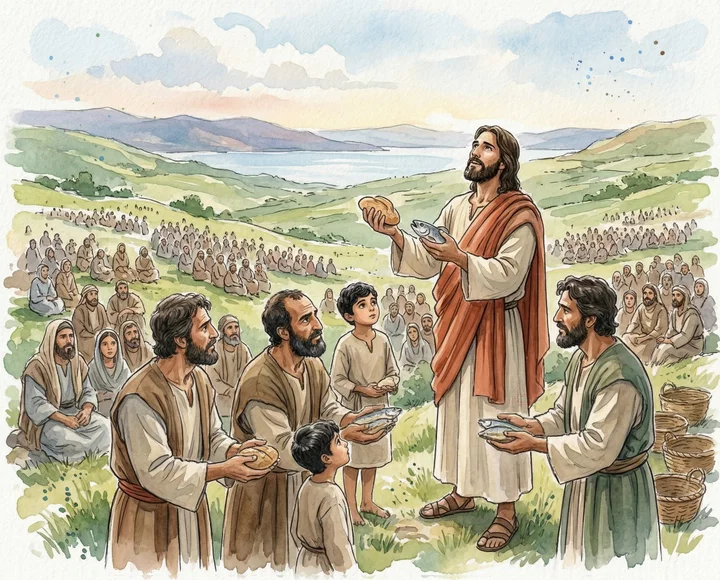
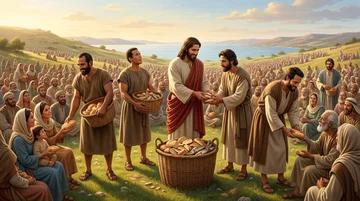
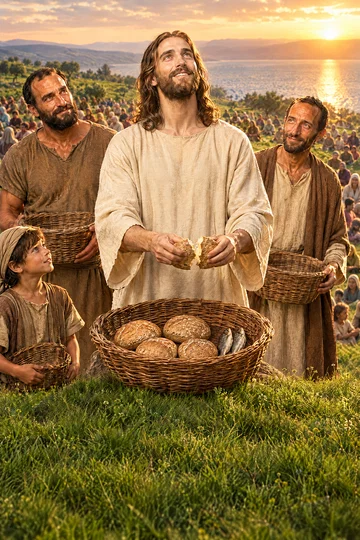
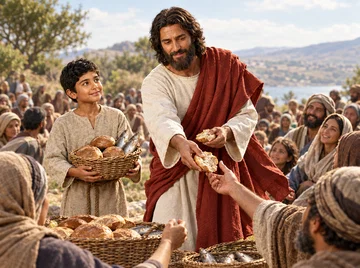
And they did eat, and were all filled: and there was taken up of fragments that remained to them twelve baskets.
Translations
American King James Version, King James Version, KJV Cambridge Paragraph Bible
And they did eat, and were all filled: and there was taken up of fragments that remained to them twelve baskets.
And they ate, and were all satisfied: and there was taken up of fragments that remained to them, twelve baskets.
And they did eat, and were all filled: and there was taken up that which remained over to them of broken pieces, twelve baskets.
And they ate, and were all filled: and there was taken up that which remained over to them of broken pieces, twelve baskets.
and they did eat, and were all filled, and there was taken up what was over to them of broken pieces, twelve baskets.
And they all ate and were filled; and there was taken up of what had remained over and above to them in fragments twelve hand-baskets.
and they did all eat and were filled. And that which remained over to them, was taken up,—of broken pieces, twelve baskets.
Berean Standard Bible, Majority Standard Bible
They all ate and were satisfied, and the disciples picked up twelve basketfuls of broken pieces that were left over.
They ate and were all filled. They gathered up twelve baskets of broken pieces that were left over.
And they all took the food and had enough; and they took up of the broken bits which were over, twelve baskets full.
So they did all eate, and were satisfied: and there was taken vp of that remained to them, twelue baskets full of broken meate.
Douay-Rheims (Challoner revision)
And they did all eat, and were filled. And there were taken up of fragments that remained to them, twelve baskets.
Pictures
Cross-references 20 of 23
- John 6:12-13
When they were filled, he said unto his disciples, Gather up the fragments that remain, that nothing be lost.
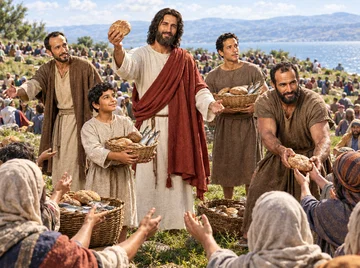
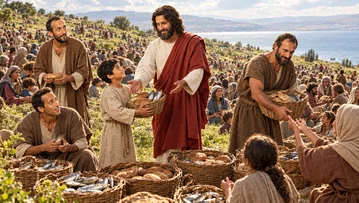
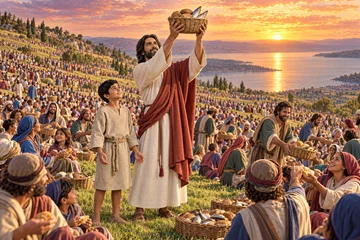
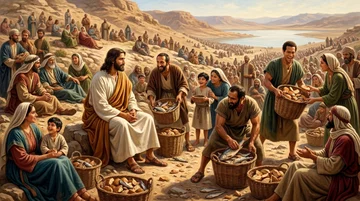
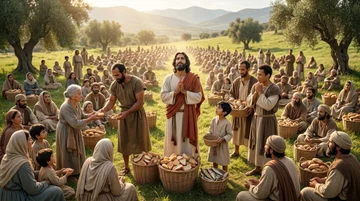
Jesus feeds the crowd and gathers the twelve baskets of remaining food.
- Matthew 14:19-20
And he commanded the multitude to sit down on the grass, and took the five loaves, and the two fishes, and looking up to heaven, he blessed, and brake, and gave the loaves to his disciples, and the disciples to the multitude.
Both accounts describe the miraculous meal, the satisfied crowd, and twelve baskets of leftovers.
- Mark 6:42-43
And they did all eat, and were filled.
Both describe the crowd eating their fill and twelve baskets of fragments being gathered.
- John 6:9
There is a lad here, which hath five barley loaves, and two small fishes: but what are they among so many?
The small supply of loaves and fishes is multiplied to feed the multitude.
- 2 Kings 4:42-44
And there came a man from Baal-shalisha, and brought the man of God bread of the firstfruits, twenty loaves of barley, and full ears of corn in the husk thereof. And he said, Give unto the people, that they may eat.
Elisha’s small supply fed a crowd, with food left over.
- Matthew 14:21
And they that had eaten were about five thousand men, beside women and children.
Adds women and children to the count of five thousand men.
- Exodus 16:14-18
And when the dew that lay was gone up, behold, upon the face of the wilderness there lay a small round thing, as small as the hoar frost on the ground.
The passage compares trust in Christ’s provision with receiving God’s manna contentedly.
- John 6:35
And Jesus said unto them, I am the bread of life: he that cometh to me shall never hunger; and he that believeth on me shall never thirst.
Named as the lesson’s golden text alongside the feeding miracle.
- Matthew 14:13-19
When Jesus heard of it, he departed thence by ship into a desert place apart: and when the people had heard thereof, they followed him on foot out of the cities.
Matthew recounts the same feeding miracle.
- Luke 9:13
But he said unto them, Give ye them to eat. And they said, We have no more but five loaves and two fishes; except we should go and buy meat for all this people.
Jesus commands the disciples to feed the multitude.
- Matthew 15:32-39
Then Jesus called his disciples unto him, and said, I have compassion on the multitude, because they continue with me now three days, and have nothing to eat: and I will not send them away fasting, lest they faint in the way.
Christ compassionately feeds the multitude after three days, and all are filled.
- Matthew 14:19
And he commanded the multitude to sit down on the grass, and took the five loaves, and the two fishes, and looking up to heaven, he blessed, and brake, and gave the loaves to his disciples, and the disciples to the multitude.
Jesus blesses and distributes food to the multitude.
- Mark 6:52
For they considered not the miracle of the loaves: for their heart was hardened.
It refers to the miracle of the loaves.
- John 6:26-27
Jesus answered them and said, Verily, verily, I say unto you, Ye seek me, not because ye saw the miracles, but because ye did eat of the loaves, and were filled.
Jesus warns the crowd not to seek him merely for food that perishes.
- Exodus 16:4
Then said the LORD unto Moses, Behold, I will rain bread from heaven for you; and the people shall go out and gather a certain rate every day, that I may prove them, whether they will walk in my law, or no.
Christ gave bread in wilderness
- Psalms 78:19
Yea, they spake against God; they said, Can God furnish a table in the wilderness?
God spreads table in wilderness
- Mark 8:1-9
In those days the multitude being very great, and having nothing to eat, Jesus called his disciples unto him, and saith unto them,
Both texts recount Christ feeding a multitude, who ate their fill with food left over.
- John 6:5
When Jesus then lifted up his eyes, and saw a great company come unto him, he saith unto Philip, Whence shall we buy bread, that these may eat?
Jesus tests Philip about how to provide bread for the crowd.
- John 6:14-15
Then those men, when they had seen the miracle that Jesus did, said, This is of a truth that prophet that should come into the world.
The parallel account links the feeding miracle to the crowd’s belief that Jesus was the promised one and its attempt to make him king.
- John 6:48-51
I am that bread of life.
Christ, the bread of life, gives life in connection with the feeding miracle.
Commentary
Each commentary is drawn from primary sources: the writings of Ellen G. White and Adventist pioneers and periodicals. Each commentary is separate. Its own words are not a quotation; follow the references to read the source passages.
Ellen G. White
48 sources
After a day spent teaching and healing a weary, hungry multitude in a wilderness place far from homes, Jesus fed five thousand men besides women and children from only five barley loaves and two small fishes until all were satisfied, and had His disciples gather the leftovers into twelve baskets full.RH Jan 18, 1912DA 364.2ST May 10, 1883DA 365.3–366.1RH Apr 8, 1909 The food did not diminish in the giving but multiplied in His hands and in the very act of imparting, with fresh supply furnished as often as the distributors emptied what they had and returned to Him.ST May 10, 1883STST May 20, 1886 The abundance produced from so little proved Him to be the Messiah, the world's Redeemer, possessing divine, omnipotent, miracle-working power that no human power could exert.Lt 37, 1895, par. 5–7ST2SP 262.3–263.1ST Mar 18, 1913RP 26.5–6 The twelve baskets show the Lord can make a meager supply all-sufficient and more than sufficient when used in faith and dependence on the Father who has infinite resources to spread a table in the wilderness.Lt 37, 1895, par. 5–7DA 368.2–3ST Aug 19, 1897Ms 114, 1899, par. 1–3Ms 66a, 1900, par. 30–31 His command to gather the fragments so nothing would be lost teaches care, thrift and economy with no waste, while His giving through the disciples teaches that what is received from Him increases as it is shared to feed the hungry in body and soul.RH Jan 18, 19123RED 55.2STB 772.1–22SP 261.2–262.26T 263.1
Setting and Circumstances
The feeding took place after Jesus had withdrawn with His disciples to a secluded place for quiet rest.DA 364.1 The multitude missed Him, learned the direction He had gone, and followed Him by land and by boat across the water.DA 364.1 Their number was increased by bands of pilgrims from far and near who were on their way to Jerusalem because the Passover was at hand.DA 364.1 Having landed unobserved, He spent a little time apart with the disciples while the multitude waited for Him on shore.DA 364.1
He then spent the day teaching them and healing them until the day was far spent and evening and night approached.DA 364.2DA 365.3–366.1RH Apr 8, 1909DA 368.2–3 The place was a wilderness far from human habitations, and the people were weary, faint and hungry, in danger of trampling one another.DA 364.2DA 365.3–366.1RH Apr 8, 1909DA 368.2–3 Some were fainting, for they had been with Him three days until their own food was used up.RH Apr 8, 1909Ms 186, 1907, par. 8–9Ms 64, 1910, par. 10–11 In that condition the disciples urged Him to send them away.RH Apr 8, 1909
The only food at hand was five barley loaves and two small fishes.DA 365.3–366.1RH Apr 8, 1909ST May 20, 1886Ms 186, 1907, par. 8–9Ms 182, 1907, par. 21–23 That was the humble daily food of Galilean fishers.DA 365.3–366.1 At His direction it was brought to Him.DA 365.3–366.1RH Apr 8, 1909Ms 186, 1907, par. 8–9Ms 182, 1907, par. 21–23Ms 180, 1907, par. 27–28
After bidding the crowd to sit down and singing a hymn, He had the people seated in order and in companies on the grass on a grassy plot.Ms 197, 1907, par. 1–4DA 365.3–366.1ST May 20, 1886Ms 186, 1907, par. 8–9Ms 182, 1907, par. 21–23 He blessed and broke the bread and placed pieces of fish in the disciples' hands.Ms 197, 1907, par. 1–4DA 365.3–366.1RH Apr 8, 1909 He gave to the disciples to give to the multitude, and they gave to the hungry and returned for more.Ms 197, 1907, par. 1–4DA 365.3–366.1RH Apr 8, 1909ST May 20, 1886Ms 186, 1907, par. 8–9
The feeding happened on a barren shore where Jesus remained after the multitude left Him there, with no boat left by which He could depart, watching their departure with compassionate eyes.ST Dec 29, 1887 News of the miracle spread far and near.ST Dec 29, 1887 On the following morning crowds returned early in large numbers to the spot where they had last seen Him, coming by land and water.ST Dec 29, 1887
Miracle of Multiplication
From the small supply of five barley loaves and two small fishes five thousand men besides women and children all ate until satisfied and filled.RH Jan 18, 1912Lt 37, 1895, par. 5–7ST May 10, 18833RED 55.2RH Apr 8, 1909 The meal was simple, the humble daily food of Galilean fishers far from human habitations, yet after a long day of weariness, faintness and hunger it was enjoyed more than luxurious feasts for perverted taste.DA 364.2DA 365.3–366.1ST May 20, 1886 The food did not run out or diminish as it was distributed through the disciples to the people seated in order on the grass.ST May 10, 1883STST May 20, 18866T 263.1Ms 64, 1910, par. 10–11 It multiplied in Christ's hands and in the very act of imparting, a fresh supply being furnished as often as the distributors gave out all they had and came back to Him for more.ST May 20, 18866T 263.1Ms 64, 1910, par. 10–11ED 286.1 Thus a slender store scarcely sufficient for twenty was portioned out to thousands until all appetites were satisfied.ST May 20, 1886Ms 64, 1910, par. 10–11ED 286.1
At Christ's command to gather the fragments so that nothing would be lost, there was taken up of what remained twelve baskets full of broken pieces and fishes.RH Jan 18, 1912ST May 10, 18833RED 55.2RH Apr 8, 1909ST The gathering showed the food was abundant and multiplied beyond need, with the leftover greater than what they began with.RH Jan 18, 1912Lt 37, 1895, par. 5–73RED 55.2 The Lord thereby made a meager supply sufficient for everyone's needs and more.RH Jan 18, 1912Lt 37, 1895, par. 5–7
Christ's Divine Identity
The feeding shows Jesus possessing divine, omnipotent, miracle-working power by God, by which five loaves and two fish were multiplied until five thousand were satisfied with food left over.Lt 37, 1895, par. 5–7RP 26.5–6CT 276.3–4 It was the same power He could have used to ease His daily toil on the shores of Galilee, yet He chose not to use it to lessen the burdens of His daily labor.RP 26.5–6CT 276.3–4 The twelve baskets of fragments show the Lord can make a meager supply sufficient for everyone's needs and more.Lt 37, 1895, par. 5–7
Together with His teaching and healing, the abundance produced from so little convinced the people that He was the Messiah and confirmed their belief in His divine power.ST2SP 262.3–263.1ST Mar 18, 1913 The small supply of five loaves and two fish did not run out as it was distributed, but kept being supplied until everyone was satisfied, and at His direction the disciples gathered the remaining pieces into twelve baskets so none would be lost.STST Mar 18, 1913 Since no human power could produce enough food for thousands from so little, the meal strengthened their conviction that Jesus was divine, the promised Messiah and the world's Redeemer.ST2SP 262.3–263.1ST Mar 18, 1913
The miracle reveals His beneficence, omnipotent power, compassion, care and love for the children of men.ST Aug 12, 1897Lt 3, 1859, par. 4–5Ms 18, 1898, par. 11 As part of His mission He had compassion on the large multitude that stayed to hear truth and provided bread for them by His divine power when He was present.Lt 3, 1859, par. 4–5Ms 18, 1898, par. 11 In working this wonder for five thousand besides women and children He expressed His love and showed Himself the world's Redeemer.ST Aug 12, 1897Ms 18, 1898, par. 11
As a man preaching the gospel He worked the same wonder He had worked in Old Testament times for one hundred men.Ms 114, 1899, par. 1–3 This proves Him to be the Coming One who guided Israel and the I AM before Abraham, greater than Moses, who in the wilderness supplied His people with bread and clear flowing streams.Ms 114, 1899, par. 1–3 The grace of God on the small portion made it all-sufficient, for by the touch of His hand scanty provision is increased a hundredfold and made sufficient for all, and from His resources He can spread a table in the wilderness for more than a million people.Ms 114, 1899, par. 1–3
The feeding draws aside the veil from nature and reveals the creative energy constantly exercised for human good.ED 107.3 The One who multiplied the loaves multiplies the seed cast into the ground every day, and by a miracle constantly feeds millions from earth's harvest fields.ED 107.3 Because men are called to cooperate with Him in the care of the grain and preparation of the loaf, they lose sight of the divine agency, ascribing His work to natural causes or human instrumentality, and too often pervert His gifts to selfish uses until they become a curse instead of a blessing.ED 107.3 Dull senses are to be quickened to discern His merciful kindness so His gifts may be the blessing He intended.ED 107.3
The miracle shows His benevolent care can provide for His people, meeting bodily need by increasing the food supply for five thousand hungry men besides women and children until they ate their fill.17MR 252.3Ms 14, 1902, par. 4 He can give them knowledge to find food in different places and ways.17MR 252.3 It shows God can give tact, skill and understanding to those who come into line with Him.Ms 14, 1902, par. 4
Economy Without Waste
After all had eaten and were satisfied from the small store of five barley loaves and two small fishes, He directed the disciples to gather up the remaining broken pieces and fishes so that nothing would be lost, and they were gathered rather than wasted.ST May 10, 1883RH Apr 8, 1909STB 772.1–22SP 261.2–262.2ST Mar 1, 1877 The food did not run out or diminish as it was passed from hand to hand through the disciples to the great multitude of five thousand men besides women and children.ST May 10, 1883RH Apr 8, 1909ST At His command the fragments that remained were taken up, filling twelve baskets full.ST May 10, 1883RH Apr 8, 1909ST2SP 261.2–262.2ST Mar 1, 1877 The abundance of the miracle did not excuse waste, for even when everyone had eaten until satisfied the leftovers were still to be carefully saved.STB 772.1–22SP 261.2–262.2ST Mar 1, 1877
That careful gathering was as essential as the creation of the food, showing that God's gifts are not to be wasted because there was use for what remained.3RED 55.22SP 261.2–262.2ST Dec 15, 1909 It teaches care and thrift and economy with no extravagance, that useful things should not be wasted.Ms 197, 1907, par. 1–4STB 772.1–22SP 261.2–262.22T 435.3 This is especially needful in times of difficulty when close economy is required.STB 772.1–22T 435.3
The gathering is a lasting lesson of economy to be woven into experience.Ms 73, 1909, par. 20–21 Those in right relation to God stand in right relation to principles of economy, know by experience what self-denial means, and willingly sacrifice for others to supply the wants and necessities of the needy and suffering.Ms 73, 1909, par. 20–21 The fragments were shared with others, so that nothing was lost.ST Dec 15, 1909Ms 73, 1909, par. 20–21
The command to save the fragments means more than saving leftover food.Ms 197, 1907, par. 1–4 It teaches plain simplicity in work such as building sanitariums, while still providing room to care for and impress people.Ms 197, 1907, par. 1–4 Every such act is to make a lasting impression on human minds so that the impression of truth remains.Ms 197, 1907, par. 1–4 What God gives is to be imparted to others, not gambled away or taken from another by scheming or robbery.Ms 182, 1907, par. 21–23 The bread Christ blessed also taught the people to pass on spiritual truth, and all the works of Christ manifested in the present day by message or by any helpfulness are to be kept as a credit, so that nothing beneficial would be lost.ST Dec 15, 1909Ms 64, 1910, par. 10–11Ms 182, 1907, par. 21–23
Trusting God's Provision
Christ met a real bodily need with the same care He gave to spiritual need, feeding a weary, faint and hungry crowd far from human habitations where no food was at hand.RH Jan 18, 1912DA 365.3–366.1 All ate until satisfied and twelve baskets of fragments remained, the small supply multiplied by His blessing until what was left over was greater than what they began with.RH Jan 18, 1912DA 365.3–366.1 It was not done to gratify appetite, which He could have met with a rich repast, but the simple meal from five barley loaves and two small fishes, the humble daily food of Galilean fishers, was enjoyed more than luxurious feasts for perverted taste.DA 365.3–366.1 It taught that God's natural provisions for man had been perverted, and led the people to the tree of life whose leaves are for the healing of the nations.DA 365.3–366.1
The abundance came through Christ's dependence on His Father for provision when food and ordinary means were lacking in the wilderness as night approached.DA 368.2–3ST Aug 19, 1897 When people follow God's direction and face needs beyond their own means, they are to seek help from Him who has infinite resources, and in genuine difficulty this is the lesson of dependence on God.DA 368.2–3ST Aug 19, 1897
The twelve baskets of fragments show the Lord can make a meager supply sufficient for everyone's needs and more, for five thousand ate from five loaves and two fishes and were satisfied with food left over.Lt 37, 1895, par. 5–7Lt 121, 1904, par. 14–16Ms 66, 1900, par. 11–12 The grace of God on a small portion makes it all-sufficient, and by the touch of His hand scanty provision is increased a hundredfold and made sufficient for all.Ms 114, 1899, par. 1–3 From His resources He can spread a table in the wilderness for more than a million people.Ms 114, 1899, par. 1–3 What is offered and used on unselfish principles God can bless and increase, making scant resources sufficient for the needs of a much wider work.Ms 66a, 1900, par. 30–31Lt 121, 1904, par. 14–16Lt 37, 1895, par. 12–15 What seems a meager supply can become abundance, leaving people satisfied and with something to give to others, and God can make meager offerings fruitful for a great work and a small supply more than sufficient for the needs of His people.Lt 121, 1904, par. 14–16Lt 37, 1895, par. 12–15Ms 66, 1900, par. 11–12
The small supply in the hand of Christ remained undiminished until the famished multitude were satisfied, increasing in the very act of imparting.DA 370.4 Means that do not seem sufficient for the work become abundant when used wisely and economically in the service of the Lord of heaven in faith in the all-sufficient power of God.DA 370.4 If the work is of God He Himself provides the means for its accomplishment and rewards honest, simple reliance upon Him with abundant resources opened up.DA 370.4 Going to the Source of all strength with hands of faith outstretched to receive sustains workers even under the most forbidding circumstances and enables them to give to others the bread of life.DA 370.4
When need is great and means in hand are small, like five loaves and two fishes among so many, hearts are not to sink and faith is not to fail, nor are believers to hesitate and hold back for fear of spending and being spent for others.DA 369.12MR 283.1–284.2 They are not to stop work or measure advance by the means at hand, since that shows very limited faith.2MR 283.1–284.2 Whether means are large or small, they are to plan and work in faith, impart what they have, lay hold upon God by faith and expect success, and go forward.DA 369.12MR 283.1–284.2 God multiplies a small and scattered supply when it is placed in missionary work and given out to others.2MR 283.1–284.2
The One who multiplied the loaves multiplies the seed cast into the ground every day, and by a miracle constantly feeds millions from earth's harvest fields.ED 107.3 Because men are called to cooperate with Him in the care of the grain and the preparation of the loaf, they lose sight of the divine agency, ascribing His work to natural causes or human instrumentality.ED 107.3 Too often they pervert His gifts to selfish uses until they become a curse instead of a blessing.ED 107.3 Dull senses are to be quickened to discern His merciful kindness, so His gifts may be the blessing He intended.ED 107.3
Sharing What Is Received
Christ's disciples receive from Him what they need to give to others, and as they continue imparting what they receive they continue to receive.RH Jan 18, 1912Ms 197, 1907, par. 1–46T 263.1Lt 7, 1901, par. 1–3 The food increased as the disciples distributed it, a fresh supply being furnished as they gave out all they had and returned for more until all were satisfied, and they also ate from the provision He supplied.Ms 197, 1907, par. 1–46T 263.1 The command to save the fragments means more than saving leftover food, teaching economy with no extravagance and plain simplicity in work while still providing room to care for and impress people, so that every such act makes a lasting impression on human minds and the impression of truth remains.Ms 197, 1907, par. 1–4 As the disciples received bread from Jesus and distributed it to the people, so those serving with God receive divine grace to share with people in need, and the gift increases as it is given.Ms 186, 1907, par. 8–9Lt 7, 1901, par. 1–3 When His followers dedicate themselves to the Lord God of heaven He will give them of His Holy Spirit so they can pass on supply to those in necessity.Ms 186, 1907, par. 8–9
Christ's command, Give ye them to eat, is a promise backed by the same power that fed the multitude beside the sea.DA 369.1 It applies both to dealing bread to the hungry and satisfying the afflicted soul and to going into all the world to preach the gospel, giving all that is had in full dependence on God for multiplication.DA 369.1 What people have should be shared, especially so those who lack the truth may receive it.Ms 66a, 1900, par. 30–31Ms 180, 1907, par. 27–28 God blesses and increases what is offered and used on unselfish principles, making scant resources sufficient for the needs of a much wider work.Ms 66a, 1900, par. 30–31
The food given to the disciples serves as an example of gifts the Lord can multiply and bless.STB 148.2–3STB 119.3–4 Used faithfully, available means and the best use of means can help feed many who hunger for the bread of life and who are starving for it.STB 148.2–3STB 119.3–4 God can make meager offerings fruitful for a great work.Lt 37, 1895, par. 12–15 He multiplies a small and scattered supply when it is placed in missionary work and given out to others, as His human agents lay hold upon God by faith, impart what they have, plan and work in faith whether means are large or small, and go forward to spread the gospel over the whole earth without stopping work or measuring advance by the means at hand.2MR 283.1–284.2
Christ's way of feeding the multitude provides a lesson for food work: His methods are to be studied, and selfish private interests must not hinder the work.Lt 302, 1906, par. 5 The feeding teaches His disciples to show compassion and active concern for people seeking salvation, as He as sanctuary, helper and great leading Physician was attentive to all who came for help when there were no sanitariums.Ms 186, 1907, par. 8–9ST Aug 12, 1897 They are to provide opportunities to hear the word of life, not neglect people when weary or hungry, find ways to help them and remove obstacles that make the way to Christ wearisome or unwelcome, so that no one leaves faint, weary or discouraged.Ms 186, 1907, par. 8–9ST Aug 12, 1897 His benevolent care can provide for His people, giving them knowledge to find food in different places and ways.17MR 252.3
Sources
Pioneers and periodicals
52 sources
They all ate of the multiplied loaves and fishes until appetites were satisfied and none was sent away hungry, and the fragments that remained filled twelve baskets.RH Jan 18, 1912ST May 10, 1883ST May 7, 1894ST Jul 26, 1905ST Feb 1, 1899 The small store increased as it was broken and passed from hand to hand, an instantaneous creation beyond natural law that left far more at the end than at the beginning.ST May 10, 1883ST Jan 20, 1898ST Dec 22, 1887 The abundance displayed his omnipotent power and beneficence as the divine Provider and Son of God, one with the Father who fed Israel with manna.STST Sep 27, 1910ST Jul 26, 1905ST Jan 20, 1898ST Aug 26, 1880 His command to gather the remainder that nothing be lost teaches economy and thrift, that God's gifts are precious and neither material blessings nor opportunities for good are to be wasted.RH Apr 8, 1909ST May 10, 1883ST Feb 1, 1899 He gave through the disciples to the multitude as the pattern for all united to him, to receive the bread of life and impart it to others, for what is given in faith increases by giving and continues to be supplied as it is shared.RH Jan 18, 1912ST Apr 11, 1906ST May 13, 1880RH Feb 17, 1903
Setting of the Feeding
The closing of the feeding of the five thousand is the only miracle recorded by all four evangelists, so its full meaning is found by comparing all four accounts for their important points. The crowd was five thousand men besides women and children who had gathered to hear teaching in a deserted, barren place in the wilderness near Bethsaida.RH Apr 8, 1909STST Jan 20, 1898ST May 7, 1894ST The day was far spent and night was near and many were hungry and fainting with nothing to eat, so the disciples urged sending them away.RH Apr 8, 1909STST Sep 18, 1893 The multitude in that deserted place was fed when the disciples obeyed the command to give them food.ST Sep 18, 1893
The only food on hand was five barley loaves and two small fishes given by a boy, a meager store scarcely sufficient for twenty.ST May 20, 1886ST Jan 20, 1898ST Dec 22, 1887RH Feb 6, 1908 Divided equally it would scarcely have given anyone even a mouthful or taste, yet after all were satisfied much more remained than there was at the beginning.ST May 7, 1894 The small offering brought into his care became enough to feed the gathered crowd.RH Feb 6, 1908 The people were seated in orderly ranks on the grass in companies of fifty and one hundred to be served and refreshed by a meal presided over by Christ.ST May 20, 1886ST Dec 22, 1887ST May 29, 1884 The setting was a plain a few miles in extent near Bethsaida Julia just across the Jordan where it flows into the head of the Sea of Galilee about two miles east of Capernaum.ST Jul 7, 1898
After the meal Jesus remained on the barren shore with no boat left by which he could depart, watching the departure with compassionate eyes.ST Dec 29, 1887 He then sent the multitudes away and went into the mountain to pray while the disciples sailed toward Bethsaida and were caught in a storm when Jesus came walking on the water and stilled the tempest on the night Peter also walked on the water.ST Jul 7, 1898 News of the miracle spread far and near and crowds returned early the next morning in large numbers by land and water to the spot where they had last seen him.ST Dec 29, 1887 The feeding stands in the earlier part of Luke 9 before the two prominent sayings on which the transfiguration follows, that the Son of man must suffer many things and be rejected and slain and be raised the third day, and that some standing there would not taste death till they see the kingdom of God.ST May 12, 1890 It was an astonishing, publicly witnessed deed, with eyewitnesses who themselves ate the bread and fish.ST Nov 1, 1910
Manner of Multiplication
Jesus gave thanks over the loaves and fishes, blessed them, broke them into pieces, and handed them to his disciples to carry to the multitude.RH Apr 8, 1909ST May 20, 1886RH Jan 6, 1859ST Dec 22, 1887 The apostles acted as servants at the meal, first seating the crowd in orderly ranks and companies on the grass and then bearing the food to them from his hands as he blessed and broke and gave it.ST May 20, 1886RH Jan 6, 1859ST Dec 22, 1887 His blessing upon the few loaves and fishes enabled the disciples to feed the entire five thousand, and through the bread he gave he made himself known as the abundant provider for the hungry.RH Apr 8, 1909RH Jul 11, 1912ST Nov 27, 1893 The small supply multiplied as it was broken and distributed and passed from hand to hand.ST May 10, 1883RH Apr 8, 1909ST May 13, 1880 It did not diminish or run out as Jesus supplied it through the disciples, but a fresh supply was furnished as often as they returned to him, an ever-increasing supply at his disposal.ST May 10, 1883ST May 20, 1886ST Dec 22, 1887ST Mar 22, 1899 The bread broken on the hillside of Galilee multiplied in the hand that took it to divide and distribute.ST Mar 22, 1899ST May 13, 1880
They all ate and were filled to satisfaction, with appetites satisfied.RH Jan 18, 1912ST May 7, 1894ST Jul 26, 1905ST Feb 1, 1899ST May 7, 1894 No one, including the children, was sent away hungry, for everyone ate until satisfied.RH Jan 18, 1912RH Apr 8, 1909 The disciples then gathered twelve baskets of leftover pieces and fishes.ST May 7, 1894ST Feb 1, 1899ST May 7, 1894ST Nov 27, 1893 Those twelve baskets of fragments that remained were more food than the disciples had supplied and much more than there was when they began to eat.RH Jan 18, 1912ST Jan 20, 1898ST May 7, 1894ST Oct 12, 1904 The amount at the start was so small that divided equally it would scarcely have given anyone even a mouthful or taste, yet after all were satisfied much more remained, showing that Christ is able to do exceeding abundantly above all that is asked or thought.RH Jan 18, 1912ST May 7, 1894ST Oct 12, 1904 The multiplication was an act of creative power, demonstrating Christ's creative power.ST Jan 20, 1898 Thousands of loaves were produced instantaneously on the hillside, a direct act of the Creator beyond the range of natural law as known to humanity rather than an ordinary process of nature.ST Jan 20, 1898ST Jan 2, 1907
Christ Revealed in Miracle
The feeding displays mighty power, wisdom, love and beneficence, revealing Jesus as the divine provider who met physical need with food blessed by his own hand until all had eaten their fill with twelve baskets left over.ST Sep 27, 1910ST Jul 26, 1905 That abundance from five loaves and two fishes for five thousand men besides women and children left more than was supplied at the start, exercising creative power that demonstrates oneness with God and confirms that he is the Son of God.ST Jan 20, 1898 He is the world's Redeemer possessing omnipotent power, and he could work the miracle because humanity and divinity were combined in him.ST Aug 12, 1897RH May 20, 1909 That same union with Christ by faith, laying hold upon him and taking up the cross of self-denial and self-sacrifice and cutting away wrong habits and practices, is needed in sanitariums and in every life and is offered as a privilege to everyone.RH May 20, 1909
Together with his teaching and healing, the unfailing supply distributed from so small a store convinced the people that he was the Messiah and confirmed belief in his divine power.ST No human power could produce enough for thousands from five barley loaves and two fishes, and the gathering of twelve baskets so nothing would be lost helped persuade them of who he was.STST Mar 18, 1913 The meal was a real, physical feeding in which people ate and were filled and left fragments behind, not merely a symbol of the soul receiving spiritual nourishment.ST Jul 25, 1911
He who fed the five thousand in the desert is the same who fed the children of Israel in the wilderness with manna from heaven, giving in both cases only plain, substantial food rather than luxuries, the same food provided for himself and his disciples. The multiplication that amazed onlookers when five loaves filled five thousand is like the familiar growth of grain from seed, which also multiplies but often goes unnoticed.ST Aug 26, 1880 The use of bread and fish, food that came from living creatures, shows that Scripture does not forbid taking life for food and that the earth is given for humanity's welfare and blessing.ST Jun 6, 1906
Having no food readily available when five thousand men besides women and children were hungry and faint far from home with night near, Jesus depended on his Father to provide, showing that in every emergency people are to seek help from God whose resources are unlimited.ST The abundance when food and ordinary means were lacking came through that dependence, teaching dependence on God in genuine difficulty.ST Aug 19, 1897 Though he had power to provide in some other way, he chose to work with the small amount offered to him, teaching hope and trust in his power.RH Apr 10, 1900
The meal shows what life with Jesus with all the conflict of human sin left out is like, where everybody is sure to get plenty to eat.RH Mar 9, 1916 That life is peace, joy, victory, triumph, life, love, and tireless, faithful, unselfish service going on forever, gained by following Christ today, tomorrow, and the day after through prayer and right living.RH Mar 9, 1916
Bread of Life Meaning
Those who ate depended entirely on food provided for them, able only to receive and eat it without supplying any strength of their own, and in the same way as food sustains bodily life Christ alone supplies righteousness which is real life, and his life fills and satisfies the hungry soul.ST May 7, 1894 The bread that nourished them shows how through faith and through his word God imparts Christ's life and righteousness, for as food strengthens the body though its life-giving power is neither seen nor understood, so God can fill a person with his own life and work perfection in him.ST May 7, 1894 He received from the Father and gave to the disciples and they to the multitude and the people to one another, working through the disciples as mediums of his blessing, and this is the pattern by which all who are united to Christ receive from him the bread of life, the heavenly food, and impart it to others.
He provides abundantly for the hungry and makes himself known through the bread he gives, and that bread is an image of his love to be shared so that the hungry and weary and sinful may know that he lives and loves them.ST Nov 27, 1893 As his words fed the multitude, so a moment spent speaking for God can become a source of far-reaching blessing.
Gathering the Fragments
When all had eaten and were filled to satisfaction, Jesus commanded the disciples to gather up the leftover fragments and fishes so that nothing would be lost, and they filled twelve baskets.ST May 10, 1883RH Apr 8, 1909STST May 20, 1886ST Dec 22, 1887 The gathering followed a miraculous multiplication in which a meager store of five barley loaves and two small fishes, scarcely sufficient for twenty, was blessed, broken, and passed from hand to hand through the disciples to the multitude seated in orderly companies on the grass until appetites were satisfied without diminishing.ST May 10, 1883RH Apr 8, 1909STST May 20, 1886ST Dec 22, 1887 The food did not run out as Jesus supplied it through the disciples, a fresh supply being furnished as often as they returned to him, and together with his teaching and healing this abundance convinced the people that he was the Messiah and confirmed belief in his divine power.ST May 10, 1883STST May 20, 1886ST Feb 1, 1899ST Dec 22, 1887
The twelve baskets match the twelve apostles, with one basket assigned to each.RH Jan 6, 1859RH Jan 6, 1859ST Feb 15, 1905 That provision was enough food for several days to come and enough to provide another meal for the disciples themselves.RH Jan 6, 1859RH Jan 6, 1859ST Feb 15, 1905 The apostles had served as servants at the miraculous meal, first seating the crowd in orderly ranks and then carrying the food to them from Christ's hands as he blessed and broke and gave it while it kept multiplying, and the public miracle impressed their minds and filled them with amazement and awe at his power.RH Jan 6, 1859RH Jan 6, 1859
Having each apostle carry away a full basket led them to reflect more calmly on the miracle after the excitement of the public occasion was over.RH Jan 6, 1859 Eating that miraculous food in quiet private meals over successive days deepened the impression of his miraculous power, fixed the recollection more firmly, and let the great lessons sink more deeply into their minds as they ate and silently meditated.RH Jan 6, 1859 Those private meals were as solemn and profitable as the public distribution.RH Jan 6, 1859
The abundance did not make the remainder disposable, for the careful gathering was as essential as the creation of the food.ST May 10, 1883ST Mar 1, 1877ST Dec 15, 1909ST It taught economy, frugality, and thrift, that his power was not meant to encourage waste and that God's gifts are precious and not to be wasted because there was use for what remained.ST Mar 1, 1877ST Dec 15, 1909STST Feb 15, 1905 The fragments were precious both as food for others and as evidences of the power and benevolence of God through Christ who is the Bread of Life, who in the desert gave only plain, substantial food rather than luxuries, the same food provided for himself and his disciples as he had given manna from heaven to Israel in the wilderness, so that in the work of Christ there is to be no waste either of material blessings or of opportunities for doing good.ST May 10, 1883
The gathering also illustrates that spiritual blessings are given to be used and not wasted or turned to purposes outside the legitimate work of the gospel.ST Dec 15, 1909ST Feb 15, 1905 The bread Christ blessed as spiritual truth was to be passed on and shared with others so that nothing beneficial would be lost.ST Dec 15, 1909ST Feb 15, 1905 He who supplies seed to the sower and bread for food will supply and multiply seed for sowing and increase the fruits of righteousness, enriching believers unto all liberality which works thanksgiving to God.ST Dec 15, 1909
Sharing What Is Received
Jesus gave the food to his disciples and they passed it on to the multitude, and this is the pattern by which those united to Christ receive the bread of life, the heavenly food, and impart it to others.RH Jan 18, 1912ST Apr 11, 1906 Receiving from the Father and giving to the disciples and they to the multitude and the people to one another, he worked through his disciples as mediums of his blessing.ST Apr 11, 1906ST Mar 22, 1899 As they continue imparting what they receive, they continue to receive, for the blessing multiplied until the food left over was greater than what they began with.RH Jan 18, 1912ST Mar 22, 1899RH Mar 27, 1900 They give what they have received and look to Christ for more, and he supplies what is needed as his followers serve others to meet both spiritual and temporal needs.RH Jan 18, 1912ST Mar 22, 1899RH Mar 27, 1900 All ate until satisfied, and twelve baskets of fragments remained, showing that Christ met the crowd's physical need.RH Jan 18, 1912ST Apr 11, 1906RH Mar 27, 1900
God never gives treasure to be selfishly hoarded but to be shared, and given treasure increases by giving.ST May 13, 1880 The bread broken on the hillside of Galilee multiplied in the hand that took it to divide and distribute.ST May 13, 1880
What is offered in simple faith can, through the Spirit's power, accomplish far more than its apparent capacity.RH Feb 17, 1903ST Mar 26, 1912ST Oct 12, 1904 Christ blessing the few loaves and fishes enabled his disciples to feed the entire five thousand, which means God's blessing multiplies small resources to meet a great need.RH Feb 17, 1903RH Jul 11, 1912ST Oct 12, 1904 The gifts given for God's work may likewise be multiplied to bless many, and with God's blessing upon what they have and what they do his people can carry this bread of life to all the world.RH Jul 11, 1912ST Oct 12, 1904ST Mar 26, 1912 The small offering brought to Jesus is made sufficient to help those in need, for Jesus multiplied the small offering of loaves and fishes so the people were fed and food remained.ST Mar 26, 1912ST Oct 12, 1904ST Mar 26, 1912 The miracle, in which everyone ate and was satisfied and twelve baskets of leftover pieces were collected from five loaves and two fish, shows what the Lord can bring from a small beginning.RH Feb 17, 1903RH Jul 11, 1912RH Aug 11, 1910
The feeding teaches compassion and active concern for people seeking salvation.ST Aug 12, 1897RH Jul 28, 1903 Opportunities to hear the word of life are to be provided, and the weary or hungry are not to be neglected, but helped so that no one leaves faint, weary, or discouraged.ST Aug 12, 1897RH Jul 28, 1903 Ways are to be found to help people and to remove obstacles that make the way to Christ wearisome or unwelcome.ST Aug 12, 1897 His power to provide abundantly is joined with care that no one, including the children, be sent away hungry.ST Aug 12, 1897RH Jul 28, 1903
Jesus could work that miracle because humanity and divinity were combined in him.RH May 20, 1909 The same uniting of humanity with Christ is needed in sanitariums and in every life, by faith that lays hold upon Christ and takes up the cross of self-denial and self-sacrifice to be truly one with him.RH May 20, 1909 That privilege of union with Christ is given to everyone who will cut away wrong habits and practices.RH May 20, 1909
Sources