John 13:1
Now before the feast of the passover, when Jesus knew that his hour was come that he should depart out of this world unto the Father, having loved his own which were in the world, he loved them unto the end.
Translations
Now before the feast of the passover, when Jesus knew that his hour was come that he should depart out of this world to the Father, having loved his own which were in the world, he loved them to the end.
King James Version, KJV Cambridge Paragraph Bible
Now before the feast of the passover, when Jesus knew that his hour was come that he should depart out of this world unto the Father, having loved his own which were in the world, he loved them unto the end.
Now before the feast of the passover, when Jesus knew that his hour was come that he should depart out of this world to the Father, having loved his own who were in the world, he loved them to the end.
Now before the feast of the passover, Jesus knowing that his hour was come that he should depart out of this world unto the Father, having loved his own which were in the world, he loved them unto the end.
Now before the feast of the passover, Jesus knowing that his hour was come that he should depart out of this world unto the Father, having loved his own that were in the world, he loved them unto the end.
And before the feast of the passover, Jesus knowing that his hour hath come, that he may remove out of this world unto the Father, having loved his own who [are] in the world — to the end he loved them.
Now before the feast of the passover, Jesus, knowing that his hour had come that he should depart out of this world to the Father, having loved his own who were in the world, loved them to the end.
Now, before the feast of the passover, Jesus, knowing that his hour had come, that he should remove out of this world unto the Father, having loved his own that were in the world, unto the end, loved them.
Berean Standard Bible, Majority Standard Bible
It was now just before the Passover Feast, and Jesus knew that His hour had come to leave this world and return to the Father. Having loved His own who were in the world, He loved them to the very end.
Now before the feast of the Passover, Jesus, knowing that his time had come that he would depart from this world to the Father, having loved his own who were in the world, he loved them to the end.
Now before the feast of the Passover, it was clear to Jesus that the time had come for him to go away from this world to the Father. Having once had love for those in the world who were his, his love for them went on to the end.
Nowe before the feast of the Passeouer, when Iesus knewe that his houre was come, that he should depart out of this world vnto the Father, forasmuch as he loued his owne which were in the world, vnto the end he loued them.
Douay-Rheims (Challoner revision)
Before the festival day of the pasch, Jesus knowing that his hour was come, that he should pass out of this world to the Father: having loved his own who were in the world, he loved them unto the end.
Pictures
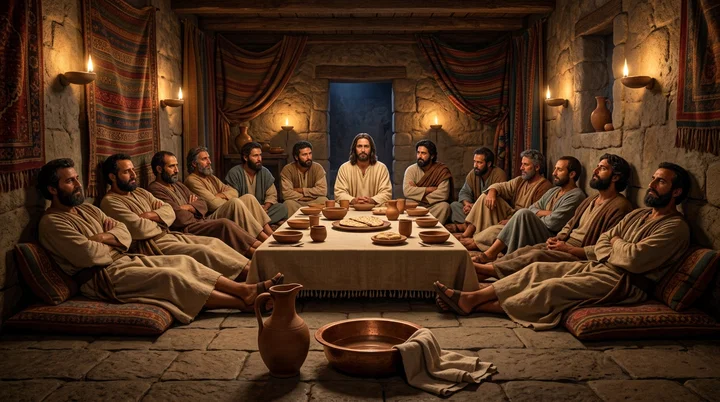
Cross-references 20 of 56
- John 13:14-15
If I then, your Lord and Master, have washed your feet; ye also ought to wash one another’s feet.
Jesus commands the disciples to wash one another’s feet, following his example.
- 1 Corinthians 11:23-26
For I have received of the Lord that which also I delivered unto you, That the Lord Jesus the same night in which he was betrayed took bread:
Explains the meaning of the bread and cup.
- John 6:4
And the passover, a feast of the Jews, was nigh.
Counts an earlier Passover in the sequence before the final one.
- John 2:13
And the Jews’ passover was at hand, and Jesus went up to Jerusalem,
An earlier Passover in the sequence helps date Jesus’ ministry.
- Luke 22:19-20
And he took bread, and gave thanks, and brake it, and gave unto them, saying, This is my body which is given for you: this do in remembrance of me.
Jesus shares bread and cup as memorials of his body given and the new covenant in his blood.
- John 14:1-3
Let not your heart be troubled: ye believe in God, believe also in me.
Jesus comforts his disciples by promising to return and receive them into the Father’s house.
- John 17:11
And now I am no more in the world, but these are in the world, and I come to thee. Holy Father, keep through thine own name those whom thou hast given me, that they may be one, as we are.
Jesus says he is leaving the world for the Father and prays for his followers.
- Matthew 26:26-28
And as they were eating, Jesus took bread, and blessed it, and brake it, and gave it to the disciples, and said, Take, eat; this is my body.
Jesus institutes the supper with bread and wine after washing the disciples’ feet.
- Mark 14:12-17
And the first day of unleavened bread, when they killed the passover, his disciples said unto him, Where wilt thou that we go and prepare that thou mayest eat the passover?
Both describe the Passover meal Jesus shared with his disciples.
- John 13:34
A new commandment I give unto you, That ye love one another; as I have loved you, that ye also love one another.
Jesus’ enduring love is the example for loving one another.
- 1 Corinthians 5:7
Purge out therefore the old leaven, that ye may be a new lump, as ye are unleavened. For even Christ our passover is sacrificed for us:
Christ is the Passover sacrifice, given for us.
- Matthew 26:20-21
Now when the even was come, he sat down with the twelve.
Places the supper on the evening Jesus was betrayed.
- John 16:28
I came forth from the Father, and am come into the world: again, I leave the world, and go to the Father.
Jesus says he leaves the world and returns to the Father.
- Exodus 12:6
And ye shall keep it up until the fourteenth day of the same month: and the whole assembly of the congregation of Israel shall kill it in the evening.
gives appointed time Jesus had to fulfill
- John 13:33
Little children, yet a little while I am with you. Ye shall seek me: and as I said unto the Jews, Whither I go, ye cannot come; so now I say to you.
Jesus tells his disciples he will soon leave them and go to the Father.
- John 16:7
Nevertheless I tell you the truth; It is expedient for you that I go away: for if I go not away, the Comforter will not come unto you; but if I depart, I will send him unto you.
Jesus leaves for the Father, making the Comforter’s coming possible.
- John 14:12
Verily, verily, I say unto you, He that believeth on me, the works that I do shall he do also; and greater works than these shall he do; because I go unto my Father.
Jesus connects his departure with going to the Father.
- John 13:36
Simon Peter said unto him, Lord, whither goest thou? Jesus answered him, Whither I go, thou canst not follow me now; but thou shalt follow me afterwards.
Jesus says Peter will follow him afterward.
- Luke 22:11
And ye shall say unto the goodman of the house, The Master saith unto thee, Where is the guestchamber, where I shall eat the passover with my disciples?
The passage connects Luke’s supper account to the earlier supper.
- John 16:16
A little while, and ye shall not see me: and again, a little while, and ye shall see me, because I go to the Father.
Jesus says he will leave the world and go to the Father.
Commentary
Each commentary is drawn from primary sources: the writings of Ellen G. White and Adventist pioneers and periodicals. Each commentary is separate. Its own words are not a quotation; follow the references to read the source passages.
Ellen G. White
32 sources
On the last evening before his death, before the Passover feast, Jesus knew his appointed hour had come to leave this world and return to the Father.Ms 19, 1897, par. 3–5Ms 102, 1904, par. 1–3Lt 336, 1906, par. 5–9DA 642.1Ms 180, 1898, par. 1 He was about to give himself as the true paschal lamb, to drink the cup of wrath and endure betrayal, rejection and the cross.Ms 19, 1897, par. 3–5Ms 102, 1904, par. 1–3Ms 54, 1897, par. 10 Having loved his own who were in the world, he loved them to the end with a divine love that does not change with circumstances but endures through time and eternity.DA 643.1Ms 22, 1898, par. 4Ms 19, 1897, par. 54–55 That love set aside concern for his own suffering to care for his disciples, bearing patiently with their selfish contention while knowing every weakness, defect and temptation yet not casting them off.Ms 102, 1904, par. 1–3Ms 54, 1897, par. 10DA 643.1Ms 203, 1899, par. 3–5Ms 22, 1898, par. 4 He showed it by taking the servant's place to wash their feet, even the feet of Judas who would betray him, and giving a lasting ordinance of humility and love to be kept with the supper.Ms 19, 1897, par. 3–5Ms 102, 1904, par. 1–3MH 493.3–4DA 720.2
Hour Come, Love Endures
The setting is before the feast of the Passover, in an upper room in Jerusalem on the last evening before death, in the last week and final time on earth.Lt 336, 1906, par. 5–9DA 642.1Ms 113, 1897, par. 17 The hours there were spent instructing the disciples and preparing and comforting them for the coming trial and separation they would witness when He was betrayed, rejected, and made to suffer.Lt 336, 1906, par. 5–9Ms 180, 1898, par. 1Ms 113, 1897, par. 17 He showed lasting love for His disciples as He prepared to depart to the Father, and the foot washing that followed was an expression of that love.Ms 180, 1898, par. 1Lt 189, 1897, par. 15Lt 73, 1888, par. 8
He knew His appointed hour had come to depart out of this world unto the Father, to leave the world and return to God from whom He came and into whose hands the Father had given all things.Ms 19, 1897, par. 3–5Ms 102, 1904, par. 1–3Ms 54, 1897, par. 10 He was the true paschal lamb to be sacrificed on the day the Passover was eaten, about to drink the cup of wrath and endure the final baptism of suffering.DA 642.1 Before Him lay betrayal, rejection, suffering at the hands of wicked men, the cross, degrading treatment, abandonment, and humiliating death, with the knowledge that many would reject the sacrifice He was about to make.Lt 336, 1906, par. 5–9Ms 54, 1897, par. 10DA 643.1 His soul was already pressed under a severe load none of the disciples could enter into.Ms 19, 1897, par. 54–55
Though facing all this, He kept His disciples foremost in His thoughts, and His care for them outweighed concern for His own suffering.Ms 54, 1897, par. 10DA 643.1 Looking on them with pity and sympathy, He knew the trials ahead of them.Ms 102, 1904, par. 1–3DA 643.1 Their dispute over who would be greatest, and their contentious, selfish spirit and jealousy, left them unready to understand the coming events and the solemnity of the supper.Ms 102, 1904, par. 1–3Ms 19, 1897, par. 54–55 That spirit kept Him from telling them all He wished to say, and He knew that after His death the memory of this scene would scourge them and be sufficient punishment.Ms 54, 1897, par. 10Ms 19, 1897, par. 54–55
Having loved His own which were in the world, He loved them unto the end with an enduring, divine love that did not change despite contention and jealousy.DA 643.1Ms 19, 1897, par. 54–55 It is a love that never disappoints, does not fluctuate or change with circumstances, shares the unchangeableness of His nature, and continues through time and through eternity.Ms 22, 1898, par. 4
That love to the end is with infinite tenderness, forbearance, mercy and long-bearing.Ms 203, 1899, par. 3–5 He sees weakness, knows defects of character, and is acquainted with every temptation and its strength, yet He does not cast off or consume them, and without that mercy they would have perished.Ms 203, 1899, par. 3–5 His enduring love is seen in His willingness to become humanity's substitute and surety, to give His life as the ransom, and to hold fast the faith of everyone who trusts in Him.Ms 125, 1901, par. 22–24 Those who receive Him are adopted into His family as loyal and true sons and daughters of God, yet whether a person is adopted into the royal family depends upon that person.Ms 22, 1898, par. 4
Footwashing Service Includes Judas
While the disciples argued and contended over who would be greatest and none would stoop to wash feet, Jesus rose from supper, laid aside His garments, girded Himself with a towel, poured water into a basin, and washed and wiped their feet.Ms 19, 1897, par. 3–5Ms 102, 1904, par. 1–3Ms 19, 1897, par. 54–55 Though Lord and the pure spotless Lamb of God presenting Himself as a sin-offering, He took the lowly servant's role, and as that hour of departure approached His humility became more evident.Ms 102, 1904, par. 1–3Ms 43, 1897, par. 24 In this He pitied them for the trials ahead, rebuked their pride and childish passions that were hurting their own souls and left them unready for coming events, and knew the memory of this scene after His death would scourge them as sufficient punishment.Ms 102, 1904, par. 1–3Ms 19, 1897, par. 54–55
In loving to the end He gave a simple, sacred, last-established ordinance in connection with the last supper.Ms 19, 1897, par. 3–5Ms 19, 1897, par. 18–19 As type met antitype in Himself as the authority, foundation and only efficacious offering for sin, He discharged the cares and burdens of ancient Jewish rites and ended the sacrifices offered for four thousand years, replacing the national festival with a memorial of feet washing and the sacramental supper to be observed by followers through all time in every country and continually repeated, so that through remembrance no exaltation of one above another would find place and brother would be brought to understand the feelings of his brother.Ms 19, 1897, par. 3–5Ms 43, 1897, par. 24Ms 19, 1897, par. 18–19 It speaks not so largely to intellect as to the heart, and He Himself is present to awaken understanding, revive memory, convict of sin and receive penitential offerings, disentangling believers from rites made of no force by the gospel.Ms 19, 1897, par. 18–19 Eating His body and drinking His blood means not merely the sacramental service but daily partaking of the bread of life by receiving His word and doing His will.Ms 19, 1897, par. 18–19
The chapter plainly expresses God's will for His people and connects with His gift of eternal life and making believers one with Him in this life and forever.Ms 14, 1895, par. 1–2RH Jun 18, 1901 Ministers are urged to study and live out this instruction of John 13:1-17 as a safeguard against leaving the simplicity of Christ.Ms 103, 1903, par. 19–21 The lesson drawn is the ordinance of humility to foster humility, expel selfishness, teach unselfish ministry, join hearts in unity and oneness with Him, and bring love, grace and peace to contrite hearts.Ms 14, 1895, par. 1–2Ms 75, 1898, par. 30–32 The saints follow it by washing one another's feet with breaking of bread in a solemn gathering that brings the congregation to humility before God.Ms 14, 1895, par. 1–27MR 218.1
The ordinances of feet washing and the sacrament are to be kept together, feet washing observed along with the Lord's Supper in church administration.7MR 218.1Lt 164, 1897, par. 4–5 The order is first washing of feet, then eating of broken bread to represent His broken body and drinking of juice of the vine to represent His spilled blood.12MR 247.1–2 It is kept in an evening service with large united participation whose solemnity belongs with revival, helps believers settle into the work, aids sinners seeking the Lord, and welcomes even new believers to wash feet for the first time.7MR 218.1 It is to be kept private and separate from the wicked and unbelievers lest reproach come on the cause, done with women washing women's feet and men washing men's feet.12MR 247.1–25MR 192.1–3 It is witnessed by angels and unseen witnesses, including messengers of darkness with those who refuse the Spirit.20MR 149.2–4Ms 47, 1897, par. 18–20
His tender ministry included Judas even though He knew Judas would betray Him, after the devil had put betrayal into the heart of Judas Iscariot, Simon's son, who had twice pledged to betray Him.Ms 19, 1897, par. 3–5DA 720.2 He patiently bore with Judas, kept him with him without condemning or sending him away until the very last, washed his feet and allowed him to share the sacrament, offering every opportunity to receive Him, repent and be cleansed.DA 655.4Ms 106, 1903, par. 54–55Ms 120, 1897, par. 9 All but Judas were brought to repentance, while Judas rejected the loving appeal, resented His humility, had his course decided, and went out to betray Him.DA 720.2DA 655.4Ms 120, 1897, par. 9 Even when done carefully a Judas may eat and drink to his own damnation but God will make him manifest and purge him out.12MR 247.1–2
His example teaches followers not to exclude professed Christians from the services since human beings cannot read hearts or distinguish sincere from insincere or faithful from unfaithful.20MR 149.2–4Ms 47, 1897, par. 18–20 They are not to abandon or carelessly separate from one believed erring or sinful lest the person be left exposed and driven further into temptation, but to bear patiently with those at fault as He bore with Judas and as Peter's failures yet becoming a life of service shows.MH 493.3–4DA 655.4Ms 106, 1903, par. 54–55 They are to serve rather than exalt themselves, becoming less inclined to seek honor as they grow in Christlike character. They are to live His final instruction and prayer for unity and love in practical life so they are united with one another and with Christ, strong against Satan's attacks and able to stand the coming test, and not to refuse to be partakers with Him in suffering and tribulation because He so loves to the end.Lt 131, 1900, par. 1–3MH 493.3–4
Sources
Pioneers and periodicals
154 sources
On the last evening of his life, before the Passover feast, Jesus sat with his disciples in the upper room in Jerusalem for the final supper before his betrayal, suffering, and death.ST Apr 19, 1905RH Jan 8, 1867ST Feb 7, 1884 He knew that his appointed hour had come to leave this world and return to the Father, to be handed over and lay down his life for sinners.STRH May 18, 1869RH Dec 6, 1864 Having loved his own who were in the world, he loved them to the end, with a constant, unchanging love to the uttermost that no change of condition could alter.ST Sep 9, 1889ST Apr 19, 1905ST Apr 19, 1905 He loved them though he knew they were faulty and unfaithful, contending for greatness, and that one would betray him, one would deny him, and all would forsake him before morning.RH Jun 4, 1914RH Jun 4, 1914ST Mar 29, 1899 That same love moved him to rise from the supper and wash their feet, instituting the ordinance of humility to be kept in connection with communion before the Lord's Supper.STCO 43.4–5
Time, Place, and Wording
The setting is before the feast of the Passover, on the last evening of Jesus' life, less than twenty-four hours before He was in the tomb.ST Apr 19, 1905ST Feb 7, 1884ST Feb 11, 1897RH Aug 24, 1869 It was in the upper room in Jerusalem on the evening He was betrayed, during the last Passover supper before His death, when He ate the Passover and the Lord's supper and instructed and prayed for His disciples.ST Apr 19, 1905RH Jan 8, 1867ST Nov 4, 1897 The teaching of chapters 13 and 14 was given at that supper before leaving the upper chamber and crossing the brook Cedron, before going to Gethsemane to face betrayal and crucifixion.ST Apr 19, 1905ST Nov 4, 1897
The washing came after the paschal meal was ready and after Jesus had sat down, after the Passover supper and before He blessed and gave the bread and wine.RH Jun 16, 1868CO 45.1–2ST Feb 4, 1903ST Feb 7, 1884 It came before the announcement that one would betray Him, before the departure of Judas and before the warning to Peter.CO 45.1–2ST Feb 4, 1903 Judas remained through the washing and the supper, and Jesus' statement about the betrayer came after the washing, fixing that order.CO 45.1–2ST Jul 12, 1905RH Nov 20, 1913 By a different reckoning the washing is placed before the supper was eaten, with Judas present at the washing and Jesus' words that they were not all clean referring to Judas among them, and with the disciples reclining at the table afterward where the account of the supper and Judas's departure confirms this order.RH Dec 23, 1858
The supper is the same one described in the Synoptic Gospels, substantially the same account as Matthew of Jesus eating the Passover with His disciples before His arrest.ST Apr 2, 1912RH Apr 15, 1873 It is identified both as the Jewish Passover which Jesus ate with His disciples and as the occasion when afterward He instituted the Lord's Supper and the feast commemorating His death as the Lamb of God.ST Apr 2, 1912ST Nov 19, 1912 It was held one day earlier than usual so that Jesus, the true Passover Lamb, could die at the appointed time.RH Apr 15, 1873
The word translated feast is the Greek heorte, meaning a feast-day, feast or festival holiday.RH Jul 22, 1852ST Mar 25, 1875ST Jul 29, 1875 It is the same word used for holyday in Colossians 2:16, where feast day or festival is the right meaning.RH Jul 22, 1852ST Mar 25, 1875 Its use for the Passover festival shows it does not mean the weekly Sabbath of the fourth commandment but designates the Jewish feast days that expired with the ceremonial system.ST Mar 25, 1875RH Nov 7, 1854 The phrase the end in this verse is an exception to the usual New Testament use of the end for the end of the age or the time of Christ's coming.RH May 5, 1874RH Apr 10, 1856 Its context shows it has a different sense here, meaning fully, to the uttermost, or to the end of His final trial and earthly course with them.RH May 5, 1874RH Apr 10, 1856ST Feb 11, 1897
Jesus knew when His hour had come because the Holy Spirit had descended upon Him at His baptism and abode upon Him, being given to Him without measure.ST Apr 19, 1905
Hour and Departure to Father
Before the feast Jesus knew that his hour had come to depart out of this world unto the Father, to leave the world and return to the Father and go to him.STRH May 18, 1869RH Dec 6, 1864 This was the appointed hour when he would be handed over and die, the time for the supreme test in which the Son of God would lay down his life for sinners. As he knew his hour and his authority and divine origin, as one who had come forth from God and existed before his earthly life, he still on the last night with his disciples presented himself as both Son of God and Son of man.RH Aug 19, 1902ST Sep 26, 1895ST Dec 9, 1880 His knowledge that he would soon be called to the Father gave his face a tender, sorrowful radiance as he sat with the twelve at the solemn feast.ST Aug 13, 1902
The place to which he went when he left the earth is the Father's house in heaven with many mansions.ST Jul 15, 1880 This confirms that the Father has a definite dwelling place in heaven rather than being present everywhere without a particular habitation.RH Mar 3, 1903 His first coming was to suffer, while his second coming would bring an unshakable kingdom.RH Jun 20, 1854 His departure then is the ground for the promise that Peter and all the disciples will follow him there afterward, when he comes again at the second advent and first resurrection to receive them unto himself and take them with him, so that the saints leave the earth and go to heaven to reign with Christ a thousand years.ST Jul 15, 1880 Before departing he gave full assurance that he would return, would not leave them comfortless but would come to them, and would take his children to heaven when he comes.ST Feb 16, 1915ST Jul 17, 1884RH Jun 20, 1854RH Aug 27, 1857
Though he knew his departure was near, his thoughts remained with his followers on earth.ST Oct 9, 1907ST Mar 8, 1910 He came to suffer for sinful, wayward people, and leaving them brought sadness because he loved them, yet the thought of leaving was made bearable by knowing his departure was for their good.ST Oct 9, 1907ST Mar 8, 1910 He came for them, returned to heaven for them, and will come again for them.ST Oct 9, 1907ST Mar 8, 1910 His death fulfilled the plan of redemption agreed upon by the Father and the Son before the world existed, and he remained faithful to his purpose to redeem humanity even as the time came for his sacrifice and he faced the cross.ST Aug 13, 1912
Love to the Uttermost
Having loved his own who were in the world, he loved them unto the end, for his love is constant and unchanging, lasting to the end, to the uttermost and fully. ST Sep 9, 1889ST Apr 19, 1905ST Apr 19, 1905ST Aug 12, 1889ST Mar 5, 1912 It is closer and more complete than a mother's, a lover's, a friend's, or a brother's, and it touches their grief with real compassion. ST Sep 9, 1889 It is full and inexhaustible, so that no number of needy sinners can exhaust what he has to give. ST Aug 12, 1889 No change in position, whether from high to low or low to high, can alter infinite love, and the Sabbath stands as its enduring memorial and sign. ST Apr 19, 1905RH Jan 19, 1905
His coming departure and the prospect of eternal glory did not lessen his love for his poor, erring, faulty disciples who were slow to learn and slow to trust him. ST Apr 19, 1905ST Apr 19, 1905ST Apr 14, 1914 Past evidence of his love assures believers that his love does not cease when circumstances grow dark or people do not feel near to God. ST Jan 21, 1889 Their slowness to trust him grieved him despite that enduring love. ST Apr 14, 1914
He loved them even though he knew they were unworthy and unprepared and would be unfaithful. RH Jun 4, 1914RH Jun 4, 1914ST Mar 29, 1899 They contended for greatness and sought the highest places, with James and John seeking highest places, Thomas doubted, Peter would deny him, Judas planned to betray him, one would betray him and all would forsake him before morning. RH Jun 4, 1914RH Jun 4, 1914ST Mar 29, 1899 Yet nothing could quench his love, for he had come forth from God and God is love, and to fail in love would have been to fail his mission. ST Mar 29, 1899 He remained faithful to them in the crisis and chose to endure the appointed test for them. RH Jun 4, 1914
In Gethsemane Satan made his final effort to overcome Jesus through his humanity and tempted him to abandon his sacrifice because those he came to save were ungrateful and sinful, using their unworthiness against him. RH Jun 4, 1914RH Jun 4, 1914 But Jesus set himself aside, his purpose did not waver, and he chose to endure the appointed test. RH Jun 4, 1914RH Jun 4, 1914 His matchless love endured through the final test and is worthy of continual praise. RH Jun 4, 1914
His love was proved through suffering and death for sinners and expressed in the cross of Calvary. ST Sep 9, 1889ST Apr 1, 1897 Their grief touches him with real compassion, he is willing and able to forgive and save everyone who comes to him, and his love for the faithful would never abate even as his departure troubled them. ST Sep 9, 1889RH May 18, 1869ST Apr 1, 1897
His love extended beyond the disciples to his own nation and the lost world despite their unworthiness. RH Jun 4, 1914RH Jun 4, 1914 Even to those who hated and crucified him he showed love, praying for their forgiveness, returning blessing for curses when cursed, struck, scourged and persecuted, and showing mercy to a thief who trusted him. RH Sep 11, 1900ST Aug 17, 1915 It was active and self-giving in serving, teaching, healing the afflicted, forgiving even enemies, giving himself in constant sacrifice to do his Father's will. RH Feb 24, 1859
His love was not limited to a few close friends and bridged the gulf between his divine greatness and the humble fishermen he chose. ST Though John had special intimacy with him, he loved all his followers including Judas, and washed even the traitor's feet. RH Nov 6, 1900ST He bore long patience with perverse Judas, not wanting to lose him, and continued to love his disciples to the end even though he knew they were about to deny and forsake him. ST Feb 9, 1915RH Nov 26, 1901 Judas, driven by hopes of earthly honor and gain, misread that humble service as proof of no personal advantage, left with sins unconfessed, and sealed his doom. RH Jan 4, 1906
His enduring love means true friendship does not ask whether a person is worth loving. It is agape, self-giving love that patiently seeks to restore the unworthy rather than ending when it is not returned, loving his own in all their unworth. ST Mar 5, 1912 It calls believers to love the weak and unworthy and let them know they are loved, with the same unselfish, enduring care. ST Mar 5, 1912
Foot Washing as Ordinance
John 13:1 begins the history of the institution of feet-washing as a divinely appointed ordinance, also called the ordinance of humility or ordinance of humiliation, established by Christ's example and instruction to be practiced in connection with communion immediately before the Lord's Supper as preparation for it.STCO 43.4–5STST May 26, 1909 The chapter gives the account of the ceremony of feet-washing and opens the account of the institution of the ordinance of humility, with John 13:1-17 clearly instituting and enjoining it and giving the account supporting it.STSTST May 26, 1909 The service of believers kneeling to wash one another's feet displays love and humility and can move observers to recognize Christian love.
The foot washing was not a customary act of hospitality or prompted by physical uncleanness, for the custom was to wash before eating and to provide water for guests to wash their own feet, whereas Jesus rose from the supper after it was ready and after he had sat down and himself washed their feet.RH Jun 16, 1868RH Apr 22, 1862ST Feb 7, 1884RH Feb 24, 1859RH Apr 22, 1862 Washing a guest's feet was not the host's customary duty, and ordinary courtesy did not require one person to wash another's feet, so the act teaches Christian fellowship and the duty to serve one another rather than being merely hospitality.RH Jun 16, 1868RH Apr 22, 1862ST Mar 9, 1888 The disciples did not understand its purpose at first, and Jesus' example and directions made washing one another's feet a specific act to follow his example, not merely a general lesson about humility or household service.RH Jun 16, 1868ST Mar 9, 1888ST Feb 7, 1884 Jesus' act and teaching thus established an example for his disciples to follow in every age, because it was not prompted by ordinary hospitality customs.RH Apr 22, 1862RH Feb 24, 1859RH Apr 22, 1862
His example teaches humility, for though their Lord and Master he took the place of a servant and washed their feet on the evening he was betrayed during the last Passover supper before his death, knowing his hour had come to depart to the Father and loving his own who were in the world to the end.RH Jan 8, 1867RH Jan 20, 1853ST Jul 15, 1886 The washing of feet is an ordinance that expresses humility toward one another and memorializes Christ's humiliation, and its motive and time — from love for his disciples when about to depart out of this world — help prove it most explicitly and strictly enjoined.RH Jan 8, 1867RH Jan 20, 1853 The account is truthful, and Christ's act is presented as an example he commanded his disciples to follow in washing one another's feet, both example and command to be followed in the way he did it and not by doing something else.ST Jul 15, 1886ST Aug 5, 1886 To neglect or refuse it is to slight both example and command, and very few of those who profess to be his disciples actually do as he did.ST Aug 5, 1886
The act is not merely a figure for serving others or ordinary hospitality or a theory or sentiment, but calls for actual, reciprocal, literal foot-washing, with the proceedings described in minute detail to show a literal transaction enjoining literal obedience by doing as he did.ST Aug 5, 1886ST Sep 9, 1886RH Apr 22, 1862 Jesus' example teaches humble service to the weak and lowly and is to be practiced in all coming time and throughout the gospel age, especially in the last days of falling away, and not as voluntary humility invented by men or a lesson in hospitality or humility only.RH Jan 8, 1867RH Apr 22, 1862ST Sep 9, 1886 The command remains binding even when many church members fail to follow it.ST Sep 9, 1886 Its benefit comes through doing, not merely knowing or remembering, and those who know this teaching are happy if they put it into practice, bringing blessing and keeping Christ's condescension vividly before them.ST Oct 31, 1878RH Apr 2, 1908RH Apr 22, 1862 The foot washing is an example of self-denial and humility that followers are to imitate, and Jesus' command makes it an obligation not to be neglected.RH Jul 24, 1856
The immediate occasion was strife and alienation among the disciples over who should be accounted greatest, proving that even those who had lived with him and seen his meek humility needed this lesson at that solemn moment on the last day of his ministry.RH Jun 23, 1910RH Feb 10, 1916ST Oct 24, 1900 They had been disputing who would have the highest place, with James and John seeking highest places, and their alienation and dissension left them unready for the bread and wine of communion.RH Jun 23, 1910RH Feb 10, 1916 Each cared more for being accounted great than for being great, each criticizing the others to show their failings disqualified them for the highest place and treating keenness to detect error as proof of fitness for supremacy, after three and one-half years of teaching meekness and humility by precept and example.RH Aug 3, 1916 At the foot-washing they began to see the sinfulness of that unholy ambition, for Jesus used the ordinance to wash away such feelings and to prepare participants for communion, answering their selfishness and discord with this lesson of humble service.RH Jun 23, 1910RH Feb 10, 1916RH Aug 3, 1916 As the Lord's Supper shows the Lord's death till he come, foot washing commemorates his humility of life till he come, and is the more necessary of the two because professed Christians are more willing to follow Christ in dying for religion than in imitating his humility in living it.ST Oct 24, 1900
Conscious that he was their Lord and Master and the greatest among them, Lord of all by right of position whom all creatures should serve and obey, and knowing his authority and divine origin as his hour had come to leave the world and return to the Father, he loved his disciples and served them by washing their feet.RH Aug 19, 1902ST May 21, 1896ST Apr 11, 1906 He emptied himself of his rights and power, not longing for high estate, and took the form and place of a servant, showing that true greatness and authority are expressed through service even by the King and Lord.RH Aug 19, 1902ST May 21, 1896ST Apr 11, 1906 His washing of their feet was a crowning display of humility, showing that he came to serve rather than to be served, rebuking ambition and teaching them to love and serve one another as he loved them.ST Apr 11, 1906 His menial service shows that humility is willing service, not a ceremony performed from pride or compulsion, and his example teaches that love for Christ and for others can overcome selfish pride and make ordinary, lowly duties a joyful expression of humility.RH May 30, 1912 For him the act was humility, while for Judas the same act was experienced as humiliation because of pride.RH May 30, 1912
The act and teaching express humility and equality among the disciples and set an example for them to follow in all future times, with meaning not limited to hospitality or to the customs of that time.RH Feb 24, 1859 His example is a practical act to imitate, not merely a theory or sentiment, permanently teaching humility so that disciples esteem others above themselves and reject ambition to be greatest by washing one another's feet.ST Jun 7, 1899 Following it fosters humble, equal fellowship among Christ's disciples, for they belong to the same body and should care for one another without castes, classes, or barriers of rank, serving one another rather than acting from selfishness or rivalry when struggling over which should be greatest.RH May 3, 1864ST Feb 20, 1901ST Feb 20, 1901 No one in his church is to claim supremacy over another, much less enslave anyone, for the law of his kingdom stands opposite to treating people as property.RH Oct 8, 1861
Feet-washing is not only a remembrance of that particular act but also a remembrance of Christ's whole humble life and of his whole earthly life of self-denial, which began when he left his exalted position as Ruler of the universe to take human nature and bear the world's sins and culminated in his death on the cross.ST Jun 14, 1905ST Oct 24, 1900 Knowing his hour had come to depart out of this world unto the Father to be exalted again and have a name above every name with the glory he had with the Father before the world was, having loved his own which were in the world, he gave them a memorial of his humiliation in taking upon him man's nature with all its painful deprivations, so that by often observing foot washing they might realize their infinite obligations to him.RH Jul 21, 1868 His taking the place of a servant just before his suffering, loving his own to the end, expresses the humility he showed before the cross, and the washing serves as a memorial of that humiliation teaching followers to humble themselves before one another.RH Jan 8, 1867 The foot washing recalls the condescension of the Son of God who laid aside his glory, took human form, and served those who followed him, as an emblem of what Christ has done for his disciples teaching humility and self-abasement by his example.RH Jun 27, 1878
The service humbled them, struck at pride, and prepared their hearts for the next service by cleansing away selfish ambition so pure love could flow in, making foot washing a duty and not merely an outward act of cleansing.ST May 13, 1875 Washing one another's feet can remove alienation and restore fellowship, and regular observance encourages members to settle difficulties before sharing the Lord's Supper.RH Jul 7, 1863 Following his example prepares followers for close self-examination before sharing the emblems of his broken body and shed blood, leading to heartfelt confession and heavenly blessing.RH Jan 14, 1858 In this preparatory act believers put away differences, confess, forgive, and prepare to share the sacrament together.CO 43.8–44.3
The Passover gathering took place in the upper room, where Jesus instituted the Lord's Supper and the rite of humility, or washing of feet, to continue until his personal return at the close of the gospel age and to remind followers of his humiliation in taking human nature, his humble life in the work of salvation, and his body and blood freely given for the world.ST May 21, 1896 His followers are to keep the Sabbath he kept and observe the ordinances he instituted that night even amid inconvenience.ST Oct 3, 1895 The account of Jesus washing his disciples' feet is regarded as an ordinance he instituted for the church, though there is noted disagreement over whether it is a standing ordinance essential to church fellowship or an act of hospitality, with some churches practicing it while members were left to decide whether and when to observe it.RH Mar 1, 1860
Carrying out the instructions Jesus gave in John 13 and commemorating his death are joined with Christian love and bring a sense of his blessing, for the passage introduces Jesus' final acts of love toward his disciples before his departure to the Father.RH Jan 9, 1872 Celebrating this ordinance of humility and loving service is a Christian duty and brings blessing to those who take part, making a deep impression on those present as a solemn act bringing spiritual blessing.ST Aug 21, 1907RH Aug 13, 1908 Keeping these ordinances of humility and communion brings the sense of his presence, joy of heart, and melts hearts in tender love for one another even when the ordinance is entirely new, and is practiced as a remembrance of his example performed as he knew he was about to return to the Father loving his own to the end.RH Mar 18, 1909RH May 22, 1913 The ordinance is practiced with the sense of his presence and of the Comforter, with joy in thinking of soon seeing Christ and satisfaction in obeying his word through heartfelt confession from following his perfect pattern.RH Mar 18, 1909RH May 22, 1913
The chapter presents Jesus' washing of the disciples' feet as an example and command supporting feet-washing as a church ordinance and token of humility and brotherly love, with Jesus' foot washing showing his humility and love and his example and command making the practice an ordinance to continue on the same evening as the Passover supper and institution of the Lord's supper.ST Jul 26, 1883RH Aug 19, 1858 The church followed that example of humble service by observing the Lord's ordinances including foot washing as an expression of love for him, invoking his example and instruction in observance of the ordinances including the Lord's Supper and connecting it with his love and the sacrifice commemorated by the emblems.RH Jan 19, 1869 His love for his own disciples still in the world continuing to the end was the motive associated with the ordinance, defining and enforcing it as a distinct Christian ordinance whose observance remains binding and which together with God's law identifies the true church.RH Jan 20, 1853ST May 25, 1915
The chapter plainly expresses God's will for his people, connecting that teaching with Christ's gift of eternal life and his work of making believers one with him in this life and forever.RH Jun 18, 1901 It teaches a marvelous lesson of humility and service through Jesus' example and is identified as the setting for the lesson showing his knowledge of his coming departure and his regard for his disciples.ST Sep 24, 1912ST Mar 29, 1899 Study of the order of the last supper should be careful to understand its full significance, since John 13:1-30 is part of the account of events connected with his last supper.ST Nov 15, 1883 The washing happened first in the celebration of the ordinances, after preparation of the Passover and before the breaking of bread and blessing of the cup that instituted the Lord's Supper, before the announcement that one would betray him, before the departure of Judas, and before the warning to Peter.ST Feb 4, 1903
Passovers, Prophecy, and Fulfillment
John 13:1 marks the fourth and final Passover in John's record of the feasts Jesus attended, the last Passover at which he was betrayed and crucified, bringing his earthly ministry to its close.ST Dec 19, 1892RH Sep 20, 1870ST Mar 2, 1882RH Jan 7, 1858ST Apr 7, 1898 The first three are those in John 2:13, John 5:1, and John 6:4.ST Mar 2, 1882 The betrayal is dated to this fourth Passover, the year after the attendance referred to in John 7:6-8 and John 8:20.RH Mar 11, 1875ST Apr 7, 1898
Counted with the three earlier yearly Passovers, these four Passovers cover no more than three and a half years from his baptism to his cross.RH Jan 10, 1854RH Apr 4, 1854 Together they show a public ministry of three years and six months, the half of a prophetic week of years.RH Apr 2, 1872 Roughly three years lie between the first and last, with ministry beginning about six months before the first.ST Dec 18, 1907 The last Passover in the sequence occurred in the spring, when he was crucified.RH Apr 30, 1901
He began his ministry in the autumn of A.D. 27 at the end of the sixty-nine weeks.ST Dec 19, 1892ST Mar 2, 1882ST May 17, 1877 His first Passover was therefore in spring A.D. 28, his second in A.D. 29, his third in A.D. 30, and this fourth Passover in spring A.D. 31 when he was crucified.ST Mar 2, 1882 That is three and a half years before the end of the seventy weeks in autumn A.D. 34.ST Mar 2, 1882 Added to a baptism in A.D. 26-27 this brings the crucifixion to the spring of A.D. 31, no later than A.D. 31.RH Sep 20, 1870RH Jan 10, 1854RH Jan 7, 1858RH Apr 4, 1854
This places the crucifixion exactly in the middle of the seventieth week of years that began in autumn A.D. 27, midway through the final week of the seventy weeks when Messiah was to be cut off.ST Mar 2, 1882ST Jul 18, 1911 He was cut off not for himself but for all people.RH May 16, 1912 By becoming the Passover sacrificed for us and offering himself as the great antitype he caused sacrifice and oblation to cease and ended the Jewish sacrifices.RH Jan 10, 1854ST Jul 18, 1911RH Apr 4, 1854 His death confirmed the covenant by sealing its principles forever, and during the first half of the week he had taught those principles to the Hebrews.ST
Jesus kept this supper with his disciples one day earlier than usual and before the regular Passover feast.RH Apr 15, 1873RH Apr 7, 1851 He did so that he, the true Passover Lamb, could die at the appointed time on the very day and hour the lambs were killed, at even about three o'clock P.M. on the fourteenth day.RH Apr 7, 1851 He could not both fulfill the type by dying then and keep the regular feast at the same time.RH Apr 7, 1851 Christ our Passover was sacrificed on the day of the feast, fulfilling the Passover service as its antitype when type met antitype in the death of the Lamb of God for the sins of the world.RH Aug 3, 1916ST Feb 11, 1897ST Aug 12, 1886 It was virtually the last Passover ever to be celebrated, reaching its final observance less than twenty-four hours before he was in the tomb.ST Feb 11, 1897ST Aug 12, 1886
In this chronology the verse supports the timing of the Passover events, placing Jesus' knowledge that his hour had come before the Passover feast. It places the final Passover before his death in A.D. 31 at the close of the three-and-a-half-year period from his baptism, when his hour had come for him to be cut off.RH May 16, 1912
Doctrine, Comfort, and Practice
The opening of the upper-room discourse extends through John 13–17 and presents John's emphasis on Christ's divine glory, with love and life as central themes.ST Mar 9, 1888
The Sabbath stands as the enduring memorial and sign of Christ's unchanging love for his own.RH Jan 19, 1905
His enduring love assures every soul who trusts in him that he will save now, sustain through the way, and save ultimately.ST Aug 10, 1904 That love comforts the lonely and suffering, sustains those in poverty and distress, and invites those troubled by sin to seek cleansing and draw near without fear, with assurance of his care and hope beyond earthly hardship.ST Mar 20, 1884 It gives troubled people courage and a place of inward rest amid sorrow, fear, and distress.ST Jun 21, 1905 It remains with believers through life and at the dying bed, giving assurance that they will be with him forever.RH Aug 12, 1862 He is a kind Saviour and Friend who died to save, who is all that is needed, who loves his own faithfully to the end, so no one needs to wander on alone without him.ST Oct 23, 1901
His unfailing love belongs to those who love the heavenly Father more than every earthly friend, even when earthly prospects are blighted and dear friends forsake and withdraw favor.RH May 19, 1863 It comforts the lonely, weak, and fainting pilgrim, lights the way to follow Christ, and calls for trust and gladness instead of sadness.RH May 19, 1863 He is a faithful friend who succors those who trust him.ST Feb 10, 1914
His enduring love for the church is the pattern for believers to love one another despite imperfections, faults, disagreements, and disappointments.RH Jun 4, 1914RH Nov 26, 1901 He loved his disciples who remained in the world all the way to the end despite their imperfections.RH Jun 4, 1914 He continued to love them to the end even though he knew they were about to deny and forsake him, and that love does not stop when disagreements or disappointments arise.RH Nov 26, 1901 He loved his own who were in the world to the end even when they failed him, with one denying knowledge of him, another betraying him, and the rest abandoning him, and his love under every condition is the example for followers' love for one another.ST Aug 17, 1915 That same love extended to those who hated and crucified him, for whom he prayed, and showed mercy to a thief who trusted him.ST Aug 17, 1915
His love is an example of divine love that should move people to serve, so that even the humblest work becomes service for the Master.ST Nov 24, 1887 As followers grow in Christlike character and learn to serve rather than exalt themselves, they become less inclined to seek honor for themselves. As the hour of his return to the Father approached, his humility became more evident, and while the disciples argued over who was greatest he washed their feet, showing humility and loving service. His foot-washing expresses the closeness and care with which he cherishes and builds up his people, and makes his self-giving love the model for a husband's love for his wife.ST Jun 3, 1913
Although exalted to the highest heaven, surrounded by the angelic host with angels and authorities and powers subject to him, he has not forgotten his own and is not ashamed to mention their names before the Father and call them his brethren.RH Dec 23, 1902 His love is a longing for their presence and companionship that will not be satisfied until those who have accepted his redeeming grace are with him where he is to behold and share his glory, brought to Zion to sit with him on his throne.RH Dec 23, 1902 To delay his coming as Son of man is to defer the gratification of this desire, and its fulfillment is the glorious reunion when Saviour and saved sinners meet in the air to enjoy each other's companionship forever.RH Dec 23, 1902 Love for the Lord can thus remain steadfast to the end of life.RH Jan 5, 1911
Even as he stooped to wash feet while facing the horrors of his near future, he remained calm, tender, and considerate of friend and foe without self-pity or resentment, steadfast in love for those who were his.ST Aug 28, 1879 His washing of their feet in the final hours before his return to the Father was a crowning display of humility, showing that he came to serve rather than to be served.ST Apr 11, 1906 Though conscious that he was their Lord and Master and the greatest among them, he served his disciples to teach that loving service and humility are true greatness.ST Apr 11, 1906 The act rebuked their ambition and taught them to love and serve one another as he loved them.ST Apr 11, 1906
His washing of Judas's feet was an act of humble service and love, while Judas experienced the same act as humiliation because of his pride.RH May 30, 1912 Driven by hopes of earthly honor and gain, Judas misread it as proof that following Jesus would bring him no personal advantage, then left with sins unconfessed, and his choice sealed his doom.RH Jan 4, 1906 The serving of the erring and faulty disciples brought all but Judas to repentance, making them meek, teachable, loving, and united in affection for their Master and one another.RH Nov 20, 1913
The verse places Jesus before Passover, knowing his hour had come to leave the world and go to the Father, loving his own who were in the world to the end, and belongs to the chapters cited for the promise that he will take his children to heaven when he comes.ST Feb 16, 1915 As he was about to leave the world for the Father, he knew trials and sorrows awaited those who remained, and his enduring love is joined to his promise not to leave them comfortless and to come to them.RH Aug 27, 1857 The hope of his coming comforts his followers in distress, in the face of death, and when loved ones die, until he takes them home to himself.RH Aug 27, 1857
Keeping the ordinance of humility set forth in John 13 brings joy in thinking of soon seeing Christ and will bring infinite satisfaction for having obeyed his word, as proof of his willingness to humble himself for his people and as example and direction to do as he did by following in his steps.ST Oct 18, 1877 His example prepares followers for close self-examination before sharing the emblems of his broken body and shed blood, and following that example leads to heartfelt confession and heavenly blessing.RH Jan 14, 1858 His perfect pattern was followed in observing the Lord's ordinances, followed by partaking of the emblems of his broken body and shed blood.RH Apr 1, 1858
The story presents his love for his own as the lesson of love taught through his life.RH Jul 21, 1874 His own are those to whom he gives love that endures to the end.RH Aug 8, 1912 He loved those who belonged to him and were in the world to the end as he was about to leave them and return to the Father.RH Feb 2, 1860ST Sep 2, 1897ST Mar 30, 1904 In the account beginning with this verse he instituted an ordinance for his church, which his professed people generally neglected.RH Feb 2, 1860 He loved his followers who were still in the world to the end, declaring his enduring love as he was about to leave them, yet continuing to love his own who were in the world to the end.ST Sep 2, 1897ST Mar 30, 1904
Sources