Mark 6:24
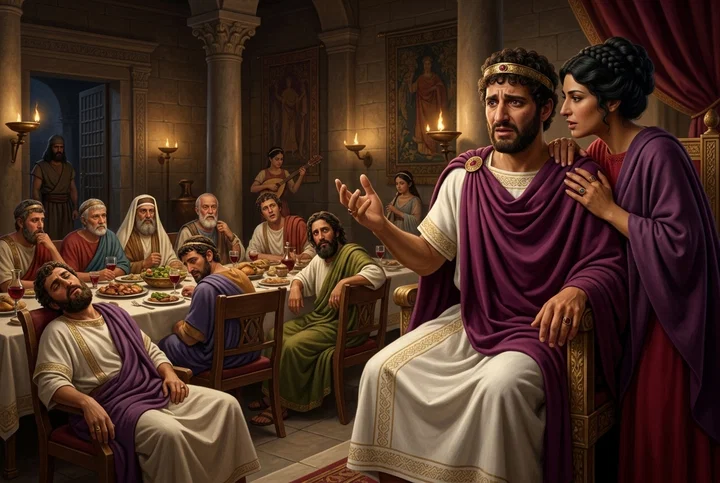
And she went forth, and said unto her mother, What shall I ask? And she said, The head of John the Baptist.
Translations
And she went forth, and said to her mother, What shall I ask? And she said, The head of John the Baptist.
King James Version, KJV Cambridge Paragraph Bible
And she went forth, and said unto her mother, What shall I ask? And she said, The head of John the Baptist.
And she went forth, and said to her mother, What shall I ask? and she said, The head of John the Baptist.
And she went out, and said unto her mother, What shall I ask? And she said, The head of John the Baptist.
And she went out, and said unto her mother, What shall I ask? And she said, The head of John the Baptizer.
And she, having gone forth, said to her mother, 'What shall I ask for myself?' and she said, 'The head of John the Baptist;'
And she went out, and said to her mother, What should I ask? And she said, The head of John the baptist.
And, going out, she said unto her mother—What shall I ask? and she said—The head of John the Immerser;
Berean Standard Bible, Majority Standard Bible
Then she went out and asked her mother, “ What should I request?”And her mother answered, “ The head of John the Baptist.”
She went out and said to her mother, “ What shall I ask?”She said, “ The head of John the Baptizer.”
And she went out and said to her mother, What is my request to be? And she said, The head of John the Baptist.
So she went forth, and said to her mother, What shall I aske? And she said, Iohn Baptists head.
Douay-Rheims (Challoner revision)
Who when she was gone out, said to her mother, What shall I ask? But she said: The head of John the Baptist.
Pictures
Cross-references
- Matthew 14:6-11
But when Herod’s birthday was kept, the daughter of Herodias danced before them, and pleased Herod.
Herodias’s daughter requests John’s head, and Herod carries out the execution.
- Luke 3:19-20
But Herod the tetrarch, being reproved by him for Herodias his brother Philip’s wife, and for all the evils which Herod had done,
John’s rebuke of Herod led to his imprisonment and Herodias’s demand for his head.
- Mark 6:18
For John had said unto Herod, It is not lawful for thee to have thy brother’s wife.
John condemned Herod’s unlawful marriage, provoking Herodias’s hostility.
- John 1:19-23
And this is the record of John, when the Jews sent priests and Levites from Jerusalem to ask him, Who art thou?
John’s identity and ministry are questioned by Jewish leaders.
- Luke 9:7-9
Now Herod the tetrarch heard of all that was done by him: and he was perplexed, because that it was said of some, that John was risen from the dead;
Herod recalls beheading John and wonders who Jesus is.
- Matthew 3:1-12
In those days came John the Baptist, preaching in the wilderness of Judaea,
John’s ministry is described, including his call to repentance.
- Matthew 11:2-3
Now when John had heard in the prison the works of Christ, he sent two of his disciples,
John questions Jesus from prison while awaiting release.
- Luke 7:19
And John calling unto him two of his disciples sent them to Jesus, saying, Art thou he that should come? or look we for another?
John questions Jesus while imprisoned, awaiting release.
- Matthew 14:5
And when he would have put him to death, he feared the multitude, because they counted him as a prophet.
Herod wished to put John to death but feared the people.
- Matthew 11:7-19
And as they departed, Jesus began to say unto the multitudes concerning John, What went ye out into the wilderness to see? A reed shaken with the wind?
Cited for Jesus’ testimony about John and his work.
- Mark 6:20
For Herod feared John, knowing that he was a just man and an holy, and observed him; and when he heard him, he did many things, and heard him gladly.
quoted to show Herod feared John
- Mark 1:2-4
As it is written in the prophets, Behold, I send my messenger before thy face, which shall prepare thy way before thee.
John is identified as the messenger preparing the way.
- Luke 1:57-80
Now Elisabeth’s full time came that she should be delivered; and she brought forth a son.
Cited for John’s birth and early life.
- Esther 7:2
And the king said again unto Esther on the second day at the banquet of wine, What is thy petition, queen Esther? and it shall be granted thee: and what is thy request? and it shall be performed, even to the half of the kingdom.
The king’s offer to Esther is recalled as a model for Herod’s offer.
- Acts 12:1-2
Now about that time Herod the king stretched forth his hands to vex certain of the church.
Herod orders the execution of John’s brother James.
Commentary
Each commentary is drawn from primary sources: the writings of Ellen G. White and Adventist pioneers and periodicals. Each commentary is separate. Its own words are not a quotation; follow the references to read the source passages.
Ellen G. White
27 sources
The girl left the banquet to ask her mother what she should claim for her dancing, and the answer was ready on her mother's lips, the head of John the Baptist, a demand the girl herself shrank from but was prevailed upon to return and present as a request for his head in a charger.RH Mar 11, 1873RH Apr 8, 1873DA 220.6–221.3 That demand sprang from Herodias's revenge against John for faithfully reproving her unlawful union with Herod as his brother's wife, with fear that his repeated warnings might persuade Herod to break free.DA 214.12SP 76.1–77.1RH Mar 11, 1873 Unable to win Herod's consent to John's death by direct means, she laid a stratagem for his birthday feast for officers and nobles, using wine and revelry to throw him off his guard and sending her daughter to dance until in impaired judgment he bound himself with a drunken oath to give whatever she asked.DA 220.6–221.3Ms 107, 1893, par. 1Ms 87, 1898, par. 18–19 The request was seized in that moment when intemperance had weakened judgment and perverted justice and mercy, and so cost God's prophet his life while the severed head was made an object of horror to Herod and his guests and of exultation to Herodias.STRH Apr 8, 1873ST Mar 15, 1883 Herod then wrongly treated his rash oath as binding above God's commandment not to kill, choosing murder rather than humble himself and refuse, and his guilt tormented him with fear while his continued indulgence hardened his conscience.STST Mar 15, 1883STCOS 144.2–33SP 135.1
Context and Request
The asking for John's head was revenge by Herodias for his faithful reproof of her unlawful union with Herod Antipas as his brother's wife while that brother was still living, with fear that his repeated warnings might persuade Herod to break free.DA 214.12SP 76.1–77.1RH Mar 11, 1873STEW 124.3–125.1 Herod feared John as a just and holy man and heard him gladly, and for a time tried to break free, but Herodias held him fast and induced him to shut John in the prison fortress east of Jordan where much of his ministry had been spent.DA 214.1 There John lay week after week in gloom and inaction, deprived of liberty and facing possible loss of life, with no change in his condition.DA 214.2–215.2
While imprisoned he did not understand the nature of Christ's kingdom, expecting Jesus to take the throne of David, to fill every valley and make low the mountains and hills of human pride and power, to hold His fan in His hand and thoroughly purge His floor and burn the chaff with unquenchable fire.DA 214.2–215.2 He expected Him in the spirit and power of Elijah to reveal Himself by fire and as the Lion of the tribe of Judah to cast down the oppressor and deliver His herald.DA 214.2–215.2 Because Jesus instead gathered disciples, healed and taught without claiming kingly authority, and did nothing to effect John's release despite the tidings his disciples brought of Jesus' works and the crowds flocking to Him, John's active labor gave way to despondency, doubt, perplexity and trouble.DA 214.2–215.2
Herodias could never win Herod's consent to John's death by direct measures, so she resolved on stratagem at Herod's birthday entertainment for officers and nobles.DA 220.6–221.3 She used feasting, wine, revelry and drunkenness to throw Herod off his guard and sent her daughter Salome to dance for the guests.DA 220.6–221.3Ms 107, 1893, par. 1 Captivated under Satan's influence, Herod in his impaired judgment promised with a drunken oath to give her whatever she asked, even to half his kingdom.DA 220.6–221.3Ms 107, 1893, par. 1Ms 87, 1898, par. 18–19
Salome hastened out from the banquet to ask her mother what she should claim, and the answer was ready: the head of John the Baptist.RH Mar 11, 1873DA 220.6–221.32SP 76.1–77.1RH Mar 11, 18733SP 135.1 Salome herself knew nothing of Herodias's thirst for revenge and shrank from presenting the request, but Herodias's determination prevailed.DA 220.6–221.3 The girl returned with the terrible petition for John's head in a charger, using Herod's reckless promise to carry out her mother's revenge.RH Apr 8, 1873DA 220.6–221.3RH Mar 11, 1873ST3SP 135.1 The request came amid intemperance that had weakened judgment and perverted the sense of justice and mercy, allowing Herodias to exploit the moment to bring about a decision that cost God's prophet his life.ST Mar 15, 1883RH Apr 8, 1873 The severed head was then brought before Herod and his guests to their horror, while Herod could not bear the sight, having heard John preach, and Herodias made it an object of exultation and insult.STRH Apr 8, 1873Ms 107, 1893, par. 1
Consequences and Warnings
Herod's intoxication and sensual excitement at the feast clouded his judgment when the demand for John's head placed an innocent prophet's life in the balance.ST Mar 15, 1883STCOS 144.2–3 He had made a rash, drunken oath and then wrongly treated it as binding above God's commandment not to kill.ST Mar 15, 1883STRH Apr 8, 1873 Rather than humble himself, refuse to violate God's law, and risk being thought to have broken his oath, he chose the real guilt of murder.ST Mar 15, 1883STRH Apr 8, 1873 He ordered John killed to please Herodias during the drunken feast, after years in which he had been deeply impressed by John's teaching yet did not turn from intemperance and sin, and his heart grew harder.ST Mar 15, 1883COS 144.2–3 Sober reason and regard for justice and duty would have made the guests recoil from the execution.ST Mar 15, 1883
His part in John's death afterward tormented him with guilty conscience and fear of punishment.ST He had once felt remorse for putting to death a man he knew to be a true prophet to satisfy the revenge of a cruel woman.3SP 135.15RED 55.1DA 730.1–5 But his continued wrongdoing and licentious life degraded his moral sense until he regarded his sins as trifles and could even boast of punishing John for reproving him, with his conscience hardened by the time he faced Jesus.3SP 135.15RED 55.1DA 730.1–5 The severed head itself became an object of Herodias's exultation and insult.ST
John's death came just after the disciples returned filled with joy over their success on their first missionary tour, and it brought them bitter sorrow and disappointment.STST Dec 19, 1916 It severely tested their faith, for they wondered why Jesus had left John to die in prison without saving him.STST Dec 19, 1916DA 380.1–2 Jesus looked with pitying tenderness on their sorrowful tear-stained faces, with tears in His own eyes and voice, and called them apart into a desert place to rest awhile.ST His pointed and fearless message had cost him his life, showing that such a witness could lead to imprisonment and death.STB 377.2STB 55.4Ms 16, 1895, par. 18 Yet his imprisonment and death made him a witness for God whose enemies could kill his body without taking away his hope or eternal life.Ms 16, 1895, par. 18
The episode warns against intemperance, self-indulgence, and popular pleasure, for the demand arose at a feast marked by overeating, drunkenness, dancing, and revelry, which weakened judgment and perverted the sense of justice and mercy.RH Apr 8, 18732SP 80.1 Sensual excess can cloud reason, surrender people to baser passions, and destroy sound judgment and conscience, leading to grave and lasting consequences for others.RH Apr 8, 18732SP 80.1 Those who hold responsibility are warned especially to practice self-control and Christian temperance, since intemperance among people in authority helped lead to John's martyrdom.RH Apr 8, 18732SP 80.1 A performance that pleases, excites, and influences another can lead to a destructive demand, and such transactions are recorded and ultimately exposed in their true light.14MR 122.1
Sources
Pioneers and periodicals
51 sources
The verse records the girl stepping out from Herod's presence to ask her mother what she should claim under his oath to give whatever she asked, and her mother answering with the demand for the head of John the Baptist.RH Mar 11, 1873ST Jun 7, 1899ST Dec 24, 1894 The asking follows her dance before Herod and his guests at his birthday feast for the lords and captains of Galilee, while John lies imprisoned nearby.ST Mar 3, 1898ST Sep 6, 1910RH Aug 29, 1865 The demand comes from Herodias in revenge and hatred because John condemned her unlawful marriage and reproved her sins, and she had long waited for an opportunity to silence him and protect her reputation.RH Mar 11, 1873STST Dec 24, 1894RH Nov 11, 1858ST Sep 13, 1910 Herod yields because he is weak and without courage, fearing man more than God and fearing to be laughed at, his judgment clouded by drink and sensual excitement so that he prefers murder to seeming a promise-breaker.ST Mar 15, 1883ST Mar 15, 1883ST Apr 20, 1882 His rash and vague promise shows that some vows are better broken than kept, and his drunken feast shows how intemperance and pleasure-seeking weaken judgment, pervert justice and mercy, and become the fruitful cause of almost every other crime.ST Mar 15, 1883ST Mar 15, 1883ST Mar 3, 1898RH Sep 11, 1860ST Apr 20, 1882
Setting and Request
The girl goes out from Herod's presence to ask her mother what she should claim after he has promised with an oath to grant whatever she asks, even to half his kingdom, and her mother answers that she is to ask for the head of John the Baptist.RH Mar 11, 1873ST Jun 7, 1899ST Dec 24, 1894ST Mar 3, 1898 The counsel is sought at his birthday feast after his offer of whatever she wants, and at her mother's direction the answer is returned that same day.ST Feb 7, 1911ST Dec 15, 1887
The consultation follows the daughter's dance before Herod and his guests, a supper made for his lords and high captains and chief estates of Galilee amid the revelry of the king's feast.ST Sep 6, 1910RH Aug 29, 1865ST Sep 13, 1910 Herodias uses the birthday feast and the king's intoxicated promise to bring about the execution while John is still imprisoned near the palace.ST Jun 19, 1907ST Sep 6, 1910
The palace stands on flat land on the very summit of a hill overlooking a beautiful valley watered by streams and covered with grass, bounded by fruitful mountains with vine and olive rising in terraces.RH Aug 29, 1865 The beheading itself takes place at Machaerus.ST Mar 3, 1898
At her mother's direction the answer given is for John's head on a platter or charger, to be given that same day.ST Sep 6, 1910ST Feb 7, 1911 Herod then orders John's head brought on a platter, carrying out the request made at the banquet.ST Sep 13, 1910
Herod had heard John preaching to multitudes in the wilderness of Judea and had been pricked in heart and listened reverently.ST Feb 7, 1911 John had confronted him with the question where his lawful spouse, the daughter of Aretas king of Arabia, was.ST Feb 7, 1911 John had then been imprisoned for a year and was thirty-three years old when killed.ST Mar 3, 1898
No one at first speaks in John's defense.ST Sep 13, 1910 Herod's rash oath together with the reaction of the guests helps seal the prophet's fate.ST Sep 13, 1910
Motives and Characters
Herodias tells her daughter to ask for the head of John the Baptist from revenge and hatred, because he condemned her unlawful marriage and reproved her unlawful life and sins.RH Mar 11, 1873ST Dec 24, 1894RH Nov 11, 1858ST Sep 6, 1910ST Sep 6, 1910 His faithful rebuke of a licentious ruler cost him his life, and she further dishonored him after the execution by having his dead tongue pierced.RH Nov 11, 1858 She had long hated him, regarded him as her enemy and a threat to be silenced to protect reputation, and waited for an opportunity to act against him.ST Sep 13, 1910ST Sep 13, 1910ST Sep 6, 1910ST Sep 6, 1910ST Sep 6, 1910 She feared his repeated warnings might persuade Herod, and she was determined to have him killed.STST Sep 13, 1910ST Sep 6, 1910
She uses her daughter and the king's offer as the means to carry out her plan, directing the girl who came to ask what to request to demand John's head.RH Mar 11, 1873RH Apr 8, 1873RH Mar 11, 1873 She presses her to act quickly before Herod can reconsider, and her insistence prevails.ST Mar 8, 1883ST Dec 15, 1887 She persuades her with promises of wealth, marriage to a powerful man, and a palace.ST Sep 6, 1910 The daughter Salome is at first shocked, resists and refuses because she does not understand her mother's desire for revenge.ST Mar 8, 1883ST Dec 15, 1887 Her horror gives way to vanity, she accepts and echoes that John must die and demands his head on a platter, and she even keeps dancing until the soldier returns with the head.ST Sep 6, 1910ST Sep 13, 1910ST Sep 6, 1910
Herod is weak and wicked chiefly because weak, a man with a conscience but without courage who fears God but fears man still more and his wife most of all.ST Apr 20, 1882 He desires to do right but dares not be laughed at, and, his judgment clouded by intoxication and sensual excitement at the feast, he is exploited in a moment when intemperance has weakened judgment and perverted justice and mercy.ST Mar 15, 1883ST Mar 15, 1883RH Apr 8, 1873ST Apr 20, 1882 Inveigled into a foolish and reckless oath, he prefers to be called murderer rather than promise-breaker, choosing the real guilt of murder rather than risk being thought to have broken his oath.STST Apr 20, 1882 He who one day listened joyfully to John listens the next day to the horrid proposal against him, halting between two opinions, convinced but not converted nor changed in heart, having no decision of character and floating loosely until despised and neglected.RH Apr 28, 1863
By contrast John is the brave prophet who fears God but not man, whom the king could not silence, a man who dares to do right cost what it would and is as quick to rebuke iniquity in high places as among the lowly.ST Apr 20, 1882 He is the just, holy, righteous and righteous prophet murdered at the close of the revelry, a model for the modern preacher.ST Apr 20, 1882ST Sep 13, 1910ST Sep 13, 1910 Herodias stands opposite as ambitious, designing, and unprincipled, a picture of what any woman may become who allows ambition to dethrone love and a frightful illustration of worldliness in womanhood.ST Apr 20, 1882 The account is an example of John being put to death at the request of a dissolute woman.ST May 8, 1907
Execution and Aftermath
The mother's answer turns the banquet promise into a death sentence, and the girl's request for the head of John the Baptist leads directly to his martyrdom and beheading.STRH Apr 8, 1873ST Mar 3, 1898 He had been imprisoned for a year and was 33 years old when he was killed at Machaerus, executed by the sword.ST Mar 3, 1898ST Mar 8, 1899 The stroke was carried out by one of Herod's own men under arms on the march to battle against Aretas, one of that same soldiery whom John had charged to show humanity and to abstain from unnecessary violence and pillage and from lawless rapine and lust.RH Sep 30, 1862 In this way revenge obtained its object, and Herod's loss of judgment through a woman's influence was set over against John's loss of his life by the sword.RH Apr 8, 1873ST Mar 8, 1899
The severed head was brought in a charger before Herod and his guests while the feast was still going on and was given to the damsel.RH Apr 8, 1873RH Aug 29, 1865 Herod ordered it brought on a platter in fulfillment of the banquet request.ST Sep 13, 1910 He gave it to her as a costly gift to carry to her mother, because her mother's enemy had fallen and he had kept his oath.ST Sep 13, 1910
To Herodias the head became an object of exultation and insult, received with fiendish joy expressing bitter hatred for the prophet who had proclaimed truth to a licentious ruler.STST Feb 10, 1881 She further dishonored it by having the dead tongue pierced.
Herod afterward acknowledged John as a just and holy man and asked whether he could be released from his oath rather than put the prophet to death.ST Sep 13, 1910 His part in the death nevertheless tormented him afterward with guilty conscience and fear of punishment.ST
Herod and Herodias and the lords and high captains and chief estates are gone, and the palace lies in ruins with a plow turning among its columns and marble floor, its builder's name forgotten by the local plowman.RH Aug 29, 1865 Pilgrims from every quarter honor the prison of the beheaded victim, a comment upon the vanity of worldly greatness.RH Aug 29, 1865
News of John's death at Herod's hand came just after the disciples returned filled with joy over their success on their first missionary tour, and it brought them bitter sorrow and disappointment.STST Dec 19, 1916 That Jesus had left John to die in prison severely tested their faith.ST Jesus looked with pitying tenderness on their sorrowful tear-stained faces, with tears in His own eyes and voice, and called them apart into a desert place to rest awhile.ST
Warnings and Application
The consultation that ends in the demand for John's head takes place at a birthday feast marked by overeating, drunkenness, dancing and revelry, where intemperance has weakened judgment and perverted the sense of justice and mercy among Herod and his guests.ST Mar 15, 1883RH Apr 8, 1873ST Mar 3, 1898 Salome's indecent dance before a drunken court shows lust and strong drink going hand in hand, and the demand that comes from it shows intemperance to be the inspiration and fruitful cause of almost every other crime.RH Apr 8, 1873ST Dec 12, 1906 Sensual self-indulgence and pleasure-seeking excess cloud reason, capture good resolutions, surrender men to baser passions, make one do another's bidding, and bring grave and lasting consequences, even to the martyrdom of God's prophet after a year of imprisonment at the age of thirty-three at Machaerus.RH Apr 8, 1873ST Mar 3, 1898ST Dec 15, 1887ST Apr 20, 1882 The Bible gives more warnings against intemperance than against any other sin and affirms its punishment more positively, so the feast warns against such scenes and calls for Christian temperance and for shunning places that stimulate the animal and sensual while impairing the spiritual, intellectual, moral sense and will.ST Dec 15, 1887ST Dec 12, 1906ST Apr 20, 1882
Herod's pledge to give whatever is asked is a vague and general promise putting himself into another's hands to do whatsoever he is bidden, and such promises are always dangerous because their enforcement can lead into sin and temptation.ST Mar 3, 1898ST Apr 20, 1882 Some vows and promises are better broken than kept and more honorable to break than to keep, and a bad promise of that kind is better broken than kept.RH Sep 11, 1860ST Apr 20, 1882ST Jun 9, 1898 Herod is not obliged to keep his vow when keeping it means beheading John, for if the daughter had asked for Herod's own head he would not have felt bound to give it.ST Jun 9, 1898ST Oct 9, 1884 It is better still to remain the unhampered master of oneself and make no vague obligation that could force wrongdoing.ST Mar 3, 1898ST Apr 20, 1882
Herod's intoxication and sensual excitement cloud his judgment, yet he wrongly treats his oath made while drunk as binding above God's commandment not to kill.ST Mar 15, 1883RH Apr 8, 1873 Under pressure from his reckless oath he chooses the real guilt of murder rather than risk being thought to have broken his oath.ST Mar 15, 1883ST Sober reason and regard for justice and duty would have made the guests recoil from putting an innocent prophet's life in the balance.ST Mar 15, 1883RH Apr 8, 1873
The demand is the result of Herod's rejection of God's reproof: although he had not intended to kill John, drunkenness and pride over a rash promise lead him to carry out the killing.ST Dec 24, 1894ST Dec 15, 1887 It shows the deadly consequence of intemperance among people in authority through impaired judgment and dormant conscience.ST Dec 24, 1894ST Dec 15, 1887
Herod's listening joyfully to John's instruction one day and listening to the horrid proposal against him the next shows instability, meaning halting between two opinions, being convinced but not converted nor changed in heart, having no decision of character, and floating loosely upon the tide and tossed like a leaf until despised, neglected and uncared for.RH Apr 28, 1863
The account shows Herod Antipas misusing his power to kill John, the messenger sent to announce the coming of the Messiah, and John's beheading stands as an example of Herod's crime.ST Jul 13, 1904RH Jul 22, 1873
The episode is the New Testament's only account of dancing and presents dancing pursued for pleasure rather than praise to God.ST Feb 18, 1886ST Apr 28, 1909 The dance by the daughter of a wicked woman leads to the request for John's head at her mother's direction, linking the dance with the execution, as if the first Baptist minister had his head danced off.ST Feb 18, 1886ST Aug 17, 1904ST Apr 28, 1909
The record of the beheading and the carrying of the head on a tray into the banquet hall presents John as a great hero who gave his life for his Master. That truth stirs admiration in boys of teen age, but its harrowing details only frighten a five-year-old, so it is unsuited to the needs of little children under six.
Sources