Matthew 17:26
Peter saith unto him, Of strangers. Jesus saith unto him, Then are the children free.
Translations
Peter says to him, Of strangers. Jesus says to him, Then are the children free.
King James Version, KJV Cambridge Paragraph Bible
Peter saith unto him, Of strangers. Jesus saith unto him, Then are the children free.
Peter saith to him, From strangers. Jesus saith to him, Then are the children free.
Revised Version, American Standard Version
And when he said, From strangers, Jesus said unto him, Therefore the sons are free.
Peter saith to him, 'From the strangers.' Jesus said to him, 'Then are the sons free;
Peter says to him, From strangers. Jesus said to him, Then are the sons free.
And, when he said, From the aliens, Jesus said unto him, Well then, free, are the sons!
“ From others,” Peter answered.“ Then the sons are exempt,” Jesus declared.
“ From others,” Peter answered. “ Then the sons are exempt,” Jesus said to him.
Peter said to him, “ From strangers.”Jesus said to him, “ Therefore the children are exempt.
And when he said, From other people, Jesus said to him, Then are the sons free.
Peter sayd vnto him, Of strangers. Then said Iesus vnto him, Then are the children free.
Douay-Rheims (Challoner revision)
And he said: Of strangers. Jesus said to him: Then the children are free.
Pictures
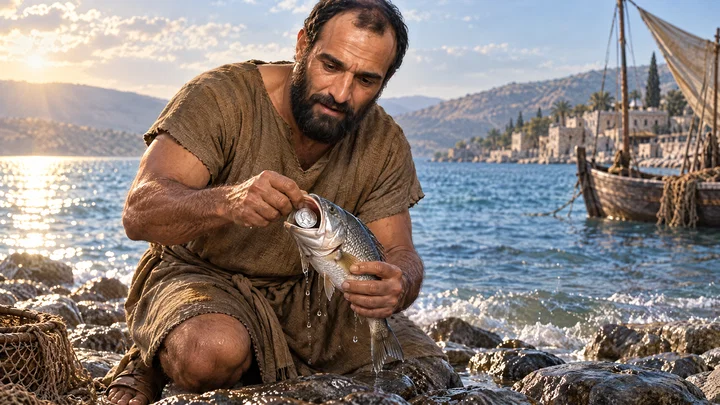


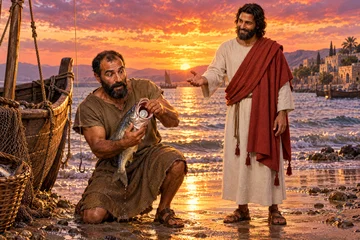
Cross-references
- Exodus 30:13-16
This they shall give, every one that passeth among them that are numbered, half a shekel after the shekel of the sanctuary: (a shekel is twenty gerahs:) an half shekel shall be the offering of the LORD.
The half-shekel contribution is the precedent for the temple tribute.
- Mark 12:14-17
And when they were come, they say unto him, Master, we know that thou art true, and carest for no man: for thou regardest not the person of men, but teachest the way of God in truth: Is it lawful to give tribute to Cæsar, or not?
Jesus answers a question about tribute to Caesar by teaching what is due to Caesar and God.
- Luke 20:22-25
Is it lawful for us to give tribute unto Cæsar, or no?
Jesus teaches to render Caesar’s due.
- Matthew 22:17-21
Tell us therefore, What thinkest thou? Is it lawful to give tribute unto Caesar, or not?
Jesus answers whether tribute should be paid to Caesar.
- Matthew 17:1-3
And after six days Jesus taketh Peter, James, and John his brother, and bringeth them up into an high mountain apart,
Jesus is transfigured on the mountain, where Moses and Elias appear with him.
- Romans 13:7
Render therefore to all their dues: tribute to whom tribute is due; custom to whom custom; fear to whom fear; honour to whom honour.
Both texts distinguish what is owed and call for rendering it accordingly.
- Romans 8:17
And if children, then heirs; heirs of God, and joint-heirs with Christ; if so be that we suffer with him, that we may be also glorified together.
Believers are God’s children and heirs with Christ.
- Deuteronomy 10:9
Wherefore Levi hath no part nor inheritance with his brethren; the LORD is his inheritance, according as the LORD thy God promised him.
The Levites’ exemption from inheritance helps explain Jesus’ freedom from tribute as God’s Son.
- Luke 23:2
And they began to accuse him, saying, We found this fellow perverting the nation, and forbidding to give tribute to Cæsar, saying that he himself is Christ a King.
Jesus is falsely accused of forbidding payment of tribute to Caesar.
- Ephesians 2:19
Now therefore ye are no more strangers and foreigners, but fellowcitizens with the saints, and of the household of God;
Believers are fellow citizens and members of God’s household, no longer strangers.
Commentary
Each commentary is drawn from primary sources: the writings of Ellen G. White and Adventist pioneers and periodicals. Each commentary is separate. Its own words are not a quotation; follow the references to read the source passages.
Ellen G. White
9 sources
The saying states the principle that a king's children are exempt from the tribute or tax that is collected from strangers and subjects.Ms 163, 1898, par. 20–22DA 432DA 432.3–433.3DA 433.4–434.53SP 129.3–130.1 Applied to Himself, it means that Jesus, as the Son of God and Lord of the temple, was under no obligation to pay the annual contribution of temple tribute for its support.DA 432.3–433.3DA 433.4–434.5 The saying belongs to an account that shows His poverty, in that He had no money to pay the tax and obtained the small amount needed by a miracle.Lt 119, 1893, par. 15
Though free, He provided the money and paid so as not to give offense or provoke needless controversy.Ms 163, 1898, par. 20–22DA 433.4–434.5Ms 22a, 1895 [Copy 1], par. 35Ms 22b, 1895 [Copy 2], par. 39–40 His paying in this way did not concede that the claim made against Him was just.DA 432.3–433.3 In paying, He showed obedience to the reigning and governing authorities and taught His disciples to do the same.3SP 129.3–130.1ST Jul 4, 1878
For His followers, freedom in conscience does not require defying civil powers when there is no conflict with God.Ms 163, 1898, par. 20–22Ms 22b, 1895 [Copy 2], par. 39–40 With minds and souls under obedience to God, they should not gratify the devil by defiance but may submit to fines, penalties, or indignities that have no right to be imposed rather than give offense, as Christ submitted even to the cross, unless obedience would bring them into conflict with God.Ms 163, 1898, par. 20–22Ms 22a, 1895 [Copy 1], par. 35Ms 22b, 1895 [Copy 2], par. 39–40 Applied to Sunday closing laws, this means stopping regular work such as running presses on Sunday and using the day for missionary work to draw souls to Jesus Christ.Ms 163, 1898, par. 20–22 Refusal is to be reserved for the time when authorities command Sundaykeeping and forbid keeping Saturday, when compliance would bring the mark of the beast.Ms 163, 1898, par. 20–22
Sources
Pioneers and periodicals
38 sources
Earthly kings collect tribute from strangers outside their own household rather than from their own children, so the children are free from that payment.ST Jul 12, 1899ST Sep 12, 1911ST Mar 26, 1896 The saying was spoken when the collectors of the yearly temple tax asked whether Jesus paid it, a sacred duty required of every Israelite for the service of the temple.ST Oct 27, 1881RH Jan 7, 1873ST Jun 2, 1898 As the Son of God, the Son and Lord of the temple whose Father's house that offering supported, Jesus was not liable to the tax and was free from contributing to its support.RH Jul 4, 1907ST Jul 12, 1899ST Oct 27, 1881ST Mar 26, 1896ST Mar 26, 1896 Though under no obligation, He waived His right and paid the demand so as not to cause offense or give the impression that He despised the temple and its service.RH Jul 4, 1907ST Jul 12, 1899 His example teaches His followers to obey civil authority and pay tribute levied by public power even when unjust, so long as obedience does not conflict with duty to God.ST Mar 26, 1896
Language and Historical Setting
Earthly kings collect tribute from strangers rather than from their own children, so the children are free from that payment.ST Jul 12, 1899ST Sep 12, 1911ST Mar 26, 1896RH Jan 7, 1873ST Jan 20, 1909 Peter's answer that the payment is taken from strangers leads to the conclusion that the children are exempt, and the comparison is applied to show freedom from the half-shekel payment.ST Jul 12, 1899ST Sep 12, 1911ST Mar 26, 1896RH Jan 7, 1873 Those outside the royal household are treated as liable while the king's own children and household are exempt from the tax.ST Jun 2, 1898ST Jan 20, 1909
The saying belongs to the account of the yearly temple tax, which was a sacred duty demanded from every Israelite including the poor.ST Oct 27, 1881RH Jan 7, 1873 It occurs when the collectors ask Peter whether Jesus pays the tribute and Peter answers that he does, in the incident in which Peter paid the tribute money by miracle.ST Oct 27, 1881RH Jan 7, 1873ST Jun 2, 1898
The tribute in the account is for the service of the temple and of the sanctuary and is regarded as given to God, distinct from the tax paid to Caesar or the Roman government.ST Mar 26, 1896ST Mar 26, 1896ST Mar 26, 1896ST Mar 26, 1896ST Mar 26, 1896 The contrast is between children taxed for their own father's service being free and the children of others being taxed, so the reasoning concerns tribute raised for God's service and not an example of exemption from civil taxes.ST Mar 26, 1896ST Mar 26, 1896ST Mar 26, 1896ST Mar 26, 1896 Since Jesus was not Caesar's son, the payment at issue was a religious payment for the temple service rather than a payment for the Roman government.ST Mar 26, 1896ST Mar 26, 1896 Strangers means people outside the king's family or household, not foreigners.ST Mar 26, 1896
Christ the Son Is Free
As the Son of God He was free from the half-shekel, or two drachms, collected for the service of the temple, since that house and its service belonged to His Father, the great King.RH Jul 4, 1907ST Jul 12, 1899ST Oct 27, 1881RH Jul 4, 1907ST Mar 26, 1896 As Son and Lord of the temple and its glory He stood in the place of a king's own child, while the tribute was owed only by those outside the royal household.ST Jul 12, 1899ST Oct 27, 1881RH Jul 4, 1907ST Jul 22, 1913ST Mar 26, 1896 His exemption therefore rested on sonship: kings gather tribute from strangers and not from their children, so the Son of the Owner was under no liability to contribute to its support.RH Jul 4, 1907ST Jul 12, 1899ST Oct 27, 1881RH Jul 4, 1907ST Mar 26, 1896
The saying presses His claim to be the Son of God.ST Mar 26, 1896ST Mar 26, 1896ST Mar 26, 1896 By declaring that the children are free He recalled to Peter the divine sonship Peter had already confessed, setting His exalted dignity before him.ST Mar 26, 1896ST Mar 26, 1896ST Mar 26, 1896 Peter had answered the gatherers rashly that Jesus would pay, failing to recognize this distinctive position and presenting Him as a merely common worshiper, out of harmony with His purpose.ST Jul 22, 1913ST Mar 26, 1896ST Mar 26, 1896 The collectors would have expected a theocratic teacher to regard himself as exempt, while Peter assumed He would pay because of His strict religious practice.ST Mar 26, 1896 In that hasty answer Peter had treated Him as though He were an alien or stranger, for which Jesus rebuked him.ST Mar 26, 1896
The priests likewise did not pay for the support of the temple, though Israel supported it and the Levites and priests served within its system, because as representatives of the heavenly High Priest they were free from that expense.RH Jan 7, 1873RH Jan 7, 1873 Since the Levitical priesthood prefigured Christ, Christ as its fulfillment and antitype was likewise free from paying for the support of His Father's house.RH Jan 7, 1873RH Jan 7, 1873 As Son of the King whose house the temple was, He shared the exemption of the king's children and of the temple priests from the two-drachm contribution.RH Jan 7, 1873RH Jan 7, 1873
Prophecy of the Kingdom
The setting that contains this saying explains the promise that some would see the kingdom, for the transfiguration was a representation of the kingdom of glory.ST Nov 7, 1900 In that representation Christ appeared as its glorified King.ST Nov 7, 1900 Moses stood for the righteous dead who will be resurrected at the second advent, while Elijah stood for those who will be translated without seeing death.ST Nov 7, 1900 That transfiguration on the mount occurred during the first advent, about twelve months before the close of His mission, and therefore it was not itself His second coming.RH Jun 18, 1861
Why He Paid Anyway
Though under no obligation as Son and Creator, Jesus waived his personal right to exemption and arranged to pay the demanded temple tribute.RH Jul 4, 1907ST Jan 30, 1901ST Jul 12, 1899RH Jul 4, 1907ST Jul 12, 1899 The payment was not lawfully required of him, since as Son of God and son of the temple's owner he was free from the half-shekel required for his Father's house and its service, yet he paid what was unjustly required of him.RH Jul 4, 1907ST Jul 12, 1899RH Jul 4, 1907ST Mar 26, 1896 He did so in order not to cause offense or stumbling, to avoid needless controversy and dispute over whether the contribution was voluntary, and lest people think he despised the temple and its service or be needlessly provoked against his work.RH Jul 4, 1907ST Jul 12, 1899RH Jul 4, 1907ST Mar 26, 1896 This teaches that it is better to yield to an unjust demand when no principle is sacrificed than to provoke needless controversy over one's rights, and it shows meekness in giving up one's own right rather than contending for it.RH Jul 4, 1907RH Jan 27, 1863RH Jul 4, 1907
He provided the money for both himself and Peter, with Peter counted as a resident of Capernaum.ST Jul 12, 1899ST Jul 12, 1899 The miraculous production of the coin from the fish proved he was the Creator of the very powers he was obeying.ST Jan 30, 1901 Jesus lived poor and destitute in his ministry, with no coin of his own to pay his tax until the fish was made to furnish it.RH Nov 4, 1873 That lack of money belonged to a whole life of poverty that stands as the greatest example against covetousness and gives force to his command to take heed and beware of covetousness.RH Nov 4, 1873 Peter likewise ordinarily had little silver and gold of his own and had no money to pay for himself and Jesus, so that the need for the miracle proves he lived in humble poverty inconsistent with great wealth or with a costly jeweled ring worth thousands as his inheritance or true sample of his condition.RH Apr 15, 1875RH Oct 4, 1870
Duty to Civil Government
The saying that the children are free is a ground for obeying civil authority and the reigning power in such matters as taxes, for Jesus paid the tribute and taught his disciples to pay it.ST Mar 26, 1896ST Sep 30, 1886ST Oct 26, 1882 God's children are to obey the civil laws of the places where they live and to pay taxes levied by public authority, even when the laws are unjust or the taxes oppressive, rather than rebel.ST Mar 26, 1896 Such obedience is rendered for Christ's sake so long as it does not conflict with duty to God or to others. Though the demand was unjustly required of him, he paid it so as not to offend the authorities or give them occasion to oppose his work. His custom was to pay the taxes and contributions common where he lived, and paying civil tribute does not mean bearing arms or paying others to fight.ST Mar 26, 1896RH May 9, 1865
Subjection to the higher powers fulfills the law of God rather than opposing it.ST Jan 30, 1901 Governmental powers are of divine institution and are given for the protection of religious and personal liberties.ST Jan 30, 1901 To the state are to be rendered the custom, tribute, fear and honor that are due, without neglecting the fear and honor owed to God.ST Jan 30, 1901 The Christian work is to reform the morals of the world, not the politics of nations.ST Mar 26, 1896
Applied to believers adopted into God's family, the freedom of the king's children means true citizenship is in God's kingdom and earthly citizenship is subordinate.RH Sep 18, 1866 That higher citizenship does not remove the duty to obey the government under which they live.RH Sep 18, 1866 Though free as the Son, Jesus paid the tribute and taught his followers to do likewise.RH May 9, 1865 His payment and teaching showed obedience to the reigning power and to the governing authorities.ST Jul 4, 1878ST Sep 30, 1886ST Oct 26, 1882 That obedience demonstrates that paying tribute did not make him a rebel against Rome.ST Oct 26, 1882
Paying tribute and submitting to temporal authority even though the children are free shows that to exempt oneself and one's clergy from the civil rule and the temporal sword is contrary to his example and is a mark of antichrist.RH Nov 29, 1870 His act in paying the tribute money has been taken to mean that even he regarded the temporal power as superior to the spiritual power.RH Dec 12, 1907ST Jun 15, 1904 On that reading it proves the emperor superior to the pope.RH Dec 12, 1907
Sources