Luke 13:34
O Jerusalem, Jerusalem, which killest the prophets, and stonest them that are sent unto thee; how often would I have gathered thy children together, as a hen doth gather her brood under her wings, and ye would not!
Translations
O Jerusalem, Jerusalem, which kill the prophets, and stone them that are sent to you; how often would I have gathered your children together, as a hen does gather her brood under her wings, and you would not!
O Jerusalem, Jerusalem, which killest the prophets, and stonest them that are sent unto thee; how often would I have gathered thy children together, as a hen doth gather her brood under her wings, and ye would not!
O Jerusalem, Jerusalem, which killest the prophets, and stonest them that are sent unto thee; how often would I have gathered thy children together, as a hen doth gather her brood under her wings, and ye would not?
O Jerusalem, Jerusalem, that killest the prophets, and stonest them that are sent to thee; how often would I have gathered thy children, as a hen gathereth her brood under her wings, and ye would not!
O Jerusalem, Jerusalem, which killeth the prophets, and stoneth them that are sent unto her! how often would I have gathered thy children together, even as a hen gathereth her own brood under her wings, and ye would not!
O Jerusalem, Jerusalem, that killeth the prophets, and stoneth them that are sent unto her! how often would I have gathered thy children together, even as a hen gathereth her own brood under her wings, and ye would not!
'Jerusalem, Jerusalem, that is killing the prophets, and stoning those sent unto her, how often did I will to gather together thy children, as a hen her brood under the wings, and ye did not will.
Jerusalem, Jerusalem, the [ city] that kills the prophets and stones those that are sent unto her, how often would I have gathered thy children together, as a hen her brood under her wings, and ye would not.
Jerusalem! Jerusalem! she that slayeth the prophets, and stoneth them that are sent unto her! How often, have I desired to gather together thy children, like as a hen, her own brood, under her wings,—and ye did not desire!
Berean Standard Bible, Majority Standard Bible
O Jerusalem, Jerusalem, who kills the prophets and stones those sent to her, how often I have longed to gather your children together as a hen gathers her chicks under her wings, but you were unwilling!
“ Jerusalem, Jerusalem, you who kills the prophets and stones those who are sent to her! How often I wanted to gather your children together, like a hen gathers her own brood under her wings, and you refused!
O Jerusalem, Jerusalem, putting to death the prophets, and stoning those who were sent to her! again and again would I have taken your children to myself, as a bird takes her young ones under her wings, but you would not!
O Hierusalem, Hierusalem, which killest the Prophets, and stonest them that are sent to thee, howe often would I haue gathered thy children together, as the henne gathereth her brood vnder her wings, and ye would not!
Douay-Rheims (Challoner revision)
Jerusalem, Jerusalem, that killest the prophets, and stonest them that are sent to thee, how often would I have gathered thy children as the bird doth her brood under her wings, and thou wouldest not?
Pictures




Cross-references 20 of 28
- Matthew 23:37
O Jerusalem, Jerusalem, thou that killest the prophets, and stonest them which are sent unto thee, how often would I have gathered thy children together, even as a hen gathereth her chickens under her wings, and ye would not!
Jesus laments Jerusalem’s refusal of his desire to gather and protect its people.
- Luke 19:41-44
And when he was come near, he beheld the city, and wept over it,
Christ weeps over Jerusalem’s refusal of peace and foretells its destruction.
- Matthew 23:34-35
Wherefore, behold, I send unto you prophets, and wise men, and scribes: and some of them ye shall kill and crucify; and some of them shall ye scourge in your synagogues, and persecute them from city to city:
Jerusalem rejects and kills God’s messengers, bringing responsibility for the prophets’ blood.
- John 5:40
And ye will not come to me, that ye might have life.
The people refuse Christ’s invitation to receive life.
- Ezekiel 33:11
Say unto them, As I live, saith the Lord GOD, I have no pleasure in the death of the wicked; but that the wicked turn from his way and live: turn ye, turn ye from your evil ways; for why will ye die, O house of Israel?
God pleads with the wicked to turn from their ways and live.
- Luke 20:9-17
Then began he to speak to the people this parable; A certain man planted a vineyard, and let it forth to husbandmen, and went into a far country for a long time.
The vineyard parable portrays Israel rejecting God’s messengers and killing his Son.
- John 1:11
He came unto his own, and his own received him not.
Israel rejected the Messiah
- Matthew 21:33-39
Hear another parable: There was a certain householder, which planted a vineyard, and hedged it round about, and digged a winepress in it, and built a tower, and let it out to husbandmen, and went into a far country:
The parable depicts Israel’s rejection of God’s messengers and killing of his Son.
- Luke 19:43-44
For the days shall come upon thee, that thine enemies shall cast a trench about thee, and compass thee round, and keep thee in on every side,
prophetic sight of Roman siege and ruined temple
- 1 Thessalonians 2:15-16
Who both killed the Lord Jesus, and their own prophets, and have persecuted us; and they please not God, and are contrary to all men:
killing prophets and rejecting Christ fills sin
- Psalms 91:4
He shall cover thee with his feathers, and under his wings shalt thou trust: his truth shall be thy shield and buckler.
Both describe shelter under wings as protection.
- Luke 19:41
And when he was come near, he beheld the city, and wept over it,
passage describes same weeping from Olivet
- Luke 23:28-31
But Jesus turning unto them said, Daughters of Jerusalem, weep not for me, but weep for yourselves, and for your children.
Jesus warns of coming calamity on Jerusalem.
- Matthew 23:32
Fill ye up then the measure of your fathers.
Israel fills up transgression by rejection
- Luke 21:20-24
And when ye shall see Jerusalem compassed with armies, then know that the desolation thereof is nigh.
Describes the surrounding armies and desolation foretold for Jerusalem.
- Jeremiah 19:11
And shalt say unto them, Thus saith the LORD of hosts; Even so will I break this people and this city, as one breaketh a potter’s vessel, that cannot be made whole again: and they shall bury them in Tophet, till there be no place to bury.
city broken beyond repair in A.D. 70
- Psalms 81:13
Oh that my people had hearkened unto me, and Israel had walked in my ways!
Both voice God's longing for wayward people to listen.
- Isaiah 62:3
Thou shalt also be a crown of glory in the hand of the LORD, and a royal diadem in the hand of thy God.
describes the beauty Christ saw before lamenting
- Luke 23:21
But they cried, saying, Crucify him, crucify him.
The crowd that rejected Christ cries out for his crucifixion.
- Hosea 11:8
How shall I give thee up, Ephraim? how shall I deliver thee, Israel? how shall I make thee as Admah? how shall I set thee as Zeboim? mine heart is turned within me, my repentings are kindled together.
Both texts lament the people’s refusal despite God’s yearning love.
Commentary
Each commentary is drawn from primary sources: the writings of Ellen G. White and Adventist pioneers and periodicals. Each commentary is separate. Its own words are not a quotation; follow the references to read the source passages.
Ellen G. White
31 sources
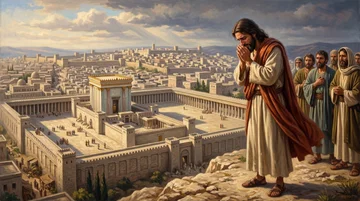
Christ wept in lament over Jerusalem, the favored city that killed the prophets and stoned those sent to her, as He looked upon her and foresaw her destruction and the leaving of her house desolate.Ms 128, 1899, par. 9–12ST Feb 27, 1896Lt 64, 1897, par. 29–30DA 620.1–2ST Feb 21, 1878 As a hen gathers her brood under her wings, He longed with repeated, motherlike devotion to gather, shelter and protect her children under His mediatorial care and breathe spiritual life into them.Ms 71, 1897, par. 11–12ST Jun 14, 18993SP 13.3 For centuries and then for three years in person He pleaded, scattered blessings and gave every measure heaven ordained for peace and salvation, yet waves of mercy were beaten back by indifference and contempt.Ms 40, 1897, par. 41–443SP 13.321MR 166.3–5 Their ruin came not because they could not come but because they would not, rejecting not merely human ministers but their Redeemer, His Word and His offered life, even to crucifying Him.Ms 128, 1899, par. 9–12Lt 125, 1886, par. 6Lt 317a, 1905, par. 14–18Ms 44, 1886, par. 3–53MR 94.1–2 Because they refused, the temple was desolated, grace ceased to be heard in the city, and the people were left defenseless and scattered when mercy's last resource was exhausted, a warning to every church and institution that perverts great light and refuses to walk in it lest it come under the same lament.Ms 128, 1899, par. 9–12ST Feb 27, 189612MR 319.1–3Ms 71, 1897, par. 11–12Lt 31, 1898, par. 9–12
Lament's Setting and Meaning
The lament was uttered in tears on the crest of Olivet during the triumphal entry, as He looked upon Jerusalem and the temple gilded by the setting sun.Ms 128, 1899, par. 9–12 It was spoken as He foresaw the city's destruction before declaring its house desolate, and it marked a painful separation as He left the temple after completing His work.DA 620.1–2ST Feb 21, 1878 Jerusalem was the disobedient city, the Israel of God given every advantage.Ms 128, 1899, par. 9–12 She killed the prophets and stoned those sent to her, venting hatred of God upon them.Ms 128, 1899, par. 9–12ST Feb 27, 1896Lt 64, 1897, par. 29–30ST Jun 14, 1899
The hen gathering her brood pictures repeated, motherlike devotion and tender desire to gather, shelter, uplift and protect her children under His wings and mediatorial protection.Lt 64, 1897, par. 29–30Ms 71, 1897, par. 11–12ST Jun 14, 18993SP 13.3ST Jan 10, 1878 Those who flee to Him for refuge are gathered there and kept safe.Ms 71, 1897, par. 11–12ST Jun 14, 1899 Like a hen defending her brood He resists the enemy and would die rather than let the sheltered suffer.ST Jun 14, 1899 It is a longing to breathe spiritual life into discouraged hearts ready to die, and to gather fallen people through faith under His banner and sheltering care.Lt 31, 1898, par. 9–12Ms 43b, 1891, par. 6
His weeping was not for Himself but for them, the last tears of rejected love shed in anguish and lamentation with remorse for those who felt no remorse.Ms 128, 1899, par. 9–12 His sorrow was over their sins and condition, and over the loss of a nation loved and cared for as a son.Ms 139, 1897, par. 21–23Ms 44, 1886, par. 3–53MR 94.1–2 He wept in broken speech from an overwhelming burden of love like that of Moses interceding for Israel.Ms 52, 1896, par. 60–66 His rebukes and warnings came from sorrow, not lack of love, and pronouncing the irrevocable sentence was hard for Him.Ms 139, 1897, par. 21–23Lt 317a, 1905, par. 14–18Ms 52, 1896, par. 60–66
He is the world's Redeemer, the Majesty of heaven and messenger of mercy.Lt 64, 1897, par. 29–30 He is the Restorer who longs to shelter and bring back His erring children under His protective care.Lt 38, 1897, par. 13–14 He grieves because the people He came to save reject God's help, and He longed to shelter them with love and save them from retribution.3RED 59.2 His saving arm is also strong to punish.Lt 125, 1886, par. 6
Rejected Mercy and Desolation
How often means repeated, long-continued pleading through centuries in which divine wrath was restrained while impenitence and abuse were borne, with every measure heaven ordained for peace and salvation given.Ms 40, 1897, par. 41–443SP 13.3ST Jan 10, 1878 For three years He came Himself and not only through prophets and delegates, working unselfishly, pleading for admittance, and scattering blessings.21MR 166.3–5 Waves of mercy beaten back by indifference, contempt and rejection returned again to break rocky hearts.21MR 166.3–5
The decisive word is would not, not could not, for failure to know what belonged to their peace came from unwillingness, not inability.Ms 44, 1886, par. 3–53MR 94.1–2Lt 9, 1893, par. 20–2221MR 166.3–5 Their doom was their own choice, not His desire to forsake them, and those lost because they will not come bear responsibility themselves.Lt 125, 1886, par. 621MR 166.3–5 Their refusal was not merely refusal of human ministers but of their Redeemer, His life-giving Word and the life He offered.Lt 125, 1886, par. 6 He had labored to bring them to recognize Him as the promised Messiah and only hope, yet they despised His love, rejected His mercy, and rejected light, warnings and entreaties.Ms 128, 1899, par. 9–12Lt 125, 1886, par. 6Lt 317a, 1905, par. 14–18Lt 317, 1905, par. 12–1521MR 166.3–5 In a few short hours they would reject their King and God and crucify Him by wicked Jewish hands, and by persecuting the Son of God they filled their cup of iniquity.Ms 128, 1899, par. 9–123SP 13.3
Because they refused, the city faced desolation and destruction, with the temple soon to be desolated and its veil rent, the glory designed for the chosen nation removed, and grace no longer to be heard in the city.Ms 128, 1899, par. 9–12ST Feb 27, 1896 Refusal to be gathered would leave the people defenseless, scattered and despised among the nations.Ms 71, 1897, par. 11–12 Their time of probation and day of mercy and reprieve was ending after no means to lead them to repentance was left untried and mercy's last resource was exhausted.Ms 40, 1897, par. 41–44Lt 317, 1905, par. 12–15Ms 52, 1896, par. 60–66 Even while He wept, Jerusalem could still have repented and escaped its impending desolation while mercy waited for acceptance.ST Jun 30, 1909
In rejecting Christ the people hardened their hearts and gave themselves into Satan's power so that acceptance became impossible.COL 236.2–237.1 If love in Jesus is not appreciated and does not become an abiding principle to soften the soul, the person is utterly lost because God can give no greater manifestation of love and there are no other means to reach the heart.COL 236.2–237.1 Every refusal and failure to open the heart strengthens unbelief, makes hearing more unwilling, and diminishes response to the last appeal of mercy, ending in the house left desolate.COL 236.2–237.1
Warning for Churches Today
Jerusalem fell because it abused great privileges and the light entrusted to it, rejecting God's messengers and refusing repeated desire to gather and protect.12MR 319.1–3Lt 55, 1886, par. 4–6 Greater light and opportunity do not save, make safe, or commend to God, but increase responsibility to prize privileges and use them rightly to advance His glory.12MR 319.1–3Lt 55, 1886, par. 4–6
Jerusalem, which killed the prophets and stoned those sent to her while He longed again and again to shelter her children as a hen shelters her brood, represents the world that rejects and despises His grace.Ms 139, 1897, par. 21–23ST Jun 30, 1909 His distress and anguish of soul over the loss of a nation loved and cared for is a symbol of the giving up of a world and the terrible loss of souls.Ms 139, 1897, par. 21–23Ms 40, 1897, par. 41–44 As Jerusalem was given up to destruction, so the world will be given up to doom, and the scenes of Jerusalem's destruction will be repeated at the great and terrible day of the Lord in a more fearful manner.Ms 40, 1897, par. 41–44
Jerusalem was favored as depository of sacred trusts with great light, pardon, healing, and messages of pardon and righteousness, yet her people perverted truth, despised entreaties, warnings and counsels, cherished selfishness and love of mammon, envy, strife and gain, and perverted the temple courts with merchandise, robbery, injustice and fraud.Lt 31, 1898, par. 9–12 She is therefore a representation and warning of what the church will become if it refuses to receive and walk in the light given, and all who follow in her tread and repeat her sin by rejecting warnings in this day come under the same lament.Lt 31, 1898, par. 9–12 So He sorrows and weeps over churches and institutions of learning that fail to meet God's demand and move in the same track, coming to investigate them after doing all that could be done and flashing light before their eyes lest their sins reach the boundary where repentance cannot be felt, while by long departure from just and righteous principles people place themselves where light, truth, justice and mercy are not discerned until that course becomes part of their very nature.Lt 31, 1898, par. 9–12
Voluntary refusal is the key to the whole mystery of impenitence, wickedness and great apostasy, not inability but ye would not.Lt 64, 1897, par. 29–30 That refusal explains the Jewish nation in His day, met with constant apparent failure because satanic influences worked in minds and hearts of priests and rulers to oppose Him, and it likewise explains the Protestant churches in the present day.Lt 64, 1897, par. 29–30
The same appeal expresses His yearning for souls in great cities who do not know what would bring them peace.Ms 87, 1886, par. 4 It applies to a person who has turned from wise counsel, showing that rejecting loving guidance is refusing the care He offers, and to straying workers to be brought back to their place, refused through blinding unbelief and self-sufficiency.Lt 85, 1894, par. 8–185T 126.1 His reproof of sin does not end His patient labor for reformation of those in error, and His grief requires tender sympathy and compassion toward the unsaved.Ms 139, 1897, par. 21–234T 487.3–488.2 For those gathered through faith under His banner and sheltering care, He as substitute and surety takes responsibility for the race, has their sins imputed to Him, assumes all their debts, pledges His word to atone for transgression, and forms in them a character like His own by imputing His righteous character to them.Ms 43b, 1891, par. 6
Sources
Pioneers and periodicals
42 sources
Jesus laments over Jerusalem as the city that kills the prophets and stones those sent to her, longing to gather her children to himself for shelter and protection as a hen gathers her brood under her wings, but they refused and would not be gathered.ST Feb 27, 1896ST Jul 23, 1894 His words are spoken with tender, motherlike love for the city, with deep anguish and weeping over its sad doom and coming darkness.ST Jan 10, 1878ST Nov 23, 1904RH Jun 11, 1901ST Jul 23, 1894RH Mar 27, 1866 The people continued that guilty history by proudly resisting his loving appeals, opposing God's messengers and rejecting and crucifying their own Master.ST Jun 14, 1899RH Aug 21, 1913ST Jun 17, 1913ST May 20, 1875ST Dec 27, 1905 The lament leads directly to the sentence that their house is left desolate, the temple no longer God's habitation, fulfilled when Jerusalem and its temple were destroyed about forty years later in the year 70 and the people scattered.ST Feb 27, 1896ST Jun 14, 1899ST Jul 23, 1894RH Jan 20, 1853ST Jun 14, 1905 The same pity and compassion remain unchanged toward sinners now, offering refuge and safety under his mediatorial protection to all who are willing to be gathered, for he cannot work out salvation apart from human consent.ST Jun 14, 1899ST Jun 9, 1914ST Jul 20, 1882RH Mar 10, 1859ST Apr 10, 1893
Words and Immediate Setting
The verse is a lament over Jerusalem as the city that kills the prophets and stones those sent to her.ST Feb 27, 1896ST Jun 30, 1909ST Jul 23, 1894RH Aug 7, 1855 It recalls a repeated history in which her people murdered the prophets, attacked and rejected those sent to them, and foresaw coming judgment for doing so.ST Feb 27, 1896RH Jul 21, 1868ST Dec 3, 1912 The lament looks toward the nation's final rejection and leads directly to the declaration that their house is left desolate and they will not see him until they welcome him in the name of the Lord.ST Jul 23, 1894RH Aug 7, 1855
The hen gathering her brood under her wings means he had often desired to gather Jerusalem's children together to himself for shelter, care and protection, as a hen gathers and shelters her brood and chicks beneath her wings.ST Feb 27, 1896ST Jul 23, 1894ST Jun 9, 1914ST Jun 18, 1902 He longed to gather and protect them and to draw Jerusalem's children to himself, but they refused his mercy and would not be gathered.ST Feb 27, 1896ST Jun 30, 1909ST Jun 18, 1902ST Jul 23, 1894 Their refusal left them outside that shelter and left his saving gathering refused and undone.ST Jun 30, 1909ST Jun 9, 1914
It was spoken after Pharisees warned him to leave because Herod wanted to kill him, and after he answered that he would continue casting out devils and healing and then be perfected.ST Jul 23, 1894 He said he must go on toward Jerusalem because a prophet cannot perish outside Jerusalem.ST Jul 23, 1894 Jerusalem was the place where fanatical zeal and hostility to Jesus was strong enough to put him to death. He therefore withdrew temporarily to Perea, where his life was not yet to be taken.
The lament was spoken looking down upon the city from the Mount of Olives east of the city.RH Jul 21, 1868 It was uttered weeping over Jerusalem at the triumphal entry with tender pity as he looked down on the city.ST It stands at the close of Luke 13 as his touching, slighted love for Jerusalem.ST Jul 23, 1894 Jerusalem had a 3,500-year history of mortal strife, seventeen times destroyed and as often rebuilt.RH Jul 21, 1868 The lament was spoken in the same spirit as the Lamentations of Jeremiah.RH Jul 21, 1868
Christ's Love and Sorrow
Jesus spoke with tender, motherlike devotion and love for Jerusalem as the city of his love, longing to gather, protect and nourish its people as a hen gathers and broods over her chickens, yet they refused him.ST Jan 10, 1878ST Jul 23, 1894RH Mar 27, 1866ST Mar 4, 1913 His brooding care did not try to make sinful Jerusalem appear righteous, for his work was not mere outward reform but inward regeneration by which sinners must be born again to enter the kingdom, and he gives his people the Holy Spirit and strength to begin loving God and keeping his commandments.RH Mar 27, 1866ST Mar 4, 1913 His words carry perfect pathos and touching sublimity as the language of Deity voicing the sorrow of Omnipotence over the city of his love in mournful appeal. He lamented with tear-wet eyes and a tender, melting Spirit, longing to gather its children together.
He grieved in heart-anguish and deep anguish, weeping over the city he loved and over its sad doom and coming time of darkness.ST Jun 14, 1899ST Nov 23, 1904RH Jun 11, 1901 He loved Judea and Jerusalem more than anyone ever did, seeking no injury to the country but only its good and the salvation of its people even at the cost of his own life.ST Apr 16, 1894 His lonely watchings and deep yearnings during his years of public ministry and loving service to humanity break out here in mingled sorrow and love in his desire to gather Jerusalem, and even in that grief he remains one with his children.RH Jan 8, 1901 That love put righteousness first and refused allegiance to injustice, so that for his stand for righteousness and truth he was misunderstood in crisis and condemned as the enemy of the very land and people he loved.ST Apr 16, 1894
His sorrow over their refusal was joined to the agony of his death on the cross, where he gave his life so that they might live and receive pardon.ST Aug 26, 1913 The lament reveals God's true attitude toward even the most unrepentant and incorrigible sinners, even toward a city that had killed the prophets and stoned those sent to her in love and was just then plotting to take his own life, over whom he wept in unutterable love. It means God loves sinners always, even while they are sinning and straying and not only if they are good, Christ being here to reveal God as one with the Father. It means God holds no grudge against the sinner and would gladly forgive him if he could, forgiveness being withheld only because repentance is the heart turning from sin, sin cannot be separated from its results of misery and death except by free repentance, and to forgive without repentance would ignore the law and lead others lightly into sin and death.
He had borne Jerusalem's impenitence and abuse for years and for centuries had held back God's wrath.ST Jan 10, 1878
Jerusalem's Guilt and Refusal
Jerusalem vented its hatred of God upon His messengers, continuing its long history as the city that kills the prophets and stones, mistreats and attacks those sent to it.ST Jun 14, 1899ST May 20, 1875 Those messengers were rejected and threatened with death for delivering their warnings, and the same hostility would meet any prophet who exposed the destructive evils of his own time.ST Dec 27, 1905 Even so Christ grieved over the city in deep anguish, for its people proudly resisted His loving appeals to gather and protect them.ST Jun 14, 1899ST May 20, 1875
Their refusal came after a wonderful deliverance from Babylon into freedom, light, joy and blessing in God's own chosen land.ST Jun 18, 1902 All power of earth as well as heaven had been enlisted in their favor, and God spoke to them by living prophets, yet their love of the world and fellowship with the heathen frustrated and made utterly vain for them that tide of heaven.ST Jun 18, 1902 Their rejection was shown in opposition to God's messengers and in crucifying Jesus and cruelly condemning their own Master.RH Aug 21, 1913ST They declared they would have no king but Caesar, thereby choosing their merited doom.ST Jun 17, 1913
He would often have gathered Jerusalem to Himself as His chosen bride, but she turned her back on Him in haughty ease and selfish vanity and pride and would not be gathered.ST Even those joining the hallelujah shout would before another Sabbath day madly cry Crucify.ST Their refusal meant they were unwilling to receive salvation through Christ, choosing instead to climb up some other way like thieves and robbers.RH Jan 8, 1861 In foolish stubborn pride they rejected Him whose life and teaching condemned them for their sins.ST Jun 17, 1913
He did not try to make sinful Jerusalem appear righteous, to make bad Jerusalem appear to be good Jerusalem.ST Mar 11, 1913ST Mar 4, 1913 He taught that God is their Father and that He came to save people from their transgressions.ST Mar 11, 1913 His work was not mere outward reform but inward regeneration by which sinners must be born again to enter the kingdom of God.ST Mar 11, 1913ST Mar 4, 1913
Desolation Pronounced and Fulfilled
The lament looks toward the nation's final rejection and leads directly to the declaration that their house is left desolate, spoken as Jesus foresaw the city's destruction after lamenting the city that kills the prophets and stones those sent to her and after declaring His repeated desire to gather and shelter her children as a hen gathers her brood, which they refused.ST Feb 27, 1896ST Feb 21, 1878ST Jul 23, 1894 That refusal leaves them defenseless, scattered and despised among the nations.ST Jun 14, 1899 Behold, your house is left unto you desolate means the temple was no longer God's habitation, for God forsook the rebuilt sanctuary because Jerusalem killed the prophets and rejected the Messiah, and after speaking the words Jesus departed from the temple and declared it would be thrown down with not one stone left upon another.RH Jan 20, 1853 In a few years the Romans fulfilled this and the worldly sanctuary ceased to exist.RH Jan 20, 1853
Even as He wept upon the mount over Jerusalem the city of His love, in heart-anguish seeing in her a symbol of the world that had rejected and despised His grace, Jerusalem might yet have repented and escaped her doom, for the Gift of heaven still waited her acceptance for a little space.ST Jun 30, 1909ST Nov 23, 1904 The saying was soon fulfilled when at Jesus' death the temple veil was torn, signifying that God's presence had left the earthly sanctuary and its typical services had ended because its people had rejected Him to whom the temple ceremonies pointed.ST Mar 17, 1898 The desolation warned of was unheeded, the light of love and grief over their sad doom and coming time of darkness remaining only a little while longer until three and one-half years after Christ's crucifixion, then the word turned to the Gentiles and the Jewish nation as a nation ceased to exist.RH Jun 11, 1901
The refusal led from worse to worse through following false christs and rebelling against Rome which they had chosen after declaring they would have no king but Caesar, until the desolation pronounced on their house was fulfilled in completed national destruction and scattering.ST Jun 17, 1913 Jerusalem and its temple were left desolate and the city was destroyed about forty years later, within less than forty years, doomed as a city with a long history of mortal strife that murdered the prophets.ST Jun 14, 1905RH Jul 21, 1868 This came in the year 70 when Titus took Jerusalem with thousands destroyed in the siege, many led away captive and sold into slavery, and some dying by slow starvation.ST Jun 17, 1913 Spoken with prophetic sight after Jerusalem persecuted the Son of God and filled up its guilt so that divine vengeance was to fall, after He had borne their impenitence and abuse for years and for centuries had held back God's wrath, the lament foretells Jerusalem filling the cup of violence and wrong and then suffering Roman judgment, with Roman banners on her walls, gilded domes dimmed, temple laid prostrate in the dust, her sons left as food for vultures, and Zion's streets flowing with blood.ST Jan 10, 1878ST
Sanctuary Ended and Transferred
Christ solemnly declared the earthly sanctuary left desolate.RH Jan 20, 1853RH Mar 1, 1870 The lament over Jerusalem that He would often have gathered her children together and they would not leads directly into the declaration that their house is left desolate.RH Mar 1, 1870 That declaration means God forsook the typical sanctuary of the first covenant and ended its services.RH Jan 20, 1853RH Mar 1, 1870
He forsook the rebuilt sanctuary because Jerusalem killed the prophets and rejected the Messiah.RH Jan 20, 1853 Though He often would have gathered her children together as a hen gathers her chickens under her wings, they would not, and by rejecting Him Israel finished transgression and was cut off from being His people.RH Jan 20, 1853 The words that their house is left desolate mean the temple was no longer God's habitation.RH Jan 20, 1853 After speaking them He departed from the temple and declared it would be thrown down with not one stone left upon another.RH Jan 20, 1853 In a few years the Romans fulfilled this, and the worldly sanctuary ceased to exist.RH Jan 20, 1853 The worldly sanctuary gave place to the true tabernacle of God in heaven where Christ ministers as high priest.RH Jan 20, 1853
Jerusalem's people in rejecting Him rejected the one to whom the temple ceremonies pointed.ST Mar 17, 1898 That rejection was soon shown when at His death the temple veil was torn, signifying that God's presence had left the earthly sanctuary and its typical services had ended.ST Mar 17, 1898 Because of her sins Jerusalem was rejected.RH Feb 28, 1856 That rejection bears on her later hope of being restored and reigning: she and her bonded children will be cast out rather than inherit with the New Jerusalem, the bride of Christ.RH Feb 28, 1856
Refuge Offered and Applied
The hen gathering her brood pictures tender, protective, motherlike care, and the refuge open to all who accept that love.ST Jun 14, 1899ST Jun 9, 1914ST Jul 20, 1882RH Mar 31, 1874 Those who flee to Christ are taken under His mediatorial shelter and kept safe.ST Jun 14, 1899ST Jun 9, 1914 As a hen stands against the enemy to defend her young, so Christ resists the destroyer and would give His own life rather than let those sheltered by Him suffer harm.ST Jun 14, 1899 That watchful affection is the pattern of a mother's care for her children, calling forth gratitude, respect and esteem.RH Mar 31, 1874
Salvation is never worked apart from human consent, for when Jerusalem would not be gathered His saving work stood refused and undone.ST Apr 10, 1893 The same call still comes as Christ standing at the door and knocking, waiting for it to be opened.ST Nov 23, 1904ST Apr 10, 1893 The human part is to let Him in, to yield as passive instruments in His hands, to be fed by His word and not to resist the Holy Spirit, so that He may work through the life and walk in His way.ST Apr 10, 1893 Receiving the Holy Spirit likewise requires a willing, humble response opposite to Jerusalem's unwillingness, asking earnestly, waiting for guidance and grace, and submitting instead of insisting on managing self.RH Nov 7, 1912 Christ then gives His people the Spirit and strength by which they begin to love God and keep His commandments.RH Nov 7, 1912RH Mar 27, 1866 He gives special help for as long as it is needed, then leaves them to care for themselves when they are able.ST Jul 20, 1882
In Jerusalem Jesus saw a symbol of the world that had rejected and despised His grace, so His tears over the city are tears for every stubborn heart and for the world's continuing unwillingness to be saved.ST Jun 30, 1909ST Nov 23, 1904RH Aug 21, 1913 Their refusal of mercy brings sorrow, not happiness, showing that heaven grieves when sinners turn away God's offers.ST Apr 17, 1893 Yet the pity, compassion, tenderness and love that longed to gather Jerusalem remain unchanged toward sinners now.RH Mar 10, 1859 That longing reveals why He came to earth, for love and pity brought Him to bear human sins and save men and women from sinking beneath them, and He stands ready still to redeem from all iniquity and to purify a peculiar people zealous of good works.RH Mar 10, 1859 Though many draw back and refuse to be gathered, He will still have a spotless people in whom God works to will and to do of His good pleasure.RH Mar 10, 1859
The same voice still pleads with the impenitent sinner today, calling in love to turn and open the door before desolation comes.ST Nov 23, 1904 Entrance into God's kingdom and true goodness require regeneration and abiding faith in Christ as humanity's mediator and redeemer, for He came not to make sin appear righteous but to save people from their transgressions.ST Nov 23, 1904ST Mar 11, 1913 His compassionate longing even for those who refused is the example for those preparing a people for His second coming, that they share His yearning for those who reject God's counsel. That mother-heart love for the needy children of earth reaches beyond its own household to neglected people of every nationality, seeking to meet their need until holiness enfolds all who receive its care.RH Jun 22, 1916 The lament is truth spoken in love, whose power is to soften the heart rather than to set forth facts with sharp distinctness and cutting sarcasm. Spoken with tear-wet eyes and a tender, melting Spirit, it is pathetic in its appeal and moves hearers to come forward for prayer.RH Aug 26, 1875
Sources