Luke 19:42
Saying, If thou hadst known, even thou, at least in this thy day, the things which belong unto thy peace! but now they are hid from thine eyes.
Translations
Saying, If you had known, even you, at least in this your day, the things which belong to your peace! but now they are hid from your eyes.
Saying, If thou hadst known, even thou, at least in this thy day, the things which belong unto thy peace! but now they are hid from thine eyes.
saying, If thou hadst known, even thou, at least in this thy day, the things which belong unto thy peace! but now they are hid from thine eyes.
Saying, If thou hadst known, even thou, at least in this thy day, the things which belong to thy peace! but now they are hid from thy eyes.
Revised Version, American Standard Version
saying, If thou hadst known in this day, even thou, the things which belong unto peace! but now they are hid from thine eyes.
saying — 'If thou didst know, even thou, at least in this thy day, the things for thy peace; but now they were hid from thine eyes.
saying, If thou hadst known, even thou, even at least in this thy day, the things that are for thy peace: but now they are hid from thine eyes;
If thou hadst got to know, in this day, even thou, the conditions of peace… But, now, are they hid from thine eyes:
and said, “ If only you had known on this day what would bring you peace! But now it is hidden from your eyes.
and said, “ If only you, even you, had known on this day what would bring you peace! But now it is hidden from your eyes.
saying, “ If you, even you, had known today the things which belong to your peace! But now, they are hidden from your eyes.
Saying, If you, even you, had knowledge today, of the things which give peace! but you are not able to see them.
Saying, O if thou haddest euen knowen at the least in this thy day those things, which belong vnto thy peace! but nowe are they hid from thine eyes.
Douay-Rheims (Challoner revision)
If thou also hadst known, and that in this thy day, the things that are to thy peace; but now they are hidden from thy eyes.
Pictures




Cross-references 20 of 42
- Matthew 23:37-38
O Jerusalem, Jerusalem, thou that killest the prophets, and stonest them which are sent unto thee, how often would I have gathered thy children together, even as a hen gathereth her chickens under her wings, and ye would not!
Christ laments Jerusalem’s refusal to be gathered and declares its house desolate.
- Luke 13:34-35
O Jerusalem, Jerusalem, which killest the prophets, and stonest them that are sent unto thee; how often would I have gathered thy children together, as a hen doth gather her brood under her wings, and ye would not!
Jesus grieves over Jerusalem’s refusal and foretells its desolation.
- Acts 13:27
For they that dwell at Jerusalem, and their rulers, because they knew him not, nor yet the voices of the prophets which are read every sabbath day, they have fulfilled them in condemning him.
Jerusalem’s rulers failed to recognize Christ despite hearing the prophets’ testimony.
- Mark 11:1-10
And when they came nigh to Jerusalem, unto Bethphage and Bethany, at the mount of Olives, he sendeth forth two of his disciples,
Parallel account of Jesus’ entry into Jerusalem.
- Matthew 21:1-11
And when they drew nigh unto Jerusalem, and were come to Bethphage, unto the mount of Olives, then sent Jesus two disciples,
Records Jesus’ entry into Jerusalem.
- Daniel 9:26-27
And after threescore and two weeks shall Messiah be cut off, but not for himself: and the people of the prince that shall come shall destroy the city and the sanctuary; and the end thereof shall be with a flood, and unto the end of the war desolations are determined.
The prophecy foretells the Messiah’s rejection and Jerusalem’s ensuing destruction.
- Zechariah 9:9
Rejoice greatly, O daughter of Zion; shout, O daughter of Jerusalem: behold, thy King cometh unto thee: he is just, and having salvation; lowly, and riding upon an ass, and upon a colt the foal of an ass.
Foretells the Messiah’s humble royal entry into Jerusalem.
- Luke 21:20-24
And when ye shall see Jerusalem compassed with armies, then know that the desolation thereof is nigh.
Describes the siege and destruction foretold in the lament.
- John 12:12-19
On the next day much people that were come to the feast, when they heard that Jesus was coming to Jerusalem,
parallel account of same entry into Jerusalem
- John 5:40
And ye will not come to me, that ye might have life.
Refusing to come to Christ leaves life and peace hidden.
- 2 Corinthians 6:2
( For he saith, I have heard thee in a time accepted, and in the day of salvation have I succoured thee: behold, now is the accepted time; behold, now is the day of salvation.)
Both stress receiving salvation while the present time of grace remains.
- John 1:11
He came unto his own, and his own received him not.
Jerusalem’s rejection illustrates the Messiah coming to his own and being rejected.
- Mark 11:12-14
And on the morrow, when they were come from Bethany, he was hungry:
The barren fig tree frames Christ’s sorrow over Jerusalem.
- Luke 13:35
Behold, your house is left unto you desolate: and verily I say unto you, Ye shall not see me, until the time come when ye shall say, Blessed is he that cometh in the name of the Lord.
Jerusalem’s house is left desolate.
- Matthew 13:13-15
Therefore speak I to them in parables: because they seeing see not; and hearing they hear not, neither do they understand.
Both describe people whose eyes are closed to what would bring them peace.
- Matthew 23:38
Behold, your house is left unto you desolate.
Jerusalem’s rejected mercy is followed by its house being left desolate.
- Psalms 48:2
Beautiful for situation, the joy of the whole earth, is mount Zion, on the sides of the north, the city of the great King.
Describes Jerusalem as beautiful and the joy of the whole earth.
- 2 Corinthians 4:4
In whom the god of this world hath blinded the minds of them which believe not, lest the light of the glorious gospel of Christ, who is the image of God, should shine unto them.
The god of this world blinds people to the truth and their peril.
- Luke 19:37-38
And when he was come nigh, even now at the descent of the mount of Olives, the whole multitude of the disciples began to rejoice and praise God with a loud voice for all the mighty works that they had seen;
The triumphant acclamation contrasts with Jesus’ tears over Jerusalem.
- Isaiah 6:9-10
And he said, Go, and tell this people, Hear ye indeed, but understand not; and see ye indeed, but perceive not.
The prophecy describes people who see and hear without understanding or turning to God.
Commentary part 1 of 2
Each commentary is drawn from primary sources: the writings of Ellen G. White and Adventist pioneers and periodicals. Each commentary is separate. Its own words are not a quotation; follow the references to read the source passages.
Ellen G. White
154 sources
Amid the shouts of the triumphal entry Jesus broke into open weeping over Jerusalem as He looked upon the city from Olivet. Lt 177, 1904, par. 4Lt 317a, 1905, par. 14–18DA 569.1–22SP 390.2–391.2ST Jul 22, 1886 In this thy day was her limited day of visitation and probation, when mercy still lingered and repentance could still avert doom before the sentence became irrevocable. COL 302.3–6Lt 125, 1886, par. 5Lt 85, 1894, par. 8–18Ms 52, 1896, par. 60–66 The things belonging to her peace were knowing and receiving Christ Himself as Redeemer and Saviour, with the pardon, healing, deliverance and reconciliation He freely offered. Ms 13, 1892, par. 26–28Ms 7a, 1886, par. 4ST Feb 27, 1896Ms 112, 1897, par. 9–10Ms 115, 1897, par. 34 Because she hardened her heart and would not come for life, light was withdrawn and those things were hid from her eyes, leaving her to the destruction He foresaw when enemies would lay her even with the ground. Ms 7a, 1886, par. 4Ms 139, 1897, par. 21–233MR 78.3–79.1Ms 57, 1901, par. 8Lt 9, 1893, par. 20–22 The same appeal reaches every soul and church still in its day of mercy, urging without delay to heed Christ while He pleads, lest continued neglect hide peace forever. Lt 11, 1883, par. 18–21Lt 11, 1883, par. 22–24Lt 125, 1886, par. 7Lt 193, 1899, par. 2–3Lt 35a, 1877, par. 12–13
Scene of Triumphal Weeping
The lament was uttered during the triumphal entry on the first day of the week, when Jesus entered Jerusalem as King.DA 569.3–4DA 569 It was the promised lowly King coming to Zion foretold by Zechariah, hailed by the crowds as Messiah and King.DA 569.1–2DA 570.1–571.1 Those crowds imagined He would drive out the Roman armies and restore Israel's political independence, mistaking the nature of His kingdom, and this is the setting for their failure to recognize what belonged to their peace.DA 570.1–571.1
The rejoicing multitude that poured out from Jerusalem to join His company was fulfilling prophecy without knowing it, even the prophecy of Isaiah, on an occasion meant never to be forgotten.Ms 7a, 1886, par. 1–2 That company included those who had felt His healing power in their bodies, cripples who had been healed, blind whose eyes had been opened, lepers cleansed from impurity, and those raised from the dead.Ms 7a, 1886, par. 1–2 They spread their garments in the way and cried Hosanna to the Lord.Ms 7a, 1886, par. 1–2
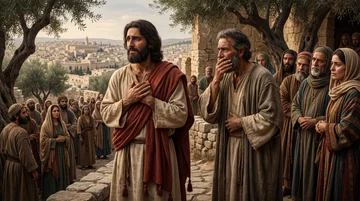
He spoke standing on the crest of Olivet and from the Mount of Olives overlooking Jerusalem, with the city in its glory and its towers before Him.Lt 177, 1904, par. 4Lt 317a, 1905, par. 14–18Lt 377, 1904, par. 22–24Ms 7a, 1886, par. 3 It was near sunset as He approached and rode into the city, with Kidron and Calvary, Gethsemane and the sheep gate where sacrificial beasts were led, in sight before Him.3MR 78.3–79.1Ms 41, 1886, par. 12–142SP 390.2–391.2 His disciples were about to burst into praise and expected Him to rejoice, while the crowd shouted hosannas.Lt 317a, 1905, par. 14–183MR 78.3–79.1Ms 41, 1886, par. 12–14 He who was a Sun and Light to that people beheld the doomed guilty city just before His crucifixion, knowing His mission's end had come.Lt 177, 1904, par. 4Lt 317a, 1905, par. 14–183MR 78.3–79.1
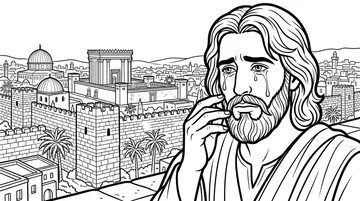
In the midst of general triumphal acclamation over the mighty works He had wrought He broke into an agony of pitying tears and insuppressible anguish.2SP 390.2–391.2Ms 7a, 1886, par. 3 Tears ran down His face with groans, choked and broken speech, quivering lips, and rocking of the body, so that even the palm branches strewn in the way were bedewed with His tears.2SP 390.2–391.2Ms 7a, 1886, par. 3 The multitude that saw His tears and heard His groans was silenced and could not understand why He lamented over the city amid rejoicing and hosannas.2SP 390.2–391.2ST Jul 22, 1886ST Jul 22, 1886ST Jan 10, 1878 His tears were not silent tears of gladness nor selfish sorrow in anticipation of His own physical suffering, humiliation and crucifixion, even though He knew He was the great Antitype to whom all sacrifices pointed and that the horror of darkness would soon overshadow Him.2SP 390.2–391.2 His anguish was pierced by what the rejoicing multitude could not see, that a nation blessed and favored with every advantage God could give had rejected Him, scorned His love, refused to be convinced by His mighty miracles, and was anticipating the death of the Son of God, the utter rejection of the only One who could give peace and hope and rest, break the yoke from their necks, and give triumph and victory, putting this blessing away because His purity pressed their sin and iniquity upon them.2SP 390.2–391.2Ms 7a, 1886, par. 3
After pleading that the city had known in this its day the things belonging to its peace, He paused in an unfinished sentence, waving His hand toward the doomed city in broken grief.4RED 124.1–125.1Lt 177, 1904, par. 4Lt 317a, 1905, par. 14–18 He hesitated with tears in His eyes and pale quivering lips because He was unwilling to pronounce the irrevocable sentence that those things were now hid from its eyes, grieved to pass sentence upon its doomed inhabitants.Lt 177, 1904, par. 4Ms 139, 1897, par. 21–23Ms 52, 1896, par. 60–66Lt 377, 1904, par. 22–24 The longing expresses His desire to gather and save, and the declaration that follows is the giving up of the city, as hard for Him as giving up a son of His care.Ms 139, 1897, par. 21–23 As He looked upon the city it was not yet too late, but the pause marks how hard the judgment is for Him before declaring peace hidden from her eyes.Ms 52, 1896, par. 60–66Lt 377, 1904, par. 22–24
The lament belongs to His final warning of the city's coming destruction before His crucifixion on the Mount of Olives, when its people failed in their time of opportunity to recognize what would bring them peace.Ms 134, 1902, par. 2–3Ms 102, 1897, par. 18–20Lt 25, 1875, par. 2–3Lt 135, 1899, par. 22 It was His final appeal to the city He loved and cared for, joined with the cleansing of the desecrated temple and the cursing of the barren fig tree pointing to Jerusalem's coming doom.ST Jan 10, 1878 It records simple grief over a guilty, hardened, impenitent city facing peril, unable to see because of impenitence after rejecting the Messiah and His message while He was among them.Ms 134, 1902, par. 2–3Ms 102, 1897, par. 18–20Lt 25, 1875, par. 2–3 The generation bore grave responsibility because it had God's word and the Redeemer in its midst, and its failure to know its visitation led to siege and destruction foreshadowing the destruction of the impenitent world at the second advent.Ms 134, 1902, par. 2–3Ms 102, 1897, par. 18–20Ms 85, 1893, par. 3
Meaning of This Day
“In this thy day” means a limited time of visitation, mercy, probation, trust, privilege and opportunity, when rare blessings belonging to peace are offered and must be known, heeded, received and acted upon before the chance passes.COL 302.3–6Lt 125, 1886, par. 5Lt 16, 1875, par. 19–20Lt 85, 1894, par. 8–18 It was still now for the church entrusted with the law, a day of trust and probation drawing to a close with the sun fast setting, and continued neglect brings the irrevocable sentence of having those things hidden from the eyes.COL 302.3–6Lt 125, 1886, par. 5ST Nov 21, 1895 The warning reaches professed followers whose hearts are estranged and whose spiritual life is dead, lest by rejecting present blessings and warnings they repeat Jerusalem’s great sin.Lt 16, 1875, par. 19–20
The day was Jerusalem’s time while Christ as its sun and light was in its midst, with warnings, entreaties, miracles and mercy long hovering over a stubborn, impenitent and rebellious people who would not open their hearts to His knocking.3MR 78.3–79.1Ms 41, 1886, par. 12–14Lt 85, 1894, par. 8–18Ms 52, 1896, par. 60–66ST Jul 24, 1879 The most solemn period for the nation was when Jesus was among them, that generation being responsible for accepting the Light of the world, and their time to receive what would bring peace and healing came when the Messiah who could save from ruin was among them.ST Jul 24, 1879Lt 16, 1895, par. 12 From the crest of Olivet He overlooked the world, so every soul indifferent to privileges within reach and careless of eternal interests is personally addressed.ST Jul 24, 1879
For three years He came seeking fruit and finding none, with one object of setting solemn warnings and gracious invitations before a thankless, disobedient people, greatly desiring them to receive His words and comprehend Him as the only hope of Israel and promised Messiah.Ms 7a, 1886, par. 4Lt 317a, 1905, par. 14–18Lt 317, 1905, par. 12–15 That ministry of three years and a half brought the message from heaven in warnings and entreaties and in healing the sick until homes were filled with gratitude instead of night vigils over the afflicted, even to raising the dead.Ms 7a, 1886, par. 4 Behind that present day lay hundreds of years and more than a thousand years of privileges, blessings, prophets, warnings and reproofs, with centuries of resisted grace, slighted opportunities, unheeded warnings, ingratitude, hollow formalism, hypocritical insincerity, Pharisaic pride and national apostasy, prophets put to death, servants abused and vineyard trodden under foot, until the cloud of vengeance loading for a thousand years was about to burst.Ms 30, 1890, par. 20–21Lt 35a, 1877, par. 12–13Ms 21, 1902, par. 31–32Lt 20, 1892, par. 31–3219MR 97.2–99.2 Had they stayed connected to God and used the privileges and blessings given through mercy and grace, Jerusalem would have become beautiful and a joy to the whole earth, but by fruitlessness and turning from God they determined their own fate.Ms 30, 1890, par. 20–21Ms 21, 1902, par. 31–32Ms 134, 1902, par. 7
As He wept the day had not yet fully ended and repentance could still avert doom, for while a little time remained the city could still recognize what would bring peace, be reconciled to God through Christ, and turn to be saved.Ms 52, 1896, par. 60–66ST Jan 10, 1878DA 577.1–33SP 11.2–32SP 393.2–395.1 But when the sun set behind the hills the day of mercy and reprieve would end, mercy would depart, its last appeal having been rejected, and the sentence that peace was hidden from its eyes would become irrevocable.Lt 85, 1894, par. 8–18Ms 52, 1896, par. 60–66ST Jan 10, 18783SP 11.2–3 The singular day means this present single day of opportunity, now while mercy still lingers and Christ pleads with gracious invitations and warnings still sounding for acceptance, not tomorrow and not many days, so the call is to improve the golden moments individually by receiving, appreciating and walking in present light without delay and without waiting to see whether great or learned men accept it.Lt 11, 1883, par. 22–24Lt 35a, 1877, par. 12–13ST Jul 24, 1879Ms 30a, 1896, par. 10–11 Each person is accountable for the light shining in their day, and money, intellect and human wisdom cannot obtain the pardon and salvation that humble, prayerful study and heeding would receive.Lt 11, 1883, par. 22–24Lt 35a, 1877, par. 12–13
Things Belonging to Peace
The things belonging to peace are centered in recognizing, knowing, receiving and coming to Christ Himself as Redeemer, Messiah, Prince of life, Saviour standing among the people, source of the hope of eternal life to whom the sacrifices pointed, and the only hope of Israel.Ms 13, 1892, par. 26–28Ms 115, 1897, par. 34ST Jul 28, 1898Ms 123, 1909, par. 21–22Ms 13, 1892, par. 32–34 In the day of visitation divine mercy came in Christ with the offer of mercy and the call to repent and be reconciled to God, and peace lay in accepting that visitation and the light of opportunity.Ms 13, 1892, par. 26–28ST Feb 27, 1896 Because the people would not believe in Jesus as the One sent from God and would not receive Him, they did not know Him, and had they known Him they would not have crucified Him.Ms 115, 1897, par. 34ST Jul 28, 1898Ms 13, 1892, par. 32–34 Their refusal to come to Him brought blindness of mind until what could have brought peace was hidden from their eyes and judgment became unavoidable.Ms 13, 1892, par. 26–28ST Feb 27, 1896ST Jul 28, 1898
That peace includes deliverance and healing of grievous malady, liberation from bondage, pardon and salvation freely offered, reconciliation to God through Christ, refuge and salvation in Him, and moral fitness for His kingdom for this life and the life beyond the grave.Ms 7a, 1886, par. 4Ms 112, 1897, par. 9–10Lt 11, 1883, par. 22–24Lt 110, 1899, par. 2–6ST Jan 10, 1878 For three years and a half the message from heaven came in warnings and entreaties and in healing the sick until homes were filled with gratitude instead of night vigils over the afflicted, even to raising the dead.Ms 7a, 1886, par. 4 That gift of pardon and salvation cannot be obtained by money, intellect, or human wisdom, but is received by recognizing and receiving Christ in the present day of visitation, turning to God and accepting the refuge He offers.Lt 11, 1883, par. 22–24Lt 110, 1899, par. 2–6 The peace He came to bring for salvation was refused and then hidden, so judgment would come for not knowing the time of visitation and the kingdom would be taken away and given to a nation bringing forth fruit.Ms 7a, 1886, par. 17–18 While a little time remains the city and each soul can still repent and turn to Christ to be saved, and light, peace and joy remain available to one who turns back.Lt 110, 1899, par. 2–6ST Jan 10, 1878
These things are the treasures of the gospel and the treasure house of all knowledge standing in the midst in Christ.13MR 129.2–3 They are like treasure buried at the roots of a tree over which a needy man rests without seeing, hearing, or discerning it, having eyes but not seeing, ears but not hearing, and intellect but not discerning the hidden treasure.13MR 129.2–3 Christ was among the people as the Gospel's treasure and the treasure of knowledge, but receiving Him required giving up cherished traditions and selfish practices, and refusal left them unable to see the truth opened to them.ST Jan 18, 1899Ms 48, 1898, par. 2–3
They mean coming back to loyalty to God and obeying His commandments, including all teachings given through Christ.Lt 89, 1898, par. 14–19 They include taking a decided position upon the truth and keeping all the commandments of God, so that those still in the valley of decision, if they knew this, would do so at once and be gathered in.Lt 254, 1899, par. 3–420MR 10.3–4 Obedience to God's word, including the Sabbath, brings people into close relationship with Christ, while failure comes from unwillingness rather than inability.RH Apr 17, 1900 That warning reaches Sabbath observers who keep it carelessly and may not recognize Christ, the source of life, present among worshipers to sanctify them, including His special presence among those gathered for worship.Ms 157, 1898, par. 8–9Ms 157, 1898, par. 13–14
For the present reader they are a general arousing and an individual work of confessing and putting away sin, earnest heed, humbling before the Lord, cleansing defiling sins from the garments of character, and faithfulness in enlightening, warning, and urging souls to repentance.Lt 125, 1886, par. 7 They are laying aside self-righteousness, putting on the righteousness of Christ and having the wedding garment on, getting the perverse heart right by humiliation, contrition and penitence before God, and doing this work between God and the soul without delay.19MR 60.3–61.1 They are giving the heart to the Lord Jesus in purity, cleanness and holiness, forever discarding defiling habits such as secret tobacco use, refusing to follow the imaginations of the sinful heart as in Noah's world, and fighting faithfully and perseveringly in real warfare against the fallen foe who plays the game of life for the soul.Lt 15a, 1896, par. 9–11 Envy, jealousy, and evil suspicions do not bring peace but make people wretched as a self-made burdensome yoke, not Christ's yoke, and cultivating them grieves Jesus and keeps people from representing Him, while stopping faultfinding of others belongs to getting ready while time is closing.19MR 60.3–61.1Lt 64, 1888, par. 5 Unless this is done, peace is hidden, separation from God remains, the blood of unwarned souls is required at the unfaithful hand, and probation may end in irrevocable doom.Lt 125, 1886, par. 719MR 60.3–61.1
They are wisdom that God gives to the humble and contrite and withholds from the worldly-wise and prudent who are self-sufficient.12MR 156.1 To know them a person must become a fool in his own estimation in order to be truly wise, for God reveals His wisdom to babes, lays all human pride in the dust, recognizes the meek and lowly and exalts them with true exaltation, and tenderly regards the humble, contrite, self-denying learner in the school of the great Teacher.12MR 156.1 Those blinded by worldly wisdom and attractions do not see Christ's beauty or understand that their sins burdened Him with grief and suffering.1RED 67.1–2
They must be sought now in the present day of opportunity while mercy still lingers and it is not yet too late to repent.Ms 30a, 1896, par. 10–11Lt 15a, 1896, par. 9–11 They are His gracious words of invitation and mercy, His invitations and warnings still sounding and still presented for acceptance, and to know them is to heed them.Ms 30a, 1896, par. 10–11 Ministers must urge souls to seek them not only by public preaching but by private personal effort, talking with people individually and around the fireside and entreating them, because the work will soon close.1T 381.2 Knowing them is recognizing truth while the opportunity is present, and where human unfaithfulness has obstructed proclamation, as in the Southern field, the present day is a day of responsibility to make that message known.Lt 145, 1903, par. 6–7
Rejection Hiding Peace From Eyes
Jerusalem did not know the things belonging to its peace because its heart was set against the Saviour in hardness and impenitence and perverseness and obstinacy, and it would not respond to repeated efforts to gather and save it or to come to Him for life.Ms 7a, 1886, par. 4Ms 57, 1901, par. 8Lt 9, 1893, par. 20–22Ms 150, 1902, par. 18–19 Its day of opportunity came while Christ was in its midst with warnings and entreaties and healing until homes were filled with gratitude and even the dead were raised, yet the city refused to recognize and receive the Messiah who could have healed it and saved it from ruin, and by following its own course brought ruin upon itself.Ms 7a, 1886, par. 4Lt 16, 1895, par. 12Ms 41, 1892, par. 9–12 Though regarded with pitying tenderness, the guilty and obstinate people failed to recognize in their day what could bring them peace, and what could have brought peace was then hidden from their eyes and their doom followed their own resistance.Ms 57, 1901, par. 8Lt 9, 1893, par. 20–22Ms 150, 1902, par. 18–19
They had turned from God and misread the Scriptures that testified of Christ, so that they failed to recognize the Messiah and the time of their visitation.Ms 112, 1897, par. 9–10 In unbelief and pride and ostentation they closed their eyes and refused the only One who could save them and give them peace, and blind unbelief kept them from knowing Him as the Prince of life, so that had they known Him they would not have crucified Him.Lt 45, 1891, par. 3–4Ms 13, 1892, par. 32–34 Pharisaical pride and hypocrisy and jealousy and malice helped prevent their being saved from the consequences of sin, and because receiving Christ required giving up cherished traditions and selfish practices they rejected Him despite abundant evidence.ST Jan 18, 18992SP 393.2–395.1 Through love of money and honor and selfish practices and cherished traditions they rejected light and mercy and evidence, and the good offered for peace became hidden after rejection through unbelief, so that what would have been received as greatest blessing became a stumbling block.Ms 112, 1897, par. 9–10ST Jan 18, 189911MR 286.3–287.2 When they rejected Him divine light and deliverance through Christ unto a life of peace and hope with God were lost, ruin became certain, and though they briefly retained a name to live they had no vital connection with God and faced spiritual death.Ms 112, 1897, par. 9–10
Sin blinded them so that they had eyes but did not see and ears but did not hear, hardened to danger and peril and ignorant of God and of Christ their Redeemer.STA 108.2Ms 61, 1890, par. 4–6 The god of this world blinds people to their danger even while Christ pleads for them to understand their merciful visitation and accept the way to peace and salvation, and unbelief and rejection blind and harden the heart.ST Nov 21, 1895ST Nov 21, 1895 Jerusalem did not know its visitation and the things belonging to its peace because it yielded blindly to false teachers, and the same blindness marked Paris when the gospel was preached to all classes for two years with power producing temperance and purity and order and industry, yet the majority rejected it until churches were closed and persecution and the stake returned.GC88 222.2–223.1GC 222.2–223.1 The same condition is found wherever unbelief and impenitence blind eyes to God and to danger, so that those entrusted with God's work rely on human wisdom instead of seeking His will and counsel.STA 108.2Ms 61, 1890, par. 4–6
By resisting the Holy Spirit and disregarding conviction and distrusting evidence and misreading truth and refusing reproof and counsel, people move almost imperceptibly step by step until spiritual blindness takes the place of light once enjoyed.Ms 28, 1897, par. 30–344MR 359.1–2 Those who refuse warnings and resist heaven's light and grace and reject opportunities to repent become hardened in impenitence, and mercy and grace and the reward of obedience belonging to peace are hidden from sight and condemnation follows.Ms 40, 1897, par. 47–49 Neglecting light and joining in fellowship with unbelievers leaves even God's people unable to discern what belongs to peace, in a position more unfavorable than that of the Jews who heard the warning.5T 75.3 When the Spirit is resisted and provoked to depart, the hiding is irrevocably fixed, so that evidences become only questioning and doubt, truth is misunderstood and perverted into error, every appeal through the Lord's servants becomes meaningless, every word is misconstrued in a perverted light, the most solemn Scripture is laughed at and ridiculed instead of causing trembling, reproof and counsel are refused, entreaties are despised, commandments once vindicated and exalted are disobeyed, and Satan leads step by step beyond the reach of striving or ministerial pleading.4MR 359.1–2
The declaration that these things are now hid from the eyes is an irrevocable sentence giving up the city, pronounced with tears and quivering lips and anguish of soul over the loss of a nation.Ms 139, 1897, par. 21–23Lt 45, 1891, par. 3–4Ms 52, 1896, par. 60–66 It marks the ending of the day of mercy and the withdrawing of light as the sun set, for Christ had been a Sun and Light to the people but the Light was about to be withdrawn because in stubbornness they would not receive it nor open their hearts to His knocking.Ms 138, 1899, par. 37–393MR 78.3–79.1Ms 41, 1886, par. 12–14 By refusing to believe they closed the door of hope against themselves, and neglect of duty brings the withholding of anger no longer withheld and being given over to the power of Satan, for God does not always strive with men.Ms 138, 1899, par. 37–393MR 78.3–79.1Ms 41, 1886, par. 12–14 Pronouncing it was hard, like giving up a son of His care, and grieving to pass irrevocable sentence upon doomed inhabitants He paused after the lament, while the loss of Jerusalem stands only as a symbol of the giving up of a world with the same anguish over every lost soul.Ms 139, 1897, par. 21–23Ms 52, 1896, par. 60–66
There is a boundary to the mercy of God, and a record is kept of blessings offered and how they are treated.3MR 78.3–79.1Ms 41, 1886, par. 12–14 Punishment for rejection is exactly according to the light that had shone upon them and that they turned away from, and judgment and retribution are proportionate to light received through warnings and reproofs and appeals to repentance.3SP 13.2ST Jan 10, 1878Ms 7a, 1886, par. 5 Each person should know the things that bring peace, and those who reject truth because it conflicts with desires or practices choose darkness.3SP 13.2ST Jan 10, 1878 Because the peace He came to bring for salvation was refused and then hidden from their eyes, judgment came upon them for not knowing the time of their visitation, and the kingdom of God would therefore be taken from them and given to a nation bringing forth fruit.Ms 7a, 1886, par. 17–18
Lost Future and Coming Destruction
Had the city accepted its Redeemer and acted on the light given in the gift of the Son, it could have been healed of its grievous malady and liberated from bondage.4RED 124.1–125.12SP 392.1–393.1ST Jun 8, 18824RED 122.2–123.2DA 576.2–3 It would have stood secure against enemies, with no armed soldiers at its gates and no Roman banners on its walls, freed in God-given power.4RED 124.1–125.1COS 95.3–6ST Feb 15, 1899 Staying connected to God and using the privileges and blessings given through mercy and grace, Jerusalem would have been made beautiful as a joy to the whole earth, with God making Zion His holy dwelling.Ms 30, 1890, par. 20–21 It might have stood in prosperity as queen of kingdoms and as the mighty metropolis of the earth, the world's diadem of glory.4RED 124.1–125.1DA 575.3–576.1DA 576.2–3 From it peace and truth and blessing would have gone to all nations, making it a prosperous, powerful center of peace for the world.4RED 124.1–125.1ST Jun 8, 1882DA 575.3–576.1ST Feb 15, 1899ST Jun 8, 1882
Instead that bright possible picture faded and was lost beyond sight, and the things that could have brought peace were hidden from its eyes.4RED 124.1–125.1Lt 43, 1903, par. 20–214RED 122.2–123.2 The city remained as it was under the Roman yoke, bearing the frown of God and doomed to retributive justice because it knew not the time of its visitation.4RED 124.1–125.1Lt 43, 1903, par. 20–21 He foresaw enemies surrounding it, laying it even with the ground and leaving not one stone upon another.GC 17.1 Strong armies would encompass the once-favored city, its defenses failing, its temple burning, with famine and suffering, its inhabitants destroyed and its people scattered without a secure home.Ms 7a, 1886, par. 43MR 78.3–79.1Ms 41, 1886, par. 12–14DA 577.1–3ST Feb 15, 1899 This was fulfilled about forty years later when Rome utterly destroyed and burned Jerusalem.ST Feb 15, 1899
His crucifixion was the last action that caused the downfall of the nation, when in crucifying the Son of God it passed its probation and placed itself beyond long-suffering, long-forbearing mercy.Ms 65, 1912, par. 29–30Ms 7a, 1886, par. 5 Its temporal punishment was only the first measure of the judgment awaiting at the final judgment, whose full reckoning was yet to come.GC88 21.34SP 20.3–21.1 Its destruction illustrates the result of transgression and refusal to heed warning, as did the destruction of the antediluvian world and of Sodom.Ms 134, 1902, par. 104MR 90.5–91.3 It stands in the same line as judgments upon Egypt's armies at Israel's deliverance, showing that Bible history is to be repeated and that cities sinful in the extreme will be destroyed by earthquake, by fire, and by flood, though if warnings are heeded and there is repentance and return to allegiance other cities may be spared for a time.4MR 90.5–91.3 The same failure was seen when Paris had its visitation and the gospel was preached to all classes in the capital for two years with power producing temperance, purity, order, and industry.GC88 222.2–223.1GC 222.2–223.1 Many accepted it, but the majority, yielding blindly to false teachers, rejected it and did not recognize the opportunity, until churches were closed and persecution and the stake returned.GC88 222.2–223.1GC 222.2–223.1
Heart of Christ Revealed
His tears in the midst of triumph were not silent tears of gladness, nor were they selfish sorrow in anticipation of His own physical suffering and crucifixion.2SP 390.2–391.24SP 18.1 He wept not for Himself, not for betrayal, trial, rejection, delivery into the hands of enemies, or the cruel death appointed Him, though innocence had been declared over Him.4SP 18.1Ms 65, 1912, par. 29–30 Gethsemane, the sheep gate where sacrificial beasts were led, and Calvary were before Him, and He knew Himself to be the great Antitype to whom all sacrifices pointed, with the horror of darkness soon to overshadow Him.2SP 390.2–391.2Ms 7a, 1886, par. 5 The tears from His eyes and the rocking of His body like a tree before a tempest were not forced by thought of His own coming agony, suffering, humiliation and shame.2SP 390.2–391.2Ms 7a, 1886, par. 5
His anguish was pierced by the sight of Jerusalem in guilt, rejecting the Son of God, scorning His love, refusing to be convinced by mighty miracles, and about to take His life.2SP 390.2–391.2Ms 7a, 1886, par. 3 He saw what she was in rejecting her Redeemer and what she might have been had she accepted Him who alone could heal her wound.2SP 390.2–391.2Ms 7a, 1886, par. 3 He saw a nation blessed and favored with every advantage rejecting Him and anticipating the death of the Son of God, putting away the utter rejection of the only One who could give peace and hope and rest, break the yoke from off their necks, and give triumph and victory.2SP 390.2–391.2Ms 7a, 1886, par. 3 They had put this blessing away because His purity was too much for them and pressed their own sin and iniquity upon them.Ms 7a, 1886, par. 3
He had come to save and could not give up the child of His care without brokenhearted grief.Lt 317a, 1905, par. 14–182SP 390.2–391.2 For three years He had come seeking fruit and finding none, with one object of presenting solemn warnings and gracious invitations to a thankless, disobedient people.Lt 317a, 1905, par. 14–18Lt 317, 1905, par. 12–15 He greatly desired them to receive His words and comprehend Him as the only hope of Israel and the promised Messiah.Lt 317a, 1905, par. 14–18Lt 317, 1905, par. 12–15 Clothing divinity with humanity as Prince of heaven in servant's form, He carried them on His heart and did all that could be done to save them and convince them He was their only hope.Lt 317a, 1905, par. 14–18Lt 317, 1905, par. 12–152SP 390.2–391.2 He bore long with souls who offended Him as His own property and did nothing to cut them off, with all the history of ages distinctly before Him, centuries of resisted grace, abused privileges, slighted opportunities, unheeded warnings and reproofs of prophets, ingratitude, formalism, hypocritical insincerity, Pharisaic pride and national apostasy, prophets put to death, servants abused, vineyard trodden under foot, and the cloud of vengeance loading for a thousand years about to burst.Lt 20, 1892, par. 31–3219MR 97.2–99.2
Pronouncing doom was hard for Him, like giving up a son of His care, revealing distress and anguish of soul over the loss of a nation.Ms 139, 1897, par. 21–23Ms 134, 1902, par. 6 With pale and quivering lips and tears in His eyes He hesitated to pronounce the irrevocable sentence giving up the city.Ms 139, 1897, par. 21–23Ms 7a, 1886, par. 7 His sorrow was a hundredfold greater than a mother weeping over her dying child, crying how He could give Jerusalem up.Ms 7a, 1886, par. 7 With loving care He longed to encircle the people with His human arm while connecting them to heaven with His divine arm, after doing all He could while they would not come for life.Ms 139, 1897, par. 21–23Ms 7a, 1886, par. 7
His weeping reveals deep fatherly love for Israel and yearning not to give them up.3SP 20.1ST Feb 27, 1896 It reveals the depth of His tenderness toward the city He loved, even toward those who refused to receive Him as Saviour.ST Feb 27, 1896Lt 44, 1908, par. 3–5 His soul's joy is to do good to men, having made them and given them wondrous faculties of mind and noble affections of heart.11MR 26.3 He is very sorrowful when the richest of His favors are poured out without effect and those gifts of mind and heart are used against the Giver, when obedience is despised, ears are not inclined to hear His voice, and tongues speak not His praise.Lt 44, 1908, par. 3–511MR 26.3
Those tears embraced all time, for in Jerusalem is represented every soul who neglects present privileges and refuses light.Lt 35a, 1877, par. 12–13ST Mar 9, 1876 From the crest of Olivet He overlooked the world, and looking down the ages He beheld in Jerusalem's fate the destruction of the world and wept for the sins of all time.Lt 35a, 1877, par. 12–13ST Jul 24, 1879Ms 56, 1902, par. 10–13 He looked through the centuries to the close of time and addressed the same words to all who repay love and admonitions with selfishness, neglect and scorn, and He wept also for the apostasy of the present time when Protestantism departs from true principles into spiritual declension.ST Mar 9, 1876Ms 56, 1902, par. 10–13 His weeping over Jerusalem is His weeping still over individuals who leave cheerful trust and a humble, happy walk in duty and peace for thoughtless gaiety and social excitement, following undisciplined inclinations under Satan's control, letting selfishness, suspicion, vanity and indulgence drive heavenly graces, tenderness and sympathy from the heart.Lt 35a, 1877, par. 12–13Lt 34, 1898, par. 16–18
To give up one soul to perish is terrible, because one soul is worth more to God than all the world beside.Ms 7a, 1886, par. 5RH Aug 5, 1902 Souls cost the life of God's only begotten Son and must be valued by that immense ransom, and here a whole nation was to be given up to destruction.Ms 7a, 1886, par. 519MR 97.2–99.2RH Aug 5, 1902 His sorrowful tears over impenitence added to guilt, and as the tears of a God-fearing mother over one who rejects God's voice will testify against him in the day of judgment, so His tears will testify.Lt 58, 1880, par. 4
The weeping also expresses righteous indignation against mixture and unholy bartering in His temple.Lt 84a, 1896, par. 3–4 Those who claim to be the temple of the Lord while continuing such practices are just as much in need of cleansing as the temple courts were in those days.Lt 84a, 1896, par. 3–4 His weeping over an impenitent nation that claimed to be His people declares that ungodliness can have no part in the kingdom of God.Lt 244, 1906, par. 9–10Ms 63a, 1906, par. 13–16
Warning to Every Reader
Earthly Jerusalem stands for the majority of professed Christians and for every soul who neglects present privileges and refuses the light God sends, so the lament reaches each person who slights mercy and every impenitent person who has a day of merciful visitation.Lt 11, 1883, par. 18–21Lt 193, 1899, par. 2–3Lt 35a, 1877, par. 12–133SP 13.2ST Jan 10, 1878 Each has a time of light, privilege and opportunity in which to know the things that bring peace, and receiving Christ brings peace while refusing His counsel leaves one responsible for the result.Lt 11, 1883, par. 18–213SP 13.2ST Jan 10, 1878DA 588.1 Judgment in that day is proportionate to the light received, for every person is accountable for the light shining in his day and must improve the golden moments without waiting to see whether great or learned men accept it.Lt 35a, 1877, par. 12–133SP 13.2 A hardened heart can make each ray of divine light either soften the soul or confirm it in persistent impenitence, until reproofs and warnings cease and grace reaches its limit.ST Jan 10, 1878DA 588.1
It is still now the day for the church entrusted with the law, a day of trust and probation that is drawing to a close with the sun fast setting.Lt 125, 1886, par. 5Ms 65, 1912, par. 33–36 Christ's eye looks down the ages with His gaze fixed upon the present time, testing Christian churches on how they stand.Lt 125, 1886, par. 5Ms 65, 1912, par. 33–36 It is still their privilege to receive every spiritual advantage in accordance with God's promises by knowing and doing what belongs to their peace before that day ends.Lt 125, 1886, par. 5Ms 65, 1912, par. 33–36 Continued neglect will bring the irrevocable sentence of having those things hidden from the eyes, so there is need for alarm and for more earnest effort now because of past neglect.Lt 125, 1886, par. 5
The world does not recognize that its time of visitation is passing, asleep and unaware in indifference and carnal security.COL 302.3–6Ms 40, 1897, par. 23–24 This thy day is the period of mercy and privilege now nearing its close, and those who reject God's grace face swift, irreversible ruin.COL 302.3–6Ms 122, 1909, par. 24–26 The final warning over the city foreshadowed the destruction of the world at the second advent, when similar events will occur at the last great day and judgment comes suddenly.Ms 134, 1902, par. 2–3Ms 122, 1909, par. 24–26Ms 57, 1901, par. 9 People may fail to recognize the time when God visits them and offers what leads to peace, blind to the choice before them between Christ and rejection of Him.Ms 40, 1897, par. 23–24 The present time remains a day of healing and opportunity when people may respond to Christ and find life, but refusing that opportunity brings loss and retribution.Ms 122, 1909, par. 24–26Ms 57, 1901, par. 9
Jerusalem's doom after Christ bore long with the nation He wished to save symbolizes the world's doom after long forbearance.Lt 45, 1891, par. 3–4Ms 7a, 1886, par. 6Ms 134, 1902, par. 10 The loss of Jerusalem is only a symbol of the giving up of a world, and the words are spoken to every heart in the world that turns from light and truth and from mercy and blessing freely offered.Ms 139, 1897, par. 21–23Ms 7a, 1886, par. 6 The same anguish rests over every lost soul, revealing distress over the loss of a nation as like giving up the son of His care.Ms 139, 1897, par. 21–23DA 645.1 That sorrow calls for tender sympathy, compassion, grief, pleading for those who do not plead for themselves, and personal labor for souls.Ms 139, 1897, par. 21–23ST May 17, 1910 The refusal that brings sorrow to those laboring to lead souls to Christ will be forgotten when the saved are seen eternally secure as monuments of mercy and redeeming love.ST May 17, 1910
Those today who go over the same ground force Him to withhold blessings He longs to bestow, by refusing messages of grace, making light of warnings, ridiculing words, despising evidence of His working, and rejecting all entreaties and efforts for salvation.Lt 317a, 1905, par. 14–18Ms 13, 1892, par. 21–22Ms 11, 1895, par. 30–32Lt 16, 1888, par. 39–42Lt 68, 1895, par. 3–5 For three years He came seeking fruit and finding none, presenting solemn warnings and gracious invitations and doing all that could be done to save a thankless, disobedient people who would not come for life.Lt 317a, 1905, par. 14–18 Not knowing the day of visitation, resisting the Spirit, disregarding conviction, and remaining in unbelief can bring an irrevocable loss of opportunity, spiritual discernment and peace.Lt 317a, 1905, par. 14–18Ms 13, 1892, par. 21–22Ms 11, 1895, par. 30–32 Unless there is a general arousing and an individual work of confessing and putting away sin, humbling before the Lord, cleansing defiling sins from character, and faithfully enlightening, warning and urging souls to repentance, peace is hidden, separation from God remains, and the blood of unwarned souls is required at the unfaithful hand.Lt 125, 1886, par. 7 The hiding of peace means the cloud of divine wrath gathering, and continued refusal to heed warnings and reproofs may leave a person unable to see the way to peace, making decisive change urgent before it is forever too late.Lt 317a, 1905, par. 14–18Lt 16, 1888, par. 39–42Lt 68, 1895, par. 3–5
The warning addresses backsliding professed followers whose hearts are estranged and whose spiritual life has become dead, though visited with rare privileges and blessings that offer peace. It addresses those given Scripture and the testimony of God's Spirit yet remaining careless, worldly or indifferent, who must respond now while Christ pleads because preparation cannot be postponed until He comes.Ms 13, 1888, par. 64–674T 187.2 It addresses those in sacred work for many years with much light and rare opportunities to develop Christian character who have not devoted the heart to God or lived according to profession, over whom retribution hangs because the time of visitation has gone unrecognized.4T 187.2 It addresses God's people when fellowship with works of darkness and concord with unbelievers show falling away from holy calling, leaving them in a worse position than the Jews warned by Christ if they neglect light.TBC1882 58.1 It addresses those in Battle Creek repeating Jerusalem's sin by centering interests while neglecting other cities, those in the Southern field hindered by unfaithfulness, workers and churches careless and worldly, and great cities still unreached, urging them to awake, repent, give diligent heed, and value loyalty of the whole heart above outward homage.5T 73.1
Judas losing his last chance is likened to the doomed city over which Jesus wept, for when the final opportunity to recognize what leads to peace with God is rejected those things are hidden and the chance is gone.Ms 19, 1897, par. 59 Christ felt the same burden for Judas as for Jerusalem, longing to save him, and His love moved Judas toward confessing sin, but Judas hardened his heart and refused repentance.DA 645.1 The sentence is not yet irrevocable for all, for Christ still calls individuals like Philip to repent and escape the enemy, with light, peace and joy remaining available if he turns back.Lt 110, 1899, par. 2–6
Knowing peace now means heeding gracious invitations while mercy lingers and receiving Christ in simple faith, so that pardon and peace become available and the receiver becomes a blessing to others.ST Aug 15, 1878Lt 193, 1899, par. 11 It means prizing the day of privilege before it passes by turning from a perilous course and developing Christian character through constant effort, self-denial and help from God.Lt 32, 1875, par. 53–54 At Battle Creek it means seeking God, changing life, learning His will and serving Jesus without neglecting opportunity.Lt 30, 1875, par. 13–16 It means overcoming selfishness and defects of character while character is forming and will soon be fixed, for delay may make it too late.4T 343.2 It means having destitute unworked fields laid upon the soul, emptying every vestige of selfishness from the heart, and dying to self in self-denying compassion like Christ's sorrow over the city.Ms 25, 1899, par. 14–15
Ministers must urge souls to seek what makes for peace not only by public preaching but by private personal effort, talking individually and around the fireside and entreating them, because the work will soon close.1T 381.2 Souls who cost the life of the only begotten Son must be valued by that immense ransom, after a thousand years of loading vengeance through resisted grace, abused privileges, slighted opportunities, unheeded warnings and reproofs, ingratitude, formalism, hypocrisy, pride and apostasy.19MR 97.2–99.2 Christians must therefore act wisely for peace by bearing long with unbalanced, diseased, presumptuous and provoking souls, healing rather than cutting them off, as He bore long with His offending property and did nothing to cut them off when no more could have been done for His vineyard.19MR 97.2–99.2 His response to those who err is compassionate sorrow, not condemnation, providing a model for weeping over them and seeking their restoration, answering ingratitude and injury with calmness, tenderness and kindness.19MR 97.2–99.2Lt 66, 1884, par. 11–13 Those vitalized by His Spirit will never comply with selfish dealing and false business maxims at the heart of the work, for blind men cannot be made to see until convicted and converted to see things in an altogether different light.Ms 26, 1899, par. 11–12
Refusing to come for life after receiving knowledge of truth joins the enemy's ranks in willful sin, by turning from great light to choose darkness and choosing sin and worldly honor instead of obedience and self-denial.Ms 121, 1903, par. 9–12Lt 124, 1893, par. 2–3 Christ carries the weight of rebellious souls day and night as a mother carries the weight of a rebellious son, and their loss brings bitter grief, disappointment and agonizing prayer to those who love them.Lt 124, 1893, par. 2–3 At the judgment rejected peace is beyond reach, with loss of everlasting life and exclusion from the holy city.Ms 121, 1903, par. 9–12 Even disparaging others endangers peace and risks being disparaged in heaven's courts.Lt 71, 1903, par. 3–4 Envy, jealousy and evil suspicions do not bring peace but make people wretched as a self-made burdensome yoke, not Christ's yoke, grieving Jesus and keeping people from representing Him.Lt 64, 1888, par. 5
Light from heaven constantly comes through messengers where people may come to it if they will, and their day holds the things belonging to peace and the salvation purchased by the Son of God.Lt 124, 1893, par. 2–3 While Christ still offers mercy, sinners with burdens can come in simple faith, be cleansed from sin, and receive moral fitness for His kingdom for both this life and the life beyond the grave.ST Aug 15, 18788T 300.3 He invites the weary to come, learn from Him and find rest, for true rest and lasting good come only through spiritual life while mercy's call is heard.8T 300.3 The verse stands as a practical solemn warning not to reject present blessings and warnings, carrying power to move hearers to tears and earnest attention.Ms 134, 1902, par. 5Ms 36, 1897, par. 9–11Lt 43, 1903, par. 20–21Ms 92, 1897, par. 16–17Ms 21, 1902, par. 31–32
Sources