Translations
American King James Version, King James Version, KJV Cambridge Paragraph Bible, Webster Bible, Revised Version, American Standard Version
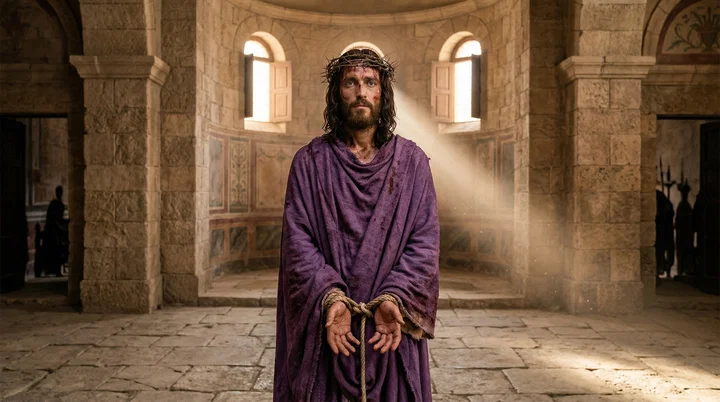
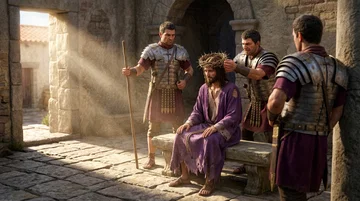
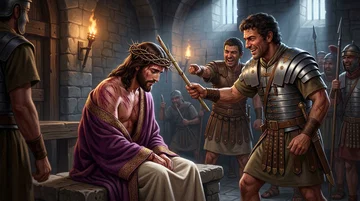
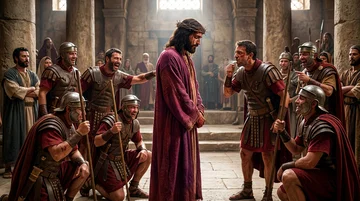
And they stripped him, and put on him a scarlet robe.
and having unclothed him, they put around him a crimson cloak,
and having taken off his garment, put on him a scarlet cloak;
and, unclothing him, a scarlet scarf, put they about him,—
Berean Standard Bible, Majority Standard Bible
They stripped Him and put a scarlet robe on Him.
They stripped him and put a scarlet robe on him.
And they took off his clothing, and put on him a red robe.
And they stripped him, and put about him a skarlet robe,
Douay-Rheims (Challoner revision)
And stripping him, they put a scarlet cloak about him.
Pictures
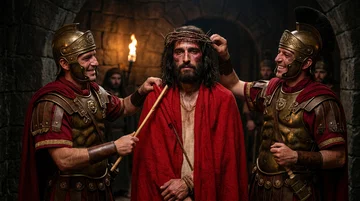
Cross-references
- John 19:2-3
And the soldiers platted a crown of thorns, and put it on his head, and they put on him a purple robe,
Describes the soldiers’ robe and mock homage to Jesus as king.
- Mark 15:17-20
And they clothed him with purple, and platted a crown of thorns, and put it about his head,
Describes the robe and the soldiers’ mockery of Jesus.
- Luke 23:11
And Herod with his men of war set him at nought, and mocked him, and arrayed him in a gorgeous robe, and sent him again to Pilate.
Herod’s soldiers mock Jesus by dressing him in a robe.
- Isaiah 53:3
He is despised and rejected of men; a man of sorrows, and acquainted with grief: and we hid as it were our faces from him; he was despised, and we esteemed him not.
The despised, grief-acquainted servant reflects Jesus bearing scorn and rejection.
- Matthew 27:35
And they crucified him, and parted his garments, casting lots: that it might be fulfilled which was spoken by the prophet, They parted my garments among them, and upon my vesture did they cast lots.
The soldiers later divide Jesus’ garments at the crucifixion.
- Matthew 26:67
Then did they spit in his face, and buffeted him; and others smote him with the palms of their hands,
Jesus is spat upon and struck during his suffering.
- Psalms 22:18
They part my garments among them, and cast lots upon my vesture.
Foretells the sufferer whose garments are divided and lots cast.
- Isaiah 53:7
He was oppressed, and he was afflicted, yet he opened not his mouth: he is brought as a lamb to the slaughter, and as a sheep before her shearers is dumb, so he openeth not his mouth.
Jesus endured his mistreatment without speaking.
- Luke 23:13-24
And Pilate, when he had called together the chief priests and the rulers and the people,
Both recount Jesus’ trial before Pilate.
- Matthew 27:22-23
Pilate saith unto them, What shall I do then with Jesus which is called Christ? They all say unto him, Let him be crucified.
jeering crowd cried Crucify him
- Matthew 27:37
And set up over his head his accusation written, THIS IS JESUS THE KING OF THE JEWS.
Both texts mock Christ with symbols of kingship.
Commentary
Each commentary is drawn from primary sources: the writings of Ellen G. White and Adventist pioneers and periodicals. Each commentary is separate. Its own words are not a quotation; follow the references to read the source passages.
Ellen G. White
31 sources
After His condemnation and before He was led away to be crucified, soldiers in the judgment hall stripped Him to the waist, laying bare His bleeding scourged back, and put an old tattered kingly scarlet robe upon Him to deride His claim to be king.Ms 29, 1909, par. 185RED 58.1–25RED 63.13SP 138.1–2ST Nov 30, 1882 This was part of a fuller ritual of mock homage, with a crown of thorns pressed to draw blood, a reed placed as a mock scepter, kneeling and hailing Him as King of the Jews, then spitting, blows, and smiting His head with the reed.SG1 50.1GC 643.1–2GC88 643.1–4 The cruelty was stirred by Satan working through priests, rulers, and the crowd, while angels witnessed in sorrow and marveled that He restrained divine power and uttered no complaint that would have broken the plan of salvation.ST Dec 4, 1893ST Mar 26, 1894EW 138.112MR 394.3–395.1 Even stripped, bleeding, and derided He remained patient, gentle, and faithful without sin, bearing as the just for the unjust the heaviest humiliation for fallen humanity that His blood might redeem men to God.3SP 143.1–29T 101.3ST Mar 26, 1894EW 40.3Ms 75, 1910, par. 19–21 Those who mocked and struck Him will see Him again in kingly majesty as King of kings and seek to flee His gaze, and the shame He bore now calls believers to undivided consecration, humility, and patience under suffering.ST Mar 26, 1894SG1 214.1–215.1Lt 1a, 1861, par. 2–5Ms 75, 1910, par. 19–21GW92 360.3
The Mocking Before Crucifixion
The soldiers stripped Jesus and put the scarlet robe upon Him as a humiliation inflicted after His condemnation and before He was led away to be crucified.Ms 29, 1909, par. 18ST Nov 30, 18825T 637.1 He was delivered by betrayal into the hands of wicked men to be mocked and abused by His persecutors, then scourged and crucified.ST Nov 30, 18825T 637.1 The stripping left Him exposed to the waist, revealing the long, bleeding stripes of the scourging with blood flowing from them.5RED 63.13SP 143.1–2
The robe mocked His claim to be king, for it was put on Him in derision and contempt as an insulting show of honoring Him.5RED 58.1–23SP 138.1–21T 240.2 It was an old, tattered purple kingly garment, once worn by a king.5RED 58.1–23SP 138.1–21T 240.2EW 138.38MR 241.2–242.3 Clothed in that purple robe He was treated with contempt amid scourging, the crown of thorns, and the mocking salute as King of the Jews, displaying the rejection, insult, and suffering He endured before His death.1T 240.2EW 138.38MR 241.2–242.3
The robe belonged to a fuller ritual of mock homage in which they bound His sacred head with a crown of thorns, put a reed in His hand as a mock scepter, and bowed before Him mockingly saluting Him as King of the Jews.SG1 50.1GC 643.1–2GC88 643.1–4 With impious hands they placed the mimic scepter in His unresisting hand, then took the reed from His hand and smote Him upon the head, causing the thorns to penetrate His temples so that blood trickled down His face and beard.SG1 50.1GC 643.1–2GC88 643.1–4 To the purple robe and thorny crown and bowing in blasphemous mockery were added smiting and spitting upon Him and blows, deriding His claim to be the Son of God.SG1 50.1GC 643.1–2GC88 643.1–4
It took place in the judgment hall, whose agony was preceded by a night of prayer to His Father, amid betrayal, condemnation, agony in Gethsemane, and movement toward the cross.3SP 148.1MH 509.1ST Jul 11, 18785T 637.1 There He was delivered to a clamorous people crying for His blood and for crucifixion, subjected to cruelty and mockery while remaining without murmur and faithful to His Father's will.3SP 148.1ST Jul 11, 18785T 637.1 The crowd's insults ridiculed His humble birth and life and His claim to be the Son of God, and He was then delivered to the people to be crucified.3SP 148.1 His own nation took the most active part in heaping contempt upon Him, urged on by Herod and the priests who encouraged the insults and jeered at His royal title, while friends and even His own brothers denied and forsook Him and those who had professed to love Him turned from Him in His trouble.3SP 138.1–2ST Dec 4, 18934RED 102.2–103.13SP 148.1
Christ's Endurance and Sacrifice
The cruelty of the scarlet robe was set in operation at the instigation of an apostate angel.ST Dec 4, 1893ST Mar 26, 1894EW 138.1 Satan and his angels worked through the chief priests and elders and leaders, stirring Jewish minds and the crowd against Jesus.ST Dec 4, 1893ST Mar 26, 1894EW 138.1 Human feeling and sympathy were destroyed until the very atmosphere of the judgment hall was heavy and polluted by their influence.EW 138.1 Under the deceiver's rule people became liars and murderers.ST Mar 26, 1894
Heavenly angels came to witness the scourging and abuse heaped on their Commander.EW 138.1Ms 39, 1898, par. 21–22 In sadness they laid off their glittering crowns and recorded every insult and cruelty and pang of anguish.EW 138.1 They marveled at the mystery that He held back righteous indignation and divine power that could have sealed the lips of scoffers and paralyzed the smiting hand.EW 138.112MR 394.3–395.1 They beheld His scourging and cruel treatment in His humiliation before death.Ms 39, 1898, par. 21–22
Satan hoped that shame and mockery and violence would draw complaint or murmur from the Son of God.EW 138.1 He hoped to provoke Him to manifest His divine power and wrench Himself from the grasp of the multitude.EW 138.1 By that failure of endurance the plan of salvation would fail.EW 138.1
Even stripped to the waist and bleeding from the scourging, crowned with thorns and derided in the scarlet robe, His patient and gentle and dignified character remained evident.3SP 143.1–2 He made no murmur and remained faithful to His Father's will.ST Jul 11, 1878 He endured without being defiled by sin.ST Mar 26, 1894 In this He stood in sharp contrast to Barabbas.3SP 143.1–2
The hardened Roman soldiers who mocked and smote Him to please the priests and rulers acted in comparative ignorance.12MR 394.3–395.1 They did not know He was the Sent of God, lacking the abundant light given to the Jewish nation and unacquainted with Old Testament history, and with that light they would not have treated Him so cruelly.12MR 394.3–395.1 The greatest guilt and heaviest responsibility belonged not to Pilate nor to Herod nor to the ignorant soldiers but to those in the highest places of the nation who basely betrayed their sacred trusts.12MR 394.3–395.1
Though Pilate declared Him without fault, and no occasion for fault could be found in Him or in His teachings, He was given up to death because His reproof and sinless character were hated.Ms 75, 1910, par. 19–21 He was beaten with rods, crowned with cruel thorns that pierced His brow, mocked with a robe, hung on the cross with nails driven through His hands and feet, killed and laid in the tomb.Ms 75, 1910, par. 19–21 Angels rolled away the stone and He came forth proclaiming Himself the resurrection and the life.Ms 75, 1910, par. 19–21 The penitent thief acknowledged Him, asking to be remembered when He came into His kingdom, and received the promise of paradise.Ms 75, 1910, par. 19–21
This was among the heaviest humiliations borne in behalf of poor fallen humanity, part of His suffering and sacrifice for humanity.9T 101.3Ms 75, 1910, par. 19–21 The just suffered for the unjust, bearing the burden of the world's sins.EW 40.3 His blood was shed so that it could redeem people to God.EW 40.3
Future Glory and Present Call
Those who mocked, struck, and rejected Him will see Him again in kingly majesty and glory as King of kings and Lord of lords.ST Mar 26, 1894SG1 214.1–215.1 The very men who derided His claim to be the Son of God, who with impious hands put the purple robe upon His form with the thorny crown upon His brow and the mimic scepter in His unresisting hand, bowing in blasphemous mockery while smiting and spitting upon Him, will behold Him sitting on the right hand of power.GC 643.1–2GC88 643.1–4 They will recognize Him as the one they crucified and recall the act with terror and remorse.SG1 214.1–215.1GC 643.1–2GC88 643.1–4 Speechless before His glory, they will turn from His piercing gaze and seek to flee from the overpowering glory of His presence.GC 643.1–2GC88 643.1–4
He foresaw the betrayal, condemnation in the judgment hall, humiliation, agony in Gethsemane, and crucifixion as a most trying ordeal for His disciples, when the multitude who had hailed Him as king would hiss, revile, hoot and scorn Him and cry for His crucifixion while those who had professed to love Him turned from Him in His trouble.4RED 102.2–103.1 He therefore deliberately brought an earlier crisis to sift out unbelieving, weak, undecided, and faint-hearted followers while He was still present to comfort and strengthen the chosen.4RED 102.2–103.1 Their apostasy in that hour of horror, grief, and ruined hopes would then not overwhelm the twelve nor carry the rest away.4RED 102.2–103.1 The faithful few would be unsurprised at the insult, tested against the inconstant favor of the world, and not hanging faith on the opinions of others.4RED 102.2–103.1
The sight of their beloved Teacher in the hands of a cruel mob, crowned with thorns and treated with derision, insult, mockery and contempt, dressed in a robe by His tormentors and persecutors, filled His followers with affliction and agony.Ms 80, 1886, par. 3–5Ms 3, 1898, par. 20–21 It killed their hope that He would deliver Israel.Ms 80, 1886, par. 3–5 Seeing Him suffer and die tested their faith, hope, and courage and gave them cause to mourn and fast.ST Jul 7, 1898Ms 3, 1898, par. 20–21 This mocking suffering led to the climax when He was stretched upon the cross at Calvary as a malefactor and died as a criminal.Ms 80, 1886, par. 3–5
The shame He bore, clothed in that old purple kingly robe to ridicule His kingship amid coarse jest and cruel mocking by an infuriated mob on His way to the judgment hall, exposes all human self-denial as nothing beside what He gave up.Lt 1a, 1861, par. 2–5 It answers the complaint that the narrow way is too strait and too self-denying with the question of what He gave up.Lt 1a, 1861, par. 2–5 It demands undivided affections, entire consecration, and transformation by the renewing of the mind through separation from the world and from dead, heartless professors instead of conformity to them.Lt 1a, 1861, par. 2–5 Joined with His conflict in the wilderness of temptation, His life of self-sacrificing love, His soul agony in Gethsemane, and His agony upon the cross, His cruelty in the judgment hall teaches self-sacrifice, patience under affliction, solemn consecration to God, and fitting preparation for holy work.GW92 360.3 One called to sacred work must put all energies into it and make every other consideration secondary.GW92 360.3
Believers can go to no greater depths in humility than He went in behalf of fallen humanity, though declared without fault and with no fault found in Him or His teachings, yet given up to death because His reproof and sinless character were hated.Ms 75, 1910, par. 19–21 If partakers of His divine nature they must be partakers of His sufferings in hard places.Ms 75, 1910, par. 19–21 This means recognizing Jesus as Saviour and Helper, loving Him, being willing to do anything He requires, and praying for grace to go through trials so as to see Him in His kingdom, as acknowledged when the penitent thief asked to be remembered at His coming and received the promise of paradise and as vindicated when He came forth as the resurrection and the life.Ms 75, 1910, par. 19–21
Sources
Pioneers and periodicals
80 sources
The soldiers stripped him of his own garment and put an old scarlet robe on him to make a cruel sport of his claim to be king.RH Dec 9, 1858ST Jul 14, 1881RH Jun 12, 1856RH Oct 17, 1854RH Jun 10, 1862 This was done in Pilate's judgment hall after Pilate had scourged him and found no fault in him, yet yielded to the demand of the priests, rulers and people that Barabbas be released and Jesus be crucified.ST Mar 13, 1901ST Nov 14, 1906ST Nov 9, 1882ST Mar 13, 1901 With the crown of thorns and reed scepter the robe joined insult with irony, for the true King of glory was scorned in his lowliness and suffering.ST Sep 23, 1889ST Dec 17, 1912RH Dec 12, 1912ST May 20, 1908ST Apr 3, 1928 He meekly bore this shame and wounding out of love, as the innocent substitute bearing the sin of the whole world that sinners might be cleansed, healed and saved.ST Jul 18, 1878RH Jun 4, 1908ST Jun 30, 1914RH Feb 21, 1865RH Jun 23, 1868 His calm endurance without anger, fear or retreat is the pattern for his followers to bear contempt for principle, to subdue pride and discontent, and to trust the Father through trial on the way to victory with him.ST Apr 17, 1879RH Apr 10, 1900RH May 5, 1863RH Mar 18, 1858ST Jul 29, 1886
Trial Setting and Sequence
Matthew 27:28 belongs to the closing scenes of Jesus' trials, crucifixion, and burial, to the trial and crucifixion scenes at Calvary leading to his crucifixion.ST May 4, 1882ST Jun 29, 1882ST May 18, 1882 It is part of his cruel mockery during the trial, when after stripping him his tormentors dressed him in a scarlet robe on the way to Calvary.ST May 4, 1882ST Jun 29, 1882ST May 18, 1882 Those terrible scenes can be pictured as if present to witness them.ST May 4, 1882
The verse belongs to the trial of Jesus before Pilate, in which Pilate examined Jesus and found no fault in him and no cause of death, yet gave sentence that Barabbas be released and Jesus be crucified because the voices of the chief priests, rulers, and people prevailed.ST Mar 13, 1901 After the soldiers had scourged Jesus and dressed him in a purple robe with a crown of thorns and probably a reed in his hand, Pilate felt compassion at seeing him bloody, meek, and helpless.ST Nov 9, 1882 He presented him to the people, declaring for the third time that he found no fault in him and hoping the sight would move them to spare Jesus, but instead the chief priests and officers renewed their demand for his crucifixion.ST Nov 9, 1882
Jesus suffered unmerited torture and mockery from Pilate's soldiers, joined with the mockery he received from Herod's soldiers, after he had been declared innocent.ST Mar 13, 1901 It was a double punishment in which an innocent man was given a compromise scourging to appease his enemies and was then handed over to his persecutors to be crucified.ST Mar 13, 1901 In this cruel manner his life was sacrificed so that lives might be saved.ST Mar 13, 1901 The verse belongs to the scene in which Jesus was led to Pilate's judgment hall and condemned to an ignominious death, and that condemnation leads to his bearing the cross to Golgotha, where he gives his life so sinful, mortal people may have life.ST Nov 14, 1906
The mocking with the scarlet robe belongs with the night of anguish and abuse after the agony in sad Gethsemane with groans and tears and great drops of blood and the prayer for the cup to pass.RH Oct 25, 1870RH Sep 11, 1866 He was in the judgment hall between Gethsemane and Calvary, scourged and spit upon, smitten, derided and oppressed, his visage marred and wan, suffering beneath the load of human guilt.RH Sep 11, 1866RH Mar 25, 1873 There he was stripped and clothed in the robe and mocked as king, and later stripped again before execution, willing to suffer deprived of everything, even his garments, on the way to expire on Calvary.RH Oct 25, 1870RH Sep 11, 1866 This amazing, divine love fills the soul with mingled agony and love and demands heart, life, and all.RH Sep 11, 1866
This derisive stripping and clothing in a scarlet robe before execution was the customary Roman practice toward criminals before and during execution.RH Feb 11, 1862 The exact agreement of this detail with the known customs and institutions of that time, without forced or designed insertion, confirms the minute accuracy and truthfulness of the Gospel history.RH Feb 11, 1862 The soldiers dressed him in royal clothing as part of a cruel imitation of a mock-king festival, treating a condemned person as an object of sport.ST Jun 8, 1904
Roman authority, exercised through Pilate, brought about his crucifixion and burial in a tomb sealed with the Roman seal.ST Oct 25, 1905 His earthly mission lay in the tomb behind a stone sealed by Rome, yet apparent defeat did not determine the true outcome.ST Oct 25, 1905ST Feb 4, 1913 That final effort to destroy him failed, for he rose and was caught up to God and his throne.ST Oct 25, 1905ST Feb 4, 1913
Meaning of Scarlet Robe
The stripping and clothing in a scarlet robe was one part of the mockery and abuse willingly endured out of love for humanity, with no separate meaning given to the robe itself beyond that suffering before crucifixion.RH Feb 1, 1870ST Jan 17, 1911RH Jul 7, 1910ST Feb 16, 1882ST Jul 27, 1882 He was subjected to mock royal treatment in his trial, dressed in a robe as part of the humiliation inflicted on him.ST Jan 17, 1911RH Jul 7, 1910 The record is of cruel mockery leading to crucifixion.ST Feb 16, 1882ST Jul 27, 1882
He was stripped of his seamless garment and dressed in an old scarlet-colored robe.RH Dec 9, 1858ST Jul 14, 1881RH Oct 17, 1854 The royal color made the insult more pointed, for the soldiers staged a cruel parody of a king to ridicule his claim to be king.RH Dec 9, 1858ST Jul 14, 1881 It was an act of shameful mockery and humiliation before execution, which the innocent Christ meekly endured as part of his suffering to save sinners.RH Dec 9, 1858RH Oct 17, 1854
Together with the thorny crown and reed scepter, the robe was used for cruel amusement, which Jesus meekly bore along with scorn and the world's cold frown.RH Jun 12, 1856 In the final scene of his earthly life as he stood before Pilate and Herod, the robe with the crown of thorns, blows, and spitting was part of the cruel jest directed at him.RH Jun 10, 1862 That jest shows the cruelty and madness of sin.RH Jun 10, 1862
The robe is a sign of insult, yet the scene makes his kingship plain through irony.ST Sep 23, 1889ST Dec 17, 1912 The true King of Glory was treated with scorn in Pilate's hall, and his royal identity was made plain in his lowliness and suffering.ST Sep 23, 1889ST Dec 17, 1912 He was crowned through suffering and lowliness.ST Sep 23, 1889
There he is remembered as the thorn-crowned King treated with scorn as a king before crucifixion and mocked as King of the Jews.RH Dec 12, 1912 The humiliation of being mocked and led away wearing the scarlet robe contrasts with his present everlasting glory as King.ST May 20, 1908
He accepted the scarlet robe as part of the soldiers' mockery of him as king at the close of his ministry.RH Jan 2, 1900 At the same time he refused an earthly crown, robe, scepter, or rule, so that accepting the mockery expressed his rejection of earthly kingship.RH Jan 2, 1900
Parallel accounts describe the robe as purple, and the scarlet robe stands for the mockery and humiliation inflicted when they dressed him in a purple robe, put a reed in his hand, crowned him with thorns, and struck and mocked him.ST Apr 3, 1928
Suffering Borne for Sinners
Matthew 27:28 belongs to the cruel treatment he endured before death on Calvary, alongside the scourging and the crown of thorns, marking the mocking and abuse before he was led away to be crucified and subjected to violence and humiliation by his persecutors as condemned.ST Nov 30, 1882RH Sep 5, 1871RH May 26, 1868RH May 5, 1868 He was scourged until his bloodied body bore long, cruel stripes, then placed beside Barabbas, whose hardened appearance sharply contrasted with his noble character.ST Oct 7, 1886 The stripping and the scarlet robe show the suffering and disgrace he endured before crucifixion, the cruel humiliation of being mocked and scourged and crowned with thorns.RH May 26, 1868RH May 5, 1868
He meekly endured that cruel mockery and shame in love for guilty people, calling them to accept his grace.ST Jul 18, 1878 His suffering at Calvary was an act of love for humanity, endured on the way to Calvary for humanity's redemption.ST Jun 30, 1914RH Jun 23, 1868 He endured humiliation and suffering for sinners as part of the sacrifice made for them, bearing the contempt shown to him while he bore the sin of the whole world.RH Jun 4, 1908RH Feb 21, 1865 The cross he bore and the shame he suffered were for humanity.ST Dec 23, 1913
At Pilate's bar his sacred body was all one wound, stripped and put in a scarlet robe in mockery on the way to Calvary where, stretched on the tree crushed beneath the load of sin, he cried out at being forsaken in what he did and suffered to redeem the ruined race.RH May 27, 1873 This suffering gives a still clearer discovery of the dreadful evil and exceeding sinfulness of sin than sin causing angels to become devils, than sin causing Adam to be driven from Paradise with loss of the favor and image of God and bringing death into the world with all woe, and than God in just displeasure sweeping off a whole world at one stroke.RH May 27, 1873 His suffering was for sinners so that through his death his blood cleanses from sin and brings healing and freedom from guilt.RH Jan 19, 1905 Through his death, when the Lord was slain amid mockers gathered around the cross, salvation was won.RH Aug 21, 1860
He suffered for human sin and prayed for those who wronged him, stripped and mocked and made to wear a crown of thorns before crucifixion.ST Mar 18, 1913 That treatment was part of the Son's suffering and death for sinners, not mercy toward him.RH Oct 20, 1863 As the truth he was scorned as a deceiver and hunted from place to place as a criminal, suffering cruelty set in operation at the instigation of an apostate angel.ST Dec 4, 1893 His own nation took the most active part in heaping contempt on him, while his friends and even his own brothers denied and forsook him, and the mock royal clothing joined with being buffeted with temptations, torn with stripes, crowned with thorns, and at last crucified as they mocked and derided him as a false king.ST Dec 4, 1893
The scene belongs to Satan stirring the Jewish leaders and crowd against him and shows Satan's power over human minds, under whose rule people became liars and murderers.ST Mar 26, 1894 He endured this suffering without being defiled by sin, and those who rejected and mocked him will later see him revealed in glory as King of kings and Lord of lords.ST Mar 26, 1894 The persecution of the Harmless One through Galilee and Judah's streets unto Calvary amid jeers from throats that had once praised him was done with relentless fury by the fiend who turned Judea's heart against her Lord.ST Mar 11, 1903 That act sealed the doom of evil and its king and forever showed what cherished thoughts of self produce even in one endowed with glory, beauty, and wisdom and familiar with heaven's love and peace, displaying a cherub transformed into a malignant fiend warring against God, inspiring dread of evil and loathing and fear of transgressing the perfect law of love even by a thought, watched with reverent suspense by countless millions on circling orbs as the climax of the lurid history of evil begun at the first fratricide and written with tears and streaming heart-blood.ST Mar 11, 1903
The robe is part of the cruel jest directed at him before Pilate and Herod with a crown of thorns, blows, and spitting, and shows the cruelty and madness of sin.RH Jun 10, 1862 His humiliation and suffering show the sorrow sin brought upon him, so that treating sin lightly is also treating his suffering lightly. He bore this suffering without speaking, as a silent prisoner before the railing mob.ST Apr 17, 1879RH Mar 21, 1912 He made no murmur but remained faithful to his Father's will, bearing abuse and scorn without malice despite cruelty and mockery before crucifixion.ST Jul 11, 1878ST Mar 11, 1908 The verse belongs to the suffering endured by the Man who went forth to die for sinners, recalled with his thorn-crowned head and cross-laden journey as mocked and made ready for crucifixion.RH Apr 8, 1902
Time Prophecy and Fulfillment
The scarlet robe belongs to the account of his rejection and suffering as the despised man of sorrows foretold of the Messiah.RH Nov 18, 1862 It records events of the day he was crucified, including his mocking and scourging and crucifixion.RH Feb 13, 1872 That day, when he gave his life for sinful people and bore the curse of the law, was more momentous than any other day in his history.RH Feb 13, 1872 It showed his love above all other days.RH Feb 13, 1872
The crucifixion occurred in the spring of A.D. 31, not A.D. 32.ST Nov 2, 1915 The one mocked there as King of the Jews, remembered as the thorn-crowned King and silent prisoner before the railing mob, is the same Christ who rose and ascended and is expected to appear again.RH Mar 21, 1912
Doctrinal Lessons From Cross
The crucifixion is the great sacrifice for human sin and the event that brought the ceremonial sacrificial system to an end. The scarlet robe belongs to the scorn endured on the way to the cross, where suffering and death were borne as the sinner's substitute.ST Dec 6, 1883 That death displayed both mercy to sinners and divine justice, for death is sin's penalty, and the sacrifice upheld the honor and claims of God's law while making it possible for God to justify believers.ST Dec 6, 1883
The events of Matthew 27:1-66, including mocking, scourging, and crucifixion, belong to the day Christ gave his life for sinful people and bore the curse of the law, a day more momentous than any other in his history and showing his love above all other days.RH Feb 13, 1872 Yet that day itself was not set apart as sacred, for the crucifixion has its memorial in the Lord's Supper, not in observance of the date.RH Feb 13, 1872 Being stripped of the robe by the soldiers is likened to stripping the seventh-day Sabbath of the fourth commandment.RH Feb 14, 1854 The crucifixion stands among unique acts, like fasting forty days, feeding five thousand, raising a dead man, and rising again, which cannot be shared by doing the identical outward deed but are partaken of by laying hold of Christ by faith, while he is followed as example in submitting to God's will and in overcoming and walking above sin with him as mighty helper.ST Dec 5, 1892
Church and Earthly Power
Matthew 27:28 shows Christ stripped and dressed in a scarlet robe as part of the mockery inflicted on him before his crucifixion, and the surrounding details of mock homage, blows, a fragile reed used as scepter, a crown of thorns, and the cross are applied to Christianity when political power appears to honor it while wounding and subjugating it, showing the contrast between genuine Christianity and corruption from alliance with temporal sovereignty.ST Jan 24, 1906 The robe and other signs of kingship were used to ridicule him, and this treatment pictures how earthly power can harm Christianity while claiming to honor it.ST May 21, 1912 The robe and the surrounding gestures of homage image how earthly power can dishonor what it appears to honor, for Christianity is treated like its Author, with signs of rule and glory turned into instruments of humiliation and harm.
The robe becomes an image of how earthly power treats Christianity by giving the church outward honors while inflicting harm, so that alliance with political power can corrupt the faith it claims to honor.ST Jul 4, 1900 The robe's royal appearance belongs to the same cruel parody in which he is hailed as king, given a reed as scepter, crowned with thorns, and subjected to violence, and that pattern describes earthly power as honoring Christianity outwardly while wounding and persecuting it.ST Feb 22, 1910 The mocking by false royal honor puts a scarlet purple robe on him to cover wounds inflicted by the same hands that robed him, and giving the church temporal sovereignty and alliance with state power repeats that treatment of her Author, offering dignity and strength that are really insult, corruption and injury, honoring outwardly while causing shame and pain.ST Oct 24, 1895
Example for Believers Lives
Contemplating what was endured in being stripped and clothed in a scarlet robe subdues pride and drives out discontent in fretful or gloomy believers.ST Apr 17, 1879 That same suffering, viewed together with the agony in Gethsemane and the mangled, bleeding form on the cross, reveals love for afflicted humanity and brings comfort to one in distress.RH Apr 10, 1900 The stripping stands as part of dreadful suffering endured in order to overcome, and it puts the trials and hardships of believers on the way to eternal life in perspective.RH Dec 30, 1858
The humiliation endured there is the measure for a meek and lowly follower, who should bear indignities without giving way to anger, hatred, or malice and without flying off at a slight indignity.RH Mar 18, 1858 Humiliation and insult were endured without fear or retreat, with courage perfectly joined to gentleness, innocence, and peace, and without abandoning truth to gain ease or satisfy the mob.RH May 5, 1863 That calm self-possession amid turmoil in the judgment hall shows faith in the heavenly Father and loving confidence in His promises.ST Jul 29, 1886 The scourging and spitting and mocking were borne for followers, so they should not expect to escape scoffs and sneers for following.RH Apr 12, 1864 That treatment stands as the pattern of the shame borne by those who live by Christian principle and face contempt for it.RH Jun 20, 1871
The mocking and abuse, endured while the hopes of the disciples were centered on Him, gave them cause to mourn and fast.ST Jul 7, 1898 That hour of suffering before the authorities and on the way to crucifixion marks the time when followers should remain close to Him rather than follow from a distance.ST Mar 14, 1906 The cross and scourging and crown of thorns did not end in defeat but gave way to glorious victory, and the path through the cross stands open to those who follow.ST Jul 7, 1914 He faced Calvary together with Gethsemane and the prison house and the tomb and came forth from them all as conqueror, and that same conquering Jesus is present with His people as Pilot with His hand on the helm to steady them through coming darkness and storm.RH Feb 4, 1915
The scarlet-robe mocking belonged to the climax of the earthly career at Calvary, where the suffering of that hour was not isolated but the cumulation of a life filled with cruel crosses and crowns of thorns.ST Jul 22, 1908 As Abraham's offering of Isaac was the climax of a life of growing faith and obedience, so day-by-day growth in faith fixes character strong to endure the most fiery trial.ST Jul 22, 1908 The humiliation of being stripped and robed in mockery is set beside the abuse and sale of a vulnerable woman, showing that wrongs done to His people are done to Him.RH May 19, 1863 That humiliation and suffering show the sorrow sin brought upon Him, so that to treat sin lightly is also to treat His suffering lightly. Victory comes only through strife and life is entered only through deep sufferings, so complaining under earthly care and weariness is vain presumption and the weak, stubborn will must be laid low in submission.RH Oct 7, 1873
Sources