John 19:31
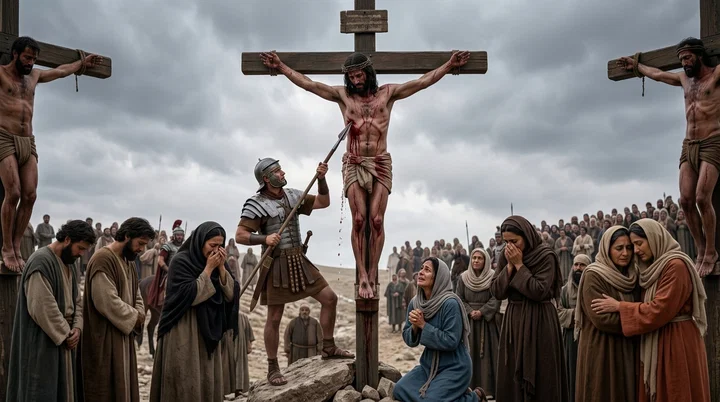
The Jews therefore, because it was the preparation, that the bodies should not remain upon the cross on the sabbath day, ( for that sabbath day was an high day,) besought Pilate that their legs might be broken, and that they might be taken away.
Translations
The Jews therefore, because it was the preparation, that the bodies should not remain on the cross on the sabbath day, (for that sabbath day was an high day,) sought Pilate that their legs might be broken, and that they might be taken away.
The Jews therefore, because it was the preparation, that the bodies should not remain upon the cross on the sabbath day, ( for that sabbath day was an high day,) besought Pilate that their legs might be broken, and that they might be taken away.
The Jews therefore, because it was the preparation, that the bodies should not remain upon the cross on the sabbath day, (for that sabbath day was a high day,) besought Pilate that their legs might be broken, and that they might be taken away.
The Jews therefore, because it was the preparation, that the bodies should not remain upon the cross on the sabbath, (for that sabbath was a great day,) besought Pilate that their legs might be broken, and that they might be taken away.
Revised Version, American Standard Version
The Jews therefore, because it was the Preparation, that the bodies should not remain on the cross upon the sabbath ( for the day of that sabbath was a high day), asked of Pilate that their legs might be broken, and that they might be taken away.
The Jews, therefore, that the bodies might not remain on the cross on the sabbath, since it was the preparation, (for that sabbath day was a great one,) asked of Pilate that their legs may be broken, and they taken away.
The Jews therefore, that the bodies might not remain on the cross on the sabbath, for it was [ the] preparation, ( for the day of that sabbath was a great [ day],) demanded of Pilate that their legs might be broken and they taken away.
The Jews, therefore, since it was, a preparation, that the bodies might not remain upon the cross during the Sabbath,—for that Sabbath day was, great, requested Pilate that their legs might be broken, and they be taken away.
Berean Standard Bible, Majority Standard Bible
It was the day of Preparation, and the next day was a High Sabbath. In order that the bodies would not remain on the cross during the Sabbath, the Jews asked Pilate to have the legs broken and the bodies removed.
Therefore the Jews, because it was the Preparation Day, so that the bodies wouldn’ t remain on the cross on the Sabbath ( for that Sabbath was a special one), asked of Pilate that their legs might be broken and that they might be taken away.
Now it was the day of getting ready for the Passover, and so that the bodies might not be on the cross on the Sabbath ( because the day of that Sabbath was a great day), the Jews made a request to Pilate that their legs might be broken, and that they might be taken away.
The Iewes then (because it was the Preparation, that the bodies should not remaine vpon the crosse on the Sabbath day: for that Sabbath was an hie day) besought Pilate that their legges might be broken, and that they might be taken downe.
Douay-Rheims (Challoner revision)
Then the Jews, ( because it was the parasceve,) that the bodies might not remain on the cross on the sabbath day, ( for that was a great sabbath day,) besought Pilate that their legs might be broken, and that they might be taken away.
Pictures
Cross-references 20 of 44
- Luke 23:54-56
And that day was the preparation, and the sabbath drew on.
Places the preparation day and Sabbath around Christ’s burial.
- Mark 15:42
And now when the even was come, because it was the preparation, that is, the day before the sabbath,
Identifies the day of Jesus’ death as the preparation day before the Sabbath.
- Mark 16:1-2
And when the sabbath was past, Mary Magdalene, and Mary the mother of James, and Salome, had bought sweet spices, that they might come and anoint him.
Places the first day and the women’s visit after the Sabbath.
- Matthew 28:1
In the end of the sabbath, as it began to dawn toward the first day of the week, came Mary Magdalene and the other Mary to see the sepulchre.
Places the women’s visit to Jesus’ tomb after the Sabbath, on the first day of the week.
- Luke 23:54
And that day was the preparation, and the sabbath drew on.
Calls the day of Jesus’ death the preparation day as the Sabbath drew near.
- John 19:42
There laid they Jesus therefore because of the Jews’ preparation day; for the sepulchre was nigh at hand.
Jesus was buried before the Sabbath began.
- John 20:1
The first day of the week cometh Mary Magdalene early, when it was yet dark, unto the sepulchre, and seeth the stone taken away from the sepulchre.
The tomb is found empty on the first day after the Sabbath.
- Luke 24:1
Now upon the first day of the week, very early in the morning, they came unto the sepulchre, bringing the spices which they had prepared, and certain others with them.
The women came to the tomb on the first day after the Sabbath.
- Mark 15:44-45
And Pilate marvelled if he were already dead: and calling unto him the centurion, he asked him whether he had been any while dead.
Pilate verifies Jesus’ death before releasing his body for removal from the cross.
- John 19:14
And it was the preparation of the passover, and about the sixth hour: and he saith unto the Jews, Behold your King!
The preparation for the Passover was the preparation for the high Sabbath.
- Exodus 12:46
In one house shall it be eaten; thou shalt not carry forth ought of the flesh abroad out of the house; neither shall ye break a bone thereof.
The Passover lamb was to remain whole, with no bone broken.
- Leviticus 23:5
In the fourteenth day of the first month at even is the LORD’s passover.
Sets the Passover date associated with the high Sabbath.
- 1 Corinthians 5:7
Purge out therefore the old leaven, that ye may be a new lump, as ye are unleavened. For even Christ our passover is sacrificed for us:
Christ’s death fulfills the Passover sacrifice.
- Deuteronomy 21:23
His body shall not remain all night upon the tree, but thou shalt in any wise bury him that day; (for he that is hanged is accursed of God;) that thy land be not defiled, which the LORD thy God giveth thee for an inheritance.
The law required a body hung on a tree to be buried that same day.
- Exodus 20:8-11
Remember the sabbath day, to keep it holy.
The Sabbath command explains why the bodies were to be removed before the high day.
- Psalms 34:20
He keepeth all his bones: not one of them is broken.
It foretold that none of Jesus’ bones would be broken.
- Genesis 2:2-3
And on the seventh day God ended his work which he had made; and he rested on the seventh day from all his work which he had made.
The Sabbath approaching at the crucifixion is creation’s hallowed seventh-day rest.
- Numbers 9:12
They shall leave none of it unto the morning, nor break any bone of it: according to all the ordinances of the passover they shall keep it.
The Passover lamb’s bones were not to be broken.
- Matthew 27:57-58
When the even was come, there came a rich man of Arimathæa, named Joseph, who also himself was Jesus’ disciple:
Joseph asks Pilate for Jesus’ body for burial after the crucifixion.
- Leviticus 23:6-7
And on the fifteenth day of the same month is the feast of unleavened bread unto the LORD: seven days ye must eat unleavened bread.
The feast calendar identifies the first day of Unleavened Bread as a holy convocation with no servile work.
Commentary
Each commentary is drawn from primary sources: the writings of Ellen G. White and Adventist pioneers and periodicals. Each commentary is separate. Its own words are not a quotation; follow the references to read the source passages.
Ellen G. White
4 sources
The Jewish leaders asked Pilate to have the legs of the crucifixion victims broken to hasten their deaths and to have their bodies removed before sunset, because the Sabbath was approaching and that Sabbath was a high day.5RED 90.4–91.1DA 771.1–2 Their stated concern was that bodies left on the cross would defile the Sabbath and violate its sanctity.5RED 90.4–91.1DA 771.1–2 That concern for the Sabbath served as a pretext, for they really feared that people would keep thinking about the events surrounding the crucifixion and that further attention to those events would bring consequences upon themselves.5RED 90.4–91.1DA 771.1–2 The priests and rulers did not want the body left on the cross during the Sabbath because the death was already drawing attention to the life and mission, and they feared the effect of a dead Christ more than that of a living one.Ms 94, 1897, par. 2–4
The two men crucified with Jesus had their legs broken to hasten their deaths, but Jesus was already dead so his legs were not broken.5RED 90.4–91.1 His unbroken bones fulfilled prophecy and corresponded to the Passover requirement that the sacrifice remain whole.5RED 90.4–91.1 The verse belongs to the account of the death and the preparations for burial, when Joseph asked Pilate for the body after Jesus was already dead and Pilate verified the death by questioning the centurion who commanded the soldiers at the cross, who confirmed it.5RED 93.2–3
Sources
Pioneers and periodicals
71 sources
Jesus died on Friday, the preparation day before the Sabbath, when the Jews asked Pilate to have the legs of the crucified broken and the bodies taken away so they would not remain on the crosses over the Sabbath, and he was laid in the nearby tomb that evening before sunset when the Sabbath began.ST May 27, 1897RH Jan 2, 1900ST Jun 10, 1875ST May 11, 1904RH Jan 1851
That Sabbath was a high day because the annual Passover Sabbath, the fifteenth of Nisan, coincided that year with the weekly seventh-day Sabbath, making one double Sabbath, while those who held the other reckoning taught it was high because the wave sheaf of the sixteenth of Nisan fell on the weekly Sabbath.RH Feb 5, 1914RH Feb 5, 1914RH Mar 15, 1860RH Apr 7, 1851
He was sacrificed on the fourteenth day of the first month at the hour the Passover lamb was killed, fulfilling the Passover type exactly as to time.RH Oct 30, 1855ST Aug 13, 1874RH Apr 7, 1851RH Dec 15, 1868
He then rested in the tomb through the seventh-day Sabbath, which followed the crucifixion as the day after the preparation and was not abolished at the cross, placing a second divine stamp upon the Sabbath in honor of redemption matching the stamp placed upon it in honor of creation.RH Dec 21, 1911RH Jan 1851RH Apr 7, 1851RH Jan 19, 1864
Because the Sabbath was a high day the soldiers broke the legs of the two thieves to hasten their death, but finding Jesus already dead they did not break his legs, fulfilling the Scripture that none of his bones would be broken and confirming that he had truly died.ST Jul 14, 1898RH Dec 12, 1912RH Oct 14, 1862ST Sep 4, 1907
Preparation and Burial Setting
John 19:31 places the death of Jesus on the preparation day before the Sabbath, the day just before the Sabbath identified as Friday.ST Jun 10, 1875RH Mar 10, 1859ST Apr 21, 1914 Because that coming Sabbath was a great or high day, described as “that Sabbath day,” the Jews asked Pilate to have Jesus and the two criminals crucified with him removed from the crosses before it began so the bodies would not remain on the crosses on the Sabbath day.ST May 27, 1897RH Jan 2, 1900ST Jun 10, 1875ST Mar 3, 1909 The request was that their legs might be broken and that they might be taken away that same day, with Jesus and the men crucified with him dying on the day of the crucifixion itself.ST May 27, 1897ST Jun 10, 1875RH Mar 10, 1859 Since the Sabbath following the crucifixion fell during Passover week, this explains why his legs were to be broken before the Sabbath began.ST May 27, 1897ST Mar 3, 1909
The bodies were to be removed from the crosses before the Sabbath began at sunset at the close of the preparation day.ST May 11, 1904RH Jan 1851RH Jun 2, 1851RH Dec 4, 1855 The crucifixion therefore took place on the day before the Sabbath, with the afternoon setting showing that the Sabbath began at evening.RH Jan 1851RH Jun 2, 1851RH Dec 4, 1855 As evening approached, the body was taken down and laid in the nearby tomb that evening so it was not left on the cross during the Sabbath.ST May 27, 1897ST Apr 8, 1903 The Sabbath began after Christ was buried, with the day of preparation coming before the high-day Sabbath and the first day of the week coming after it.ST May 11, 1904RH Jun 2, 1851ST Apr 8, 1903
Joseph of Arimathea asked Pilate for permission to bury Jesus, Pilate granted the request and ordered soldiers to supervise the burial.RH Jul 16, 1861 A few days later the tomb was found empty while the disciples proclaimed that he had risen as he had foretold.RH Jul 16, 1861
Among the Jews crucified persons were buried on the day of their crucifixion, so death was hastened by other means such as breaking their bones with a mallet, kindling a fire under the cross, letting wild beasts loose upon them, or similar means.RH Dec 9, 1858ST Jul 14, 1881 In the case of Jesus no such hastening was necessary because he died within a few hours, but to be sure that he was really dead one of the soldiers pierced his side with a spear.RH Dec 9, 1858ST Jul 14, 1881 Leg-breaking as a means of ending a crucified person’s life and removing him from the cross is illustrated by the account of a crucified man still alive on Saturday whose legs were broken at sunset before he was strangled.RH May 10, 1864
Meaning of High Day
That Sabbath was a high day because the annual Passover Sabbath, the fifteenth of Nisan, the first day of unleavened bread, coincided that year with the weekly seventh-day Sabbath, so that both Sabbaths were observed together on one day as a double Sabbath.RH Mar 15, 1860RH Apr 7, 1851RH Apr 15, 1873RH Jun 16, 1863 The crucifixion therefore took place on the sixth day of the week, Friday, the preparation or day before the Sabbath, with the weekly Sabbath next and the first day of the week coming after it.RH Mar 15, 1860RH Apr 7, 1851RH Apr 15, 1873RH Jun 16, 1863RH Jan 9, 1872 The annual festival Sabbath and the weekly Sabbath did not always coincide, but on that occasion the weekly Sabbath in commemoration of creation and the yearly Sabbath in remembrance of escape from Egypt fell on the same seventh day.RH Jan 9, 1872 This fixes that Friday as the fourteenth of Nisan, the preparation day before the Passover feast when the lamb was killed, and fixes the count of fifty days from the sixteenth of Nisan so that Pentecost fell on the first day of the week.RH Apr 15, 1873
That Sabbath was also taught to be high because it was the second Passover day, when the wave sheaf or sheaf of first fruits was offered as commanded in the law on the sixteenth of Nisan, which in that year fell on the weekly Sabbath.RH Feb 5, 1914RH Feb 5, 1914RH Feb 12, 1914RH Jan 22, 1914 On that reckoning it was the first Sabbath of the Passover feast, and the wave-sheaf day, the sixteenth of Abib, always followed the first Passover Sabbath, the fifteenth of the month, which identifies the crucifixion as occurring on Friday, the fifteenth day of Nisan.RH Feb 5, 1914RH Feb 12, 1914RH Jan 22, 1914 Put together, if the high day was the fifteenth of Nisan it was high because the Passover Sabbath coincided with the weekly Sabbath, and if the weekly Sabbath was the sixteenth of Nisan it was high because the wave sheaf was offered that day.
A Sabbath is called a high day when a chief Jewish solemnity falls on the seventh day of the week, so that the same day is both the Sabbath of Jehovah and the ceremonial day, as when the Day of Atonement, the tenth day of the seventh month, falls on the seventh day.ST Oct 2, 1879 Here “that Sabbath” refers naturally to the regular weekly Sabbath, while “high day” reflects its place among the great Passover days during Passover week.ST Mar 3, 1909ST Mar 20, 1907 The annual Passover feast was governed by lunar date rather than fixed to a particular weekday, so its feast days could fall on the weekly Sabbath or another day, and on this occasion the Sabbath on which Christ lay in the grave coincided with a special Passover feast day.STST Mar 20, 1907 Because the bodies were not to remain on the crosses for that Sabbath, the Jews asked Pilate to have the crucified men’s legs broken and their bodies taken away before the Sabbath began.ST Mar 3, 1909
One position held the day after the crucifixion to be a high Sabbath distinct from the weekly Sabbath observed according to the commandment, the next day after the crucifixion and the preparation for the high Sabbath, so that two Sabbaths occurred while the body was in the tomb.RH Apr 12, 1860 The opposite position holds that both uses of Sabbath in the verse mean the weekly Sabbath of the Lord, not one of the festival or land sabbaths that expired by limitation and ceased at the cross.RH Mar 19, 1857 On that reckoning the day following the preparation was the weekly Sabbath, not a merely ceremonial Passover Sabbath, and its being called a high day means some circumstance distinguished it from usual Passover Sabbaths.RH Apr 12, 1860 The sanctity that restrained the disciples from continuing the embalming work could not have been that of a mere Passover Sabbath but was that of the weekly Sabbath.RH Apr 12, 1860 The great Sabbath before the Passover called a high day is the ancient seventh-day Sabbath of the Lord, not Sunday.RH Jun 17, 1873
Passover Timing and Fulfillment
Christ our Passover was sacrificed on the fourteenth day of the first month, the very day the Passover lamb was killed.RH Oct 30, 1855ST Aug 13, 1874RH Dec 15, 1868 The fulfillment met the type exactly as to time, for the grand event for which the day was noted meets its antitype on the very day of the type.RH Oct 30, 1855 Mere preliminary and circumstantial offerings do not prevent that exact meeting of type and antitype.RH Oct 30, 1855
The preparation was the fourteenth day, when the Passover lamb was killed at even.RH Apr 7, 1851 Even means the late afternoon before evening begins, and the lamb was killed at about three o'clock.RH Apr 7, 1851 Jesus died at that same hour, fulfilling the Passover-lamb pattern, before the feast began on the fifteenth day.RH Apr 7, 1851 The Friday on which He was crucified was therefore the fourteenth of Nisan, the preparation day before the Passover feast.RH Apr 15, 1873 That date fixes the count of fifty days from the sixteenth of Nisan so that Pentecost fell on the first day of the week.RH Apr 15, 1873
On another reckoning, Jesus was crucified and buried on Friday, the preparation for the weekly Sabbath, while that Friday itself was the fifteenth of Nisan, the first yearly Passover Sabbath.RH Jun 24, 1873RH Feb 5, 1914 On this reckoning John 19:14 means the preparation for the weekly Sabbath occurring in Passover week, requiring special preparation.RH Jun 24, 1873 The special preparation was required because the full preparation restraint that applied to the weekly Sabbath did not apply as on yearly Sabbaths, on which necessary food could be prepared.RH Jun 24, 1873 That following Sabbath was high because the weekly seventh-day Sabbath fell inside Passover week and because the count to the following Pentecost was dated from it, and because the sheaf of first fruits was offered on that day as commanded in the law as the first Sabbath of the Passover feast.RH Jun 24, 1873RH Feb 5, 1914
The day after Jesus was crucified on Passover, the fourteenth of Abib, was a Sabbath, making that year's fifteenth of Abib or Nisan fall on the weekly Sabbath.ST Jul 3, 1879ST Jul 3, 1879 This does not establish that the fifteenth always fell on the weekly Sabbath.ST Jul 3, 1879ST Jul 3, 1879 That Sabbath after the crucifixion during Passover week stood alone in the calendar with Jesus at rest in the tomb, and the predicted middle of the week had arrived.ST Jan 31, 1911
Sabbath Witness and Rest
The Sabbath came directly after the crucifixion as the day following the preparation, when the bodies were to be taken down from the crosses before it began.RH Jan 1851RH Apr 7, 1851 Its observance after the death of Jesus shows that the seventh-day Sabbath was not abolished or nailed to the cross.RH Apr 7, 1851 Jesus resting in the grave on that day, identified as a high Sabbath, confirms the sanctity of the seventh-day Sabbath.RH Jan 19, 1864
The verse stands among the New Testament references to the Sabbath that belong to the time after the crucifixion, and together with the later references in Acts it shows the Sabbath remained an acknowledged institution in the gospel dispensation.RH Jan 19, 1860 It is counted as one of the eleven references to the Sabbath in John, belonging to the evidence that the Sabbath remained binding after the crucifixion and in the gospel dispensation.RH Jan 19, 1860
John still calls the day before the first day of the week the Sabbath even decades after the crucifixion, distinguishing the seventh day from the first day.ST Mar 18, 1889ST Jan 20, 1881 That Sabbath stands immediately before the first day of the week named in John 20:1, with John 19:42 belonging to the same burial Sabbath sequence, marking the Sabbath in the New Testament as distinct as the last day of the week.RH Apr 21, 1874ST Mar 16, 1882 At the death of Christ the Sabbath was therefore the day before the first day of the week and the seventh day of the week, the same seventh day blessed and sanctified at creation as the memorial of the Creator.ST Nov 18, 1903 It is the same seventh day the law of God calls the Sabbath of the Lord and commands to be observed because of the creation and because the Creator rested on that day at the close of creation week, and which the Lord claims as his day.ST Nov 18, 1903ST Jan 20, 1881 It supplies the setting in which the women rested on the Sabbath and then came with spices on the first day of the week in Luke 24:1.RH Jan 2, 1900
Christ finished the work of redemption on the sixth day of the week, the preparation day before the Sabbath, then rested in death through the seventh day in the newly cut tomb of Joseph.RH Dec 21, 1911 By that Sabbath rest in death He placed a second divine stamp on the seventh-day Sabbath in honor of redemption, matching the first divine stamp placed on it in honor of creation.RH Dec 21, 1911 Both stamps bear the authority of the government of heaven, both are indelible and remain intact, both give the day more than double value, and both stand equal in heaven and should stand equal on earth.RH Dec 21, 1911 That He shed His blood and declared His work finished on Friday, the day before the Sabbath identified as a high day, does not establish the first day as a memorial of redemption.RH Jun 24, 1852 The Sabbath day is one entire day of the week, a day of twenty-four hours embracing both night and day, proving the Greek word for day means the full period and not only the hours of light.RH Dec 12, 1871
Real Death and Unbroken Bones
Because that Sabbath was a high day the Jews asked Pilate to have the legs of the crucified men broken and their bodies removed, and the soldiers broke the legs of the two thieves but when they came to Jesus and found Him already dead they did not break His legs.ST Jul 14, 1898RH Dec 12, 1912RH Oct 14, 1862 This fulfilled the Scripture that none of His bones would be broken and showed that Christ was offered whole, not divided.ST Jul 14, 1898 Breaking the legs was intended to hasten death, since crucifixion otherwise brought death slowly, and Jesus had already died before the others, so that act did not cause His death.ST Nov 30, 1915RH Oct 14, 1862ST Sep 4, 1907 The actions of the soldiers and the spear wound piercing His side, from which blood and water came, the water being fluid from the sac around the heart, confirm that He had truly died.RH Dec 12, 1912RH Oct 14, 1862
The putting to death on the cross and the shedding of blood, burial and resurrection was of no other person than the Word who was in the beginning as God with God by whom all things were made, who was made flesh from the Father, dwelt among men, taught and worked miracles, was falsely accused by the Jews, and died on the cross.RH Apr 14, 1874 The cross is the place where sin led Christ and where His blood was shed as the sin-atoning sacrifice of the Son of God Himself, not merely a human nature dying apart from Him, nor one person humbling Himself and another becoming obedient unto death.RH Nov 10, 1863RH Apr 14, 1874 His death was a real blow that seemed to give Death victory until He rose from the tomb and overcame it.ST Jul 30, 1912
The thieves were still alive late that afternoon and when taken down near the close of the day at the start of the Sabbath, which began at sunset, so their legs were broken to hasten death and to keep them from escaping once removed from the very public place where the crosses stood.ST Nov 30, 1915ST Feb 24, 1898RH Sep 25, 1913ST May 13, 1903 Breaking the legs was not a certain way to kill them that day or at all, since criminals often survived on the cross for several days, and a more effectual means would have been used if immediate death had been wanted.ST May 13, 1903RH Jun 8, 1911 Thus there is no evidence the converted thief died the same day as Christ, he could not have met Jesus in Paradise that day, and the claim that he went there that day would require that he went alive.ST Nov 30, 1915ST Feb 24, 1898RH Sep 25, 1913ST May 13, 1903RH Jun 8, 1911
Hypocrisy Exposed and Suffering Shared
The Jewish rulers were careful not to leave the crucified bodies on the crosses during the sacred rest of the high day, and asked Pilate to have the men's legs broken so they could be taken down before the Sabbath beginning at sunset.ST Jul 25, 1878RH Dec 12, 1912RH Jul 18, 1854 They showed scrupulous observance of religious form while standing alongside the grave wickedness of having arranged to murder Jesus, even helping kill the Lord of that rest.RH Dec 12, 1912RH Jul 18, 1854 Their strict keeping of the Sabbath rule after calling for his blood and crucifying him exposed their hypocrisy.RH Jul 18, 1854 Their stated concern to keep the high day from being defiled by bodies remaining on the crosses concealed their fear that the public would continue reflecting on the events surrounding Jesus' death.ST Jul 25, 1878 Without repentance and faith in Jesus as Redeemer they could not escape judgment, for Jesus was already dead when a soldier pierced his side and he was taken down from the cross.RH Dec 12, 1912RH Jul 18, 1854
The verse belongs to the inspired account of Jesus' crucifixion, presented as the saddest tragedy in human history when the Man of Galilee was crucified by a bloodthirsty, sin-hardened mob. It belongs to the account of his suffering on the cross, where he bore the world's woe and endured agony from love for souls while the Father beheld him.RH Jan 16, 1908 It places those events on the preparation day before a high Sabbath, surrounded by his thirst and the cross and spear.ST May 7, 1902
That record of Christ's sufferings can help a fretful or discontented Christian overcome pride and discontent.ST Apr 17, 1879 It shows Jesus as a man of sorrows who suffered the bitter depths of human woe below, coming in pitying love to share every burden and care through days of toil and nights of prayer, bearing the heavy cross, wearing the piercing crown of thorns, and enduring the nails, the spear, and the gore. While such a record remains, no grief or pain gives cause to murmur or complain, no one with such memories can ask for a life of ease or live one hour only to please self, and since Jesus suffered, pain is made sweet because it brings the sufferer lower at his feet where they meet in closer sympathy. Calvary is the way to the throne of God, for the glory of the ascending Lord and a seat with him on his throne cannot be rightly appreciated apart from the wilderness of temptation, patient toil, nights of prayer, and the awful experiences of Gethsemane and Calvary.RH Feb 4, 1904 Christ reached the throne for a redeemed world with hands and feet pierced and brow scarred with a crown of thorns, and no one can expect the throne above who sees the throne with no crucified Lord between him and the throne.RH Feb 4, 1904
Jesus hung dead upon a Roman cross and lay dead within the tomb, seen as dead by the Jews who crucified him.ST May 25, 1904 Even after that death was witnessed, power remained in his name to hold his faithful followers and to win many believers to the truth.ST May 25, 1904
Sources