Nehemiah 13:19
And it came to pass, that when the gates of Jerusalem began to be dark before the sabbath, I commanded that the gates should be shut, and charged that they should not be opened till after the sabbath: and some of my servants set I at the gates, that there should no burden be brought in on the sabbath day.
Translations
American King James Version, King James Version, KJV Cambridge Paragraph Bible
And it came to pass, that when the gates of Jerusalem began to be dark before the sabbath, I commanded that the gates should be shut, and charged that they should not be opened till after the sabbath: and some of my servants set I at the gates, that there should no burden be brought in on the sabbath day.
And it came to pass, that, when the gates of Jerusalem began to be dark before the sabbath, I commanded that the gates should be shut, and charged that they should not be opened till after the sabbath: and I set some of my servants at the gates, that there should no burden be brought in on the sabbath day.
Revised Version, American Standard Version
And it came to pass that, when the gates of Jerusalem began to be dark before the sabbath, I commanded that the doors should be shut, and commanded that they should not be opened till after the sabbath: and some of my servants set I over the gates, that there should no burden be brought in on the sabbath day.
And it cometh to pass, when the gates of Jerusalem have been dark before the sabbath, that I speak, and the doors are shut, and I say, that they do not open them till after the sabbath; and of my servants I have stationed at the gates; there doth not come in a burden on the sabbath-day.
And it came to pass, that when it began to be dark in the gates of Jerusalem before the sabbath, I commanded that the gates should be shut; and I commanded that they should not be opened till after the sabbath. And I set [ some] of my servants at the gates, so that no burden should be brought in on the sabbath day.
And it came to pass, when the gates of Jerusalem made a shadow before the sabbath, then gave I word, and they shut the doors, and I gave word, that they should not open them, until after the sabbath,—and, some of my young men, set I near the gates, so that no burden should be brought in, on the sabbath day.
Berean Standard Bible, Majority Standard Bible
When the evening shadows began to fall on the gates of Jerusalem, just before the Sabbath, I ordered that the gates be shut and not opened until after the Sabbath. I posted some of my servants at the gates so that no load could enter on the Sabbath day.
It came to pass that when the gates of Jerusalem began to be dark before the Sabbath, I commanded that the doors should be shut, and commanded that they should not be opened until after the Sabbath. I set some of my servants over the gates, so that no burden should be brought in on the Sabbath day.
And so, when the streets of Jerusalem were getting dark before the Sabbath, I gave orders for the doors to be shut and not to be open again till after the Sabbath: and I put some of my servants by the door so that nothing might be taken in on the Sabbath day.
And when the gates of Ierusalem beganne to be darke before the Sabbath, I commaded to shut the gates, and charged, that they should not be opened til after the Sabbath, and some of my seruants set I at the gates, that there shoulde no burden be brought in on the Sabbath day.
Douay-Rheims (Challoner revision)
And it came to pass, that when the gates of Jerusalem were at rest on the sabbath day, I spoke: and they shut the gates, and I commanded that they should not open them till after the sabbath: and I set some of my servants at the gates, that none should bring in burthens on the sabbath day.
Pictures
Cross-references 20 of 32
- Exodus 20:8-10
Remember the sabbath day, to keep it holy.
Nehemiah enforces the command to keep the seventh day as Sabbath.
- Leviticus 23:32
It shall be unto you a sabbath of rest, and ye shall afflict your souls: in the ninth day of the month at even, from even unto even, shall ye celebrate your sabbath.
Both place the Sabbath’s beginning at evening, establishing its evening-to-evening observance.
- Jeremiah 17:21
Thus saith the LORD; Take heed to yourselves, and bear no burden on the sabbath day, nor bring it in by the gates of Jerusalem;
Both prohibit carrying burdens through Jerusalem’s gates on the Sabbath.
- Isaiah 58:13
If thou turn away thy foot from the sabbath, from doing thy pleasure on my holy day; and call the sabbath a delight, the holy of the LORD, honourable; and shalt honour him, not doing thine own ways, nor finding thine own pleasure, nor speaking thine own words:
Both forbid ordinary activity that profanes the Sabbath.
- Exodus 16:28-30
And the LORD said unto Moses, How long refuse ye to keep my commandments and my laws?
Sabbath observance required ceasing from ordinary work and remaining in place.
- Genesis 2:2-3
And on the seventh day God ended his work which he had made; and he rested on the seventh day from all his work which he had made.
God rested on the seventh day, blessed it, and made it holy.
- Nehemiah 10:31
And if the people of the land bring ware or any victuals on the sabbath day to sell, that we would not buy it of them on the sabbath, or on the holy day: and that we would leave the seventh year, and the exaction of every debt.
The people pledged not to buy goods on the Sabbath.
- Isaiah 56:2
Blessed is the man that doeth this, and the son of man that layeth hold on it; that keepeth the sabbath from polluting it, and keepeth his hand from doing any evil.
Both texts teach faithful Sabbath observance and its blessing.
- Exodus 20:10
But the seventh day is the sabbath of the LORD thy God: in it thou shalt not do any work, thou, nor thy son, nor thy daughter, thy manservant, nor thy maidservant, nor thy cattle, nor thy stranger that is within thy gates:
Both require Sabbath observance within Jerusalem’s gates.
- Genesis 1:5
And God called the light Day, and the darkness he called Night. And the evening and the morning were the first day.
The day is reckoned from evening, explaining the Sabbath’s timing.
- Luke 23:56
And they returned, and prepared spices and ointments; and rested the sabbath day according to the commandment.
The women rested on the Sabbath according to the commandment.
- Exodus 31:13-17
Speak thou also unto the children of Israel, saying, Verily my sabbaths ye shall keep: for it is a sign between me and you throughout your generations; that ye may know that I am the LORD that doth sanctify you.
Sabbath keeping is commanded as a covenant sign and day of rest.
- Deuteronomy 5:12-14
Keep the sabbath day to sanctify it, as the LORD thy God hath commanded thee.
Both require Sabbath rest from ordinary labor.
- Jeremiah 17:27
But if ye will not hearken unto me to hallow the sabbath day, and not to bear a burden, even entering in at the gates of Jerusalem on the sabbath day; then will I kindle a fire in the gates thereof, and it shall devour the palaces of Jerusalem, and it shall not be quenched.
Sabbath-breaking would bring fire and destruction upon Jerusalem.
- Nehemiah 13:15
In those days saw I in Judah some treading wine presses on the sabbath, and bringing in sheaves, and lading asses; as also wine, grapes, and figs, and all manner of burdens, which they brought into Jerusalem on the sabbath day: and I testified against them in the day wherein they sold victuals.
listed together as Sabbath scriptures
- Exodus 16:23
And he said unto them, This is that which the LORD hath said, To morrow is the rest of the holy sabbath unto the LORD: bake that which ye will bake to day, and seethe that ye will seethe; and that which remaineth over lay up for you to be kept until the morning.
Both give rules for proper Sabbath keeping.
- Ezekiel 20:12
Moreover also I gave them my sabbaths, to be a sign between me and them, that they might know that I am the LORD that sanctify them.
The Sabbath is a sign of God’s relationship with and sanctification of his people.
- Ezekiel 20:20
And hallow my sabbaths; and they shall be a sign between me and you, that ye may know that I am the LORD your God.
God calls the Sabbath a sign between him and his people.
- Mark 2:28
Therefore the Son of man is Lord also of the sabbath.
Christ observed the Sabbath as its Lord.
- John 5:9-10
And immediately the man was made whole, and took up his bed, and walked: and on the same day was the sabbath.
Jesus tells a healed man to carry his bed on the Sabbath, like Nehemiah’s forbidden burdens.
Commentary
Each commentary is drawn from primary sources: the writings of Ellen G. White and Adventist pioneers and periodicals. Each commentary is separate. Its own words are not a quotation; follow the references to read the source passages.
Ellen G. White
4 sources
This action belongs to the reform after the return from Persia to Jerusalem, when Judah had departed from the Lord after solemnly pledging to obey God's law, and evils threatening to pervert the nation had crept in during the absence when the influence of Ezra and Nehemiah was withdrawn.PK 669.1–670.1 The shutting of the gates was a later measure, for earlier the effort to stop Sabbath trading had been to bind the people in a covenant not to buy from the traders, in the hope that this would discourage the traders from coming and so end the traffic.PK 667.1 When it began to be dark before the Sabbath, the gates of Jerusalem were shut and kept shut until the Sabbath was past, so that no Sabbath traffic could occur and no burdens or trade goods could be brought in.PK 671.1–672.1PK 667.1
The Sabbath is the sign distinguishing Israelites from all other nations as worshipers of the true God, and disregard for it had come through intercourse with idolaters, as heathen merchants and traders induced Israelites to buy and sell on the Sabbath.PK 671.1–672.1 The rulers had failed to prevent this Sabbath breaking because desire for their own interests led them to favor the ungodly, and they were therefore rebuked for profaning the Sabbath and bringing more wrath upon Israel, just as their fathers had brought evil upon the city.PK 671.1–672.1 Having more confidence in his own servants than in men whom the magistrates of Jerusalem would appoint, Nehemiah stationed his servants at the gates to enforce his orders that no burden be brought in on the Sabbath day.PK 671.1–672.1
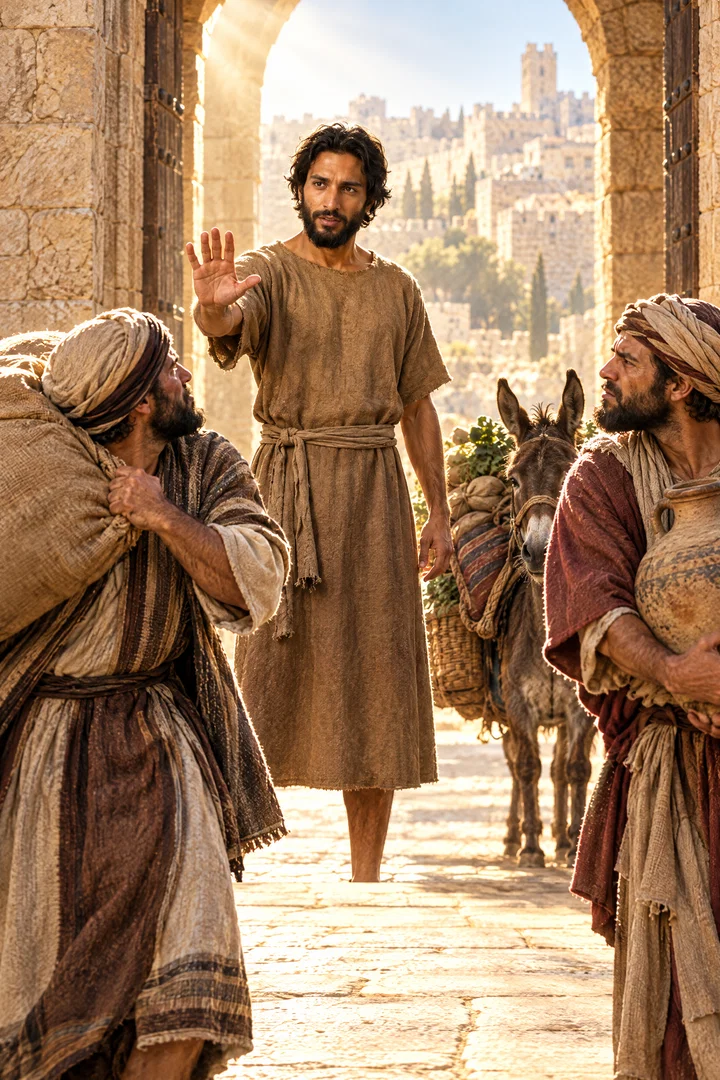
The Levites were also directed to guard the gates of Jerusalem to keep the Sabbath from being broken by burdens brought in.PK 669 They stood together at a large arched stone gateway guarding the entrance to the temple courtyard while men approaching with sacks were stopped, and traders with burdened donkeys, bundles, containers and vessels were kept outside.PK 669
Sources
Pioneers and periodicals
74 sources
When the gates began to grow dark before the Sabbath Nehemiah had them shut and kept shut till after the Sabbath, setting his servants at them so no burden would be brought in on the Sabbath day.ST Dec 20, 1899ST Oct 6, 1914ST Nov 15, 1899
The darkening shows the Sabbath beginning at sunset in the evening, and kept from evening to evening, in present reckoning from Friday evening at sunset till Saturday evening at sunset.RH Aug 22, 1865ST Feb 2, 1915ST Feb 27, 1912ST May 16, 1911ST Jul 16, 1912
The Sabbath so kept is the definite seventh day of the fourth commandment, not the first day, still known after the captivity and not left for each person to choose.RH Jul 30, 1867ST Jul 25, 1911ST Apr 10, 1907ST Apr 11, 1900ST Mar 20, 1884
Keeping it means giving God the whole sacred day by stopping ordinary trade and carrying of substantial loads for gain, with the household answerable for family, hired help, and the stranger within its gates.RH Jan 21, 1862RH Jul 30, 1867ST Feb 2, 1915RH Jul 9, 1908RH Feb 3, 1852
Its profanation had brought wrath and captivity upon Jerusalem, while its observance carries promised blessing, making the Sabbath with the tithe a test of loyalty still binding.ST Jun 11, 1894RH Jan 26, 1905RH Apr 19, 1864ST Nov 25, 1908
That shutting and guarding belonged to a theocracy in a city set apart to God and is no warrant for civil force to compel rest under the gospel, but calls Sabbath-keepers to finish work beforehand and shut worldly traffic out at sunset in worship through the whole day.RH Aug 22, 1865RH Jul 9, 1908ST Feb 20, 1893ST Aug 23, 1910
Sabbath Timing in Verse
The Sabbath begins at sunset in the evening, when the gates of Jerusalem began to grow dark before the Sabbath.RH Aug 22, 1865ST Feb 2, 1915ST Feb 27, 1912ST Nov 15, 1899 As the city grew dark and daylight was ending, the gates were ordered shut and kept closed until after the Sabbath, with servants set as guards so that no burden would be brought in on the Sabbath day.RH Aug 22, 1865ST Feb 2, 1915ST Feb 27, 1912ST Nov 15, 1899 The shutting took place as sunset approached before the seventh day, and the guarding through the Sabbath shows that observance meant stopping ordinary trade and carrying of goods and giving the full day, not merely keeping the correct day.ST Feb 2, 1915ST Feb 27, 1912ST Jul 16, 1912 This closing and guarding supports the reckoning that the Sabbath begins and ends at sunset, not at midnight, sunrise, or dawn.ST May 16, 1911ST Jul 16, 1912RH Dec 9, 1852ST Aug 9, 1899ST Dec 29, 1909
So begun, the Sabbath is kept from evening to evening like every other day, in present reckoning from Friday evening at sunset till Saturday evening at sunset.ST May 16, 1911RH Dec 9, 1852ST Aug 9, 1899ST Dec 29, 1909ST Jun 10, 1908 It begins when the day begins, at evening when the sun goes down, and ends with the day at evening the next day, keeping the same evening-to-evening reckoning in harmony with the sixth and first days.ST May 16, 1911ST Aug 9, 1899ST Dec 29, 1909ST Jun 10, 1908 The going down of the sun marks the start of the day, and the practice of shutting the gates as it grew dark and keeping them closed until the Sabbath was over is evidence for that evening-to-evening observance.ST May 16, 1911ST Jul 16, 1912RH Dec 9, 1852ST Aug 9, 1899
The darkening is the sun's withdrawal from the gates, with deep and heavy shadows of the walls falling upon them at sunset.RH Aug 22, 1865ST May 16, 1911ST Aug 21, 1907ST Dec 8, 1914ST Dec 29, 1909 The east-facing sides began to fall into shadow toward sunset, and the gates were ordered shut then so that everything could be quiet when the Sabbath began.RH Aug 22, 1865ST May 16, 1911RH Dec 4, 1855ST Aug 21, 1907 The closing is not at the very moment the sun sinks behind the western horizon, but earlier when it begins to be dark, when lengthening shadows and receding light proclaim that the sun is finishing its daily circuit and preparation is to be made.RH Jul 9, 1908ST May 16, 1911RH Dec 4, 1855 The time is set by the approach of sunset, not by shadows cast by nearby mountains, and when the sky is clear it gives the better indication.RH Jul 9, 1908ST Aug 21, 1907
Those who held a different position taught from the shutting of the gates when it began to grow dark that the Sabbath did not always begin at sunset, even in Palestine.RH Jun 24, 1852RH Jun 2, 1851 In that argument the day did not always begin at the exact time of sunset because sunset varies through the year, while the Sabbath was still prepared for before darkness fell near sunset.RH Jun 24, 1852RH Jun 2, 1851 The episode was dated to the latter part of the seventh month, when sunset at Jerusalem was about five o'clock.RH Jun 2, 1851 Another discussion raised whether this timing conflicts with the claim that evening is at sunset, and left the question unanswered.RH Apr 14, 1863
Nehemiah's Reform Action
Nehemiah commanded that the gates of Jerusalem be shut when they began to be dark before the Sabbath and not be opened till after the Sabbath, and he set some of his servants at the gates so that no burden should be brought in on the Sabbath day.ST Dec 20, 1899ST Oct 6, 1914ST Nov 15, 1899RH Jan 21, 1862ST Feb 20, 1893 The shutting began as the Sabbath approached and continued until it ended, with guards assigned to keep out loads of merchandise and ordinary traffic.ST Dec 20, 1899ST Oct 6, 1914RH Jan 21, 1862ST Nov 15, 1899ST Feb 20, 1893 The measure enforced the Sabbath by stopping trade and the carrying of goods, taking preventive action against profanation in order to stop desecration and prevent its recurrence.ST Dec 20, 1899ST Oct 6, 1914ST Nov 15, 1899RH Jan 21, 1862ST Nov 15, 1899
He did this as a God-appointed governor over a city restored to Israel and set apart to God for His service, acting within the community of God's people under Israel's still-theocratic government.ST Nov 15, 1899ST Jul 28, 1898ST Apr 9, 1896ST Aug 23, 1910 Jerusalem was the Lord's city and the Sabbath was the Lord's Sabbath, and its rulers were responsible to carry out God's laws and require outward observance from those within their care, though subject to human imperfection.ST Apr 9, 1896ST Aug 23, 1910 He had the right to prevent Sabbath desecration there as a person may prevent it in his own home, to keep merchants from profaning the Sabbath within Jerusalem rather than to compel outsiders to keep it.ST Feb 20, 1893ST Jul 28, 1898
The action belongs to the last reform wrought in Israel before Christ came, a work of Sabbath reformation after the Babylonian captivity when God gave Israel another opportunity.ST Jun 2, 1909ST Sep 8, 1909 After the people heard and understood the law, confessed their sins, and covenanted not to buy from vendors, proper Sabbath observance was restored alongside the payment of tithes.RH Mar 23, 1905RH Jan 26, 1905 When the people withheld the holy tithe they did not keep the holy Sabbath, for withholding the tithe prepared the way to steal holy time for work and for buying food from heathen vendors.RH Jan 26, 1905 Nehemiah contended with the nobles of Judah for their evil in profaning the Sabbath, warning that their fathers had done the same and God had brought evil upon them and upon Jerusalem, and that they were bringing more wrath upon Israel. At first he relied on the covenant and later used his authority to enforce the Sabbath, and his closing of the city against Sabbath burden-bearing belongs to God's work of reformation typical of His work in other ages, especially in the last days.ST Jun 2, 1909
Enforcing strict observance of the Sabbath to arouse and quicken the moral and spiritual life of the people was the most difficult of all his tasks.RH Oct 8, 1908 After being recalled to court and traveling more than a thousand miles in going and returning, he hastened back and plunged into the struggle with unwearied energy, vigor and tenacity of purpose, the same as he had displayed twelve years before.RH Oct 8, 1908 Though opposition met him everywhere, priest and Levite and people and the high priest himself yielded to his energetic initiative.RH Oct 8, 1908 The period is that of Ezra and Nehemiah, illuminated by Babylonian life and Babylonian and Assyrian discoveries giving background for Israel and its dealings with adjoining lands.ST Mar 10, 1909
Sabbath Conduct Required
Keeping the Sabbath in this verse means stopping ordinary trade, commerce and the carrying of goods, not merely keeping the correct day, and giving God the full sacred day.RH Jan 21, 1862RH Jul 30, 1867ST Feb 2, 1915ST Feb 16, 1915ST Mar 13, 1879 Jerusalem's gates were ordered shut as the Sabbath approached when it began to be dark and were kept closed until the Sabbath had ended, with servants set as guards to prevent any burden from being brought into the city on the Sabbath day.RH Jan 21, 1862RH Jul 30, 1867ST Feb 2, 1915ST Apr 19, 1877ST Feb 16, 1915 That closing and guarding enforced the Sabbath by stopping trade and Sabbath commerce by outside merchants and by preventing ordinary traffic and gainful work from profaning the day.RH Jan 21, 1862RH Jul 30, 1867ST Feb 2, 1915ST Apr 19, 1877ST Mar 13, 1879 Applied in this way, the account supports not buying or selling on the Sabbath and treats trade and the carrying of burdens as not to be allowed during the day.ST Apr 19, 1877ST Feb 16, 1915ST Mar 13, 1879
The burdens forbidden are substantial loads brought in for ordinary activity and worldly gain, whose bringing through the gates violates the fourth commandment.RH Feb 3, 1852RH May 2, 1854RH Apr 11, 1854 They are burdens of merchandise such as sheaves, wine, grapes and figs brought into Jerusalem to sell, and that carrying was labor for worldly gain and a violation of the Sabbath law.RH Feb 3, 1852RH May 2, 1854RH Apr 11, 1854 That prohibition does not forbid the healed man's carrying his slight mat or bed at Jesus' direction while praising God.RH Feb 3, 1852RH May 2, 1854RH Feb 11, 1862 His carrying was for God's glory and an act of mercy manifesting God's power and serving as evidence of his cure, not the kind of burden God had forbidden by Scripture.RH Feb 3, 1852RH May 2, 1854RH Feb 11, 1862
The verse enforces the fourth commandment's household rule, which makes a household responsible not only for its own family and hired help and cattle but even for the stranger sojourning within its gates, who must regard the Sabbath as long as he lingers there.ST Feb 7, 1911RH Jul 9, 1908 Therefore a Sabbath-keeper must not allow hired workers to work on the Sabbath, and the Sabbath must be kept holy by shutting out all business.ST Feb 7, 1911RH Jul 9, 1908 Planning business or dismissing business matters on the Sabbath is the same as actually transacting business, and entering into partnership with those who have no respect for the Sabbath makes a Sabbath-keeper equally guilty when the business is carried on on the Sabbath for gain, so the partnership must be dissolved even at great loss.ST Feb 7, 1911 Obedience in business affairs is never unaffordable while disobedience is always unaffordable, and carelessness in Sabbath observance will be punished, while the family that shuts out worldly traffic and gathers in worship to welcome the holy day receives the blessing promised to the one who keeps the Sabbath from polluting it.ST Feb 7, 1911RH Jul 9, 1908
Seventh Day Identified
The Sabbath shut in by the darkening gates is the definite seventh day of the week, kept as a weekly Sabbath at evening.RH Jul 30, 1867ST Jul 25, 1911ST Apr 10, 1907ST Apr 11, 1900RH Mar 19, 1857 It was still identified and observed after the Babylonian captivity, when Ezra and Nehemiah and the Jews knew which day was the Lord's Sabbath even when they perverted its observance.ST Apr 10, 1907RH Aug 21, 1855ST Jun 28, 1905 It is not a day each person may choose for himself.RH Jul 30, 1867
The day guarded is the Sabbath of the fourth commandment, the seventh day, not the first day of the week.ST Jul 25, 1911ST Apr 11, 1900ST Mar 20, 1884ST Mar 28, 1911ST Jan 19, 1882 Nehemiah's protest was against work and trading on that Sabbath, not against work on Sunday, and his rebuke cannot be turned to teach that Sunday replaces Saturday as the Sabbath.ST Mar 20, 1884ST Jan 19, 1882 The account therefore gives no support for Sunday observance or for a Sunday law, no divine command to close gates or doors on Sunday, and no authority for civil Sunday closing now.ST Jul 25, 1911ST Mar 28, 1911ST Feb 6, 1893
In the restoration from Babylonian captivity keeping this Sabbath was a test of obedience, whose violation had been among the chief causes of the captivity.ST Jun 11, 1894ST Oct 29, 1902 The Sabbath and the tithe stand together as two grand principles by which loyalty to God is tested, holy by the same power with neither more holy than the other, so that when the tithe was withheld the Sabbath was not kept and when the tithe was brought in the Sabbath was restored.RH Jan 26, 1905 That restoration work was marked by God's seal, the Sabbath, seen in practice when the gates were shut before the Sabbath and burdens kept out during it.ST Nov 25, 1908 This teaching belongs to a thread running through the whole Bible, best known directly from Scripture and settled by Jesus Christ as Lord of the Sabbath and Head of the church, with its obligation still binding as when Nehemiah taught it and with the seventh day upheld as a rest day for all mankind.RH Sep 3, 1908RH Aug 21, 1855
Judgment and Blessing Involved
Profaning the Sabbath by violating God's law even while being restored to favor and enjoying blessing was evil that brought more wrath upon Israel.ST Jun 11, 1894RH Aug 22, 1865 Nehemiah contended with the nobles of Judah for that evil, warning that their fathers had done the same and God had brought evil upon them and upon Jerusalem.ST Apr 1, 1875 Its violation had been among the chief causes of the Babylonian captivity, and continued Sabbath-breaking was a reason Jerusalem was eventually destroyed.ST Jun 11, 1894RH Apr 19, 1864ST Oct 17, 1900 This confirmed the warning that the city would stand if the Sabbath were hallowed but be destroyed if profaned, with observance carrying God's promised blessing and violation bringing judgment.RH Apr 19, 1864 To stop the profanation in the last reform before Christ came, the gates of Jerusalem were shut when it began to be dark before the Sabbath and kept shut till after the Sabbath, with servants set at the gates so that no burden would be brought in on the Sabbath day.ST Jun 11, 1894ST Apr 1, 1875ST Oct 17, 1900
When the people left off paying the holy tithe they did not keep God's holy Sabbath, and when they obeyed the command to bring in the tithe the Sabbath was restored.RH Jan 26, 1905 The Sabbath is holy and the tithe is holy by the same power, and neither is more holy than the other, standing as two grand principles by which loyalty to God is tested.RH Jan 26, 1905 An impenitent robber of holy time cannot meet God in peace any more than a robber of holy money, and a robber of holy money cannot be saved while a robber of holy time is lost.RH Jan 26, 1905RH Apr 19, 1864
After the Babylonian captivity the Sabbath was strongly emphasized, and Nehemiah's shutting of the gates from its beginning to its end to prevent burdens being brought in made a partial reform restoring outward practice.ST Aug 25, 1909ST Sep 10, 1896 In many cases it did not reach the spirit of the law, for the Jews failed to learn its true lesson.ST Aug 25, 1909ST Sep 10, 1896 Instead of making it a day of spiritual blessing, they burdened it with human traditions and made it seem like a curse rather than a blessing.ST Aug 25, 1909
Theocratic Enforcement Limits
Nehemiah's shutting of the gates and setting guards to keep out burdens on the Sabbath belonged to Israel's theocracy, a nation and city belonging to the Lord alone and guided by God and His prophets.ST Feb 20, 1893ST Aug 23, 1910 That theocracy ended when Israel deliberately declared they had no king but Caesar.ST Aug 23, 1910 It is therefore not a pattern for using civil force to compel religious observance under the gospel, when God sets up His kingdom not by might or power but in hearts by His Spirit, with the literal earthly kingdom to be established only when He Himself comes.ST Feb 20, 1893ST Aug 23, 1910 To take the closing as authority for church influence over the state would imply a theocratic union of religious and civil power, with religious leaders directing the civil power.ST Apr 20, 1888ST Apr 20, 1888
The enforcement was limited to the Jews within their own territory because they had promised to keep the Sabbath.ST Apr 9, 1896ST Mar 28, 1911 It did not attempt to compel Tyrian merchants to keep the Sabbath, but to prevent them from profaning it within Jerusalem, the Lord's city restored to Israel for service to God and set apart for the Lord's Sabbath under His special providence.ST Jul 28, 1898ST Apr 9, 1896 Outsiders who camped outside the wall to sell were merely driven away from Jewish land rather than forced to rest, which is distinct from forcing people to observe or rest on the Sabbath in their own homes.ST Mar 28, 1911ST Sep 21, 1915 Nehemiah had the right to prevent desecration there as a person may prevent it in his own home, so any parallel would only bind professed keepers of a day while on premises owned and controlled by keepers of that day.ST Jul 28, 1898ST Mar 28, 1911 For this reason the circumstances have no parallel with ancient or modern Sunday laws.ST Apr 9, 1896ST Mar 28, 1911
The closing of the gates is a Jewish, theocratic precedent that supporters of Sunday laws use to justify civil enforcement of a day of rest.ST Feb 6, 1893ST Jul 3, 1893 Nehemiah is invoked as a model for a modern leader who would compel corporations and individuals to observe a day of rest, a feature of the predicted last-day movement applied to a demanded Sunday observance.ST Jul 3, 1884ST Apr 20, 1888 But the command belongs to the Jewish theocracy and to the seventh-day Sabbath, not to Sunday, and gives no divine command to close gates or doors on Sunday.ST Feb 6, 1893 With no theocracy now existing it gives no authority for civil Sunday closing, since applying it to Sunday would require church direction of the civil power and the establishment of a theocracy.ST Feb 6, 1893ST Apr 20, 1888 The account of gates shut before the Sabbath and kept closed through it so no burden could be brought in cannot be used to claim that Sabbath observance would have prevented the disciples' flight from Jerusalem, since Jewish conduct around the time of that flight did not show strict Sabbath observance.RH Jul 12, 1864
Present Application Practice
Because mountains and high walls could block the sun before the Sabbath actually began, secular work is to be stopped some time in advance rather than continued until the last light.RH Aug 22, 1865 The darkening of the gates marks the sun's withdrawal from them, and the shutting of the gates then shows that the sun determines when preparation and observance should begin.RH Aug 22, 1865RH Aug 22, 1865 Work is to be finished the day before so the Sabbath beginning at sundown can be properly observed.RH Jul 21, 1910 Leaving work until near sundown and then excusing an unfinished preparation is warned against, as in arriving home late from town on Friday after delays when Sabbath duties should already have been completed before the Sabbath begins.RH Dec 10, 1861 Strict care for the Sabbath is the example to imitate, since the Sabbath remains as binding as when it was so kept.RH Aug 22, 1865
The closing is not at the moment the sun sinks but earlier, when it begins to be dark before the Sabbath, when lengthening shadows and receding light proclaim that the sun is finishing its daily circuit.RH Jul 9, 1908 At that time worldly traffic is to be shut out and preparation made to receive the holy Sabbath, and the gates are not to be opened again until after the Sabbath is past.RH Jul 9, 1908RH Jul 9, 1908 When the sun sinks behind the western horizon, families should gather in worship to welcome the holy day.RH Jul 9, 1908 Keeping the Sabbath shut through the whole Sabbath in this way is keeping it according to Bible rule, preaches the Sabbath to the neighborhood by example, and brings the promised blessing to the one who keeps the Sabbath from polluting it.RH Jul 9, 1908RH Jul 9, 1908
The Sabbath is kept holy by shutting out all business, and planning business or dismissing business matters on the Sabbath is the same as actually transacting business.ST Feb 7, 1911 Entering into partnership with those who have no respect for the Sabbath makes a Sabbath-keeper equally guilty when the business is carried on on the Sabbath for gain, and such a partnership must be dissolved even at great loss.ST Feb 7, 1911 A Sabbath-keeper must not allow hired workers to work on the Sabbath, for the household rule makes one responsible for family and hired help and cattle and even the stranger lingering within the gates.ST Feb 7, 1911RH Jul 9, 1908 Obedience in business affairs is never unaffordable, while disobedience is always unaffordable, and carelessness in Sabbath observance will be punished, with God's blessing enjoyed only when the Sabbath is kept holy.ST Feb 7, 1911
Keeping the Sabbath free from buying and selling recognizes it as God's day.RH May 20, 1909 Firm limits on commerce and labor belong to keeping the Sabbath, with the gates closed before the Sabbath and guarded until it ended so that no burden would be brought in on that day.ST Sep 1, 1881RH Jun 12, 1855 Stopping buying and selling stands in contrast with places where business continues as usual, as with Rome.RH Jun 12, 1855
Sources