1 Kings 17:16
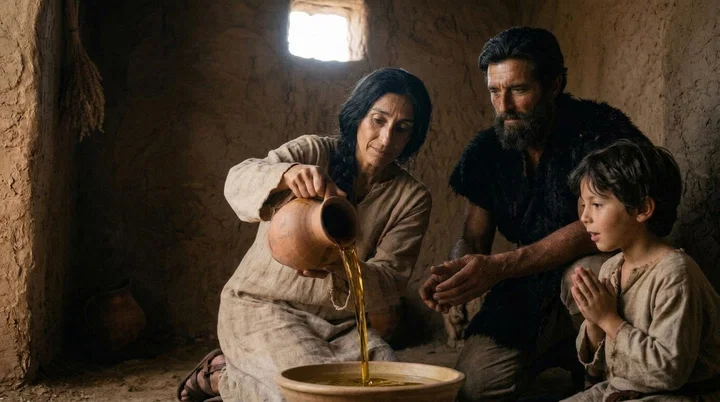
And the barrel of meal wasted not, neither did the cruse of oil fail, according to the word of the LORD, which he spake by Elijah.
Translations
American King James Version, Webster Bible
And the barrel of meal wasted not, neither did the cruse of oil fail, according to the word of the LORD, which he spoke by Elijah.
And the barrel of meal wasted not, neither did the cruse of oil fail, according to the word of the LORD, which he spake by Elijah.
And the barrel of meal wasted not, neither did the cruse of oil fail, according to the word of the Lord, which he spake by Elijah.
The barrel of meal wasted not, neither did the cruse of oil fail, according to the word of the LORD, which he spake by Elijah.
The jar of meal wasted not, neither did the cruse of oil fail, according to the word of Jehovah, which he spake by Elijah.
the pitcher of meal was not consumed, and the dish of oil did not lack, according to the word of Jehovah that He spake by the hand of Elijah.
The meal in the barrel did not waste, neither did the oil in the cruse fail, according to the word of Jehovah which he had spoken through Elijah.
The jar of meal, did not waste,—and, the cruse of oil, did not fail,—according to the word of Yahweh, which he spake through Elijah.
Berean Standard Bible, Majority Standard Bible
The jar of flour was not exhausted and the jug of oil did not run dry, according to the word that the LORD had spoken through Elijah.
The jar of meal didn’t run out and the jar of oil didn’t fail, according to the LORD’s word, which he spoke by Elijah.
The store of meal did not come to an end, and the bottle was never without oil, as the Lord had said by the mouth of Elijah.
The barrell of the meale wasted not, nor the oyle was spent out of the cruse, according to the worde of the Lord, which he spake by the hand of Eliiah.
Douay-Rheims (Challoner revision)
The pot of meal wasted not, and the cruse of oil was not diminished, according to the word of the Lord, which he spoke in the hand of Elias.
Pictures
Cross-references
- Luke 4:25-26
But I tell you of a truth, many widows were in Israel in the days of Elias, when the heaven was shut up three years and six months, when great famine was throughout all the land;
Jesus recalls Elijah’s mission to the widow during famine as a rebuke to Israel’s unbelief.
- 1 Kings 17:6
And the ravens brought him bread and flesh in the morning, and bread and flesh in the evening; and he drank of the brook.
God feeds Elijah by ravens during the famine before providing for the widow.
- James 5:17-18
Elias was a man subject to like passions as we are, and he prayed earnestly that it might not rain: and it rained not on the earth by the space of three years and six months.
Both show Elijah praying earnestly, with God withholding and then bringing rain.
- 1 Kings 17:9
Arise, get thee to Zarephath, which belongeth to Zidon, and dwell there: behold, I have commanded a widow woman there to sustain thee.
God appoints a widow to sustain Elijah, and her supplies do not fail.
- John 6:5-13
When Jesus then lifted up his eyes, and saw a great company come unto him, he saith unto Philip, Whence shall we buy bread, that these may eat?
Both accounts describe food miraculously multiplied to meet need.
- 1 Kings 17:1
And Elijah the Tishbite, who was of the inhabitants of Gilead, said unto Ahab, As the LORD God of Israel liveth, before whom I stand, there shall not be dew nor rain these years, but according to my word.
The drought Elijah announced required the miraculous provision that followed.
- 2 Kings 2:11
And it came to pass, as they still went on, and talked, that, behold, there appeared a chariot of fire, and horses of fire, and parted them both asunder; and Elijah went up by a whirlwind into heaven.
Elijah is taken up to heaven in a whirlwind.
- Matthew 14:17-21
And they say unto him, We have here but five loaves, and two fishes.
Jesus fed more than five thousand with five loaves and two fish.
- Exodus 16:35
And the children of Israel did eat manna forty years, until they came to a land inhabited; they did eat manna, until they came unto the borders of the land of Canaan.
Both describe God sustaining people with food over an extended time.
- Matthew 6:31-33
Therefore take no thought, saying, What shall we eat? or, What shall we drink? or, Wherewithal shall we be clothed?
Both texts show God providing food and necessities to those who trust him.
- 1 Kings 17:12
And she said, As the LORD thy God liveth, I have not a cake, but an handful of meal in a barrel, and a little oil in a cruse: and, behold, I am gathering two sticks, that I may go in and dress it for me and my son, that we may eat it, and die.
The widow’s scarcity precedes God’s provision through Elijah.
- 1 Kings 17:10-11
So he arose and went to Zarephath. And when he came to the gate of the city, behold, the widow woman was there gathering of sticks: and he called to her, and said, Fetch me, I pray thee, a little water in a vessel, that I may drink.
Elijah’s request for water and bread leads to the provision miracle.
- 1 Kings 17:24
And the woman said to Elijah, Now by this I know that thou art a man of God, and that the word of the LORD in thy mouth is truth.
The widow affirms that the Lord’s word spoken through Elijah is true.
- 2 Kings 4:1-7
Now there cried a certain woman of the wives of the sons of the prophets unto Elisha, saying, Thy servant my husband is dead; and thou knowest that thy servant did fear the LORD: and the creditor is come to take unto him my two sons to be bondmen.
grouped as true miracles called legends
- 2 Kings 4:42-44
And there came a man from Baal-shalisha, and brought the man of God bread of the firstfruits, twenty loaves of barley, and full ears of corn in the husk thereof. And he said, Give unto the people, that they may eat.
Elisha feeds a hundred men with a small supply of bread.
- Psalms 37:19
They shall not be ashamed in the evil time: and in the days of famine they shall be satisfied.
The faithful are satisfied in days of famine.
- John 6:35
And Jesus said unto them, I am the bread of life: he that cometh to me shall never hunger; and he that believeth on me shall never thirst.
The passage calls the spiritual message bread for hungry souls.
- 2 Kings 8:1-2
Then spake Elisha unto the woman, whose son he had restored to life, saying, Arise, and go thou and thine household, and sojourn wheresoever thou canst sojourn: for the LORD hath called for a famine; and it shall also come upon the land seven years.
The Shunammite family is spared during famine.
- Luke 7:12-15
Now when he came nigh to the gate of the city, behold, there was a dead man carried out, the only son of his mother, and she was a widow: and much people of the city was with her.
Jesus restores a widow’s only son, recalling Elijah’s provision for the widow of Zarephath.
- Luke 12:29-31
And seek not ye what ye shall eat, or what ye shall drink, neither be ye of doubtful mind.
God provides life’s necessities to those who seek his kingdom.
Commentary
Each commentary is drawn from primary sources: the writings of Ellen G. White and Adventist pioneers and periodicals. Each commentary is separate. Its own words are not a quotation; follow the references to read the source passages.
Ellen G. White
27 sources
According to the word of the Lord spoken by Elijah, the barrel of meal did not waste and the cruse of oil did not fail, for God worked a miracle every day to keep food for many days and preserve the lives of the widow, her household, and Elijah.6T 345.4–346.1RH Aug 28, 1913PK 130.3–131.1 Elijah had been hidden many months by the brook Cherith and fed morning and evening until it dried up in the drought, and with no safety for him in Israel, God directed him away to find refuge and succor in the widow's house at Zarephath of Zidon, where he met her gathering sticks at the gate of the city.PK 129.1–32SP 112.2–113.1SLP 250.3Ms 40, 1887, par. 8–11LC1 53.2–54.1 That widow was a heathen, Gentile, Phoenician foreigner who never had the privileges of God's chosen people, yet she walked in all the light shining on her pathway and lived up to what she could distinguish as right.PK 129.1–3SLP 229.1–230.2ST Feb 17, 18812SP 113.2–3 God passed over the many widows in Israel because apostasy, unbelief, hardness of heart, and rejection of light cut them off from the channel of blessing, and sent Elijah instead to a receptive stranger who was counted more righteous than those who had turned from Him.DA 238.2–239.1SLP 229.1–230.24RED 5.3–7.1 Her sharing of her last morsel with Elijah was the greatest possible test of faith and hospitality, trusting God to supply every need at the cost of suffering to herself and her child.6T 345.4–346.1RH Aug 28, 1913PK 130.3–131.1 That unfailing supply stands as a promise that God has not changed and His power is no less now, so that those who in time of trial give sympathy and assistance to others more needy will themselves be provided for and will not be left to perish.2T 28.2PK 131.5GC88 629.2–4SG2 243.1–245.1
Context and Unfailing Supply
The verse belongs to Elijah's stern confrontation with Ahab, in which Ahab and his father's house are charged with troubling Israel.PK 129
The widow lived at Zarephath, which belongs to Zidon and was called Sarepta in New Testament times, a city of Sidon in a heathen land.PK 129.1–32SP 112.2–113.1LC1 53.2–54.1
It was there, at the gate of the city, that Elijah met her gathering sticks.PK 129.1–3
Before this, Elijah had remained hidden many months by the brook Cherith, where he was miraculously fed morning and evening.PK 129.1–3RH Oct 7, 1873
The brook dried up because of the continued drought, during a famine brought on by apostasy.PK 129.1–3Ms 40, 1887, par. 8–11RH Oct 7, 1873
With no safety for him in Israel from Jezebel's power and from hatred and hostility, God directed him away to a heathen land to find refuge, asylum, help and succor in the widow's house.PK 129.1–3SLP 250.3Ms 40, 1887, par. 8–11RH Nov 9, 1911AA 430.4–431.2
According to the word of the Lord spoken by Elijah, the barrel of meal did not waste and the cruse of oil did not fail.6T 345.4–346.1RH Aug 28, 1913PK 130.3–131.1DA 238.2–239.1SLP 229.1–230.2
God worked a miracle every day to keep food for many days.RH Aug 28, 1913PK 130.3–131.13T 288.1–2RH Oct 7, 1873
So provision was kept for the widow, her son and child, her household, and Elijah, and their lives were preserved.6T 345.4–346.1RH Aug 28, 1913PK 130.3–131.1DA 238.2–239.13T 288.1–2
Faith Preferred to Privilege
The woman to whom the unfailing meal and oil were given was not an Israelite and had never shared the privileges and blessings of God's chosen people, but was a heathen, Gentile, Phoenician, foreign widow of Zarephath who believed in the true God.PK 129.1–32SP 113.2–3 She walked in all the light shining on her pathway and lived up to the light she had received, doing right so far as she could distinguish right from wrong.2SP 113.2–34RED 5.3–7.12SP 112.2–113.1 She had a heart to feel and faith to believe, had always treated strangers with kindness and liberality, and was open to greater light.PK 130.3–131.14RED 5.3–7.1 Her faithfulness to what she knew brought a special display of God's power, and her willingness to care for God's servant brought God's care in return.ST Feb 17, 18812SP 113.2–3AA 416.2–417.1
God passed over the many widows in Israel because of apostasy, unbelief, rebellion, self-exaltation, hardness of heart, and rejection of warnings and light, which cut Israel off from the channel of blessing.DA 238.2–239.14RED 5.3–7.12SP 112.2–113.1AA 416.2–417.1LC1 56.1 He could not trust Elijah with Israel and would not make the hard-hearted and unbelieving the special subjects of this display of power.SLP 229.1–230.24RED 5.3–7.1LC1 56.1 He sent him instead to a receptive foreign widow outside Israel, who was counted more righteous than His chosen people who had turned from Him.DA 238.2–239.12SP 112.2–113.1AA 416.2–417.1
Her sharing her last morsel with Elijah was the greatest possible test of faith and the supreme test of hospitality.PK 130.3–131.1 It required her to trust the God of Israel to supply every need regardless of the suffering that might result to herself and her child.6T 345.4–346.1RH Aug 28, 1913PK 130.3–131.1 Prophets chosen for special work are not allowed to labor for a hard-hearted and unbelieving people while those with faith are favored.4RED 5.3–7.1LC1 56.1 Even heathen who live by the best light they have are regarded with greater favor than those who have great light and make high pretensions to godliness while their daily lives contradict their profession, and those with great privilege who fail to live by it can be harder to reach.2T 28.24RED 5.3–7.1ST Feb 17, 1881
Help for Others Today
The widow of Sarepta shared her food with Elijah and made a home for God's servant, and in return her supply was preserved and her life and her son's life were saved.2T 28.2PK 131.5 Her sharing cheerfully for God's glory brought provision to those who gave as well as to those they welcomed.2T 28.2 The verse means that God has promised great blessing to all who in time of trial and want give sympathy and assistance to others more needy.PK 131.5 That promise is linked with the Saviour's word that he that receives a prophet in the name of a prophet shall receive a prophet's reward.PK 131.5
God has not changed, and His power is no less now than in the days of Elijah, and the promise is no less sure now.PK 131.5 He can provide for His faithful people in times of severe want, and for His self-sacrificing children even in famine.PK 131.5GC88 629.2–4SG2 243.1–245.1 They may suffer privation, but they will not be left to perish.GC88 629.2–4 Even in famine they will be satisfied, and their bread and water will be sure, while the wicked perish for lack of bread.SG2 243.1–245.1RH Nov 26, 1857
God worked a miracle every day to keep Elijah and the widow's family supplied with food after the brook Cherith dried, first sending Elijah food morning and evening by the brook away from Jezebel's power and then sending him to the widow of Zarephath for safety.RH Oct 7, 1873 This unfailing daily supply was evidence of God's love and care that should have kept Elijah from ever distrusting God.RH Oct 7, 1873 During the famine Elijah was sent to a widow at Sarepta, a city of Sidon, rather than to the many widows in Israel, showing that God's care and mercy were not limited to Israel.LC1 53.2–54.1 That providing for the Gentile widow at Zarephath was part of the blessings Jesus recalled when confronting the pride of His hearers.DA 239.2–240.1
Sources
Pioneers and periodicals
96 sources
The barrel of meal did not waste or run out and the cruse of oil did not fail, but were continually replenished to feed Elijah together with the widow, her son and her household for many days until rain and plenty came again.RH Jun 24, 1902ST Jun 23, 1898ST Jul 27, 1904ST Jun 6, 1900RH Jan 16, 1872 It was a literal miracle by direct creative power fulfilling the word of the Lord spoken and promised by Elijah.RH Jun 24, 1902ST Jun 23, 1898RH Dec 6, 1864RH Dec 23, 1902 The poor heathen widow of Zarephath, gathering sticks with only a handful of meal and a little oil for a last cake before expecting to die, trusted God's word and gave Elijah the first cake, and her self-sacrificing obedience was rewarded with preserved life and continuing blessing.RH Mar 13, 1900RH Mar 17, 1903RH Jun 24, 1902RH Jan 16, 1872RH Apr 23, 1857 The unfailing supply proves the faithfulness and mercy of the heavenly Father, showing it is safe to do right and trust him when resources appear scant and that those who give in faith to serve God and others do not lose by giving.RH Aug 28, 1913ST Mar 18, 1889RH Sep 15, 1859RH Dec 5, 1871 As God kept the widow's meal and oil from running out, he will likewise provide food and water for his remnant people in famine and in the time of trouble, even repeating the miracle if necessary.RH Feb 25, 1915RH Oct 1, 1861
Setting in Drought and Famine
The account belongs to the reign of Ahab, king of Israel, contemporary of Jehoshaphat of Judah and Elijah the Tishbite, the seventh king of Israel and second ruler of the third Israelitish dynasty, who reigned twenty-two years early in the ninth century before Christ.RH Nov 7, 1912 The fuller record of Ahab as man and king in 1 Kings 16-22 was written for the learning and profit of men and kings of after generations and shows divine solicitude in giving Ahab more than average opportunities.RH Nov 7, 1912 From a civil viewpoint he was a successful ruler, clever statesman, skilled general, and patriotic toward his people and country, yet a moral coward who sold himself to the worship of a plurality of heathen deities and enforced their worship upon a people devoted to monotheistic religion and semitheocratic rule.RH Nov 7, 1912
The verse stands in years of drought and famine with no dew nor rain, lasting three years, three and a half years, and three years and six months with great famine over all the land.ST Sep 7, 1904RH Jun 15, 1911RH Feb 25, 1873ST Apr 17, 1907 During that time God was working to turn Israel from idolatry to allegiance to Himself, while Elijah prayed and waited for the time to act. Elijah served in that setting as the agent of divine indignation against sin, and used the long drought for spiritual education, with the unfailing meal and oil fulfilling God's word through him.RH Jun 15, 1911RH Sep 15, 1859 Through adversity he developed strong living faith, and God's care for him in the three and a half years illustrates inimitable ways and means of caring for His own and readiness for any emergency.ST Sep 7, 1904
After being fed morning and evening by ravens with bread and flesh by the brook Cherith, and after the brook dried, Elijah was sent by the Lord's command to Zarephath, where God had commanded a poor widow of Sidon to sustain him.RH Oct 7, 1873RH Feb 25, 1873 Her help, like the ravens' provision, was a means of God's care for His servant, supplying his daily food by the Lord's command.RH Apr 9, 1914 God thereby preserved Elijah's life while Ahab cursed him and hunted through his own and other kingdoms to kill him, and made the prophet a blessing to her.ST Apr 17, 1907 He worked a miracle every day to keep Elijah and the widow's family supplied with food, evidence of love and care that should have kept Elijah from ever distrusting God.RH Oct 7, 1873
Zarephath in the land of Sidon was one of Elijah's hiding-places from the wrath of Ahab and from Jezebel.ST Oct 22, 1894ST Sep 8, 1898 He lodged there in the widow's humble dwelling, stopping with the woman of Zarephath who gave him welcome refuge.ST Mar 14, 1878ST May 28, 1885 Hatred drove him to the widow of Sarepta for help, and he found succor and refuge with her while the Lord upheld and protected him there.RH Nov 9, 1911ST May 22, 1884ST Mar 14, 1878 While she fed the prophet hiding from Jezebel, the food continued by miracle as the Lord had spoken through Elijah.ST Oct 22, 1894
The widow was a poor heathen Gentile woman of Sarepta in Sidon, a foreigner with her son and fatherless child and household.ST Jun 16, 1887RH Mar 13, 1900RH Nov 1, 1853 She was found at the gate gathering sticks to bake her last cake, having only a handful of meal, a small cruse of oil, and enough for one small meal before expecting to eat and die.RH Mar 13, 1900ST Nov 27, 1884RH Feb 25, 1873 She had little food and no means to buy more, with all ways of relief stopped and purses empty.RH Apr 23, 1857ST Nov 27, 1884 God sent Elijah to her and used her to provide for the prophet, and when he shared her morsel the provision sustained her and Elijah.RH Mar 13, 1900RH Apr 23, 1857
The unfailing supply fed Elijah together with the widow, her son, her household, and her family of three for many days, without the meal being used up or the oil running out.RH Jun 24, 1902ST Jun 23, 1898ST Jul 27, 1904ST Jul 27, 1904 The Lord kept the promise He spoke by Elijah to the widow at Zarephath, keeping her flour and oil from running out so she and her household were fed through the drought.ST Jun 23, 1898ST Jul 27, 1904 This provision came while she was caring for God's servant in poverty.CO 73.5 It lasted until rain and plenty came again and rain returned.RH Jun 24, 1902RH Jan 16, 1872ST Oct 22, 1902
The many days of eating meant a full year of sustenance from a handful of meal and a small cruse of oil for Elijah and the widow's family.ST Apr 6, 1888RH Jun 12, 1900 The meal and oil were continually replenished according to the Lord's word through Elijah, providing daily food for Elijah, the widow, and her son for a full year.RH Dec 17, 1914 God sustained the widow's supply by divine power for a year.RH Jan 9, 1900 Those who held that the many days were likely between two and three years understood them as reaching from Elijah's coming to Zarephath until rain and food came again.ST Jun 23, 1898
The widow had lived according to the light she possessed, valued God's gifts, showed kindness to God's servant, received Elijah in faith, and was open to greater light.ST Jun 16, 1887ST Feb 17, 1881ST Jun 23, 1909ST Feb 19, 1894 Her faithfulness to the light she had received and her willingness to care for God's servant brought her a special display of God's power.ST Feb 17, 1881 God favored the heathen widow who lived according to the light she had, while Israel's unbelief, contradictory profession, and rejection of warnings shut its people off from blessing and cut them off from the channel of His blessing.ST Jun 16, 1887ST Feb 17, 1881ST Jun 23, 1909 While caring for God's servant in poverty, the widow also had her son restored to life through Elijah, showing God's tender sympathy for a mother.CO 73.5RH Sep 16, 1902
Miracle of Unfailing Supply
The barrel of meal did not waste, run out, or diminish, and the cruse of oil did not fail, run out, or go bankrupt, but the meal and oil were continually replenished, renewed, increased, and multiplied so that food did not run out.ST Jun 6, 1900RH Dec 17, 1914ST Mar 18, 1889RH Jul 9, 1867 That continuing renewal supplied daily food for Elijah together with the widow, her son, her household, and her family of three for many days, understood as a full year of eating.ST Apr 6, 1888RH Dec 17, 1914RH Jul 9, 1867RH Dec 31, 1903 The renewal came according to the word of the Lord spoken by Elijah and promised through him to the widow, fulfilling what had been spoken.RH Dec 17, 1914ST Mar 18, 1889RH Jul 9, 1867RH Dec 31, 1903 In famine the scanty provision held out because the Lord had promised it, showing that sharing a scarce supply can provide for both giver and another while the supply keeps being renewed.ST Mar 18, 1889RH Jun 24, 1902
The keeping of the meal and oil was a literal miracle by direct creative power, a miracle every day and evidence of divine power.RH Oct 7, 1873RH Dec 23, 1902RH Sep 3, 1908 After the brook Cherith dried, where food had been sent morning and evening away from hostile power, the same care worked daily to keep Elijah and the widow's family supplied, a supply that should have kept Elijah from ever distrusting divine love and care.RH Oct 7, 1873RH Dec 23, 1902 It is true history and not pious legend, myth, allegory, or fancy, belonging with Creation, the Fall, the Flood, the confusion of tongues, and the miracles of Elisha as Old Testament truth to be taught to children as true history.ST Jan 24, 1906 To deny this miracle is soul-destroying error that at last denies every essential saving truth, while to hold it stands as proof of an infallible Bible whose every word is cherished and whose every promise proves a staff and stay, manifesting with the whole story and work of the Bible and its central figure Jesus Christ the mighty miraculous power of God to fallen man.
God can make a small supply sufficient and make little go far, sustaining a household from a handful of meal and a small cruse of oil.ST Apr 6, 1888RH Jan 9, 1900RH Jan 28, 1902 His daily provision is itself a miracle, and the sustaining of the widow's meal and oil by divine power is a sign of the divine source of ordinary food.ST Apr 6, 1888RH Jan 9, 1900 That extraordinary provision was no more a manifestation of divine power than his ordinary work in sustaining life and providing food today through farming and human labor, for both are works of the same source of life.RH Jan 9, 1900RH Jan 28, 1902
He who replenishes the cruse is inexhaustible, so the supply for today does not fail because daily provision comes from an unfailing source.RH Dec 8, 1863RH Jun 24, 1902 As the blessing was passed on the supply remained inexhaustible, and giving away what God provides does not leave the giver without it, while selfishly holding back can lead to loss.RH Dec 8, 1863RH Jun 24, 1902 Fretting about the time to come is therefore foolish, burying daily happiness and slighting present good in anxiety for future good, and wasting today's oil in trying to procure tomorrow's supply forgets that unfailing source.RH Dec 8, 1863
God is never at a loss for means and used humble means, the small amount of meal and oil, to provide food through the long famine and to keep the word spoken by Elijah.ST Jul 23, 1912ST Jun 23, 1898 The supply came through mutual help, the widow feeding Elijah and Elijah bringing help to the widow, but God himself did the work in both.ST Jun 23, 1898
Fulfillment of Prophetic Word
What took place fulfilled the word of the Lord spoken by Elijah and promised through Elijah to the widow, for God faithfully kept the promise and the word He had spoken.RH Jun 24, 1902ST Jun 23, 1898ST Jul 27, 1904ST Jul 27, 1904ST May 3, 1899 The widow, Elijah, and her household ate for many days without the meal in the barrel being used up or the oil in the cruse running out, and this sustained provision lasted until rain came.RH Jun 24, 1902ST Jun 23, 1898ST Jul 27, 1904 The supply sustained Elijah together with the widow and her household through the drought, illustrating trust in God's provision amid worldly need.ST Jul 27, 1904ST Jul 27, 1904ST May 3, 1899ST Jul 4, 1900 It was help given by Elijah to a woman of the region where Jesus later met the Gentile woman.ST Jul 4, 1900
Elijah had prophesied a three-year drought, and it happened according to his word, which stands as evidence that Elijah was a prophet.RH Dec 6, 1864 The unfailing meal and oil further show him as a strong courageous man of faith serving as God's instrument in miraculously providing food for others during the famine.RH Dec 6, 1864
The verse shows the word of God's two olive trees spoken by Elijah's mouth.ST May 10, 1883 The two olive trees are the Old Testament and the New Testament, the law and the gospel, bearing testimony to duty in the law and to power to save from sin by the gospel.ST May 10, 1883 Their word by Elijah shut heaven so that it did not rain, and by that same word the barrel of meal and cruse of oil did not fail.ST May 10, 1883
The account is an example of prayer being answered, in that the widow's meal and oil did not run out as the Lord had promised through Elijah.RH Nov 21, 1912 It shows further blessing attending manifestations of faith in God's word, with the meal not wasting and the oil not failing as Elijah and the widow acted in obedience.RH Nov 21, 1912ST Jun 23, 1898
The kept supply shows the faith of the poor widow when her meal was low that it would not waste or diminish.ST Jul 27, 1904RH Jan 14, 1873 Her self-sacrifice in obeying the prophet was met by divine provision, for God sustained both His servant and the needy widow from the small supply that did not run out because God had spoken through Elijah.ST Jul 27, 1904RH Jan 14, 1873 That provision served the widow's conversion and care, and it means a treasury used to give freely to the poor instead of selling will not be emptied or go bankrupt but will be kept up by God through the gifts of brethren.ST Jul 27, 1904RH Jan 14, 1873
God's Faithful Care
The unfailing meal and oil display God's inimitable ways and means of caring for His own during the three and a half years of famine.ST Sep 7, 1904 He is prepared for any emergency, and His promise to those who trust and obey is that He will never leave nor forsake them.ST Sep 7, 1904
The provision proves the faithfulness and mercy of the heavenly Father and gives reason for courage in duty and firm reliance on Him.RH Sep 15, 1859 It is safe to do right and trust God to provide even when resources appear scant and His care does not fail.RH Sep 15, 1859RH Dec 5, 1871 Those who faithfully fulfill every required duty will be fed and upheld as Elijah was, whether by a raven sent to feed them, water made to flow from flinty rock, or an angel sent to strengthen them for sore trial and conflict.RH Sep 15, 1859
That same God still brings succor and sustenance to tried, tempted and afflicted Christians, knowing their frame is built of dust and their spirit fails in extremity unless He makes a way of escape with it.RH Sep 15, 1859 He provides for the needs of His trusting children and can supply His trusting children with the food they need.RH Dec 17, 1914ST Jun 24, 1889 During the famine He preserved the widow of Zarephath by keeping her meal and oil from running out as He had promised through Elijah, sustaining her household through a time of need.ST Oct 1, 1896RH Sep 10, 1872 This is an assurance that God cares for those who trust in Him, though it does not promise a miracle when people neglect the means of salvation He has provided.RH Mar 4, 1873
God cared for Elijah in famine from the undiminished barrel of meal and unfailing cruse of oil, and so cared for and sustained the prophet through a most severe famine of three years.RH Nov 26, 1857RH Feb 25, 1873 After Elijah was fed morning and evening by ravens with bread and flesh, God sent him to Zarephath where He had commanded a widow to sustain him, finding her gathering sticks to bake her last cake to eat and die and promising unfailing meal and oil when she baked for him first.RH Feb 25, 1873 God first directed Elijah away from Jezebel's power to safety by the brook, sending him food morning and evening, then sent him to the widow where He worked a miracle every day to keep Elijah and the widow's family supplied with food.RH Oct 7, 1873 This unfailing daily supply was evidence of God's love and care that should have kept Elijah from ever distrusting God.RH Oct 7, 1873
Widows are objects of God's special care who should trust Him implicitly.ST Jun 23, 1898 God's self-sacrificing children are assured that He will care for them, and that even in famine their bread and water will be sure while the wicked perish for lack of bread.RH Nov 26, 1857 He sustains His work amid hardship and scarcity, as reflected in continued provision for the work in Argentina despite financial difficulty.RH Aug 27, 1914
Prophecy and Last Days
Elijah stands as a type of John the Baptist and, in further application, of those carrying on a reforming and converting work before the second advent.RH Jul 9, 1901 That work unfolds against the great apostasy of Elijah's time, when God found a faithful remnant who responded to his prophet's call.
As the widow's meal and oil were kept from running out according to the word spoken through Elijah, so food and water will be provided for the remnant people during the time of trouble.RH Feb 25, 1915 Then they will be driven from the cities and face persecution while the wicked suffer hunger and thirst, and Elijah is a type of that remnant church.RH Feb 25, 1915 The same miracle will be repeated for the saints remaining on earth while the seven last plagues are poured out.RH Oct 1, 1861
They will be involved in a measure in the troubles, though no plague will come nigh their dwelling.RH Oct 1, 1861 The rage of the people will be turned against them as the cause of trouble and will seek to destroy them.RH Oct 1, 1861 God will interpose for them, feeding them in famine if necessary by ravens or by causing the meal not to fail, and delivering them from the rage of those who rejected the final warning.RH Oct 1, 1861 Then he will appear with chariots to take them up to heaven as Elijah was taken.RH Oct 1, 1861
Links to Other Scriptures
Elijah's unfailing meal and oil belong to the same region of Tyre and Sidon and Galilee where Christ later worked, and the object and mission of that miracle illustrate the object and mission of Christ's miracles for the Canaanite woman and the multitudes.ST Mar 17, 1898 It is an example of help given by Elijah to a woman of the region where Jesus later met the Gentile woman.ST Mar 17, 1898ST Jul 4, 1900 Though there were many widows in Israel when heaven was shut up three years and six months and great famine came over all the land, Elijah was sent to none of them but only to Zarephath in the land of Sidon to a woman that was a widow, where the meal wasted not and the oil did not fail. God's power through the prophet thus blessed a Gentile outsider, a foreign woman of Sarepta chosen to shelter Elijah, while His own people were passed by after Israel had rejected God's light.ST May 22, 1884ST Dec 23, 1889 This proves that no prophet is acceptable in his own country, as Jesus was rejected at Nazareth after declaring Scripture fulfilled in Him, and it shows that God has precious souls in every nation to whom truth must be carried.ST Dec 23, 1889
During the famine God kept the widow, her fatherless child, and Elijah alive by making their small supply of meal last and their oil not fail through His word.RH Nov 1, 1853 That handful of meal became an image of the remaining spiritual nourishment in a famine of hearing God's word, namely the third angel's message, whose fruit would spread widely.RH Nov 1, 1853 The meal and oil continuing without wasting or failing picture the Bible as food to feed upon daily without it ever growing less and without tiring of it.ST Nov 24, 1898 It remains satisfying like bread of which no one ever has enough, unlike honey and condiments that soon cloy and grow flat and stale.ST Nov 24, 1898
The raising of the widow's son in 1 Kings 17 was a resurrection from the dead just as really as if he had been raised to immortality.RH May 28, 1861 The Bible makes no distinction between resurrection to mortality and resurrection to immortality and calls the raising of the wicked a resurrection no less than the raising of the righteous.RH May 28, 1861 It therefore stands with other explicit raisings before Christ as proof that Christ can still be called the first-fruits, the first to rise, the first-begotten and first-born from the dead.RH May 28, 1861 Those titles denote His preeminent rank and power by which all resurrections were accomplished rather than priority in time.RH May 28, 1861
Giving Trust and Obedience
The widow trusted the divine word and made the first cake for the prophet out of her last food, putting God and His cause first, and God kept His word to preserve her and her son alive and to sustain her household through the famine until rain and plenty came again.RH Mar 17, 1903RH Jun 24, 1902RH Jan 16, 1872ST Mar 26, 1885 Her willingness to give what she had brought her no loss, for the supply remained unfailing and her obedience was met with continuing and more abundant blessing.RH Jun 24, 1902RH Jan 16, 1872RH Apr 2, 1914 After she gave from the little she had she was sustained through the famine according to what had been spoken through Elijah.ST Mar 26, 1885RH Apr 2, 1914ST Mar 25, 1903
The unfailing supply rewarded her trust and generosity in sharing despite her own need, supplying the widow, her household, and Elijah for many days in fulfillment of the promised provision.RH Aug 28, 1913RH Aug 28, 1913 It stands as a pattern to be repeated among those with the faith of Jesus and Elijah, that those who give in faith and freely support God's work will receive what God provides.RH Mar 17, 1903ST Mar 25, 1903
Giving away what God provides does not leave the giver without it, for sharing a scarce supply can provide for both giver and another with the supply continually renewed.ST Mar 18, 1889RH Jun 24, 1902 Giving to serve God and others is not ultimately a loss, while selfishly holding back can lead to loss.RH Jun 24, 1902RH Apr 2, 1914RH Jun 24, 1902ST Jun 12, 1901 As she passed on the blessing the supply remained inexhaustible, and the same trust is urged in sharing resources and passing on spiritual light.RH Jun 24, 1902RH Jun 24, 1902 By sharing her food with Elijah she received provision that preserved her life and her son's in their time of need, and her hospitality was rewarded with many days of supply for her household and for Elijah.RH Aug 28, 1913RH Aug 28, 1913
Trusting God when purses are empty with only a handful of meal and a cruse of oil left and all ways of relief stopped is the wisdom of Christian grace, whereas trusting when warehouses and bags are full and tables are spread is no hard thing.ST Nov 27, 1884 God supplies the cruse so that it does not fail, proving He has every person on His great loving heart, and Christ gives strength to carry every legitimate load to those who cast care on Him and drop superfluous anxieties and sinful desires and heave worry overboard.ST Nov 27, 1884ST Feb 18, 1886 Fretting about the time to come is foolish, burying daily happiness and slighting present good in anxiety for future good, for He who replenishes the cruse is inexhaustible so the supply for today does not fail.RH Dec 8, 1863 Wasting today's oil in fruitless attempts to procure tomorrow's supply forgets that daily provision comes from an unfailing source.RH Dec 8, 1863
When the cruse of comfort is failing, rising and sharing it with another makes it serve through all the years of famine for both giver and brother, for giving is the divine law for receiving and as we give God imparts.ST Jan 27, 1904ST Mar 24, 1898RH Jul 13, 1911 Giving is living and denying is dying, and divine love fills the storehouse and renews the handful so that scanty fare for one becomes a royal feast for two.ST Jan 27, 1904ST Mar 24, 1898 Even a poor invalid gains health by resolving to create sunshine for those around.ST Jan 27, 1904
Every person has a cruse of oil in abilities and opportunities, and it is increased by being poured out without doubting until it fills all vessels at hand right where one is, without waiting for different circumstances or golden opportunities.ST Dec 5, 1895 For a mother shut in at home by ill health and children, that cruse is power to do work that counts.ST Dec 5, 1895 To keep it unfailing is to use that place with gratitude for husband, children, home, and new baby, and with cheerful gentle loving words that brighten the home and hold husband and children close, while to waste it is to spend power in fretful complaining, ingratitude, gloom, reproach, and censure that darken the home, defeat her aims, lessen her husband's solicitude, and widen the breach.ST Dec 5, 1895 With God's help a mother's limited efforts can be multiplied to provide for her household and even a neighbor, and the widow of Sarepta's sharing with the prophet was missionary service for God and others.RH Oct 3, 1907RH Sep 2, 1915
The cruse gives a lesson in submission, for discontent wastes blessings already given, but grace teaches thankful submission amid circumstances.ST Dec 5, 1895 As the widow's meal and oil did not run out as she gave, so giving thank-offerings did not leave Mrs. Stanton without earthly comforts but sustained and sweetened her gifts by gratitude and love, and so limited household money spent helping others and serving God never quite runs out.ST Feb 27, 1893ST Jul 29, 1889 The God who replenished the barrel and cruse is the same yesterday, today, and forever, still miraculously providing bread and daily necessities for those who obey at personal cost in Sabbath-keeping and tithe, withholding success when tithe is refused and blessing with sales and supplied needs when it is given.RH Dec 31, 1903
The same provision pictures treasuries and funds that appear nearly exhausted yet continue to supply the work's needs, whether a mission treasury, means replenished while a church responds to repeated calls, or God sustaining the work despite nearly exhausted funds.RH Feb 4, 1909RH Sep 7, 1911ST Jun 16, 1909RH Nov 12, 1901 A treasury used to give tracts freely to the poor instead of selling them will not be emptied or go bankrupt but will be kept up through gifts, and when believers give freely to mission warriors God makes their own barrel and cruse yield more in return.RH Jan 14, 1873RH Nov 24, 1904 The continuing miraculous supply also pictures the way George Müller's needs were supplied, illustrating faithful provision for those who trust Him.RH Dec 23, 1902
Sources