1 Kings 19:13
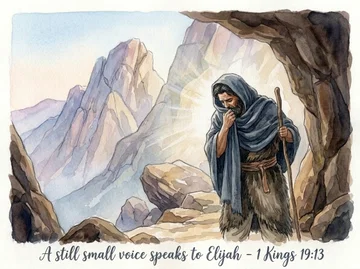
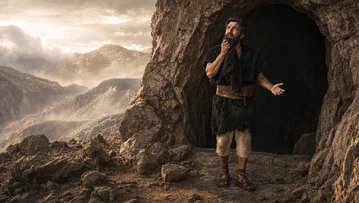
And it was so, when Elijah heard it, that he wrapped his face in his mantle, and went out, and stood in the entering in of the cave. And, behold, there came a voice unto him, and said, What doest thou here, Elijah?
Translations
And it was so, when Elijah heard it, that he wrapped his face in his mantle, and went out, and stood in the entering in of the cave. And, behold, there came a voice to him, and said, What do you here, Elijah?
King James Version, Revised Version
And it was so, when Elijah heard it, that he wrapped his face in his mantle, and went out, and stood in the entering in of the cave. And, behold, there came a voice unto him, and said, What doest thou here, Elijah?
And it was so, when Elijah heard it, that he wrapped his face in his mantle, and went out, and stood in the entering in of the cave. And behold, there came a voice unto him, and said, What doest thou here, Elijah?
And it was so, when Elijah heard it, that he wrapped his face in his mantle, and went out, and stood in the entrance of the cave. And behold, there came a voice to him, and said, What doest thou here, Elijah?
And it was so, when Elijah heard it, that he wrapped his face in his mantle, and went out, and stood in the entrance of the cave. And, behold, there came a voice unto him, and said, What doest thou here, Elijah?
and it cometh to pass, at Elijah's hearing [it], that he wrappeth his face in his robe, and goeth out, and standeth at the opening of the cave, and lo, unto him [is] a voice, and it saith, 'What — to thee, here, Elijah?'
And it came to pass, when Elijah heard it, that he wrapped his face in his mantle, and went out, and stood in the entrance of the cave. And behold, a voice [ came] to him and said, What doest thou here, Elijah?
And it came to pass, when Elijah heard it, he wrapped his face in his mantle, and went forth, and stood at the entrance of the cave,—and lo! unto him, a voice; and it said—What doest thou here, Elijah?
Berean Standard Bible, Majority Standard Bible
When Elijah heard it, he wrapped his face in his cloak and went out and stood at the mouth of the cave. Suddenly a voice came to him and said, “ What are you doing here, Elijah?”
When Elijah heard it, he wrapped his face in his mantle, went out, and stood in the entrance of the cave. Behold, a voice came to him, and said, “ What are you doing here, Elijah?”
And Elijah, hearing it, went out, covering his face with his robe, and took his place in the opening of the hole. And there a voice came to him saying, What are you doing here, Elijah?
And when Eliiah heard it, he couered his face with his mantel, and went out, and stoode in the entring in of ye caue: and behold, there came a voyce vnto him, and sayd, What doest thou here, Eliiah?
Douay-Rheims (Challoner revision)
And when Elias heard it, he covered his face with his mantle, and coming forth stood in the entering in of the cave, and behold a voice unto him, saying: What dost thou here, Elias? And he answered:
Pictures

Cross-references 20 of 24
- 1 Kings 18:20-40
So Ahab sent unto all the children of Israel, and gathered the prophets together unto mount Carmel.
Elijah’s earlier victory on Carmel contrasts with his later flight and the still voice.
- 1 Kings 19:4
But he himself went a day’s journey into the wilderness, and came and sat down under a juniper tree: and he requested for himself that he might die; and said, It is enough; now, O LORD, take away my life; for I am not better than my fathers.
Elijah flees Jezebel’s threat into the wilderness and prays to die.
- 2 Kings 2:11
And it came to pass, as they still went on, and talked, that, behold, there appeared a chariot of fire, and horses of fire, and parted them both asunder; and Elijah went up by a whirlwind into heaven.
Elijah ascends to heaven rather than descending to the tomb.
- Romans 11:4
But what saith the answer of God unto him? I have reserved to myself seven thousand men, who have not bowed the knee to the image of Baal.
God answers Elijah’s complaint by preserving seven thousand faithful Israelites.
- 1 Kings 19:18
Yet I have left me seven thousand in Israel, all the knees which have not bowed unto Baal, and every mouth which hath not kissed him.
God reveals that seven thousand in Israel have not worshiped Baal.
- 1 Kings 17:2-4
And the word of the LORD came unto him, saying,
God sent Elijah to the brook Cherith and sustained him there.
- 1 Kings 19:9
And he came thither unto a cave, and lodged there; and, behold, the word of the LORD came to him, and he said unto him, What doest thou here, Elijah?
The same question is addressed to Elijah in the cave.
- 1 Kings 18:4
For it was so, when Jezebel cut off the prophets of the LORD, that Obadiah took an hundred prophets, and hid them by fifty in a cave, and fed them with bread and water.)
Jezebel persecuted the Lord’s prophets.
- 1 Kings 19:19
So he departed thence, and found Elisha the son of Shaphat, who was plowing with twelve yoke of oxen before him, and he with the twelfth: and Elijah passed by him, and cast his mantle upon him.
Elijah’s mantle marks Elisha’s succession, following Elijah’s Horeb experience.
- 1 Kings 18:1-2
And it came to pass after many days, that the word of the LORD came to Elijah in the third year, saying, Go, shew thyself unto Ahab; and I will send rain upon the earth.
God sent Elijah to deliver a message to Ahab, contrasting with his flight into the wilderness.
- Matthew 17:1-3
And after six days Jesus taketh Peter, James, and John his brother, and bringeth them up into an high mountain apart,
shared mountain seeing of the Master
- 1 Kings 19:2-3
Then Jezebel sent a messenger unto Elijah, saying, So let the gods do to me, and more also, if I make not thy life as the life of one of them by to morrow about this time.
Jezebel’s threat prompted Elijah to flee.
- Matthew 17:11
And Jesus answered and said unto them, Elias truly shall first come, and restore all things.
Elijah’s coming is connected with the work of restoration.
- Exodus 19:19
And when the voice of the trumpet sounded long, and waxed louder and louder, Moses spake, and God answered him by a voice.
both record God answering by voice
- James 5:17
Elias was a man subject to like passions as we are, and he prayed earnestly that it might not rain: and it rained not on the earth by the space of three years and six months.
Elijah’s discouragement illustrates his shared human frailty.
- 1 Kings 19:5-7
And as he lay and slept under a juniper tree, behold, then an angel touched him, and said unto him, Arise and eat.
An angel feeds Elijah before his journey to Horeb.
- Romans 11:5
Even so then at this present time also there is a remnant according to the election of grace.
Paul applies the remnant in Elijah’s time to his own day.
- 1 Kings 18:22
Then said Elijah unto the people, I, even I only, remain a prophet of the LORD; but Baal’s prophets are four hundred and fifty men.
Elijah says he alone remains a prophet of the Lord.
- 1 Kings 18:40
And Elijah said unto them, Take the prophets of Baal; let not one of them escape. And they took them: and Elijah brought them down to the brook Kishon, and slew them there.
prior slaying of Baal's prophets
- Exodus 3:1
Now Moses kept the flock of Jethro his father in law, the priest of Midian: and he led the flock to the backside of the desert, and came to the mountain of God, even to Horeb.
both show communion on Mount of God
Commentary
Each commentary is drawn from primary sources: the writings of Ellen G. White and Adventist pioneers and periodicals. Each commentary is separate. Its own words are not a quotation; follow the references to read the source passages.
Ellen G. White
31 sources
After fleeing Jezebel's threat in weariness and discouragement without being sent, Elijah took refuge in a cave at Horeb, and when he heard the still small voice he wrapped his face in his mantle in reverence and went out and stood at the entrance where God asked him what he was doing there.Lt 62, 1900, par. 11–16Lt 62, 1900, par. 3–6PK 166.2PK 168.43T 291.3–292.1 God met him there to confront his self-chosen flight and remind him of the work He had commissioned him to do.PK 167.1PK 167.2PK 168.1 God revealed Himself not in the rending wind, earthquake, or fire, but in a quiet voice that subdued and softened him into reverent trust.Lt 62, 1900, par. 11–16PK 168.43T 291.3–292.1PK 168.3GW92 266.1–2 The encounter teaches that God's purpose is best accomplished not by loud display but by the quiet influence of His Spirit, which meets with present help all who trust Him with childlike simplicity even when their work seems defeated.Lt 62, 1900, par. 11–16PK 168.4GW92 266.1–2 The question still calls every discouraged or idle believer to leave hiding, examine why they are where they are, return to duty, and stand with God to listen and shine.PK 167.213MR 362.114MR 174.2Lt 40, 1890, par. 15–16Ms 40, 1890, par. 42–43
Elijah's Flight to Horeb
The verse belongs to Elijah's flight after Jezebel threatened his life, when after forty days of journeying he found refuge in a cave at Horeb.Lt 62, 1900, par. 3–6PK 166.2ED 151.1–2RH Oct 30, 1913 He had borne a heavy burden for Israel, warning faithfully against national idolatry, watching through three years and a half of famine for some token of repentance, and standing alone for God upon Mount Carmel where through the power of faith idolatry was cast down and the blessed rain testified to showers of blessing waiting for Israel.ST Nov 17, 1909 Yet in weariness and weakness he focused on the queen's threat, lost courage and confidence, and his faith failed.Lt 62, 1900, par. 3–6ED 151.1–2ST Nov 17, 1909 Without being sent he fled into the wilderness praying for death, and came to Horeb in despair and deep depression.Lt 62, 1900, par. 3–6ED 151.1–2RH Oct 30, 1913 The account warns that God's people can lose courage after a great work unless they keep looking to God and trusting Him.Lt 62, 1900, par. 3–6
At the cave God met him at the entrance through a mighty angel, who came to ask about his needs and to make His purpose for Israel clear.PK 167.1 The question what he was doing there confronted his hasty flight and made him face that he had fled from the work God had commissioned him to do.PK 167.2PK 168.1 It reproved his self-chosen wilderness journey, where God had not sent him, by recalling where He had sent him — to the brook Cherith, to the widow of Sarepta, and to Samaria with a message to Ahab — and the work He had commissioned him to do.PK 168.1RH Oct 7, 1873 Elijah needed to learn to trust wholly in God and to recognize the weakness of his present position compared with the stronger position God intended for him.PK 167.2
When Elijah heard the still small voice he wrapped his face and head in his mantle, went out of the cave, and stood in its entrance.Lt 62, 1900, par. 11–16PK 168.43T 291.3–292.1PK 168.3Ms 16, 1888, par. 9–10 His covering expresses reverence in the presence of God.Ms 16, 1888, par. 9–10 There the voice repeated the question what he was doing there, and he repeated his complaint of jealousy for God, Israel's broken covenant, and his lonely peril.3T 291.3–292.1RH Oct 7, 1873 His discouraged withdrawal into the cave is not a model for hiding one's light, but a call to come forth and stand with God.Ms 40a, 1890, par. 50–52
Through one failure of faith his life-work was cut short, for the work he had begun he was not to complete, since God bade him anoint another to be prophet in his stead.ED 151.1–2ST Nov 17, 1909 Yet God had marked the heart-service of His servant, watched over him, and would not forsake him while he remained faithful.RH Oct 30, 1913ST Nov 17, 1909 He did not leave him to die alone discouraged in the wilderness and to perish in discouragement and solitude.ED 151.1–2RH Oct 30, 1913ST Nov 17, 1909 For him there was not the descent to the tomb but the ascent with God's angels to the presence of His glory.ST Nov 17, 1909
God's Quiet Guiding Voice
God made Himself known to Elijah not in the great wind that rent the mountains, nor in tempest, earthquake, devouring fire, thunder or lightning, but in a still small quiet voice.PK 168.4PK 168.3GW92 266.1–2RH Oct 7, 1873 When Elijah heard that voice he wrapped his face and head in his mantle and went out and stood in the entering in of the cave.PK 168.4PK 168.3GW92 266.1–2RH Oct 7, 1873
That voice had power to subdue and soften, to silence petulance and subdue the spirit, bringing reverence and quiet trust and firm reliance.Lt 62, 1900, par. 11–16PK 168.4PK 168.3 The meeting teaches that quiet trust and firm reliance upon God will ever find Him a present help in time of need.PK 168.43T 291.3–292.1RH Oct 7, 1873 It was in his greatest weakness, when his life's work seemed defeated and under the most forbidding circumstances, that Elijah learned so to trust, for God watched over him and would not forsake him while he remained faithful.RH Oct 30, 1913 So God meets one who trusts Him and receives His word with childlike simplicity.Lt 154, 1894, par. 2
The encounter shows that the work making the greatest display is not always the work that best accomplishes God's purpose.PK 168.4 His work is not always best achieved through loud forceful displays or the most powerful words.Lt 62, 1900, par. 11–16 The still small voice illustrates that the Holy Spirit's quiet influence has power to convict and convert the soul and to accomplish great things.Lt 62, 1900, par. 11–16GW92 266.1–2
The verse belongs to Elijah's making intercession against Israel, saying they have killed God's prophets and digged down His altars, and he is left alone and they seek his life, and to God's answer to him.WAJP 2.1–2 His complaint shows Israel's rejection, yet God's answer shows He did not reject them, for He had reserved to Himself seven thousand men who have not bowed the knee to Baal.WAJP 2.1–2 Even so at this present time, after Israel rejected His Son, there is a remnant according to the election of grace.WAJP 2.1–2
Call to Come Forth
The question puts Elijah face to face with the fact that he had fled from the work he had been commissioned to do, and he needed to learn to trust wholly in God and to see how weak his present position was beside the stronger position God intended for him.PK 167.2 That history belongs to his discouragement after fleeing Jezebel's threat, and it helps God's people when difficulties come to trust in the Lord, to remain in the way of duty, and to wait patiently and prayerfully for Him rather than yielding to discouragement from fear or leaning on human wisdom.13MR 362.1Ms 6, 1889, par. 57 Patient, prayerful trust in trial gives God room to display His power instead of closing the way by fear.13MR 362.1Ms 6, 1889, par. 57
The same question challenges those who are using their talents for themselves to consider whether they are standing idle instead of laboring in God's vineyard.Ms 42, 1890, par. 60 It confronts a professing Christian with whether actions agree with professed faith and obedience, calling such a one to account for dishonest business dealings and to receive reproof and change.Lt 110, 1897, par. 31–35 It was the challenge to Brother Michaels to leave work that sows error for work that teaches truth.Ms 47, 1898, par. 4
With tender pity the question is addressed to a child of God whose voice has been silenced and who has left the work through ease, worldly advantage, discouragement, opposition, or persecution.PK 171.3 It calls that person to remember the mission to preach the gospel throughout the world and to prepare a people for the day of God, and to consider why he is where he is and who sent him there.PK 171.3 It calls Christian families and individuals who could serve others to leave places where their gifts are not as needed and to go in self-sacrifice to spiritually dark places, to work wisely and perseveringly for people without hope.PK 172.2 Answering that call means willingness to endure hardship in order to tell others of the Saviour, as surely as worldly advantage or knowledge can lead men to endure hardship for lesser ends.PK 172.2
God's voice calling Elijah to come out of the cave and stand with God to hear what He will say comes as a call to come under divine guidance, to submit to it, and to receive the Holy Spirit's leading.14MR 174.2Lt 40, 1890, par. 15–16 Coming out to hear God means being led by the Comforter into all truth, the Holy Spirit taking the things of Christ and infusing them as living principles into hearts opened to receive them, so that listeners come to know both the Father and the Son.14MR 174.2 Elijah's discouraged withdrawal into the cave is not a model for hiding the light, and Christians are warned not to withdraw from duty but to come forth, leave their hiding place, stand with God ready to listen, and shine.Ms 40, 1890, par. 42–43Lt 10, 1892, par. 18–21Ms 40a, 1890, par. 50–52 The call is to leave concealment and stand with God in readiness to hear.Ms 40, 1890, par. 42–43Lt 10, 1892, par. 18–21
The call to come out, talk with God, and hear Him teaches that when cherished plans are shattered by affliction, God gives grace to meet the trial and calls the grieving person to turn to Him rather than remain absorbed in sorrow.Lt 19, 1895, par. 11–12 Remaining in thoughts that deepen sorrow hinders witness for Christ, and coming out to commune with God breaks that bondage.Lt 19, 1895, par. 29 Elijah's reverent covering of his face is also a lesson to approach Scripture humbly, not presuming by limited understanding to judge what is or is not inspired.Ms 16, 1888, par. 9–10
Sources
Pioneers and periodicals
64 sources
When Elijah heard the still small voice he knew it was the voice of God, and he wrapped his face in his mantle and went out and stood at the mouth of the cave to listen and receive direction for his future work.ST May 2, 1906RH Aug 16, 1906RH Mar 14, 1871 God was not in the mighty wind that tore the rocks, nor in the earthquake, nor in the fire, but only in the still small voice that followed, turning attention away from spectacular display to His calm authoritative word.ST Jul 20, 1915ST Aug 24, 1904RH Jun 13, 1865 The wrapping of the face was humble reverence before God's holiness and glory, for the nearer a person comes to God the more deeply he feels God's infinite purity and his own unworthiness by contrast.ST Jan 1, 1894RH Mar 14, 1871RH May 21, 1857RH Jun 6, 1871 With the question, What doest thou here, Elijah, God confronted His servant for fleeing in fear and discouragement and for leaving the work entrusted to him to hide in the wilderness instead of standing as watchman and light to Israel.RH Oct 7, 1873RH Sep 16, 1909ST Aug 24, 1904 The encounter quieted and softened him, corrected his belief that he alone was left by revealing the seven thousand who had not bowed to Baal, and sent him back with renewed courage and a new commission without hesitancy or delay.RH Oct 23, 1913ST Aug 19, 1889RH Dec 24, 1861RH Jun 3, 1873RH Aug 16, 1906
Historical Setting and Background
The verse belongs to the history of the two separate kingdoms of Judah and Israel for about eighty years, from the revolt of the ten tribes to the death of Jehoshaphat, comprising the reigns of several kings of both kingdoms and including the extraordinary ministry of Elijah.RH May 25, 1916 It stands in the wholly historical chapters of 1 Kings 3-21, a sad record of general downward moral tendency from David onward with times of reviving, showing that whenever the people sought God He worked abundantly for and through them and showing the heavy responsibility of leaders, since faithful kings and priests molded the people while unfaithful leaders caused the people to fail with them.ST Apr 26, 1910 It belongs to the record of Ahab, seventh king of Israel and second ruler of the third Israelite dynasty, who reigned twenty-two years early in the ninth century before Christ as contemporary of Jehoshaphat of Judah and of Elijah the Tishbite, and that fuller-than-usual record was written for the learning of later men and kings, showing divine solicitude in Ahab's more than average opportunities, his civil success, clever statesmanship, skilled generalship and patriotism, yet his moral cowardice in selling himself to many heathen gods and enforcing their worship on a monotheistic people under semitheocratic rule.RH Nov 7, 1912
The verse comes after Elijah's day of anxiety and triumph at Carmel and his run of at least sixteen miles before Ahab's chariot to Jezreel.ST May 13, 1908 Threatened with death by Jezebel for destroying the false prophets, the weary prophet became discouraged and fearful in a manner unlike himself, cast himself under the juniper tree wishing to die, and fled for his life to Horeb.ST May 13, 1908 His discouragement came even after slaying Baal's prophets and praying successfully for rain, yet it did not keep God from afterward translating him.ST May 13, 1908ST May 20, 1913 God did not forsake him, but at Horeb he learned a wonderful lesson and then went back to do God's work with Elisha joined to him.ST May 13, 1908
In the desert an angel as messenger of deliverance found discouraged Elijah under a bush and first baked a cake to feed him before speaking to his heart.RH Mar 30, 1916 After two such meals Elijah traveled forty days and nights through rugged country in the strength of the food, filled with the Spirit.RH Sep 25, 1913 For forty days without eating or drinking he communed with God until his meeting with God at Horeb, the mountain of God.RH Sep 25, 1913ST Aug 27, 1896
The verse is part of Elijah's celestial vision and dramatic, soul-shaking revelation of God at Mount Horeb, the mount of God where he had fled, about ten years before his ascension.RH Nov 17, 1859RH Jun 16, 1874ST Mountains were places of communion where he was trained and met God in stillness and grandeur, and weary and disheartened by the hate of Jezebel he hastened there for communion with his Maker.ST Sep 10, 1902ST Apr 24, 1901 That revelation shows the grandeur, power, glory, largeness, infinity and eternity of the divine nature.ST Mar 25, 1880RH Jun 16, 1874
Elijah's Reverent Response
When Elijah heard the still small voice that followed the wind, the earthquake, and the fire, he recognized it as God's voice, wrapped his face in his mantle, and went out and stood in the entering in of the cave to listen and receive instruction about his future work.ST May 2, 1906RH Aug 16, 1906 There at the entrance he stood to hear God ask why he was there, for the quiet voice was God's way of addressing him after the dramatic displays.RH Aug 16, 1906 His covering of his face with his mantle was humble reverence before God's holiness, glory, and presence, the reverent posture of a prophet who recognizes that God is present and hears His voice.RH Mar 14, 1871RH May 21, 1857 It is the right posture for humanity before God's glory and Christ's condescension in redeeming the lost.ST Jan 1, 1894
The wrapping shows humility joined to holiness, for the nearer a person comes to God the more deeply he is impressed with God's infinite purity, majesty, and glory, and the more impure, insignificant, and worthless he appears to himself by marked contrast, with blushing face veiled like Elijah.RH Jun 6, 1871 God's glory in concealing Himself and His ways is not keeping men in ignorance of light and knowledge but surpassing the uttermost human capacity to know, so that humanity can comprehend only in part.ST Jan 1, 1894 Because Christ's sacrifice, self-denial, humiliation, and love in descending step by step to die for fallen men passes knowledge, and redemption remains an unexhausted mystery, men should respond with reverent humility like Elijah, wrapping their mantles about them and listening to hear God's voice.ST Jan 1, 1894 He wrapped his mantle round him because no soul can bear God's awful, righteous gaze.RH Aug 21, 1913 Though zealous for the Lord of glory, he was trembling, perplexed with doubt and fear, cast down and fraught with grim despair in the gloom, fleeing to hide though abiding within God's care with his Helper near, until God called him forth from hiding to stand before his Maker.RH Aug 21, 1913
This came after fierce winds had spent their force, the quaking earth surrounded him, and fearful fires blazed, and then in a calm the still small voice answered his own prayer by asking what he was doing there, meaning God was his defender and he was not left alone.RH Aug 21, 1913 Erelong the chariots of God would take him to his mansion in the courts of light, and no force of earth or hell could deter him if valiant in God's might.RH Aug 21, 1913 The encounter quieted his petulance and softened his spirit, as he left the cave to stand at its entrance after hearing the still small voice.RH Oct 23, 1913 It teaches that quiet trust and firm reliance on God will ever find Him a present help in time of need, revealing the Lord's tender compassion to those who quietly trust Him and speak to him personally.RH Oct 23, 1913RH Aug 16, 1906 The Lord then spoke audibly and gave Elijah definite, positive instructions about his work.ST Jul 16, 1902 God spoke to men in an audible voice before Christ, and Christ is the Voice of the eternal Father who spoke the words the prophets uttered.ST Jul 16, 1902
Still Small Voice
God was not in the mighty wind that rent rocks and mountains, nor in the earthquake that shook the hills, nor in the consuming fire that followed. ST Jul 20, 1915ST Aug 24, 1904RH Jun 13, 1865ST Aug 8, 1906 Elijah heard Him only in the still small voice that came afterward, and at that voice he wrapped his face in his mantle and stood in the entering of the cave. ST Aug 24, 1904RH Jun 13, 1865ST Aug 8, 1906 That quiet voice spoke to his soul, marked the way for him, told him what to do, and turned attention away from spectacular display toward God's calm authoritative word. ST Jul 20, 1915ST Aug 24, 1904
God's power and message do not always come through great display but may be revealed quietly in a still small voice. RH Oct 23, 1913ST Sep 7, 1904 The work that makes the greatest outward demonstration is not always what most effectively accomplishes God's purpose, and the greatest demonstration is not evidence of the greatest power. RH Oct 23, 1913ST Feb 8, 1892 Therefore the smallest act performed or sacrifice made in Christ's name with unselfish motive and loving spirit cannot fail to do good and will receive its reward, and lack of time or ability to do something large excuses no one from doing the little he can for the spread of truth. ST Feb 8, 1892
According to those who held it, the spectacular forces were not God's work but were meant to bewilder and deceive Elijah. ST Sep 7, 1904 The wind, earthquake and fire are destructive agencies that God uses but is not in, coming as consequences of sin and perverted law which He permits to teach humanity sin's destructive power and human helplessness. In his fear and discouragement Elijah had withdrawn into the cave as God's presence passed by in the events around him.
God is a God of peace whose ways are not in discord and strife, nor in blare of trumpets, show and ostentation. RH Mar 18, 1909 His presence and working can be real without being forceful or outwardly dramatic, and quietly, unseen to natural vision, He speaks to the waiting trusting heart of His child. RH Feb 13, 1900RH Mar 18, 1909 That gentle satisfying influence accompanies a heart emptied of self and enlarged in regard for others. RH Feb 13, 1900 It is profitable to cultivate quietness, to meditate on God's goodness and providences, and to open the soul to the Holy Spirit, for at such quiet seasons God speaks as He did to Elijah, so that even when shut in from human companionship a person may have sweet satisfying communion with Him. RH Mar 18, 1909
God, the great I Am, is gentle, with life, light and love gentler than a feather's fall, with blessings flowing in gentle grace, with omniscience serenely kind and omnipotence supremely mild. ST Nov 19, 1902 He was not in the cyclone's path, nor in the earthquake's fearsome tread, nor in the fire's consuming wrath, but in the still small word whose whispers of love are sweet and whose counsels of wisdom are calm. ST Nov 19, 1902 That voice can speak through quiet reflection rather than through dramatic events, as Elijah at Horeb sought the Lord for counsel to sustain him. ST Aug 8, 1906ST Nov 19, 1902
The voice of Horeb is one of God's chosen ways of revealing Himself, given on the barren mountain together with what Moses and the disciples saw. ST Feb 4, 1903 It is the spiritual, diviner, holy-of-holies revelation of the Master, greater than His expressions in mountains, trees, flowers, grasses and the sea. ST Feb 4, 1903 Those who hear it are to reflect it to others as proof they have seen the Master. ST Feb 4, 1903
The same is true when earth is darkened by the smoke of war and men sacrifice all for naught while demons seek blood. ST Jul 20, 1915 The Lord is not in that dark carnage and is not the leader of armies in battle, but His still small voice still speaks to the soul. ST Jul 20, 1915 Beyond the strife, wretchedness, widows' groans, orphans' cries and clash of weapons, that voice promises peace to come when the Prince of peace will come, kingdoms will fall, and earth will rise from dread ruin to greet her King. ST Jul 20, 1915
Divine Question and Reproof
After flight to Horeb in fear, discouragement and despair, believing himself alone, Elijah was met at the entrance of the cave by the repeated question what he was doing there, challenging his hiding in the wilderness instead of serving in his appointed field while work still remained to be done.RH Oct 30, 1913ST Aug 24, 1904 He had covered his face with his mantle and come to stand at the mouth of the cave when he heard the still small voice, and the question with the command to return confronted him and turned him back to his work.RH Oct 30, 1913ST Aug 24, 1904
The question reproved a self-chosen wilderness journey, in contrast to where God had sent him, to the brook Cherith and to the widow of Sarepta and to Samaria with a message to Ahab.RH Oct 7, 1873RH Sep 16, 1909 Having left the work entrusted to him and traveled on his own initiative instead of trusting God to protect him as before, he had abandoned his post as watchman and light to Israel, and the Lord sent him back to his work.RH Oct 7, 1873RH Sep 16, 1909 At Horeb that heavenly reproof was gently administered after he had vindicated Jehovah before the host of Baal worshipers.ST Jul 6, 1915 Trained under the direct supervision of Heaven's power and taught by the prompt answer to his petition for a manifestation and by the gentleness at Horeb, he learned something of divine gentleness and paternal promptness, finding God more than a severe judge of human action and knowing Him as a loving Father.ST Jul 6, 1915
The same question calls every person to account for where he is and whether he is neglecting the duty belonging to his place and time.RH Sep 16, 1909ST Jan 15, 1885 It warns against relying on former zeal or usefulness to excuse present neglect, and it applies to Christians who pursue worldly amusements, ambition or trivial concerns instead of their spiritual duties.ST Jan 15, 1885 It also searches where people go and what they do, bidding them avoid places and pastimes they would be ashamed to face under God's attention.ST Nov 20, 1901 It applies as well to those who abandon places where God has assigned them to serve, who are to consider whether they have left their light and responsibility without a representative, rather than seeking convenience or ease.RH Sep 16, 1909
The cave entrance is thus a setting for solitude, self-examination and rest to gain strength for renewed duty.ST Oct 16, 1884 The question prompts consideration of spiritual condition and readiness for the Lord's coming.RH May 30, 1865 Judgment comes when people honestly account to conscience.RH May 30, 1865ST Oct 16, 1884
The questioning was joined to a command to return, sending Elijah back with a new commission to go on his way to the wilderness of Damascus and to anoint Hazael and Jehu, proving his work was not finished and he must honor God longer on earth before rest.ST Aug 19, 1889RH Jun 3, 1873ST Aug 8, 1906 Prolonged grief borders on selfishness, and the remedy for undue sorrow is new employment for the mind, so that personal disappointments are forgotten in carrying forward God's broader plans.ST Aug 19, 1889 The still small voice meeting the discouraged prophet withdrawn in the cave began a communion that renewed his courage and strengthened him for renewed service.ST Aug 8, 1906ST Aug 7, 1901 He answered with immediate obedience without hesitancy, doubt or lingering delay, going forward trusting the mighty God of Israel to sustain him though Jezebel sought his life.RH Jun 3, 1873
Remnant and Renewed Courage
Elijah was convinced he alone had stayed loyal while Israel had gone after Baal, and on Carmel he seemed to stand without any human help against apostasy.ST Jul 1, 1880RH Feb 21, 1865 That widespread visible turning away did not mean God’s true people had been wiped out, for God kept a faithful people alive even when human judgment would have counted them destroyed.RH Feb 21, 1865 His sense of utter aloneness therefore reflected his own limited sight rather than the real state of Israel.RH Feb 21, 1865RH Dec 24, 1861
God answered that loneliness by revealing that seven thousand in Israel had neither bowed to Baal nor kissed him.RH Dec 24, 1861RH Jun 3, 1873RH Oct 5, 1905 The disclosure both reproved his complaint that he alone remained and encouraged him that he was not alone in the struggle.RH Dec 24, 1861RH Jun 3, 1873RH Oct 5, 1905 Hearing this as he came out of the cave at God’s voice gave him renewed courage for the commission to return by way of the wilderness of Damascus.RH Dec 24, 1861RH Jun 3, 1873RH Oct 5, 1905
Those who come out of such great apostasy at the prophet’s call are the remnant according to the election of grace. Overwhelmed by loneliness and facing persecution, Elijah was learning patience alone with God, and he learned that others remained to encourage him.ST Apr 28, 1914 God did not forsake him but watched over him, and would not forsake him while he stayed faithful.RH Oct 30, 1913ST May 13, 1908 In his greatest weakness, when his life’s work seemed defeated, he learned at Horeb the wonderful lesson of trusting God even under the most forbidding circumstances, then went back to do God’s work with Elisha joined to him.RH Oct 30, 1913ST May 13, 1908
After bearing Israel’s burden, faithfully warning against national idolatry, watching through three and a half years of famine for repentance, and standing alone on Carmel where faith cast down idolatry and the rain testified of coming blessing, he in weariness fled Jezebel’s threats and his faith failed.ST Nov 17, 1909 The voice asking what he did there met him in that letting go of faith, and the work he had begun he was not to complete, for God bade him anoint another to be prophet in his stead.ST Nov 17, 1909 One failure of faith thus cut short his life-work, showing that even once yielding to human weakness brings shame and loss and that unbelief means failure.ST Nov 17, 1909
Yet God had marked His servant’s heart-service, so Elijah was not to perish in discouragement in the wilderness nor go down to the tomb but to ascend with God’s angels to God’s glory.ST Nov 17, 1909RH Aug 21, 1913 Though zealous yet trembling, perplexed with doubt and fear and cast down with despair, he was called from hiding to stand before his Maker, and the still small voice answered his own prayer by showing God was his defender and he was not left alone.RH Aug 21, 1913 Soon the chariots of God would take him to his mansion in the courts of light, where no force of earth or hell could deter the valiant in God’s might.ST Nov 17, 1909RH Aug 21, 1913 God’s mercy reaches the deepest depths, and faith lifts the repenting soul to share the adoption of the sons of God.ST Nov 17, 1909
Prophecy Doctrine and Life
The history surrounding the cave supplies the background for the name Jezebel in Revelation's message to Thyatira.RH Jun 17, 1862RH Aug 7, 1860RH Feb 12, 1857ST Jan 15, 1880 She was Ahab's wife, who slew the Lord's prophets and led Ahab into idolatry and promoted its worship.RH Jun 17, 1862RH Aug 7, 1860RH Feb 12, 1857ST Jan 15, 1880 Taken together with the accounts in 1 Kings 18 and 21 and chapter 19, her killing of the prophets and corrupting influence make her the fitting figure for the Papal abominations.RH Jun 17, 1862RH Aug 7, 1860RH Feb 12, 1857 The name is thus used figuratively for a corrupting power that opposed God's prophets and promoted idolatry.RH Jun 17, 1862RH Aug 7, 1860ST Jan 15, 1880
Elijah's conflict belongs to a time of apostasy in which he warned a people turned from God's commandments.RH Dec 3, 1901RH Jul 9, 1901 That people blamed the commandment-faithful prophet for the trouble their own disobedience had brought, and the scene at the cave belongs to the account of his danger amid that apostasy.RH Dec 3, 1901 This forms a parallel to a future crisis.RH Dec 3, 1901 His work represents John the Baptist and, in later application, those doing a reforming and converting work before the great and dreadful day of the Lord.RH Jul 9, 1901
God gave Elijah extraordinary signs to support human weakness.ST Aug 7, 1901 The revelation to the prophet who had fled to the side of the mountain was dramatic and soul-shaking.RH Jun 16, 1874 It showed the glory, largeness, infinity and eternity of the divine nature and the grandeur of the divine nature in a way found nowhere in the Gospels and only slightly if at all in the Epistles.ST Aug 7, 1901RH Jun 16, 1874
The greatest outward demonstration is not evidence of the greatest power.ST Feb 8, 1892 God was not in the wind that rent the mountains and rocks, nor in the earthquake that shook the hills, nor in the fire that consumed the forests, but in the still small voice to Elijah.ST Feb 8, 1892ST May 5, 1898 This means God works through small quiet means rather than always displaying His power outwardly.ST Feb 8, 1892ST May 5, 1898 Therefore the smallest act performed or sacrifice made in the name of Christ with unselfish motive and in the spirit of love cannot fail to accomplish good and will receive its reward, and lack of time or ability to do something large excuses no one from doing the little he might do for the spread of truth.ST Feb 8, 1892 Likewise the still small voice of the Creator spoken in love has greater power than impressive displays, and like Elijah God's children must learn that this quiet power can work within the heart to remove deeply rooted sin though its work may seem slow.ST Feb 8, 1892ST May 5, 1898
God is a God of peace whose ways are not found in discord and strife, blare of trumpets, show and ostentation, but quietly and unseen He speaks to the waiting trusting heart.RH Mar 18, 1909 It is profitable to cultivate quietness, to meditate quietly on God's goodness and His providences, and to throw open the soul to the divine influences of His Holy Spirit.RH Mar 18, 1909 At such quiet seasons God will speak as He did to Elijah, so that even when shut in from human companionship a person may experience sweet and satisfying communion with God.RH Mar 18, 1909 The voice of Horeb given on the barren mountain is one of God's chosen spiritual, diviner, holy-of-holies revelations, greater than His expressions in mountains, trees, flowers, grasses and the sea and greater than what Moses and the disciples saw, which those who hear it are to reflect to others as proof they have seen the Master.RH Mar 18, 1909ST Feb 4, 1903
Sources