1 Samuel 14:2
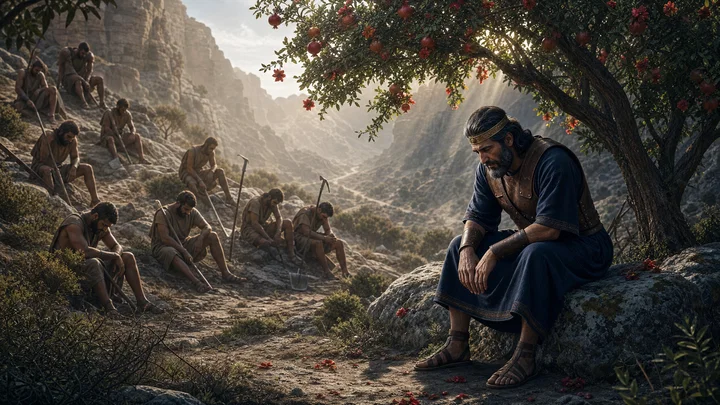
And Saul tarried in the uttermost part of Gibeah under a pomegranate tree which is in Migron: and the people that were with him were about six hundred men;
Translations
American King James Version, King James Version, KJV Cambridge Paragraph Bible, Webster Bible
And Saul tarried in the uttermost part of Gibeah under a pomegranate tree which is in Migron: and the people that were with him were about six hundred men;
And Saul abode in the uttermost part of Gibeah under the pomegranate tree which is in Migron: and the people that were with him were about six hundred men:
And Saul abode in the uttermost part of Gibeah under the pomegranate-tree which is in Migron: and the people that were with him were about six hundred men;
And Saul is abiding at the extremity of Gibeah, under the pomegranate which [is] in Migron, and the people who [are] with him, about six hundred men,
And Saul abode at the extreme end of Gibeah under the pomegranate-tree which [ was] in Migron; and the people that were with him were about six hundred men.
Now, Saul, was tarrying in the uttermost part of Gibeah, under the pomegranate tree that is in Migron,—and, the people that were with him, were about six hundred men;
Berean Standard Bible, Majority Standard Bible
Meanwhile, Saul was staying under the pomegranate tree in Migron on the outskirts of Gibeah. And the troops who were with him numbered about six hundred men,
Saul stayed in the uttermost part of Gibeah under the pomegranate tree which is in Migron; and the people who were with him were about six hundred men,
And Saul was still waiting in the farthest part of Geba, under the fruit-tree in Migron: there were about six hundred men with him;
And Saul taried in the border of Gibeah vnder a pomegranate tree, which was in Migron, and the people that were with him, were about sixe hundreth men.
Douay-Rheims (Challoner revision)
And Saul abode in the uttermost part of Gabaa under the pomegranate tree, which was in Magron: and the people with him were about six hundred men.
Pictures
Cross-references
- 1 Samuel 14:17-20
Then said Saul unto the people that were with him, Number now, and see who is gone from us. And when they had numbered, behold, Jonathan and his armourbearer were not there.
Saul leaves his post and joins the battle after discovering Jonathan is missing and the Philistine camp is confused.
- 1 Samuel 14:6-15
And Jonathan said to the young man that bare his armour, Come, and let us go over unto the garrison of these uncircumcised: it may be that the LORD will work for us: for there is no restraint to the LORD to save by many or by few.
Jonathan and his armourbearer attack the Philistines, bringing Israel a great deliverance.
- 1 Samuel 14:16
And the watchmen of Saul in Gibeah of Benjamin looked; and, behold, the multitude melted away, and they went on beating down one another.
watchmen see confusion and melting host
- Judges 19:22-30
Now as they were making their hearts merry, behold, the men of the city, certain sons of Belial, beset the house round about, and beat at the door, and spake to the master of the house, the old man, saying, Bring forth the man that came into thine house, that we may know him.
both happened at Gibeah
- 1 Samuel 14:20
And Saul and all the people that were with him assembled themselves, and they came to the battle: and, behold, every man’s sword was against his fellow, and there was a very great discomfiture.
Philistines turn swords against each other
- 1 Samuel 11:7
And he took a yoke of oxen, and hewed them in pieces, and sent them throughout all the coasts of Israel by the hands of messengers, saying, Whosoever cometh not forth after Saul and after Samuel, so shall it be done unto his oxen. And the fear of the LORD fell on the people, and they came out with one consent.
Both show Saul acting from Gibeah.
- 2 Samuel 21:8-9
But the king took the two sons of Rizpah the daughter of Aiah, whom she bare unto Saul, Armoni and Mephibosheth; and the five sons of Michal the daughter of Saul, whom she brought up for Adriel the son of Barzillai the Meholathite:
both happened at Gibeah
- 1 Samuel 14:18-19
And Saul said unto Ahiah, Bring hither the ark of God. For the ark of God was at that time with the children of Israel.
Saul has ark brought and priest inquire
- 1 Samuel 14:21-22
Moreover the Hebrews that were with the Philistines before that time, which went up with them into the camp from the country round about, even they also turned to be with the Israelites that were with Saul and Jonathan.
Hidden and deserted Israelites rejoin the pursuit.
- 1 Samuel 14:24-45
And the men of Israel were distressed that day: for Saul had adjured the people, saying, Cursed be the man that eateth any food until evening, that I may be avenged on mine enemies. So none of the people tasted any food.
Saul’s decree and its consequences are part of the same chapter.
Commentary
Each commentary is drawn from primary sources: the writings of Ellen G. White and Adventist pioneers and periodicals. Each commentary is separate. Its own words are not a quotation; follow the references to read the source passages.
Ellen G. White
4 sources
Saul tarried inactive in the uttermost part of Gibeah under the pomegranate tree in Migron with about six hundred men, sitting in fear and discontent while the Philistines threatened, and his small company showed the weakness and disorder of Israel's forces in the crisis.Lt 16, 1897, par. 37–48PP 623.1–21SP 358.2–359.2SG4 70.1–71.1 While Saul tarried, Jonathan and his armor-bearer went without Saul's knowledge against the Philistine garrison, God moving on their hearts to go.Lt 16, 1897, par. 37–481SP 358.2–359.2SG4 70.1–71.1 Jonathan believed that God could save by many or by few, and he asked counsel of God before moving forward in trust.SG4 70.1–71.1
Because of Saul's sin in his presumptuous offering, the Lord would not give him the honor of vanquishing the Philistines or of commanding the armies of Israel against them.PP 623.1–2SG4 70.1–71.1 God permitted matters to be brought to this crisis to rebuke Saul's perversity and to teach His people humility and faith.PP 623.1–2 He chose Jonathan, the king's son, a man who feared the Lord, as the instrument to deliver Israel.PP 623.1–2
The Lord Himself gained the victory and wrought deliverance for His own name's glory, so that Israel would not credit or exalt its own strength, merit, righteousness, valor, or wisdom, and so that the heathen army would not triumph over His people and proudly exalt themselves against God.PP 623.1–21SP 358.2–359.2SG4 70.1–71.1 God protected Jonathan and his armor-bearer by angels and fought by Jonathan's side, striking the Philistine host and the spoilers with great fear, making the earth tremble as with horsemen and chariots, and turning the Philistines to fight and slaughter one another.SG4 70.1–71.1 The battle went on for quite a length of time before Saul and his men knew that deliverance was being wrought for Israel.1SP 358.2–359.2SG4 70.1–71.1
His watchmen perceived the confusion and decreasing numbers with none missing from Israel, and numbering showed only Jonathan and his armor-bearer absent.SG4 70.1–71.1 Saul was perplexed and had the ark of God brought while the priest inquired, and the noise grew like two great armies in close battle.SG4 70.1–71.1 When it was plain that God was fighting for them, those who had fled and hidden in terror and those who had joined the Philistines through fear united with Saul and Jonathan and pursued.SG4 70.1–71.1
Sources
Pioneers and periodicals
9 sources
Saul tarried in the uttermost or far end part of Gibeah under the pomegranate tree which is in Migron, with about six hundred men with him while Jonathan acted apart from him.ST Sep 20, 1883ST Mar 12, 1885ST Oct 4, 1910RH Nov 12, 1901 Gibeah means high, and Gibeah of Benjamin lies within an hour's walk from Jerusalem on the right past Mizpeh, a little more than a mile from Nob, stands 2,690 feet above the sea, about 200 feet higher than Jerusalem, and commands a fine view even beyond the Dead Sea far into the mountains of Moab.ST Oct 27, 1898
The verse is set during the battle with the Philistines at Michmash, while Saul waited behind and Jonathan with only his armor-bearer as his single helper set out to attack the Philistines.ST Sep 20, 1883RH Dec 30, 1915ST Mar 12, 1885RH Dec 29, 1904 Those two Israelites, trusting in God, went against a much larger trained enemy force and routed it, bringing Israel deliverance, victory, and triumph through Jonathan's noted victory.ST Sep 20, 1883RH Dec 30, 1915RH Dec 29, 1904ST Jul 21, 1909 Jonathan's act of faith, valor, and courage shows that God gives victory through his own power and through faith in his power, not through human strength or numbers, so that two can rout a trained army and a larger force cannot claim the victory for itself.RH Dec 30, 1915ST Mar 12, 1885ST Jul 21, 1909ST Oct 4, 1910ST Apr 14, 1909
The surrounding chapter also exposes Saul's growing rashness in his rash decree forbidding food and his sentence of death against Jonathan, who had unknowingly eaten honey.ST Sep 20, 1883 Jonathan's youthful zeal in God's cause is presented as an example and not a new thing, an exploit comparable to a young man's courage in maintaining a consistent Christian life.ST Mar 12, 1885RH Dec 29, 1904 Jonathan's personal act of courage teaches Christians not to fight the Philistines physically but to resist harmful habits and indifference to God's claims on physical and spiritual life, and when they become earnestly active in this duty others will be stirred to work as well.RH Nov 12, 1901
Sources