1 Samuel 15:33
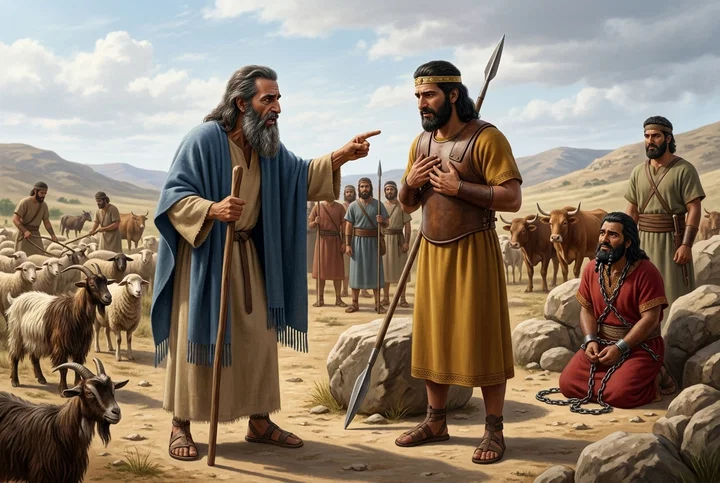
And Samuel said, As thy sword hath made women childless, so shall thy mother be childless among women. And Samuel hewed Agag in pieces before the LORD in Gilgal.
Translations
And Samuel said, As the sword has made women childless, so shall your mother be childless among women. And Samuel hewed Agag in pieces before the LORD in Gilgal.
King James Version, Webster Bible, Revised Version
And Samuel said, As thy sword hath made women childless, so shall thy mother be childless among women. And Samuel hewed Agag in pieces before the LORD in Gilgal.
And Samuel said, As thy sword hath made women childless, so shall thy mother be childless among women. And Samuel hewed Agag in pieces before the Lord in Gilgal.
And Samuel said, As thy sword hath made women childless, so shall thy mother be childless among women. And Samuel hewed Agag in pieces before Jehovah in Gilgal.
And Samuel saith, 'As thy sword bereaved women — so is thy mother bereaved above women;' and Samuel heweth Agag in pieces before Jehovah in Gilgal.
And Samuel said, As thy sword has made women childless, so shall thy mother be childless above women. And Samuel hewed Agag in pieces before Jehovah in Gilgal.
And Samuel said, As women have been made childless by thy sword, So, childless among women, shall be, thine own mother. And Samuel cut Agag asunder before Yahweh, in Gilgal.
Berean Standard Bible, Majority Standard Bible
But Samuel declared:
“ As your sword has made women childless,
so your mother will be childless among women.”And Samuel hacked Agag to pieces before the LORD at Gilgal.Samuel said, “ As your sword has made women childless, so your mother will be childless among women!” Then Samuel cut Agag in pieces before the LORD in Gilgal.
And Samuel said, As your sword has made women without children, so now your mother will be without children among women. And Agag was cut up by Samuel, bone from bone, before the Lord in Gilgal.
And Samuel sayde, As thy sworde hath made women childlesse, so shall thy mother bee childelesse among other women. And Samuel hewed Agag in pieces before the Lord in Gilgal.
Douay-Rheims (Challoner revision)
And Samuel said: As thy sword hath made women childless, so shall thy mother be childless among women. And Samuel hewed him in pieces before the Lord in Galgal.
Pictures
Cross-references
- 1 Samuel 15:3
Now go and smite Amalek, and utterly destroy all that they have, and spare them not; but slay both man and woman, infant and suckling, ox and sheep, camel and ass.
The command to destroy Amalek provides the context for Agag’s execution.
- 1 Samuel 15:9
But Saul and the people spared Agag, and the best of the sheep, and of the oxen, and of the fatlings, and the lambs, and all that was good, and would not utterly destroy them: but every thing that was vile and refuse, that they destroyed utterly.
Saul spared Agag, prompting Samuel’s rebuke and execution.
- Esther 3:1
After these things did king Ahasuerus promote Haman the son of Hammedatha the Agagite, and advanced him, and set his seat above all the princes that were with him.
Haman is identified as an Agagite, linking him to Agag.
- Exodus 17:14-16
And the LORD said unto Moses, Write this for a memorial in a book, and rehearse it in the ears of Joshua: for I will utterly put out the remembrance of Amalek from under heaven.
God declares enduring war against Amalek and the eventual blotting out of its remembrance.
- 1 Samuel 15:28
And Samuel said unto him, The LORD hath rent the kingdom of Israel from thee this day, and hath given it to a neighbour of thine, that is better than thou.
Samuel announces that the kingdom is taken from Saul and given to another.
- Deuteronomy 25:19
Therefore it shall be, when the LORD thy God hath given thee rest from all thine enemies round about, in the land which the LORD thy God giveth thee for an inheritance to possess it, that thou shalt blot out the remembrance of Amalek from under heaven; thou shalt not forget it.
The command to blot out Amalek is carried out in Samuel’s judgment on Agag.
- Deuteronomy 25:17-18
Remember what Amalek did unto thee by the way, when ye were come forth out of Egypt;
Amalekite ambush of faint Israel
- 1 Samuel 15:8
And he took Agag the king of the Amalekites alive, and utterly destroyed all the people with the edge of the sword.
Saul captured Agag alive.
- Esther 3:10
And the king took his ring from his hand, and gave it unto Haman the son of Hammedatha the Agagite, the Jews’ enemy.
Haman is called an Agagite, linking him to Agag.
- 1 Samuel 15:2
Thus saith the LORD of hosts, I remember that which Amalek did to Israel, how he laid wait for him in the way, when he came up from Egypt.
Amalek’s attack on Israel is given as the cause of judgment.
- Numbers 24:20
And when he looked on Amalek, he took up his parable, and said, Amalek was the first of the nations; but his latter end shall be that he perish for ever.
Predicts Amalek’s eventual destruction.
- 1 Chronicles 4:43
And they smote the rest of the Amalekites that were escaped, and dwelt there unto this day.
Reports the Simeonites’ final destruction of the Amalekite remnant.
- Numbers 31:17
Now therefore kill every male among the little ones, and kill every woman that hath known man by lying with him.
same command to kill explained by same reason
- Numbers 14:45
Then the Amalekites came down, and the Canaanites which dwelt in that hill, and smote them, and discomfited them, even unto Hormah.
Both texts record conflict between Israel and the Amalekites.
- 1 Samuel 27:8
And David and his men went up, and invaded the Geshurites, and the Gezrites, and the Amalekites: for those nations were of old the inhabitants of the land, as thou goest to Shur, even unto the land of Egypt.
David defeated Amalekites who survived.
Commentary
Each commentary is drawn from primary sources: the writings of Ellen G. White and Adventist pioneers and periodicals. Each commentary is separate. Its own words are not a quotation; follow the references to read the source passages.
Ellen G. White
3 sources
Agag was the king of the Amalekites.PP 627.3 At Gilgal before the Lord, Samuel himself carried out God's sentence of judgment against Agag by executing him.PP 627.31SP 366.2–367.2PP 632.3 Agag's violent cruelty with the sword had made women childless.PP 627.31SP 366.2–367.2PP 632.3 Samuel announced a matching retribution that Agag's own mother would become childless among women.PP 627.31SP 366.2–367.2PP 632.3
Agag's influence also promoted idolatry.PP 632.3 The judgment followed Saul's disobedience in sparing Agag and rejecting God's command.1SP 366.2–367.2 The execution vindicated God's honor and rebuked Saul.PP 632.3 The execution punished a wicked people whose attack on Israel and defiance of God had brought a long-delayed sentence.PP 627.3
Sources
Pioneers and periodicals
32 sources
Samuel himself carried out God's commanded judgment on Agag king of the Amalekites at Gilgal, hewing him in pieces before the Lord to complete the utter destruction Saul had failed to accomplish when he took Agag alive.RH Dec 9, 1915RH Oct 8, 1861RH Oct 19, 1916 The execution was just retribution, making Agag's mother childless among women because his own sword had made women childless, for his notorious cruelties and upholding of his people's debasing heathenism.ST Aug 31, 1882RH Dec 9, 1915RH Jun 16, 1868 Saul had directly disobeyed God's command to smite and utterly destroy Amalek by sparing Agag and the best of the flocks under pleas of usefulness and sacrifice, and for that rebellion he was rejected as king and lost the kingdom to David.RH Oct 19, 1916ST Mar 31, 1909 The chapter teaches that to obey is better than sacrifice, requiring literal obedience to the plain letter of God's commands with all the heart, since going beyond His word is disobedience just as falling short is.RH Mar 23, 1916ST Jun 25, 1885RH Oct 25, 1864 The verse therefore warns against partial obedience and compromise, for cherished sins and fleshly lusts are modern Agags that must be decisively hewn in pieces with no provision for the flesh, lest disobedience cost spiritual standing.RH Oct 8, 1861RH Oct 19, 1916RH Oct 8, 1861
Samuel Executes Agag
Samuel himself carried out God's commanded judgment on Agag king of the Amalekites at Gilgal, hewing him in pieces before the LORD.RH Dec 9, 1915RH Oct 8, 1861RH Oct 19, 1916ST Sep 20, 1899ST Jun 25, 1885 Saul had taken Agag alive and brought him to Gilgal, sparing him and the best of the sheep and oxen against the command to utterly destroy Amalek, and Samuel completed what Saul failed to do.RH Dec 9, 1915RH Oct 8, 1861RH Oct 19, 1916RH Mar 10, 1874ST Jun 25, 1885 The account belongs to Saul's presumption in keeping Agag alive, and it closes with the judgment that followed disobedience.RH Dec 9, 1915RH Mar 10, 1874ST Jun 25, 1885 God's commands are to be followed as given, without substituting a human course on the plea of honoring Him better.ST Jun 25, 1885
The execution was just retribution announced in the words spoken to Agag: as his sword had made women childless by violence, so his mother would be made childless among women.RH Dec 9, 1915RH Jun 16, 1868ST Apr 11, 1911RH Oct 28, 1862ST Jul 15, 1908 Samuel then killed him and hewed him in pieces before the Lord at Gilgal, openly before the Lord.RH Dec 9, 1915RH Jun 16, 1868ST Apr 11, 1911RH Oct 28, 1862ST Jul 15, 1908 Agag is thus remembered among those who opposed the word of God and whose lives ended in infamy.ST Jul 15, 1908
Agag deserved death for his own personal transgressions and cruelties, and for notorious public murders and violence.ST Aug 31, 1882RH Sep 11, 1860RH Jun 16, 1868 He deserved the heaviest penalty above all who had fallen by the sword of Israel, as the upholder of his people's debasing heathenism and the instigator of their revolting cruelties.ST Aug 31, 1882 His execution was just retribution, comparable in justice to the execution of a murderer.RH Sep 11, 1860RH Jun 16, 1868
The killing was an official act of judgment in magisterial capacity under divine authority, not a sacrifice to the Lord and not murder.RH Sep 11, 1860RH Oct 28, 1862 A prophet could thus engage in violence under divine authority without guilt of murder, and the deed was done openly before the Lord.RH Sep 11, 1860RH Jun 16, 1868RH Oct 28, 1862 Those who so hold it teach that Samuel likely acted through an executioner rather than with his own sword.RH Sep 11, 1860
Though tender in spirit and strong in affection, Samuel performed this required and unwelcome task unflinchingly, maintaining faithfulness to God at whatever sacrifice of personal feeling.ST Aug 31, 1882ST Aug 31, 1882 It was a stern and terrible act of justice to publicly vindicate the honor of God and rebuke the course of Saul, who could be exceedingly cruel to serve his own purpose yet spared Agag on whom the curse of God especially rested, flattering himself more merciful than his Maker.ST Aug 31, 1882ST Aug 31, 1882 Agag came at Samuel's command in pride of royalty, flattering himself that all danger of death was past and that he could overawe God's servant, until Samuel's words dispelled his assurance.ST Aug 31, 1882 Afterward Samuel returned to his home at Ramah and Saul to his at Gibeah, and prophet and king never met again.ST Aug 31, 1882
Saul's Disobedience Judged
God commanded Saul to smite and utterly destroy the Amalekites and all they had, for they had become a curse to the nations they encountered.RH Oct 25, 1864ST Jul 29, 1889 Saul directly disobeyed in selfish, stubborn, self-willed presumption, sparing Agag alive and saving the best of the sheep and oxen.RH Oct 19, 1916ST Sep 20, 1883RH Mar 10, 1874 He excused himself by fear of the people, by usefulness and religion, and by intent to sacrifice to God, even attempting to do better than required.ST Jun 25, 1885RH Oct 25, 1864 He treated his royal dignity as grounds to dictate terms to God, flattering himself more merciful than his Maker and by his act declaring the divine requirement unjust and cruel.ST Aug 31, 1882ST Feb 19, 1885 He struck only the lesser offenders while sparing Agag, the one on whom the curse of God especially rested.ST Aug 31, 1882
The chapter teaches that to obey is better than sacrifice and to hearken than the fat of rams.RH Mar 23, 1916ST Dec 30, 1903 God requires literal obedience to the plain letter of His commands as given, not obedience to a human idea of their spirit, and men cannot substitute their own course and claim it honors Him better.ST Jun 25, 1885ST Jul 29, 1889 Going beyond His command is disobedience just as falling short is, even in apparently small matters.RH Oct 25, 1864 His word must be respected and obeyed with all the heart, and not kept only when compatible with self-interest and disregarded when self-interest suits otherwise.ST Aug 31, 1882 God speaks what He means and means what He speaks, sin is the transgression of the law and the wages of sin is death, so even what seems a small sin must be amended at once.ST Dec 30, 1903
The same rule applies now, for God is as particular about obedience to His written word as in Saul's day, and adding to it or taking from it is no safer now than disobedience then.RH Oct 25, 1864 Only perfect obedience to His revealed will is safe, and refusal to amend when shown wrong is the downward path to eternal destruction.RH Oct 25, 1864ST Dec 30, 1903 The spirit of obedience to the Sabbath command consists in actually observing the seventh day itself, which God set apart and hallowed to commemorate creation, not in keeping a rival day in its place, which is why changing the Sabbath is not a small thing.ST Dec 30, 1903ST Jul 29, 1889 The chapter holds a striking lesson about disobedience for all God's children, not to trample God's holy law underfoot, especially now that light is shining and the last call of mercy is sounding while His people prepare to meet the King in His beauty.RH Oct 25, 1864
For his rebellion Saul was rejected by the Lord as king, lost the kingdom, grieved away the Spirit of God, and the Lord finally refused to have to do with him.ST Feb 19, 1885ST Sep 15, 1898ST Jul 29, 1889 His rashness and weakness led to the rejection of him and his family.ST Mar 31, 1909 The events that led to his rejection opened the way for the anointing of David in his place as the one chosen instead of Saul.ST Mar 31, 1909ST Jul 2, 1885
The destruction of Amalek was commanded because they were wholly given over to evil and had utterly shut God away despite His efforts to save them through the sojourn of His faithful servants among them, such as Abraham and Isaac, so that only corruption and evil could come from leaving them alive.ST Destroying them stopped their own sinning and kept them from corrupting others, so that death was better than preservation and sometimes the greatest blessing that can come to the wicked.ST God's reasons are largely unseen and unknown, and it is not for humans to pass judgment on them.ST The judgment is typical of what will come upon the nations of the world that utterly reject God, and though remnants survived, their later destruction fulfilled the prediction that Amalek would be blotted out.STRH Sep 15, 1874
Prophecy and Present Application
Agag's line did not end with his death at Gilgal, for Haman the Agagite was his probable direct descendant, and that descent helps explain Haman's enmity toward the Jews.ST Sep 20, 1899ST Apr 23, 1902ST Jan 20, 1898 Saul was of Benjamin, the same tribe as Mordecai the Jew, so Haman's plot to destroy all the Jews because Mordecai would not bow to him was vengeance by the remaining Amalekite upon Saul's people for Saul's destruction of his nation.ST Apr 23, 1902 It was also a continuation of the original Amalekite treachery and cruelty begun in the ambush of faint and weary Israel at Rephidim after Israel left Egypt.ST Apr 23, 1902 In Esther's day that old hatred placed the whole nation under death sentence for loyalty to God.ST Apr 23, 1902RH Jun 24, 1915
Saul had been instructed to destroy all the Amalekites but was unfaithful and spared Agag their king, leaving the line that later threatened the Jews.RH Jun 24, 1915 Such unfaithfulness to God's instruction may bring sore trials upon others in a later generation.RH Jun 24, 1915
The judgment on Agag warns against partial obedience and compromise with sin, for modern Agags are cherished sins, habits, idols, besetting sins and fleshly lusts that have neither part nor lot with the soul redeemed by Jesus Christ.RH Oct 8, 1861RH Oct 19, 1916RH Oct 8, 1861 They are the things people spare as useful, reasonable, or religious, intending to give them up later or surrender them only partly, yet they must be decisively put away and hewn in pieces before disobedience costs spiritual standing and the kingdom.RH Oct 8, 1861RH Oct 8, 1861RH Feb 17, 1859 There must be no compromise with sin but utter slaying with no provision for the flesh, and uncompromising destruction of evil is the secret of spiritual power, as when Elijah slew the false prophets at the brook Kishon.RH Oct 19, 1916
Samuel cutting Agag to pieces before the Lord is the pattern for putting spiritual Agags to death in secret work alone with God.RH Dec 7, 1911 Every person must take time to be alone with Him, bringing inner sins out in His secret presence with no one near but Him and destroying them there in the closet where lions and bears are slain.RH Dec 7, 1911 Those who do this secret work will have strong confidence when they appear before brethren or the world, will see Goliaths slain, will be of use to God and glorify Him on earth, and will do God's work in God's own way that most honors Him.RH Dec 7, 1911 By comparison, Samuel's sword cutting Agag to pieces pictures the inspired word cutting down alluring errors in religious tradition, so that tradition must bow before God's word and be hewn in pieces by it instead of ruling faith and practice.RH Mar 30, 1876ST Dec 30, 1880 Agag is thus remembered among those who opposed the word of God and whose lives ended in infamy, since as his sword had made women childless, his mother was made childless by his being hewn in pieces before the Lord at Gilgal.ST Jul 15, 1908
Sources