1 Samuel 20:41
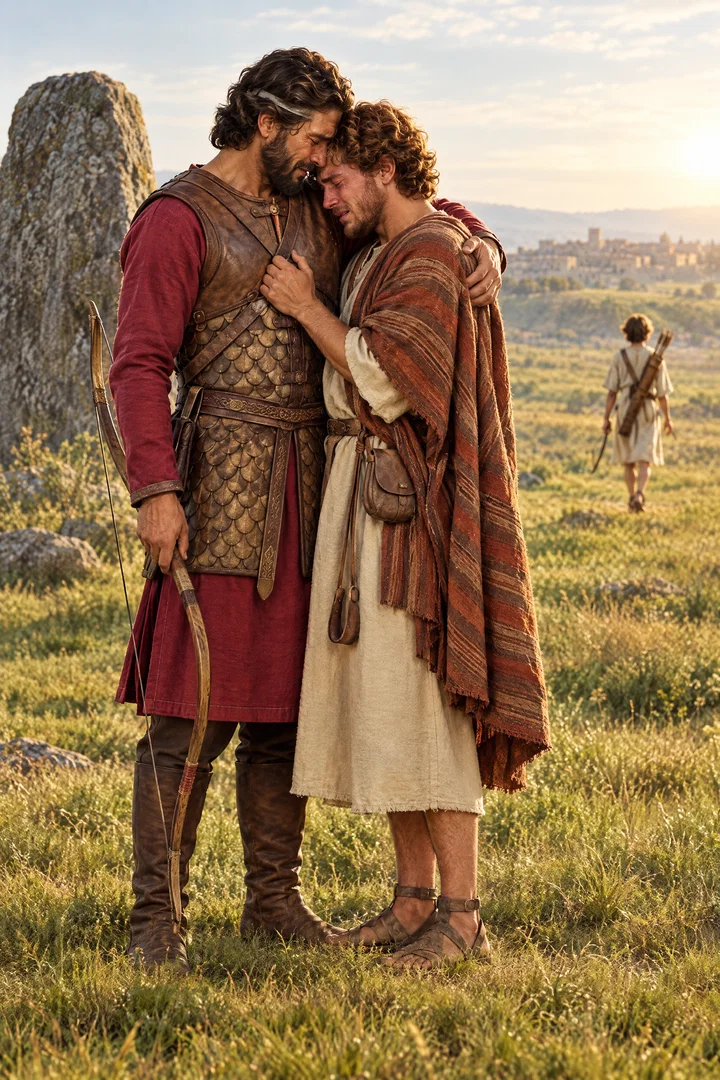
And as soon as the lad was gone, David arose out of a place toward the south, and fell on his face to the ground, and bowed himself three times: and they kissed one another, and wept one with another, until David exceeded.
Translations
American King James Version, King James Version, KJV Cambridge Paragraph Bible
And as soon as the lad was gone, David arose out of a place toward the south, and fell on his face to the ground, and bowed himself three times: and they kissed one another, and wept one with another, until David exceeded.
And as soon as the lad was gone, David arose out of a place towards the south, and fell on his face to the ground, and bowed himself three times: and they kissed one another, and wept one with another, until David exceeded.
Revised Version, American Standard Version
And as soon as the lad was gone, David arose out of a place toward the South, and fell on his face to the ground, and bowed himself three times: and they kissed one another, and wept one with another, until David exceeded.
The youth hath gone, and David hath risen from Ezel, at the south, and falleth on his face to the earth, and boweth himself three times, and they kiss one another, and they weep one with another, till David exerted himself;
The lad went, and David arose from the side of the south, and fell on his face to the ground, and bowed himself three times; and they kissed one another, and wept one with another, until David exceeded.
As soon as, the lad, was gone, David, arose from beside the South, and fell on his face to the earth, and bowed himself down three times,—and they kissed each other, and wept over each other, until, David, exceeded.
Berean Standard Bible, Majority Standard Bible
When the young man had gone, David got up from the south side of the stone, fell facedown, and bowed three times. Then he and Jonathan kissed each other and wept together—though David wept more.
As soon as the boy was gone, David arose out of the south, and fell on his face to the ground, and bowed himself three times. They kissed one another and wept with one another, and David wept the most.
And when the boy had gone, David came from his secret place by the hill, and falling to the earth went down on his face three times: and they gave one another a kiss, weeping together, till David's grief was the greater.
Assoone as the boy was gone, Dauid arose out of a place that was towarde the South, and fel on his face to the ground, and bowed him selfe three times: and they kissed one another, and wept both twaine, till Dauid exceeded.
Douay-Rheims (Challoner revision)
And when the boy was gone, David rose out of his place, which was towards the south, and falling on his face to the ground, adored thrice: and kissing one another, they wept together, but David more.
Pictures
Cross-references
- 1 Samuel 18:1
And it came to pass, when he had made an end of speaking unto Saul, that the soul of Jonathan was knit with the soul of David, and Jonathan loved him as his own soul.
Jonathan and David’s deep friendship and love are shown in their farewell.
- Proverbs 18:24
A man that hath friends must shew himself friendly: and there is a friend that sticketh closer than a brother.
David and Jonathan illustrate the closeness of a faithful friend.
- 2 Samuel 1:26
I am distressed for thee, my brother Jonathan: very pleasant hast thou been unto me: thy love to me was wonderful, passing the love of women.
David mourns Jonathan and praises his extraordinary love.
- 1 Samuel 20:14-15
And thou shalt not only while yet I live shew me the kindness of the LORD, that I die not:
Jonathan’s concern for his family and covenant with David are recalled at their parting.
- 1 Samuel 20:32-33
And Jonathan answered Saul his father, and said unto him, Wherefore shall he be slain? what hath he done?
Jonathan's plea and Saul's spear attack confirm Saul's murderous intent toward David.
- 1 Samuel 20:3
And David sware moreover, and said, Thy father certainly knoweth that I have found grace in thine eyes; and he saith, Let not Jonathan know this, lest he be grieved: but truly as the LORD liveth, and as thy soul liveth, there is but a step between me and death.
David’s danger of death explains the sorrowful farewell.
- 1 Samuel 20:1
And David fled from Naioth in Ramah, and came and said before Jonathan, What have I done? what is mine iniquity? and what is my sin before thy father, that he seeketh my life?
David's appeal that he did nothing precedes parting
- 1 Samuel 20:28-29
And Jonathan answered Saul, David earnestly asked leave of me to go to Beth-lehem:
cover story for absence provokes Saul's rage
- 1 Samuel 23:16
And Jonathan Saul’s son arose, and went to David into the wood, and strengthened his hand in God.
David and Jonathan meet in the wilderness and reaffirm their covenant.
- 1 Samuel 23:17
And he said unto him, Fear not: for the hand of Saul my father shall not find thee; and thou shalt be king over Israel, and I shall be next unto thee; and that also Saul my father knoweth.
Jonathan acknowledges that David will be king.
- 1 Samuel 18:4
And Jonathan stripped himself of the robe that was upon him, and gave it to David, and his garments, even to his sword, and to his bow, and to his girdle.
Jonathan gave David his robe and weapons as a sign of their bond.
Commentary
Each commentary is drawn from primary sources: the writings of Ellen G. White and Adventist pioneers and periodicals. Each commentary is separate. Its own words are not a quotation; follow the references to read the source passages.
Ellen G. White
3 sources
This parting belongs to the time after David defeated Goliath, when Saul kept David with him and would not allow him to return to his father's house.PP 649.1 At that time Jonathan loved David as deeply as his own life and made a covenant to be united as brothers.PP 649.1 In token of that covenant he stripped off his robe and gave it to David together with his other garments, his sword, his bow and his belt.PP 649.1 At that same time David was entrusted with important responsibilities, yet he remained modest and won the affection of both the people and the royal household.PP 649.1
The verse shows the final meeting of David and Jonathan at an appointed place, where Jonathan reported that Saul was firmly resolved to kill David.PP 654.2–655.2 There they embraced and wept bitterly together, falling on each other's neck in grief too intense to express.PP 654.2–655.2 Saul's dark murderous hatred shadowed their lives and forced them to separate to go different ways.PP 654.2–655.2
The verse reveals a sacred bond of union in which Jonathan's heart was knit to David's, a friendship that remained unbroken until the deaths of Saul and Jonathan.SG4 79.1 That friendship was the Lord's doing, so that Jonathan could be the means of preserving David's life when Saul tried to kill him.SG4 79.1
Sources
Pioneers and periodicals
7 sources
This farewell belongs to the account of the covenant and friendship between David and Jonathan, set within the history of Israel from Saul's anointing to the beginning of David's reign, and it forms part of the story that shows Jonathan's noble, unselfish generosity.ST Apr 7, 1909RH Dec 3, 1908 Jonathan's signal had confirmed that David was in danger and would have to flee to save his life.ST Aug 31, 1888ST Nov 28, 1895 After the lad was gone, David and Jonathan met, bowed to one another, kissed and embraced, and wept and grieved bitterly together.ST Aug 31, 1888ST Dec 12, 1895
Though their hearts were united, they had to separate because Saul's hostility made their friendship dangerous.ST Aug 31, 1888 Their parting meant their paths diverged: David became a refugee and outlaw, while Jonathan remained the prince and might be called on to pursue him.ST Nov 28, 1895 David "exceeded" in grief, meaning he could not control his emotions and wept aloud.ST Nov 28, 1895
The farewell shows the depth of Jonathan's love and his noble, unselfish generosity toward David.ST Dec 12, 1895ST Apr 7, 1909 Jonathan parted convinced that David was called of God to take Saul's throne and willingly yielded to God's choice, showing grace that raised him above the weakness of human nature so he could acquiesce in another taking the kingdom, in contrast to Saul who had the same conviction about David yet was wholly incapable of submitting to God because evil reigned in his heart and the Spirit of God had departed from him.ST Sep 20, 1883 Their friendship illustrates the strong love that should exist between each person and the Redeemer.ST Dec 12, 1895
Sources