1 Samuel 21:1
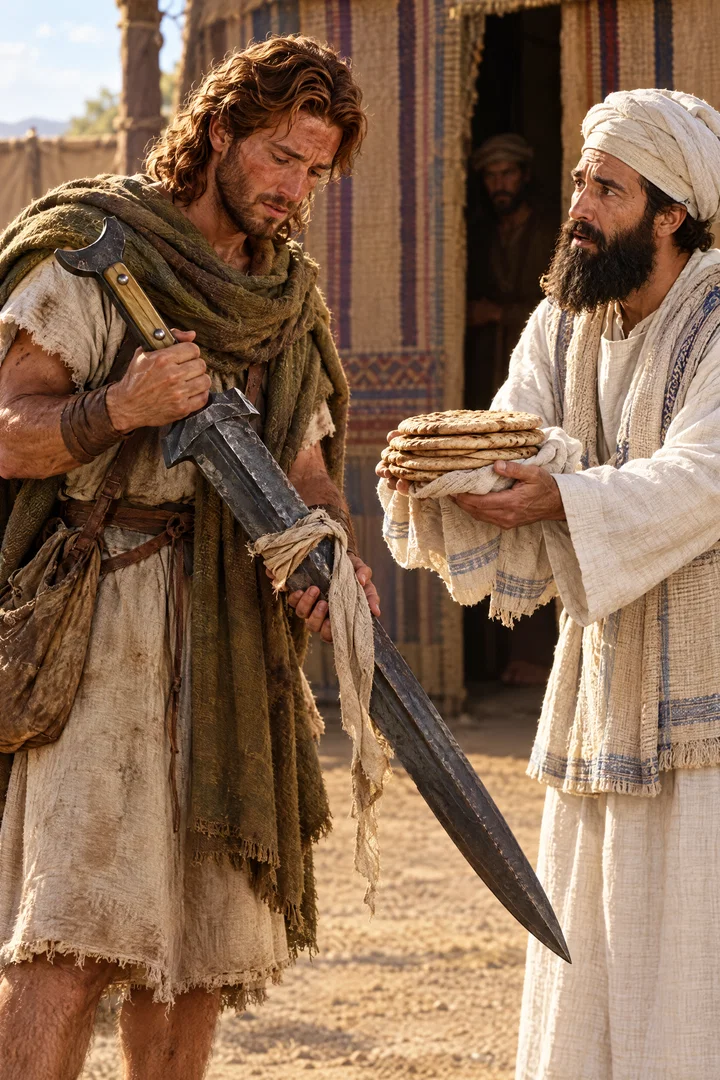
Then came David to Nob to Ahimelech the priest: and Ahimelech was afraid at the meeting of David, and said unto him, Why art thou alone, and no man with thee?
Translations
Then came David to Nob to Ahimelech the priest: and Ahimelech was afraid at the meeting of David, and said to him, Why are you alone, and no man with you?
King James Version, KJV Cambridge Paragraph Bible
Then came David to Nob to Ahimelech the priest: and Ahimelech was afraid at the meeting of David, and said unto him, Why art thou alone, and no man with thee?
Then came David to Nob to Ahimelech the priest: and Ahimelech was afraid at the meeting of David, and said to him, Why art thou alone, and no man with thee?
Revised Version, American Standard Version
Then came David to Nob to Ahimelech the priest: and Ahimelech came to meet David trembling, and said unto him, Why art thou alone, and no man with thee?
And David cometh in to Nob, unto Ahimelech the priest, and Ahimelech trembleth at meeting David, and saith to him, 'Wherefore [art] thou thyself alone, and no man with thee?'
And David came to Nob, to Ahimelech the priest; and Ahimelech trembled at meeting David, and said to him, Why art thou alone, and no man with thee?
Then came David to Nob, unto Ahimelech, the priest,—and Ahimelech trembled when he met David, and said unto him—Why art thou, alone, and, no man, with thee?
Berean Standard Bible, Majority Standard Bible
Then David came to Nob, to Ahimelech the priest. And when Ahimelech met David, he trembled and asked him, “Why are you alone? Why is no one with you?”
Then David came to Nob to Ahimelech the priest. Ahimelech came to meet David trembling, and said to him, “Why are you alone, and no man with you?”
Then David came to Nob, to Ahimelech the priest: and Ahimelech was full of fear at meeting David, and said to him, Why are you by yourself, having no man with you?
Then came Dauid to Nob, to Ahimelech the Priest, and Ahimelech was astonied at the meeting of Dauid, and saide vnto him, Why art thou alone, and no man with thee?
Douay-Rheims (Challoner revision)
And David came to Nobe to Achimelech the priest: and Achimelech was astonished at David’s coming. And he said to him: Why art thou alone, and no man with thee?
Pictures
Cross-references
- Matthew 12:3-4
But he said unto them, Have ye not read what David did, when he was an hungred, and they that were with him;
Jesus cites David eating the showbread when hungry to defend his disciples.
- Mark 2:25-26
And he said unto them, Have ye never read what David did, when he had need, and was an hungred, he, and they that were with him?
Jesus recalls David’s need and his companions eating the sacred bread.
- Luke 6:3-4
And Jesus answering them said, Have ye not read so much as this, what David did, when himself was an hungred, and they which were with him;
Jesus answers the Sabbath accusation by recalling David eating the showbread when hungry.
- 1 Samuel 22:18-19
And the king said to Doeg, Turn thou, and fall upon the priests. And Doeg the Edomite turned, and he fell upon the priests, and slew on that day fourscore and five persons that did wear a linen ephod.
Ahimelech and the priests are killed after David receives their help at Nob.
- Leviticus 24:5-9
And thou shalt take fine flour, and bake twelve cakes thereof: two tenth deals shall be in one cake.
Describes the bread given to David as priestly sanctuary bread.
- Matthew 12:5
Or have ye not read in the law, how that on the sabbath days the priests in the temple profane the sabbath, and are blameless?
Priestly service for God permits a departure from ordinary Sabbath restrictions.
- 1 Samuel 22:20-21
And one of the sons of Ahimelech the son of Ahitub, named Abiathar, escaped, and fled after David.
Abiathar escapes Saul’s slaughter of Ahimelech’s household.
- 1 Samuel 21:6
So the priest gave him hallowed bread: for there was no bread there but the shewbread, that was taken from before the LORD, to put hot bread in the day when it was taken away.
David receives the hallowed showbread while fleeing Saul.
- 1 Samuel 21:9
And the priest said, The sword of Goliath the Philistine, whom thou slewest in the valley of Elah, behold, it is here wrapped in a cloth behind the ephod: if thou wilt take that, take it: for there is no other save that here. And David said, There is none like that; give it me.
David takes Goliath’s sword while fleeing Saul.
- 2 Samuel 8:17
And Zadok the son of Ahitub, and Ahimelech the son of Abiathar, were the priests; and Seraiah was the scribe;
Abiathar, son of Ahimelech, survives as priest.
- 1 Samuel 20:42
And Jonathan said to David, Go in peace, forasmuch as we have sworn both of us in the name of the LORD, saying, The LORD be between me and thee, and between my seed and thy seed for ever. And he arose and departed: and Jonathan went into the city.
Jonathan and David part after renewing their sworn bond.
- Deuteronomy 23:25
When thou comest into the standing corn of thy neighbour, then thou mayest pluck the ears with thine hand; but thou shalt not move a sickle unto thy neighbour’s standing corn.
Permits plucking grain to satisfy hunger on an ordinary day.
- 1 Kings 2:27
So Solomon thrust out Abiathar from being priest unto the LORD; that he might fulfil the word of the LORD, which he spake concerning the house of Eli in Shiloh.
Solomon deposes Abiathar after his escape.
- Matthew 9:13
But go ye and learn what that meaneth, I will have mercy, and not sacrifice: for I am not come to call the righteous, but sinners to repentance.
Jesus’ teaching on mercy is linked to the precedent of David.
Commentary
Each commentary is drawn from primary sources: the writings of Ellen G. White and Adventist pioneers and periodicals. Each commentary is separate. Its own words are not a quotation; follow the references to read the source passages.
Ellen G. White
5 sources
Nob was a Benjaminite city to which the tabernacle had been moved from Shiloh.PP 655.3–656.1 Ahimelech served there as high priest.PP 655.3–656.1 David came there in haste, apparently alone, with an anxious and sorrowful face.PP 655.3–656.12SP 195.2–197.1COS 71.4–73.4 He was hungry and in need of food.2SP 195.2–197.14RED 48.2–49.1Lt 422, 1907, par. 5COS 71.4–73.4
Ahimelech was afraid and astonished at meeting David and asked why he was alone with no man with him.PP 655.3–656.1COS 71.4–73.4 Fearing discovery, David falsely claimed Saul had sent him on a secret, urgent mission, showing lack of faith in God, and this deception led to the high priest's death.PP 655.3–656.1 Ahimelech gave David the consecrated shewbread ordinarily reserved for priests, which David shared with his hungry followers.2SP 195.2–197.14RED 48.2–49.1Lt 422, 1907, par. 5COS 71.4–73.4
David's urgent and excessive hunger made his taking of the bread guiltless.2SP 195.2–197.14RED 48.2–49.1 Meeting urgent human need in service to God takes precedence over rigid application of ceremonial rules, does not violate God's purpose for sacred service, and shows that exceptional need can make justifiable use of what is ordinarily set apart.2SP 195.2–197.14RED 48.2–49.1Lt 422, 1907, par. 5 The episode supports the right of the disciples to pluck and eat grain on the Sabbath to sustain themselves for God's work.4RED 48.2–49.1 The episode does not excuse careless neglect of the tithe.Lt 422, 1907, par. 5
Sources
Pioneers and periodicals
40 sources
David came alone to Ahimelech the priest at Nob while fleeing for his life from Saul, and the priest trembled at meeting him and asked why he was alone with no man with him.ST Aug 31, 1888RH Mar 23, 1916RH Mar 3, 1910RH Jun 10, 1852ST Sep 18, 1884 Though he appeared alone, his men were with him hungry and in need, and he sought food where only the consecrated bread set before the Lord each Sabbath was available.RH Jun 10, 1852RH Feb 3, 1852ST Nov 11, 1897ST Oct 22, 1894ST Oct 22, 1894 He received that holy bread, which was lawful only for the priests to eat, on the Sabbath day when fresh bread was set out.RH Jan 21, 1862RH Mar 3, 1910RH Jan 6, 1853ST Apr 14, 1881RH May 17, 1906 Jesus recalled this hunger and need to declare His own hungry disciples guiltless for plucking grain on the Sabbath, showing that relieving hunger in God's service is right and lawful and that mercy takes precedence over the rule.ST Apr 14, 1881ST Nov 11, 1897RH Aug 15, 1854ST Nov 14, 1900ST Mar 30, 1888 Although the need made the act guiltless and in harmony with the law, it remains an extreme case pardonable only under pressure of necessity and does not warrant the same in ordinary circumstances, while David's fearful deception in that danger showed distrust of God and led to harm.ST Feb 10, 1904RH Jun 10, 1852RH Feb 3, 1852ST Aug 25, 1909ST Oct 22, 1894
Place and Circumstances at Nob
David came alone to Ahimelech the priest at Nob while fleeing for his life from Saul.RH Mar 23, 1916RH Mar 3, 1910RH Jun 10, 1852RH Feb 3, 1852 The flight was from King Saul, and David came as a fugitive in need of food, with no ordinary bread available.RH Mar 3, 1910RH Jun 10, 1852RH Feb 3, 1852 The meeting teaches the bitter fruit of jealousy.RH Mar 23, 1916
Ahimelech was afraid at meeting David alone, astonished and trembling at the sight.ST Aug 31, 1888ST Sep 18, 1884RH Jan 12, 1911ST Nov 14, 1900 He asked why David had come without anyone accompanying him, why he was alone with no man with him.ST Aug 31, 1888ST Nov 14, 1900 His fear sets the scene for the bread David received for himself and his men.ST Sep 18, 1884
David had men with him who were hungry and in need, though he came alone to the priest to seek food and help.ST Nov 11, 1897ST Oct 22, 1894ST Oct 22, 1894RH Jan 8, 1857 His companions were with him, and the account continues with his taking and sharing the priests' showbread.ST Oct 22, 1894ST Oct 22, 1894 This provides the setting for what Jesus later recalled about David and his companions being in need and hungry.ST Nov 11, 1897ST Oct 22, 1894
Nob was a city of the priests in the tribe of Benjamin, two miles north of Jerusalem.RH Mar 3, 1910ST Oct 27, 1898 It lay about a mile on the way from Anathoth toward Jerusalem and a little more than a mile from Gibeah where Saul dwelt.ST Oct 27, 1898 Another reckoning places it about twelve miles west by north of Jerusalem.RH Aug 28, 1856
At that time the tabernacle with its remaining sacred vessels was at Nob.RH Mar 3, 1910RH Aug 28, 1856RH Jan 6, 1853 It was the first interim home of the sanctuary after its removal from Shiloh and before its settlement in Judah.RH Mar 3, 1910 There Ahimelech served as priest and high priest, and the priests set the showbread before the Lord there each Sabbath.ST Aug 31, 1888RH Mar 3, 1910ST Nov 5, 1912 The tabernacle had been moved from Shiloh, after the ark had been taken and had not returned there.ST Aug 31, 1888RH Jan 6, 1853
This was in the days of Saul, about seventy-nine years after the ark was captured.RH Aug 28, 1856 The ark and God's glory had not returned to the tabernacle after their capture.RH Aug 28, 1856RH Jan 6, 1853
There Ahimelech gave David consecrated bread that was only for the priests to eat.RH Mar 3, 1910 David also took the sword of Goliath that had been kept behind the ephod.RH Mar 3, 1910ST Oct 27, 1898 That sword is never traced again in the sacred record.RH Mar 3, 1910 He took with it the showbread.ST Oct 27, 1898
Saul later destroyed the city and killed its inhabitants because David had been shown that mercy.ST Sep 20, 1883 They had no thought that helping him would displease Saul.ST Sep 20, 1883 On Saul's order Doeg slew eighty-five priests, and only Ahimelech's son Abiathar escaped.ST Sep 18, 1884RH Jan 12, 1911 This shows priests made mere instruments under the king's direction after the monarchy was established under Saul.RH Jan 12, 1911
The verse stands in the closing chapters of 1 Samuel that tell of Saul's jealousy and his effort to slay David.RH Mar 23, 1916ST Apr 7, 1909 They tell of the covenant between David and Jonathan and Jonathan's noble, unselfish generosity.ST Apr 7, 1909 They set forth the wonderful contrast between the jealous Saul and his noble son.ST Apr 7, 1909 They tell also of David's hope and trust in God and his utter refusal to take vengeance in his own hands upon the enemy who was pursuing him.ST Apr 7, 1909
David's Fear and Deceit
David was afraid when he met Ahimelech alone at Nob, and he answered the priest's question with deception, an act that showed distrust of God and lack of faith.ST Aug 31, 1888ST Aug 31, 1888 His faith was shaken by fear and distress under pressure, so that instead of trusting God he acted as though he had to manage his danger by his own strength.ST Aug 31, 1888
The fact that Scripture records this deceit without condemning it on the spot does not approve or excuse it, for its sinfulness is shown by principles given elsewhere in Scripture and by the harmful consequences that followed it.RH Oct 29, 1861 That sin led to Ahimelech's death.ST Aug 31, 1888 The experience exposed David's weakness and taught him his need for constant dependence on God.ST Aug 31, 1888
Showbread Given on Sabbath
1 Samuel 21:1 begins the account of David receiving the shewbread from Ahimelech.RH Jan 21, 1862RH Apr 7, 1863 The priest's surprise at meeting David may have been partly because the meeting took place on the Sabbath, and the circumstances support the view that the bread David received had been removed that day as fresh bread was set before the Lord.RH Jan 21, 1862 The question is raised whether the event probably took place on the Sabbath and how that would explain Jesus' later reference to it.RH Apr 7, 1863
The act was done on the Sabbath day, which made Jesus' reference to it in defending His hungry disciples doubly appropriate, though the Sabbath timing was not essential to His argument.ST Apr 14, 1881 Both when David ate the showbread and when the disciples plucked corn the Sabbath in question was the seventh day, not Sunday, and Jesus gave no instruction on that occasion or at any other time about what is proper to do on Sundays or about observance of the first day.RH May 17, 1906 David, esteemed as a model of Jewish piety, came hungry with his men and did not hesitate to break rules and violate the sanctity of the holy place to get food.ST Apr 14, 1881
Christ's Defense of Disciples
When accused of breaking the Sabbath because His hungry disciples plucked grain, Jesus recalled David coming hungry and in need to the priest at Nob and receiving the showbread ordinarily reserved for priests and sharing it with the men who were with him, and on that ground declared the disciples guiltless.ST Nov 11, 1897RH Aug 15, 1854ST Mar 30, 1888ST Jul 8, 1897RH May 19, 1851 David had satisfied his hunger with the consecrated shewbread in extreme need although it was set apart for the priests, and Jesus cited that proper and guiltless act to justify His disciples against the Pharisees' accusation, showing that matters of necessity do not violate the Sabbath just as the priests who labored in the temple offering additional offerings on the Sabbath days were guiltless.RH Aug 15, 1854ST Mar 30, 1888RH Feb 3, 1852 His defense did not relax or set aside the Sabbath law but exposed the human traditions that burdened it.ST Jul 8, 1897RH Feb 3, 1852
As David in excessive hunger ate the holy bread of the sanctuary and his violation of its holiness was excused so that his act was guiltless, so the disciples plucking and eating grain on the Sabbath day to sustain bodily strength for God's service was right and lawful and far more excusable.ST Apr 14, 1881RH May 19, 1851 Human need justified satisfying hunger even against ceremonial holiness, proving that the service of God comes first and that fatigue and hunger attending God's work may rightly be relieved even on the Sabbath.ST Apr 14, 1881 In this way God's requirements are shown not to be opposed to mercy, the Sabbath is stripped of useless human traditions, and human need is not to be subordinated to restrictive Sabbath rules.ST Nov 14, 1900ST Mar 30, 1888ST Jul 8, 1897
Christ uses the example to show that mercifully meeting human need is allowable, while distinguishing proper use of the Sabbath from its superstitious abuse.RH Apr 5, 1860 David's case does not suggest that the law reserving the bread for priests was wrong or repealed, and Jesus' defense did not relax or set aside the Sabbath law.RH Aug 15, 1854RH Feb 3, 1852 Giving David the bread because he had need and no other bread was available was an act of mercy and was right in those circumstances, though it would have been wrong under other circumstances, and so David's case helps explain why Jesus called His hungry disciples guiltless when they gathered grain on the Sabbath without showing that any amount of labor was permitted.RH Feb 3, 1852
Necessity Mercy and Law
David and his men were in need and hungry when he came to the priest at Nob while fleeing for his life, and because no ordinary bread was available he sought and received the sacred showbread that was ordinarily lawful only for the priests to eat.RH Jun 10, 1852RH Feb 3, 1852ST Oct 22, 1894ST Oct 22, 1894ST Oct 22, 1894 The bread was consecrated and reserved for priests, yet their urgent need took precedence over this ceremonial rule, and Jesus later recalled their eating and sharing it to show that hunger and companions in need provide the setting for the act.ST Oct 22, 1894ST Oct 22, 1894ST Oct 22, 1894RH Sep 2, 1851 Although giving them the bread was technically unlawful and a departure from the prescribed rule, necessity demanded it and mercy took precedence over the rule, so their hunger was met with mercy.ST Feb 10, 1904ST Aug 25, 1909ST Oct 22, 1894RH Apr 25, 1871 Jesus did not condemn the priest's act, and God did not rebuke David for receiving it, for God's laws are not intended to destroy people.ST Feb 10, 1904ST Oct 22, 1894
His hunger excused his violation of the holiness of the sanctuary and made his act guiltless, proving that human need justified satisfying hunger even against ceremonial holiness and that the service of God comes first.ST Apr 14, 1881ST Oct 22, 1894ST Mar 30, 1888 A deed seemingly in violation of law was in reality in harmony with law and an act of obedience, showing that matters of necessity do not violate the Sabbath and that acts of necessity and mercy accord with its law.ST Mar 30, 1888 Jesus used the account to establish the principle that the pressure of hunger vindicates setting aside for the time even the strictest temple regulations, and to show that need and mercy matter when judging an act.ST Apr 14, 1881ST Nov 11, 1897 The act was done on the Sabbath day, which made the reference doubly appropriate in defending hungry disciples, though the Sabbath timing was not essential to the argument.ST Apr 14, 1881
By contrast, those who held the other teaching held that the demands of nature did not make the violation obedience to the law's spirit, because the spirit neither permits nor requires what the letter forbids.ST Jan 16, 1879 Eating to satisfy hunger is lawful on the Sabbath and does not violate the law, since Scripture does not forbid eating on the Sabbath when hungry, and the disciples were likewise guiltless for plucking and eating grain.RH Oct 21, 1851RH May 19, 1851 A deed of necessity is not out of harmony with law, so all deeds of necessity are lawful on the Sabbath day, including providing bread for a family even with physical labor. One forced to do such labor on the Sabbath is often guilty of sin for neglecting to make proper provision the day before.
Such an extreme, seldom-arising case where God is glorified is pardonable only under pressure of necessity when nothing else was at hand, and does not warrant doing the same in ordinary circumstances or under different circumstances where it would be wrong.RH Jun 10, 1852RH Feb 3, 1852RH Apr 25, 1871RH Feb 3, 1852 David's case helps explain why Jesus called His hungry disciples guiltless when they gathered grain on the Sabbath, but it does not show that any amount of labor was permitted.RH Feb 3, 1852 God did not condemn David because He understood and weighed all the circumstances, which warns against judging others without knowing their circumstances and motives.RH Sep 30, 1915
Sources