Matthew 12:5
Or have ye not read in the law, how that on the sabbath days the priests in the temple profane the sabbath, and are blameless?
Translations
Or have you not read in the law, how that on the sabbath days the priests in the temple profane the sabbath, and are blameless?
King James Version, KJV Cambridge Paragraph Bible
Or have ye not read in the law, how that on the sabbath days the priests in the temple profane the sabbath, and are blameless?
Or have ye not read in the law, that on the sabbath the priests in the temple profane the sabbath, and are blameless?
Or have ye not read in the law, how that on the sabbath day the priests in the temple profane the sabbath, and are guiltless?
Or have ye not read in the law, that on the sabbath day the priests in the temple profane the sabbath, and are guiltless?
'Or did ye not read in the Law, that on the sabbaths the priests in the temple do profane the sabbath, and are blameless?
Or have ye not read in the law that on the sabbaths the priests in the temple profane the sabbath, and are blameless?
Or have ye not read, in the law, that, on the sabbaths, the priests, in the temple, the sabbath, profane, and are, blameless?
Berean Standard Bible, Majority Standard Bible
Or haven’ t you read in the Law that on the Sabbath the priests in the temple break the Sabbath and yet are innocent?
Or have you not read in the law that on the Sabbath day the priests in the temple profane the Sabbath and are guiltless?
Or is it not said in the law, how the Sabbath is broken by the priests in the Temple and they do no wrong?
Or haue ye not read in the Lawe, how that on the Sabbath dayes the Priestes in the Temple breake the Sabbath, and are blameles?
Douay-Rheims (Challoner revision)
Or have ye not read in the law, that on the sabbath days the priests in the temple break the sabbath, and are without blame?
Pictures
Cross-references 20 of 61
- Mark 2:27-28
And he said unto them, The sabbath was made for man, and not man for the sabbath:
Jesus explains the Sabbath’s purpose and declares his authority over it.
- Matthew 12:12
How much then is a man better than a sheep? Wherefore it is lawful to do well on the sabbath days.
same discourse on lawful Sabbath keeping
- Exodus 20:8-10
Remember the sabbath day, to keep it holy.
The fourth commandment sets apart the seventh day and prohibits ordinary work on the Sabbath.
- Numbers 28:9-10
And on the sabbath day two lambs of the first year without spot, and two tenth deals of flour for a meat offering, mingled with oil, and the drink offering thereof:
Commands additional offerings on the Sabbath, explaining the priests’ service that did not profane it.
- Luke 6:1-5
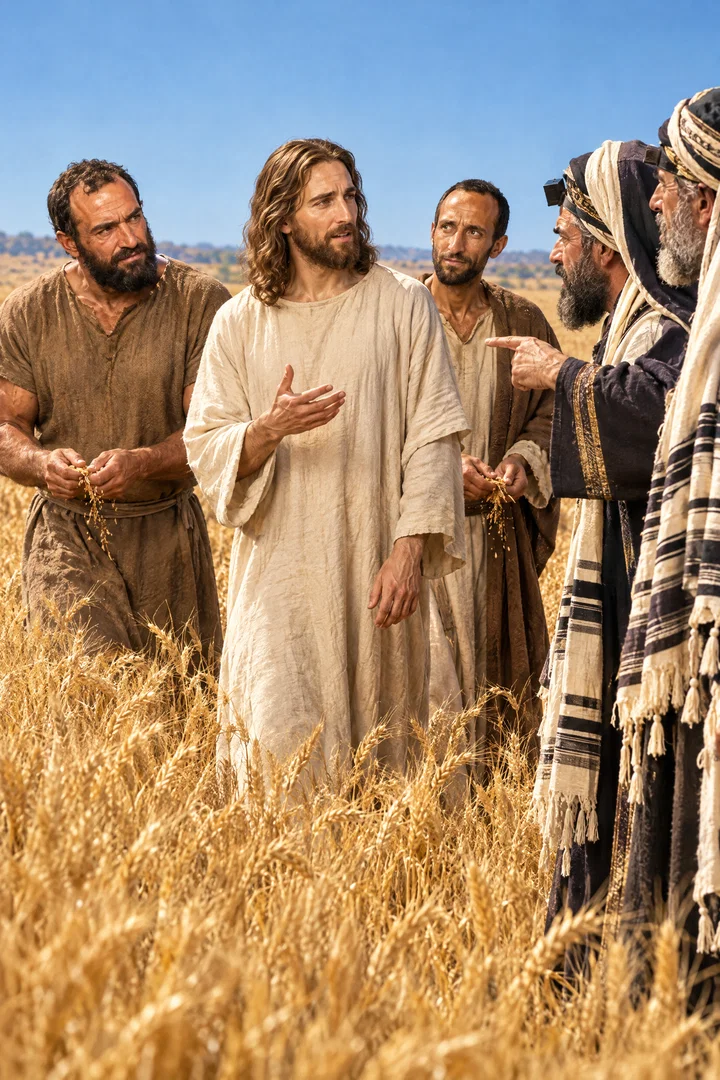
And it came to pass on the second sabbath after the first, that he went through the corn fields; and his disciples plucked the ears of corn, and did eat, rubbing them in their hands.
Luke recounts the grainfield dispute and Jesus’ defense, including David’s example.
- 1 Samuel 21:1-6
Then came David to Nob to Ahimelech the priest: and Ahimelech was afraid at the meeting of David, and said unto him, Why art thou alone, and no man with thee?
David’s eating of the showbread parallels the priests’ Sabbath service in Jesus’ defense.
- Matthew 5:17-19
Think not that I am come to destroy the law, or the prophets: I am not come to destroy, but to fulfil.
Jesus fulfills rather than abolishes the law, affirming its continuing force in the Sabbath dispute.
- Isaiah 58:13
If thou turn away thy foot from the sabbath, from doing thy pleasure on my holy day; and call the sabbath a delight, the holy of the LORD, honourable; and shalt honour him, not doing thine own ways, nor finding thine own pleasure, nor speaking thine own words:
Both texts address honoring the Sabbath as God’s holy day.
- Luke 4:16
And he came to Nazareth, where he had been brought up: and, as his custom was, he went into the synagogue on the sabbath day, and stood up for to read.
Jesus’ customary Sabbath worship exemplifies his observance of the Sabbath.
- John 5:17
But Jesus answered them, My Father worketh hitherto, and I work.
Jesus appeals to the Father’s continuing work to explain his Sabbath activity.
- Luke 13:15-16
The Lord then answered him, and said, Thou hypocrite, doth not each one of you on the sabbath loose his ox or his ass from the stall, and lead him away to watering?
Jesus defends freeing a sufferer on the Sabbath as a lawful act of mercy.
- Genesis 2:2-3
And on the seventh day God ended his work which he had made; and he rested on the seventh day from all his work which he had made.
God’s rest, blessing, and sanctification at creation ground the Sabbath.
- Mark 3:1-5
And he entered again into the synagogue; and there was a man there which had a withered hand.
Jesus heals on the Sabbath and contrasts doing good with doing evil.
- Leviticus 24:5-9
And thou shalt take fine flour, and bake twelve cakes thereof: two tenth deals shall be in one cake.
The priests set out the showbread in the sanctuary each Sabbath.
- Mark 2:28
Therefore the Son of man is Lord also of the sabbath.
Jesus declares himself Lord of the Sabbath.
- Colossians 2:16
Let no man therefore judge you in meat, or in drink, or in respect of an holyday, or of the new moon, or of the sabbath days:
Its plural “sabbath days” is linked to the seventh-day Sabbath.
- John 7:23
If a man on the sabbath day receive circumcision, that the law of Moses should not be broken; are ye angry at me, because I have made a man every whit whole on the sabbath day?
Jesus defends Sabbath healing by pointing to lawful circumcision on the Sabbath.
- Luke 14:1-5
And it came to pass, as he went into the house of one of the chief Pharisees to eat bread on the sabbath day, that they watched him.
Jesus heals on the Sabbath and teaches that doing good then is lawful.
- Numbers 15:32-36
And while the children of Israel were in the wilderness, they found a man that gathered sticks upon the sabbath day.
Contrasts the priests’ blameless Sabbath service with defiant Sabbath-breaking punished in the wilderness.
- John 9:14
And it was the sabbath day when Jesus made the clay, and opened his eyes.
Jesus heals on the Sabbath, prompting criticism.
Commentary
Each commentary is drawn from primary sources: the writings of Ellen G. White and Adventist pioneers and periodicals. Each commentary is separate. Its own words are not a quotation; follow the references to read the source passages.
Ellen G. White
15 sources
When the Pharisees charged the hungry disciples with doing what is not lawful by plucking grain and rubbing it in their hands as they passed through the field, Christ answered first from David eating the shewbread and then from the law of the priests, and followed it by declaring one greater than the temple present, mercy required rather than sacrifice, and the Son of man Lord even of the Sabbath day.Ms 31a, 1898, par. 1–314MR 335.1–3 To profane the Sabbath and yet be blameless means the priests do the temple's required work and added sacrifices on the Sabbath, labor that would otherwise profane it, but are guiltless because it serves God's worship and pointed to Christ's redeeming work.DA 284.2–285.315MR 247.1–248.1ST Sep 16, 1913 In the same way the disciples in gathering grain to satisfy hunger and sustain themselves for God's service were blameless, acting also under the law's permission for a hungry man to eat from his neighbor's field and for the poor to share in the soil's produce.ST Sep 16, 19134RED 48.2–49.1PP 531.1–2 He who spoke is greater than the temple, the Maker and Lord of the Sabbath, who by His own authority defends His followers and declares them guiltless.DA 284.2–285.3STMW6 43.218MR 155.1–3 He upheld the Sabbath of God's law as still binding while rejecting distorted human requirements and oppressive restrictions, and His Sabbath actions with His disciples were in perfect harmony with the commandment so that no charge of Sabbath-breaking could be proved.ST Jul 29, 1897PK 183.1RH May 28, 1901Ms 43b, 1891, par. 9 Work needed for God's service or for human need does not violate the Sabbath though the same labor for ordinary business would, for the Sabbath was set apart to be a delight and not to forbid happiness, walking outdoors, or teaching by the lakeside outside enclosed walls.15MR 247.1–248.14RED 48.2–49.1Ms 3, 1879, par. 4–5
Verse Setting and Sense
The saying belongs to the dispute over going through the grainfields on the Sabbath, when the Pharisees charged the hungry disciples with doing what is not lawful by plucking ears of wheat, rubbing the kernels in their hands, and eating as they went through the field, the same controversy that includes healing a man with a withered hand.Ms 31a, 1898, par. 1–314MR 335.1–3 It was spoken from the law as Christ's answer to that accusation, coming right after the example of David entering the house of God and eating the shewbread with those who were with him.Ms 31a, 1898, par. 1–3 Its purpose was to show that the priests in the temple do work on the Sabbath days and are blameless, and thereby that the disciples were guiltless.Ms 31a, 1898, par. 1–3 Immediately after it came the declaration that in that place was one greater than the temple, that mercy is required rather than sacrifice, and that the Son of man is Lord even of the Sabbath day.Ms 31a, 1898, par. 1–3
To profane the Sabbath yet be blameless means the priests carry on the temple's required work and offer additional sacrifices on the Sabbath days.DA 284.2–285.315MR 247.1–248.1 That labor involves work otherwise described as profaning the Sabbath, yet they are blameless because it serves God's worship.DA 284.2–285.315MR 247.1–248.1ST Sep 16, 1913 Their service pointed to Christ's redeeming work, and work needed for God's work of redeeming people accords with the Sabbath law.DA 284.2–285.3 By that temple example the gathering and eating of grain to satisfy hunger was likewise in harmony with the Sabbath commandment, so Christ and His disciples were guiltless.ST Sep 16, 19134RED 48.2–49.1 Their act sustained themselves for service to God, and work needed for God's service or for human needs is not forbidden by Sabbath regulation, while comparable labor for ordinary business would violate the Sabbath.4RED 48.2–49.1
The disciples' plucking and eating of the standing grain as they passed through a field upon the Sabbath day was also in accordance with the permission of God's law.PP 531.1–2 That law gave the poor a right to a certain portion of the produce of the soil and allowed a hungry man to go into his neighbor's field or orchard or vineyard and eat of the grain or fruit to satisfy his hunger.PP 531.1–2 The verse thus presents in that place one greater than the temple, even the Lord who made the Sabbath.DA 284.2–285.3STMW6 43.218MR 155.1–3 By His own authority He defends the disciples' act, shields them, and declares them guiltless.DA 284.2–285.3Ms 43b, 1891, par. 9 The charge of the Jewish rulers, scribes, and Pharisees that Jesus broke or transgressed the Sabbath, though He is its Maker and Lord, was foolish, unjust, and blind, showing how blindly people can misjudge Sabbath observance and its Maker, and Sabbath observance was not meant to be a yoke of oppressive human restrictions.STMW6 43.218MR 155.1–3Ms 43b, 1891, par. 9Ms 43b, 1891, par. 1
Sabbath Teaching and Practice
Christ upheld the Sabbath according to God's law, which remains binding, and not according to distorted rules imposed by religious leaders.PK 183.1 His example rejects human requirements that misrepresent God's character and that would make Sabbath observance a yoke of oppressive restrictions.PK 183.1Ms 43b, 1891, par. 9 When the disciples plucked and ate grain on the Sabbath He defended their act as innocent and shielded them with His own authority.Ms 43b, 1891, par. 9 The example of the priests in the temple shows that service to God could involve work on the Sabbath without making them guilty.Ms 43b, 1891, par. 9
The defense declares the disciples guiltless, for their actions in plucking grain and eating it were in harmony with the Sabbath commandment.ST Jul 29, 1897 No charge of Sabbath-breaking could be proved against Christ, for His works were in perfect harmony with God's law.ST Jul 29, 1897RH May 28, 1901 His obedience in human nature shows that God's law can be kept.RH May 28, 1901
The Jewish rulers accused Jesus of breaking the Sabbath, even though He made the Sabbath and is its Lord.STMW6 43.2 That accusation was foolish and unjust.STMW6 43.2 The scribes and Pharisees accused the Lord who made the Sabbath of transgressing it, and their charge shows how blindly people can misjudge Sabbath observance and its Maker.18MR 155.1–3Ms 43b, 1891, par. 1
Sabbath regulations do not forbid work needed for God's service or for human needs.4RED 48.2–49.1 The priests' work in the temple on the Sabbath, including additional sacrifices, was lawful because it served God's worship, though comparable labor for ordinary business would violate the Sabbath.15MR 247.1–248.14RED 48.2–49.1 The disciples' act of gathering grain to sustain themselves for service to God was therefore blameless, and this temple example supports Jesus' defense of the disciples and His authority as Lord of the Sabbath.4RED 48.2–49.1 Necessary religious service is therefore not a sin or violation of the Sabbath, as applied to writing on the Sabbath.15MR 247.1–248.1
The Sabbath is a day set apart by God to be a delight, not a day when happiness or walking outdoors is forbidden.Ms 3, 1879, par. 4–5 Christ taught His disciples by the lakeside on the Sabbath, proving that Sabbath teaching need not take place within enclosed walls.Ms 3, 1879, par. 4–5
Sources
Pioneers and periodicals
109 sources
Jesus used the priests to answer the charge that the hungry disciples broke the Sabbath by plucking grain as they walked through the field.RH Feb 4, 1862ST Apr 14, 1881ST Feb 17, 1898 On the Sabbath the priests did increased bodily labor in offering doubled sacrifices, preparing fires and replacing the showbread, yet were blameless because they were obeying God's law and doing His worship and not their own secular work for profit or pleasure.RH Jun 10, 1852RH Nov 4, 1858RH Feb 3, 1852RH Oct 29, 1914RH Nov 4, 1858 By that example He declared the disciples guiltless, showing their eating to satisfy hunger was lawful under the fourth commandment and condemned only by human tradition.RH Mar 1, 1864RH Jan 8, 1857ST Feb 26, 1885 The verse therefore teaches that the Sabbath does not forbid all work, but allows works of necessity that sustain life, works of mercy and doing good like healing, and work directly required for God's worship.ST Jan 31, 1911ST Apr 10, 1893RH Jul 18, 1912RH Jan 28, 1873 As one greater than the temple and as Creator and Lord of the Sabbath, Christ has authority to declare what is lawful on it, and He upheld it as the binding seventh-day institution rather than abolishing or moving it.RH Mar 1, 1864ST Mar 10, 1898ST Mar 11, 1889ST Feb 18, 1886
Setting and Wording
The verse belongs to the dispute over the hungry disciples plucking ears of grain and eating as they walked through the field on the Sabbath, which the Pharisees charged as doing what is not lawful.RH Feb 4, 1862ST Apr 14, 1881ST Feb 17, 1898ST Jun 26, 1901 Jesus answered that charge by appealing to the law itself, where the priests in the temple do work on the Sabbath days that profanes the Sabbath and yet are blameless.RH Feb 4, 1862ST Feb 17, 1898 He joined this with the example of David entering the house of God and eating the showbread that belonged only to the priests, with the declaration that one greater than the temple is present, with the requirement of mercy rather than sacrifice, with the truth that the Son of man is Lord of the Sabbath, and with the proof that it is lawful to do good by healing.RH Feb 4, 1862ST Feb 17, 1898
The grain-field eating stands in immediate connection with the healing of the man with the withered hand, going from the cornfield directly to the synagogue where the healing took place.ST Feb 17, 1898ST Nov 11, 1897 Eating ears of grain to relieve hunger and healing the sick are lawful on the Sabbath and exactly adapted to the sabbatic institution, as deeds of mercy for the relief of suffering and the honor of God rather than careless or irreverent violation of the law.RH May 5, 1874ST Nov 11, 1897 With the statement that the Sabbath was made for man, this connection explains that it is lawful to do well on the Sabbath days.RH May 5, 1874ST Nov 11, 1897
Jesus called to the Pharisees' minds a fact already familiar to them after reminding them what David did.ST Feb 17, 1898 The Jews of that time were strict and particular about keeping the Sabbath, and they watched Jesus in order to accuse him.ST Apr 9, 1894 The offense charged was not against the Sabbath law itself but against Jewish tradition that loaded the day with extra bans, regarding the disciples' rubbing out grain while traveling hungry as forbidden reaping and threshing.ST Mar 21, 1878ST Sep 8, 1881ST Oct 29, 1896 That tradition turned human need into an oppressive rule, while Jesus did not rebuke the disciples and taught that such acts of need are lawful, agreeable to and in perfect harmony with the fourth commandment.ST Mar 21, 1878ST Oct 29, 1896
The plural Greek form sabbata in the verse means the Sabbath day, not a week, as used by the first three evangelists for the Sabbath.RH Nov 8, 1853RH Jan 29, 1867RH Jun 5, 1860 The word sabbaton in singular or plural refers to cessation from labor, rest, or the Sabbath, the seventh day of the week.RH Nov 8, 1853RH Dec 15, 1863RH Apr 24, 1879 It is included among New Testament texts that call the seventh day the Sabbath, though the word does not necessarily refer to the seventh day every time it is used.RH Jun 5, 1860RH Dec 15, 1863RH Apr 24, 1879
Profane means to treat the Sabbath as common or irreverently, and the same Greek verb is also used of profaning the temple in Acts 24:6.RH Jul 8, 1875ST Nov 7, 1878 The term describes ordinary labor that would have profaned the day if it had not been required by divine appointment, and does not mean the priests were doing wrong in performing their necessary temple service.RH Aug 15, 1854RH Jul 8, 1875 Christ's enemies accused him of profaning the Sabbath, but he showed his actions were lawful and exposed their false ideas, while Sabbath profanation remains a real offense and his conduct was not Sabbath-breaking.RH Aug 15, 1854RH Jul 8, 1875ST Nov 7, 1878 Without repealing or changing the Sabbath commandment, he used the priests' case to defend the disciples' limited work of plucking and rubbing grain to satisfy hunger, since the Sabbath allows time for necessary meals and mercy takes precedence over sacrifice.RH Aug 15, 1854
Priests' Temple Service
On the Sabbath the priests carried out the temple service with bodily labor that included offering sacrifices, killing beasts, preparing fires for burning offerings, replacing the showbread, and other work connected with that service.RH Nov 4, 1858RH Nov 4, 1858ST Nov 11, 1889ST Feb 10, 1904ST Oct 31, 1906 Alongside the daily offerings they offered two additional victims, so that the offerings were doubled, and their ministry was increased and greater on the Sabbath than on other days.RH Nov 4, 1858RH Nov 4, 1858ST Sep 23, 1913ST Feb 10, 1904ST Oct 31, 1906 That increased work could be described as profaning the Sabbath, yet those who performed the sanctuary duties were blameless and guiltless, which shows that the Sabbath law does not forbid religious service and that work required by the temple service did not make them guilty of breaking the Sabbath.ST Jul 8, 1897ST Feb 10, 1904ST Nov 11, 1889ST Sep 23, 1913ST Feb 10, 1904 Their Sabbath service shows that work required for public service to God was permitted, and that service was not diminished on the Sabbath but increased, supporting earnest spiritual activity rather than idleness while refraining from one's own ways, pleasure, and words.RH Nov 4, 1858ST Sep 23, 1913ST Oct 31, 1906
That service was required by God's law through special enactments and the ceremonial law, not part of the Sabbath's original institution.ST Jul 8, 1897ST Feb 10, 1904RH Aug 27, 1857ST Feb 7, 1911RH Jan 21, 1862 The priesthood was instituted before the man in the wilderness was stoned for Sabbath-breaking, so the law stood in its fullest, unrelaxed force after the time when the priests are claimed to have continually transgressed it.RH Aug 27, 1857 Those enactments did not relax the claims of the Sabbath law and gave no intimation that the law was any less binding or the Sabbath any less sacred, but only proved the claims of the law by foreshadowing the necessary consequence of its transgression.ST Jul 8, 1897RH Aug 27, 1857ST Aug 24, 1888 The priests could not be charged with breaking the law, since the law itself allowed that service and required those duties, and what would otherwise count as Sabbath profanation was lawful temple duty rather than a burden of human tradition.ST Feb 10, 1904RH Aug 27, 1857ST Feb 7, 1911RH Jan 21, 1862ST Aug 24, 1888
They were blameless because they were obeying God and exclusively engaged in his service and worship, not doing their own work, secular business, ordinary labor for livelihood and worldly needs, or work for their own pleasure, profit, and individual interests.RH Jun 10, 1852RH Feb 3, 1852ST Apr 5, 1883RH May 27, 1873ST Oct 31, 1906 What the commandment calls thy work does not include maintaining God's appointed worship, for the Sabbath command forbids people's own work, not work done for the Lord, and work required for worship is lawful on the Sabbath.RH Oct 29, 1914ST Apr 5, 1883RH May 27, 1873 Their preparation of sacrifices involved work that would otherwise count as servile, yet it served the merciful purpose of dealing with the people's sins, showing that keeping the Sabbath does not forbid necessary work done for mercy.RH Jun 10, 1852RH Feb 3, 1852RH Sep 2, 1851 Christ used this example together with David's act of mercy to show that the hungry disciples were guiltless when they gathered grain to eat, since Sabbath requirements do not forbid work that serves God or meets human need and doing good is in harmony with the divine law.RH Jun 10, 1852RH Feb 3, 1852RH Oct 29, 1914
Their example does not permit any amount of labor on the Sabbath, for what is lawful depends on the circumstances and the purpose of the act.RH Jun 10, 1852RH Feb 3, 1852RH Feb 3, 1852 It supports the distinction between forbidden secular work and work done in God's service, and does not make ordinary Sabbath labor permissible or justify willful violation of the fourth commandment.RH Jun 10, 1852RH Feb 3, 1852RH Feb 3, 1852RH Feb 3, 1852 Their case did not relax or suspend the Sabbath law, since an act of mercy is in keeping with the law and is not a violation of the Sabbath.RH Feb 3, 1852RH Feb 3, 1852 Their work was a shadow of Christ's work, and because Christ and his work are greater than the temple and its symbolic service, Jesus and his disciples were guiltless in carrying forward the real work, so that work necessary for the Gospel or the worship of God is lawful on the Sabbath. To be a priest under that system was not rest, because the Levitical priests had to continue their work on the Sabbath of necessity, and their responsibility was very small compared with that of Jesus Christ, whose whole work of priesthood still lay untouched after he was raised from the dead, so the time for his rest had not come at his resurrection.RH Oct 12, 1869
Christ's Defense of Disciples
When charged with doing what is not lawful because his hungry disciples plucked and ate grain on the Sabbath, Jesus answered from the law itself by pointing to David entering the house of God and eating the showbread that belonged only to the priests, and to the priests in the temple doing work on the Sabbath days that profanes the Sabbath and yet leaves them blameless.RH Feb 4, 1862ST Feb 17, 1898RH Sep 1, 1859 That defense declared one greater than the temple present in that place, called for mercy rather than sacrifice as what God requires, affirmed the Son of man as Lord even of the Sabbath day, and proved it lawful to do good on the Sabbath by healing.RH Feb 4, 1862ST Feb 17, 1898 The action was lawful under the divine law governing Sabbath observance, identified with the commandment that makes the seventh day the Sabbath.RH Nov 2, 1911 The same defense is set against enforcing Sabbath practice by coercion, contrasting the seventh-day Sabbath with observance of the first day.RH Sep 1, 1859
He vindicated the hungry disciples and declared them guiltless, showing their gathering of grain to eat was merciful and lawful according to the fourth commandment.ST Jul 29, 1897RH Mar 1, 1864ST Feb 26, 1885 Their act did not break God's law but only Jewish tradition, and those who accused them had condemned the guiltless.ST Jul 29, 1897ST May 17, 1910RH May 13, 1875 Hunger justified the plucking of grain as necessary service consistent with the day's sacred purpose, and the priests' blameless temple work confirmed that Sabbath restrictions did not forbid such acts.RH Jan 8, 1857ST Feb 26, 1885 Truth is thus set against tradition rather than spirit against letter, for what is lawful stands in perfect harmony with law and it is lawful to do well on the Sabbath day.ST May 17, 1910 The lesson is to rightly divide duty by putting first the weightier matters of judgment and mercy and faith, without leaving undone the smallest things, with all else following in harmony with those principles.ST May 17, 1910
Jesus and his disciples did only what was lawful on the Sabbath and did not break the Father's law, so the Sabbath remained in full force at that time even on the claim that it was abolished at the crucifixion.RH Aug 27, 1857 No charge of Sabbath-breaking against him could be proved, because his works were in perfect harmony with God's spiritual, just, and good commandments and committed no sin.RH May 28, 1901ST Jun 26, 1901 The accusation by his enemies that he caused Sabbath-breaking was false.ST Jun 26, 1901 To say he broke it without necessity while it was in force would leave him no longer a pattern to follow, and if he had transgressed God's law by healing on the Sabbath or walking through the grainfield with his disciples he would have been a sinner and could not be the sinless sacrifice for humanity.RH Aug 27, 1857RH Nov 1, 1853 His obedience in human nature shows God's law can be kept, meeting the demand for righteousness exceeding that of the scribes and Pharisees without abating one jot or tittle of the law.RH May 28, 1901
This was the first New Testament controversy over Sabbath observance, concerning not its sacredness or perpetuity but the manner in which it should be kept.RH Apr 21, 1868 Christ used the priests' case, whose temple work profanes the Sabbath yet is lawful, to lay down his right to determine how the Sabbath is kept.RH Apr 21, 1868RH Mar 14, 1854 The Sabbath must be distinguished from Pharisaic austerities by determining what is lawful to do on that day.RH Mar 14, 1854RH Jan 13, 1852 For the Son of man is Lord even of the Sabbath day, and lord means a ruler with authority and jurisdiction whose decision is broad, positive, final, and without appeal.RH Apr 21, 1868
What Is Lawful
Sabbath keeping does not forbid every kind of work, for works of necessity that sustain life and relieve suffering are lawful.ST Jan 31, 1911ST Jul 1, 1908ST Sep 19, 1911ST The disciples taking grain for food when hungry, rescuing a sheep fallen into a pit, loosing an ox to water it, and loosing a woman bound eighteen years are of this kind, as are building a fire for one freezing to death, cooking for one starving, and kindling fire when necessary for life and comfort.ST Apr 10, 1893ST Jul 1, 1908ST Sep 19, 1911ST Lending an article such as a rake or hoe for a plainly indispensable use like relieving pain, sickness, or burial is likewise lawful.RH Sep 4, 1860 The priests' required temple service shows the same rule, since in the ordinary sense it profaned the Sabbath yet they were blameless because that service was lawful and necessary.ST Jan 31, 1911ST Apr 10, 1893ST Jul 1, 1908
Works of mercy, piety, and doing good are lawful and fulfill the law's highest requirements.RH Jul 18, 1912RH Jan 28, 1873ST Jan 25, 1910 Healing the sick, freeing sufferers, and relieving the afflicted accord with the design of the Sabbath, are made for man's good, and are done for the relief of suffering and the honor of God, not in a careless or irreverent manner.RH Jul 18, 1912ST Jan 25, 1910RH May 5, 1874 Teaching God's truth is compatible with keeping the seventh-day Sabbath, and keeping it calls for earnest spiritual activity rather than idleness or mere inaction, while refraining from one's own ways, pleasure, and words.RH Oct 18, 1906ST Oct 31, 1906 The Sabbath was made for man and not man for the Sabbath, so such acts honor God and bless people, and the Sabbath should be devoted to deeds of mercy and benevolence.ST Apr 10, 1893RH Jan 28, 1873RH May 5, 1874
Work required for worship and direct service to God is in harmony with the Sabbath commandment.ST Jul 1, 1908ST Jun 20, 1911STRH May 27, 1873 Temple duties and religious service, including twice the usual number of lamb offerings, could be done by priests on the Sabbath without guilt, and giving an offering to God as worship not business belongs to the same class.ST Jun 20, 1911STRH May 27, 1873ST Oct 31, 1906 Necessary travel to worship is comparable service that supports keeping the day holy.RH Feb 5, 1857 By contrast the Sabbath forbids work done for one's own profit, pleasure, trade, and ordinary interests, and is for rest, blessing, and enjoyment of God's works rather than personal profit.ST Jul 1, 1908RH Feb 5, 1857
Where fire or other work is unnecessary, as with Israel in the wilderness, doing it on the Sabbath is just as sinful now as then.ST Apr 10, 1893 Boiling, frying, baking, washing dishes, sweeping, and farm chores after the Sabbath begins remain doubtful under the fourth commandment when they are not really necessary and might have been done before.RH Jul 29, 1862 Lending anything for common use is unlawful, and knowingly helping another break the Sabbath makes the lender share guilt in the offense.RH Sep 4, 1860 Sabbath travel for meetings treated as ordinary visiting, cutting wood, ordinary secular transactions that can be done another day, and travel for pleasure or business violate the Sabbath by pursuing ordinary interests instead of its sacred purpose.RH Feb 5, 1857RH Nov 8, 1853 Deciding what household work is necessary is left to individual conscience before God. The law forbids all labor except work required by necessity or mercy, clearly expressed by divine authority in solemn language with no other exceptions, so using necessity and mercy to defend other Sabbath breaking abuses that doctrine and disobeys the command to rest on the seventh day even in busy times.RH Jun 18, 1861
Christ's Authority and Example
As one greater than the temple, Jesus as Creator and Lord of the Sabbath has right as master and proprietor to declare what is lawful on it, a lordship grounded in his making the worlds and appointing the order of evening and morning and seven days with the seventh day in remembrance of creative work, a dominion he still holds with nothing relinquishing it.ST Mar 11, 1889ST Feb 18, 1886 Because he knows its purpose as a blessing for humanity, doing good on the Sabbath is lawful, and the priests may perform temple duties on the Sabbath that would otherwise count as profaning it and remain blameless.ST Apr 14, 1881ST Mar 11, 1889 The disciples' act of plucking and eating grain to sustain their strength for God's service was likewise lawful, since that Sabbath work served God while the same labor done as ordinary business would violate the Sabbath, and as Lord of the Sabbath he had authority to declare them blameless.ST Apr 14, 1881 His lordship over the Sabbath means responsibility to protect and restore its proper use by freeing it from abuses imposed by tradition, not permission to abolish it.
His authority as Lord of the Sabbath also establishes the correct Sabbath reckoning if any time had been lost during the Levitical dispensation, so that the Sabbath recognized by Christ and his apostles was the original seventh day in continuous weekly succession.ST Mar 25, 1889
Christ kept the seventh-day Sabbath according to the law as one of God's spiritual, just, and good commandments, not after a formal manner of boasting in righteousness, doing only what is lawful on the Sabbath and therefore committing no sin.ST Apr 10, 1893 The charge of Sabbath-breaking against him was false even by strict conception, for his healing work was lawful as fully in accord with the law, so to condemn him was to condemn the guiltless, just as the priests' temple service does not make Sabbath observance unlawful.ST Apr 10, 1893RH Jul 25, 1912 Lawful Sabbath work of that kind includes what is necessary to relieve suffering, as with rescuing a sheep fallen into a pit, loosing an ox to water it, and loosing a woman bound by infirmity eighteen years, and for the same reason building a fire for one freezing to death and cooking for one starving are lawful, because the Sabbath was made for man and not man for the Sabbath.ST Apr 10, 1893 Where fire or other work is unnecessary, as with Israel in the wilderness, doing it on the Sabbath is just as sinful now as then.ST Apr 10, 1893 He recognized the Sabbath as part of God's law and observed it according to its true spirit and according to God's word even while denounced as a Sabbathbreaker, showing great regard for the Sabbath of the Lord, the seventh day of the week, with the priests' necessary temple work not making them guilty of breaking the Sabbath.RH Jul 25, 1912RH May 20, 1909RH Apr 10, 1916 By precept and example throughout his earthly ministry as creator and Lord he gave mankind an example of proper Sabbath observance to be followed, enjoining its proper observance on others and making no suggestion of a change in the day of its observance after his death.RH Jul 15, 1915RH May 20, 1909
Sabbath Continuity and Day
Christ's answer cleared away human traditions and left the Sabbath itself standing, recognizing it as part of God's law and as a divine institution still binding in the gospel age as a sufficient rule of faith and practice, without changing the law, relaxing it, abolishing it, or moving it to another day.RH Mar 1, 1864ST Mar 10, 1898RH Jul 25, 1912ST Aug 6, 1912RH Nov 2, 1911 His vindication of the hungry disciples and of healing on the Sabbath showed those merciful acts to be lawful according to the fourth commandment, and identified the governing law with the commandment that makes the seventh day the Sabbath.RH Mar 1, 1864RH Jul 25, 1912ST Aug 6, 1912RH Nov 2, 1911 Jesus and his disciples did only what was lawful and did not break the Father's law, which was still in full force at that time even on the claim that it was abolished at the crucifixion, so to say he broke it without necessity leaves him no longer a pattern to follow.RH Aug 27, 1857
The Sabbath is not a type or shadow abolished with the old system, but was instituted in Eden, made for all humanity and not for Jews only, and remains sacred, so its reasons and obligation apply to Christians as well and transgressing its commandment is sin because it is part of God's law.RH Apr 5, 1860RH Oct 3, 1865 Permission to do well on the Sabbath does not take away the holiness of the day and does not mean it is not to be kept in a special way, for Jesus still honored it and laid its observance on his disciples.ST Mar 16, 1904 The promise of a Saviour did not affect the Sabbath, and its fulfillment in Christ embraced no more than the promise contained, so Christ would not attempt to overthrow it and his teaching left it intact, and as Lord of the Sabbath he did not abolish his memorial of creation and of redemption.ST Mar 16, 1904
The day at issue was the seventh day, not the first day of the week or Sunday, the day the Jews regarded as the Sabbath and the day before the Roman Sunday, so Christ's reply about being Lord of the Sabbath refers to the seventh day, gives no instruction about Sunday, cannot be used to identify another day as the Sabbath, and has no application to Sunday.ST Apr 11, 1900ST Apr 15, 1886RH May 17, 1906ST Jul 23, 1912 The Fourth Commandment therefore teaches observance of the seventh day, and keeping that Sabbath is distinct from Sunday's weekly rest arising through civil legislation and is not an effort to Judaize the church.
The controversy concerned how the Sabbath should be observed, not which day is the Sabbath, for Jesus and his disciples were challenged over practices but were not accused of keeping the wrong day.ST Jun 6, 1878ST Oct 17, 1900 Jesus emphatically endorsed the continued existence of the Sabbath and the lawfulness of observing it by teaching that doing good on the Sabbath is lawful, claiming it as his own as Lord of the Sabbath with right as master and proprietor to declare what is lawful on it, a dominion grounded in his making the worlds and appointing evening and morning and seven days with the seventh in remembrance of creative work, which he still holds without relinquishing.ST Feb 18, 1886 He rejected Pharisaic traditions and upheld the law, while he and the apostles kept the Sabbath by custom through resorting to the synagogues for public worship, his followers after his death prepared spices on the preparation day then rested on the Sabbath according to the commandment and came on the first day of the week, he told disciples to pray their flight at Jerusalem's destruction would not be on the Sabbath, and the absence of any charge by the Jews against the disciples after his death and resurrection for violating or subverting the Sabbath proves no new day was introduced in place of the seventh day the commandment requires.ST Mar 16, 1904ST Feb 18, 1886ST Feb 7, 1911ST Jun 6, 1878
Some held that the Sabbath is a positive institution rather than a moral principle because Jesus compared the disciples' hunger with David's eating the showbread against a positive law without guilt, a comparison which in that argument would fail if the Sabbath were moral since the cases would lack the same basis for treating the hungry as guiltless.RH Nov 12, 1872 Others held that his plucking grain was a deliberate sign that the Jewish priesthood had ended and passed to his disciples, since the grain was not to be eaten until the wave sheaf had been presented to the priest and his giving it to them transferred the priestly role, so that with changed priesthood came changed law and the Jewish Sabbath was abolished.RH Sep 30, 1858 Still others held that Christ commanded labor so men are not forbidden to labor, that the cornfield incident itself abolished the Sabbath, that classing the Sabbath with ceremonies proves it ceremonial and of the same nature as the law of Moses, and that Jesus sat at meat with publicans and plucked corn on Sunday so prosecuting quiet Sunday labor while keeping Saturday holy is contrary to his example.RH Aug 13, 1857RH Apr 19, 1870ST Sep 22, 1909RH Feb 26, 1857
Against those claims, classing with ceremonies proves the opposite rather than proving the seventh-day Sabbath a prominent ceremonial part of the law of Moses.RH Aug 13, 1857 Jesus did not say the Jews had misidentified the Sabbath, and his example of the blameless temple priests did not transfer the Jewish priesthood to his disciples nor require a change of Sabbath law with a changed priesthood.RH Oct 21, 1858 He separated human traditions from the Sabbath and restored it as a merciful institution, yet the Sabbath remains the seventh day commanded in the moral law and not merely any one day in seven, the priests' service does not abolish the commandment or change the memorial of creation, and his actions in keeping the Fourth Commandment while rejecting additions do not excuse lax observance.ST Jul 29, 1880 Keeping Saturday holy while working Sunday fulfills the law of God as it should of man.ST Sep 22, 1909
Christ brings over the Sabbath on the authority of the original law, not as a new command on a new score, quoting the commandments including the Sabbath on that authority as with stealing and the other nine, with special bearing in verses 7, 10 and 12. He found the Jews strict and particular about keeping the Sabbath, showing it had not been lost before his time.
Purpose and Right Use
Jesus rebuked slavish keeping of the Sabbath and by His own example showed how it should be observed.ST Mar 10, 1898ST Mar 30, 1888ST Aug 6, 1912ST Jun 11, 1894 His defense belonged to the charge over the disciples and the healing of the man with the withered hand, in which eating ears of corn to relieve hunger and healing the sick were lawful and exactly adapted to the sabbatic institution.ST Mar 30, 1888ST Jun 11, 1894RH May 5, 1874 The priests' temple service with its additional offerings involved work on the Sabbath yet left them blameless, proving that proper keeping is not a ban on every act of service and that necessity and mercy are compatible with observance.ST Mar 10, 1898ST Mar 30, 1888ST Jun 11, 1894RH May 5, 1874 That defense cleared away useless, rigorous and burdensome human traditions and rules that made the day a yoke of bondage, restoring it from those rules to its original simplicity, true meaning and sacredness.ST Mar 10, 1898ST Mar 30, 1888ST Aug 6, 1912ST Jun 11, 1894RH May 5, 1874 So restored, the Sabbath stands as a merciful institution made for man's good, for blessing, joy, delight, helpfulness, relief of suffering, honor of God, and enjoyment of His works, kept not in a careless or irreverent manner but in accord with God's law and without changing the law or moving the day to another.ST Mar 10, 1898ST Aug 6, 1912ST Jun 11, 1894RH May 5, 1874
The restoration sets truth against tradition, not spirit against letter, for what is lawful is in perfect harmony with law and it is lawful to do well on the Sabbath.ST May 17, 1910 The disciples broke only Jewish tradition, not God's law, for Jesus never broke the Sabbath law but interpreted it.ST May 17, 1910 The lesson is to rightly divide duty by putting first the weightier matters of judgment and mercy and faith, with all other things following in harmony with those great principles, rather than leaving undone the smallest things.ST May 17, 1910
Permission to do well does not take away the holiness of the day and does not mean it is not to be kept in a special way.RH Apr 5, 1860ST Mar 16, 1904ST Jul 29, 1897 Jesus still honored the Sabbath and laid its observance on His disciples, as in telling them to pray that their flight at the destruction of Jerusalem would not be on the Sabbath, and as Lord He did not abolish His memorial of creation and redemption.RH Apr 5, 1860ST Mar 16, 1904 He freed the day from many rituals and from superstitious abuse without diminishing its holiness or sacredness, distinguishing proper merciful use and meeting of genuine need from breaking its law, while the day remains binding and the Lord's day to be kept holy and devoted to God.RH Apr 5, 1860ST Mar 16, 1904ST Jul 29, 1897 Its meaning and observance must be judged by God's law, not by a state's ruling, and religious people must not condemn others over observance while failing to see their own inconsistencies, using religious rules to compel conformity or forcing observance by courts against the positive command of the Almighty.ST Nov 21, 1911ST Feb 2, 1915ST Nov 21, 1895
Sabbath actions required in God's service and done for His glory are not violations, as the priests performed temple service that would ordinarily count as profaning the day yet were blameless because that service was required.ST Jun 4, 1874RH May 19, 1851RH Aug 27, 1914RH Feb 25, 1873RH Nov 16, 1914 Their example supports the declaration that the hungry disciples were guiltless, for eating when hungry did not violate the law any more than lawful temple service did, and the verse does not relax the commandment but shows those acts were consistent with it.ST Jun 4, 1874RH May 19, 1851RH Feb 25, 1873 The principle is that necessary service, doing good, showing mercy, meeting genuine need, and relieving the sick and suffering express the true manner and spirit of Sabbath observance against restrictive human traditions that make the day a burden.ST Jun 4, 1874RH Aug 27, 1914RH Jan 21, 1915RH Nov 16, 1914 Such service must not be made a burden by human restrictions nor turned to self-serving pleasure, and deciding necessary household work and distinguishing need from tradition belongs to conscience before God.ST Jun 4, 1874RH Aug 27, 1914RH Jan 21, 1915
Sources