1 Samuel 21:2
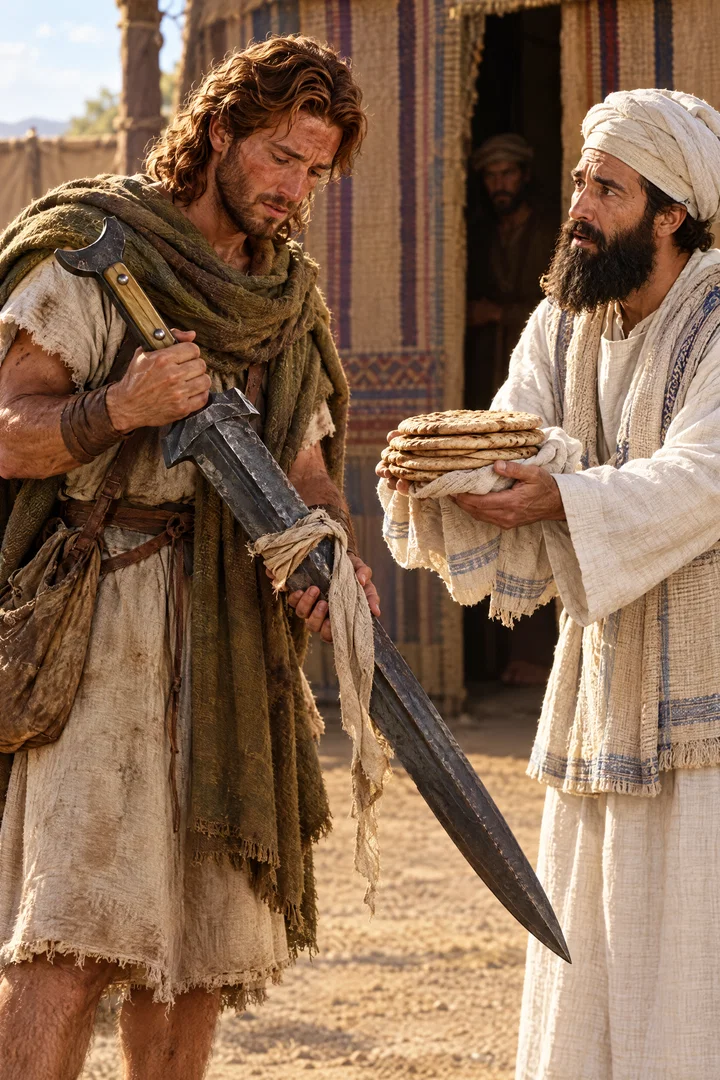
And David said unto Ahimelech the priest, The king hath commanded me a business, and hath said unto me, Let no man know any thing of the business whereabout I send thee, and what I have commanded thee: and I have appointed my servants to such and such a place.
Translations
And David said to Ahimelech the priest, The king has commanded me a business, and has said to me, Let no man know any thing of the business about which I send you, and what I have commanded you: and I have appointed my servants to such and such a place.
King James Version, KJV Cambridge Paragraph Bible
And David said unto Ahimelech the priest, The king hath commanded me a business, and hath said unto me, Let no man know any thing of the business whereabout I send thee, and what I have commanded thee: and I have appointed my servants to such and such a place.
And David said to Ahimelech the priest, The king hath commanded me a business, and hath said to me, Let no man know any thing of the business about which I send thee, and what I have commanded thee: and I have appointed my servants to such and such a place.
And David said unto Ahimelech the priest, The king hath commanded me a business, and hath said unto me, Let no man know any thing of the business whereabout I send thee, and what I have commanded thee: and I have appointed the young men to such and such a place.
And David said unto Ahimelech the priest, The king hath commanded me a business, and hath said unto me, Let no man know anything of the business whereabout I send thee, and what I have commanded thee: and I have appointed the young men to such and such a place.
And David saith to Ahimelech the priest, 'The king hath commanded me a matter, and he saith unto me, Let no man know anything of the matter about which I am sending thee, and which I have commanded thee; and the young men I have caused to know at such and such a place;
And David said to Ahimelech the priest, The king has commanded me a business, and has said to me, Let no man know anything of the business whereon I send thee, and what I have commanded thee; and I have directed the young men to such and such a place.
And David said unto Ahimelech the priest—The king, hath charged me with a matter, and hath said unto me—Let, no man, know aught of the business on which I am sending thee, and with which I have charged thee,—But, unto the young men, have I appointed, such and such a place.
“ The king has given me a mission,” David replied. “ He told me no one is to know about the mission or charge. And I have directed my young men to meet me at a certain place.
“ The king has given me a mission,” David replied. “ He told me no one is to know about the mission on which I am sending you. And I have directed my young men to meet me at a certain place.
David said to Ahimelech the priest, “ The king has commanded me to do something, and has said to me, ‘Let no one know anything about the business about which I send you, and what I have commanded you. I have sent the young men to a certain place.’
And David said to Ahimelech the priest, The king has given me orders and has said to me, Say nothing to anyone about the business on which I am sending you and the orders I have given you: and a certain place has been fixed to which the young men are to go.
And Dauid saide to Ahimelech the Priest, The King hath commanded mee a certaine thing, and hath sayd vnto me, Let no man know whereabout I sende thee, and what I haue commanded thee: and I haue appointed my seruants to such and such places.
Douay-Rheims (Challoner revision)
And David said to Achimelech the priest: The king hath commanded me a business, and said: Let no man know the thing for which thou art sent by me, and what manner of commands I have given thee: and I have appointed my servants to such and such a place.
Pictures
Cross-references
- Matthew 12:3-4
But he said unto them, Have ye not read what David did, when he was an hungred, and they that were with him;
Jesus cites David’s hungry companions eating the restricted showbread to defend his disciples.
- Mark 2:25-26
And he said unto them, Have ye never read what David did, when he had need, and was an hungred, he, and they that were with him?
Jesus cites David’s hunger and eating the showbread to defend his disciples.
- Luke 6:3-4
And Jesus answering them said, Have ye not read so much as this, what David did, when himself was an hungred, and they which were with him;
Jesus invokes David’s example of eating the consecrated bread when hungry.
- 1 Samuel 22:18-19
And the king said to Doeg, Turn thou, and fall upon the priests. And Doeg the Edomite turned, and he fell upon the priests, and slew on that day fourscore and five persons that did wear a linen ephod.
Saul massacres Nob’s priests and people because Ahimelech helped David.
- Leviticus 24:9
And it shall be Aaron’s and his sons’; and they shall eat it in the holy place: for it is most holy unto him of the offerings of the LORD made by fire by a perpetual statute.
The showbread was reserved for the priests, though David ate it.
- 1 Samuel 21:6
So the priest gave him hallowed bread: for there was no bread there but the shewbread, that was taken from before the LORD, to put hot bread in the day when it was taken away.
David receives the showbread during his visit to Nob.
- 1 Samuel 22:20
And one of the sons of Ahimelech the son of Ahitub, named Abiathar, escaped, and fled after David.
Abiathar escapes the slaughter and flees to David.
- 1 Samuel 21:9
And the priest said, The sword of Goliath the Philistine, whom thou slewest in the valley of Elah, behold, it is here wrapped in a cloth behind the ephod: if thou wilt take that, take it: for there is no other save that here. And David said, There is none like that; give it me.
David takes Goliath’s sword during his visit to Nob while fleeing Saul.
- Mark 2:27-28
And he said unto them, The sabbath was made for man, and not man for the sabbath:
Jesus uses David’s episode in a dispute about Sabbath observance.
- 1 Samuel 20
And David fled from Naioth in Ramah, and came and said before Jonathan, What have I done? what is mine iniquity? and what is my sin before thy father, that he seeketh my life?
grouped in same bitter-fruit-of-jealousy reading
- 2 Samuel 8:17
And Zadok the son of Ahitub, and Ahimelech the son of Abiathar, were the priests; and Seraiah was the scribe;
names Ahimelech's son as joint high priest
- Matthew 12:7
But if ye had known what this meaneth, I will have mercy, and not sacrifice, ye would not have condemned the guiltless.
Jesus uses David’s case to show the disciples were guiltless.
Commentary
Each commentary is drawn from primary sources: the writings of Ellen G. White and Adventist pioneers and periodicals. Each commentary is separate. Its own words are not a quotation; follow the references to read the source passages.
Ellen G. White
5 sources
David told Ahimelech the priest that the king had commanded him a secret business about which no man must know anything, and that he had appointed his servants to a certain place.PP 655.3–656.14RED 48.2–49.1 The claim was untrue, for out of fear of being discovered he resorted to deception in order to obtain refuge and help, and in doing so he failed to trust God.PP 655.3–656.1 That deception helped bring about the death of the high priest.PP 655.3–656.1
The verse belongs to the episode in which David, hungry and accompanied by his men, was given the consecrated bread from the sanctuary that was ordinarily reserved for priests, and he and his companions ate it.2SP 195.2–197.14RED 48.2–49.1Lt 422, 1907, par. 5COS 71.4–73.4 Because of their urgent hunger and need, eating the sacred bread was guiltless and justifiable despite its ordinary restriction.2SP 195.2–197.14RED 48.2–49.1Lt 422, 1907, par. 5 The episode establishes that supplying urgent human need in the course of serving God does not violate God's service even when ordinary rules would forbid the act.2SP 195.2–197.14RED 48.2–49.1 By the same principle, an urgent need like David's can justify the emergency use of tithe, though this does not excuse careless neglect of tithing.Lt 422, 1907, par. 5 David's receiving and sharing the sacred bread when hungry was later appealed to in defense of the hungry disciples who ate grain on the Sabbath.COS 71.4–73.4
Sources
Pioneers and periodicals
39 sources
David came to Nob as a fugitive fleeing for his life from Saul and sought bread from Ahimelech, covering his flight with the claim that the king had sent him on secret business no one should know and that he had appointed his servants to wait at another place.ST Sep 20, 1883RH Jun 10, 1852ST Oct 22, 1894RH Sep 1, 1859 That claim was a deception born of fear and distrust, when in perplexity he failed to rely on God and resorted to falsehood instead of truthfulness even in danger.ST Aug 31, 1888ST Aug 31, 1888RH Oct 29, 1861 He and his companions were famished, and the priest in mercy gave them the holy showbread ordinarily reserved for priests alone, an act consistent with God's law because urgent human need and mercy take precedence over ceremonial restriction.ST Feb 10, 1904RH Jun 10, 1852RH Feb 3, 1852RH Oct 21, 1851 Jesus cited that eating when hungry as defense for His own hungry disciples when they plucked grain on the Sabbath, pronouncing them guiltless and showing that God's requirements do not conflict with mercy and that the Sabbath was made for man and not to bring pain as a grievous burden.ST Apr 14, 1881ST Apr 14, 1881ST Mar 30, 1888RH Aug 15, 1854 The pressure of hunger vindicated setting aside for the time even the strictest regulation, yet the deed was pardonable only because extreme, seldom-arising necessity demanded it and does not warrant the same act in ordinary circumstances or relax God's law.ST Aug 25, 1909ST Apr 14, 1881RH Apr 25, 1871RH Feb 3, 1852
Flight to Nob
The verse belongs to 1 Samuel 20 to 22, which shows the bitter fruit of jealousy.RH Mar 23, 1916 It stands in the closing chapters of 1 Samuel, chapters 17 through 31, which tell the story of Saul's jealousy and his effort to slay David, the covenant between David and Jonathan and Jonathan's noble, unselfish generosity.ST Apr 7, 1909 Those chapters show the striking contrast between jealous Saul and his noble son, and David's hope and trust in God and his utter refusal to take vengeance in his own hands upon the enemy who was pursuing him.ST Apr 7, 1909
David came to Nob as a fugitive fleeing for his life from Saul and sought favor and food from Ahimelech.ST Sep 20, 1883RH Jun 10, 1852RH Feb 3, 1852RH Jan 12, 1911ST Oct 27, 1898 Those at Nob did not realize their kindness in receiving him would displease Saul.ST Sep 20, 1883
The sanctuary was then at Nob in Benjamin, two miles north of Jerusalem, in the interim between its removal from Shiloh and its location in Judah.RH Mar 3, 1910 The tabernacle was at Nob during Saul's reign, about seventy-nine years after the ark was captured, about twelve miles west by north of Jerusalem, and it later appears at Gibeon in David's and Solomon's time.RH Aug 28, 1856 Nob was the city of the priests, lying about a mile from Anathoth toward Jerusalem and a little more than a mile from Gibeah where Saul dwelt.ST Oct 27, 1898
In Saul's time the tabernacle and its sacred vessels were at Nob although the ark had not returned after God forsook Shiloh.RH Jan 6, 1853 The priests set the showbread before the Lord there each Sabbath.ST Nov 5, 1912 The episode took place on the Sabbath, the seventh day: the priest had no common bread because the showbread had been removed that day and replaced with fresh bread, and David and his men received and ate the holy bread taken from before the Lord.RH Jan 21, 1862ST Feb 10, 1904RH May 17, 1906
David explained his visit as a secret mission from the king, saying no one should know the business, and said he had appointed his servants to another place where they were waiting.ST Oct 22, 1894RH Sep 1, 1859 At Nob David received consecrated bread that was only for the priests to eat, and he also took away the sword of Goliath that was kept there behind the ephod, nevermore to be traced in the sacred record.RH Mar 3, 1910ST Oct 27, 1898 The meeting was reported to Saul, who called the trembling priest to explain.RH Jan 12, 1911 Saul had eighty-five priests slain by Doeg, and Abiathar, Ahimelech's son, was the only one of the household to escape.ST Sep 18, 1884RH Jan 12, 1911
Deception and Distrust
David deceived Ahimelech about why he had come, falsely claiming that Saul had sent him on secret business about which no one was to know and which required him to travel alone.ST Aug 31, 1888ST Aug 31, 1888RH Oct 29, 1861RH Sep 1, 1859 He said he had appointed his servants to another place where they were waiting, and when hungry he received the holy bread.RH Sep 1, 1859 In fear, perplexity and distress he distrusted God and resorted to deception instead of relying on God.ST Aug 31, 1888ST Aug 31, 1888 This was his first error at Nob, revealing his lack of faith and weakness and teaching him his need for constant dependence on God.ST Aug 31, 1888ST Aug 31, 1888
His deception contributed to the death of the high priest.ST Aug 31, 1888 The absence of an express condemnation of the deception in the verse does not approve or excuse it, for the principles of Scripture condemn such conduct.RH Oct 29, 1861 The account may stand to show the harmful consequences of sin.RH Oct 29, 1861 God's people must be truthful even when in danger.ST Aug 31, 1888
Necessity Over Ceremony
David and his companions were famished and in urgent need as he fled from Saul, and David, esteemed as a model of piety, did not hesitate to seek food even by setting aside the sanctity of the holy place.ST Apr 14, 1881RH Apr 5, 1860ST Mar 30, 1888 He was forced by hunger to eat the showbread, consecrated bread ordinarily reserved for priests alone, and he ate it without condemnation because he was in need.ST Apr 14, 1881RH Apr 5, 1860ST Mar 30, 1888 That eating was a matter of necessity and therefore proper, leaving him guiltless, and meeting such urgent human need does not violate the Sabbath but strips it of useless traditions that forbid such acts.RH Apr 5, 1860ST Mar 30, 1888 The act may have been done on a Sabbath day, which would make it doubly fitting to answer a charge of Sabbath-breaking, though that timing is not essential to the point.ST Apr 14, 1881
The priest's giving of the holy bread was an act of mercy consistent with God's law and a weightier matter of the law, though the same act would have been wrong under other circumstances.RH Jun 10, 1852RH Feb 3, 1852 The pressure of hunger vindicated setting aside for the time even the strictest temple regulations, and Jesus cited David's conduct as a shield of defense for His own hungry disciples to establish that principle.ST Apr 14, 1881 Need outweighed the ceremonial restriction that the sanctuary bread was for priests, God did not rebuke David, and God's laws are not meant to destroy people.ST Apr 14, 1881ST Oct 22, 1894 Necessity may thus take precedence over a ceremonial rule, and mercy and human need take precedence over ceremonial restrictions.ST Feb 10, 1904ST Oct 22, 1894
The act was unlawful on any day and in violation of the ordinary restriction and technically unlawful, yet David and his men ate and were not condemned but were guiltless and pardonable because extreme, seldom-arising necessity demanded it.ST Apr 14, 1881ST Feb 10, 1904ST Aug 25, 1909RH Apr 25, 1871 Such an extreme necessity does not warrant doing the same act in ordinary circumstances.RH Apr 25, 1871 His excessive hunger excused his violation of even the holiness of the sanctuary, and Jesus did not condemn the deed because they were suffering from hunger.ST Apr 14, 1881ST Feb 10, 1904 Eating to satisfy hunger was not forbidden and did not violate God's law, and on the same ground the hungry disciples were guiltless when they plucked and ate grain on the Sabbath.ST Mar 30, 1888RH Oct 21, 1851RH May 19, 1851
A deed of necessity is not out of harmony with law, for where nothing was at hand except the showbread the law forbidding him to eat it was set aside in the face of his need. A deed that seems to violate the letter is in reality obedience when necessity requires it, because to enforce the letter against life and need would defeat the purpose of the law. Applied to the Sabbath, all deeds of necessity are lawful on the Sabbath day, so that if a family had no bread it would be lawful to buy or provide it even with physical labor, though one so compelled is often guilty of sin in neglecting to make proper provision the day before. Necessity and mercy, rather than presumptuous violation, can warrant conduct otherwise forbidden, but the example does not mean that any amount of labor is guiltless or that God's law was relaxed.RH Feb 3, 1852RH Jan 8, 1857 Jesus' healing of suffering people on the Sabbath should likewise have been excused.ST Aug 25, 1909
God understood David's circumstances and did not condemn him, so people should not rush to judge actions without knowing the circumstances.RH Sep 30, 1915 Those who held the contrary taught that David's eating violated the letter of the law, and that his need did not mean he kept its spirit, because the spirit never permits what the letter forbids.ST Jan 16, 1879
Christ's Sabbath Defense
Jesus took up what David did when he and his men were hungry and ate the showbread as a shield of defense for His own hungry disciples when they plucked grain and ate on the Sabbath, pronouncing them guiltless and answering the charge of the Pharisees.ST Apr 14, 1881ST Mar 30, 1888RH Feb 3, 1852RH Sep 2, 1851RH Apr 21, 1863 David, though esteemed as a model of Jewish piety, did not hesitate to seek food and set aside the sanctity of the holy place, entering the house of God in flight from Saul and receiving and eating the consecrated bread when forced by hunger and in need.ST Apr 14, 1881ST Mar 30, 1888RH Sep 2, 1851RH Aug 15, 1854RH Apr 21, 1863 His need and circumstances made the act one of mercy and of extreme urgency, proper and excusable and leaving him guiltless, and it stands as the parallel for the disciples' need to satisfy hunger on the Sabbath.ST Mar 30, 1888RH Feb 3, 1852RH Sep 2, 1851RH Aug 15, 1854RH Apr 21, 1863 The example does not mean that any amount of labor is guiltless or that God's law was relaxed.RH Feb 3, 1852 That fittingness would have been doubled if David acted on a Sabbath day, though that timing is not essential to the point.ST Apr 14, 1881 The day in both David's case and the disciples' case was the seventh day, not Sunday.RH May 17, 1906
Jesus used David's case without finding fault with the law reserving the showbread for priests, to show that God's requirements do not conflict with mercy.RH Aug 15, 1854ST Jul 8, 1897 The service of God comes first, and if fatigue and hunger attend the work it is right to satisfy human want even on the Sabbath.ST Apr 14, 1881 The disciples' simple act in plucking grain and eating it on the Sabbath to sustain bodily strength for God's service was therefore much more excusable, right and lawful, since David's excessive hunger excused even his violation of the holiness of the sanctuary and made his act guiltless.ST Apr 14, 1881 The Sabbath was made for man to give him rest and peace and remind him of his Creator's work, not to interfere with the needs of his being or to bring pain and discomfort as a grievous burden.ST Apr 14, 1881 Jesus as Lord of the Sabbath, above all question and above all law, acquits such acts by appeal to the very statutes charged.ST Apr 14, 1881
The account strips the Sabbath of useless traditions that forbid meeting urgent need, teaching that meeting urgent human need does not violate the Sabbath.ST Mar 30, 1888 By the same necessity that excused David's unlawful eating of the showbread, Jesus' healing of suffering people on the Sabbath should likewise have been excused.ST Aug 25, 1909 David's eating of the sacred bread is set alongside the priests' temple service to explain Jesus' defense of the disciples, and like David the priests' Sabbath work was blameless because it did not break the law.RH Feb 3, 1852RH May 19, 1851 The precedent therefore defends the disciples without relaxing or setting aside the Sabbath law, showing that eating to satisfy hunger did not violate God's law.RH Feb 3, 1852RH May 19, 1851 David and his companions ate the showbread, which was not lawful for him nor for them but only for the priests, showing that their need was relevant to eating bread normally reserved for priests.ST Nov 11, 1897ST Nov 14, 1900
Sources