1 Samuel 21:6
So the priest gave him hallowed bread: for there was no bread there but the shewbread, that was taken from before the LORD, to put hot bread in the day when it was taken away.
Translations
So the priest gave him hallowed bread: for there was no bread there but the show bread, that was taken from before the LORD, to put hot bread in the day when it was taken away.
So the priest gave him hallowed bread: for there was no bread there but the shewbread, that was taken from before the LORD, to put hot bread in the day when it was taken away.
So the priest gave him hallowed bread: for there was no bread there but the shewbread, that was taken from before the Lord, to put hot bread in the day when it was taken away.
So the priest gave him hallowed bread: for there was no bread there but the show-bread, that was taken from before the LORD, to put hot bread in the day when it was taken away.
So the priest gave him holy bread: for there was no bread there but the shewbread, that was taken from before the LORD, to put hot bread in the day when it was taken away.
So the priest gave him holy bread; for there was no bread there but the showbread, that was taken from before Jehovah, to put hot bread in the day when it was taken away.
And the priest giveth to him the holy thing, for there was no bread there except the bread of the Presence which is turned aside from the presence of Jehovah to put hot bread in the day of its being taken away.
And the priest gave him holy [bread]; for there was no bread there but the shew-loaves that were taken from before Jehovah, to put on hot bread in the day when they were taken away.
So the priest gave him hallowed [bread],—because there was there no bread, save the Presence-Bread, which had to be removed from before Yahweh, to put hot bread, on the day when it should be taken away.
Berean Standard Bible, Majority Standard Bible
So the priest gave him the consecrated bread, since there was no bread there but the Bread of the Presence, which had been removed from before the LORD and replaced with hot bread on the day it was taken away.
So the priest gave him holy bread; for there was no bread there but the show bread that was taken from before the LORD, to be replaced with hot bread in the day when it was taken away.
So the priest gave him the holy bread: there was no other, only the holy bread which had been taken from before the Lord, so that new bread might be put in its place on the day when it was taken away.
So the Priest gaue him halowed bread: for there was no bread there, saue the shewe bread that was taken from before the Lord, to put hote bread there, the day that it was taken away.
Douay-Rheims (Challoner revision)
The priest therefore gave him hallowed bread: for there was no bread there, but only the loaves of proposition, which had been taken away from before the face of the Lord, that hot loaves might be set up.
Pictures
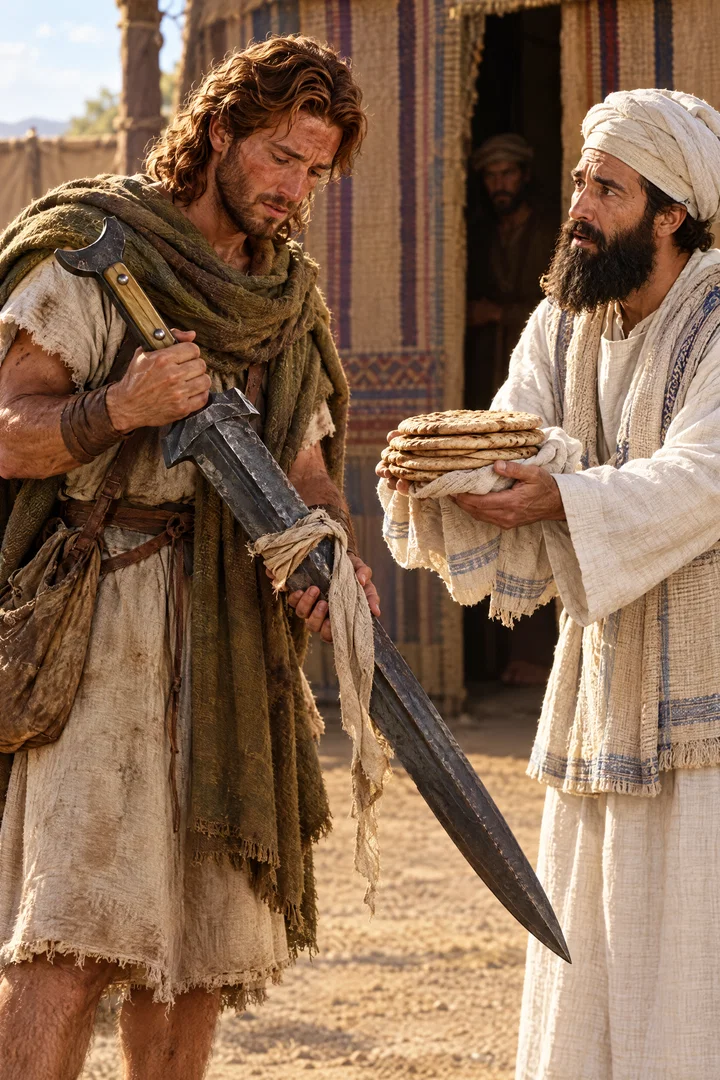
Cross-references 20 of 25
- Matthew 12:3-4
But he said unto them, Have ye not read what David did, when he was an hungred, and they that were with him;
Jesus cites David eating the consecrated bread to defend his hungry disciples.
- Mark 2:25-28
And he said unto them, Have ye never read what David did, when he had need, and was an hungred, he, and they that were with him?
Jesus cites David’s need and eating the showbread to defend his disciples’ Sabbath actions.
- Luke 6:3-4
And Jesus answering them said, Have ye not read so much as this, what David did, when himself was an hungred, and they which were with him;
Jesus cites David eating the showbread to defend his hungry disciples.
- Leviticus 24:8
Every sabbath he shall set it in order before the LORD continually, being taken from the children of Israel by an everlasting covenant.
The bread was set in order before the LORD every Sabbath.
- 1 Chronicles 9:32
And other of their brethren, of the sons of the Kohathites, were over the shewbread, to prepare it every sabbath.
Both describe the showbread being prepared or changed each Sabbath.
- Matthew 12:5
Or have ye not read in the law, how that on the sabbath days the priests in the temple profane the sabbath, and are blameless?
Priests’ temple work on the Sabbath is permitted and blameless.
- Mark 2:25-26
And he said unto them, Have ye never read what David did, when he had need, and was an hungred, he, and they that were with him?
Jesus recalls David receiving and eating the holy bread when hungry.
- 1 Samuel 22:18-19
And the king said to Doeg, Turn thou, and fall upon the priests. And Doeg the Edomite turned, and he fell upon the priests, and slew on that day fourscore and five persons that did wear a linen ephod.
Saul’s slaughter of Nob’s priests followed Ahimelech’s giving David bread.
- Matthew 12:7
But if ye had known what this meaneth, I will have mercy, and not sacrifice, ye would not have condemned the guiltless.
Mercy explains why the disciples are guiltless.
- Matthew 12:11-12
And he said unto them, What man shall there be among you, that shall have one sheep, and if it fall into a pit on the sabbath day, will he not lay hold on it, and lift it out?
Jesus teaches that meeting need and doing good is lawful on the Sabbath.
- Matthew 12:1
At that time Jesus went on the sabbath day through the corn; and his disciples were an hungred, and began to pluck the ears of corn, and to eat.
The disciples’ hunger and eating corn recall David receiving bread when hungry.
- 1 Kings 2:27
So Solomon thrust out Abiathar from being priest unto the LORD; that he might fulfil the word of the LORD, which he spake concerning the house of Eli in Shiloh.
Solomon later removes Abiathar from the priesthood.
- Exodus 25:30
And thou shalt set upon the table shewbread before me alway.
The table’s shewbread is the bread given to David.
- Leviticus 24:5-7
And thou shalt take fine flour, and bake twelve cakes thereof: two tenth deals shall be in one cake.
Describes the bread set before the Lord and its Sabbath renewal.
- Leviticus 24:9
And it shall be Aaron’s and his sons’; and they shall eat it in the holy place: for it is most holy unto him of the offerings of the LORD made by fire by a perpetual statute.
The priests ate the old showbread in the holy place.
- Matthew 12:8
For the Son of man is Lord even of the sabbath day.
Christ’s lordship gives authority to acquit his disciples.
- Matthew 12:6
But I say unto you, That in this place is one greater than the temple.
One greater than the temple frees His followers.
- John 6:48
I am that bread of life.
Connects the showbread with Christ as living bread.
- John 7:22-23
Moses therefore gave unto you circumcision; ( not because it is of Moses, but of the fathers;) and ye on the sabbath day circumcise a man.
Jesus appeals to accepted exceptions to Sabbath rules.
- John 6:53
Then Jesus said unto them, Verily, verily, I say unto you, Except ye eat the flesh of the Son of man, and drink his blood, ye have no life in you.
Connects the bread with spiritual life in Christ.
Commentary
Each commentary is drawn from primary sources: the writings of Ellen G. White and Adventist pioneers and periodicals. Each commentary is separate. Its own words are not a quotation; follow the references to read the source passages.
Ellen G. White
6 sources
No common bread was present, so the priest gave David the hallowed shewbread that had been taken from before the Lord, to satisfy his hunger.PP 655.3–656.12SP 195.2–197.1DA 284.2–285.34RED 48.2–49.1Lt 422, 1907, par. 5 That bread was ordinarily reserved for the priests alone, and on the day it was taken away fresh hot bread was put in its place.2SP 195.2–197.1DA 284.2–285.34RED 48.2–49.1 David received the sacred bread of the tabernacle when hungry and shared it with his hungry followers.2SP 195.2–197.1DA 284.2–285.3COS 71.4–73.4
Because of his hunger his eating was guiltless, showing that meeting urgent human need may take precedence over a ceremonial restriction on sacred things, especially when done in service to God.2SP 195.2–197.1DA 284.2–285.34RED 48.2–49.1COS 71.4–73.4 Jesus used this example to uphold the right of the disciples to gather grain for food on the Sabbath, showing that service to God and His redemptive purpose are central to Sabbath observance.DA 284.2–285.34RED 48.2–49.1 Meeting hunger takes precedence over restrictive rules about sacred things, and meeting a genuine human need can be right even when it involves something sacred.2SP 195.2–197.1DA 284.2–285.34RED 48.2–49.1COS 71.4–73.4
The exceptional granting of the holy bread in a case of need parallels the use of tithe funds in a needful case, which does not excuse carelessness or laxity in paying tithe.Lt 422, 1907, par. 5 David deceived the priest about why he had come, showing lack of faith in God, and this led to the high priest's death.PP 655.3–656.1
Sources
Pioneers and periodicals
51 sources
The priest gave David the hallowed shewbread that had just been taken from before the Lord to make room for hot, fresh loaves the same day, because there was no common bread there but only the bread reserved for the priests.RH Jan 21, 1862ST Feb 10, 1904ST Sep 20, 1883RH Dec 25, 1900ST Apr 11, 1911 David received it as a fugitive fleeing for his life from Saul, hungry and in need of food for himself and his men, and the priest showed him mercy.RH Mar 3, 1910ST Sep 20, 1883RH Feb 3, 1852 Although the bread belonged only to the priests so that eating it broke the prescribed rule, hunger and necessity made David and those with him guiltless, for ceremonial restriction yields to human need and mercy takes precedence over sacrifice.ST Apr 14, 1881RH Feb 4, 1862ST Aug 25, 1909ST Apr 14, 1881ST Mar 30, 1888 The exchange took place on the Sabbath when the old bread was removed, and Jesus cited David's need and eating to show His hungry disciples were blameless when they plucked grain on the Sabbath.RH Jan 21, 1862RH Apr 7, 1863RH Dec 25, 1900ST Oct 22, 1894ST Oct 22, 1894 Necessary acts and works of mercy are therefore lawful on the Sabbath, which was made for man to give rest and not as a grievous burden, and the weekly renewal of the bread symbolizes Christ giving Himself with new strength and warmth to His people each Sabbath.ST Apr 14, 1881ST Jun 20, 1911ST Apr 14, 1881ST Mar 30, 1888
Bread and Sanctuary Setting
The bread was hallowed shewbread taken from before the Lord to make room for hot, fresh bread put in its place on the very day it was taken away.RH Jan 21, 1862ST Sep 20, 1883RH Dec 25, 1900ST Apr 11, 1911ST Jun 20, 1911 There was no ordinary or common bread there at all, only the consecrated bread reserved for the priests, and for that reason the priest gave David this holy bread.ST Aug 31, 1888ST Feb 10, 1904ST Apr 11, 1911ST Nov 19, 1912ST Oct 22, 1894 The removed loaves were replaced with fresh, hot bread on the appointed day, the exchange by which the old was taken and the new set hot before the Lord occurring on the Sabbath when the priests ate the old.ST Sep 20, 1883RH Dec 25, 1900ST Jun 20, 1911ST Nov 19, 1912
The twelve loaves were kept in the sanctuary before the Lord through the week and were replaced every Sabbath, when the old loaves were then eaten by the priests.RH Jan 21, 1862ST Feb 10, 1904RH Apr 7, 1863RH Dec 25, 1900RH Jan 26, 1905 Because the shewbread was thus renewed each Sabbath, the circumstances indicate the transaction with David took place on the Sabbath, which explains the reference to his eating the showbread.RH Jan 21, 1862RH Apr 7, 1863RH Dec 25, 1900ST Nov 19, 1912 The old bread was eaten in the holy place by priests who were ceremonially pure, and new shewbread was prepared and set in order each Sabbath and continued through the following week until the next Sabbath.RH Jan 26, 1905RH Jan 22, 1914RH Feb 4, 1862
Each Sabbath there was a double measure, the old and the new, the old yielding more when eaten than when first given the Sabbath before.RH Jan 26, 1905 When eaten by the priests representing the people, the old was more fully appropriated and became part of their very being and continued, while the new, fresh, additional supply also continued through the following week.RH Jan 26, 1905 The tabernacle was then at Nob in Benjamin, where the sanctuary rested in the interim between its removal from Shiloh and its location in Judah, and it still held its sacred vessels with the shewbread there after the ark had been taken.RH Mar 3, 1910RH Jan 6, 1853
That site is given as two miles north of Jerusalem, while those who place it otherwise put the sanctuary at Nob roughly twelve miles west by north of Jerusalem and about seventy-nine years after the ark was captured during Saul's reign.RH Mar 3, 1910RH Aug 28, 1856 Nob was the city of the priests, about a mile on the way from Anathoth toward Jerusalem and a little more than a mile from Gibeah where Saul lived.ST Oct 27, 1898
David's Flight and Aftermath
David came to the priest as a fugitive fleeing for his life from King Saul, hungry and in need of food for himself and his men, and the priest showed him mercy by giving him the consecrated bread.ST Sep 20, 1883RH Feb 3, 1852RH Jun 10, 1852RH Feb 3, 1852RH Jan 8, 1857 The giving was right as mercy under that pressure of flight and hunger, when no other bread was at hand, though the same eating would have been wrong in ordinary circumstances.RH Mar 3, 1910RH Feb 3, 1852RH Jun 10, 1852RH Feb 3, 1852RH Jan 8, 1857 At that same visit he also took the sword of Goliath, which had been kept there behind the ephod, and that sword is never traced again in the sacred record.RH Mar 3, 1910ST Oct 27, 1898
The episode belongs to the account of Saul's jealous pursuit and effort to slay David, which includes the covenant between David and Jonathan, Jonathan's noble unselfish generosity, the contrast between jealous Saul and his noble son, and David's hope and trust in God and utter refusal to take vengeance into his own hands against the enemy pursuing him.ST Apr 9, 1912ST Apr 7, 1909 In his flight he nevertheless showed distrust of God by seeking safety through his own judgment rather than relying on God, and the episode exposed his weakness and taught him his need for constant dependence on God.ST Aug 31, 1888
His deceit toward Ahimelech is recorded without condemnation in that account, but silence does not approve or excuse it, for the act must be judged by the principles Scripture gives elsewhere and its sinfulness is shown by its consequences.RH Oct 29, 1861 Ahimelech, the father of Abiathar, was the one who gave David and his men the sacred bread, and for this act Saul summoned the trembling priest to explain himself after it was reported, then commanded the slaughter in which Doeg slew eighty-five priests.ST Sep 18, 1884RH Jan 12, 1911 Abiathar alone among Ahimelech's sons survived that slaughter of the family, later serving as joint high priest with Zadok until he was deposed by Solomon.ST Sep 18, 1884RH Jan 12, 1911
Mercy Over Ceremonial Restriction
The hallowed loaves belonged to the priests alone, so the eating of them by David and his men broke the rules, violated the sanctity of the holy place, and was technically unlawful and a departure from the prescribed rule.ST Apr 14, 1881RH Feb 4, 1862ST Aug 25, 1909ST Apr 14, 1881 The priest gave the consecrated bread because no common bread was there, only bread removed from before the Lord to make room for fresh loaves, and hungry men ate on a day when the same act on an ordinary day would have been unlawful.ST Aug 25, 1909RH Apr 25, 1871 Hunger, necessity, and the pressure of fleeing for life excused the act and left David and those with him guiltless, so that eating to satisfy hunger in such need did not violate the law and did not bring sin.ST Apr 14, 1881ST Mar 30, 1888RH Oct 21, 1851RH Feb 4, 1862RH Jul 30, 1861 Doing right in his necessity, he satisfied hunger in the house of God, and that need in satisfying hunger makes the eater guiltless.RH Feb 4, 1862RH Feb 4, 1862RH Jul 30, 1861
Ceremonial restriction yields to human need without guilt, for God's laws are not meant to destroy people and mercy takes precedence over sacrifice in meeting the need for food and preserving life.ST Feb 10, 1904ST Aug 25, 1909ST Oct 22, 1894ST Nov 11, 1897 Need took precedence over the rule restricting the bread to priests, and meeting urgent necessity was in harmony with the purpose of the law to preserve life.ST Oct 22, 1894ST Nov 11, 1897 Hunger made mercy and necessity take precedence, so what was technically unlawful was not condemned, and rigid rule-keeping must give way to mercy in judging such relief of want.ST Feb 10, 1904ST Aug 25, 1909ST Nov 11, 1897 Giving and eating the bread in those circumstances accorded with God's law and was right as an act of mercy toward one fleeing for life and in need of food, though in other ordinary circumstances the same act would have been wrong, though not expressly forbidden.RH Feb 3, 1852RH Jun 10, 1852RH Apr 5, 1860RH Feb 3, 1852
The case was extreme and very seldom arises and cannot warrant doing likewise in ordinary circumstances, since it was pardonable only under the pressure of necessity in a matter relating purely to individual interests.RH Apr 25, 1871 Sabbath labor likewise is warranted only by real necessity or by work inseparably connected with exclusive engagement in God's service, and avoidable need may result from failing to prepare beforehand.RH Apr 25, 1871 Circumstances understood by God must be considered rather than condemning without them.RH Sep 30, 1915 His eating violated the letter of the law, raising whether he kept it in its spirit; the answer given is that the spirit does not permit what the letter forbids.ST Jan 16, 1879
Sabbath Defense and Symbolism
The exchange happened on the Sabbath, the day the old loaves were taken from before the Lord and hot, fresh bread was put in their place.RH Jan 21, 1862RH Apr 7, 1863RH Dec 25, 1900ST Nov 19, 1912ST Apr 14, 1881 Because the shewbread was replaced every Sabbath and the removed loaves were then eaten by the priests, the fact that Ahimelech had only hallowed bread and no common bread shows David received it on that day.RH Jan 21, 1862RH Dec 25, 1900ST Nov 19, 1912ST Apr 14, 1881 David and his hungry men ate the holy bread then, an act unlawful on an ordinary day that broke the rules and violated the sanctity of the holy place.RH Apr 7, 1863ST Apr 14, 1881 That Sabbath timing made it doubly fitting for Jesus to cite it in defense of His hungry disciples and explains His reference to David eating the showbread in Matthew.RH Apr 7, 1863ST Apr 14, 1881
Jesus pointed to David's need and eating when answering the Pharisees' charge that His disciples acted unlawfully on the Sabbath by plucking and eating grain, showing David's case bore directly on whether their actions were lawful.ST Oct 22, 1894ST Oct 22, 1894RH Apr 21, 1863RH Aug 15, 1854 When no ordinary bread was available the priest gave David the consecrated bread removed from before the Lord, and Jesus used that urgent satisfying of hunger as the parallel to His own case and that of His disciples when accused concerning the Sabbath.ST Oct 22, 1894ST Oct 22, 1894RH Apr 21, 1863RH Aug 15, 1854 The accusation came from hypocritical men who saw goodness only in outward observances and by their traditions had made the commandments of God of none effect. Christ was neither a law-breaker nor a Sabbath-breaker, but taught that the essential condition of keeping all God's laws, the Sabbath included, is a heart right with God, and by His life of perfect obedience He fulfilled the law and made it honorable.
As David in necessity was guiltless in entering the house of God while fleeing for his life and eating the shewbread belonging only to the priests, so the disciples who relieved their hunger by eating corn on the Sabbath were blameless and lawful.RH Feb 4, 1862ST Nov 11, 1897RH Jan 8, 1857ST Mar 30, 1888ST Nov 14, 1900 They had not even violated a precept of the ceremonial law as David had, yet mercy rather than rigid rule-keeping should guide judgments about Sabbath observance.RH Feb 4, 1862ST Nov 11, 1897ST Jan 31, 1911 Need can justify eating bread ordinarily restricted by religious rules, and meeting human need in that way is not a violation of God's law.ST Mar 30, 1888ST Nov 14, 1900ST Jan 31, 1911 The pressure of hunger justifies setting aside for a time even the strictest temple regulations.ST Apr 14, 1881
Necessary acts and works of mercy are therefore lawful on the Sabbath, and David's example proves the Sabbath law allows works of necessity while freeing the Sabbath from useless human traditions that forbade them.ST Apr 14, 1881ST Mar 30, 1888RH Jan 24, 1871 The law's restriction on bread ordinarily reserved for the priests yielded to urgent necessity, in harmony with the law's purpose of preserving life, though avoidable need may result from failing to prepare beforehand.ST Mar 30, 1888 Necessity and mercy do not violate the Sabbath, and Jesus in defending the plucking of standing grain did no more to break the day than the most scrupulous Sabbath-keeper would do.RH Jan 24, 1871 The priests were required to prepare new shewbread on each Sabbath, and in doing that Sabbath work they were guiltless.RH Feb 4, 1862 That priestly Sabbath service belongs together with David's eating, and both show the disciples were free from guilt when, in following One greater than the temple who had nowhere to lay His head, they ate standing corn to relieve hunger.RH Feb 4, 1862
Jesus' defense did not relax or abolish the Sabbath law, reject the Sabbath command, or teach another day.RH May 17, 1906RH Aug 15, 1854RH Feb 3, 1852RH Jan 24, 1871 Both David's Sabbath and the disciples' Sabbath were the seventh day, not Sunday, and Jesus gave no instruction then or at any other time about the observance of any other day.RH May 17, 1906RH Jan 24, 1871 He upheld the sanctity and obligation of the Sabbath as Lord of the Sabbath who fulfilled the law.RH Jan 24, 1871 The Sabbath was made for man to give him rest and peace and remind him of the work of his Creator, not to interfere with the needs of his being with pain and discomfort as a grievous burden.ST Apr 14, 1881RH Jan 24, 1871 The service of God is first of all, and plucking and eating grain to sustain bodily strength to be used in His service, and satisfying hunger and fatigue in that work, is right and lawful even on the Sabbath.ST Apr 14, 1881 Sabbath labor is warranted only by real necessity or by work inseparably connected with exclusive engagement in God's service, and David's departure from the prescribed rule in a matter relating purely to his own individual interests was pardonable only because he acted under the pressure of an extreme case that very seldom arises and cannot warrant doing likewise in ordinary circumstances.RH Apr 25, 1871
The showbread symbolized the presence of Jesus Christ, and its weekly renewal means that on the Sabbath Christ gives Himself with all His new strength and warmth to His people.ST Jun 20, 1911ST Sep 8, 1909 Every Sabbath the old loaves that had stood on the holy table before the Lord through the week were taken away and new hot loaves put in their place, applied to the promise of fresh supplies of grace from the Father each Sabbath.ST Jun 20, 1911ST Sep 8, 1909 Hot bread was put on the table in the day the old bread was taken away, and this means Sabbath teachers and ministers must set hot bread before the people.RH Dec 25, 1900 A minister or Bible worker who goes out on the Sabbath to give a Bible reading and only presents old, stale truths, the same thoughts gone over again without one change from a set form, is setting stale bread before the people.RH Dec 25, 1900 The Lord would have His workers give hot bread, and when they officiate in the service of the Lord on the Sabbath as they should they have the privilege of placing hot bread before those they teach.RH Dec 25, 1900
Sources