Matthew 26:52
Then said Jesus unto him, Put up again thy sword into his place: for all they that take the sword shall perish with the sword.
Translations
Then said Jesus to him, Put up again your sword into his place: for all they that take the sword shall perish with the sword.
King James Version, KJV Cambridge Paragraph Bible
Then said Jesus unto him, Put up again thy sword into his place: for all they that take the sword shall perish with the sword.
Then said Jesus to him, Put up again thy sword into its place: for all they that take the sword, shall perish by the sword.
Revised Version, American Standard Version
Then saith Jesus unto him, Put up again thy sword into its place: for all they that take the sword shall perish with the sword.
Then saith Jesus to him, 'Turn back thy sword to its place; for all who did take the sword, by the sword shall perish;
Then saith Jesus to him, Return thy sword to its place; for all who take the sword shall perish by the sword.
Then, Jesus saith unto him—Put back thy sword into its place, for, all they who take a sword, by a sword, shall perish.
“ Put your sword back in its place,” Jesus said to him. “ For all who draw the sword will die by the sword.
“ Put your sword back in its place,” Jesus said to him. “ For all who draw the sword will perish by the sword.
Then Jesus said to him, “ Put your sword back into its place, for all those who take the sword will die by the sword.
Then says Jesus to him, Put up your sword again into its place: for all those who take the sword will come to death by the sword.
Then sayde Iesus vnto him, Put vp thy sworde into his place: for all that take the sworde, shall perish with the sworde.
Douay-Rheims (Challoner revision)
Then Jesus saith to him: Put up again thy sword into its place: for all that take the sword shall perish with the sword.
Pictures
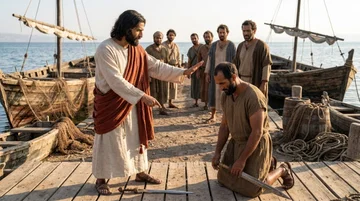
Cross-references 20 of 39
- John 18:36
Jesus answered, My kingdom is not of this world: if my kingdom were of this world, then would my servants fight, that I should not be delivered to the Jews: but now is my kingdom not from hence.
Jesus says his kingdom is not worldly, so his servants do not fight for it.
- Luke 22:51
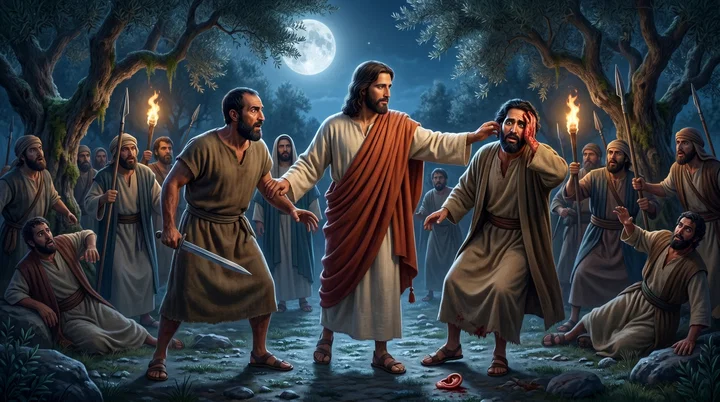
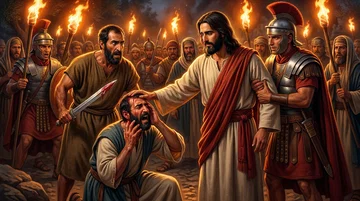
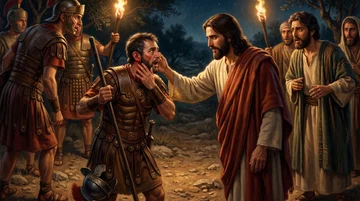
And Jesus answered and said, Suffer ye thus far. And he touched his ear, and healed him.
Jesus heals the servant wounded by a disciple’s sword.
- John 18:10-11
Then Simon Peter having a sword drew it, and smote the high priest’s servant, and cut off his right ear. The servant’s name was Malchus.
Jesus tells Peter to put away his sword and accept the cup given by the Father.
- 2 Corinthians 10:4
( For the weapons of our warfare are not carnal, but mighty through God to the pulling down of strong holds;)
Christian warfare uses weapons that are not carnal.
- Luke 9:54-56
And when his disciples James and John saw this, they said, Lord, wilt thou that we command fire to come down from heaven, and consume them, even as Elias did?
Jesus rebukes his disciples’ wish to destroy those who reject him, affirming his mission to save lives.
- Ephesians 6:17
And take the helmet of salvation, and the sword of the Spirit, which is the word of God:
The Spirit’s sword is God’s word, not a carnal weapon.
- Luke 22:38
And they said, Lord, behold, here are two swords. And he said unto them, It is enough.
The disciples’ two swords set the context for Jesus’ rebuke when Peter uses one.
- Matthew 5:39
But I say unto you, That ye resist not evil: but whosoever shall smite thee on thy right cheek, turn to him the other also.
same teaching against retaliation
- 1 Peter 2:23
Who, when he was reviled, reviled not again; when he suffered, he threatened not; but committed himself to him that judgeth righteously:
Christ suffered without retaliation and entrusted himself to the righteous Judge.
- Mark 14:47
And one of them that stood by drew a sword, and smote a servant of the high priest, and cut off his ear.
Mark records a disciple striking the high priest’s servant during Jesus’ arrest.
- Romans 12:19
Dearly beloved, avenge not yourselves, but rather give place unto wrath: for it is written, Vengeance is mine; I will repay, saith the Lord.
Vengeance belongs to God, not to those seeking revenge.
- John 18:10
Then Simon Peter having a sword drew it, and smote the high priest’s servant, and cut off his right ear. The servant’s name was Malchus.
Identifies Peter as the disciple who struck the high priest’s servant with a sword.
- Exodus 20:13
Thou shalt not kill.
The prohibition against killing supports refusing violence and warfare.
- Matthew 5:44
But I say unto you, Love your enemies, bless them that curse you, do good to them that hate you, and pray for them which despitefully use you, and persecute you;
Jesus commands love and prayer for enemies as an alternative to violence.
- Revelation 13:10
He that leadeth into captivity shall go into captivity: he that killeth with the sword must be killed with the sword. Here is the patience and the faith of the saints.
Both state that those who kill with the sword will face the same fate.
- Mark 14:48-49
And Jesus answered and said unto them, Are ye come out, as against a thief, with swords and with staves to take me?
Jesus questions the armed arrest and says Scripture must be fulfilled.
- Luke 22:36-37
Then said he unto them, But now, he that hath a purse, let him take it, and likewise his scrip: and he that hath no sword, let him sell his garment, and buy one.
Jesus’ counsel about swords is set against his being reckoned among transgressors.
- Luke 3:14
And the soldiers likewise demanded of him, saying, And what shall we do? And he said unto them, Do violence to no man, neither accuse any falsely; and be content with your wages.
Both forbid violence.
- Romans 13:4
For he is the minister of God to thee for good. But if thou do that which is evil, be afraid; for he beareth not the sword in vain: for he is the minister of God, a revenger to execute wrath upon him that doeth evil.
Government bears the sword to punish those who do evil.
- Genesis 9:6
Whoso sheddeth man’s blood, by man shall his blood be shed: for in the image of God made he man.
Both express the principle that those who take life will face death.
Commentary
Each commentary is drawn from primary sources: the writings of Ellen G. White and Adventist pioneers and periodicals. Each commentary is separate. Its own words are not a quotation; follow the references to read the source passages.
Ellen G. White
22 sources
Jesus ordered Peter to sheath his sword, rebuking his rash strike that cut off the servant's ear and forbidding armed defense to stop the arrest.ST Aug 21, 18795RED 24.2–3Ms 29, 1909, par. 10–11 He warned that all who resort to violent force will themselves be destroyed by it.ST Aug 21, 18795RED 24.2–3Ms 29, 1909, par. 10–11 His refusal came not from helplessness, for He could have asked His Father for more than twelve legions of angels, but He chose to submit to binding and drink the appointed cup so the Scriptures would be fulfilled, even healing the wound by freeing His bound hands to touch the ear.ST Aug 21, 18795RED 24.2–3Ms 42, 1897, par. 23–27COS 123.2ST Jun 6, 1878 His kingdom is not built or defended by physical force as earthly kingdoms are, so His church must banish carnal weapons and coercion and His followers must not join in war and bloodshed but cooperate with Him to save lives.Ms 87, 1898, par. 33Ms 27a, 1900, par. 12–13
Gethsemane Arrest Setting
The words were spoken on the way to and in the garden of Gethsemane on the night after the Passover supper with His disciples.DA 685.1Ms 107, 1893, par. 2Ms 95, 1897, par. 10–12 In company with His disciples He slowly made His way to the garden under the broad and full Passover moon shining from a cloudless sky while the city of pilgrims' tents was hushed into silence.DA 685.1 This came after His long agony in the garden in conflict with satanic agencies striving to divorce Him from God, when great drops of blood came from the pores of His skin.Ms 107, 1893, par. 2Ms 95, 1897, par. 10–12
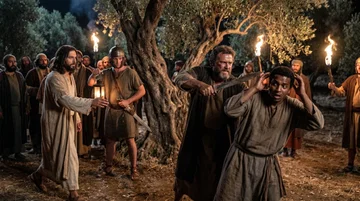
Judas, one of His professed disciples, betrayed Him with expressions of love, with a kiss.Ms 107, 1893, par. 2Ms 95, 1897, par. 10–12 He was arrested by a band of men and soldiers with staves and spears, including Roman soldiers who held His hands and chief priests and captains of the temple who came with swords and staves though He had taught daily in the temple, with cords brought to bind Him.ST Jun 6, 1878COS 122.5–123.1Ms 107, 1893, par. 2Ms 95, 1897, par. 10–12 His disciples all forsook Him and fled.Ms 95, 1897, par. 10–12 He was taken to Annas, then to Caiaphas, then to Pilate, then sent to Herod who found nothing to condemn yet mocked Him with insult and mockery, then sent again to Pilate, from insult to renewed insult, from mockery to mockery, twice tortured by the scourge.Ms 95, 1897, par. 10–12 Through it all He bore Himself with dignity through the disgraceful farce of a trial and spoke no word but that tended to glorify God, not one syllable more than was essential.Ms 95, 1897, par. 10–12 After the Sanhedrin condemned Him to death He was brought before Pilate for legal condemnation because execution required Pilate's confirmation.Ms 107, 1893, par. 2
The disciples expected Him to free Himself by the power that could strike down and prostrate the mob.5RED 24.2–3COS 122.5–123.1 When they saw Him make no effort to escape arrest they blamed Him and could not understand His submission.5RED 24.2–3COS 123.3–4COS 122.5–123.1 In anger and indignation Peter rashly drew his sword to prevent the binding and struck the crowd, cutting off the ear of the high priest's servant.5RED 24.2–3ST Jun 6, 1878SG1 48.1COS 122.5–123.1
Christ Refuses Armed Rescue
Jesus ordered Peter to put his sword back again into its place, rebuking his rash violence in cutting off the ear of the high priest's servant and forbidding any armed defense of Himself to stop the arrest.ST Aug 21, 18795RED 24.2–3Ms 42, 1897, par. 23–27COS 123.2COS 122.5–123.1 The command rejected Peter's attempt to prevent the binding and refused the use of armed force to keep Jesus free.5RED 24.2–3Ms 29, 1909, par. 10–11Ms 42, 1897, par. 23–27COS 123.2ST Dec 9, 1897 The reason given was a warning that all who take up and resort to the sword will perish and face destruction by the sword.ST Aug 21, 18795RED 24.2–3Ms 29, 1909, par. 10–11Ms 42, 1897, par. 23–27COS 123.2 Violent resistance and reliance on the sword were thus rejected because of their deadly consequences.5RED 24.2–3Ms 29, 1909, par. 10–11Ms 42, 1897, par. 23–27ST Dec 9, 1897ST Sep 23, 1886
He enforced the lesson by freeing His own bound hands held by soldiers to touch and instantly heal the wounded ear.5RED 24.2–3COS 123.2ST Jun 6, 18783SP 104.2–3COS 122.5–123.1 Though His hands were held by Roman soldiers, He released them to restore the servant and then ordered the sword returned to its place and refused to fight.5RED 24.2–3ST Jun 6, 1878COS 122.5–123.1 His refusal was not helplessness or lack of power to resist and stay free.5RED 24.2–3DA 696.3ST Sep 23, 1886ST Jun 6, 1878COS 122.5–123.1 The same power that had prostrated the mob could have kept Him free.5RED 24.2–3COS 122.5–123.1 He could pray to and ask His Father for more than twelve legions of angels and could have stopped the arrest by calling for angelic help.ST Aug 21, 18795RED 24.2–3Ms 42, 1897, par. 23–27COS 123.2ST Dec 9, 1897
He deliberately chose not to escape by force or to call for angelic rescue.ST Aug 21, 18795RED 24.2–3ST Dec 9, 1897DA 696.3ST Sep 23, 1886 Instead He submitted to binding and allowed Himself to be taken.ST Aug 21, 18795RED 24.2–3Ms 42, 1897, par. 23–27COS 123.2ST Jun 6, 1878 He accepted the suffering appointed to Him and drank the cup His Father had given Him.ST Aug 21, 18795RED 24.2–3Ms 42, 1897, par. 23–27COS 123.2DA 696.3 He did so that the Scriptures that it must be so would be fulfilled.ST Aug 21, 18795RED 24.2–3DA 696.3ST Sep 23, 18863SP 104.2–3
No Sword for Followers
Christ's kingdom is not established or defended by physical force, and unlike earthly kingdoms that use war and destruction to gain power, the church must banish carnal weapons and every instrument of coercion.Ms 27a, 1900, par. 12–13 War and bloodshed do not pattern after Christ, for He came not to destroy lives but to save them.Ms 87, 1898, par. 33 His followers therefore must not join in deadly conflict but cooperate with God in His work of salvation by proclaiming the truth now and pressing to the mercy seat to claim promised power as co-workers with Christ.Ms 87, 1898, par. 33
Those who use violent force to gain strength will themselves perish by violence, and this applies to nations pursuing power through robbery and violence.Ms 16, 1900, par. 4914MR 166.2–167.1Lt 28, 1900, par. 30–32 In wars and rumors of wars, rivalries and unholy ambition drive nation to rise against nation, with selfishness and covetousness producing violence, crime and all kinds of wickedness.14MR 166.2–167.1 Nation watches nation for advantage, one concession only brings demand for another, and presumptuous, daring deeds rob others to gain power.14MR 166.2–167.1 Men who do these things face certain destruction by the very violence they employ, though they do not realize it.14MR 166.2–167.1Lt 28, 1900, par. 30–32
The same violent wickedness existed in the old world described in Genesis, when the wickedness of men became so great that God would no longer bear with them but washed the earth of its moral pollution by the flood.14MR 166.2–167.1 Christ's followers must not answer opposition with a combative spirit or take up the sword.Ms 22a, 1895 [Copy 1], par. 38 Acting in their own spirit instead of relying on Jesus can damage the cause, and the harm done may take months or years to undo.Ms 22a, 1895 [Copy 1], par. 38
Sources
Pioneers and periodicals
168 sources
Jesus told Peter to put his sword back in its place at the arrest after Peter cut off the servant's ear, and He healed the wound while accepting suffering instead of resisting seizure.ST Feb 7, 1900ST Jul 14, 1898RH Dec 16, 1862ST Jan 25, 1899ST Feb 7, 1900 The order means exactly what it says and requires literal obedience, forbidding private revenge, self-defense with deadly weapons, and answering violence with violence.ST Mar 1, 1899RH Dec 16, 1862ST Jul 7, 1898RH Mar 7, 1865ST Apr 21, 1898 It forbids using the sword even to defend Christ himself, his cause, his church, or true religion in the most just cause, and it binds nations as well as individuals, though those holding the other position limit it to individuals as people of peace.RH Jan 6, 1910ST Jul 14, 1898RH May 9, 1865ST Apr 4, 1900ST Feb 28, 1911 His kingdom is not of this world and is never established, defended, or advanced by earthly force and bloodshed, but only by preaching the gospel and by the power of the Spirit working through love and persuasion.ST Aug 21, 1893ST Jul 4, 1899STST Jan 23, 1893 Those who take the sword to kill will themselves perish by the sword, the same truth as Revelation 13:10, because the sword is a false human dependence that passes away with the earthly kingdoms that trust in it.ST Jul 7, 1898ST Aug 4, 1898ST Jul 3, 1893ST Feb 27, 1901RH Nov 19, 1914
Arrest Scene and Details
The saying was given at the arrest when Peter drew a sword and was ordered to return it to its place, while Jesus chose to accept the suffering appointed by the Father rather than resist with violence.ST Dec 9, 1897ST Sep 23, 1886ST Feb 7, 1900ST Feb 7, 1900ST Jun 11, 1896 The rebuke warned that all who take the sword will perish by it, forbidding followers to defend Him by force even though He could have asked the Father for more than twelve legions of angels.ST Dec 9, 1897ST Sep 23, 1886ST Feb 7, 1900RH Jun 25, 1901 Spoken amid armed men, the calm command displayed pity, restraint and quiet endurance rather than vengeance close at hand.RH Jun 25, 1901
Peter had struck the high priest's servant Malchus and cut off his ear, a mortal blow that glanced, and Jesus freed His held hands to touch the hanging ear and instantly make it whole while the wounded man looked on astonished.ST Jul 14, 1898RH Dec 16, 1862ST Jan 25, 1899ST Jan 10, 1906ST Dec 10, 1894 By healing the injury He rebuked the violence, refused to fight those who had come with swords and staves, and showed He came to save life rather than take it.ST Jan 10, 1906ST Dec 10, 1894 The healing reinforced that carnal weapons have no part in service to Christ and that physical enemies are not to be overcome by physical force.ST Jul 14, 1898ST Jan 10, 1906ST Dec 10, 1894
The place was Gethsemane by the brook Kidron beneath the olive trees in the night, where Jesus was betrayed, surrounded by a mob with swords, staves, lanterns and torches, seized and hurried to prison and the tribunal where He would be condemned.RH Oct 24, 1854ST Jan 8, 1902ST Apr 30, 1902ST Mar 8, 1899ST Apr 8, 1903 He endured betrayal and outrage with patience, without unkind words or reproaches, standing calm and kinglike before stormy men of death with only loving word and patient breath.RH Oct 24, 1854ST Apr 30, 1902ST Apr 8, 1903 The movement from hollow homage to smiting and buffeting showed how near outward profession joined to denial of life stands to open rejection.RH Dec 29, 1863
Though bound by Roman soldiers, He had far greater protection at command and could have prayed to the Father for more than twelve legions of mighty angels obedient to His word, with all the forces of the universe at His disposal.ST Oct 21, 1897ST Jun 11, 1912ST Dec 20, 1905RH Dec 10, 1867 He possessed an invincible army yet chose not to use force even to prevent His own death, not even asking for the help prayer could have brought.ST Oct 21, 1897ST Jun 11, 1912ST Dec 20, 1905RH Dec 10, 1867 His proper recourse was the Father, and His refusal left His work guaranteed by abiding divine power rather than by human law and armies.ST Oct 21, 1897RH Dec 10, 1867
The two swords among the disciples were permitted only that He might be reckoned among transgressors and that their rash resistance might give occasion for this impressive and memorable rebuke, not for defense or use.RH Dec 16, 1862ST Sep 20, 1910ST Dec 10, 1894ST Aug 4, 1909 The earlier words about purse and sword were not understood until after the resurrection, for the sword was no call to defend Him by force and buying swords was not needed for their defense.ST May 21, 1896ST Dec 10, 1894 Carrying a sword gave His enemies a pretext to accuse Him as a transgressor though He was none, while the purse and sword marked the alternatives that arise when faith falters.ST May 21, 1896ST Dec 10, 1894 After redemption was accomplished, the dominion people may no longer use the sword because His kingdom is not earthly and His servants cannot fight.ST Aug 4, 1909
Peter acted after declaring Jesus should not suffer at the hands of the chief priests and that he was ready to go with Him to prison and to death, in rash, impetuous, warlike zeal while still unconverted and ignorant of the Gospel spirit.RH Dec 16, 1862ST Jan 13, 1898ST Mar 18, 1897RH Jul 13, 1911ST Jan 18, 1916 His physical courage and reliance on human strength did not prepare him to stand on moral principle, for zeal expressed through outward force differs from faithful action from principle.RH Jul 13, 1911RH Feb 5, 1914ST Apr 11, 1906 When Jesus took his sword and crossed his will, Peter took offense, followed afar off, forsook the Lord and denied Him, exposing the weakness behind aggression and proving it easier to die for Christ than to live for Him amid daily trials without losing equilibrium.ST Jan 18, 1916RH Feb 5, 1914ST Apr 11, 1906
Peter, whose successor the pope claims to be, lifted his strong right hand with the sword while Jesus suffered far greater indignities, treated and branded as a criminal and dying as such.ST Sep 13, 1905 Peter accepted the rebuke and did not repeat the offense, showing the cause is not to be defended by arousing millions against a human enemy but by committing it to Him who judges righteously, enduring reviling without reviling and suffering without threatening.ST Sep 13, 1905
Those who so held it treated the command to put the sword away as leaving the sword's authority intact, claiming both spiritual and temporal swords belong to the church.ST Jan 9, 1879 In that teaching priests wield the spiritual sword while monarchs wield the temporal sword for the church and under priestly authority.ST Jan 9, 1879
Christ's Refusal and Reasons
Even at His arrest in Gethsemane, when innocent and about to sacrifice His life on the cross, betrayed and seized by a murderous mob in the worst religious persecution, Jesus stopped armed defense of Himself and commanded the sword put away, because those who use it perish by it.ST Oct 21, 1897ST Jun 11, 1912ST Mar 18, 1897 Though He said He could pray to His Father for more than twelve legions of angels, with far greater protection at His command, He did not even ask for them.ST Oct 21, 1897ST Jun 11, 1912 When Peter in sincere but rash defense cut off an attacker’s ear, Jesus healed the wounded enemy rather than retaliate, to show He came to save life not to take it and would not use arms to kill others.ST Mar 18, 1897ST Dec 1, 1914 Peter acted in ignorance of the Gospel spirit while still unconverted, so his example is not to be followed, and since the Lord suffered every indignity without complaint or resistance, His disciples who are not greater than He cannot fight in defense of themselves or even of persecuted brethren but are called to follow His steps and suffer unjustly patiently.ST Mar 18, 1897 Taking the sword for any cause however worthy brings certain destruction, which Satan uses to destroy Christians filled with fighting zeal, and therefore no true representative of Christ needs an army of men or human law and power to advance His cause, because all power in heaven and earth belongs to Christ and His abiding presence to the end is full guarantee and protection for His work.ST Oct 21, 1897ST Mar 18, 1897
He accepted the suffering given Him by the Father rather than resist with violence, willingly drinking the cup the Father had given Him as sin-bearer to save those coming to Him in faith.ST Feb 7, 1900ST Aug 21, 1893ST Jun 11, 1896 His kingdom was not of this world, so His servants had no right to advance it by earthly force or power.ST Aug 21, 1893 He could have stopped the arrest and instantly called legions of mighty angels obedient to His word, but He deliberately refused rescue or force and submitted so the Scriptures would be fulfilled.ST Aug 21, 1879ST Sep 23, 1886 Using power to escape would have broken the Scriptures that said it must happen this way and broken the solemn eternal compact between Jehovah and His Son, written in the volume of the book, by which He had vowed and come to give His life-blood. His response was not helplessness but acceptance of the suffering appointed to Him.ST Sep 23, 1886
He healed the enemy Peter wounded and told Peter and every disciple to put the sword away, giving an example for His followers as He gave His life as a sacrifice and lived as humanity’s example while not summoning angelic power to defeat His attackers.ST Dec 4, 1893ST Nov 25, 1908 His answer of submission rather than force, with pity, calm restraint and quiet endurance and non-resistance, displays a strength that those mistaking noise and turmoil for power may not recognize.RH Jun 25, 1901ST Feb 27, 1901 When the sword was drawn for Him and violence and vengeance waited only on His word, He looked with pitying eyes on the scene and with loving word and patient breath commanded the sword back into its sheath.ST Apr 30, 1902ST Apr 8, 1903 By Kidron’s brook beneath the olive trees He stood calm and Kinglike before sword and stave and torch and stormy men of death, an armed mob with swords and clubs and torches bent on death, daring a felon’s grave and bearing scorn as the bravest hero ever born.ST Apr 30, 1902ST Apr 8, 1903 His calm command spoken amid armed men is the model for Christian rulers today, that one gallant czar, valiant king or fearless queen follow Him in refusing violence and daring to live and die without taking up arms as the King and Lord commanded beneath the blessed peaceful olive boughs, which would bring an end of war.RH Jun 25, 1901ST Apr 30, 1902ST Apr 8, 1903
His kingdom is spiritual and is not to be established or supported by military force or bloodshed, and He would not permit even a single drop of blood to be shed in its support, miraculously healing the wound Peter had inflicted.ST Dec 16, 1886 His peaceable spirit does not inspire men to make weapons for mass slaughter or to fight, but warns that violence brings destruction.ST Jun 9, 1898 When arrested at Gethsemane He did not use His power to resist or bring charges against His attackers, though He knew the arrest and conspiracy and the events that followed were unlawful, but allowed men to take Him rather than pursue punishment through force.ST Aug 29, 1895
The command forbids His followers to use the sword and warns that those who take it will perish by it, laying down a foundation principle of the church against the carnal sword.ST Sep 6, 1899ST Jan 13, 1898 Since Christ would not accept armed defense of His own person, He will not accept it in behalf of any of His followers.ST Jan 13, 1898 It shows He is tender, loving, gentle and pitying, the Prince of Peace and not a god or prince of war, whose kingdom is ruled by love and not by the sword or force, distinct from earthly kingdoms whose servants fight with steel weapons.ST Sep 6, 1899ST Jan 13, 1898ST Oct 31, 1916RH Nov 24, 1868 Peter was still unconverted and warlike in nature when he drew the sword, but afterward became a subdued and tender apostle.ST Jan 13, 1898 Powers and people clamoring for bloodshed while claiming to be Christian are not acting in harmony with His instruction and have no right to the title, and His true followers should work to enlighten and win them over.ST Jan 13, 1898
His present reign is peaceful, building God’s spiritual temple and bringing people to God through reconciliation, righteousness and the gospel, not through physical force.ST Aug 28, 1898 His servants are to persuade people and invite them to accept the gospel willingly, not coerce them in matters of faith or worship.ST Aug 28, 1898 Christian greatness is not gained by destroying human life at the expense of others by armies and navies, and a nation that becomes great by that means can be Christian only in name.ST Jun 6, 1906 Those who rely on the sword will perish by the sword, as proved by the utter perishing of Babylon, Medo-Persia, Grecia and the iron empire of Rome with their all-conquering armies.ST Jun 6, 1906 Even in temporal terms, states without great armies as mere non-producing consumers have greater average material prosperity, more general tranquility and fewer difficulties with neighbors.ST Jun 6, 1906
Command Against the Sword
The order to return the sword to its place means exactly what it says, and its meaning cannot be mistaken.ST Mar 1, 1899ST Jan 16, 1901ST Jul 14, 1898 It is the present command of Christ as Commander to His soldiers, requiring prompt, almost instinctive, literal obedience in this and in everything He commands.ST Apr 21, 1898ST Jul 14, 1898ST Jul 14, 1898 There is no right to explain it away, and no one who refuses it remains His true follower.ST Mar 1, 1899ST Jul 14, 1898 While God directed Israel to use the sword in the old dispensation under peculiar circumstances not yet fully understood, nothing in the life or teaching of Jesus harmonizes with the use of the cruel, carnal sword, and truly believing in Him and knowing His strong yet gentle life leaves the sword behind.ST Mar 1, 1899 The Bible and the sword do not go hand in hand, for the Bible holds divine gems beyond comparison with the sword and with all the unsatisfying glories and superficial splendors of the battlefield that men of this world hold dear.ST Mar 1, 1899
The rebuke was given not only in private revenge but on a public occasion, even in defense of Christ Himself when Peter cut off the servant's ear at the arrest.RH Dec 16, 1862 It is therefore an everlasting rebuke by the Head of the church to all His disciples in all future generations for using the sword.RH Dec 16, 1862 Jesus had permitted the two swords just before the arrest so Peter would have occasion to use one in His defense, making the rebuke more impressive and memorable, after Peter had declared Jesus should not suffer and that he was ready to go with Him to prison and to death.RH Dec 16, 1862 The command rejects self-defense by carnal weapons and answering violence with violence, reflecting God's opposition to carnal warfare present in David's time as well as in Christ's.ST Jul 7, 1898RH Mar 7, 1865 Whoever places hope and trust in the sword will perish with that hope, because the sword is reliance on the world and its means of force.ST Jul 7, 1898ST May 19, 1898
Christians are to follow Jesus' example of not retaliating when harmed, but to trust God and His righteous judgment, with hope not in force or civil power but in life beyond the grave and God's final setting-right of all things.ST May 19, 1898 This means refusing armed violence even when hated, cursed, abused, invaded by mobs, or wronged by persecutors, loving enemies, doing good to haters, blessing cursers, and praying for abusers, rather than keeping loaded guns to kill attackers or joining a crusade with earthly armies.ST Apr 8, 1897ST Feb 13, 1896 It means following Christ who when reviled did not revile again and when He suffered threatened not, but committed His cause to Him who judges righteously, putting the cause in God's hands rather than depending on the arm of flesh, whether one's own weapons or the great powers of earth.ST Apr 8, 1897
The command forbids using the sword to defend Christ Himself, His cause, His church, or true religion, even when the situation seems to justify force and even in the most just cause.RH Jan 6, 1910ST Jul 14, 1898RH May 9, 1865ST Mar 17, 1898ST Mar 5, 1894 Peter's zeal did not make his resort right, for evil must not be met with violence, and Jesus could have asked the Father for more than twelve legions of angels so the violence was unnecessary.RH May 9, 1865 Christians should rely on God rather than fight, and may flee danger, since using weapons not in Christ's armor proves non-membership in His spiritual army.RH Jan 6, 1910RH May 9, 1865 The warning that those who take the sword will perish by it teaches that violence brings destruction, and forbids the church to use the state's power or weapons to defend Christianity, spread it, or punish people for rejecting it.RH Jan 6, 1910ST Feb 3, 1909
The weight of teaching holds the prohibition against any follower of Christ ever going to war.ST Jan 16, 1901 Those who held that the instruction is addressed to individuals, not to nations, taught that God's nation now consists of regenerated individuals who are people of peace.ST Apr 4, 1900 Those who held the opposite taught that the command applies to nations as well as individuals, teaching that Christianity opposes war, strife, and bloodshed and calls Christians to love and promote peace.ST Feb 28, 1911ST Jan 5, 1915 On that ground Christians and Christian nations are commanded to lay down military weapons instead of arming in mortal terror of one another, for building dreadnoughts for war between Christian nations disobeys Christ, and continued disobedience leaves danger of spilling human blood on a scale this world has never known.ST Jan 5, 1915ST Jul 28, 1909
The verse states the general principle that those who use the sword to kill will themselves perish by the sword, the same truth as Revelation 13:10.ST Jul 3, 1893ST Feb 27, 1901 Resorting to the sword brings death by the sword, and war even when treated as a legal right to kill brings death on a vast scale and does not remove the account owed for those slain.ST Feb 27, 1901RH Nov 19, 1914 Government, military rank, or patriotic duty does not make killing right or remove a person's responsibility before God.RH Nov 19, 1914ST Apr 14, 1898 The sword is always unjust, unholy, and destructive whoever wields it, and war is not right in itself.ST Apr 12, 1899ST Mar 18, 1897 Calling an act Christian or claiming truth, honor, purity, humanitarian or political reasons does not make killing righteous, and Christ does not authorize war or fighting in His name even for such ends.ST Mar 17, 1898ST Mar 18, 1897
Christians who take up the sword do the same evil as others and undermine their profession, for the Christian's work is to gain moral victories and develop character in harmony with Christ, built on righteousness and not carved out with the sword.ST Mar 18, 1897 Since Jesus when innocent and suffering the worst religious persecution, betrayed and seized by a murderous mob, stopped Peter after he cut off an attacker's ear in sincere defense and healed the wounded enemy to show He came to save life not take it, His disciples who are not greater than their Lord cannot fight in defense of themselves or even of persecuted brethren.ST Mar 18, 1897 Peter acted in ignorance of the Gospel spirit while still unconverted, and his example is not to be followed, for taking the sword for any cause no matter how worthy brings certain destruction.ST Mar 18, 1897 Putting away the sword and learning peace is therefore true heroism, superior to rushing into war.ST Jun 21, 1899
His calm command, spoken amid armed men when violence and vengeance were at hand, demonstrates pity and peaceful restraint.RH Jun 25, 1901ST Apr 30, 1902 By Kidron's brook beneath the olive trees He stood calm and kinglike before sword and stave and torch and stormy men of death, speaking only with loving word and patient breath, though a sword was drawn for Him and vengeance waited only on His word.ST Apr 30, 1902ST Apr 8, 1903 He is thereby the bravest of the brave, the bravest hero ever born, because He dared a felon's grave and bore scorn.ST Apr 30, 1902ST Apr 8, 1903 Following Him means refusing violence and daring to live and die without taking up arms, and true bravery for rulers today — one gallant czar, valiant king, or fearless queen — is to follow Him in crying put up thy sword beneath the blessed peaceful olive boughs, which would bring an end of war.RH Jun 25, 1901ST Apr 30, 1902ST Apr 8, 1903
Kingdom Without Earthly Force
Christ's kingdom is not of this world and is not to be established, defended, advanced, protected or supported by earthly force, military power, bloodshed, armed force or carnal weapons, for a kingdom founded on force is not His kingdom and His servants do not fight but have no right to advance it by earthly force or power.ST Aug 21, 1893ST Jul 4, 1899ST Jun 9, 1898ST Sep 13, 1905 The refusal to use military force even at the critical moment of arrest is evidence that His kingdom is not worldly, and the rebuke of the sword used to defend Him is a lasting rule for followers in every age that Christian service is not warfare with physical weapons.ST Jun 9, 1898ST Sep 13, 1905ST Mar 19, 1896 The disciple who struck the high priest's servant was told to put the sword away, and those who take up carnal weapons to kill bring destruction upon themselves and will perish by them, when angelic help from the Father could have been asked instead.ST Aug 21, 1893ST Jul 4, 1899ST Jun 9, 1898
No one has any right to form a Christian empire or Christian state, for Christ wholly disavowed making His church or His kingdom a part of the states or empires of this earth, and His coming kingdom will not be one of the kingdoms ruled by sinful men but will supersede all earthly kingdoms by their everlasting destruction at His coming. The command to put away the sword divinely recognizes the distinction between church and state and forbids their union, clearly distinguishing affairs of state from things pertaining to His kingdom, since all union of the church with the world is spiritual fornication and alienation from Christ.ST Sep 4, 1907ST Jun 23, 1914 The church must therefore neither unite with the state nor seek or use its civil or carnal power but depend wholly on spiritual weapons that are not carnal, staying out of politics and civic affairs and participation in government and its armed enforcement, because taking up such a carnal weapon is contrary to the peaceable way of Jesus and causes loss of spiritual character.ST Sep 4, 1907RH Jul 31, 1856ST Dec 24, 1896ST Jul 21, 1914 The gospel is not to be propagated or enforced by force, and the kingdom is not to be advanced by force or enforced through the state.ST Dec 24, 1896ST Jul 21, 1914
The church is not given a carnal weapon for its work but advances its work by preaching the Gospel, not by using the state's force.ST The gospel is not to be spread, upheld, enforced or advanced by earthly force, physical force, violence or human power, though heaven's power was at command, but by the Spirit and the word of God, which is the sword of the Spirit proceeding from the Lord's mouth and God's word and Spirit persuading the heart.STST Jan 23, 1893ST Sep 3, 1894 Its ministers are to persuade and serve, not compel, and its obedience is voluntary service arising from love and faith, working through love, persuasion, entreaty, argument and invitations that leave people free to accept or reject and free to choose.RH Mar 27, 1900ST Apr 16, 1894ST Sep 3, 1894
Force must not be used to compel religious obedience or observance through civil authority, political power, laws or their enforcement, whether by sword or statute, bullet or ballot, penalties or punishments for refusing counsel, whether for the Sabbath, Sunday observance or any doctrine.ST Oct 4, 1910ST Dec 25, 1893ST Feb 20, 1893 True religion must be free and received as an invited guest, producing character and changed conduct with power to convict souls, while religion enforced by the state is not religion but only appearance of religion and formal hypocrisy earning the condemnation of God and man, misrepresenting God and oppressing men.RH Oct 26, 1911 Christ's doctrine does bring division because light and darkness cannot mingle, but its purpose is never to destroy men, and His servants may give their lives for others but may not enforce religious institutions by force, for worship must be voluntary and coercion cannot make the heart right.RH Oct 26, 1911ST Dec 25, 1893ST Feb 20, 1893 Those who take up state force of the civil ruler, the sword of steel belonging to His kingdom which has only the sword of the Spirit, to advance religion will perish and lose their souls, and the professed church so acting becomes a monster of violence that imprisons, tortures, beheads, hangs and burns God's truest children, as when priests and policemen join cross to fleshly sword.RH Oct 26, 1911 The sword the church grasps through alliance with the State is contrasted with the sword of the Spirit, and seeking civil power to enforce religion rejects reliance on God.ST Oct 16, 1893
Heeding the command to put away the sword would have prevented persecutions and wars carried out in Christianity's name, for the hasty, cruel attempt at human defense was rebuked and its harm healed to teach that the church must not imitate the world or use carnal weapons to promote or defend the gospel.ST Feb 27, 1901 A Christianity that resorts to armed force will be destroyed by armed force, so Christian work must include the peace-making part of the whole counsel and its weapons of warfare must not be carnal before its free triumph among the nations comes.ST Oct 10, 1900 God conquers through His Spirit working in human hearts while love pleads even through suffering until Christ and righteousness triumph, and the church must trust God rather than the arm of flesh, for when it relies on civil power, penalties or other human force it trusts an arm that will fail and brings suffering and eventual defeat.STST Jun 11, 1896 Coercive laws and state power to suppress other religions cannot make the church spiritually strong but provoke protest and contribute to its fall, whereas the early Christians prevailed through faith and reliance on Christ and the Holy Spirit.RH Jul 4, 1912 Peter's attempt to deliver Jesus through force was contrary to the way of victory by betrayal, suffering and the cross, and Christ's kingdom is not established by armies or human power or advanced by human might, military power or civil penalties.STST Jun 11, 1896
The refusal to use the sword to advance or defend the cause, relying instead on God's word, suffering and the cross, is illustrated by the Reformers, for violence brings destruction and followers are to put away the sword and trust God.ST Mar 5, 1894 God's kingdom does not advance through violent force but through civic righteousness and social improvement.ST Jan 17, 1906 Coercion by legislation and state power cannot establish Christ's kingdom or permanently check sin and restrain evil, for that work requires the power of the Holy Spirit.ST Jul 29, 1913
Jesus did not call on the Roman Empire to use the sword in support of His religion and did not resist arrest with force though having power to do so.ST Aug 13, 1896 His response forbids His followers from opposing civil authority by force and gives them an example of committing themselves to God rather than resisting.ST Aug 13, 1896 When human commands conflict with God's law obedience belongs to God, for human authority is subject to God's supreme law and is just only when it accords with that law, so Christians remain loyal to civil government only within the limits of that higher law and their attitude is neither hostile nor submissive without limit.RH May 9, 1865ST May 15, 1901 They may pay tribute and provide other service rather than fight, even if the government uses the money to support soldiers.RH May 9, 1865
War and Peaceful Obedience
Followers must lay aside rifles, cannons and every instrument of war, refusing to bear arms under earthly governments, to fight for earthly kingdoms or to give voluntary support to war, and instead they pray rather than fight, fleeing danger when they may and refusing to fight even when refusal puts them in danger.RH May 9, 1865ST Jan 25, 1899RH Oct 2, 1900ST Dec 22, 1914RH Mar 7, 1865 Jesus forbade the sword even to defend His own sinless self when Peter struck the high priest's servant, commanding it back to its place and warning that all who take it perish by it, since evil is not to be met with violence and reliance on arms is reliance on the world rather than on God who had more than twelve legions of angels at call.RH May 9, 1865ST Jan 25, 1899ST Dec 22, 1914RH Mar 7, 1865RH Nov 3, 1868 His kingdom is not of this world, so His followers do not fight with worldly weapons.RH Oct 2, 1900ST Dec 22, 1914RH Nov 3, 1868
Literal fighting is forbidden to old and young alike, who are to be trained and drilled instead in the spiritual armor God has prescribed for continual use, for taking up carnal weapons against foes is contrary to the spirit of Christ.ST Nov 21, 1895ST Aug 4, 1898 A minister who takes up weapons to fight his foes ceases to act as a minister of Christ, whose servants leave judgment to God and answer with forgiveness as Jesus did toward those who killed Him.ST Aug 4, 1898ST Jul 7, 1898 A nation that goes to war is therefore not a true Christian nation.ST Jul 7, 1898
Believers keep clear of the wars and rumors of war that last until the end, refusing to kill in the cause of Christianity, and live as those not of this world, called and chosen to follow Christ to glory, so as to stand with the Lord's army when the armies of the nations gather to fight against Him at the end.ST Jan 25, 1899ST Jun 2, 1898 Those who take up the sword are destined to perish by it, weapon and user alike, and joining in warfare follows the evil influence that stirs the last-days battle.ST Jan 25, 1899ST Jun 2, 1898 Christians are not called to destroy lives but to save them by pointing men to Christ, for the gospel brings peace and salvation, not fire and sword.ST Jan 25, 1899
The command condemns the building and use of submarine torpedo-boats and other ingenious works of destruction, high explosives, horrible bullets, modern rifles, automatic pistols, ammunition and dreadnoughts, as proof that demonic power rather than the will of the Prince of Peace fills the minds of men.ST Nov 28, 1911ST Apr 14, 1898ST Jun 23, 1898ST Jul 28, 1909 Taking the sword is doing Satan's work, for he seeks to destroy every person he can and fills men with craving for destruction of human life, succeeding most when he makes them believe killing is right and proper, bringing blood-guiltiness and terrible work in the great war ahead.ST Jun 9, 1898 Jesus does not inspire men to make weapons for mass slaughter or to fight, and war and Christianity do not go hand in hand; building dreadnoughts for war between Christian nations in mortal terror disobeys Christ, and continued disobedience threatens bloodshed on a scale the world has never known.ST Jun 23, 1898ST Jun 9, 1898ST Jul 28, 1909
So-called Christian nations now fighting with ferocity, cruelty and unreason expose wretched ignorance and endanger civilization, leaving mangled corpses in fields, widowed women, darkened houses, poverty and pestilence.RH Jan 7, 1915ST Jan 5, 1915ST Nov 23, 1915 Nations engaged in war have not followed Christ's teaching whatever their Christian profession, and arming a nation to crush militarism is contrary to Christianity.ST Oct 19, 1915ST Jan 5, 1915ST Nov 23, 1915 Christ's explicit law is plain and binding: those who take up the sword will perish by the sword, and there is nothing holy or humane in war's killing.ST May 19, 1898
Powers that cultivate military force risk bringing conflict and ruin upon themselves, a warning applied to the arming of Asian nations and growing preparations for war.ST Aug 9, 1899RH Jun 29, 1916 Because Turkey drew the sword it would itself be destroyed by violence, showing that the principle of war sustaining earthly governments ends in self-destruction, with those relying on the sword bringing death and ruin upon themselves.ST Aug 9, 1899RH Oct 9, 1916RH Jun 29, 1916
In wartime Christians pray for rulers and love and pray for enemies rather than answer hostility with violence or pray for their own side to kill its foes.ST May 19, 1898ST May 26, 1898 They follow Jesus in not retaliating when harmed but trusting God and His righteous judgment, submitting patiently when wronged and refusing to defend themselves or advance Christ's cause by armed force or temporal power.ST May 19, 1898ST May 26, 1898ST Oct 21, 1897 Their hope is not in force or civil power but in life beyond the grave and God's final setting-right of all things.ST May 19, 1898 When a war is manifestly lost they put away the sword and stop fighting rather than perish by it, since fighting on gains only empty human honor and it is more profitable to accept just concessions and equal rights than to fight on for naught.ST Jul 18, 1900
Those ready to greet the Lord at His coming will have lived in harmony with His principles of peace, putting away the sword, pursuing peace and righteousness, and rejecting the practice and celebration of war.ST Mar 8, 1899RH Oct 29, 1914ST Aug 23, 1899 Christian warfare is instead against selfish and evil thoughts, to be cast out through Christ's presence and power.ST Aug 23, 1899 If all obeyed there would be no bloody wars, and righteousness would produce peace.ST Aug 23, 1899
Perishing by the Sword
Depending on the sword means perishing with the power relied on, for the sword stands for reliance on the world and its means of force, for human government and every human dependence of a human character opposed to the righteous rule of the Most High.ST Jul 7, 1898ST Aug 4, 1898ST Feb 27, 1901ST Jan 20, 1898 Those who place hope and trust in it and identify themselves with earthly kingdoms will perish when those temporary kingdoms pass away to give place to the everlasting kingdom of righteousness with Christ Himself as king that shall fill the whole earth.ST Aug 4, 1898ST Jan 20, 1898ST May 27, 1897 Human vengeance brings its own punishment, so that those who resist meet resistance, while gentleness and willingness to bear injuries lead to triumph, as shown by the example in Gethsemane.ST Feb 27, 1901 Self-defense by carnal weapons is therefore rejected.ST Jul 7, 1898
Perishing does not mean that each one will be killed by a weapon, but that when Christ sets up His kingdom the sword itself will be destroyed forever.ST Jun 18, 1912 The power of the sword will perish together with the earthly powers that trusted in it, and everyone inside the church or outside it who has trusted in the sword will perish with it and be utterly annihilated and consumed and destroyed.ST Jun 18, 1912ST Jan 20, 1898 Those who have trusted in God's truth and love and the power of His Holy Spirit will instead inherit the kingdom prepared from the foundation of the world.ST Jun 18, 1912 The church must therefore not use civil authority to sustain itself or to enforce a Sabbath or any other religious teaching.ST Jun 18, 1912
History proves the warning, for Babylon, Medo-Persia, Grecia and the iron empire of Rome with their all-conquering armies utterly perished.ST Jun 6, 1906 A whole continent of professed Christians attacking another continent to rescue the Holy Sepulcher and redeem Palestine for the honor of Christ proved it true again, when their bleaching bones were strewn all the way from Europe to Jerusalem and piled thickly at Antioch and Caesarea.ST Jan 14, 1897 The same warning stands against reviving the redemption of Palestine by human power and human arms, for wars and battles are diametrically opposed to the teachings of Christ and professed Christians are forbidden to take up arms against people of another faith.ST Jan 14, 1897 The warfare of Christ's kingdom is a spiritual struggle against sin, not a physical war to control holy places, since God is worshiped everywhere and not in one place alone. Zwingli's choice to leave preaching to inspire an army against Catholics fulfilled the warning, for he perished by the kind of force he had appealed to and died on the battlefield, his work cut short and unfinished.ST Jan 16, 1912ST Oct 2, 1893ST Jan 20, 1909
Christian greatness is not gained by destroying human life at the expense of others through armies and navies, and a nation that becomes great by that means can be Christian only in name.ST Jun 6, 1906 Even in temporal terms, states without great armies as mere non-producing consumers have greater average material prosperity, more general tranquility, and fewer difficulties with neighbors.ST Jun 6, 1906 Trying to establish God's kingdom by military conquest leads to death, for taking up the sword ends in perishing by the sword.RH Aug 14, 1913 This way of establishing the kingdom is a scheme of Satan to ensnare and ruin the world in the last days, and taking the sword follows the evil influence that stirs up the last-days battle.RH Aug 14, 1913ST Jun 2, 1898 The saying applies both to the weapon and to those who use it, as a clear rule that Christ's followers must put away the sword and not kill people in the cause of Christianity nor join in warfare.ST Jun 2, 1898
The rejectors of the peace Christ offers are the ones who take the sword, for war is wicked, cruel, murderous and not Christlike.ST Jul 6, 1915 Those who use the sword and rely on violence face destruction by violence upon themselves.ST Aug 9, 1899ST Jul 6, 1915 The saying applies to the arming of Asian nations and the growing preparations for war, where powers that cultivate military force risk bringing conflict and ruin upon themselves.ST Aug 9, 1899
Those who take up state force to advance religion will perish and lose their souls, for Christ forbids the use of the sword of steel of the civil ruler in His kingdom, which has only the sword of the Spirit.RH Oct 26, 1911 Those who use the sword to compel obedience and worship will perish by the same means and have no part in Christ's kingdom of liberty, but those who now resist by force shall receive damnation to themselves.ST Jan 24, 1911ST Aug 4, 1909 Compulsion can produce only the appearance of religion and not Christians fit for God's kingdom, for true religion must be free and received as an invited guest, producing character and changed conduct with power to convict souls.RH Oct 26, 1911ST Jan 24, 1911 Religion enforced by the state is not religion but becomes formal hypocrisy earning the condemnation of God and man, misrepresenting God, oppressing men, and making the professed church a monster of violence that imprisons, tortures, beheads, hangs and burns God's truest children.RH Oct 26, 1911 Christ's doctrine does bring division because light and darkness cannot mingle, but its purpose is never to destroy men.RH Oct 26, 1911 After the redemption of the dominion was accomplished His servants cannot fight because His kingdom is not earthly, and the sword is the instrument by which man commits transgression, the two swords at the arrest being allowed only to fulfill the prophecy that He would be reckoned among transgressors.ST Aug 4, 1909 Those who have forsaken the Source of all power resort to the sword, but all power in heaven and earth belongs to Christ and is at the disposal of His people, so taking the sword denies the power of the Redeemer.ST Aug 4, 1909 Henceforth reaping is given to the angels, and at the end of the world the Son of Man will send His angels to gather out of His kingdom all offenders and workers of iniquity, and then the righteous shall shine forth in the kingdom of their Father.ST Aug 4, 1909
The sword proceeding from the Lord's mouth is the word of God by which He judges.RH Oct 16, 1856 Christ's followers must put away the sword and not use carnal weapons or take vengeance, but follow His work of saving rather than destroying human lives.RH Oct 16, 1856 True Christianity does not use carnal force to defend Christ or the church, but saves lives by pointing to Christ, since the gospel brings peace and not fire and sword.RH Oct 16, 1856ST Dec 14, 1915
Peter's attempt to deliver Jesus through force was contrary to the way of victory Jesus had taught by betrayal, suffering and the cross.ST Jun 11, 1896 Christ rebuked Peter's rash zeal, though He healed the wound it caused.ST Christ's kingdom is not advanced by human might, military power, civil penalties or other human force, and when the church relies on civil power and penalties to advance Christ's cause it trusts an arm of flesh that will fail and brings suffering and eventual defeat.STST Jun 11, 1896 Using the sword to advance Christianity and to spread religion through violence contradicts the Saviour's teaching and degrades religion.RH Jan 9, 1913ST Jan 14, 1913 The distinction stands between physical warfare and the spiritual sword, which is God's word.RH Jan 9, 1913 God conquers through His Spirit working in human hearts, while love is allowed to plead even through suffering, until Christ and righteousness ultimately triumph and force gives way to God's will and to love.STST Jun 11, 1896
Spiritual Weapons and Witness
Christians are to put away the physical sword because their struggle is spiritual and not against human beings, their weapons being not made of steel that takes life but spiritual power mighty through God to pull down strongholds, overthrow kingdoms and win hearts.RH Aug 14, 1856ST Jun 1, 1915ST Oct 20, 1914 That warfare is against selfish and evil thoughts, sin and human transgression in the heart, to be cast out through Christ's presence and power, and if all obeyed there would be no bloody wars because righteousness produces peace.ST Aug 23, 1899ST Oct 20, 1914 Christian strength lies in simplicity and not in physical force, diffusing Christ's spirit in the hearts of opposers and demolishing thrones without carnal weapons.ST May 13, 1880 Force and violence, including political reform pursued by force, are contrary to Christ's work and spirit, and the sword used for such a cause is distinct from the word of God.ST Sep 12, 1895
Surrendering to Christ means laying down carnal weapons, for their place is not in the hands of His followers for use against other people.ST Sep 29, 1898 Obeying the command to put up the sword means yielding personal honor, glory and every selfish comfort, accepting the cup of suffering the Father gives, and following Christ who took human nature with mortal frailty and voluntarily laid down His life for a fallen race.ST May 13, 1880 By that humiliation He became victor over the world, the flesh and the devil and rose a triumphant conqueror.ST May 13, 1880
Following His example means loving enemies, doing good to haters, blessing cursers and praying for abusers, rather than keeping loaded guns to kill attackers or joining a crusade with earthly armies.ST Apr 8, 1897 It means when reviled not reviling again and when suffering not threatening, but committing the cause to Him who judges righteously and putting it in God's hands rather than depending on the arm of flesh, whether one's own weapons or the great powers of earth.ST Apr 8, 1897 It means enduring reviling without reviling again and suffering without threatening, praying Father forgive them, even while suffering far greater indignities as one treated and branded as a criminal.ST Aug 4, 1898 Meeting bludgeon with blow and sword thrust with stab may break the persecutor's head or spill his lifeblood, but it will not win his heart or save his soul, whereas drinking the persecution cup as the Head drank it serves God's object to win men to repentance and save them from sin.ST Jan 14, 1897 God's long-suffering is salvation to every soul that can be reached and the reason the saved are saved, as shown when justice could have destroyed Saul the persecutor but long-suffering saved him.ST Jan 14, 1897 A minister who takes up weapons to fight his foes ceases to act as a minister of Christ, for taking up the sword and waging crusades against the ungodly, the oppressive and the persecuting is contrary to His spirit and always does more harm than good to His cause.ST Aug 4, 1898ST Jan 14, 1897
Jesus rejected human armed defense even at His arrest in Gethsemane when His life was about to be sacrificed, commanding the sword to be put away because those who use it perish by it, though He had far greater protection at command, more than twelve legions of angels from His Father, which He did not even ask for.ST Oct 21, 1897 Therefore no true representative of Christ needs an army of men or human law and power to advance His cause, because all power in heaven and earth belongs to Christ and His abiding presence to the end is full guarantee and protection for His work.ST Oct 21, 1897ST Aug 4, 1909 Those who have forsaken the Source of all power resort to the sword, but taking it denies the power of the Redeemer, and those who now resist by force receive damnation to themselves.ST Aug 4, 1909 The two swords at the arrest were allowed only to fulfill that He would be reckoned among transgressors, for after accomplishing redemption of the dominion His servants cannot fight because His kingdom is not earthly, and henceforth reaping is given to the angels whom the Son of Man will send at the end to gather offenders and workers of iniquity out before the righteous shine in the Father's kingdom.ST Aug 4, 1909 Trust in God's power must not become an excuse for inaction or inactivity, but when opposed believers are to pray, seek God's help, put away wrongdoing, and actively place themselves and all they have on God's side, making the battle the Lord's who fights for them and gives rest.RH Oct 10, 1907ST May 2, 1916 Christians are thus to rely on prayer rather than armed force, since the same Father remains their help in time of need.RH May 9, 1865
Missions advance not by armies, navies, civil governments or military intervention for protection, but by spiritual weapons and the Spirit's power reaching hearts.ST Jul 4, 1900 Christ's followers are not to fight His battles with worldly weapons, armor or policies, but to be trained for spiritual warfare.ST May 30, 1906 Christianity gains no true security or strength from weapons, but rests in its benevolent character and its power to reach human hearts.ST Mar 3, 1898
As respects the kingdoms and governments of men Jesus was not of the world and would take no part in politics or forceful methods of civil government, having rebuked the sword in His defense and refused to call for force.ST Sep 16, 1897 Defending any doctrine He gave with secular force, human law and penalties is forbidden, for only secular institutions need secular defense, so resorting to drawn swords and civil power to guard Sunday proves it merely secular and shows no practical faith in its sanctity.ST Aug 26, 1897
Christ has no use for rash, headstrong, self-conceited, boastful, self-righteous, unhumbled service able to fight for Him but unable to submit and suffer shame for His sake.RH Jul 6, 1869 Peter had not learned the spirit of Christ and principles of His kingdom, for even under rebuke he still hoped for opportunity to fight and expected Christ to assert forceful authority as in the cleansing of the temple, and all who now profess Christ's name and seek to promote His kingdom by carnal means likewise profit nothing.ST Mar 14, 1906 Outward zeal and bodily action cannot take the place of giving self fully to Christ, and all with zeal for self and their own advancement and no devotion to Him will be destroyed like hurtful thorns and tares and useless chaff and stubble devoured by fire until none is left.RH Jul 6, 1869ST May 1, 1901
In building Christ's kingdom the sword was used against His followers, not by them, for violence against them came from those who opposed Him.ST Feb 26, 1902 His followers must not use violence to defend Him or advance His cause, for those who resort to the sword bring destruction upon themselves, and are to leave vengeance to God.ST Nov 14, 1895 In the last days they are to endure patiently while God fights for His church rather than secure the promised kingdom by physical violence.ST Jun 1, 1915
Peter's attempt to use force illustrates the mistaken belief that carnal weapons can serve Christ's cause, bringing at most temporary deliverance while those relying on the sword perish by it, whereas leaving the outcome with God leads to eternal life and victory.ST Jan 30, 1907 The sword the church grasps through alliance with the State is contrasted with the sword of the Spirit, for seeking civil power to enforce religion rejects reliance on God and brings persecution and ruin.ST Oct 16, 1893 In the context of religious coercion, resorting to violence faces violence in return, so reliance is to be on God rather than force.ST Jul 1, 1908
The weapons against false teaching are argument and persuasion, not force, for Jesus rejected the sword in teaching His doctrine.ST Jun 3, 1889 The church should seek spiritual ends through prayer to God, not through the secular sword or efforts to gain worldly power and wealth.ST Oct 31, 1916 Putting up the sword means staying out of politics and civic and State affairs and not taking up force to invade the State or back resolutions for municipal reform, for union of church and State is abnormal and destructive to spirituality and power.ST Feb 13, 1901 Duty ends with loving men and reasoning with them from the pulpit, since meddling in affairs outside the church's own field causes church and Bible to lose hold on people, returns to Dark Ages interference in governments, and loses the battle because work for God done outside its congregations fails.ST Feb 13, 1901
Sources