2 Chronicles 26:19
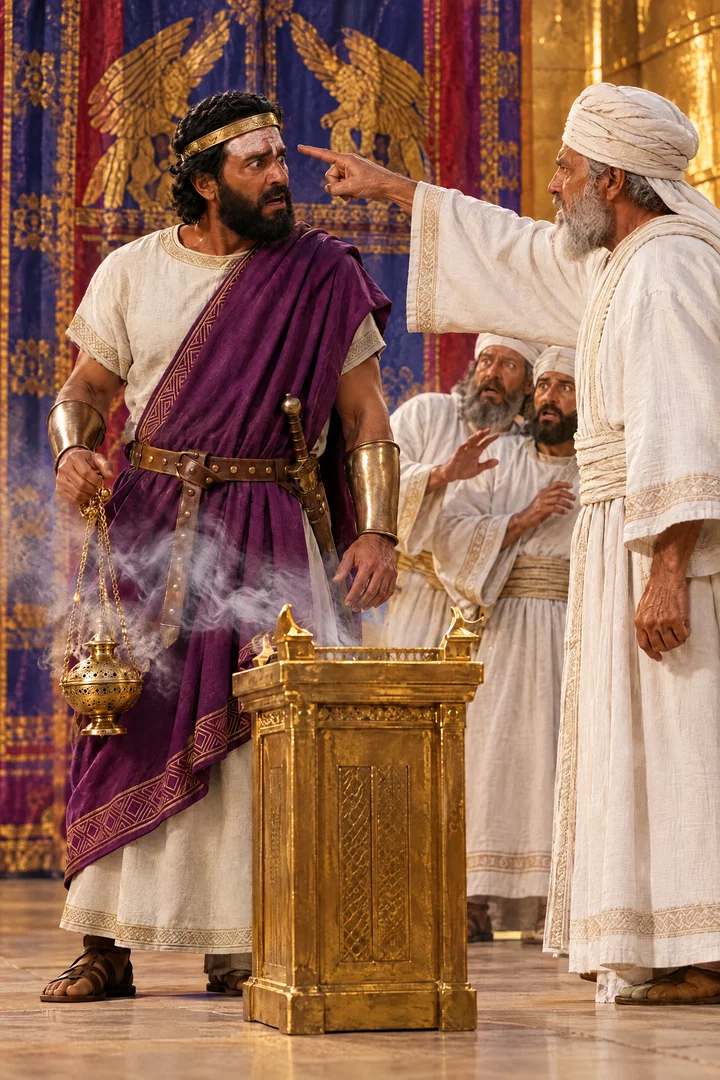
Then Uzziah was wroth, and had a censer in his hand to burn incense: and while he was wroth with the priests, the leprosy even rose up in his forehead before the priests in the house of the LORD, from beside the incense altar.
Translations
American King James Version, King James Version, Webster Bible
Then Uzziah was wroth, and had a censer in his hand to burn incense: and while he was wroth with the priests, the leprosy even rose up in his forehead before the priests in the house of the LORD, from beside the incense altar.
Then Uzziah was wroth, and had a censer in his hand to burn incense: and while he was wroth with the priests, the leprosy even rose up in his forehead before the priests in the house of the Lord, from beside the incense altar.
Then Uzziah was wroth; and he had a censer in his hand to burn incense; and while he was wroth with the priests, the leprosy brake forth in his forehead before the priests in the house of the LORD, beside the altar of incense.
Then Uzziah was wroth; and he had a censer in his hand to burn incense; and while he was wroth with the priests, the leprosy brake forth in his forehead before the priests in the house of Jehovah, beside the altar of incense.
And Uzziah is wroth, and in his hand [is] a censer to make perfume, and in his being wroth with the priests — the leprosy hath risen in his forehead, before the priests, in the house of Jehovah, from beside the altar of perfume.
And Uzziah was wroth; and he had a censer in his hand to burn incense; and while he was wroth with the priests, the leprosy rose up in his forehead before the priests in the house of Jehovah, beside the incense altar.
Then was Uzziah wroth, and, in his hand, was a censer, to burn incense,—and, when he was wroth with the priests, a leprosy, shot forth in his forehead, before the priests, in the house of Yahweh, from off the altar of incense.
Berean Standard Bible, Majority Standard Bible
Uzziah, with a censer in his hand to offer incense, was enraged. But while he raged against the priests in their presence in the house of the LORD before the altar of incense, leprosy broke out on his forehead.
Then Uzziah was angry. He had a censer in his hand to burn incense, and while he was angry with the priests, the leprosy broke out on his forehead before the priests in the LORD’s house, beside the altar of incense.
Then Uzziah was angry; and he had in his hand a vessel for burning perfume; and while his wrath was bitter against the priests, the mark of the leper's disease came out on his brow, before the eyes of the priests in the house of the Lord by the altar of perfumes.
Then Vzziah was wroth, and had incense in his hand to burne it: and while he was wroth with the Priestes, the leprosie rose vp in his forehead before the Priestes in the house of the Lord beside the incense altar.
Douay-Rheims (Challoner revision)
And Ozias was angry, and holding in his hand the censer to burn incense, threatened the priests. And presently there rose a leprosy in his forehead before the priests, in the house of the Lord at the altar of incense.
Pictures
Cross-references 20 of 21
- Leviticus 10:1-2
And Nadab and Abihu, the sons of Aaron, took either of them his censer, and put fire therein, and put incense thereon, and offered strange fire before the LORD, which he commanded them not.
Both accounts describe an unlawful incense offering and its judgment.
- Numbers 3:10
And thou shalt appoint Aaron and his sons, and they shall wait on their priest’s office: and the stranger that cometh nigh shall be put to death.
Priestly service was reserved for Aaron’s family, a law Uzziah violated.
- Numbers 16:40
To be a memorial unto the children of Israel, that no stranger, which is not of the seed of Aaron, come near to offer incense before the LORD; that he be not as Korah, and as his company: as the LORD said to him by the hand of Moses.
Forbids anyone outside Aaron’s line from offering incense.
- Numbers 18:7
Therefore thou and thy sons with thee shall keep your priest’s office for every thing of the altar, and within the vail; and ye shall serve: I have given your priest’s office unto you as a service of gift: and the stranger that cometh nigh shall be put to death.
Altar service was assigned to Aaron and his sons.
- Numbers 16:35
And there came out a fire from the LORD, and consumed the two hundred and fifty men that offered incense.
Unauthorized incense offering brings divine judgment.
- Numbers 15:30
But the soul that doeth ought presumptuously, whether he be born in the land, or a stranger, the same reproacheth the LORD; and that soul shall be cut off from among his people.
Presumptuous wrongdoing reproaches God and brings judgment.
- 2 Kings 15:5
And the LORD smote the king, so that he was a leper unto the day of his death, and dwelt in a several house. And Jotham the king’s son was over the house, judging the people of the land.
Records Uzziah’s leprosy and Jotham ruling in his stead.
- Leviticus 13:45-46
And the leper in whom the plague is, his clothes shall be rent, and his head bare, and he shall put a covering upon his upper lip, and shall cry, Unclean, unclean.
The law required lepers to declare themselves unclean and live apart.
- Exodus 30:9
Ye shall offer no strange incense thereon, nor burnt sacrifice, nor meat offering; neither shall ye pour drink offering thereon.
Restricts what may be offered on the incense altar.
- Isaiah 6:1
In the year that king Uzziah died I saw also the Lord sitting upon a throne, high and lifted up, and his train filled the temple.
Isaiah’s vision came as Uzziah’s reign was ending.
- Exodus 30:7
And Aaron shall burn thereon sweet incense every morning: when he dresseth the lamps, he shall burn incense upon it.
Aaron burns incense on the altar.
- 1 Samuel 13:13-14
And Samuel said to Saul, Thou hast done foolishly: thou hast not kept the commandment of the LORD thy God, which he commanded thee: for now would the LORD have established thy kingdom upon Israel for ever.
Saul is judged for unlawfully performing a priestly act.
- Numbers 18:1-5
And the LORD said unto Aaron, Thou and thy sons and thy father’s house with thee shall bear the iniquity of the sanctuary: and thou and thy sons with thee shall bear the iniquity of your priesthood.
Assigns priests duties in the sanctuary.
- Leviticus 10:2
And there went out fire from the LORD, and devoured them, and they died before the LORD.
Nadab and Abihu die after offering unauthorized fire.
- Leviticus 16:12-13
And he shall take a censer full of burning coals of fire from off the altar before the LORD, and his hands full of sweet incense beaten small, and bring it within the vail:
Both describe a priest using a censer and incense in the sanctuary.
- Amos 1:1
The words of Amos, who was among the herdmen of Tekoa, which he saw concerning Israel in the days of Uzziah king of Judah, and in the days of Jeroboam the son of Joash king of Israel, two years before the earthquake.
Dates Amos’s prophecy to two years before the earthquake.
- Luke 1:9
According to the custom of the priest’s office, his lot was to burn incense when he went into the temple of the Lord.
Both describe a priest burning incense in the temple.
- Zechariah 14:5
And ye shall flee to the valley of the mountains; for the valley of the mountains shall reach unto Azal: yea, ye shall flee, like as ye fled from before the earthquake in the days of Uzziah king of Judah: and the LORD my God shall come, and all the saints with thee.
Recalls the earthquake in Uzziah’s days.
- 2 Chronicles 26:5
And he sought God in the days of Zechariah, who had understanding in the visions of God: and as long as he sought the LORD, God made him to prosper.
Uzziah prospered while he sought the Lord.
- Exodus 28:41-43
And thou shalt put them upon Aaron thy brother, and his sons with him; and shalt anoint them, and consecrate them, and sanctify them, that they may minister unto me in the priest’s office.
Priests are consecrated for sanctuary service and restricted to their appointed duties.
Commentary
Each commentary is drawn from primary sources: the writings of Ellen G. White and Adventist pioneers and periodicals. Each commentary is separate. Its own words are not a quotation; follow the references to read the source passages.
Ellen G. White
5 sources
Only the descendants of Aaron were authorized to serve as priests, so Uzziah's entering the sanctuary to burn incense was an unauthorized and arrogant seizure of priestly work upon himself.RH Aug 14, 1900PK 304.1–3DA 262.1–3 When the priests opposed him with united protest and correction, he became filled with wrath and stood in rebellious anger against them because he, the king, had been rebuked.RH Mar 4, 1915RH Aug 14, 1900PK 304.1–3DA 262.1–3 While he stood wrathful in the house of the Lord with a censer in his hand to burn incense beside the incense altar, leprosy suddenly rose up on his forehead before the priests as a divine judgment that did not permit him to profane the sanctuary.RH Mar 4, 1915RH Aug 14, 1900PK 304.1–3DA 262.1–3
In dismay he fled the temple and never again entered its courts, being forced to leave the temple to live in isolation.RH Mar 4, 1915PK 304.1–3DA 262.1–3 Even though he was king acting as ruler, when afflicted he had to give up the scepter and surrender his royal duties and leave society.MH 67.1–2DA 262.1–3 He remained a leper until his death some years later, so his presumptuous sin marred the closing years of his reign and brought the judgment of Heaven upon himself.RH Mar 4, 1915RH Aug 14, 1900PK 304.1–3 Neither his exalted rank and position nor his long life of service could excuse his violation of God's plain command.RH Mar 4, 1915PK 304.1–3
Leprosy was regarded among the Jews as a judgment for sin and as a symbol of sin, incurable and deadly, rendering its sufferer unclean and cut off from the community.MH 67.1–2DA 262.1–3 The verse stands as a living example of the folly of departing from a plain Thus saith the Lord and warns against presumptuous disobedience, showing that anger at correction does not prevent divine judgment.RH Mar 4, 1915RH Aug 14, 1900PK 304.1–3
Sources
Pioneers and periodicals
29 sources
Uzziah sought God and was marvelously helped until his name spread far and he became strong, but when strong his heart was lifted up and he forgot God and transgressed to his destruction.RH Apr 9, 1914 In presumption he entered the house of the Lord with a censer to burn incense beside the altar, though that duty belonged to Aaron's descendants alone and the priests withstood and warned him.RH Jul 14, 1903ST Apr 22, 1889ST Nov 1, 1877 While he was still wroth with the priests for rebuking him, leprosy rose up in his forehead before them in the sanctuary by an immediate divine stroke, so he was not permitted to profane it.ST May 7, 1912ST Jan 8, 1885ST Apr 11, 1911ST Dec 9, 1889RH Nov 9, 1869 He was then thrust out and cut off from the house of the Lord, remaining a leper until his death and never again entering the temple courts.RH Apr 9, 1914ST Sep 3, 1896RH Dec 3, 1857 His royal rank as king of Judah did not authorize him to take the priest's office, showing that civil sovereignty must not grasp priestly worship.ST Sep 3, 1896ST Apr 15, 1886STST Aug 13, 1896ST Mar 24, 1909
Uzziah's Intrusion and Punishment
Uzziah began well, doing what was right and seeking God, and as long as he sought the Lord he was made to prosper and given mighty power in war, being marvelously helped until his name spread far abroad and he became strong.RH Apr 9, 1914 But when he was strong his heart was lifted up, he forgot God and transgressed against the Lord to his own destruction, becoming presumptuous in pride, self-confidence and ambition.RH Jul 14, 1903RH Apr 9, 1914 In that presumption he entered the house of the Lord to burn incense, holding a censer beside the incense altar, though the priests withstood him, warned him, and unitedly protested that this duty belonged to Aaron's descendants alone.RH Mar 4, 1915RH Jul 14, 1903ST Apr 22, 1889ST Nov 1, 1877 Only Aaron's descendants were authorized to burn incense on the altar, and his royal rank did not permit him to disregard God's command.ST Apr 22, 1889
While he insisted on the forbidden act he became wroth with the priests for rebuking and correcting him, standing in wrathful rebellion against them and even angrily threatening those who opposed him.RH Mar 4, 1915RH Aug 14, 1900ST May 7, 1912RH Nov 9, 1869RH Oct 29, 1861 He was filled with wrath because he, the king, was rebuked, and his anger at correction did not prevent judgment.RH Mar 4, 1915RH Aug 14, 1900RH Oct 29, 1861 While he was still angry with the priests and holding the censer, leprosy rose up on his forehead before the priests in the sanctuary beside the incense altar.ST May 7, 1912ST Jan 8, 1885ST Apr 11, 1911ST Dec 9, 1889ST Apr 15, 1886 The stroke was immediate and divine, so he was not permitted to profane the sanctuary, showing that departure from God brings loss rather than blessing.RH Mar 4, 1915ST May 7, 1912
They thrust him out and he fled in dismay, cut off and excluded and barred from the house of the Lord.RH Apr 9, 1914ST Sep 3, 1896ST Dec 9, 1889 He never again entered the temple courts, but remained a leper until his death some years later, though still mighty in valor.RH Mar 4, 1915RH Apr 9, 1914 He spent his final seven years apart with Jotham ruling in his place, having lost his freedom and active kingship, forced as a leprous king under judgment for sin to give up the scepter and leave society.ST Apr 11, 1911ST Mar 24, 1909 His grasping the holy censer in that condition illustrates the danger of joining civil sovereignty with religious authority, and his anger and attempt as king did not remove the boundary between civil authority and priestly worship.ST Sep 3, 1896ST Mar 24, 1909
The event occurred in connection with a great earthquake as a sign of divine displeasure against his sin of entering the temple and usurping the priests' sacred office by offering incense.RH Nov 9, 1869 Chronicles itself does not mention the earthquake, but Josephus reports it.RH Sep 11, 1856 The flight from it is compared with the flight described in Zechariah.RH Sep 11, 1856
Kingship and Priesthood Distinguished
While the Aaronic priesthood was in force it was sinful for a man of another tribe to perform a priest's duties, for only Aaron's descendants were authorized to burn incense on the altar.ST Apr 22, 1889ST Apr 1, 1897 Uzziah's attempt to burn incense brought immediate judgment.ST Apr 22, 1889ST Apr 1, 1897 His royal rank did not permit him to disregard God's command, for being a king of Judah in David's line did not authorize him to serve as priest or to take the priests' office at the altar.ST Apr 15, 1886ST Apr 22, 1889 When he presumptuously tried to perform a priest's duty by burning incense in the temple, leprosy appeared on his forehead while he argued angrily with the priests beside the incense altar.ST Apr 15, 1886ST Aug 13, 1896 Even a king may not perform the priestly service at the altar, and neither rank nor consecrated office exempts anyone from obedience, nor can sacred duties and institutions be replaced or taken up without regard for God's commands.STST Aug 13, 1896
His anger and attempt as king did not remove the boundary between civil authority and priestly worship.ST Sep 3, 1896 While he stood beside the incense altar, leprosy appeared on his forehead before the priests, and he was driven from the temple and remained a leper until his death.ST Sep 3, 1896 His attempt to burn incense in the temple, an act reserved for the priests, brought immediate judgment while he was angry with the priests, and he lost his freedom and active kingship.ST Mar 24, 1909 His grasping the holy censer illustrates the danger of joining civil sovereignty with religious authority.ST Mar 24, 1909
His punishment for presuming to perform the priestly service of burning incense, which belonged to Aaron's descendants, illustrates that the law reserving the priesthood and its duties to Aaron's family remained binding.RH Aug 9, 1870RH Feb 4, 1873 That priesthood law was distinct from the moral law.RH Aug 9, 1870 Its binding force is proved by the smiting of a king of Israel with leprosy for disregarding the exclusive grant of priestly service to Aaron and his sons, and that is the law which had of necessity to be changed so that Christ, who was of the tribe of Judah, could be recognized as priest.RH Feb 4, 1873
Presumption Warned and Applied
Pride, self-confidence, and ambition lifted up Uzziah's heart until he forgot God, transgressed His order, and departed from a plain Thus saith the Lord, and that departure marred the closing years of his reign.RH Jul 14, 1903RH Dec 3, 1857ST Nov 10, 1881 His pride moved him to presume to perform the priestly duty of burning incense, and while he angrily opposed and insisted against the priests who warned him that the work belonged to Aaron's descendants, leprosy rose on his forehead beside the incense altar.RH Jul 14, 1903RH Dec 3, 1857ST Nov 10, 1881 That immediate stroke ended his temple service and brought lifelong isolation as a leper, showing that rejecting reproof brings lasting consequences and that disobediently taking priestly authority is rebellion against God.RH Jul 14, 1903RH Dec 3, 1857ST Nov 10, 1881
Neither exalted position nor long life of service could excuse his presumptuous sin or exempt him from obedience, for rank and consecrated office do not set anyone above God's commands.RH Mar 4, 1915ST Even a king might not perform the priestly service at the altar, and sacred duties and institutions cannot be replaced or taken up without regard for what God has appointed.RH Mar 4, 1915ST Standing in wrathful rebellion against the priests' united protest, he was not permitted to profane the sanctuary but was suddenly smitten with divine judgment, and in dismay he fled and never again entered the temple courts, remaining a leper until his death some years later as a living example of the folly of departing from a plain Thus saith the Lord.RH Mar 4, 1915RH Aug 14, 1900
His anger at correction brought the judgment of Heaven upon him, for while he held the censer to burn incense in the Lord's house leprosy appeared on his forehead before the priests.RH Aug 14, 1900RH Oct 29, 1861 That angry response to reproof, which left him a leper until his death, stands in contrast to Jehoshaphat's submission and renewed diligence when reproved.RH Aug 14, 1900RH Oct 29, 1861 The record was caused to be written for those upon whom the ends of the world are come as a warning against letting strength and a far-spread name lift up the heart to forget God.RH Apr 9, 1914RH Dec 3, 1857 He had done right and sought God, and as long as he sought the Lord God made him prosper and gave him mighty power in war until his name spread far abroad, but when strong his heart was lifted up and he became presumptuous to his destruction.RH Apr 9, 1914 When God's servants withstood him he was wroth, was smitten beside the incense altar, was thrust out, and was cut off from the house of the Lord, remaining a mighty man in valor but a leper, proving that people cannot sin with impunity and that defying God's command and persisting in sin brings destructive consequences.RH Apr 9, 1914RH Dec 3, 1857ST Jul 30, 1902
A good aim cannot make a wrong action good, so his purpose in offering incense did not make the act right.RH Oct 11, 1864 Holy work cannot be done with unholy hands or by substituting one's own authority for God's instructions, and taking a role God had not assigned brings serious consequences.ST Aug 13, 1896ST Sep 17, 1902 His presumptuous irreverence toward God's worship ended disastrously, and his punishment shows that grasping priestly authority in disobedience is rebellion against God.RH Oct 9, 1900ST Nov 10, 1881ST Aug 13, 1896ST Sep 17, 1902 Leprosy could fall even upon a king as judgment for sin, forcing him to give up the scepter and leave society, and he ended his reign as a leper.ST Jan 31, 1911 That spreading leprosy on his forehead is also an image of sin's gradual, visible damage, by which wrongdoing alters face and manner over time until its effects deepen into isolation and punishment.ST Feb 1, 1899
Sources