Acts 18:3
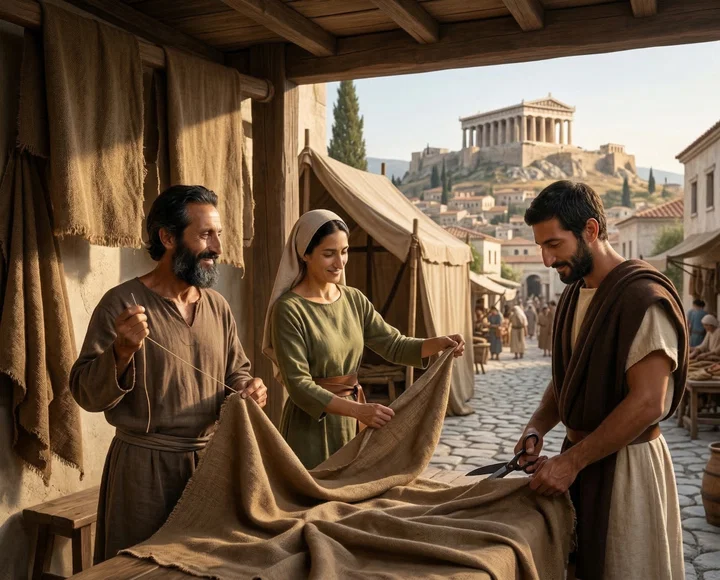
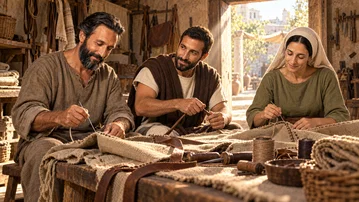
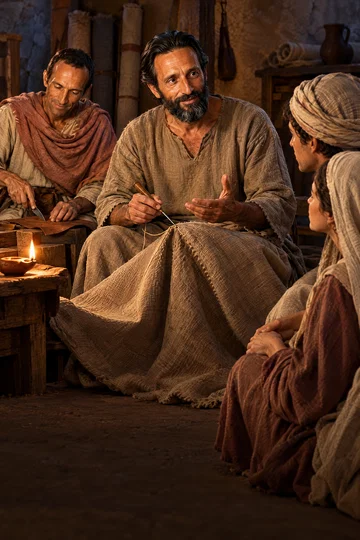
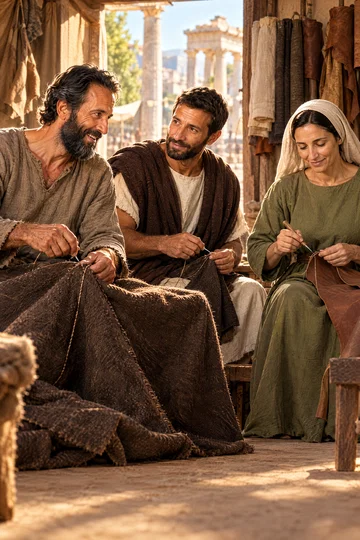
And because he was of the same craft, he abode with them, and wrought: for by their occupation they were tentmakers.
Translations
And because he was of the same craft, he stayed with them, and worked: for by their occupation they were tentmakers.
King James Version, KJV Cambridge Paragraph Bible
And because he was of the same craft, he abode with them, and wrought: for by their occupation they were tentmakers.
And because he was of the same occupation, he abode with them, and wrought (for by their occupation they were tent-makers)
Revised Version, American Standard Version
and because he was of the same trade, he abode with them, and they wrought; for by their trade they were tentmakers.
and because of being of the same craft, he did remain with them, and was working, for they were tent-makers as to craft;
and because they were of the same trade abode with them, and wrought. For they were tent-makers by trade.
and, because he was of the same craft, he abode with them, and wrought, for they were tent-makers by their trade.
Berean Standard Bible, Majority Standard Bible
and he stayed and worked with them because they were tentmakers by trade, just as he was.
and because he practiced the same trade, he lived with them and worked, for by trade they were tent makers.
And because he was of the same trade, he was living with them, and they did their work together; for by trade they were tent-makers.
And because hee was of the same crafte, he abode with them and wrought (for their crafte was to make tentes.)
Douay-Rheims (Challoner revision)
And because he was of the same trade, he remained with them, and wrought; ( now they were tentmakers by trade.)
Pictures
Cross-references
- 1 Thessalonians 2:9
For ye remember, brethren, our labour and travail: for labouring night and day, because we would not be chargeable unto any of you, we preached unto you the gospel of God.
Paul worked at his trade while preaching so as not to burden believers.
- Acts 20:34
Yea, ye yourselves know, that these hands have ministered unto my necessities, and to them that were with me.
Paul’s hands supplied his needs through his own work.
- 2 Thessalonians 3:8-9
Neither did we eat any man’s bread for nought; but wrought with labour and travail night and day, that we might not be chargeable to any of you:
Paul labored to support himself and set an example without burdening others.
- Acts 18:11
And he continued there a year and six months, teaching the word of God among them.
Paul taught in Corinth for a year and six months.
- 1 Corinthians 9:12-18
If others be partakers of this power over you, are not we rather? Nevertheless we have not used this power; but suffer all things, lest we should hinder the gospel of Christ.
Paul forgoes support he could claim so his ministry will not hinder the gospel.
- 2 Corinthians 11:9
And when I was present with you, and wanted, I was chargeable to no man: for that which was lacking to me the brethren which came from Macedonia supplied: and in all things I have kept myself from being burdensome unto you, and so will I keep myself.
Paul worked and accepted support from others to avoid burdening the Corinthians.
- Acts 18:26
And he began to speak boldly in the synagogue: whom when Aquila and Priscilla had heard, they took him unto them, and expounded unto him the way of God more perfectly.
Aquila and Priscilla instructed Apollos more fully.
- 1 Corinthians 4:12
And labour, working with our own hands: being reviled, we bless; being persecuted, we suffer it:
Paul describes working with his own hands.
- 2 Thessalonians 3:10
For even when we were with you, this we commanded you, that if any would not work, neither should he eat.
Paul's manual labor exemplifies the rule to work.
- Romans 16:3
Greet Priscilla and Aquila my helpers in Christ Jesus:
Aquila and Priscilla, fellow tentmakers, are named as Paul’s helpers in Christ.
- 1 Corinthians 9:6
Or I only and Barnabas, have not we power to forbear working?
Paul contrasts ministers’ right to forbear working with his own labor for support.
- 1 Corinthians 9:18
What is my reward then? Verily that, when I preach the gospel, I may make the gospel of Christ without charge, that I abuse not my power in the gospel.
Paul sometimes worked to preach the gospel without charge.
- Genesis 2:15
And the LORD God took the man, and put him into the garden of Eden to dress it and to keep it.
Both present work as a blessing from God.
- Acts 18:19
And he came to Ephesus, and left them there: but he himself entered into the synagogue, and reasoned with the Jews.
Paul leaves Priscilla and Aquila at Ephesus to counsel disciples.
- 2 Corinthians 12:13-14
For what is it wherein ye were inferior to other churches, except it be that I myself was not burdensome to you? forgive me this wrong.
Paul supported himself rather than burdening the Corinthians.
Commentary
Each commentary is drawn from primary sources: the writings of Ellen G. White and Adventist pioneers and periodicals. Each commentary is separate. Its own words are not a quotation; follow the references to read the source passages.
Ellen G. White
55 sources
Paul was of the same craft as Aquila and Priscilla, so he stayed with them in Corinth and worked with his hands making tents to earn his bread while reasoning in the synagogue every Sabbath and persuading Jews and Greeks.GW 234.3–235.1Ms 142, 1897, par. 1–2AA 349.2–350.1 Aquila and Priscilla were Christian Jews banished from Rome who had established their tentmaking business in Corinth, and Paul, though a free-born Roman citizen of reputable family, solicited work from them and labored with them.RH Mar 6, 1900Ms 95, 1899, par. 1–2 Though as an apostle he could rightly have claimed support, he gave up that right and labored day and night so as not to burden poor believers or be chargeable to any man, and so his preaching would not be suspected as a way to gain money or give opponents cause for reproach.GW 234.3–235.1AA 350.2–34T 409.1–3SLP 100.3–101.2GW92 163.4 He had learned the trade in his youth according to the Jewish custom of teaching every child a useful craft, showing that manual labor has true dignity and is not inconsistent with true greatness of human and Christian character.4T 409.1–3ST Mar 27, 1884CH 641.3CE 61.1–3FE 97.1 His workshop itself became a witness, for as he toiled ingeniously and faithfully to support himself and help others he brought religion into his daily labor, taught Scripture, held prayer with fellow workers, and turned many from error to truth.19MR 25.1–2Ms 93, 1899, par. 6–8Lt 107, 1904, par. 2–6Ms 97, 1899, par. 3–4Ms 81, 1906, par. 22–25
Corinth and Its Workers
The verse belongs to Paul's stay with Aquila and Priscilla in his work at Corinth.AA 243.3AA 243.1 It took place in the first century of the Christian era, when Corinth was one of the leading cities not only of Greece but of the world.AA 243.1 Its streets were thronged with Greeks, Jews, and Romans, with travelers from every land eagerly intent on business and pleasure.AA 243.1 The city was deeply idolatrous and immoral, yet as a great commercial center situated within easy access of all parts of the Roman empire it was an important place in which to establish memorials for God and His truth.AA 243.3AA 243.1
Aquila and Priscilla were Christian Jews banished from Rome after unbelieving Jews stirred up envy and opposition and complained that the Christian Jews were disorderly and dangerous to the public good.RH Mar 6, 1900 They had been banished for preaching that Jesus was the Messiah, and they went to Corinth and there established a business as manufacturers of tents.RH Mar 6, 1900Ms 95, 1899, par. 1–2 When Paul came to Corinth he solicited work from Aquila and Priscilla because he was of the same craft, and he abode with them and wrought at tentmaking.RH Mar 6, 1900Ms 95, 1899, par. 1–2 Paul himself came from a family of reputation, was a Cilician, and was a free-born Roman citizen, unlike others who obtained Roman freedom with a great sum.Ms 95, 1899, par. 1–2
At Corinth he labored for a year and six months and proved the divine character of his mission by raising up a flourishing church composed of Jews and Gentiles.7T 268.1Lt 96, 1902, par. 4–5 The Gentile converts were more numerous than the Jewish converts, and many of them were truly converted, brought from darkness into the light of the gospel.Lt 96, 1902, par. 4–5 They were in a more favorable condition than the Jews to receive the truth, for they were not walled in by the maxims and traditions of priests and elders.Lt 96, 1902, par. 4–5 His going from place to place preaching the truth to those in the darkness of error calls workers today to make the world their field of labor, rather than to work for the churches only.Lt 96, 1902, par. 4–5
Tentmaking as Shared Trade
Paul was of the same craft as Aquila and Priscilla, and therefore he abode with them and wrought with them as a tentmaker to provide for his own needs.GW 234.3–235.1Ms 142, 1897, par. 1–2AA 349.2–350.18RED 61.2–3ST Mar 27, 1884 He supported himself by manual labor while also reasoning in the synagogue every Sabbath and persuading both Jews and Greeks.GW 234.3–235.1AA 349.2–350.18RED 61.2–3 He had learned the trade in his youth, and though he was one of the most effectual missionary workers, a clear eloquent speaker able to meet adversaries on almost any ground and not behind the chiefest apostle, he labored at the humble occupation to avoid burdening others and to keep his preaching from being suspected as a way to gain money, even though as an apostle he could rightly have claimed support from his hearers.GW 234.3–235.1Ms 142, 1897, par. 1–28RED 61.2–3ST Mar 27, 1884SLP 209.2–210.2 His self-supporting toil sustained his preaching and opened access to fellow workers whom he could reach with salvation as he worked alongside them.8RED 61.2–3SLP 209.2–210.2
His work was fashioning canvas with his hands to earn his bread, and the bread so earned was justly his as part of his apostolic service.AA 352.2GW 236.2Ms 97, 1899, par. 1–2 Tentmaking did not bring returns as quickly as some other lines of business, so that at times only by the strictest economy could he supply his necessities.Ms 97, 1899, par. 1–2 Skill in the trade had higher and lower branches, and Paul had learned the higher branches yet could also work at the common branches when circumstances demanded.MYP 216.1Ms 97, 1899, par. 1–2 He often worked in this way during his ministry to support himself and others, and his labor gave him access to people he might not otherwise have reached, showing that skill in ordinary crafts is a gift from God to be honored in everyday toil without weakening the force of ministry.MYP 216.1
Tentmaking was the trade of humble working people practiced in Corinth, even as fishing was the trade in Galilee from which Christ chose co-laborers for salvation.CTBH 98.3–99.1ST May 4, 1882 Ordinary working men could thus be chosen to labor with Christ, and humble manual work was no barrier to lasting spiritual service but became a source of power felt through eternity.CTBH 98.3–99.1ST May 4, 1882 Aquila and Priscilla themselves earned their living by making tents, the same trade at which Paul stayed and worked with them.8RED 66.1–3 Their humble occupation did not prevent them from teaching Apollos more perfectly about Christ, and their instruction helped make him a stronger defender of the faith.8RED 66.1–3
Why Paul Worked
Paul worked at his trade to support himself and others while traveling, preaching, winning converts, and caring for churches, and his self-supporting labor sustained his unwearied travel preaching Christ and establishing churches.8RED 61.2–3GW 58.4Lt 107, 1904, par. 2–6 He did this especially after he had spent his means advancing Christ's cause and supporting himself, returning to tentmaking to earn a living when he was not preaching.4T 409.1–3CH 641.3SLP 99.3–100.2GW92 163.3AA 347.1 This was particularly needful in places where people might misunderstand his motives.AA 347.1
He worked so as not to burden believers or churches already pressed by poverty, and so as not to be chargeable to any man for food, clothing, or support.4T 409.1–3SLP 100.3–101.2GW92 163.4Lt 103, 1900, par. 19–2220MR 344.2–345.1 He labored day and night to avoid being chargeable to his brethren, at times suffering hunger himself to relieve others.Lt 103, 1900, par. 19–2220MR 344.2–345.1 He shared his earnings with Luke and helped Timothy obtain equipment for his journey.Lt 103, 1900, par. 19–2220MR 344.2–345.1
Though as an apostle he could rightly have claimed support from his hearers, he gave up that right and chose not to be supported by the churches he founded.GW 234.3–235.1AA 350.2–3SLP 100.3–101.2GW92 163.4RH Mar 13, 1900 He did so that his preaching would not be suspected as a way to gain money.GW 234.3–235.1SLP 100.3–101.2GW92 163.4RH Mar 13, 1900 He did so that opponents would have no cause for reproach and no opportunity to misrepresent him and weaken his message.AA 350.2–3SLP 100.3–101.2GW92 163.4RH Mar 13, 1900
He willingly worked when circumstances called for it, yet he did not consider the work wasted and did not let earning a living distract him from pressing toward his high calling.GW 238.1GW 58.4 He could set his trade aside when duty, opposition to the gospel, or an opportunity to win souls required his attention, and return to it afterward.GW92 164.1GW 238.1RH Mar 13, 1900
He worked long hours supporting himself and helping meet others' needs, combining manual labor with teaching salvation.SLP 100.3–101.2 While working at his trade he spoke of the Saviour, helped those in trouble, and turned souls from error to truth.SLP 100.3–101.2Lt 107, 1904, par. 2–6 His life of self-denial and self-sacrifice fitted him to organize good works, since one correct example is worth more than many commands.Ms 40, 1900, par. 3
Training and Dignity of Labor
Paul had learned tentmaking in his youth in keeping with the Jewish custom of teaching every child a trade regardless of expected position or future eminence, so that after spending his means advancing Christ's cause and supporting himself he could earn a living by his own hands when he was not preaching.4T 409.1–3ST Mar 27, 1884CH 641.3SLP 99.3–100.2GW92 163.3 Though he had held an elevated position and had not previously depended on manual labor, he turned to his trade to provide for his necessities and to avoid burdening churches already pressed by poverty or giving occasion for suspicion about his motives.4T 409.1–3CH 641.3SLP 99.3–100.2GW92 163.3AA 346.2 This training was regarded as essential even for a child to be educated for holy office, whether parents were rich or poor.AA 346.2
The requirement rested on direction given in the pillar of cloud and on God's command that every youth learn a trade so the people could earn their own bread and, knowing how hard money is to obtain, would not spend means foolishly.Ms 97, 1899, par. 1–2PP 593.3RH Oct 30, 1900 Even the wealthy as well as the poorer classes were to train sons and daughters in literary lines and also in some useful craft as an indispensable part of education, and pupils sustained themselves as husbandmen and mechanics, so that when adverse circumstances came they would not be dependent on others but would have ability to provide for their own necessities.AA 346.2Ms 93, 1899, par. 4–5PP 593.3RH Oct 30, 1900 Paul himself was an educated tentmaker who had also studied diligently under Gamaliel, and he had learned the higher branches of tentmaking yet could also work at the common branches when circumstances demanded, though tentmaking did not bring returns as quickly as some other business and at times only by strictest economy could he supply his necessities.Ms 97, 1899, par. 1–2Ms 93, 1899, par. 4–5 While working at the trade with Aquila he labored to obtain means for support and at the same time gave a more thorough knowledge of Christ to those who heard him, showing that useful physical labor is part of the gospel.Ms 97, 1899, par. 1–2Ms 93, 1899, par. 4–5
Manual work was not considered degrading or strange even as late as the time of Christ, and Paul and Aquila were no less honored as religious teachers because they earned their livelihood by tentmaking.CE 61.1–3FE 97.1Ms 93, 1899, par. 6–8PP 593.3RH Oct 30, 1900 Ministry and manual labor go together, and such work is nothing to be ashamed of or afraid of and in no way lowers the work of the ministry.Ms 93, 1899, par. 6–8 There is true dignity in labor, manual labor cannot be degrading, and it is not inconsistent with true greatness and elevation of human and Christian character.Lt 103, 1900, par. 19–2220MR 344.2–345.1
Skill in ordinary crafts is a gift from God, and God is to be honored in everyday toil.RH Oct 3, 1912CT 279.3MYP 216.1RP 29.2 The skill, genius and wisdom brought into workmanship are given by God to be used for His glory, as shown when, while working with Aquila, Paul repeated to fellow workers Christ's specifications to Moses for building the tabernacle and God's communications about that work, teaching that supreme honor is to be given to God.Ms 97, 1899, par. 3–4 His labor supported himself and others and gave him access to people he might not otherwise have reached.RH Oct 3, 1912CT 279.3MYP 216.1RP 29.2
Paul's toil-worn and toil-hardened hands took nothing from the force of his sensible, intelligent, eloquent and pathetic appeals beyond any other prominent minister, and he did not consider the work wasted.RH Oct 3, 1912CT 279.3RP 29.2Lt 103, 1900, par. 19–2220MR 344.2–345.1 Mechanical toil in any honorable line does not necessarily lessen anyone's influence and should not make a man coarse and rough and uncourteous, though ministers are not obligated in all respects to do as Paul did.Lt 103, 1900, par. 19–22 Manual work does not lessen the force of Christian ministry.RH Oct 3, 1912CT 279.3MYP 216.1
Even though he was one of the most effectual missionary workers, a clear eloquent speaker able to meet adversaries on almost any ground and not behind the chiefest apostle, he still abode and worked at the humble occupation of tentmaking because he was of the same craft.Ms 142, 1897, par. 1–2 Though exalted above the other apostles by Christ's revelation in his conversion by a voice and great light when persecuting Christians and by later visions in ministry of things not lawful for a man to utter, and though able to match eloquence with eloquence and philosophy with philosophy, he still did ordinary daily labor for support.Lt 103, 1900, par. 19–22Ms 27, 1902, par. 10–1120MR 344.2–345.1 This teaches that no one should spend time longing to do the impossible and forget common duties in the desire to do something great, but must climb the ladder round after round from the lowest even by painful effort, for success comes with diligent effort and such progress is of great value to the earnest striver for victory.Ms 27, 1902, par. 10–11
His example dignifies honest work and presents it as honorable, and his labor supported his ministry while he could set his trade aside when duty called and return to it afterward.GW92 164.1SLP 100.3–101.2 His example teaches diligence and willingness to perform humble work rather than seeking ease, and willingly working at his trade when circumstances called for it did not lessen his readiness to set secular work aside when opposition to the gospel or an opportunity to win souls required his attention.GW92 164.1GW 238.1 As an apostle of the highest rank spending time in mechanical labor when to all appearances that time might have been put to better account in preaching, his laboring with his hands was itself preaching the Word, set against the sentiment then gaining influence that preaching the gospel excuses the minister from mechanical and physical labor.Ms 97, 1899, par. 9 By it he meant to rebuke indolence and selfish ease and love of ease and indulgence, for ministers who neglect physical work become enfeebled, whereas by working with their hands young ministers would become sturdy with muscles and sinews strengthened.SLP 100.3–101.2Ms 97, 1899, par. 9 The Vaudois pastors followed him by learning a trade or profession so they could provide for their own support when needed.GC 68.1GC88 68.1
Workshop as Gospel Witness
Paul's tent work supported himself and others, and working alongside fellow laborers gave him access to men he could not otherwise have reached and opened the way to bring salvation to them.RH Oct 3, 1912CT 279.3MYP 216.1RP 29.2SLP 100.3–101.2 While living and working with Aquila and Priscilla he taught the Scriptures and instructed them more perfectly in the truth.Ms 93, 1899, par. 6–8Ms 93, 1899, par. 4–5 He labored to obtain means for support and in doing so gave a more thorough knowledge of Christ to those who heard him.Ms 93, 1899, par. 4–5Ms 97, 1899, par. 3–4 While working with Aquila he stayed in touch with Christ, gave needed instruction in spiritual things, and educated believers in unity.Ms 97, 1899, par. 3–4 In his trade he gave an example of diligence and thoroughness, as one diligent in business, fervent in spirit, serving the Lord.Ms 97, 1899, par. 3–4
With Aquila and Priscilla he held praise and prayer meetings with those associated with them in tentmaking, making their work a testimony to the value of the truth.Ms 97, 1899, par. 3–4 He brought his religion into the workshop, speaking words of faith and encouragement in a genuine, sensible way.Ms 81, 1906, par. 22–25 Losing no opportunity to witness to those he contacted, he preached the gospel while at his trade, spoke of the Saviour, helped those in trouble, and turned many souls from error to truth.Lt 107, 1904, par. 2–6 His unwearied self-supporting labor thus sustained constant travel from place to place preaching Christ and establishing churches.Lt 107, 1904, par. 2–6
His designs in tentmaking were ingenious and brought fresh methods.19MR 25.1–2 His business tact made him no less fervent and able in preaching the Word.19MR 25.1–2 While at work he was skillful, quick and intelligent with his hands, diligent in business and fervent in spirit in serving the Lord, and his laboring itself preached the Word.19MR 25.1–2Ms 97, 1899, par. 3–4 Many were brought to a knowledge of the truth by witnessing his faithful toil to support himself so as not to be dependent on anyone for food and clothing.19MR 25.1–2
Ministry therefore includes service in useful, profitable manual labor and not only study and preaching, to keep all faculties healthy, provide self-support, and win souls.19MR 25.1–2 Useful physical labor is a part of the gospel.Ms 97, 1899, par. 1–2 Every person is to be a worker with brain and muscle and sinew, dedicated without reserve to the service of God, bearing the tax on physical powers while at the same time advancing in spiritual knowledge and practicing what is taught.Lt 2, 1889, par. 18–19
Ordinary working men and humble toilers in Corinth, like the fishermen chosen in Galilee, could be chosen by Christ as co-laborers in the work of salvation, and humble manual work is no barrier to lasting spiritual service.CTBH 98.3–99.1ST May 4, 1882Ms 58, 1890, par. 17 Their daily business was not divided from religion, and their contented industry in the necessary duties of life reproves separating religion from business.Ms 58, 1890, par. 17 From these humble men went forth a power that will be felt through all eternity.CTBH 98.3–99.1Ms 58, 1890, par. 17 Workers in common business, sanctified by the Holy Spirit, can get the very best results in proclaiming present truth by timely speech and by short, pointed tracts and papers, refusing to be satisfied unless something is done and earnestly asking if they have done all they might in sowing seeds of truth.Ms 81, 1906, par. 22–25
Paul thus joined the labor of a craftsman with his highest ministry, both human and divine.ED 217.1–2 His manual labor did not lessen his gospel work or his readiness to serve.19MR 25.1–2 He did common physical labor without feeling belittled, degraded, or discontented.Lt 2, 1889, par. 18–19
Sources
Pioneers and periodicals
97 sources
At Corinth Paul stayed with Aquila and Priscilla and worked with them at their shared trade of making tents.RH Mar 4, 1862RH Jun 7, 1864 Through the week he labored with his hands at tentmaking and every Sabbath he reasoned in the synagogue, persuading both Jews and Greeks.ST Aug 27, 1885ST Jul 13, 1882ST Mar 15, 1910 Continued a year and six months, this was seventy-eight Sabbaths in succession on the seventh day, while the first day of the week remained an ordinary working day.RH May 2, 1854ST Mar 18, 1889RH Feb 3, 1852RH Mar 7, 1854ST Sep 29, 1909 By this daily work he earned his own living and helped meet the needs of those with him, so as not to burden those among whom he preached or eat any man's bread for nothing.ST Jul 15, 1897RH Feb 4, 1862ST Mar 18, 1889RH Feb 6, 1908ST Jul 29, 1897 His example proves that ordinary manual labor is not degrading and is not beneath a minister of the gospel, but honors God when done patiently and honestly for his service and glory.RH Oct 3, 1912ST Jan 18, 1916ST May 4, 1882ST Oct 24, 1895ST May 1, 1884
Paul's Trade and Stay
At Corinth Paul shared the tentmaking trade of Aquila and Priscilla, and for that reason he stayed with them and worked with them at making tents.RH Mar 4, 1862RH Jun 7, 1864ST Aug 8, 1906ST Mar 18, 1889 His preaching was not his only work, for his manual work and his ministry went forward together while he lodged with them.ST Jul 15, 1897ST Jul 15, 1897 That work at the trade is distinguished from his practice of reasoning and teaching in the synagogue every Sabbath, where Jews and Greeks attended worship.RH Mar 4, 1862RH Jun 7, 1864ST Aug 8, 1906ST Mar 18, 1889
The stay belongs to his year and six months of teaching the word of God at Corinth, in which he founded and raised up the Corinthian church.RH Jan 10, 1871ST Oct 20, 1914RH Feb 27, 1908 He labored there at tentmaking for his support before Silas and Timothy arrived from Macedonia, and the events also include a contribution sent by the Philippians for his support.ST Jul 15, 1897ST Sep 27, 1883 His self-supporting tent labor sustained him and his helpers as they reasoned in the synagogue every Sabbath and persuaded the Jews, and the fruit of that combined work ripened into the church.RH Jan 10, 1871ST Oct 20, 1914 The Corinth experience stands within the wider work in Thessalonica, Berea, Athens, Corinth, Ephesus, Troas, and the farewell to the elders of Ephesus, showing how wonderfully God wrought and how the word triumphed in every case notwithstanding persecutions.ST Jul 7, 1909
Aquila and Priscilla were Christian Jews banished from Rome after unbelieving Jews stirred up envy and opposition and complained that the Christian Jews were disorderly and dangerous to the public good.RH Mar 6, 1900 They went to Corinth and there established a business as manufacturers of tents, and when Paul came he solicited work from Aquila and abode with them and wrought at the same craft.RH Mar 6, 1900 They owned their house, which shows they were not of the poor class who gave themselves to the work simply to make a living.RH Apr 4, 1871 Their long familiarity with Paul helps explain how he learned details about the church at Rome and its disagreements.RH Apr 20, 1876
Tentmaking was a low-status but useful occupation, likely making cloth from Cilician goat hair.ST Jul 15, 1897ST Jan 22, 1885 Paul had learned the trade in his youth, though he was educated under Gamaliel, according to the Jewish and Hebrew custom requiring parents to teach every son and every child a trade.ST Mar 27, 1884ST Jul 15, 1897ST Jan 22, 1885RH Oct 22, 1872 Pupils sustained themselves by their own labor as husbandmen and mechanics, every child was taught some trade in obedience to the command of God even though he was to be educated for holy office, and many religious teachers supported themselves by manual labor, so manual labor was not thought degrading even as late as the time of Christ.RH Oct 30, 1900 His industry and experience at work helped preserve him from immoral habits.ST Jan 22, 1885 He was a tentmaker by trade and not a sailor, so dangers at sea lay beyond his human skill and power, yet he faced them over and over, being thrice shipwrecked and spending a night and a day in the deep for the sake of the principles for which he contended, which is true bravery as a good soldier of Jesus Christ.RH Apr 10, 1900
Sabbath Keeping at Corinth
Paul worked at tentmaking with Aquila and Priscilla during the week and reasoned in the synagogue every Sabbath, persuading both Jews and Greeks, setting weekday labor against Sabbath worship and teaching.ST Aug 27, 1885ST Jul 13, 1882ST Mar 15, 1910ST Jul 5, 1910ST Dec 25, 1893 The Sabbath was the exception to his work, which he laid aside to worship, preach and teach.ST Mar 15, 1910ST Jul 5, 1910ST Jan 18, 1905 Jews and Gentiles met for worship on that day, and his work during the week with preaching and teaching on the Sabbath was his practice at Corinth.ST Jul 13, 1882ST Dec 25, 1893ST Jan 18, 1905
Continued a year and six months at Corinth, this was seventy-eight Sabbaths kept and preached in succession there.RH Feb 3, 1852RH Mar 7, 1854ST Sep 29, 1909ST Apr 19, 1883RH Jun 24, 1852 It was his manner respecting the Sabbath to attend divine worship on the Sabbath day as Jesus did and to reason with the people out of the Scriptures.RH Feb 3, 1852ST Sep 29, 1909 Not one word is uttered respecting stated or any worship on Sunday, and this proves the primitive church kept the seventh-day Sabbath as their custom rather than keeping the first day as the Sabbath.RH Feb 3, 1852ST Nov 16, 1876 Some reckon eighty-four Sabbath meetings in his wider ministry.ST Feb 25, 1913
The Sabbath he kept was the very seventh day the Jews were accustomed to meet for worship when Moses was read every Sabbath day, not the first day of the week.RH May 2, 1854ST Mar 18, 1889ST Jan 4, 1877RH Jun 23, 1853 At that time there were no Sabbaths other than those the Jews observed, and Jews and Christians kept the same day with no indication of two Sabbaths.ST Sep 29, 1909RH Jan 13, 1910 The Jews in that synagogue were unbelievers in Christ who opposed and blasphemed and would not have adopted a Christian first-day meeting day, and Paul afterward shook his raiment and left the synagogue to teach the Gentiles in an adjoining house.RH May 2, 1854 Greeks kept the Sabbath as well as Jews in that Gentile city, the seventh day still kept its title of the Sabbath day, and Paul kept it without any hint of condescension to the weakness of others.RH Sep 2, 1851 His distinctive custom of keeping the seventh day as the Sabbath shows he kept the commandments and did not replace it with Sunday.RH Jan 13, 1910
The first members of the Corinthian church were therefore Sabbath keepers when they received the gospel, since Jews and Gentiles attended Sabbath worship at Corinth.RH Mar 4, 1862 Devout Gentiles at Corinth kept the Sabbath with the Jews, and many Gentiles who became Christians continued observing it.RH Sep 2, 1851RH Aug 10, 1869 While working at tentmaking with fellow craftsmen he preached every Sabbath to Jews and Gentiles, first in the synagogue and later in a believer's house.ST Dec 11, 1901 His trade partnership and association with fellow workers who were Sabbath-keepers was consistent with the disciples following Christ's example of keeping the Sabbath.ST Dec 11, 1901ST May 14, 1902
The first day of the week was evidently an ordinary working day occupied by Paul and his hosts in tentmaking, since his partners worked on Sunday and he shared in the proceeds of their work.RH Jun 12, 1860AUST Jun 21, 1920 During eighteen months continued there teaching the Word of God there is no account of Sunday meetings, preaching on the first day, or instruction to observe it in honor of the resurrection.RH Feb 3, 1852ST Jul 13, 1882AUST Jun 21, 1920 Sunday was left among the days on which he wrought at his trade, showing his preference for Sunday was not strong and that he did ordinary work on the other days rather than treating the first day as his Sabbath.RH Feb 3, 1852ST Sep 26, 1911 Even after the ruler of the synagogue and many Corinthians believed and teaching moved to an adjoining house, he never introduced the first day, proving the first-day sabbath was instituted after that time.RH May 2, 1854
This was in A.D. 54, twenty-one years after the resurrection, and was recorded by Luke in A.D. 63, thirty years after the resurrection and thirty years into the Christian church.ST Jan 4, 1877RH Jun 23, 1853 Every Sabbath means every seventh day, and Luke still calls those days the Sabbath, which is plain proof the seventh day was the Sabbath at least thirty years after the resurrection.ST Jan 4, 1877RH Jun 23, 1853 Being Luke was a Christian, the seventh day was then the Christian Sabbath.ST Jan 4, 1877RH Jun 23, 1853 Since no man or body of men has had lawful right to alter this command of God since A.D. 63, and the New Testament contains not one word, hint or allusion that the first day was ever thought of as a Christian Sabbath by any apostle, the seventh day is the Sabbath now.ST Jan 4, 1877RH Jun 23, 1853 The record continuing to mention the Sabbath after the resurrection shows the seventh day did not disappear from the calendar or cease to be recognized, nothing Christ did by teaching or death overthrew it, what His death did not abolish has never been abolished, the day was not lost or uncertain, and the Sabbath remains just as binding today as when spoken at Sinai as Saturday, the seventh day.ST Mar 4, 1889ST Jun 3, 1886ST Feb 25, 1913
This gives apostolic example that Christians kept the seventh-day Sabbath according to the commandment after the crucifixion just as before, as Christ did, with no change to the first day and no teaching that all days are alike.RH Mar 7, 1854ST Jan 9, 1896 Paul delighted in and served God's law including the fourth commandment, honored the Sabbath while working the other six days, and his labor as a tentmaker was consistent with his Sabbath ministry and does not contradict its continuing obligation.ST Dec 2, 1886ST Jan 9, 1896 His continuing Sabbath practice after preaching to the Gentiles began shows he did not switch to another day, did not teach it abolished or changed, and the Sabbath was acknowledged in the Christian age.ST Oct 31, 1906RH Jan 7, 1858ST May 16, 1878 He closed his business from Friday sundown through Saturday and would not have made tents on the Sabbath against the customs of the fathers.RH Jan 21, 1858
Paul kept at least seventy-eight Sabbaths at Corinth though it was far west of Jerusalem with different local time, and the Sabbath was observed there even though its local hours began about an hour later than in Palestine.ST Aug 2, 1877RH Feb 24, 1863 Sabbath observance follows the day as marked by the earth's rotation, not identical hours everywhere.RH Feb 24, 1863 His working at tentmaking while leaving time to reason in the synagogue every Sabbath distinguishes the weekly Sabbath from an indefinite one-seventh part of time.RH Jul 31, 1866
Self-Support in Ministry
At Corinth Paul stayed and worked with Aquila and Priscilla because they shared his craft, and day after day he wrought with his hands at making tents while he actively preached.ST Jul 15, 1897RH Feb 4, 1862ST Mar 18, 1889ST Jan 28, 1903 His preaching was not his only work, for he earned his living from place to place by this occupation rather than depending on the church or the world for support.RH Feb 4, 1862ST Mar 18, 1889ST Jul 29, 1897 His manual labor enabled him to support himself and his ministry instead of burdening those among whom he preached or eating any man's bread for nothing.ST Jan 28, 1903 His labor there was sacrifice and toil, not a holiday.ST Mar 18, 1889
His work met practical expenses and paid a considerable part of his own support, helping provide for his own temporal needs and those of others with him, including fellow workers and other workers.RH May 4, 1911ST Jan 27, 1904RH Feb 13, 1913ST May 6, 1897RH Oct 4, 1864 Manual labor did not hinder his ministry but helped him advance the cause of truth, demonstrated unselfishness, and set an example for others.RH Oct 4, 1864 Material gain was not his aim, for preaching the gospel and preaching Christ and him crucified was his life-work, commission, and chief business, while earning money by worldly work was only a means to his gospel work and a means of support.RH May 4, 1911ST Jan 27, 1904ST Nov 21, 1892
He chose not to be supported by the churches he had founded, laboring at his trade when his means were exhausted to earn his own bread while he preached the gospel without charge.RH Mar 13, 1900RH Feb 6, 1908RH Aug 16, 1870 He labored to avoid burdening poor churches, being chargeable to anyone, suffering all things lest he hinder the gospel, and giving opponents grounds to misrepresent his motives and weaken his message.RH Mar 13, 1900RH Feb 6, 1908RH Aug 16, 1870 He set aside his trade when duty called him to oppose opponents and then returned to it afterward, and his humility and self-sacrifice in meeting his own needs by labor so the gospel remains free stands in contrast to supporting ministry by dancing festivals, gambling, and worldly pleasure.RH Mar 13, 1900RH Aug 16, 1870 His course illustrates self-supporting mission, in which missionaries work at a trade while teaching the gospel, after a method used in Christianity from its earliest days.ST Dec 5, 1892
His example proves a Christian can fulfill both the duty to provide for himself and the duty to witness for Christ and to the truth.RH May 4, 1911ST Jan 27, 1904 Gospel workers whose business is to preach Christ and him crucified may need to support themselves by manual labor, to cobble shoes to pay expenses, while engaged in the Master's business.RH Sep 6, 1906 Therefore schools must teach youth both to preach the word and to work industriously at some trade or occupation by which, if need be, they may earn a livelihood, and teachers must themselves be industrious and know how to make expenses and meet expenses in order to teach pupils industry and how to pay expenses.RH Sep 6, 1906 Manual labor is not degrading but honorable and is God's service just as much as preaching, giving young men of integrity a pattern to follow by learning a practical trade, going forth into the harvest field, meeting the needs of the cause everywhere, supporting themselves wholly or as nearly as possible, and thereby helping conferences struggling under heavy debt to lift their load.RH Mar 6, 1900
A minister in pressing want can follow him by giving the time he can spare to the gospel and supporting himself by manual labor rather than depending on immediate church support or requiring full support before proving his calling and faithfulness.RH Aug 8, 1865RH Aug 8, 1865 His manual work did not prevent him from preparing and preaching thoughtful sermons, for his work and ministry went together while he carried responsibility for the churches and endured persecution and oppression, and devotion fitted his mind for action.RH Jul 17, 1860RH Aug 8, 1865 The same course appears when mission labor includes carpentry to help reduce the mission's expenses, and when a preacher supports his family as a harness-maker while preaching, so that losing his preaching appointments also costs him income.RH Jan 24, 1907 He did good, honest tentmaking work, but he said very little about his trade in his sermons or in his epistles and never gave even a single lecture on tentmaking or any other industry by which men and women earn their bread. Doing such work was not wrong, but tentmaking was not the gospel or any part of the gospel, for the gospel is God's power for the eradication of sin from the heart and life of the believer; honest work is the fruit and result of being a Christian, not the gospel itself, and religion sanctifies all human activities rather than making a religion of human activities.
Dignity of Manual Labor
Paul worked with his hands as a tentmaker day after day while actively engaged in preaching, not merely on occasion, earning his living at Corinth together with Aquila in the same trade.ST Jun 22, 1882ST Aug 13, 1885ST Oct 24, 1895ST Nov 1, 1899 Ordinary manual labor is therefore not degrading, even for religious teachers, and it is not beneath a minister of the gospel.ST Jun 22, 1882ST Aug 13, 1885ST Oct 24, 1895ST Nov 1, 1899 God has honored the work of the everyday toiler, and with the toil of the craftsman Paul linked the highest ministry, both human and divine.ST Jan 18, 1916 Pupils and teachers could in this way support themselves by useful work, showing the nobility and dignity of ordinary labor.ST Jun 22, 1882ST Nov 1, 1899
Skill in ordinary work is a gift from God, to be used to honor Him in daily labor and to reach people who might not otherwise be reached, without weakening the appeal of a Christian minister.RH Oct 3, 1912 Ordinary working men could thus be chosen by Christ to labor in the work of salvation, and humble manual work is no barrier to a life of lasting spiritual service.ST May 4, 1882 When done patiently and honestly for His service and glory out of love to Christ, even a common trade such as sewing tents could serve God and help prepare a man for heaven.ST May 1, 1884
A minister need not remain faultlessly attired nor refuse to soil his hands with sawing and planing, digging, carrying parcels and like work, for Paul was neither ashamed nor afraid to labor.ST Oct 24, 1895 The false dignity that shuns such work is opposed to the spirit of the gospel.ST Oct 24, 1895 Working at a manual trade belongs to the habit of Christ and the apostles in honoring physical work and remains worthy of imitation, showing that religious service can accompany diligent secular labor by one educated and highly active.RH Sep 11, 1900RH Jan 28, 1902
Ministers should do physical work to set a proper example of industry, to preserve physical, mental and moral health by exercise with proper diet and other healthful habits, to relieve feeble and overtaxed women of outdoor work done beside their husbands, and as a blessed means of winning souls to Christ and teaching the truth as it is in Jesus.RH Sep 11, 1900 To be ashamed of and to neglect physical exercise disgraces the religion of Jesus Christ and goes against God's original plan.RH Sep 11, 1900 Children and youth are to learn from Paul the tentmaker the dignity and blessing of common duties and that manual labor belongs with a useful life, for God gave man work as a blessing together with the examples of Jesus learning carpentry and Moses shepherding.ST Jan 18, 1916ST Mar 20, 1901 Boys should be trained to do something useful, such as shoemaker, carpenter, tailor, printer, painter or tentmaker, because an idle brain and idle hands give Satan a workshop and mischief, while having a trade keeps men from crime and the penitentiary, and Paul's own industry and experience at work helped preserve him from immoral habits.ST Jan 22, 1885ST Mar 20, 1901 Manual labor is not degrading but honorable and is God's service just as much as preaching, giving young men of integrity a pattern of learning a practical trade, going forth into the great harvest field, supporting themselves wholly or as nearly as possible, and thereby helping conferences struggling under heavy debt to lift their load.RH Mar 6, 1900
Helpers and Missionary Pattern
Because they shared the same craft of tentmaking, Paul was taken into the house of Aquila and Priscilla at Corinth to live and work alongside them, and the common occupation gave shared interest and opportunity to preach the gospel to them.RH Apr 4, 1871RH Nov 28, 1912 Their home, trade and livelihood provided the base from which he reasoned in the synagogue every Sabbath and sustained his preaching and instruction, making them self-supporting missionaries.RH Apr 4, 1871RH Nov 28, 1912RH Nov 17, 1904 They owned their house, which shows they were not of the poor class who gave themselves to the work of the Lord simply to make a living.RH Apr 4, 1871
They exemplify the humble, subordinate office of helpers in Christ, who give their lives to assist, counsel, advise and privately instruct young disciples from house to house and church to church rather than serving as apostles, prophets or preachers.RH Apr 4, 1871 Aquila's sphere shows that those who cannot serve in Paul's sphere can still work faithfully and help persuade others to come and hear the truth, whether at home or abroad.ST Sep 16, 1875RH Mar 1, 1870RH Aug 19, 1862 People who cannot leave home or give up their work can still seek preparation to teach others, following their example of earning a living as tentmakers while welcoming and working with Paul.RH Jan 7, 1904RH Mar 1, 1870
Priscilla united with her husband in the trade of tentmaking, proving that women as well as men had employment.ST Jun 15, 1915RH Nov 13, 1900 Her part with Aquila in teaching Apollos shows that women could take part in public teaching and ministry.ST Jun 15, 1915
The verse illustrates self-supporting mission from Christianity's earliest days, in which missionaries work at a trade while teaching the gospel and quietly witness through everyday work and conversation.ST Dec 5, 1892RH Nov 25, 1915 It is an example of how the gospel can spread along the routes of commercial intercourse, as from Canton as a center to the surrounding provinces. At Corinth Paul resolved to make Jesus Christ and him crucified central to his work, having seen in Athens a weakness he sought to strengthen, which teaches workers to identify and address weaknesses as they begin their work.RH Oct 3, 1907 His faithful sowing at Corinth that gathered a promising church was no more acceptable duty than his preaching at Athens that brought no apparent result, for a minister's business is faithful sowing of the pure seed of the word and reward does not depend on the amount of visible fruit.RH Feb 7, 1871
Sources