Acts 8:34
And the eunuch answered Philip, and said, I pray thee, of whom speaketh the prophet this? of himself, or of some other man?
Translations
And the eunuch answered Philip, and said, I pray you, of whom speaks the prophet this? of himself, or of some other man?
King James Version, KJV Cambridge Paragraph Bible, Webster Bible
And the eunuch answered Philip, and said, I pray thee, of whom speaketh the prophet this? of himself, or of some other man?
Revised Version, American Standard Version
And the eunuch answered Philip, and said, I pray thee, of whom speaketh the prophet this? of himself, or of some other?
And the eunuch answering Philip said, 'I pray thee, about whom doth the prophet say this? about himself, or about some other one?'
And the eunuch answering Philip said, I pray thee, concerning whom does the prophet say this? of himself or of some other?
And the eunuch, making answer unto Philip, said—I pray thee! Of whom, is the prophet saying this? of himself, or, of some different person?
Berean Standard Bible, Majority Standard Bible
“ Tell me,” said the eunuch, “ who is the prophet talking about, himself or someone else?”
The eunuch answered Philip, “ Who is the prophet talking about? About himself, or about someone else?”
And the Ethiopian said to Philip, About whom are these words said by the prophet? about himself, or some other?
Then the Eunuche answered Philippe, and saide, I pray thee of whome speaketh the Prophet this? of himselfe, or of some other man?
Douay-Rheims (Challoner revision)
And the eunuch answering Philip, said: I beseech thee, of whom doth the prophet speak this? of himself, or of some other man?
Pictures
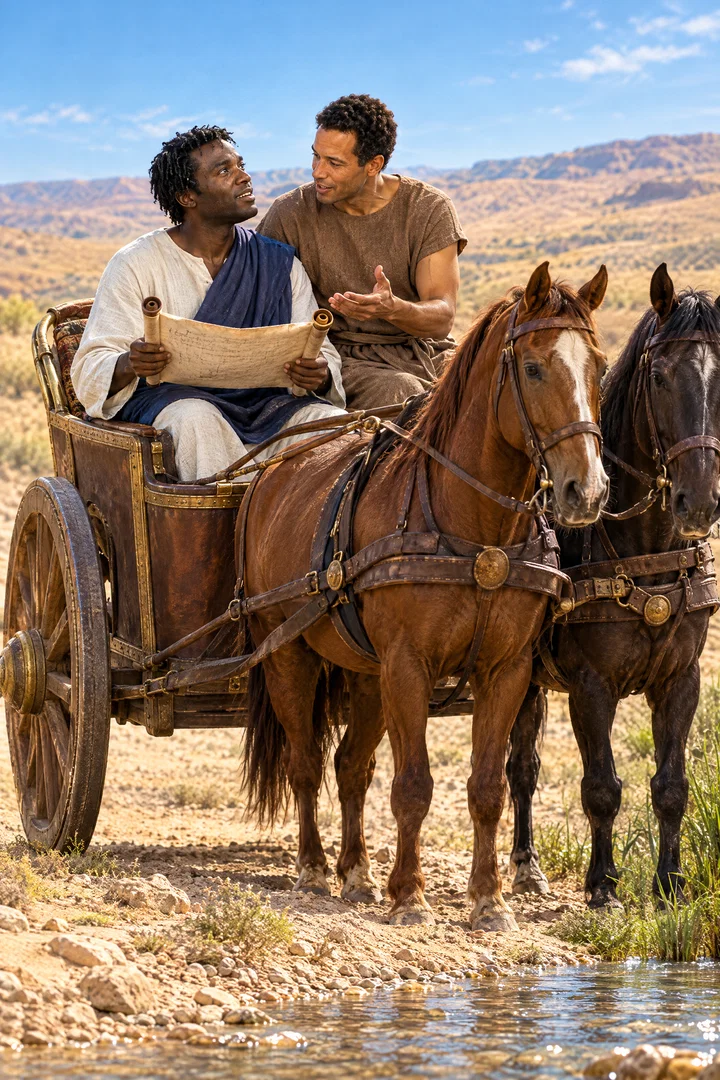
Cross-references 20 of 23
- Isaiah 53:7-8
He was oppressed, and he was afflicted, yet he opened not his mouth: he is brought as a lamb to the slaughter, and as a sheep before her shearers is dumb, so he openeth not his mouth.
The eunuch asks whom Isaiah’s prophecy about the suffering servant describes.
- Acts 8:38
And he commanded the chariot to stand still: and they went down both into the water, both Philip and the eunuch; and he baptized him.
Philip baptizes the eunuch after the eunuch’s response of faith.
- Acts 8:26
And the angel of the Lord spake unto Philip, saying, Arise, and go toward the south unto the way that goeth down from Jerusalem unto Gaza, which is desert.
An angel directs Philip to the seeker.
- Isaiah 52:14
As many were astonied at thee; his visage was so marred more than any man, and his form more than the sons of men:
The eunuch asks Philip to explain the prophecy of the marred servant.
- Isaiah 53:5-6
But he was wounded for our transgressions, he was bruised for our iniquities: the chastisement of our peace was upon him; and with his stripes we are healed.
The servant bears others’ sins and suffers for their transgressions.
- Isaiah 53:8
He was taken from prison and from judgment: and who shall declare his generation? for he was cut off out of the land of the living: for the transgression of my people was he stricken.
Philip explains the passage as pointing to Jesus, whose suffering and death prompt the question.
- Isaiah 53:3
He is despised and rejected of men; a man of sorrows, and acquainted with grief: and we hid as it were our faces from him; he was despised, and we esteemed him not.
The despised and rejected one prompts the question of whom the prophet speaks.
- Acts 8:29
Then the Spirit said unto Philip, Go near, and join thyself to this chariot.
The Spirit directs Philip to approach the eunuch’s chariot.
- Acts 21:8
And the next day we that were of Paul’s company departed, and came unto Cæsarea: and we entered into the house of Philip the evangelist, which was one of the seven; and abode with him.
Philip is identified as the evangelist who hosted Paul’s company.
- Acts 6:5
And the saying pleased the whole multitude: and they chose Stephen, a man full of faith and of the Holy Ghost, and Philip, and Prochorus, and Nicanor, and Timon, and Parmenas, and Nicolas a proselyte of Antioch:
Philip is listed among the seven before meeting the eunuch.
- Luke 24:27
And beginning at Moses and all the prophets, he expounded unto them in all the scriptures the things concerning himself.
Jesus explains that the Scriptures foretold his suffering and glory.
- Acts 8:30
And Philip ran thither to him, and heard him read the prophet Esaias, and said, Understandest thou what thou readest?
Philip's question leads to opening Scripture.
- Isaiah 53:10
Yet it pleased the LORD to bruise him; he hath put him to grief: when thou shalt make his soul an offering for sin, he shall see his seed, he shall prolong his days, and the pleasure of the LORD shall prosper in his hand.
The suffering servant is bruised and made an offering for sin.
- Isaiah 53:11-12
He shall see of the travail of his soul, and shall be satisfied: by his knowledge shall my righteous servant justify many; for he shall bear their iniquities.
The servant bears the sins of many and intercedes for transgressors.
- Isaiah 53:9
And he made his grave with the wicked, and with the rich in his death; because he had done no violence, neither was any deceit in his mouth.
The servant is described as having done no violence and spoken no deceit.
- Isaiah 53:2
For he shall grow up before him as a tender plant, and as a root out of a dry ground: he hath no form nor comeliness; and when we shall see him, there is no beauty that we should desire him.
The tender plant with no beauty prompts the question of whom the prophet describes.
- Isaiah 56:3-5
Neither let the son of the stranger, that hath joined himself to the LORD, speak, saying, The LORD hath utterly separated me from his people: neither let the eunuch say, Behold, I am a dry tree.
Promises eunuchs a lasting place among God’s people, fulfilled in the eunuch’s inclusion.
- Acts 8:39
And when they were come up out of the water, the Spirit of the Lord caught away Philip, that the eunuch saw him no more: and he went on his way rejoicing.
The eunuch goes on his way rejoicing after Philip’s sermon.
- Acts 8:5
Then Philip went down to the city of Samaria, and preached Christ unto them.
Philip preached Christ in Samaria.
- Deuteronomy 23:1
He that is wounded in the stones, or hath his privy member cut off, shall not enter into the congregation of the LORD.
Shows the former exclusion of eunuchs from Israel’s congregation.
Commentary
Each commentary is drawn from primary sources: the writings of Ellen G. White and Adventist pioneers and periodicals. Each commentary is separate. Its own words are not a quotation; follow the references to read the source passages.
Ellen G. White
29 sources
The Ethiopian treasurer under Candace is returning from worship at Jerusalem reading Isaiah's prophecy of the suffering servant led as a sheep to the slaughter, and he asks Philip whether the prophet means himself or another man because he cannot tell without a guide.AA 107.2–108.1Ms 46, 1900, par. 10–13Ms 15, 1909, par. 23–26Ms 126, 1902, par. 3–6Ms 17, 1908, par. 14–17 The prophecy speaks of Jesus Christ and His mission to save sinners through His humiliation, suffering and death.AA 107.2–108.1ST Dec 5, 1878RH Mar 2, 1911 Philip begins at that same scripture and opens it to preach Jesus as its fulfillment, and the eunuch believes with all his heart that Jesus Christ is the Son of God, is baptized in water, and goes on his way rejoicing.AA 107.2–108.18T 57.5–58.4Ms 46, 1900, par. 10–13SPBC 163.6–7Ms 126, 1902, par. 3–6 He stands for a large class who read the Scriptures without understanding their true meaning and cannot understand unless someone guides them.8T 57.5–58.4SPBC 163.6–7Lt 5, 1895, par. 9–11 God therefore directs His servants by angel and Spirit to join themselves to such ready, honest-hearted seekers, since even one soul in an out-of-the-way place is worth personal labor and may carry the light onward to many others.Ms 15, 1909, par. 23–26Ms 11, 1900, par. 9–12Ms 8, 1900, par. 4–8Lt 5, 1895, par. 9–11ST Dec 5, 1878
The Eunuch's Question
The question is asked by the Ethiopian eunuch, a man of great authority under Candace queen of the Ethiopians who had charge of all her treasure.Ms 46, 1900, par. 10–13Ms 15, 1909, par. 23–26Ms 17, 1908, par. 14–17Ms 11, 1900, par. 9–12 He had come to Jerusalem to worship and was journeying homeward, seated in his chariot reading Isaiah the prophet.Ms 46, 1900, par. 10–13Ms 15, 1909, par. 23–26Ms 126, 1902, par. 3–6Ms 17, 1908, par. 14–17Ms 11, 1900, par. 9–12 He was studying the prophecy he was reading without understanding of whom the prophet speaks, and his question confesses his need of a guide and invites Philip to come up, sit beside him, and explain it.Ms 46, 1900, par. 10–13Ms 15, 1909, par. 23–26Ms 126, 1902, par. 3–6
What he was reading was Isaiah's prophecy of the suffering servant, concerning Christ and His redemption.AA 107.2–108.1RH Mar 2, 1911RH Apr 20, 1905 It is the prophecy of Christ's suffering, humiliation and death.Ms 126, 1902, par. 3–6 It is the place about One led as a sheep to the slaughter who opened not His mouth.Ms 17, 1908, par. 14–17Ms 11, 1900, par. 9–12
He asks of whom the prophet speaks, of himself or of some other man.AA 107.2–108.18T 57.5–58.4Ms 46, 1900, par. 10–13SPBC 163.6–7RH Mar 2, 1911 His question shows that people can read Scripture without understanding its true meaning and cannot identify the person in the prophecy without guidance.SPBC 163.6–7RH Mar 2, 1911RH Mar 2, 1911AA 109.1–2 It confesses he needs someone knowledgeable to guide him in what he reads, and it opens the way for Philip to explain the passage and preach Jesus from it.8T 57.5–58.4Ms 46, 1900, par. 10–13SPBC 163.6–7RH Mar 2, 1911RH Mar 2, 1911
He is an honest-hearted seeker after light and truth, seeking light and ready to receive the gospel, with an interested and inquiring mind and a newly awakened mind.Ms 8, 1900, par. 4–8AA 109.1–2Ms 52, 1900, par. 40–41 He is half-converted, believing the Scriptures yet unable to understand them by reading alone and unable to comprehend the written prophecies without a human guide.Ms 126, 1902, par. 3–6Ms 8, 1900, par. 4–8ST Dec 5, 1878 He is longing and praying for light from heaven, starving for it, and angels take notice of him as one seeking enlightenment.Ms 8, 1900, par. 4–8 He is drawn to the Saviour without resisting the drawing and without making his high position an excuse for not accepting the crucified One.Ms 11, 1900, par. 9–12 He had become interested by hearing Christ's sermons to the people, and was searching the Scriptures with desire for light.Ms 52, 1900, par. 40–41
Philip Preaches Christ
The question points to Isaiah's prophecy of the suffering servant, and that prophecy concerns Jesus Christ, His redemption, and His mission to save sinners.AA 107.2–108.1ST Dec 5, 1878RH Mar 2, 1911ApRGC 26.1–4 It is not about the prophet himself but about another Man, and the seeker's need for guidance to see this gives the opening to explain it as concerning Jesus and to preach the gospel from it.ST Dec 5, 1878RH Mar 2, 1911ApRGC 26.1–4 Philip answers by beginning at that same scripture, opening it to understanding, explaining the passage, and preaching Jesus from it as its fulfillment.AA 107.2–108.18T 57.5–58.4SPBC 163.6–7Ms 126, 1902, par. 3–6RH Apr 20, 1905 He does not leave the reader to read alone without meaning but takes the very place being read and makes Christ known from it.AA 107.2–108.18T 57.5–58.4SPBC 163.6–7
With heart and mind enlightened the hearer is delighted with the truth.Ms 15, 1909, par. 23–26 He believes with all his heart that Jesus Christ is the Son of God, confesses that faith, takes the steps requisite in conversion through baptism, and is baptized by Philip in water when they come to water.Ms 46, 1900, par. 10–13Ms 15, 1909, par. 23–26Ms 126, 1902, par. 3–6Ms 17, 1908, par. 14–17Ms 11, 1900, par. 9–12 He then goes on his way rejoicing as a believer in God's Word, promptly acting on belief in a lesson of accepting, confessing, and obeying the call of duty.Ms 15, 1909, par. 23–26Ms 126, 1902, par. 3–6Ms 17, 1908, par. 14–17Ms 8, 1900, par. 4–8ST Dec 5, 1878 What began as inability to comprehend the written prophecies without a human guide ends in faith, baptism, and joy.Ms 126, 1902, par. 3–6Ms 11, 1900, par. 9–12Ms 8, 1900, par. 4–8
His conversion carries the gospel to Ethiopia, where many accept Christ.ST Dec 5, 18783SP 305.1 It also helps convince the apostles and leaders in Jerusalem that God has granted Gentiles repentance unto life, and this prepares the way for Paul's mission.SLP 39.2
Guiding Seekers Today
The question about whether the prophet speaks of himself or of another reveals that a person can read Scripture without grasping its true meaning.8T 57.5–58.4SPBC 163.6–7AA 109.1–28T 58.5 The eunuch reading without understanding represents a large class of people who cannot understand what they read unless someone guides them.8T 57.5–58.4SPBC 163.6–7Lt 5, 1895, par. 9–11 This includes those who search the Scriptures yet remain ignorant of them, who starve for the Word of the Lord, and who are as sheep having no shepherd because shepherds feed themselves and do not feed the flock.Lt 5, 1895, par. 9–11AA 109.1–2Ms 158, 1899, par. 8–11
God brings His servants into association with susceptible hearts that need help and are ready to receive the gospel.Ms 15, 1909, par. 23–26HMW 22.3–4AA 152.3 He sends missionaries who hear His voice and go where He sends them, as Philip was directed by an angel and by the Spirit to go and join himself to the chariot.Lt 5, 1895, par. 9–11HMW 22.3–4AA 152.3 Angels take notice of honest seekers after light and cooperate by sending a heavenly messenger to show the human worker his work.Ms 11, 1900, par. 9–12Ms 8, 1900, par. 4–8 Heavenly messengers do not themselves preach the gospel, for God sends light through angelic ministration to His people so that it can be given to the world through them, as the Holy Spirit guides willing men and women into positions to communicate what they have received.Ms 11, 1900, par. 9–12Ms 8, 1900, par. 4–8
Even one soul in a neglected or out-of-the-way place is worth personal labor and a special mission.Ms 15, 1909, par. 23–26Ms 15, 1909, par. 27–28 Such a soul is more precious than all the combined wealth of the world, and God puts forth great effort for even one such person, with His Spirit waiting to enlighten and convert souls to the truth.Ms 15, 1909, par. 23–26Lt 5, 1895, par. 9–11 Those seeking preparation for service in the byways and hedges should therefore be given a place, given hearty encouragement and support, and allowed to go where there are only a few.Ms 15, 1909, par. 27–28
Workers must be on the watch and ready to help every case that comes to their notice.Ms 46, 1900, par. 10–134MR 135.2–136.2 They are to be wholly consecrated, quick to understand their work, and wise to take advantage of every circumstance to teach the grace of God and draw men to Christ.Ms 46, 1900, par. 10–13Ms 11, 1900, par. 13 The need is urgent because a case may hang in the balance at a decisive moment, when evil angels wait for opportunity to press in falsehoods and Satan interposes obstacles to confuse the mind and divert the seeker from truth.Ms 11, 1900, par. 13 Left then without guidance the seeker might never accept the Saviour, and neglect of this work of guiding readers of Scripture to Christ brings judgment.Lt 5, 1895, par. 9–11Ms 11, 1900, par. 13
Through such a convert the light of truth shines to the higher classes and opens doors to enter new fields and to work with people who have an advanced acquaintance with temperance principles.Ms 46, 1900, par. 10–134MR 135.2–136.2 There are many ways for truth to find access to those who desire light and search the Scriptures with an interested and inquiring mind.Ms 52, 1900, par. 40–41Ms 126, 1902, par. 7 The Lord in providence brings honest-hearted ones in every age into connection with those best fitted by special knowledge and training to reach the individual needs of each case.Ms 52, 1900, par. 40–41Ms 126, 1902, par. 7 Just as God sent Philip to the earnest seeker, He will raise up workers today to carry the message of truth to those who greatly need it, calling white people and colored people together to engage in His service as laborers together with Him.Ms 17, 1909, par. 13–14Ms 126, 1902, par. 7
Sources
Pioneers and periodicals
69 sources
The eunuch was reading Isaiah 53 about the suffering servant led as a lamb to slaughter, and he asked whether the prophet meant himself or some other man.ST Sep 23, 1897RH Feb 18, 1909RH Nov 16, 1916RH Apr 9, 1914ST Sep 13, 1905 His question confessed that he could not understand without a guide and needed instruction to identify whom the prophecy concerned.RH Mar 2, 1911ST Dec 5, 1878RH Mar 2, 1911 It opened the way for Philip to begin at that same scripture and preach Jesus as the promised Messiah, the Son of God, who suffered and died to save sinners.ST Dec 5, 1878ST Sep 23, 1897RH Feb 18, 1909RH Nov 16, 1916ST Sep 13, 1905 Philip's preaching included baptism, and the eunuch believed with all his heart, confessed Christ, was immersed without delay, and went on rejoicing.ST Feb 14, 1884RH Dec 17, 1901ST Apr 9, 1912RH Sep 1, 1874 Through him the good news went to a new continent and people in Ethiopia, marking the gospel's course to the Gentiles and the pattern of Spirit-led personal work for one soul.ST Dec 5, 1878ST Mar 11, 1897RH Feb 18, 1902RH Jan 7, 1915ST Jun 7, 1883
Road, Reader, and Timing
The man who asks the question is an Ethiopian eunuch of great authority under Candace queen of the Ethiopians, in charge of all her treasure, described as treasurer, officer and nobleman.ST Feb 14, 1884RH Dec 17, 1901ST Jun 14, 1905 He lives in Central Africa in western Ethiopia beyond the Red Sea where the Abyssinian churches were afterward found, in Abyssinia divided by the Red Sea from eastern Ethiopia.RH May 13, 1862 That people are said to descend from Abraham through Ishmael, and his reading proves they had accepted the Hebrew Scriptures.
He had been to Jerusalem to worship and is returning in his chariot, reading Isaiah the prophet.RH Dec 17, 1901ST Jun 7, 1883 The road is the desert road going down from Jerusalem to Gaza southwest of Jerusalem, on his journey from Jerusalem toward Gaza.ST May 20, 1880 Desert here can mean an uninhabited region, and the route crossed cultivable hills and valleys with springs, pools and reservoirs that could provide ample water for immersion.ST May 20, 1880
The encounter is dated to the early summer of A.D. 37 after the dispersion of the Christians, when Philip was led by angel and Spirit to join the chariot. The chapter belongs to A.D. 34 when the 490 years allotted to the Jews closed, Israel's national probation ended and the gospel began going to the Gentiles.RH Feb 18, 1902ST Nov 28, 1895 It is thus the account of the gospel reaching beyond the Jewish people.RH Feb 18, 1902
The eunuch is an honest, humble, diligent student of Scripture, well informed and highly cultured yet unable to understand without instruction because the word is spiritually discerned.ST Feb 14, 1884 As a proselyte who had left the superstition of Ethiopia for truth he still counted himself only a learner, attentively searching even beyond his comprehension.ST Jun 7, 1883 He believed the Scriptures yet could not understand the prophecy without instruction, and sincerely sought light from heaven with desire for guidance.ST Dec 5, 1878RH Sep 27, 1870 His heart was already prepared as soil made ready ahead of the sower, fully ready to receive truth when Philip came to sow the gospel seed.ST Oct 23, 1901
The Philip he questions is Philip the evangelist, one of the seven deacons of the church at Jerusalem before the dispersion who had preached with great power in Samaria.ST Feb 14, 1884ST Jun 7, 1883 He is not Philip the apostle, since the apostles remained in Jerusalem while Philip preached Christ in Samaria and baptized the eunuch.ST Jun 7, 1883 After the baptism he went to Azotus and on to Caesarea where he made his home and had four virgin daughters who prophesied.ST Feb 14, 1884
Meaning of the Question
The question asks Philip to identify whom the prophet means in the prophecy about the suffering servant, whether the prophet speaks of himself or of some other man.ST Sep 23, 1897RH Feb 18, 1909RH Nov 16, 1916ST Mar 5, 1902ST Jan 17, 1878 While reading Isaiah's prophecy of a suffering servant, the officer does not know whom the prophet's words concern and asks Philip to tell him.RH Mar 2, 1911ST Dec 5, 1878RH Mar 2, 1911ST Jan 17, 1878ST Jun 14, 1905
The asking confesses inability to understand without a guide and reveals need for instruction, for he believes the Scriptures yet cannot identify the person in the prophecy without guidance.RH Mar 2, 1911ST Dec 5, 1878RH Mar 2, 1911 Lack of understanding is met by God providing help to identify whom the prophecy concerns, as God provided Philip to help explain the prophet's words.RH Dec 17, 1903ST Mar 27, 1907 Clear Bible instruction can make plain a passage previously read without being understood, and the sending of a good human friend to aid is one of the Father's ways by His Spirit of teaching all who desire to know, fulfilling the promise to teach and to guide into all truth.RH Dec 17, 1903ST Mar 27, 1907
A prophet's words may refer either to the prophet himself or to someone else, and the speaker must be identified by considering the context and the facts.ST Jan 26, 1915 Identification comes by comparing Scripture with Scripture and seeking a meaning consistent with the rest of Scripture.ST Jan 26, 1915
The scripture being read at that moment was not Isaiah 52:15 but the next chapter, Isaiah 53, especially the passage about being led like a lamb to slaughter, concerning humiliation and death.RH Apr 9, 1914ST Sep 13, 1905ST Feb 7, 1878RH Mar 28, 1871 Philip turned the question about Isaiah 53:7-8 into direct preaching of Jesus, explaining it as concerning Christ.RH Apr 9, 1914ST Feb 7, 1878 It presents the suffering Messiah as a Man of Sorrows growing as a tender plant and root out of dry ground with neither form nor comeliness nor beauty to be desired, with visage marked with grief and form marred, despised and rejected, led as a lamb to slaughter and as a sheep dumb before shearers, with judgment taken away in humiliation and life taken from the earth and soul laid as an offering for sin.RH Nov 11, 1862ST Feb 7, 1878 The contrast between humiliation and expected glory strangely interests and perplexes the devout reader, who confesses inability to understand without a guide and asks for the person to be identified.RH Nov 11, 1862
Philip's Preaching of Jesus
The question whether the suffering servant is the prophet himself or some other man opened the way for Philip, sitting beside him in the chariot, to unfold the truth of Scripture and bring light to one seeking understanding.ST Sep 23, 1897RH Feb 18, 1909RH Nov 16, 1916ST Mar 5, 1902RH Mar 13, 1913 After listening to the reading he opened his mouth, began at that same scripture, and preached Jesus, making Christ the theme.ST Sep 23, 1897ST Mar 5, 1902RH Apr 9, 1914
He explained the prophecy as concerning Christ and His earthly mission, His suffering and death to save fallen people and sinners, and His victory over sin and the grave.ST Dec 5, 1878RH Feb 18, 1909ST Nov 7, 1900 It speaks of His humiliation and death, His suffering and death for human sin, revealed as Jesus Christ and His mission to save sinners.ST Dec 5, 1878ST Nov 7, 1900ST Feb 7, 1878 He is taught as the promised Messiah, the Son of God, the world's hope and salvation, whose holy life, suffering, and death bring infinite power and draw people to His love.RH Jun 29, 1911 It was the glad tidings formerly announced to the humble shepherds, and faith in Jesus as the promised Messiah was the great testing truth for Jews and all the world in the early church.RH Jun 29, 1911
The exchange is an example of early Christians using an Old Testament passage as scriptural evidence for Christ, fulfilled in His life and work.RH Oct 17, 1912ST Sep 13, 1905 It means every opportunity is to be used for direct preaching of Jesus from the Scriptures, following His own example of expounding from Moses and the prophets the things concerning Himself.RH Apr 9, 1914
Faith, Confession, and Baptism
The question opened the way for preaching Jesus from that same scripture, and that preaching included the duty of baptism and drew immediate obedience from an honest heart.ST Feb 14, 1884ST May 27, 1880 Having heard, the officer confessed faith in Jesus Christ as the Son of God, believed with all his heart, and was baptized by Philip in water on the way without delay, then went on his way rejoicing.RH Dec 17, 1901ST Jun 14, 1905ST Apr 9, 1912 This belief included repentance and trust that Christ's righteousness covers sin.ST Apr 9, 1912
Hearing, believing, and accepting God's word and the glad tidings about Jesus formerly announced to the shepherds must come before baptism, and upon such hearing, believing, and accepting the promised Messiah one becomes a candidate for baptism.RH Jun 29, 1911 Belief in Christ's saving work, through whom sins are remitted, is essential for baptism, and baptism is a sign of that faith.RH Sep 1, 1874RH Jun 29, 1911 The great testing truth in the days of the early church for Jews and all the world was faith in Jesus Christ as the promised Messiah.RH Jun 29, 1911
The account does not establish that only a small stream was found or that sprinkling was used, but is used in support of immersion.ST Feb 7, 1878 Baptismal water itself is distinguished from cleansing from sin, which comes through Christ's blood.ST Feb 7, 1878 The passage in Acts 8:28-40 is read in connection with the ordinance of baptism and provides an example of someone receiving baptism after needing a teacher to guide him.RH Jul 16, 1901RH Jun 14, 1867
The teaching given in answer to his question contained no hint of a new Sabbath, though he would have needed it if one had already been made, which proves no change of the Sabbath had yet been made by the apostles.RH Nov 21, 1871 At the same time, the silence of the record in Acts 8:1-40, where no command to keep the Sabbath is recorded in the preaching of the gospel in Samaria, does not prove that not a single individual was commanded to keep it or that converts were not taught to keep it.RH Nov 9, 1911
Gospel Reaches New Peoples
The meeting carried the good news of salvation through Christ beyond the regions where it had first been preached, into what is now Abyssinia.ST Dec 5, 1878ST Mar 11, 1897 The convert carried the gospel to a new continent and to his own people in Ethiopia and Abyssinia, going on his way rejoicing and preaching the word to those he met after Philip explained the prophecy and preached Jesus to him.ST Jun 7, 1883ST Jan 22, 1902ST Jul 29, 1913 Through this trip to the desert the Ethiopians heard the truth as fully as if Philip had been sent on a mission to Ethiopia.ST Jun 7, 1883 Philip was full of the Holy Ghost and wisdom and able to preach to a city congregation, yet he was sent to preach in the wilderness to a congregation of one man and went without hesitation without knowing he would find even one man.ST Jun 7, 1883 Preaching to small congregations is just as important as preaching to large ones, for preaching to a large congregation where only one is finally converted accomplishes no more than preaching to that one alone, and Christ also gave two of His most instructive sermons to single individuals.ST Jun 7, 1883
The official asked whether Isaiah's prophecy concerns Isaiah himself or another person, revealing need for instruction and receptiveness to truth, and he promptly accepted the gospel, believed, was changed, was baptized, and acted on belief in obedience to duty.ST Dec 5, 1878RH Apr 20, 1905ST Jul 29, 1913 His question about whom the prophet meant opened the explanation from Isaiah that led him to the gospel.ST Jan 22, 1902ST Jul 29, 1913 The episode shows God's guidance bringing a truth-seeker into contact with a teacher.RH Apr 20, 1905
That conversion perhaps marks the beginning of the churches of Abyssinia and Ethiopia in the first part of the Christian era, churches outside the rule of the Roman pontiff among whom the Bible Sabbath was observed from age to age.RH May 13, 1862 Their history proves the perpetuity of the Sabbath in the Christian church for eighteen centuries, because though their religious life was molded by the apostasy affecting the whole church and Sunday crept in among them as a festival sister day to the Sabbath, they continued to observe the Sabbath and still keep both Saturday and Sunday while remaining free from the gross errors of the great apostasy.ST Oct 1, 1896
The eunuch's admission to the blessings promised to God's people, although eunuchs had been excluded from the congregation under the old dispensation, applies Isaiah's promise that eunuchs would receive a place and name among God's people.RH Oct 15, 1872 The account proves that strangers in far countries and colored people in Ethiopia heard, came to worship, accepted the gospel, and were accepted by the Lord.RH Dec 17, 1901 He was a man of Ethiopia, an eunuch of great authority under Candace queen of the Ethiopians in charge of all her treasure, who had heard of the true God and His temple and had come to Jerusalem to worship and on his return was reading Esaias the prophet, and his question led Philip to begin at the same scripture and preach Jesus to him, and he believed that Jesus Christ is the Son of God and was baptized by Philip in water on the way.RH Dec 17, 1901 The chapter belongs to the account of the gospel reaching beyond the Jewish people, dated to A.D. 34 when Israel's national probation ended and the gospel began going to the Gentiles.RH Feb 18, 1902 The Ethiopian stands as one whom the gospel changed, an example of the gospel meeting people's needs through the power of God's Holy Spirit.
Pattern for Personal Ministry
Acts 8:26-39 is the pattern for winning others from sin to Christ, with the question opening the way to be led to Christ, by a winsome Christian life that expresses the gospel in lips and conduct and mirrors Christ in character, disposition and temper.ST Apr 2, 1896 The account of the lone eunuch and his conversion and baptism is the example of one person coming to faith and being sought and taught.RH Jan 7, 1915ST Jul 8, 1886 Philip, full of the Holy Ghost and wisdom and able to preach to a city congregation, was sent without hesitation to preach in the wilderness to a congregation of one man, and preaching to small congregations is just as important as preaching to large ones, for preaching to a large congregation where only one is finally converted accomplishes no more than preaching to that one alone.ST Jun 7, 1883 Christ also gave two of His most instructive sermons to single individuals, and the sermon to the eunuch had great consequences, for he went on his way rejoicing in the new light he had received and preached the word to those he met.ST Jun 7, 1883 The best work in the New Testament is work for individuals, for hand-picked personal soul-winning is better than shaking fruit from the tree in mass, and each church member quickened by the Holy Spirit should with tact, piety, zeal and love make an assault of love upon unconverted friends to win them to Christ, supplementing the pastor's labors and co-operating with the Holy Spirit whose power is as great today as at Pentecost.ST Mar 30, 1882 God sends help to one seeker as readily as to a multitude, Jesus would give His life for one person as freely as for the whole world, and no one is too isolated to receive His sympathy and care.ST Mar 5, 1902 The direct personal question opens the way for individual teaching and conversion and makes prominent the results of personal work, leaving an example of personal ministry that calls ministers and all believers to reach people by personal contact and conversation about salvation and house-to-house visitation for soul-saving.RH Jun 20, 1912
The meeting shows gospel work led directly by the Spirit to a specific person in need, when the Spirit bids Philip join himself to the chariot in which sits the Ethiopian of great authority, outside any human-assigned district or territory.ST Sep 11, 1907 Ministers must obey God's call wherever it leads rather than refuse because the place lies outside prescribed limits, and dividing territory among denominations would curtail and hinder the freedom and work of the Spirit.ST Sep 11, 1907 The question about the prophecy relating to Christ came at the exact moment Philip reached the highway after being sent from Samaria, with the hour timed so the speed of both travelers brought them together, giving Philip a scripture from which he could easily preach Jesus, and improving God's time in prompt obedience fulfilled the divine purpose with blessed results, where delay might have meant the loss of a soul.RH Aug 22, 1912 God knew where this honest, devout seeker searching for truth was and used Philip, who recognized the Holy Spirit's leading, to bring him understanding.RH Dec 1, 1904 The telling of Philip to go south toward the desert to meet the eunuch shows individual guidance by the living God, not assignment by men without consent, and refusal to follow a merely human decision unsanctioned by the Spirit of God does not cut a man off from Christ.RH May 30, 1907 Those instructed by God as Philip was remain always in harmony with the body of the church, while those at variance with the spirit of prophecy are out of harmony, proving God lives to direct His people and is as willing to lead now as in the past, and gospel order preserves such individual leading while counseling those of little experience to connect with God and be sound in the principles of the Word of God.RH May 30, 1907 The calling of Philip to instruct the eunuch proves the disciples after Pentecost were led by a superhuman power with wisdom and courage and self-denial and fidelity, proving an all-seeing eye and a master hand was at the helm of the gospel work directing it.ST Jun 26, 1901
Although an angel could have instructed him, God sent Philip to explain the prophecy, showing that human servants are entrusted with sharing instruction from God.ST Aug 25, 1898 Philip sitting beside the Ethiopian in his chariot and explaining Scripture unfolds the truth of Scripture and brings light to someone seeking understanding, and believers can assist people whom the Holy Spirit is leading toward fuller understanding of God's truth.RH Mar 13, 1913RH Dec 18, 1913 Lack of understanding is met by God dispatching a good human friend to aid, as Philip was sent to the eunuch, and this sending of help is one of the Father's ways by His Spirit of teaching all who desire to know, fulfilling the promise to teach and to guide into all truth.ST Mar 27, 1907 God's guidance brings a truth-seeker into contact with a teacher, for the official asking whether Isaiah's prophecy concerns Isaiah himself or another person is receptive to the truth, and Philip explains the Scripture and the man is converted and baptized.RH Apr 20, 1905 Philip is sent to meet this hungry soul and preach Jesus to him when the seeker asks whom the prophet is speaking about.RH Oct 19, 1905
The eunuch is a diligent student of the word of God who did not understand what he read, a proselyte to the Jewish religion who had worshiped at the temple at Jerusalem, leaving the superstition of his native Ethiopia for truth, yet still counting himself only a learner.ST Jun 7, 1883 Reading the Bible while traveling he got no meaning from it, and his question confesses his need for instruction, yet because he was willing to do God's will and was attentively searching the Scriptures even beyond his comprehension, Philip was sent to teach him, and his reading opened the way for that light.ST Jun 7, 1883 Studying the Bible on a journey as commanded and reading even portions beyond comprehension brings enlightenment by an evangelist or by God's ever-ready Spirit.ST Jun 7, 1883 God provided Philip to help explain whom the prophet's words concerned when the Ethiopian sought help to understand.RH Dec 17, 1903 The Javanese tailor is compared with the Ethiopian because he had often read without understanding and was glad to have someone teach him and bring him light.RH Apr 4, 1912 The prayer for God to send a teacher to explain the Bible is answered as with a Bible-reading invitation, as the sincere seeker asking Philip to explain whom the prophet is speaking about opens the way for Philip to teach him from Scripture.RH Nov 26, 1903 The eunuch was led to ask whom Isaiah's prophecy concerned, and Philip explained the written Word to him, showing the Spirit can bring people to Christ through Scripture and its explanation without a dramatic outward sign.RH Dec 30, 1915 Clear Bible instruction can help someone understand a passage that was previously read without being understood, and such searching in Isaiah leads to personal salvation.RH Apr 5, 1906
Philip's preaching to the Ethiopian eunuch shows that a deacon may preach the gospel when the Lord leads him and opens the way, so deacons are not shut out from preaching, though their duties are largely temporal as assistants of elders and servants of the church.CO 34.2 The official asking Philip to explain whom Isaiah's prophecy concerns reveals his need for instruction, and in this encounter he promptly accepts the gospel and acts on his belief, a lesson in promptly accepting and confessing Christ and obeying the call of duty.ST Dec 5, 1878 He was sincerely seeking spiritual truth and asking for light from heaven, earnestly seeking understanding of Scripture whether the prophet is speaking about himself or another person, and when Christ was revealed to him he received him gladly, believed with all his heart, and was ready to be baptized.ST Dec 5, 1878ST Mar 9, 1915
Sources