Daniel 7:5
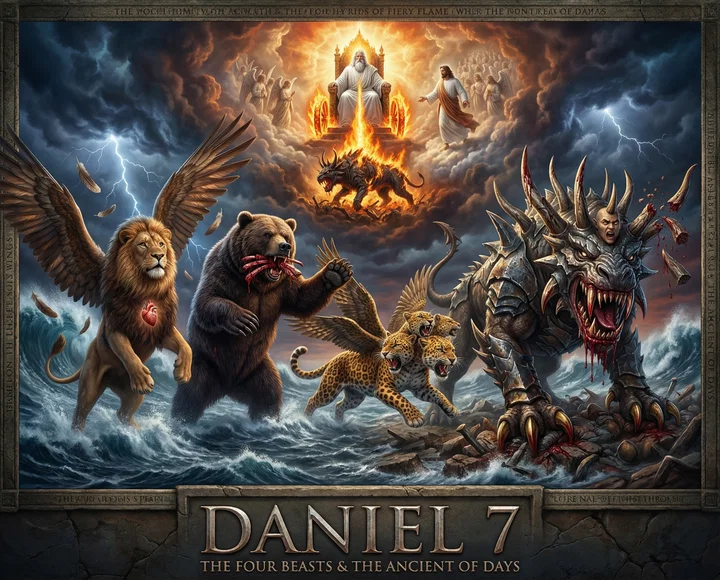
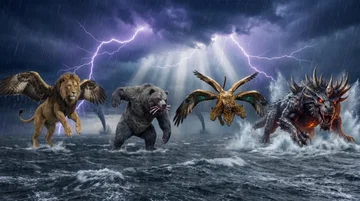
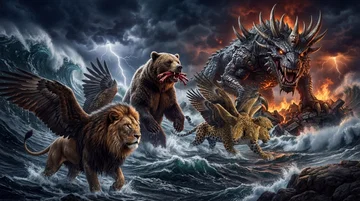
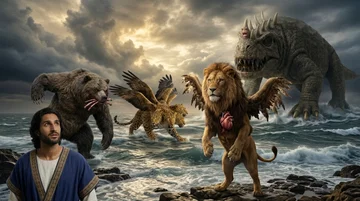
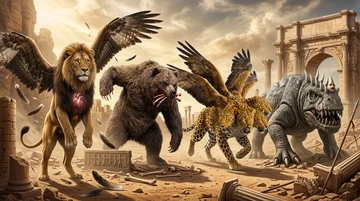
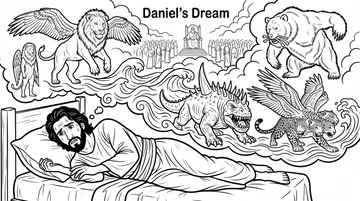
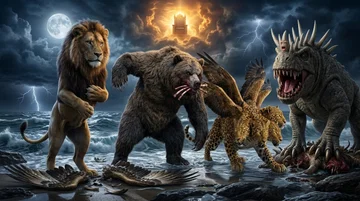
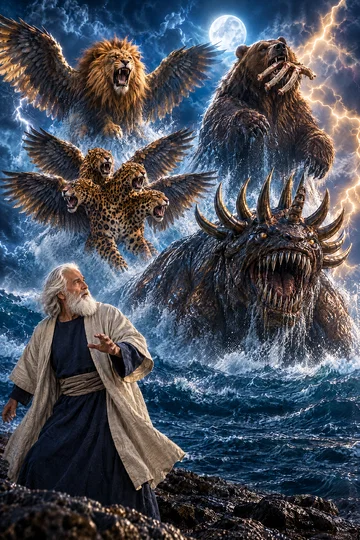
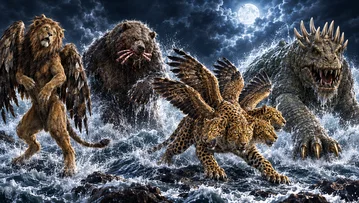
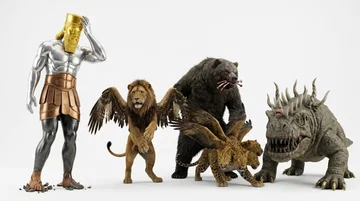
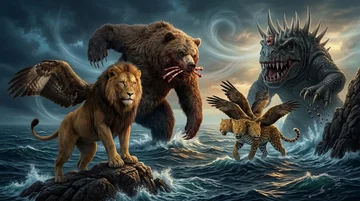
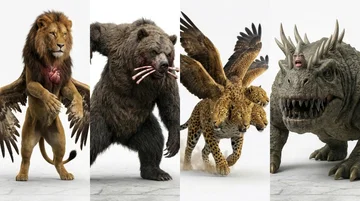
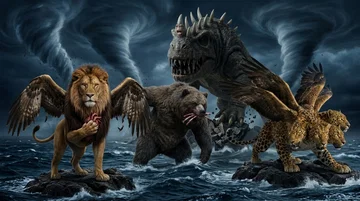
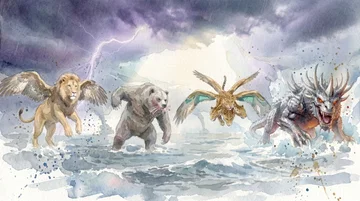
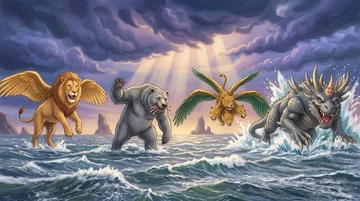
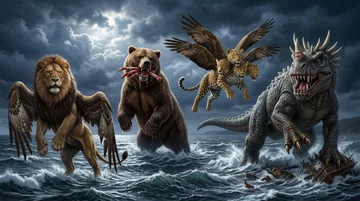
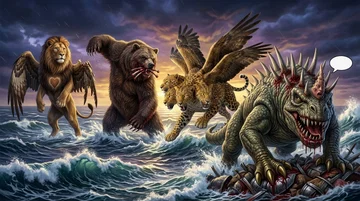
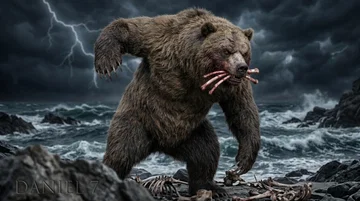
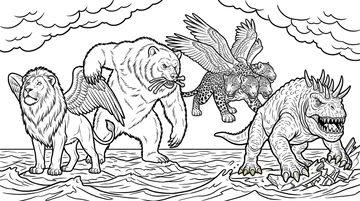
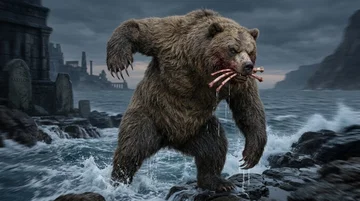
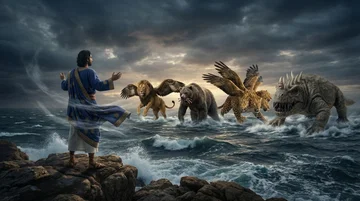
And behold another beast, a second, like to a bear, and it raised up itself on one side, and it had three ribs in the mouth of it between the teeth of it: and they said thus unto it, Arise, devour much flesh.
Translations
And behold another beast, a second, like to a bear, and it raised up itself on one side, and it had three ribs in the mouth of it between the teeth of it: and they said thus to it, Arise, devour much flesh.
And behold another beast, a second, like to a bear, and it raised up itself on one side, and it had three ribs in the mouth of it between the teeth of it: and they said thus unto it, Arise, devour much flesh.
And behold, another beast, a second, like to a bear, and it raised up itself on one side, and it had three ribs in the mouth of it between the teeth of it: and they said thus unto it, Arise, devour much flesh.
And behold another beast, a second, like a bear, and it raised itself on one side, and it had three ribs in the mouth of it between the teeth of it: and they said thus to it, Arise, devour much flesh.
And behold another beast, a second, like to a bear, and it was raised up on one side, and three ribs were in his mouth between his teeth: and they said thus unto it, Arise, devour much flesh.
And, behold, another beast, a second, like to a bear; and it was raised up on one side, and three ribs were in its mouth between its teeth: and they said thus unto it, Arise, devour much flesh.
And lo, another beast, a second, like to a bear, and to the same authority it hath been raised, and three ribs [are] in its mouth, between its teeth, and thus they are saying to it, Rise, consume much flesh.
And behold, another beast, a second, like unto a bear, and it raised up itself on one side; and [ it had] three ribs in its mouth between its teeth; and they said thus unto it: Arise, devour much flesh.
And, lo! another wild beast, a second, resembling a bear, and, on one side, was it raised up, with three ribs in its mouth, between its teeth,—and, thus, were they saying to it, Rise! devour much flesh.
Suddenly another beast appeared, which looked like a bear. It was raised up on one of its sides, and it had three ribs in its mouth between its teeth. So it was told, ‘Get up and gorge yourself on flesh!’
Suddenly another beast appeared, which looked like a bear. It was raised up on one of its sides, and it had three ribs in its mouth between its teeth. So it was told, ‘ Get up and gorge yourself on flesh!’
“Behold, there was another animal, a second, like a bear. It was raised up on one side, and three ribs were in its mouth between its teeth. They said this to it: ‘ Arise! Devour much flesh!’
And I saw another beast, like a bear, and it was lifted up on one side, and three side-bones were in its mouth, between its teeth: and they said to it, Up! take much flesh.
And beholde, another beast which was the second, was like a beare and stood vpon the one side: and hee had three ribbes in his mouth betweene his teeth, and they saide thus vnto him, Arise and deuoure much flesh.
Douay-Rheims (Challoner revision)
And behold another beast like a bear stood up on one side: and there were three rows in the mouth thereof, and in the teeth thereof, and thus they said to it: Arise, devour much flesh.
Pictures



Cross-references
- Daniel 2:39
And after thee shall arise another kingdom inferior to thee, and another third kingdom of brass, which shall bear rule over all the earth.
Both visions foretell successive kingdoms, including the second kingdom represented by the bear.
- Revelation 13:1-2
And I stood upon the sand of the sea, and saw a beast rise up out of the sea, having seven heads and ten horns, and upon his horns ten crowns, and upon his heads the name of blasphemy.
The beast combines features of Daniel’s symbolic beasts, including bear-like feet.
- Daniel 7:17
These great beasts, which are four, are four kings, which shall arise out of the earth.
Explains the beasts as kings, meaning kingdoms.
- Daniel 8:3-4
Then I lifted up mine eyes, and saw, and, behold, there stood before the river a ram which had two horns: and the two horns were high; but one was higher than the other, and the higher came up last.
The ram’s unequal horns parallel the bear’s one-sided rise, symbolizing Medo-Persia.
- Daniel 2:32
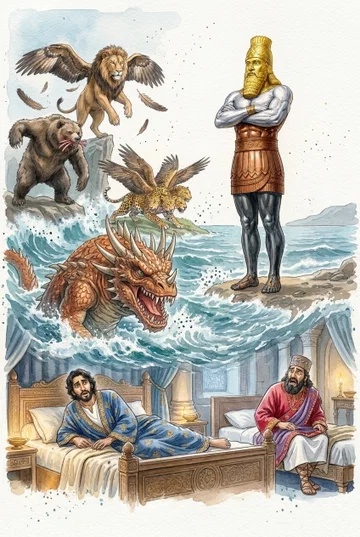
This image’s head was of fine gold, his breast and his arms of silver, his belly and his thighs of brass,
The silver breast and arms represent the same kingdom as the bear.
- Daniel 7:27
And the kingdom and dominion, and the greatness of the kingdom under the whole heaven, shall be given to the people of the saints of the most High, whose kingdom is an everlasting kingdom, and all dominions shall serve and obey him.
The beastly kingdoms end, and the everlasting kingdom is given to the saints.
- Daniel 7:12
As concerning the rest of the beasts, they had their dominion taken away: yet their lives were prolonged for a season and time.
The passage connects the beasts’ succession with dominion being taken away while their lives continue.
- Daniel 8:20
The ram which thou sawest having two horns are the kings of Media and Persia.
The ram is identified as the kings of Media and Persia, the empire represented by the bear.
- Daniel 7:23
Thus he said, The fourth beast shall be the fourth kingdom upon earth, which shall be diverse from all kingdoms, and shall devour the whole earth, and shall tread it down, and break it in pieces.
The beasts represent kingdoms ruling on earth.
- Daniel 2:40-44
And the fourth kingdom shall be strong as iron: forasmuch as iron breaketh in pieces and subdueth all things: and as iron that breaketh all these, shall it break in pieces and bruise.
Both visions portray Rome’s divided kingdom and culminate in God’s everlasting kingdom.
- Daniel 7:16
I came near unto one of them that stood by, and asked him the truth of all this. So he told me, and made me know the interpretation of the things.
An angel explains the beast symbols to Daniel.
- Daniel 7:26
But the judgment shall sit, and they shall take away his dominion, to consume and to destroy it unto the end.
The verse belongs to the vision whose remaining judgment is described there.
- Daniel 2:44
And in the days of these kings shall the God of heaven set up a kingdom, which shall never be destroyed: and the kingdom shall not be left to other people, but it shall break in pieces and consume all these kingdoms, and it shall stand for ever.
Both visions trace earthly kingdoms and point to God’s everlasting kingdom.
- Daniel 7:18
But the saints of the most High shall take the kingdom, and possess the kingdom for ever, even for ever and ever.
Promises the kingdom to the saints.
Commentary
Each commentary is drawn from primary sources: the writings of Ellen G. White and Adventist pioneers and periodicals. Each commentary is separate. Its own words are not a quotation; follow the references to read the source passages.
Ellen G. White
9 sources
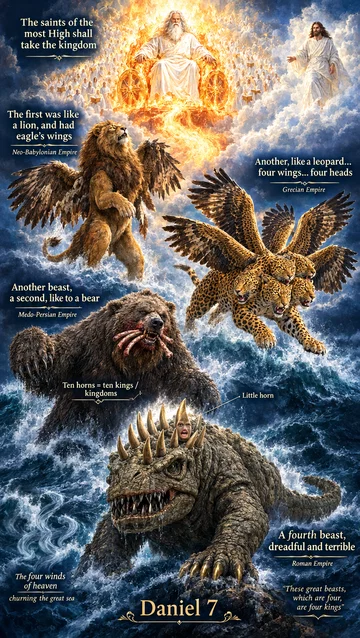
The second beast is pictured as a bear raised up on one side, with three ribs in its mouth between its teeth.LS 40.1–5 The bear stands for Persia, also called Medo-Persia, the second of four successive world empires — Babylon, Persia, Greece, and Rome — which succeeded Babylon in 538 B.C.LS 40.1–54SP 502.2–3PK 535.1 The beast of Revelation 13 combines the characteristics of these four beasts and inherits in succession the power they held.4SP 502.2–3
The vision was taught to Daniel by God for recording for coming generations the history of this world till the close of time, as part of the revelations of coming ages recorded in chapters seven to twelve.PK 547.1PK 484.3 Understanding of the vision came as God's blessing on firmness, self-denial, and purity of motive, as Daniel clung to God with unwavering trust while learning court duties, with the spirit of prophetic power coming upon him in fulfillment of the promise that those who honor God will be honored.PK 484.3 The words were not fully understood even by Daniel; they were shut up and sealed until the time of the end, to be unsealed in the closing period of this world's history, when Daniel is assured he will rest and stand in his lot and place at the end of the days.PK 547.1
God permitted Medo-Persia to hold its place on earth for a period of test to show whether it would fulfill the purposes of the Watcher and the Holy One; it failed, so its glory faded and its power departed, repeating the history of each of the great empires.PK 535.1 The ferocious beasts of prey, including the bear, symbolize earthly kingdoms that pursue advantage, gain power, prevail, and maintain dominion by war, destruction, and physical force.Ms 27a, 1900, par. 12–13COL 76.1–77.2ST Feb 16, 1915 The apocalyptic beasts arise from the union of church and state, which becomes a deadly power that persecutes and crushes those who oppose it.DA 837.3–4
Earthly governments are opposite in principle to the kingdom of Christ, which is a new creation that grows by unfolding the implanted life-principle of God and depends on no human power.COL 76.1–77.2ST Feb 16, 1915 Its founder is the Prince of Peace, the Lamb of God who takes away the sin of the world, and His government uses no brute force to compel the conscience but implants truth and righteousness to counterwork error and sin, rather than promoting righteousness by external measures, methods, and plans.COL 76.1–77.2ST Feb 16, 1915
Sources
Pioneers and periodicals
212 sources
The bear is Medo-Persia, the second universal world kingdom that succeeded and overthrew Babylon and held dominion from Cyrus's taking of Babylon in 538 B.C. until Greece overthrew it in 331 B.C., answering to the silver breast and arms of Daniel 2 and the ram of Daniel 8:3-4.RH Dec 11, 1860ST Oct 17, 1906RH Feb 3, 1853ST Sep 29, 1881ST May 3, 1877 Its being raised up on one side shows its twofold character as the unequal dual kingdom of Media and Persia, with Media first prominent and Persia afterward rising to predominant and controlling power.RH Feb 3, 1853ST Sep 29, 1881RH Sep 9, 1915ST Sep 1, 1881RH Mar 16, 1869 The three ribs between its teeth are Babylon, Lydia and Egypt, three great powers conquered and cruelly oppressed in succession, held in its teeth as the pledge and encouragement of further conquest.ST Sep 29, 1881RH Sep 9, 1915RH Dec 26, 1907ST May 26, 1909RH Sep 29, 1863 The command to arise and devour much flesh marks it as a cruel, rapacious and bloodthirsty spoiler whose vast conquests over many populous kingdoms and 127 provinces were accomplished with great loss of life.RH Feb 3, 1853ST Sep 29, 1881RH Sep 9, 1915ST Jun 30, 1914 This second sign stands in consecutive order after the lion and before the leopard and the terrible beast, proving the prophecy true thus far and leading on through Rome and its divisions to the judgment, the coming of the Son of man, and the everlasting kingdom of Christ and the saints.RH Jun 20, 1854ST Aug 2, 1877ST Jul 23, 1874RH Aug 9, 1915
Vision Setting and Symbols
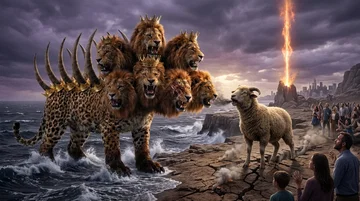
The verse presents the second of four great diverse beasts coming up from the sea, following the lion with eagle's wings and preceding the leopard with four wings and four heads and the dreadful terrible beast with great iron teeth and ten horns, with that same beast later showing three horns plucked up and a peculiar horn with eyes like a man and a mouth speaking. ST Jul 23, 1874RH Dec 13, 1853ST May 3, 1877RH Jun 6, 1912 These four are four successive kings or kingdoms to be fulfilled in consecutive order exactly as written, so this beast is the second earthly power and the second of those kingdoms. RH Dec 13, 1853ST May 3, 1877RH Jun 6, 1912 Unlike the image in Daniel 2 which portrays successive dynasties by glory and lasting qualities, the beasts portray the powers of earth by character and by attitude toward God and His people. ST Nov 29, 1905
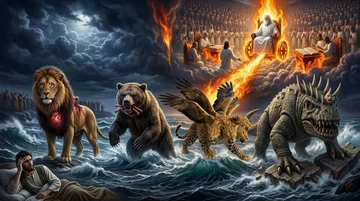
It was seen in Daniel's night dream and visions of his head in the first year of Belshazzar over Babylon, when the four winds of heaven strove upon the troubled mighty sea and four great diverse beasts rose from it. It was received two years before the vision in Daniel 8, when Daniel was well advanced in years. ST Feb 10, 1898 It stands in the Aramaic or Chaldee portion of Daniel which begins at Daniel 2:4 and ends with the close of chapter 7, placed there for close similarity in subject to Daniel 2, distinctively prophetic though in Hebrew Daniel is counted among the Hagiographa and not among the prophets, belonging to the prophetic chapters that follow the narrative chapters 1 through 6 although all chapters are more or less prophetic and give rulers and nations great practical lessons of life. ST Oct 21, 1908RH Nov 25, 1873 It is part of the vision of four beasts given in a dream, showing God teaches His servants and reveals Himself through dreams. RH Apr 21, 1851RH Apr 23, 1867
Beasts are symbolic figures for kingdoms and for kings, nations, governments and empires continuing through successive changes and rulers, with animals chosen for particular characteristics, and the symbol beast does not by itself describe their character apart from the portrayal given. ST Nov 29, 1905ST Dec 22, 1881ST Oct 25, 1883 Horns denote divisions to take place in the nation symbolized or kingdoms growing out of it, and whatever acts are ascribed to such a beast are all accomplished before this division takes place. RH Mar 18, 1862 When a beast's dominion is taken away, the nation it represents may continue to exist for a time. RH May 19, 1851
The sea from which the four arise is peoples, nations, tongues and multitudes, and the striving of the four winds upon the great sea is political strife, commotion, wars and conflict among nations and governments. ST Aug 7, 1879RH Jun 9, 1874RH Jul 14, 1874 Their rise therefore symbolizes governments and empires formed through popular upheaval, revolution, aggressive wars and wars of conquest, by making war on others, subverting the government before them, overthrowing predecessors and establishing power on their ruins. ST Aug 7, 1879RH Jan 15, 1861RH Mar 21, 1854RH Jun 9, 1874RH Jul 14, 1874 This is unlike a kingdom growing up peacefully out of the earth, as with the two-horned beast. RH Jul 14, 1874
The chapter is symbolic prophecy conveyed through symbols rather than predictions stated directly in words, using picture illustrations to make truth visible and forceful, where unlike a figure used to illustrate an expressly named person, place or thing, a symbol does not itself state what it represents. RH Jun 12, 1855 Its symbols of beasts, heads and horns are used by the Holy Spirit, and all Scripture is profitable, so they are to be treated with care and not derided or scoffed at as showing God's view of the nations pointing toward Christ coming again. RH Aug 1, 1865RH Oct 5, 1905RH Sep 28, 1905 Their meaning of beasts, horns and little horn is explained within the same chapter by the angel as four kingdoms or powers arising from the earth, not left to speculation, to be interpreted from the chapter's own explanation then considered alongside related prophecies and the history of fulfilling nations and powers, understood by comparing Scripture with Scripture with Daniel 2 as its alphabet and resuming its subject with many additional facts. RH Aug 1, 1865RH Jan 23, 1913RH Oct 5, 1905RH May 29, 1900
The telling is threefold, first shown as an emblematic representation passing before the eyes, then repeated as an inquiry into the meaning of the imagery, then explained in order by a divine messenger, each of the three ending with the never-ending universal triumph of the saints. RH Jun 20, 1854 The four beasts appear as real, living creatures but are symbols rather than actual beasts, and the word bear need not mean a literal animal. ST Feb 22, 1877 The beast symbols are fitting biblical language for portraying great events and the succession of earthly powers and marking the course of time, picturing earthly kingdoms as cruel, ravenous beasts in contrast to Daniel 2 where they appear as a magnificent image reflecting human esteem for earthly power and glory, showing their character while they exist and that Babylon and all other human governments will come to an end. ST Aug 4, 1881ST Jan 20, 1898 Daniel grasped symbols like the bear more readily than the unnatural fourth beast and the little horn. ST Jun 24, 1913
As part of the larger four-kingdom prophecy and sequence presenting the same earthly kingdoms as Daniel 2 in the form of four great beasts, the verse stands with the prophecy whose later verses describe the little horn arising among the ten kingdoms, containing eleven specifications of which ten have been fulfilled in the Papacy and the eleventh will soon be fulfilled when it again becomes the world's dominating power. ST Jun 3, 1897ST Jun 24, 1897ST Aug 19, 1880 In that whole setting bringing Christ's advent near, with the little horn's career and decline run through to destruction at the second advent and the beginning of God's everlasting kingdom over the whole earth, the bear with its raised side, three ribs and command is not separately detailed beyond its place as second in the fulfilled succession of Babylon, Medo-Persia, Greece and Rome. RH Aug 31, 1869ST Nov 29, 1905ST Jun 27, 1878
Bear Identified as Medo-Persia
The bear is Medo-Persia, the Persian Empire, the second beast and second universal world kingdom and monarchy in succession after Babylon and before Greece and Rome, the kingdom that succeeded and overthrew Babylon.RH Dec 11, 1860ST Oct 17, 1906RH Feb 3, 1853ST Sep 29, 1881RH Sep 9, 1915 Its voracity, cruelty, bloodshed, rapacity and thirst for blood fit its conquest of many populous kingdoms, for which it is called the spoiler, illustrated when Ahasuerus, or Artaxerxes, ruled over 127 provinces.RH Feb 3, 1853ST Sep 29, 1881RH Sep 9, 1915RH Dec 26, 1907ST Jul 23, 1874 The three ribs in its mouth belong to this same prophetic outline, and its place already fallen locates later readers further along the sequence leading to God's everlasting kingdom.RH Dec 11, 1860ST Oct 17, 1906RH Feb 3, 1853
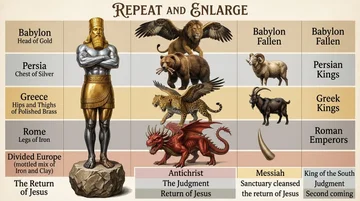
The vision repeats and enlarges Daniel 2, presenting the same succession of Babylon, Medo-Persia, Grecia and Rome under different symbols.RH Dec 11, 1860ST Aug 19, 1880ST Oct 14, 1889ST Jun 5, 1884 The bear corresponds to the silver breast and arms, the chest and arms and silver part of the image, and to the ram in Daniel 8:3-4, and also to the wolf in Jeremiah.RH Dec 11, 1860ST Sep 29, 1881ST Oct 14, 1889ST Jul 23, 1874 The beast symbols set forth features of that history which the metal symbols were not suited to express, including the two-phase fourth beast with the Papacy as persecutor, rebel against law, and blasphemer whose earthly rule is removed at Christ's coming when judgment passes to the saints.ST Oct 14, 1889ST Jun 5, 1884
Unlike the metals which portray glory, lasting qualities and successive dynasties, the beasts portray the character of human kingdoms and their attitude toward God and His people as cruel, rapacious beasts of prey devouring and breaking in pieces and caring only for themselves while ravaging and spoiling others.ST Sep 29, 1881ST Apr 5, 1877ST Nov 29, 1905 The bear as a baser and ignoble beast after the proud lion shows Medo-Persia inferior to Babylon in wealth, magnificence and brilliance.ST Sep 29, 1881ST Apr 5, 1877ST Oct 1, 1902 The symbol beast by itself denotes governments or nations, with character shown by the particular beast chosen.ST Nov 29, 1905ST Dec 22, 1881
Medo-Persia took world sovereignty when Cyrus took Babylon in 538 B.C. and held it until 331 B.C. when Alexander's Grecian forces won at Arbela and became undisputed rulers, after which Rome succeeded Greece as the fourth power.LS 40.1–5ST Sep 29, 1881ST May 3, 1877ST Oct 1, 1902 The bear raised on one side with three ribs in its mouth is a fit emblem of the character and conquests of Persia, whose wars were marked by cruelty and by the clumsy mass of armies gathered from many peoples.LS 40.1–5ST Sep 29, 1881ST Jul 6, 1915 Its three great conquered territories added by conquest were Chaldea, Lydia and Egypt.ST Sep 29, 1881ST Jul 23, 1874ST Jul 6, 1915
The second universal kingdom pictured as a bear with three ribs in its mouth is identified with Darius.RH Nov 2, 1905 In its historical setting the second kingdom in the sequence of beasts is identified with the Ostrogoths in Italy, whose power under Theodoric kept the papacy subordinate and whose removal helped clear the way for papal supremacy.ST Oct 27, 1881 The ram vision of Media-Persia, the same empire as the bear, begins with that empire at the height of its power rather than with Babylon.RH Apr 30, 1857RH Nov 21, 1854
Raised Side Dual Kingdom
The lifting of one side shows a double kingdom made of two peoples and two lines of kings, Media and Persia, two unequal nations with one longer and stronger than the other, the two nationalities distinctly set forth in answer to the two arms of the image and to the ram's two unequal horns.RH Feb 3, 1853ST Sep 29, 1881RH Sep 9, 1915RH Dec 26, 1907RH Nov 14, 1854 Its raised side marks the Persian part as holding the ascendancy in the second kingdom in the succession of world kingdoms.ST Sep 29, 1881RH Sep 9, 1915RH Jun 6, 1912
The Medes stood foremost at first and Media held dominance at first, then the Persians rose under Cyrus and his successors and Persia held control after the conquest of Babylon.RH Feb 3, 1853ST Sep 29, 1881RH Sep 9, 1915RH Dec 26, 1907RH Nov 14, 1854 The Persian element became predominant and controlling, as also shown by the higher horn that came up last and by the later naming as Persia and Media.ST Sep 29, 1881RH Sep 9, 1915RH Dec 26, 1907 That twofold character with its two elements belonged to the kingdom from the very beginning of its history, not as a separation arising later in its career.ST Sep 1, 1881RH Mar 16, 1869
Leaning to one side also pictures the clumsy mass of its armies, and those who so hold it teach that rising on one side marks dominion extended chiefly in one direction, answering to the ram's westward, northward and southward pushing.ST Jun 30, 1914RH Nov 26, 1857RH Jan 31, 1856ST Jan 22, 1880 The threefold conquest of Babylon or Chaldea, Lydia or Libya, and Egypt is set beside that one-sided expansion as the westward, northward and southward work of Daniel 8.ST Jun 30, 1914RH Nov 26, 1857RH Jan 31, 1856ST Jan 22, 1880 The call to devour much flesh belongs with forceful conquests, while the meaning of the raised side and the ribs is left as an open question.ST Oct 22, 1885
Three Ribs Conquered Powers
The three ribs held between the teeth are Babylon or Chaldea, Lydia, and Egypt, three great powers, provinces and territories conquered and brought into subjection.ST Sep 29, 1881RH Sep 9, 1915RH Dec 26, 1907ST Jul 23, 1874ST Apr 5, 1877 They were subdued in succession under Cyrus and Cambyses after forming an alliance against Persia, then robbed, cruelly oppressed and held fast in its teeth.ST Sep 29, 1881RH Sep 9, 1915ST Apr 5, 1877RH Nov 26, 1857 Their overthrow encouraged further conquests and is linked to the call to devour much flesh.ST Sep 29, 1881RH Dec 26, 1907ST Jul 23, 1874ST Apr 5, 1877 Those who list the three as Babylon, Libya and Egypt connect them to the ram's westward, northward and southward expansion in Daniel 8.RH Jan 31, 1856
The ribs signify conquests in general and some of the earliest conquests in particular, portraying further military expansion and enlargement of dominion.ST May 26, 1909RH Sep 29, 1863ST Jan 21, 1889ST Jul 23, 1874 The command to devour much flesh points to that expansion following the first conquests.ST May 26, 1909RH Sep 29, 1863ST Jul 23, 1874RH Sep 9, 1902 The bear's strength and ferocity fit the reputation of the Medes and Persians as spoilers of nations.ST Sep 29, 1881RH Nov 26, 1857ST Jan 21, 1889 The unnatural feature of ribs in the mouth indicates a ferocious disposition and unnatural ferocity.RH Nov 26, 1857ST Oct 1, 1885ST Oct 6, 1881RH Jun 15, 1869ST Apr 26, 1877
A different teaching makes the three ribs the union of Media, Persia and Chaldea in one kingdom.RH Feb 3, 1853RH Nov 14, 1854RH Apr 23, 1857RH Nov 14, 1854 The verse does not predict three kingdoms that would make war before Rome arose.ST Jul 15, 1913
Devour Much Flesh Command
The voice bidding the bear to arise and devour much flesh portrays Medo-Persia as cruel, bloodthirsty, voracious, rapacious, fierce, ferocious, tenacious, slow, strong and destructive, a spoiler plundering, robbing and despoiling others.ST Sep 29, 1881RH Dec 26, 1907ST Oct 1, 1885ST Dec 14, 1882 The bear fits the Medes and Persians in their ferocity and thirst for blood, subduing many populous kingdoms through extensive conquests with great loss of life.RH Feb 3, 1853RH Sep 9, 1915RH Nov 14, 1854ST Jul 23, 1874RH Feb 8, 1870 That voracity and cruelty and bloodshed mark it as a persecuting power, inferior to Babylon in wealth, magnificence and brilliance yet dreaded for its spoiling of nations.RH Feb 3, 1853ST Sep 29, 1881RH Dec 26, 1907RH Nov 14, 1854ST Jul 23, 1874
The command denotes the cruelty of its wars and its destructive conquests, wrought by the clumsy mass of its armies gathered from many peoples leaning heavily to one side.ST Jun 30, 1914ST Jul 6, 1915ST Oct 1, 1885ST Dec 14, 1882 It expresses an appetite in which acquiring territory feeds ambition for still greater conquests, so that its overthrows encouraged further overthrows and its oppressive acts stirred it to greater cruelty.ST Sep 29, 1881RH Sep 9, 1915ST Jun 30, 1914ST Jul 6, 1915ST Oct 1, 1885 The same pattern of expanding territorial ambition is seen in powerful nations that devour flesh to feed their hunger for dominion.ST Jun 30, 1914ST Jul 6, 1915
The command was permission to make further conquests before disappearing, reflecting the Persian belief that their armies could not be defeated and their continuing drive for conquest after Babylon, Lydia and Egypt were subdued in succession under Cyrus and Cambyses.RH Sep 9, 1915RH Dec 26, 1907RH Jan 23, 1908 The one-sided bear rose with great power to devour, and after accomplishing its purpose its power waned.ST Jul 20, 1882RH Jan 23, 1908 Like Babylon it was softened by ease and made weak by plenty, so it fell beneath the sword of the forcible Greek.ST Jul 20, 1882ST Sep 21, 1882
Its vast extent is illustrated by Ahasuerus, or Artaxerxes, ruling over 127 provinces, showing how widely it subdued populous kingdoms westward, northward and southward.RH Feb 3, 1853RH Nov 14, 1854ST Jul 23, 1874RH Apr 23, 1857RH Nov 14, 1854 That dominion from Cyrus's overthrow of Babylon in 538 B.C. to Alexander's victory at Arbela in 331 B.C. answers to the silver breast and arms of Daniel 2.ST Sep 29, 1881ST Jul 23, 1874RH Feb 8, 1870 Rome's march and power to tread under foot and devour was equal to the march and power of the Medo-Persian kingdom.RH Jun 25, 1857
Prophetic Sequence to Kingdom
The vision is a consecutive and full prophecy of successive governments reaching from Daniel's day down to the coming of the everlasting kingdom of Jesus Christ, delineating the character of one government and its relation to the others so clearly that the government intended can hardly be mistaken.RH Jun 20, 1854ST Aug 2, 1877 It begins with literal Babylon and continues to the end of time, when spiritual Babylon is judged and its victims receive the everlasting inheritance.RH Aug 9, 1915 It shows the second of four great kingdoms that arise in succession in the earth and fill up all the time from Daniel to the coming of the Son of man in the clouds of heaven, that succession having taken place with the second kingdom belonging to the past while the fourth and last kingdom now exists and awaits the coming of Christ.RH Jun 20, 1854ST Oct 14, 1889 It resumes Daniel 2 under different symbols with many additional facts, running through the two-phase fourth beast including the Papacy as persecutor of God's people, rebel against His laws, and blasphemer, whose power as an earthly ruler will be removed yet who will persecute until the second coming when judgment is put in the hands of the saints and they possess the kingdom under the whole heaven.RH Jun 20, 1854ST Oct 14, 1889 It extends through Rome and its papal phase and divided fourth kingdom, is further filled up by Daniel 8-9 and 10-12, and reaches to the judgment with books opened, the coming of the Son of man in the clouds, the New Earth and the everlasting kingdom of Christ and the saints.RH Jun 20, 1854ST Aug 2, 1877RH Aug 9, 1915RH Jun 20, 1854ST Oct 14, 1889
Its predictions are definite and dependable and were exactly fulfilled in history, giving confidence in the remaining prophecies.ST Nov 24, 1914ST Dec 11, 1893ST Jun 13, 1878 The prophecy of Daniel 7 reaches to the end of this dispensation, fulfilled except the very closing specifications, foreshowing with Daniel 2 and 8 the successive rise and passing away of Babylon, Medo-Persia, Grecia, and Rome.ST Aug 2, 1877RH Dec 13, 1853RH Jun 20, 1854 The details given in Daniel 7 are more definite and particular than those in Daniel 2, and the predictions concerning Medo-Persia were fulfilled and identified in past history.ST Dec 11, 1893ST Jun 13, 1878 Only the closing work remains, and the fifth universal empire, God's everlasting kingdom, is immediately impending and near.ST Aug 2, 1877RH Jun 20, 1854
The bear with three ribs in its mouth is the second waymark on the road to the Judgment and the everlasting kingdom of the redeemed, the glorious city governed by a most benevolent and lovely prince where there is neither sickness, sorrow, pain, nor death.ST Jul 23, 1874RH Feb 3, 1853RH Jul 23, 1872 It comes after the lion with eagle's wings and before the leopard with four wings and four heads, the dreadful terrible beast with great iron teeth and ten horns, and that same beast with three horns plucked up and a peculiar horn having eyes like a man and a mouth, after which the city comes next.ST Jul 23, 1874ST Aug 2, 1910 Seeing this second sign after the first proves the directions true and increases faith, and after it travelers look not for the city but for the leopard, marking progress along the journey as a sign that God knows and has foretold the course ahead.ST Jul 23, 1874RH Feb 3, 1853ST Jan 17, 1884 Its station has already been passed, coming after Babylon and before Grecia and Rome in its undivided and divided form, and like the other beasts before the fourth, its dominion was taken away but its life was prolonged after its dominion ended.RH Jul 23, 1872ST Aug 2, 1910
The plain and thrilling prophecy of Daniel 7, together with Daniel 2 and Daniel 8, traces the course of empire and shows that the God of heaven is about to set up His kingdom at the second advent.RH Dec 24, 1867RH Feb 26, 1867RH Dec 3, 1867 It is one of about twelve great lines of prophecy in the Word of God, and together with the other lines these converging highways of time bring the present to the very focal center, showing that the end of earthly rule with its destruction is nearly over and the glorious reign of Jesus at His second coming is near, giving a sure word of prophecy as a light shining in a dark place until the day dawns.RH Jan 20, 1910ST Dec 14, 1904 It is included among the prophetic chains said to locate the second advent within a few years of the present time.RH Apr 26, 1864
The successive, increasingly cruel beasts continue toward the end, when the powers are destroyed rather than converted.ST Aug 19, 1886ST Jul 1, 1908 The kingdoms represented by the beasts are all destroyed together at Christ's second coming, the bear being one of the four beasts representing universal kingdoms whose feet are among the features later combined in Revelation's ten-horned beast, which represents the same dominion and locality as all four beasts.RH Jan 31, 1856RH Jan 31, 1856 The verse is cited as part of the prophecy about the kingdoms and Christ's eventual dominion, not as evidence that earthly nations will willingly submit to him.ST Aug 19, 1886ST Jul 1, 1908
The kingdom described in Daniel 7 was not established at Pentecost and was still future, when it would be given to the saints.RH Sep 8, 1874 The fourth beast is the fourth or Roman kingdom, followed by ten horns which are ten kingdoms arising out of that empire, followed by the little horn of the papacy which thinks to change God's law and wears out the saints, followed by its destruction at Christ's coming, and only then the giving of the kingdom and dominion under the whole heaven to the people of the saints of the Most High as an everlasting kingdom, proving God's kingdom was not set up at Christ's first advent and does not overturn earthly governments until then.RH Sep 8, 1874ST Sep 14, 1882 The judgment of Daniel 7:9-14 takes place before Christ's return to earth, where he comes having received his kingdom, and the chapter's timeline places that judgment at least six centuries after Peter Waldo's time.RH Nov 30, 1869RH Sep 2, 1851 The saints will finally receive the kingdom and possess it forever, the kingdom being under the whole heaven — the same earthly territory over which the empires ruled — not merely a reign within people's hearts, inherited after Christ's coming and the destruction of the wicked when flesh and blood is made incorruptible, with present-tense belonging being prospective until world kingdoms become Christ's at the seventh trumpet.RH Sep 8, 1874RH Dec 18, 1855ST Sep 14, 1882
Daniel seeing the lion and the other three beasts come up does not mean Babylon and the following kingdoms rose at the time he had the vision; his attention was carried back to the rise of that kingdom in order that the whole consecutive chain may stand complete before the student of prophecy.RH Mar 19, 1857ST Mar 23, 1915 The locality and power of the prophecy are found with definiteness because the power is known when its rise and development fulfill the specifications marked out in the prophecy.RH Mar 19, 1857RH Jun 25, 1857 The vision repeatedly sees events as if they were then present in Daniel's day although their fulfillment lies later, with some things in the chapter not yet fulfilled, showing the difference between the time a prophecy is given and the time to which it applies.RH Mar 19, 1857ST Mar 23, 1915
The verse gives the seventy weeks set apart upon the Jews, seventy weeks of years beginning B.C. 457 and ending A.D. 34 after 490 years.ST During those seventy weeks God worked for the Jews and through them for others.ST At the end of that time they were no longer God's special people, because the nation as a nation had rejected Him and He could use that people as a people no longer.ST The clear marking of that end was the second rejection of Christ in His servant Stephen by the Jews as recorded in Acts 7, saying by their actions as they had said when Christ was crucified, His blood be upon us and upon our children.ST Thenceforward His people were scattered abroad, winning souls from other peoples wherever they went, and it was about seven years after Stephen that Peter preached to Cornelius the centurion.ST
In this prophetic setting, time is symbolic rather than literal, and a prophetic day represents a year.RH Dec 29, 1863ST Aug 9, 1910 The four beasts represent four Gentile kingdoms, whose allotted rule is called the times of the Gentiles.ST Oct 28, 1908RH May 23, 1854 Those times continue until Christ comes in the clouds to receive his universal and everlasting kingdom; the Jewish people's blindness therefore continues until Christ's coming and the destruction of the wicked.ST Oct 28, 1908RH May 23, 1854 The symbolic meaning as one of the beasts was already open before 1798, while the beginning and ending of the twenty-three hundred days remained closed until the time of the end which began about 1793-1798, the verse belonging with the sanctuary and 2300 days giving a measure of time to Christ's near approach.ST Oct 28, 1908RH May 28, 1867ST Oct 10, 1906ST Nov 29, 1905RH Jan 1, 1861
Rome Horns and Papacy
The succession after the bear leads to the dreadful terrible fourth beast as pagan Rome with paganism seated at Rome, continuing through both pagan and papal phases to the judgment, the coming of Christ, and the saints possessing the kingdom under the whole heaven.ST Oct 14, 1889RH Aug 31, 1869GSAM 54.1–2 Where Daniel 2 shows the image complete with toes developed and then nothing until the stone sets up God's kingdom, Daniel 7 repeats and enlarges it by showing beasts leading to ten horns, which are ten kingdoms occupying its exact territory.ST Jun 5, 1884RH Jan 23, 1855GSAM 54.1–2 Those ten kingdoms are the Alemanni, Franks, Burgundians, Vandals, Suevi, Visigoths, Saxons, Ostrogoths, Lombards, and Heruli, formed in Europe between 476 and 493 and existing by A.D. 483, about five hundred years after Christ.ST Jun 5, 1884ST Oct 29, 1902RH Jan 23, 1855 The ground is the same as gold, silver, brass, and iron ending in iron mixed with miry clay, now covered again under four great beasts diminishing in power and grandeur down to division into ten parts and the setting up of God's everlasting kingdom over all the earth forever.ST Oct 14, 1889RH Jan 23, 1855GSAM 54.1–2
Among them arises another little horn, small at first and diverse from the others as an ecclesiastical power attaining civil power, cunning and far-seeing, arrogant and blasphemous against the Most High and stronger than its fellows.ST Oct 14, 1889ST Jun 5, 1884GSAM 54.1–2 It is the Papacy, the man of sin and son of perdition, the beast, representing Rome under the popes after union of the apostate church with the Roman state.ST Oct 14, 1889RH Aug 31, 1869RH Jan 23, 1855 It received pagan Rome's civil power and seat at Rome by Justinian's decree, as Rome in its papal spiritual ruler phase subduing three and continuing 1260 years.ST Jun 5, 1884GSAM 54.1–2 The Heruli, Vandals, and Ostrogoths are the three that were plucked up before it.ST Jun 5, 1884ST Oct 29, 1902GSAM 54.1–2
It uprooted three horns, the last the Arian Ostrogoths withdrawn from Rome in 538 which removed the obstacle to exercising Justinian's grant.ST Jun 5, 1884ST Oct 29, 1902GSAM 54.1–2 It wore out the saints through centuries of Dark Ages persecution, distinct from the later plagues on the wicked, and will persecute until the second coming when its power as earthly ruler is removed.ST Oct 14, 1889RH Aug 31, 1869ST Jun 5, 1884 It thought to change times and laws by setting aside the second commandment and changing the Sabbath from the seventh day to Sunday as the mark of its authority, in rebellion against His laws.ST Oct 14, 1889ST Jun 5, 1884 It continued 1260 prophetic days or years, forty-two months, time and times and dividing of time, from 538 to 1798 when Berthier took Rome and Pius VI prisoner with a deadly wound, its career and decline having run their course except destruction at Christ's advent.RH Aug 31, 1869ST Jun 5, 1884RH Jan 23, 1855GSAM 54.1–2
After 1798 it continues as a church until destroyed at Christ's coming when judgment is given to the saints.ST Oct 14, 1889RH Aug 31, 1869GSAM 54.1–2 Its tribulation ceased about 1776 through the Reformation so that the May 19, 1780 darkening of the sun was after the tribulation.ST Oct 14, 1889RH Aug 31, 1869 The judgment therefore could not come prior to that division of the fourth empire and the 1260 years of triumph, and the Judgment-hour message belongs after 1798.ST Oct 14, 1889RH Aug 31, 1869RH Jan 23, 1855
The prophecy parallel to Revelation 13:1-10, 18 refers to the Papacy in dominance over Western Rome, with specifications of chronology, continuance, character, and work fully met in the Papacy and in no other power.ST Nov 28, 1892ST Dec 9, 1880RH Mar 31, 1874 Daniel 7:4-8 describes the same power brought to view in Revelation 13:1-2.ST Dec 9, 1880RH Mar 31, 1874ST Aug 26, 1889 The persecuting, blasphemous character of the little horn is the same as Revelation 13:5-7, and time, times, and dividing of time is the same tribulation period as the forty-two months, ending with captivity in 1798 when another lamb-like power comes up.RH Jun 3, 1858ST Dec 9, 1880ST Nov 28, 1895
When the prophecy is used to claim the little horn changed the Sabbath law, its rise after Rome's division places the alleged change after Rome's fall, which is argued to conflict with historical testimony that Christians observed Sunday before then.RH May 27, 1873
The prophecy applies to the Roman power pagan and papal, not to Antiochus Epiphanes, a Syrian king who could not resist the mandates of Rome.RH Dec 23, 1852RH Dec 10, 1857ST Feb 12, 1880 That application is a shift from Rome made to save the papal church from any share in fulfillment, followed by opposers of the Advent faith.RH Dec 23, 1852ST Feb 12, 1880 Antiochus was only eighth of twenty-six Syrian kings and died 164 years before Christ, while Persia reigning over 127 provinces is called great and Grecia very great, but the little horn waxes exceeding great, exacting tribute from Syrian kings, commanding them to abandon Egypt, and enlarging dominion far beyond his temporary conquests.RH Dec 23, 1852ST Feb 12, 1880
The third and fourth beasts are distinct, the fourth having ten horns and nails of brass, so to mix them and make a Syrian head of the third absorb the whole fourth ends the prophecy before the First Advent and destroys its order, though it reaches to the First Advent and beyond.ST Nov 19, 1885RH Mar 2, 1852RH Dec 10, 1857 Daniel 7's little horn representing Rome during only part of its history is distinct from Daniel 8's little horn representing Rome throughout pagan and papal forms, elsewhere said on the ground of origin and sphere to be Mahometanism and the Roman Catholic hierarchy respectively.ST Nov 19, 1885RH Apr 15, 1873RH Dec 10, 1857
The brief description of the four beasts serves as steps leading to the main subject, modern Babylon, whose territory, time of rise, duration of supremacy, and nature of work the vision is really intended to reveal, with the pope as king among kings reigning over kings of the earth for just the length specified and doing just the work foretold.RH Oct 28, 1902RH Aug 7, 1900RH Sep 18, 1900 It shows pride, self-exaltation and arbitrary power of Babylon of the Chaldees revealed again, paganism from Babel taking the place of Christianity, and the human substituted for the divine.RH Aug 7, 1900RH Sep 18, 1900 Salvation requires keeping clear not only of the papacy as organization but of its principles wherever found, by individual relation with God determined by fruits rather than outward connection, with the gospel revealing heaven's principles against this world's.RH Oct 28, 1902RH Sep 18, 1900
The prophecy outlines the Roman peril and delineates the Roman system, furnishing the proper setting for protest against Romanism.RH Jun 6, 1912ST Aug 16, 1905 Studied together with Daniel 2 it eliminates the Church of Rome from possible true churches and shows the Catholic Church is not the true church, giving assurance of salvation in God's everlasting kingdom.RH Jun 6, 1912ST Aug 16, 1905RH Aug 17, 1905
Revelation Composite Beast Link
The bear's feet reappear with the lion's mouth and the leopard's body in the composite sea beast of Revelation 13, showing Rome as successor that absorbed and inherited the power, territory and characteristics of the earlier empires.ST Aug 24, 1882RH Apr 10, 1916ST Oct 2, 1884ST Jul 4, 1899 The bear is Persia, the second of four great universal kingdoms that successively rule the world until God's kingdom is established, coming after Babylon and before Greece and Rome, and by the time of John's vision that kingdom had passed away but Rome as successor inherited its power and territory.ST Aug 24, 1882ST Jan 30, 1879RH Mar 12, 1857ST Oct 22, 1894 Its bear-like feet show that its dominion extended over territory represented by the beasts of Daniel 7, signifying preceding kingdoms absorbed into Rome's territory.ST Aug 24, 1882ST Oct 2, 1884 Its characteristics together with the other three beasts reappear combined in the beast of Revelation 13 with ten horns like the fourth nondescript beast, and the same powers continue through the dragon of Revelation 12 and the beast carrying the woman in Revelation 17.RH Oct 25, 1870 The kingdom symbolized by the stone that smites the image is not set up at Christ's first coming but after the judgment of Daniel 7:9-10 when the Son of Man receives everlasting dominion, glory and a kingdom in Daniel 7:14, at Christ's second coming when He breaks the nations with a rod of iron and dashes them like a potter's vessel and overcomes the beast, the kings of the earth and their armies making war against Him.RH Oct 25, 1870 Medo-Persia as a bear is the second head in a succession of powers and continues the Babylonian church-and-state system in another form.ST Jul 4, 1899
The combining of lion, bear, leopard and nondescript fourth beast into Rome proves that the Revelation 13 power rises after those three kingdoms have passed away, succeeds and combines them in itself, and reaches back through the third and second kingdoms to the first.ST Jan 30, 1879ST Jun 19, 1884RH Mar 12, 1857ST Oct 22, 1894ST Oct 8, 1902 It is identical with the fourth beast of the Daniel 7 series in its papal phase after paganism gave way, not in its first pagan form represented by the dragon, for the dragon and the seven-headed ten-horned beast represent its two phases as pagan then papal after the little horn's rise.ST Jan 30, 1879RH Mar 12, 1857 The heads of that beast are successive kingdoms, and while the Medo-Persian head flourished the beast was Medo-Persian in character, but Medo-Persia no longer exists as a dominant power but is merged in its papal successor which inherits all the forms and nature of the beasts of Daniel 7.ST Nov 14, 1906 Medo-Persia is one of the first four persecuting heads through which Satan speaks, covered by Daniel's prophecy and Revelation 12, and the Revelation 13 power is closely related to the fourth beast and the little horn of Daniel 7 as the same prophetic subject.ST Oct 22, 1894ST Oct 8, 1902
Although the bear kingdom lost dominion its life was prolonged after dominion ended by being merged into the succeeding kingdom.RH Jul 23, 1872RH Feb 5, 1901RH May 19, 1851 Its station on the road of time leading to the everlasting kingdom of God has already been passed, coming after Babylon and before Grecia and Rome in its undivided and divided form.RH Jul 23, 1872 When dominion passed the earlier people and territory continued but the beast no longer represented it, as Persia under Cyrus took over Babylon's territory, subjects and character without exterminating it, and Alexander did the same to Persia, and Babylonia continued to exist as part of its empire after being conquered.STRH Oct 31, 1871 Medo-Persia arose in territory of its own north and east of Babylonia, illustrating the law of symbols that each one occupies territory peculiarly its own, with the original territory of each new government lying outside that occupied by the previous powers, so that together Babylon and Medo-Persia covered all that portion of Asia known to ancient civilization.STRH Oct 31, 1871 Its continued existence after loss of dominion does not require its people to be resurrected when the kingdoms are finally destroyed, for when a beast's dominion is taken away the nation it represents may continue to exist for a time.RH May 19, 1851
The bear is one stage of the same satanic system later shown as a single composite beast of four distinct empires, and the four beasts are symbolized again in the one beast of Revelation 13 and are not to be explained in isolation.ST Jul 4, 1911ST Oct 8, 1902ST Nov 26, 1896ST Feb 25, 1913 It is one manifestation of the same satanic principle and system seen in the lion, the leopard and the ten-horned beast, continuing the perverted church-and-state system begun with Babylon, and all four are gathered into one continued system in the seven-headed, ten-horned beast of Revelation 13, each head giving a distinct character to the system during its time.ST Jul 4, 1911ST Nov 26, 1896 Each empire is an earthly government under the control of Satan the dragon, who is behind every persecuting power against the church.ST Jul 4, 1911 The cruel bear pictures the character of its government born from the union of church and state and therefore a persecutor, fierce, wild and cruel.ST Jul 18, 1900ST Jul 4, 1899ST Jan 23, 1907 Its civil power with the other symbols of Daniel 7 is taken up into the one composite seven-headed beast of Revelation 13:1-10, swayed, dominated and energized by Satan, showing Papal Rome as the legitimate inheritor and successor of the earlier church-state governments whose character gathers their tyranny, cruelty and ravenousness and which acts as the agent of the dragon carrying out Satan's persecuting work in its civil phase.ST Jul 18, 1900RH Mar 2, 1852ST Jan 23, 1907ST Mar 30, 1915 Its bear's feet are also related to the second beast's relation to the first beast.RH Mar 24, 1874
Doctrinal Lessons and Application
Like the other beasts the bear stands for a kingdom antagonistic to God, His truth, Gospel, work and people, one of successive world-dominant empires rising and falling in a long contest in which outward worldly power seeks to crush truth and replace it with a lie.RH Aug 7, 1900ST Dec 24, 1912ST Oct 1, 1902ST Aug 9, 1910ST Mar 30, 1915 These earthly empires are cruel powers caring only for themselves and ravaging and spoiling others, persecuting powers opposed to the kingdom of God, yet the vision points to victory through Christ and to loyalty to God and seeking His kingdom and righteousness as the only basis of permanent prosperity and lasting stability.RH Aug 7, 1900ST Dec 24, 1912ST Oct 1, 1902ST Mar 30, 1915ST Sep 8, 1909 Worldly kingdoms are pictured under the symbol of fierce beasts of prey to show a plan of government that uses brute force to compel the conscience and promotes righteousness by external measures, methods and plans.ST Feb 16, 1915 This is the opposite of Christ, the Lamb of God which taketh away the sin of the world, whose government implants the principle of truth and righteousness to counterwork error and sin.ST Feb 16, 1915
The chapter warns against evil systems and their consequences, not against particular people, for submitting to an evil system based on evil principles can lead even a conscientious person to do evil.ST The reign of the beasts and the crushing tyranny of the little horn is temporary, and beyond it lies the reign of the Son of man and His saints. When believers look forward and are dismayed by what is coming upon the world, they are to look beyond that coming storm to the Coming One, who will abolish evil and introduce blessing, eternal glory, and the New Jerusalem where there is no more sorrow, tears, nor death.
Earthly nations are judged when Christ comes, and their power and identity will end and never exist again.ST Jan 21, 1913 Before the resurrection God the Father sits in judgment and an investigation of the cases of all men takes place to determine the character of each, whether righteous or wicked, and afterward the Son of God descends to execute that judgment.RH Sep 5, 1871 At the end of the thousand years the wicked dead rise as individuals with their former characters, not as citizens of the old nations, whose national lines and boundaries have been erased.ST Jan 21, 1913 That dominion is taken away but life is prolonged after dominion ends, as with Medo-Persia after Babylon and before Grecia and Rome in undivided and divided form on the road of time to the everlasting kingdom of God, does not require its people to be resurrected when the kingdoms are finally destroyed.RH Jul 23, 1872
The chapter foretells religious persecution caused by exalting institutions and things above people, partly fulfilled in the persecution of Christ, His apostles, and His disciples through the Dark Ages, with its final fulfillment beginning in Sunday laws, growing intolerance, and persecution.ST Oct 29, 1896 Its great line in connection with Revelation 12 and 13 climaxes in the third angel's loud warning against worship of the beast and his image and receiving his mark, contrasted with keeping the commandments of God and the faith of Jesus, a message unseen and unproclaimed before the 1844 disappointment.RH Mar 25, 1875 The prophecy foretells blasphemous and persecuting powers that must arise before Christ's second coming, whose appearance showed the day of Christ was not yet at hand in Paul's time, and it exposes the mystery of iniquity and warns the church against all deceivableness of unrighteousness.ST Oct 24, 1911ST Aug 19, 1886ST Oct 22, 1885ST Oct 3, 1878RH Sep 13, 1915
The Adventist application of the four beasts as successive kingdoms was right and is to be held fast as one of three leading points of the 1844 faith, along with the personal coming of Christ and prophetic time, the only mistake being the event to take place at the termination of the prophetic periods.RH Feb 16, 1869 The chapter is the pattern after which all visions of beasts and horns are framed, and its explanation must guide study of later prophetic symbols such as the two-horned beast, while Revelation complements Daniel by giving additional light for fully understanding the fourth beast and the little horn during the time they are active.ST Oct 8, 1902RH Sep 30, 1873 The consecutive and descriptive prophecy with Daniel 2 and Revelation 12 and 13 shows nearness to the Judgment and the close of human probation and brings mankind to a grand and final test closing probation forever, namely the message of the third angel on the commandments of God and the faith of Jesus which discovers true worshipers and distinguishes them from worshipers of the beast and followers of the great papal apostasy, so plain that the common mind can understand it because a just God will not make salvation or destruction depend on what men cannot comprehend.RH Jul 1, 1873 It is one of eleven long chains spanning the whole Christian dispensation and reaching back ages before Christ, followed link by link placing the present in its last link on the verge of the day of God, evidencing the nearness of the personal second coming to punish the ungodly, reward the saints, and bring the reign of peace and restitution of all things.RH Mar 11, 1875
The prophecy of Daniel 2 and 7 is continued by the sounding of the first four trumpets describing the fall of the Roman Empire and its breaking into ten parts as the ten toes and ten horns.RH Sep 29, 1874 Its sea-versus-earth distinction gives the setting for the rise of the United States around 1798 as a young power rising rapidly from the New World rather than the Old World of Babylon, Medo-Persia, Greece and Rome, the sea representing peoples and the earth territory outside the civilized nations.ST Feb 20, 1896ST Jan 23, 1907 Babylon has long ceased as a kingdom though its principles shaped later powers, while Medo-Persia and Greece survive only as small states and Rome remains in divided form. Medo-Persia holds its prophetic place as successor of Babylon for the same reasons of origin, connection with God's people and work, and strong molding religious, educational and political influence, making it a prophetic term in the great outlines of earth's history.ST Aug 1, 1911
The vision furnishes bearings for tracing national histories and parallels the great statue leading to Christ's second coming, the fifth universal kingdom, and the 1260-year papal rule, with its periods harmonizing with Daniel 8, 9, 12 and Revelation 11-13 and with Matthew 24, Mark 13, Luke 21 and signs in heaven, earth, sea, church and nations as conclusive testimony that the world-wide gospel preaching of the kingdom and judgment hour has already been made through the world by the Holy Spirit.RH Feb 6, 1855RH Dec 9, 1851RH Jun 9, 1851RH Sep 23, 1902RH Jan 5, 1860 It points also to the New Earth, teaching that the saints will finally receive the kingdom and possess it forever under the whole heaven, the same earthly territory over which the empires ruled, renewed at the end of the thousand years, not merely a reign within hearts nor an inheritance beyond time and space.RH Dec 18, 1855RH Oct 11, 1870ST Apr 5, 1905RH Mar 21, 1854 By the same symbolic method in which days stand for years, as also in Revelation, the lion is taken by some to mean Great Britain, the bear Russia, the crescent the Turkish Empire, and the eagle Germany.RH May 8, 1916
The wild-beast symbols cover the same history as Daniel 2 with later events to the close of the eighteenth century and belong with the sanctuary and twenty-three hundred days, to be pictured and studied together with John's visions and the great statue with attention to Christ's coming, helping show where events stand without revealing how long fulfillment takes or the time of coming, yet plain to the humblest mind through history's testimony as God's view of the nations and the sure word of prophecy.ST Feb 7, 1884RH Jul 22, 1862RH Jul 9, 1867RH Oct 20, 1863 The bear with its three ribs has already passed in the foretold sequence of Babylon, Medo-Persia, Grecia, Rome and Rome's ten divisions, examples of nations that declined and fell, which must be fulfilled before Christ comes in the way to judgment and God's everlasting kingdom.ST Feb 4, 1913RH Jun 10, 1902ST May 6, 1897RH Dec 27, 1855RH Nov 21, 1854 The lion, bear and leopard were three predecessors merged into Rome, keeping the bear as feet with leopard-like body and lion-like mouth, making with the four Roman forms of Imperial, Barbarian, Papal and Napoleon the only seven successive forms of universal supremacy.RH Feb 14, 1856
The vision is to be read in light of prophecy concerning the Papacy as a religious and political system forging into power, seen in Spain, Italy, Ireland and South American states in social, political and educational condition and doomed as an utterly lost cause to be avoided for God's better cause, covering Babylon ancient and modern with ancient pagan principles revived under Christian forms taught in place of the genuine gospel, and presenting kingdoms to locate the territory, time and work of antichrist.ST Oct 1, 1902ST Sep 17, 1902 It belongs to the second of four distinct lines in Daniel 2, 7, 8-9 and 10-12 covering Babylon, Media-Persia, Grecia, Rome and God's eternal kingdom, beginning with Babylon and closing with Rome's end at Christ's second coming and resurrection, whose condensed advance history the student quickly understood for Babylon and the three kingdoms explained from Daniel 2 and 7 and whose fulfillment is shown by comparing prophecy with history.ST Apr 9, 1912RH Jan 13, 1852ST Nov 15, 1905RH Aug 21, 1913RH Jan 1, 1867
Sources