Daniel 2:42
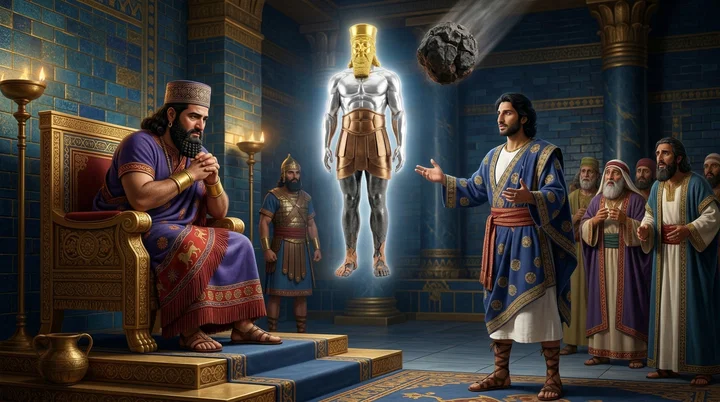
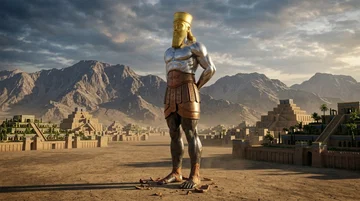
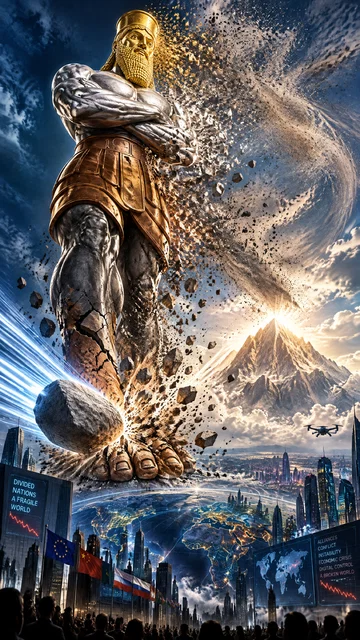
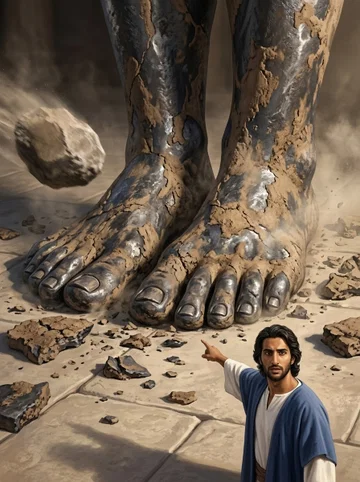
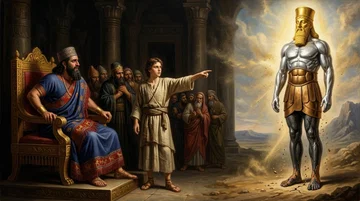
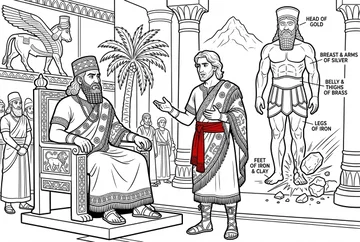
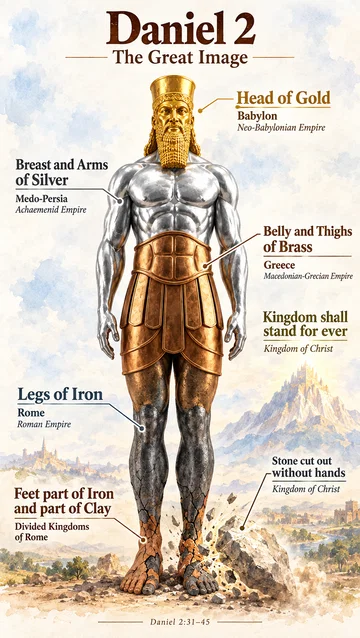
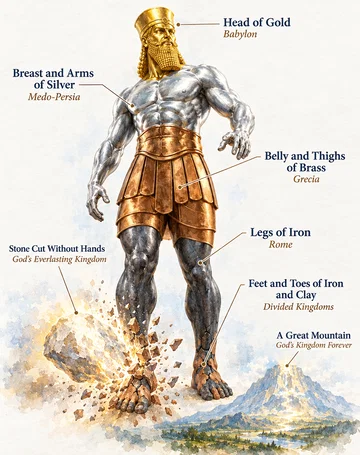
And as the toes of the feet were part of iron, and part of clay, so the kingdom shall be partly strong, and partly broken.
Translations
American King James Version, King James Version, KJV Cambridge Paragraph Bible, Webster Bible, Revised Version, American Standard Version
And as the toes of the feet were part of iron, and part of clay, so the kingdom shall be partly strong, and partly broken.
As to the toes of the feet, part of them iron, and part of them clay: some part of the kingdom is strong, and some part of it is brittle.
And [ as] the toes of the feet were part of iron and part of clay, the kingdom shall be partly strong and partly fragile.
and, the toes of the feet, part of them, iron, and, part, of clay,—some part of the kingdom, shall be strong, but, a part thereof, shall be brittle;
Berean Standard Bible, Majority Standard Bible
And as the toes of the feet were partly iron and partly clay, so this kingdom will be partly strong and partly brittle.
As the toes of the feet were part of iron, and part of clay, so the kingdom will be partly strong and partly brittle.
And as the toes of the feet were in part of iron and in part of earth, so part of the kingdom will be strong and part of it will readily be broken.
And as the toes of the feete were parte of yron, and parte of clay, so shall the kingdome be partly strong, and partly broken.
Douay-Rheims (Challoner revision)
And as the toes of the feet were part of iron, and part of clay, the kingdom shall be partly strong, and partly broken.
Pictures
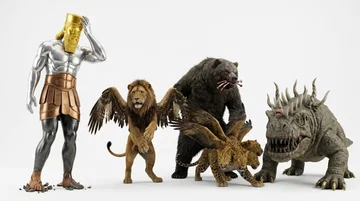
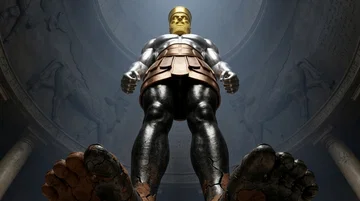
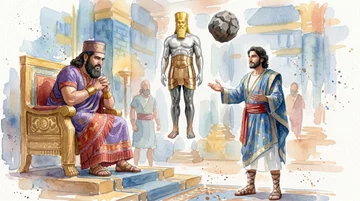
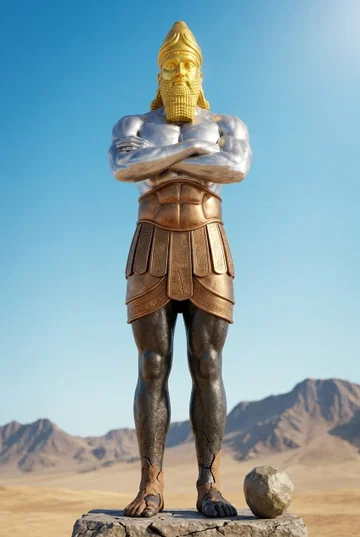
Cross-references 20 of 26
- Daniel 7:7-8
After this I saw in the night visions, and behold a fourth beast, dreadful and terrible, and strong exceedingly; and it had great iron teeth: it devoured and brake in pieces, and stamped the residue with the feet of it: and it was diverse from all the beasts that were before it; and it had ten horns.
The fourth beast’s ten horns correspond to the image’s ten toes.
- Daniel 2:34-35
Thou sawest till that a stone was cut out without hands, which smote the image upon his feet that were of iron and clay, and brake them to pieces.
The stone strikes the image’s feet and breaks the kingdoms.
- Daniel 7:23-24
Thus he said, The fourth beast shall be the fourth kingdom upon earth, which shall be diverse from all kingdoms, and shall devour the whole earth, and shall tread it down, and break it in pieces.
The fourth kingdom is divided into ten kingdoms, with another ruler arising among them.
- Daniel 2:38
And wheresoever the children of men dwell, the beasts of the field and the fowls of the heaven hath he given into thine hand, and hath made thee ruler over them all. Thou art this head of gold.
The head of gold represents Nebuchadnezzar’s Babylonian kingdom.
- Daniel 2:28-29
But there is a God in heaven that revealeth secrets, and maketh known to the king Nebuchadnezzar what shall be in the latter days. Thy dream, and the visions of thy head upon thy bed, are these;
God reveals through Nebuchadnezzar’s dream what will come in the latter days.
- Daniel 2:35
Then was the iron, the clay, the brass, the silver, and the gold, broken to pieces together, and became like the chaff of the summer threshingfloors; and the wind carried them away, that no place was found for them: and the stone that smote the image became a great mountain, and filled the whole earth.
The stone strikes the image’s feet and destroys the kingdoms.
- Daniel 7:17
These great beasts, which are four, are four kings, which shall arise out of the earth.
The four beasts are explained as four kingdoms, matching the image’s kingdoms.
- Daniel 2:32-33
This image’s head was of fine gold, his breast and his arms of silver, his belly and his thighs of brass,
gives image metals ending in feet
- Revelation 17:12
And the ten horns which thou sawest are ten kings, which have received no kingdom as yet; but receive power as kings one hour with the beast.
The ten kings correspond to the divided kingdoms represented by the toes.
- Daniel 7:27
And the kingdom and dominion, and the greatness of the kingdom under the whole heaven, shall be given to the people of the saints of the most High, whose kingdom is an everlasting kingdom, and all dominions shall serve and obey him.
Both visions trace the empires to God’s everlasting kingdom.
- Daniel 8:3-9
Then I lifted up mine eyes, and saw, and, behold, there stood before the river a ram which had two horns: and the two horns were high; but one was higher than the other, and the higher came up last.
Its symbols portray successive kingdoms also represented in Daniel 2.
- Daniel 2:1-13
And in the second year of the reign of Nebuchadnezzar Nebuchadnezzar dreamed dreams, wherewith his spirit was troubled, and his sleep brake from him.
The king demands his dream and its interpretation, and the wise men fail.
- Daniel 2:19-23
Then was the secret revealed unto Daniel in a night vision. Then Daniel blessed the God of heaven.
God reveals the dream and its meaning to Daniel, who praises him.
- Daniel 7:19
Then I would know the truth of the fourth beast, which was diverse from all the others, exceeding dreadful, whose teeth were of iron, and his nails of brass; which devoured, brake in pieces, and stamped the residue with his feet;
Daniel seeks further detail about the fourth beast associated with the kingdoms.
- Daniel 2:32
This image’s head was of fine gold, his breast and his arms of silver, his belly and his thighs of brass,
silver breast and arms are Media and Persia
- Daniel 2:31
Thou, O king, sawest, and behold a great image. This great image, whose brightness was excellent, stood before thee; and the form thereof was terrible.
Both describe the image’s excellent brightness and terrible form.
- Daniel 11:3-4
And a mighty king shall stand up, that shall rule with great dominion, and do according to his will.
Daniel 11 adds detail to Daniel 2’s prophecy of kingdoms and the division of Alexander’s empire.
- Revelation 13:1
And I stood upon the sand of the sea, and saw a beast rise up out of the sea, having seven heads and ten horns, and upon his horns ten crowns, and upon his heads the name of blasphemy.
The beast’s ten horns correspond to the image’s ten toes.
- Daniel 7:2-3
Daniel spake and said, I saw in my vision by night, and, behold, the four winds of the heaven strove upon the great sea.
Daniel 7 covers the same ground as Daniel 2.
- Daniel 7:23
Thus he said, The fourth beast shall be the fourth kingdom upon earth, which shall be diverse from all kingdoms, and shall devour the whole earth, and shall tread it down, and break it in pieces.
Both describe the fourth kingdom and its dominion over the earth.
Commentary part 1 of 3
Each commentary is drawn from primary sources: the writings of Ellen G. White and Adventist pioneers and periodicals. Each commentary is separate. Its own words are not a quotation; follow the references to read the source passages.
Ellen G. White
48 sources
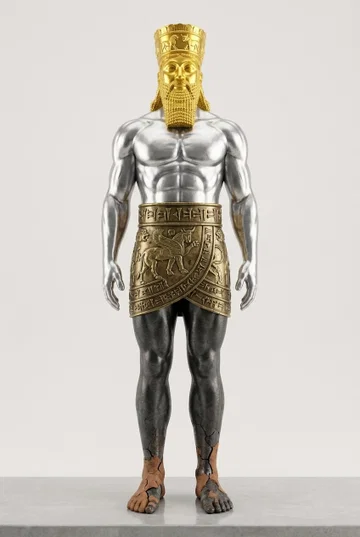
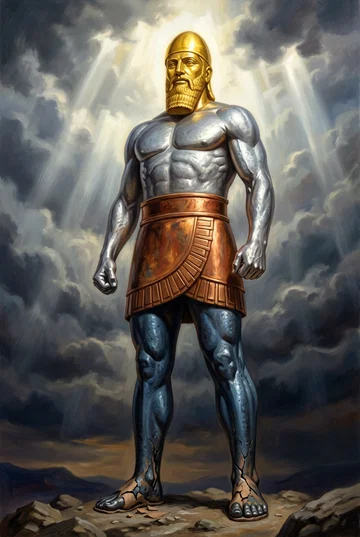
The iron means strength and the clay means fragility, so the feet and toes portray the last phase of earthly rule as a divided kingdom that is partly strong and partly broken and cannot hold together as one enduring unified power.PK 498.1–499.1PK 491.2–31T 360.3–361.2Lt 109a, 1898, par. 5–81MR 50.4
Rome was broken into divisions that would never reunite into one kingdom, so attempts to weld Europe together again by intermarriage or by force would fail because the parts would not cleave together.PK 496.6
The saying belongs to Nebuchadnezzar's dream of the great image, by which God revealed the course of world empires down to the latter days, beginning with Babylon and followed by Medo-Persia, Greece and Rome.PK 495.1ST Apr 29, 1897PK 495.3–496.2PK 535.1Ms 8, 1896, par. 22–23
In the days of these divided kings the God of heaven shall set up a kingdom which shall never be destroyed, which shall break in pieces and consume all these kingdoms and stand forever.PK 495.2ST Apr 29, 189712MR 218.2–220.1
The mingling of iron and clay also means moral deterioration, for kingdoms grew weaker and more corrupt in proportion as they forgot God, made void His law and lost the fear of the Lord.Ms 39, 1899, par. 5–81MR 49.1–21MR 50.4Ms 39, 1899, par. 9–11RH Feb 6, 1900
That same mingling describes the present time in the union of churchcraft and statecraft, when church power is invested with state power to exalt the spurious sabbath above the seventh-day Sabbath, showing that the coming of the Lord and His everlasting kingdom are at hand.GC 364.2–31T 360.3–361.21MR 51.115MR 39.1–2Ms 63, 1899, par. 30–31
Words and Imagery
Iron means strength and clay means weakness and fragility, so the kingdom shown by the feet and toes is partly strong and partly fragile, partly strong and partly broken.PK 498.1–499.1PK 491.2–3Ms 142, 1901, par. 5 The feet and toes are the final phase of the image, a divided kingdom uneven in character and strength, with some parts strong like iron and other parts broken and fragile like clay.Lt 109a, 1898, par. 5–81MR 50.4Ms 142, 1901, par. 5RH Feb 6, 1900 The metals lessen in purity and value down to the feet, and the kingdoms that followed sank lower as they turned from allegiance to God.1MR 50.4RH Feb 6, 1900
That divided kingdom is unstable, like material that cannot hold together, and earthly dominion at the end will not endure as one invincible, unified power.1T 360.3–361.2Ms 15, 1896, par. 10–12 The toes portray powers that will not unite, while the prophecy points to the nearness of God's great day and the coming of the everlasting kingdom.1T 360.3–361.2Ms 15, 1896, par. 10–12
Rome is the iron that was to become divided, partly strong and partly broken, and barbarian incursions from northern and eastern Europe in the fourth century brought that division and broke Rome permanently.PK 496.6 The divisions of Rome would never reunite as one kingdom, for efforts to reunite Europe by intermarriage or by force would fail because the parts would not cleave together.PK 496.6 This includes the efforts of Charlemagne and Napoleon to unite Europe by force.PK 496.6
Dream and Its Setting
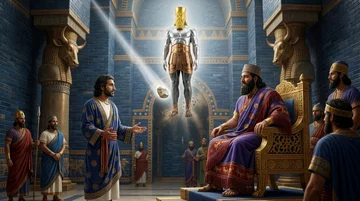
This verse belongs to Nebuchadnezzar's dream of the great image, through which God revealed the future course of earthly kingdoms and what shall be in the latter days.PK 495.1ST Apr 29, 1897Ms 8, 1896, par. 22–23 The head of gold is Nebuchadnezzar's kingdom of Babylon, given kingdom, power, strength and glory by the God of heaven, with rule over the children of men and the beasts of the field and the fowls of heaven wherever they dwell.ST Apr 29, 1897 After Babylon would arise another kingdom inferior to it, then a third kingdom of brass which would bear rule over all the earth, and a fourth kingdom strong as iron.ST Apr 29, 1897 In the days of these kings the God of heaven shall set up a kingdom which shall never be destroyed and shall not be left to other people, but it shall break in pieces and consume all these kingdoms and shall stand forever.ST Apr 29, 1897 The dream and Daniel's explanation of it revealed the course of earthly kingdoms and showed that God rules over kings and kingdoms.Ms 8, 1896, par. 22–23
The dream revealed to idolatrous Babylon the power and faithfulness of the God of Israel.PK 491.1 It was light of God's hidden purposes given to reflect upon proud Babylon, giving that idolatrous nation knowledge of the kingdom the Lord was to establish and by His power maintain against all the power and craft of Satan.Lt 32, 1899, par. 6–11 By it Nebuchadnezzar was shown that the God of heaven is Ruler over all monarchs and kings of earth.Lt 32, 1899, par. 6–11Ms 8, 1896, par. 22–23 The partly strong and partly broken kingdom is one of the earthly kingdoms that rule by ascendancy of physical power, in contrast to the Messiah's kingdom whose ensign is a lamb, which banishes every carnal weapon and every instrument of coercion and was to be established to uplift and ennoble fallen humanity.Lt 32, 1899, par. 6–11
The dream had been forgotten, and its interpretation was revealed by God to Daniel and the Hebrew captives when they were under Nebuchadnezzar's decree of death with the other wise men.Lt 151, 1904, par. 3–5Ms 85, 1910, par. 41–44CTBH 20.1–21.2 It was revealed to the Hebrew captives who depended on Him rather than to those captivated by Babylon's splendor, showing God's wisdom and the treasures of eternity to those who depend on Him.Lt 151, 1904, par. 3–5 Because the interpretation was given and understood their lives were spared.Ms 85, 1910, par. 41–44 It was given through Daniel to help the king out of his difficulty, and Daniel made it known to the king many years before the feast of Belshazzar.16MR 336.2CTBH 20.1–21.2
Daniel interpreted the dream in the light of the Scriptures, the living oracles, foretelling what would come upon Babylon and the other kingdoms and exalting Jehovah as more powerful than earthly kings.Ms 168, 1898, par. 1–3Ms 47a, 1898, par. 2–5 Nebuchadnezzar instead read it through his own idolatrous ideas, mind and ambitions for the glory and excellency of himself and his kingdom, concluding that his own kingdom should keep growing in power and extent instead of giving way to God's everlasting kingdom.Ms 168, 1898, par. 1–3Ms 47a, 1898, par. 2–5Ms 15, 1896, par. 10–12Ms 163, 1898, par. 5–11 His desire for a greater earthly kingdom turned him from the dream's lesson that earthly kingdoms do not endure and will come to an end before God sets up His everlasting kingdom, the kingdom of the Prince of heaven filling the whole earth.12MR 218.2–220.113MR 63.1–3Ms 163, 1898, par. 5–11 Though Babylon as the head of gold was a kingdom given by God for His glory, he perverted that light and made an all-gold image representing Babylon and himself, to turn all nations to worship of his image.12MR 218.2–220.1Ms 168, 1898, par. 1–313MR 63.1–3Ms 47a, 1898, par. 2–5 All men, whether king or subjects, are not to read the Scriptures and God's providences in the light of their dreams and fancies, but to read their dreams in the light of the living oracles, lest the meaning be perverted to serve human ambition.Ms 47a, 1898, par. 2–5
The interpretation declared God's power over Babylon and the other kingdoms, with the feet and toes showing a divided final phase, partly strong like iron and partly fragile like clay, so that earthly dominion would not endure as one invincible, unified power.Lt 109a, 1898, par. 5–8Ms 15, 1896, par. 10–12 Nebuchadnezzar failed to let the dream teach him about the end of the kingdoms and the progressively less value of the kingdoms that would appear in history and at the end.Ms 163, 1898, par. 5–11 Babylon later fell during a feast, many years after Daniel had made the interpretation known and before the feast of Belshazzar.Ms 168, 1898, par. 1–3Lt 109a, 1898, par. 5–8CTBH 20.1–21.2
Succession and Fulfillment
The image portrays four great world-moulding empires that arise before the end of human dominion, beginning with Babylonia, namely Babylon, Medo-Persia, Greece, and Rome.PK 495.3–496.2PK 535.1ED 176.4 The head of gold is Nebuchadnezzar's kingdom of Babylon, given kingdom, power, strength and glory by the God of heaven, with rule over the children of men, the beasts of the field and the fowls of heaven wherever they dwell.ST Apr 29, 1897Ms 36, 1896, par. 3 After Babylon would arise another kingdom inferior to it, then another third kingdom of brass which shall bear rule over all the earth, and a fourth kingdom strong as iron that was to subdue the nations of the world.ST Apr 29, 1897Ms 36, 1896, par. 3 This succession was traced by the prophetic pen under the Holy Spirit hundreds of years before the peoples came upon the stage of action, describing the kingdoms that would rise and fall.Ms 36, 1896, par. 3
The predicted kingdoms rose and fell in succession, each given a place and a period of test and trial as to whether its people would exalt the one Ruler, the only true God.1MR 49.1–2Ms 36, 1896, par. 3PK 535.1ED 176.4 Not doing this, its glory would fade away, and proved by obedience or disobedience it also would pass away and be replaced by another.Ms 36, 1896, par. 3PK 535.1ED 176.4 Each failed, lost its glory and saw its power depart, the fourth being strong as iron and subduing nations, and their course showed that God rules world affairs and sets kings in place to fulfill His purpose.1MR 49.1–2PK 535.1ED 176.4
The metals of the image grow less pure and valuable from head to feet, from gold to silver to brass to iron mingled with clay, showing deterioration of the kingdoms.RH Feb 6, 1900Ms 15, 1896, par. 4–613MR 60.1–61.2Ms 163, 1898, par. 5–11 The declining value of the metals signifies that the nations would become less valuable as they separated further from God.Ms 15, 1896, par. 4–613MR 60.1–61.2Ms 163, 1898, par. 5–11 The prophecy has been fulfilled with wonderful exactness as seen in the record of ancient history, proving the inspiration of the Scriptures.GC 364.2–3GC88 364.3–365.1
God's Sovereign Everlasting Kingdom
The succession of kingdoms in the image declares that God is the ruling power over all kingdoms, more powerful than earthly rulers.7T 161.1Ms 36, 1896, par. 3 He changes the times and the seasons, removing kings and setting up kings to fulfill His own purpose.Ms 36, 1896, par. 3 Under His rule kingdoms and their rulers rise and fall, for He casts down one mighty ruler and sets up another.Lt 57, 1896, par. 4–7 The vision was traced by the prophetic pen under the Holy Spirit hundreds of years before the peoples came upon the stage of action, describing the kingdoms that would rise and fall.Ms 36, 1896, par. 3 Babylon would be superseded, and a second kingdom would arise with its period of test and trial as to whether its people would exalt the one Ruler, the only true God, and failing this its glory would fade away and a third kingdom would occupy its place, and proved by obedience or disobedience this also would pass away, and a fourth strong as iron was to subdue the nations of the world.Ms 36, 1896, par. 3
The vision humbles human pride and brings human glory to nothing.Lt 57, 1896, par. 4–7Ms 142, 1901, par. 5 It exalts God, not human agents, and points toward God's everlasting kingdom.Lt 57, 1896, par. 4–7 The kingdom represented by the feet and toes is divided in character, part strong like iron and part fragile like clay, and that succession reveals how human glory is brought low.Ms 142, 1901, par. 5
Earthly kingdoms are temporary and will pass away and come to an end.PK 495.213MR 63.1–3 Babylon would not stand forever.PK 495.2 Its universal rule would fall and other earthly kingdoms would follow it, and these earthly powers would eventually be superseded.PK 514.1 Babylon, represented by the head of gold, was a kingdom given by God for His glory, yet Nebuchadnezzar's desire for a greater earthly kingdom turned him from the dream's lesson.13MR 63.1–3
In the days of these kings the God of heaven shall set up a kingdom which shall never be destroyed and shall not be left to other people.ST Apr 29, 1897 It shall break in pieces and consume all these kingdoms and shall stand forever.ST Apr 29, 1897 It is the kingdom of Christ, the Living Stone, the only kingdom that will never pass away.PK 495.2 It is the kingdom of the Prince of heaven, filling the whole earth, following earthly kingdoms that do not endure.PK 514.112MR 218.2–220.1 The head of gold is Nebuchadnezzar's kingdom of Babylon, given kingdom, power, strength and glory by the God of heaven, with rule over the children of men, the beasts of the field and the fowls of heaven wherever they dwell, and after Babylon arises another kingdom inferior to it, and another third kingdom of brass which shall bear rule over all the earth, and a fourth kingdom strong as iron.ST Apr 29, 1897
The partly strong and partly broken kingdom is one of the earthly kingdoms that rule by ascendancy of physical power.Lt 32, 1899, par. 6–11 In contrast stands the Messiah's kingdom whose ensign is a lamb, which banishes every carnal weapon and every instrument of coercion.Lt 32, 1899, par. 6–11 It was to be established to uplift and ennoble fallen humanity, and the Lord was to establish it and by His power maintain it against all the power and craft of Satan.Lt 32, 1899, par. 6–11 It shows Nebuchadnezzar that the God of heaven is Ruler over all monarchs and kings of earth, giving that idolatrous nation knowledge of the kingdom the Lord was to establish.Lt 32, 1899, par. 6–11
Moral and Religious Decline
The mingling of iron and clay in the toes, together with the descent from gold to silver to brass to iron mixed with clay, means moral deterioration, for the kingdoms lose purity and value as they separate from God.Ms 39, 1899, par. 5–8Ms 39, 1899, par. 9–11RH Feb 6, 19001MR 50.1 They deteriorate in moral value and strength because they make void the law of God, forget Him, and lose the fear of the Lord.Ms 39, 1899, par. 5–8Ms 39, 1899, par. 9–11RH Feb 6, 1900 If rulers had kept the fear of the Lord ever before them, wisdom and power would have been given them which would have bound them together and kept them strong, but instead they made God their strength only when harassed and perplexed.Ms 39, 1899, par. 5–8Ms 39, 1899, par. 9–11
Babylon passed away because in prosperity her rulers forgot God and ascribed honor to human achievement, and the Medo-Persian kingdom was visited by wrath because God's law was trampled underfoot while wickedness, blasphemy and corruption prevailed.Ms 39, 1899, par. 9–11RH Feb 6, 1900 The kingdoms that followed sank even lower in baseness and corruption, and the vast empire of Rome crumbled into pieces.Ms 39, 1899, par. 9–11RH Feb 6, 1900 The same iron-and-clay mixture also fitly represents deterioration of religion, for men grow weak morally and spiritually just in proportion as they forget God.Ms 39, 1899, par. 9–11RH Feb 6, 19001MR 50.1 It is seen in the boastful infallible religion of the church of Rome that keeps people in ignorance of God's will, and in professed Protestants departed from old landmarks and trusting forms, ceremonies and outward display instead of purity, piety, meekness and obedience.RH Feb 6, 1900 Sin is what ruins nations today as in the past, as nations turn from allegiance to God and forget Him and become morally weak.1MR 50.4Ms 39, 1899, par. 9–11RH Feb 6, 19001MR 50.1
Church-State Union Today
The feet with iron mixed with miry clay describe the present time, when God's sacred work is represented by the mingling of churchcraft and statecraft, the church invested with the power of the state.1MR 51.115MR 39.1–2Ms 63, 1899, par. 30–31 The iron mixed with clay is the mingling of church power and state power, and the kingdom partly strong and partly broken is this union.1MR 51.115MR 39.1–2Ms 63, 1899, par. 30–31 That union weakens all the power of the churches and will bring evil results.1MR 51.115MR 39.1–2Ms 63, 1899, par. 30–31
The union is seen when men invest their strength in politics and unite with the papacy.15MR 39.1–2Ms 63, 1899, par. 30–31 It is seen when statesmen uphold the spurious sabbath, the child of the papacy, mingling religious faith with its observance and placing it above the seventh-day Sabbath.1MR 51.115MR 39.1–2Ms 63, 1899, par. 30–31 The seventh-day Sabbath was sanctified and blessed by the Lord and set apart to be kept holy as a sign between Him and His people.15MR 39.1–2Ms 63, 1899, par. 30–31 If the government honored the Sabbath as God commanded it would stand in the strength of God and in defense of the faith once delivered to the saints, in loyalty to His commandments.15MR 39.1–2Ms 63, 1899, par. 30–31
Men in this union have almost passed the point of God's forbearance by making void His law.15MR 39.1–2Ms 63, 1899, par. 30–31 The time will come when God will punish those who have made void His law and their evil work will recoil upon themselves.15MR 39.1–2Ms 63, 1899, par. 30–31 In this time God has a chosen, commandment-keeping people whose discernment must be sanctified, who must not lay wood, hay and stubble upon the foundation.15MR 39.1–2 Every soul loyal to the commandments of God will see the seventh-day Sabbath as the distinguishing feature of faith.15MR 39.1–2
Study and Proclamation
The exact fulfillment of the prophecy, seen with wonderful exactness in the record of ancient history, gives testimony to the inspiration of the Scriptures that anchors faith amid rationalism and skepticism and leads to positive faith.GC 364.2–3GC88 364.3–365.1 The prophecies of Daniel are not unintelligible mysteries that cannot be understood, for prophetic history was shown in symbols that were to be set out plainly so readers could understand the lessons they convey, and even children can understand and explain them.GC88 364.3–365.1HSFM 211.5–212.4 Understanding the king's prophetic dream requires discernment and knowledge from God, not merely worldly learning, and its lessons were given by God for people living in the present day.FE 412.1
The symbolic image was given as God's light through Daniel to foretell what would come upon Babylon and the other kingdoms and to exalt Jehovah as more powerful than earthly kings, communicating truth about the nations and God's purpose for the world rather than glorifying human power.PK 505.1Ms 47a, 1898, par. 2–5 Daniel interpreted the dream in the light of the Scriptures, the living oracles, while Nebuchadnezzar perverted that light by reading the interpretation through his own idolatrous mind and ambitions for the glory and excellency of himself and his kingdom, which led him to set up a golden image to turn all nations to worship of his image.Ms 47a, 1898, par. 2–5 All, whether king or subjects, are therefore not to read the Scriptures and God's providences in the light of their own dreams and fancies, but to read their dreams in the light of the living oracles, lest the meaning be misapplied to serve human ambition and hinder the spread of the knowledge of God.PK 505.1Ms 47a, 1898, par. 2–5
The prophecy figuratively portrays historical events leading to the close of earth's history, and its prophetic waymarks must be carefully guarded and the prophecy correctly applied, rather than replaced by mistaken theories that create confusion.Ms 31, 1896, par. 1–2 The toes portray a divided, unstable kingdom, partly strong and partly broken like material that cannot hold together, describing earthly powers that will not unite.1T 360.3–361.2 Study of the prophecy shows that the coming of the Lord is at hand and God's great day is near, pointing to the coming of the everlasting kingdom.GC 364.2–31T 360.3–361.2GC88 364.3–365.1 This solemn truth of great value is to be brought before the people, young and old, despite the popular belief that the prophecies of Daniel are mysteries that cannot be understood.GC 364.2–3GC88 364.3–365.1
Sources
Pioneers and periodicals
550 sources
The toes of iron mixed with miry clay show the fourth kingdom of Rome continued in a divided state that is partly strong and partly broken, with some parts strong as iron and others weak and brittle as clay.ST Aug 14, 1893RH Oct 27, 1863ST Jun 16, 1914ST Nov 4, 1886ST Jun 4, 1885 The iron and clay do not cleave or amalgamate, so the divisions can never be welded again into one universal empire, but remain without cohesion to the end.RH Oct 27, 1863RH Jan 30, 1879RH Oct 27, 1863ST Jun 29, 1882 The ten toes are ten kingdoms arising from the breakup of Rome, the modern nations of Western Europe occupying its ruins, corresponding to the ten horns of Daniel 7.ST Feb 26, 1880RH May 27, 1915ST Dec 3, 1912RH Sep 15, 1863ST Feb 15, 1883 In the days of these divided kings the God of heaven sets up His everlasting kingdom, which shall never be destroyed but shall break in pieces and consume all earthly kingdoms and stand forever.ST Dec 16, 1880RH Jun 24, 1873ST Feb 15, 1883 The present stands in the toe state at the very end of the image, with all before it fulfilled, so the next event is the stone smiting the feet at the second coming of Christ.ST Oct 14, 1889ST Mar 17, 1887RH Sep 30, 1862RH Apr 9, 1857RH Sep 22, 1863
Language and Immediate Sense
The kingdom shown by the toes is divided, and it shall be partly strong and partly broken, keeping some of the iron's strength while being weak, fragile, brittle and broken like clay.ST Aug 14, 1893RH Oct 27, 1863ST Jun 16, 1914ST Aug 13, 1902ST Oct 11, 1905 The iron-and-clay division holds iron strength and clay weakness together at the same time, so the kingdom is partly strong and partly fragile, and its parts do not form a lasting unity, just as iron and clay do not mix.RH Oct 27, 1863ST Aug 13, 1902ST Jul 29, 1897 This divided state of the kingdoms that arose after Rome broke up has lasted for many years, with its mixture becoming increasingly evident in the monarchies of the Old World.ST Aug 14, 1893ST Jul 29, 1897
The iron's strength is weakened and degraded by the clay, so the divided empire continues only in a mixed condition of strength and weakness until God takes His rightful rule.ST Jun 29, 1882ST May 3, 1877RH Jan 23, 1908 A kingdom made of iron mixed with clay has neither strength nor cohesion because its unlike parts do not hold together.ST Oct 2, 1901RH Feb 7, 1871 The clay marks degeneration and an emblem of weakness, showing the divided final state as inferior and fragile after the glory of the earlier kingdoms, with Rome losing tenacity before division through corrosion that left insufficient cohesion to withstand pressure.ST May 3, 1877RH Apr 18, 1912 The division is marked not by the toes themselves but by the clay coming in, which prevents lasting union so that attempts to join the parts by marriage and intermarriage and mixing with men of other nations do not hold together any more than iron mixes with clay.RH Jan 23, 1908ST Oct 2, 1901
Some divided parts are strong as iron and some are feeble, brittle and weak as clay, so the kingdoms are uneven in strength.ST Nov 4, 1886ST Sep 30, 1886ST Jun 15, 1915ST Jun 25, 1874 Powerful kingdoms overshadow weaker ones, while others are weak and easily broken, and Western European history from A.D. 476 onward accords with this after the division of the Western Roman Empire.ST Nov 4, 1886ST Jun 15, 1915 A kingdom may be weakened, brought low, or made tributary to another without being destroyed, for being broken is not the same as being plucked up by the roots.ST Sep 30, 1886ST Sep 1, 1881 The iron represents strength that could resist efforts to reunite the kingdoms, while the clay represents their broken, weakened state, including both large and small powers after Rome.ST Jun 4, 1885ST Sep 1, 1881ST Jun 15, 1915
The succession from gold through silver and brass to iron mixed with clay marks continued decline, degeneracy, deterioration and inferiority in value.ST Dec 16, 1880ST May 3, 1877ST May 1, 1907ST Dec 3, 1912 The descent from precious metals to iron mixed with clay comes before the stone replaces it with an eternal, glorious order that fills the earth, showing the rise and fall and deterioration of the kingdom of man until men's kingdoms give place to the everlasting kingdom of Christ.ST May 3, 1877ST May 1, 1907 Each part is formed of material inferior in value to the one before it but increasing in strength, until the feet and toes are the place where the stone cut out without hands smites the image.RH Jul 9, 1908ST Dec 3, 1912 This course is foretold, not imposed by arbitrary decree, and human efforts to make an earthly kingdom endure cannot prevent it from passing away through its own weakness and corruption, with real worth measured by character rather than outward splendor.ST Dec 3, 1912ST Sep 29, 1881
In the symbolism the materials, not the body parts, represent the kingdoms.ST Dec 29, 1909RH Dec 12, 1912ST The whole image represents the kingdom of man, made up of men, and the iron and clay symbolize a kingdom.ST Dec 29, 1909ST Head, breast, arms, thighs, legs, feet and toes are natural and incidental to a human figure, which is in human form because it represents the kingdom of man.ST The metals alone carry the prophetic meaning, and feet and toes symbolize literal kingdoms just as metals do.RH Dec 12, 1912STST Dec 24, 1885
The division is signified by the intermingling of iron and clay which cannot be united, amalgamated, welded or mixed.ST Jan 2, 1912 It begins in the feet above the toes and not simply by having toes, for feet and toes are mentioned only because they are the end parts of the image of man.ST Jan 2, 1912 Whether the toes denote division is conjectural, and the verse itself does not state the number, does not identify the toes with particular nations, and gives no specific explanation of the partly strong, partly broken image beyond what is stated.RH Jan 30, 1879ST May 8, 1907ST Jan 2, 1912 The dream reveals the future rise and fall of kingdoms and what would come after Nebuchadnezzar's kingdom through the feet struck by the stone, stretching from Babylon through Medo-Persia, Greece and Rome to the present age and the everlasting kingdom of God.ST May 8, 1907ST May 8, 1907
Dream Origin and Setting
The dream was given to Nebuchadnezzar king of Babylon in the second year of his reign after succeeding Nabopolassar, about 604-603 B.C., three years after association with his father and at the beginning of the seventy years captivity.RH Nov 19, 1857ST Apr 30, 1894RH Nov 3, 1910ST Aug 17, 1904 His spirit was troubled and his sleep broke from anxiety whether his empire would endure, and the great image he saw had head of fine gold, breast and arms of silver, belly and sides or thighs of brass, legs of iron, and feet and toes part of iron and part of clay, to be smitten by a stone cut out without hands and dashed like chaff of the summer threshing-floor.RH Nov 19, 1857ST Apr 30, 1894ST Aug 17, 1904 The account teaches the superiority of heaven's kingdom over earthly governments and reveals God as able to disclose what is hidden and as concerned with the affairs of nations.RH Apr 25, 1912ST Aug 9, 1910
None of Babylon's wise men, magicians and astrologers could tell the dream when required first to tell it and then to interpret it, confessing their inability, and a decree went forth to slay all the wise men so that Daniel and his fellows were sought to be slain.ST Apr 30, 1894ST Jan 16, 1901ST Sep 21, 1904 Daniel obtained time of the king and sought God together with his three friends and associates with implicit faith, fasting and earnest prayer in the audience-chamber with God, and the secret was revealed to Daniel in a night vision to increased confidence and great joy.ST Apr 30, 1894ST Jun 3, 1913 Brought before the king, Daniel declared that there is a God in heaven that revealeth secrets and maketh known what shall be in the latter days, recounting the king's bedtime thoughts and then both telling and interpreting the dream.ST Apr 30, 1894ST Jan 16, 1901ST Sep 21, 1904 The dream and its interpretation present earthly kingdoms leading toward God's everlasting kingdom and call Babylon to receive healing, emphasizing that Nebuchadnezzar's kingdom and glory were gifts from God and not grounds for pride, and showing that God knows the end from the beginning, overrules to put down and raise up kings, planting Medo-Persia, Grecia and Rome in succession after proud Babylon outlived usefulness, permitting the cruel to humble His willingly captive people that they may learn wisdom, and always forewarning through prophets as with Noah before the Flood and with Sodom before destruction.ST Nov 26, 1912RH Jun 12, 1900ST May 15, 1907
The interpretation was revealed through Daniel to make known what shall be hereafter and in the latter days, outlining world history from Babylon to God's everlasting kingdom and the rise and fall of kingdoms.ST Oct 11, 1905ST Feb 15, 1883ST Jul 14, 1887ST Oct 13, 1909 It was given for those living in the latter days even more than for Nebuchadnezzar, showing that human wisdom cannot reveal the future and that God is the source of true knowledge.ST Feb 15, 1883 Honor was given to Daniel as prophet given understanding in visions and dreams, through whom God revealed what would come afterward.ST Oct 11, 1905ST Oct 13, 1909ST Apr 9, 1896
The object-lesson of four metals smitten by a stone was given by the kindergarten method of naming simple objects and making them actors in a simple story in figures and parables, to open the future to childlike minds and hold attention.ST May 27, 1908RH Feb 18, 1873 Dreams are God's way of making Himself known and speaking to prophets, and its simplicity made a profound impression on Nebuchadnezzar's giant mind as no other statement could, leading with the later tree and stump lesson toward his conversion.ST May 27, 1908RH Apr 23, 1867RH Apr 21, 1851 Unlike an ordinary figure that explicitly names what it illustrates, a symbol does not state its meaning directly but is conveyed through symbols rather than verbal prediction, its iron and clay being figurative language for governments and kingdoms that must be explained by Scripture itself and then understood literally, with every word literally fulfilled so that history and prophecy agree, as applied to Christ's literal future kingdom.RH Jun 12, 1855RH Feb 18, 1873ST Jan 21, 1886
The verse is written in Aramaic or Chaldee as part of the section from Daniel 2:4 to the close of Daniel 7.RH Nov 25, 1873 The change from Hebrew to Chaldee comes where speeches at court and proceedings there make Chaldee, the language spoken at court and understood by the Jews generally, the natural language, showing the account was written not for learned Jews at a later date but for the common people during the Babylonian captivity.RH Nov 25, 1873 The great similarity of subject between Daniel 2 and Daniel 7 accounts for continuing the Chaldee through the seventh chapter, while Hebrew is resumed afterward for Daniel's personal introduction as writer and for the restoration of the Jews and the future dealings of God with them.RH Nov 25, 1873
Nebuchadnezzar asserted that Babylon would remain unbroken forever contrary to succeeding kingdoms and division, believing his empire should stand forever and setting up an image all of gold to keep his people from conceiving Babylon could be defeated, claiming universal and perpetual worship.ST Oct 11, 1905 He was obliged to accept the interpretation because the dream was told correctly, and though he acknowledged Daniel's God as supreme he was dissatisfied and sought to thwart the verdict.ST Oct 11, 1905RH Aug 26, 1902 The succession shows his kingdom coming to an end followed by second, third and fourth kingdoms each passing away, the final iron-and-clay feet and toes divided partly strong and partly broken or weak and fragile, proving God the source of all might and declaring that no human empire lasts forever but all are succeeded by Christ's eternal kingdom symbolized by the stone, with human government supplanted to fill the whole earth after failure to establish lasting universal empire.ST Oct 11, 1905RH Aug 26, 1902ST Aug 4, 1898RH Sep 13, 1915ST Nov 8, 1905 Babylon's rulers had known the lesson, yet by Belshazzar's time about sixty years after it was given they ignored it as a warning whose meaning did not prevent Babylon's fall.
The securing of the interpretation shares points of similarity with Daniel 4 in the manner of securing an interpretation of the dream.RH Jan 2, 1900 By contrast Daniel 11 is literal without symbols, given mostly in plain language rather than clothed in figures and symbols like Daniel 2.RH Dec 28, 1911ST Jan 10, 1878ST Apr 6, 1882 Nebuchadnezzar's metallic-image dream is an example of a dream through which God communicated knowledge, a difficult circumstance God permitted and used to bring honor to His name and His faithful followers, showing He can work through seemingly impossible situations for all later kingdoms with lessons for states and individuals.RH Feb 28, 1856RH Apr 24, 1900
Daniel was a man of fervent piety thoroughly educated in Babylon, a city illustrious for its schools where astronomy and all the sciences were taught, with the best opportunities Nebuchadnezzar the Great could furnish, receiving the most wonderful prophecy giving world history thousands of years in advance.RH Jun 18, 1872 Daniel in Babylon, with Joseph in Egypt, shows what God wants His workers to be in the closing time, with God fulfilling the new covenant promise to lead each worker individually, holding the light higher in medical missionary work to reach spiritually and physically perishing people who cannot be reached by an institution.RH Dec 20, 1906
Four Kingdoms Before Division
The image shows only four universal kingdoms reaching from Daniel's time to the end, the head of gold being Babylon under Nebuchadnezzar given kingdom and power and strength and glory with rule over men and beasts and fowls, the breast and arms of silver being Media and Persia which overthrew Babylon, the belly and sides of brass being Greece under Alexander which bears rule over all the earth, and the legs of iron being Rome which broke and subdued all before it.RH Dec 13, 1853ST Jul 4, 1878ST Oct 29, 1885ST After those four in succession comes next the fifth kingdom, the everlasting kingdom of God symbolized by the stone, set up in the divided era of the toes when the world has reached the feet.RH Dec 13, 1853ST Oct 11, 1905 History makes certain beyond doubt that the four arose in the given order and each did its predicted work, with Rome divided in A.D. 483 into ten parts whose division remains in the old world today.ST Jul 4, 1878ST
The head of gold began with Nimrod in A.M. 1771, B.C. 2233 and ended with Belshazzar in A.M. 3466, B.C. 538 after nearly seventeen hundred years, while silver properly began under Darius the Mede when Cyrus by capturing Babylon in B.C. 538 terminated the Chaldean Empire.ST May 29, 1884 Brass was the Macedonian or Greek Empire founded by Alexander the Great who terminated the Persian monarchy at Arbela on Oct. 2, A.M. 3673, B.C. 331, and after his death it was divided into four kingdoms shown also by the four heads and four wings of the leopard.RH Nov 21, 1854ST May 29, 1884 Iron was the Roman Empire, which did not succeed to universal dominion by a single decisive act of conquest as Persia and Greece did but waxed exceedingly great, subduing Syria in B.C. 65 and Egypt in B.C. 30, which left it master of the world, while no date is given for the setting up of the kingdom of God that follows.ST May 29, 1884
Rome is the fourth kingdom because iron surpasses brass and silver and gold, far superior to its predecessors and excluding the weaker divided successors of Alexander.ST May 29, 1884 It advanced to the Euphrates and Danube and Rhine and ocean and Tigris and Forth and Atlantic and Sahara and Arabia and Persian Gulf, successively breaking the gold and silver and brass nations, sometimes vanquished in battle yet always victorious in war, grown from a village on the Tiber to the greatest and most terrible and enduring empire, queen of nations and new Babylon.ST May 29, 1884ST Jun 13, 1878 The dream was permitted as an outline of all leading nations to the close of time, in which Babylon then existing would be followed by three universal kingdoms bearing rule over all the world, and the fourth divided never again to be under one government until God establishes His eternal kingdom.ST May 8, 1907 The Babylonian, Medo-Persian, Grecian, and united Roman kingdoms have already come in exact order, leaving only the ten-toe phase already lasting more than thirteen hundred and sixty years, longer than the whole image before it, whose end is near at the doors.ST Aug 2, 1877RH Sep 27, 1853
The iron legs represent the Roman Empire while still united, not separate Eastern and Western empires, continuing into the feet and toes to identify Rome in united and then divided state.RH Jun 9, 1868RH Feb 17, 1874 The vision shows Rome without distinguishing its pagan and papal phases, that distinction being marked in other prophecies, yet it embraces Rome through its whole career in both phases including papal rule from A.D. 538 and continuing to its last papal form.ST May 10, 1877RH Nov 26, 1857 Prophetic history does not necessarily begin when kingdoms are founded, for Babylon arose in 747 B.C. but entered prophecy in 677 B.C., and Rome was founded in 754 B.C. but did not enter prophetic history until 161 B.C..RH Mar 12, 1857RH Apr 22, 1862 Nations are noted only when in some way connected with the people of God and only after developed far enough to affect them, so Rome already existed in embryo on the Tiber while the first empire rose to glory yet was not noted until grown able to cope with the nations, holding in turn with Persia and Greece jurisdiction over God's people whom God used Nebuchadnezzar to punish in the seventy years captivity.RH Mar 12, 1857
The metals alone carry prophetic meaning and together represent the kingdom of man, deteriorating in value while increasing in strength until the stone replaces it.RH Aug 11, 1853ST Oct 21, 1875RH Dec 17, 1872 The fall from gold to silver to brass to iron mixed with clay continues the diminution in value and depicts steady physical and mental and moral degeneration of the fallen race, a fit emblem of gradual apostasy since Eden proving the world is not growing better toward a golden age but sinking in darkness and ripening for final doom.RH Aug 11, 1853ST Oct 21, 1875RH Dec 17, 1872 The four earthly monarchies of Babylon, Persia, Grecia, and Rome belong to the mortal state while the fifth universal kingdom belongs to the immortal state, so the conversion of the world is an impossibility and no human device can make the divided kingdoms one, with earth-born kingdoms ending in ruin before God establishes His everlasting kingdom by His own power.ST May 10, 1877ST Oct 21, 1875RH Dec 17, 1872ST Aug 13, 1902ST Sep 6, 1899 The succession was taken by some to show four monarchies passed with Turkish power arising from the fourth and remaining but nearing decline, indicating the day of resurrection and judgment near, and three of the four powers were said to have existed for centuries in a divided state.RH Oct 7, 1862
Tenfold Division Identified
The ten toes are ten kingdoms or divisions arising from Rome, and the mixture of iron and clay means that divided kingdom is partly strong and partly broken.ST Feb 26, 1880RH Sep 15, 1863ST Feb 15, 1883ST Sep 21, 1882RH Mar 16, 1869 The same divided state is represented by the ten horns of the beast in Daniel 7, which are ten kings arising from the fourth kingdom, and by the horns in Revelation, with Daniel 7 paralleling the prophecy and supplying the number.ST Feb 26, 1880ST Sep 21, 1882RH Mar 9, 1869 The fourth universal empire was thus to be divided into ten distinct parts continuing until God sets up His kingdom.ST Feb 15, 1883ST Sep 21, 1882
That divided state is the modern nations of Western Europe that arose from the breakup of the Western Roman Empire, occupying its former territory and ruins within its bounds.RH May 27, 1915ST Dec 3, 1912ST Apr 2, 1894ST Sep 12, 1916 They are to be sought only in fresh western territory added by Rome and not in the eastern territories of Babylon, Persia or Greece.ST Dec 3, 1912 Rome was broken into fragments by northern tribes, forming the kingdoms of modern Europe which have remained side by side, commonly described as the Ten Kingdoms of Modern Europe.ST Apr 2, 1894ST May 8, 1901
The ten nations on the ruins of the Western Empire were the Alemanni, Franks, Burgundians, Vandals, Suevi, Visigoths, Saxons, Ostrogoths, Lombards and Heruli.ST Feb 13, 1912 They are also listed as the Huns, Ostrogoths, Visigoths, Franks, Vandals, Suevi, Burgundians, Heruli, Anglo-Saxons and Lombards.ST Sep 29, 1881RH Dec 17, 1857 With variants the lists include the Heruli and Rugii or Thuringi, the Sueves and Alans, the Saxons and Angles, and the Huns, Ostrogoths, Visigoths, Franks, Vandals, Sueves and Alans, Burgundians, Heruli and Turingi, Saxons and Angles, Lombards.RH Sep 22, 1874RH Dec 17, 1857
Some divisions were major powers such as France, Germany, Austria, Spain, England and Italy, while others were smaller powers such as the Swiss cantons, Bavaria, Portugal, Holland, Wurttemberg, Saxony and Belgium.ST Jun 16, 1914 Britain, France and Germany are powerful, Switzerland, Spain and Portugal weak, and Italy lies between strong and weak.RH Aug 28, 1900 The divisions arose as Germanic and northern barbarian tribes invaded Roman provinces and established kingdoms there while Rome declined and perished.ST Jan 20, 1909ST Dec 30, 1903ST Dec 3, 1885 Some successor nations remain in modern Europe including England, France, Germany, Spain, Portugal and Italy, whose remnants are found in Europe today.ST Jan 20, 1909ST Oct 28, 1930ST Dec 3, 1885 The Roman Empire which filled the world in Christ's time was thus divided into ten lesser kingdoms becoming the nations of Western Europe, the Gothic kingdoms of modern Europe forming a tenfold commonwealth of unequal strength.RH Mar 26, 1908ST May 15, 1907
The ten kingdoms arose as distinct peoples after Rome fell rather than being parts counted among the fallen empire, and developed in western Europe where the image stands.ST Oct 7, 1886 After three, the Heruli, Vandals and Ostrogoths, were uprooted, the remaining are Britain, France, Germany, Switzerland, Spain, Portugal and Italy, yet still contemplated as ten because God sets up His kingdom in the days of those divisions.RH Mar 10, 1904RH Sep 27, 1853ST May 18, 1904 The feet represent the Roman kingdom in its divided state and the toes its division, accomplished through the last revolutions which completed the image.RH Feb 17, 1853ST Feb 26, 1880 The fourth kingdom continues as one kingdom after division but weakened as a whole, its parts distinct kingdoms from the same empire as toes belong to one foot.RH Sep 8, 1874RH May 24, 1864
The Huns are not one of the ten because their Western power ended at Netad in A.D. 453 leaving no vestige, and the Magyars are not because they entered Europe in 884 and Hungary in 889, 396 years too late.ST Oct 21, 1886 A proposed list for 456 names Britons, Saxons, Franks, Burgundians, Visigoths, Sueves and Alans, Vandals, Alemanes, Ostrogoths later succeeded by Longobards, and Greeks.ST Oct 7, 1886 The fourth Roman kingdom in divided toe condition is displaced only by a kingdom wholly unlike the four, not made with hands, within one ideal colossal figure keeping brightness, terrible form and God-lent majesty until the end, while the first three monarchies are displaced by succeeding human monarchies.RH Jan 16, 1908
Dates Lists and Duration
The division of Rome into its tenfold toe-state occurred between 356 and 483, also given as 350-476, 351-476, 356-476, 356-488, about 350-476, 306-483, and was accomplished in 483 about 450 years after Christ's first advent.ST Dec 3, 1874ST Dec 20, 1910RH Jun 19, 1860ST Apr 2, 1894RH Apr 9, 1857 Rome was broken into fragments by northern tribes between 351 and 476 to form the kingdoms of modern Europe, and because the image could not be struck before that division the kingdom of God was not established at Christ's first advent while pagan and papal powers persecuted the church.ST Dec 3, 1874ST Apr 2, 1894RH Jun 9, 1859 The ten divisions between 356 and 483 were the Huns in Hungary in 356, the Ostrogoths in Mysia in 377, the Visigoths in Pannonia in 378, the Franks in France in 407, the Vandals in Africa in 407, the Sueves and Alans in Gascoigne and Spain in 407, the Burgundians in Burgundy in 407, the Heruli and Rugii in Italy in 476, the Saxons and Angles in Britain in 476, and the Lombards in Germany in 483. The same division is also stated as between 356 and 383 by the same peoples, understood as ten independent kingdoms existing at the same time and not successive rulers, holding the territories of the Huns, Ostrogoths, Visigoths, Franks, Vandals, Suevi, Burgundians, Heruli, Anglo-Saxons, and Lombards.RH Mar 9, 1869
Rome in prophecy is dated from B.C. 161 when connected with God's people by the league with the Jews, lasting 644 years till its full division into ten kingdoms in A.D. 488.RH Sep 22, 1863 That division was completed in 457, fulfilled between 350 marked by the great Gothic kingdom and 483 in its last decline, broken by northern tribes between 351 and 476 forming modern Europe, with the world remaining in this divided state of partly strong and partly weak until the stone strikes and God establishes His everlasting literal earthly kingdom.ST Feb 15, 1883RH Dec 15, 1863RH Oct 31, 1854RH Apr 9, 1857ST Dec 20, 1910 The division was accomplished a little before A.D. 500 and completed in 483 and still continues while earthly governments exercise authority, after which the outline gives no further historical detail until the stone appears.RH Jul 23, 1872ST Jun 19, 1884ST Jun 5, 1884 The ten kingdoms arose between 356 and 483, and the dominion of the beast whose throne is at Rome commences after this division soon after the commencement of the sixth century.ST Dec 20, 1883
This divided state has continued since the fourth-century breakup, its successors being the strong and weak governments of Western Europe corresponding to the ten toes and the ten horns of the fourth beast.ST May 8, 1901 It has lasted almost fourteen hundred years, about fourteen centuries side by side with no ruler able to unite them despite campaigns and marriage alliances, more than thirteen hundred and sixty years longer than the whole image before it, more than 1,260 years after the fall of Eastern and Western Rome, and about eighteen hundred years of the long Roman period down to the present.RH Jan 20, 1853ST Apr 2, 1894RH Sep 27, 1853RH Dec 11, 1860ST May 8, 1901 The kingdoms are still called the ten kings from their first number about 456, recognized again about 1240, at the Reformation and in later times within the bounds of the old Roman Empire.RH Apr 7, 1874 Their number was not always exactly ten, for through great disorder and confusion one falls and another rises by conquest or inheritance, yet they retain identity through continual transition without consolidation, and change of name, limits, conquest, dependence, tributary dependence, or succession does not destroy their identity as the ten.ST Nov 9, 1882RH Apr 7, 1874ST Mar 4, 1880ST Sep 8, 1881RH Jul 28, 1874
The ten kingdoms arose within about 125 years and continued together under different names, still in existence when God is to establish His kingdom.RH Sep 8, 1874 The division began in the fourth century after Christ and was completed by 483, after which it would remain divided until God's kingdom, marking the span from Babylon to that kingdom but giving no details of intervening events among nations or God's people.ST Nov 20, 1901RH Oct 13, 1874 They must have existed before 493, so later divisions such as the exarchate of Ravenna come too late, and kingdoms of the Eastern Empire cannot be combined to make up the ten within the Western Empire.ST Oct 7, 1886 Seven divisions had appeared by 407 as the Huns, Ostrogoths, Visigoths, Franks, Vandals, Suevi and Burgundians, retaining separate identities until Rome's fall was completed with some remaining distinct 1400 years later, and the image was not complete at the cross which stood at the thighs 483 years before the feet existed and were fully formed by 493.ST Oct 21, 1886RH Dec 10, 1857RH Sep 22, 1863RH Oct 27, 1874
Sources