Daniel 3:15
Now if ye be ready that at what time ye hear the sound of the cornet, flute, harp, sackbut, psaltery, and dulcimer, and all kinds of musick, ye fall down and worship the image which I have made; well: but if ye worship not, ye shall be cast the same hour into the midst of a burning fiery furnace; and who is that God that shall deliver you out of my hands?
Translations
Now if you be ready that at what time you hear the sound of the cornet, flute, harp, sackbut, psaltery, and dulcimer, and all kinds of music, you fall down and worship the image which I have made; well: but if you worship not, you shall be cast the same hour into the middle of a burning fiery furnace; and who is that God that shall deliver you out of my hands?
King James Version, KJV Cambridge Paragraph Bible
Now if ye be ready that at what time ye hear the sound of the cornet, flute, harp, sackbut, psaltery, and dulcimer, and all kinds of musick, ye fall down and worship the image which I have made; well: but if ye worship not, ye shall be cast the same hour into the midst of a burning fiery furnace; and who is that God that shall deliver you out of my hands?
Now if ye be ready that at what time ye hear the sound of the cornet, flute, harp, sackbut, psaltery, and dulcimer, and all kinds of music, ye fall down and worship the image which I have made; well: but if ye worship not, ye shall be cast the same hour into the midst of a burning fiery furnace; and who is that God that shall deliver you out of my hands?
Now if ye be ready that at what time ye hear the sound of the cornet, flute, harp, sackbut, psaltery, and dulcimer, and all kinds of music, ye fall down and worship the image which I have made, well: but if ye worship not, ye shall be cast the same hour into the midst of a burning fiery furnace; and who is that God that shall deliver you out of my hands?
Now if ye be ready that at what time ye hear the sound of the cornet, flute, harp, sackbut, psaltery, and dulcimer, and all kinds of music, ye fall down and worship the image which I have made, well: but if ye worship not, ye shall be cast the same hour into the midst of a burning fiery furnace; and who is that god that shall deliver you out of my hands?
Now, lo, ye are ready, so that at the time that ye hear the voice of the cornet, the flute, the harp, the sackbut, the psaltery, and the symphony, and all kinds of music, ye fall down and do obeisance to the image that I have made! — and lo, ye do no obeisance — in that hour ye are cast into the midst of a burning fiery furnace; who is that God who doth deliver you out of my hands?'
Now if ye be ready at the time that ye hear the sound of the cornet, pipe, lute, sambuca, psaltery, and bagpipe, and all kinds of music, to fall down and worship the image that I have made, [well]: but if ye worship not, ye shall be cast that same hour into the midst of a burning fiery furnace: and who is the God that shall deliver you out of my hands?
Now, if ye be ready, at what time ye shall hear the sound of the cornet, the pipe, the lyre, the harp, the psaltery and the bagpipes, and all the instruments of music, ye shall fall down and adore the image which I have made, but, if ye shall not adore, instantly, shall ye be cast into the midst of the burning furnace of fire,—and who is the god that shall deliver you out of my hands?
Now, if you are ready, as soon as you hear the sound of the horn, flute, zither, lyre, harp, pipes, and all kinds of music, you must fall down and worship the statue I have made. But if you refuse to worship, you will be thrown at once into the blazing fiery furnace. Then what god will be able to deliver you from my hands?”
Now when you hear the sound of the horn, flute, zither, lyre, harp, pipes, and all kinds of music, if you are ready to fall down and worship the statue I have made, very good. But if you refuse to worship, you will be thrown at once into the blazing fiery furnace. Then what god will be able to deliver you from my hands?”
Now if you are ready whenever you hear the sound of the horn, flute, zither, lyre, harp, pipe, and all kinds of music to fall down and worship the image which I have made, good; but if you don’t worship, you shall be cast the same hour into the middle of a burning fiery furnace. Who is that god who will deliver you out of my hands?”
Now if you are ready, on hearing the sound of the horn, pipe, harp, trigon, psaltery, bagpipe, and all sorts of instruments, to go down on your faces in worship before the image which I have made, it is well: but if you will not give worship, that same hour you will be put into a burning and flaming fire; and what god is there who will be able to take you out of my hands?
Now therefore are ye ready when ye heare the sound of the cornet, trumpet, harpe, sackebut, psalterie, and dulcimer, and all instruments of musike, to fall downe, and worship the image, which I haue made? for if ye worship it not, ye shall be cast immediatly into the middes of an hote fierie fornace: for who is that God, that can deliuer you out of mine handes?
Douay-Rheims (Challoner revision)
Now therefore if you be ready at what hour soever you shall hear the sound of the trumpet, flute, harp, sackbut, and psaltery, and symphony, and of all kind of music, prostrate yourselves, and adore the statue which I have made: but if you do not adore, you shall be cast the same hour into the furnace of burning fire: and who is the God that shall deliver you out of my hand?
Pictures
Cross-references 20 of 36
- Acts 5:29
Then Peter and the other apostles answered and said, We ought to obey God rather than men.
Both texts show obedience to God taking precedence over conflicting human commands.
- Daniel 3:25-28
He answered and said, Lo, I see four men loose, walking in the midst of the fire, and they have no hurt; and the form of the fourth is like the Son of God.
God preserves the faithful men in the furnace and delivers them.
- Daniel 2:31-45
Thou, O king, sawest, and behold a great image. This great image, whose brightness was excellent, stood before thee; and the form thereof was terrible.
The golden image defies the revealed succession of earthly kingdoms and God’s everlasting kingdom.
- Daniel 6:10
Now when Daniel knew that the writing was signed, he went into his house; and his windows being open in his chamber toward Jerusalem, he kneeled upon his knees three times a day, and prayed, and gave thanks before his God, as he did aforetime.
Daniel keeps worshiping God despite a king’s decree.
- Exodus 20:3-5
Thou shalt have no other gods before me.
Worshiping the image would violate God’s commands against other gods and idols.
- Acts 4:19
But Peter and John answered and said unto them, Whether it be right in the sight of God to hearken unto you more than unto God, judge ye.
Human authority cannot override obedience to God.
- Daniel 3:28
Then Nebuchadnezzar spake, and said, Blessed be the God of Shadrach, Meshach, and Abed-nego, who hath sent his angel, and delivered his servants that trusted in him, and have changed the king’s word, and yielded their bodies, that they might not serve nor worship any god, except their own God.
The king praises God for delivering those who trusted Him and refused to worship another god.
- Daniel 4:37
Now I Nebuchadnezzar praise and extol and honour the King of heaven, all whose works are truth, and his ways judgment: and those that walk in pride he is able to abase.
Nebuchadnezzar’s defiant question is answered by his praise of God, who humbles the proud.
- Jeremiah 27:5-8
I have made the earth, the man and the beast that are upon the ground, by my great power and by my outstretched arm, and have given it unto whom it seemed meet unto me.
God appoints rulers but limits their authority.
- Revelation 13:15
And he had power to give life unto the image of the beast, that the image of the beast should both speak, and cause that as many as would not worship the image of the beast should be killed.
Refusal to worship the image brings a death sentence.
- Daniel 3:5-6
That at what time ye hear the sound of the cornet, flute, harp, sackbut, psaltery, dulcimer, and all kinds of musick, ye fall down and worship the golden image that Nebuchadnezzar the king hath set up:
The music signals the commanded image worship, with a fiery furnace threatened for refusal.
- Revelation 14:9-10
And the third angel followed them, saying with a loud voice, If any man worship the beast and his image, and receive his mark in his forehead, or in his hand,
Warns of judgment for worshiping the beast and its image.
- Daniel 3:19-20
Then was Nebuchadnezzar full of fury, and the form of his visage was changed against Shadrach, Meshach, and Abed-nego: therefore he spake, and commanded that they should heat the furnace one seven times more than it was wont to be heated.
The king responds to their refusal by ordering the furnace heated and the men bound.
- Daniel 3:29
Therefore I make a decree, That every people, nation, and language, which speak any thing amiss against the God of Shadrach, Meshach, and Abed-nego, shall be cut in pieces, and their houses shall be made a dunghill: because there is no other God that can deliver after this sort.
The king reverses his taunt after their deliverance, declaring that no God delivers like theirs.
- Hebrews 11:34
Quenched the violence of fire, escaped the edge of the sword, out of weakness were made strong, waxed valiant in fight, turned to flight the armies of the aliens.
Faith enabled God’s people to overcome the power of fire.
- Daniel 6:7
All the presidents of the kingdom, the governors, and the princes, the counsellors, and the captains, have consulted together to establish a royal statute, and to make a firm decree, that whosoever shall ask a petition of any God or man for thirty days, save of thee, O king, he shall be cast into the den of lions.
Both decrees enforce worship under threat of death.
- Matthew 4:10
Then saith Jesus unto him, Get thee hence, Satan: for it is written, Thou shalt worship the Lord thy God, and him only shalt thou serve.
Commands worship and service to God alone, contrary to Babylon's false demand.
- Daniel 2:47
The king answered unto Daniel, and said, Of a truth it is, that your God is a God of gods, and a Lord of kings, and a revealer of secrets, seeing thou couldest reveal this secret.
Nebuchadnezzar earlier acknowledges the God he later challenges.
- Daniel 3:1
Nebuchadnezzar the king made an image of gold, whose height was threescore cubits, and the breadth thereof six cubits: he set it up in the plain of Dura, in the province of Babylon.
The golden image is the object of the demanded worship.
- 2 Chronicles 32:15
Now therefore let not Hezekiah deceive you, nor persuade you on this manner, neither yet believe him: for no god of any nation or kingdom was able to deliver his people out of mine hand, and out of the hand of my fathers: how much less shall your God deliver you out of mine hand?
Both mock God's power to deliver from their hands.
Commentary
Each commentary is drawn from primary sources: the writings of Ellen G. White and Adventist pioneers and periodicals. Each commentary is separate. Its own words are not a quotation; follow the references to read the source passages.
Ellen G. White
26 sources
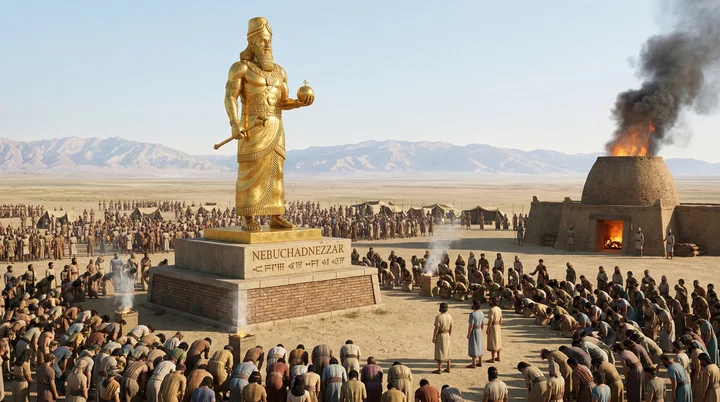
Nebuchadnezzar gave an ultimatum that when the instruments and all kinds of music sounded all must fall down and worship the image he had made, and whoever refused would be cast the same hour into the burning fiery furnace.PK 50312MR 218.2–220.1Lt 90, 1897, par. 13–18 The golden image set up on the plain of Dura represented Babylon and the king himself in his glory, set up as a rival to the God of heaven to be worshiped in His place.Ms 16, 1896, par. 31–3419MR 119.1–120.2Lt 109a, 1898, par. 5–8Ms 168, 1898, par. 1–3Ms 47a, 1898, par. 2–5 His demand joined civil power to false religion to enforce idol worship, and his question who could deliver from his hands was arrogant defiance challenging God's power to save.ST Sep 2, 1897Ms 16, 1896, par. 31–34SPBC 160.5–161.119MR 119.1–120.2PK 507.2 Shadrach, Meshach, and Abednego would not dishonor God by obeying a human law against His law, would not bow to a symbol of human power because they worshiped God alone, and trusted He was able to deliver them while remaining faithful even if He did not.ST Dec 24, 1912ST Sep 2, 1897Ms 16, 1896, par. 31–34Lt 90, 1897, par. 19–20PK 506.2 God proved His power to deliver when Christ Himself walked with them in the fire and preserved them, and the miracle brought Nebuchadnezzar to acknowledge God's superior power.PK 503SPBC 160.5–161.15T 453.1–4Lt 109a, 1898, par. 5–8Ms 47a, 1898, par. 2–5 That test over worship enforced by law under threat of death will be repeated when civil power joined to religious authority demands Sunday observance in place of God's Sabbath.PK 512.112MR 218.2–220.1Ms 15, 1896, par. 33–34Lt 90, 1897, par. 13–18
Setting and Defiant Demand
Daniel 3:15 belongs to the time after Nebuchadnezzar had once acknowledged the power of God, when pride and self-exaltation led him to honor idols with increased zeal.PK 503.2 It stands set against his earlier dream of a great image, which had revealed events reaching to the close of time and foretold that God would establish an everlasting kingdom that would destroy the earthly kingdoms and endure forever.PK 503.1 The golden image he set up on the plain of Dura represented the kingdom of Babylon, and more particularly the king himself, his own glory and the excellency of Babylon.Lt 109a, 1898, par. 5–8Ms 168, 1898, par. 1–3Ms 47a, 1898, par. 2–5
The image arose because he read the interpretation that he was the head of gold in accordance with his own idolatrous mind and ambitions.Lt 109a, 1898, par. 5–8Ms 47a, 1898, par. 2–5 That reading perverted the light given to show that earthly kingdoms would pass away before the kingdom of heaven, for the dream had been given to show earthly kingdoms passing away to be followed by the kingdom of the Prince of heaven filling the whole earth.12MR 218.2–220.1Ms 47a, 1898, par. 2–5 He determined instead to make an image all of gold to take the place of God and to be worshiped as God, hoping by such a display to convert all nations to worship the excellence of Babylon.12MR 218.2–220.1Lt 109a, 1898, par. 5–8Ms 47a, 1898, par. 2–5
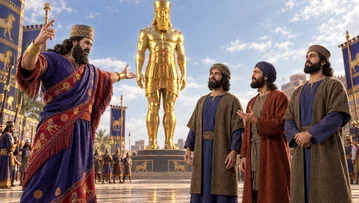
The verse gives his ultimatum that at what time the cornet, flute, harp, sackbut, psaltery, and dulcimer and all kinds of music sound, all must fall down and worship the image which he made.PK 50312MR 218.2–220.1 Anyone who would not worship was to be cast the same hour into the midst of a burning fiery furnace.PK 50312MR 218.2–220.1Lt 90, 1897, par. 13–18 The public display with its impressive appearance and music was calculated to charm the senses, and the offer of readiness was another chance to obey.Lt 90, 1897, par. 19–20PK 507.2Lt 90, 1897, par. 13–18 The king assumed that his command together with the dreadful immediate punishment would compel obedience.Lt 90, 1897, par. 19–20PK 507.2
His question, who is that God that shall deliver out of his hands, expresses defiance and arrogant confidence in his own power.ST Sep 2, 1897Ms 16, 1896, par. 31–34PK 507.2 It is a direct challenge to the power of God to save.ST Sep 2, 1897Ms 16, 1896, par. 31–34PK 507.2STE 212.2–214.1 Falling down before the image was understood by all as an act of worship, and worship of that kind belongs to God alone.PK 507.1PK 506.2 The image was a rival to the God of heaven, a symbol of human power set up to take the place of God and be worshiped as God.Ms 16, 1896, par. 31–34SPBC 160.5–161.119MR 119.1–120.2PK 506.212MR 218.2–220.1 The verse therefore means a union of civil power with false religion to enforce worship of an idol in the place of God, making human authority a rival to God.12MR 218.2–220.1Lt 90, 1897, par. 13–18
Faithful Loyalty and Deliverance
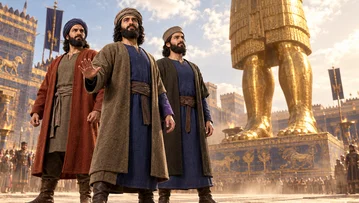
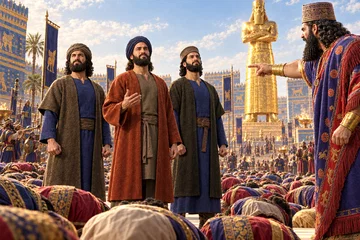
The ultimatum put Shadrach, Meshach, and Abednego to the test whether they would remain loyal to God rather than worship an idol even under threat of immediate death in the burning fiery furnace.Ms 16, 1896, par. 31–34SPBC 160.5–161.119MR 119.1–120.2STE 212.2–214.15T 42.2–43.2 The image was a rival to the God of heaven, so their principles and loyalty to Him forbade them to honor it, and they would not compromise that loyalty even to preserve their own lives.Ms 16, 1896, par. 31–34SPBC 160.5–161.119MR 119.1–120.2 They would not violate conscience to obey even a great king, nor dishonor God by obeying a human law against His law.ST Dec 24, 1912Lt 90, 1897, par. 19–20 They would not bow to that symbol of human power because they worshiped God alone as King of kings and Lord of lords, and though the decree had made image worship the established religion, that did not change their duty.ST Dec 24, 1912PK 506.2
The threat of the furnace did not change their decision to remain faithful even at the cost of death, for they trusted that God was able to deliver them while remaining faithful even if He did not.ST Dec 24, 1912ST Sep 2, 1897Lt 90, 1897, par. 19–20 Their integrity was severely tested before an idolatrous nation.Lt 118, 1910, par. 2BS 29.1 That history sets forth the working out of the Lord's purpose for the children of obedience and the children of disobedience, and their trial showed the power and faithfulness of the God of Israel.Lt 118, 1910, par. 2BS 29.1
God preserved His servants in the furnace and they survived.PK 503SPBC 160.5–161.113MR 60.1–61.2 Christ Himself answered the challenge by walking with the three faithful servants in the fire, showing His power and faithfulness to save and proving that the king's threat could not defeat God's power to deliver.Lt 109a, 1898, par. 5–8Ms 168, 1898, par. 1–313MR 60.1–61.2Ms 47a, 1898, par. 2–5 The attempted enforcement instead gave Babylon's rulers and people a public demonstration of the true God.5T 453.1–4Lt 109a, 1898, par. 5–8 That wonderful miracle wrought upon Nebuchadnezzar's heart so that he believed in God and acknowledged His superior power over every other kingdom and over earthly kings.Lt 109a, 1898, par. 5–8Ms 47a, 1898, par. 2–5
End-Time Repetition and Duty
The test on the plain of Dura, where refusal to fall down and worship the image brought the threat of the burning fiery furnace the same hour, will be repeated in this day.PK 512.1 Though innocent of wrongdoing, many of God's servants will be given over to suffer humiliation and abuse at the hands of those inspired by Satan and filled with envy and religious bigotry.PK 512.1 Especially those who hallow the Sabbath of the fourth commandment will arouse the wrath of man, until at last a universal decree denounces them as deserving of death.PK 512.1
As Nebuchadnezzar's advisers schemed to ensnare the captives by leading the king to decree universal bowing, so men today strive to turn God's people from allegiance by cruel enactments.12MR 218.2–220.1 The coercion by public display and music-backed law requiring worship parallels that coercion, with impressive appearance and music calculated to charm the senses while human authority is made a rival to God.Lt 90, 1897, par. 13–18 The Sunday idol is set up in the same way, with human laws demanding it be honored as sacred and holy where God's holy Sabbath of the fourth commandment should be.12MR 218.2–220.1 Civil power joined to religious authority pressures conscience to violate conscience and obey human enactments requiring Sunday observance in place of God's Sabbath.12MR 218.2–220.1Lt 90, 1897, par. 13–18
Their situation shows the duty to remain loyal to God when human law demands disobedience to His commandments, as when Sunday observance is enforced by law.Ms 15, 1896, par. 33–34 That same stand will be required in the Southern States when a period comes that forces a decision for or against the commandments of God.Lt 35, 1895, par. 1–3 Until that time believers must not be presumptuous and must never encourage a spirit of defiance and resistance, even if put in the chain gang.Lt 35, 1895, par. 1–3 Instead they should go to other cities or countries, pray for those who treat them evilly, and resist not evil.Lt 35, 1895, par. 1–3
The threatened destruction also illustrates that those who make cruel laws against God's people may themselves be destroyed by the consequences of their actions.12MR 218.2–220.1Lt 90, 1897, par. 13–18 As those who sought to destroy the Hebrew captives were themselves destroyed, so those who make such laws are destroyed by the recoil of their actions.12MR 218.2–220.1Lt 90, 1897, par. 13–18
Sources
Pioneers and periodicals
137 sources
Nebuchadnezzar gives a second-chance ultimatum that at the sound of the music all must fall down and worship the image he made, but if they worship not they shall be cast the same hour into the midst of a burning fiery furnace, taunting them with who is the God able to deliver out of his hands.ST Sep 2, 1897ST Jun 28, 1899ST Jan 9, 1912RH Apr 13, 1869ST Jan 9, 1912 The three Hebrews must refuse even outward bowing, because when a human command conflicts with God's law obedience to God takes precedence, worship belongs to God alone, and bowing would publicly deny Him and break the first and second commandments even at cost of death.ST Dec 24, 1912ST Sep 2, 1897RH Mar 1, 1860RH Oct 21, 1862 God answers the defiance by going with them into the furnace and bringing them out unharmed, proving Jehovah the Deliverer above all gods and forcing the king to acknowledge that no other god can deliver after this sort.ST Jan 9, 1912ST Jul 16, 1912ST Nov 8, 1905RH Apr 25, 1912RH May 1, 1855 Civil government is ordained to restrain evil, not to direct worship or coerce conscience, so requiring worship under threat is union of church and state putting man in the place of God, and to refuse is crime against human law but not sin against God.ST Sep 6, 1899ST Jul 11, 1911ST Jan 23, 1912ST Apr 14, 1898ST Mar 6, 1907 That situation is precisely the final crisis when all shall worship the image of the beast on pain of death, first drawn by music and outward show then forced by threat, when God's loyal minority must likewise obey God rather than men whether deliverance or death awaits.ST Sep 6, 1899RH May 1, 1855RH Apr 10, 1916ST Aug 29, 1895
Setting and Wording
The verse is a second offer, a further opportunity to obey when the signal sounds, with immediate punishment if refused the same hour in the midst of a burning fiery furnace.ST Jun 28, 1899ST Jan 9, 1912RH Apr 13, 1869ST Jun 28, 1899ST Nov 17, 1914 When the cornet, flute, harp, sackbut, psaltery, dulcimer and all kinds of music are heard, the men are to fall down and worship the image he made, and if they worship not they will be cast at once into the furnace.ST Jun 28, 1899ST Jan 9, 1912RH Apr 13, 1869RH Aug 13, 1908ST Nov 17, 1914 The offer shows forbearance, yet it is also a test of the rights of conscience against a ruler's command, joined to a defiant challenge to what god can deliver them out of his hands.RH Apr 13, 1869RH Aug 13, 1908ST Nov 17, 1914 The men understood the command, so their refusal was deliberate and not from ignorance.RH Apr 13, 1869
The list of instruments is exactly true to Babylon in the sixth century B.C., about 538 B.C., and proves the book was learned and written there when the events occurred and could never have been thought of three centuries later.ST Jul 23, 1885 Every historical and social allusion is borne out by discovered fact, and the history under Nebuchadnezzar and Cyrus is confirmed by baked clay tablets, cylinders, obelisks, steles, bas-reliefs and inscriptions from old Babylon, Assyria and Egypt.ST Jul 23, 1885RH May 13, 1909 The supposed Greek words are limited to the names of two or three instruments, and Greek instruments and traders with Greek culture were known in the region as early as the eighth century B.C., so they could have been known in Babylon in Nebuchadnezzar's time.ST Jan 11, 1916
The word for image means a physical image made by human hands, here the golden image commanded to be worshiped.RH Jan 5, 1860 It was an idol erected on the plain of Dura at its dedication, where at the signal all were to bow, and the decree enforced religious worship by law under threat as an example of earthly government persecuting God's people.ST Oct 15, 1894ST Jan 18, 1883ST Jun 25, 1912ST Aug 13, 1896 The account contrasts the human ideas of earthly kingdoms expressed in Nebuchadnezzar's image with God's view of those kingdoms expressed in the earlier image in Daniel's dream, presenting Jehovah as Deliverer.ST Jan 9, 1912ST Oct 11, 1905 After learning Babylon would not rule forever, the king set up an image wholly of gold and demanded its worship to assure the perpetuation of his kingdom, to prove untrue the revelation that it would be overcome and succeeded by another, to make Babylon universal and everlasting, and to make loyalty to Babylon a test of allegiance, placing faith in human power and patriotism instead of God and declaring God's judgment false.ST Oct 11, 1905ST Jun 3, 1913ST Dec 3, 1912RH Oct 22, 1901
The king spoke in rage and fury when jealous Chaldean wise men reported that the men remained standing in defiance at the signal, and in anger at disrespect to his slightest wish at the dedication he had them brought before him.ST May 6, 1897RH Aug 13, 1908ST Dec 16, 1897ST Oct 10, 1895 Moved by their moral dignity, innocence, purity, superiority and past faithfulness in duty, he was gracious enough to give a second trial, yet with hand stretched upward in defiance he repeated the order, the penalty the same hour, and the challenge to their God.ST May 6, 1897ST Dec 16, 1897 The record in Daniel gives a correct inspired account of what he said and did in chapters 1, 2, 3 and 4, but he himself was not inspired as Daniel and the prophets were, and his own words of threat and defiance were not inspired.ST Jul 16, 1912 The threat was carried out by ordering the furnace heated seven times hotter than usual and having the men bound and thrown in, and the flames were so fierce that the executioners and warriors who carried out the order were killed while the servants of God were miraculously preserved unharmed.ST Nov 8, 1905STST Jan 9, 1912ST Aug 13, 1896
King's Pride and Defiance
The question who is able to rescue from his hands was defiance and scorn, vain human boasting rooted in royal power and authority, challenging the power of their God to save them from immediate death by fire.ST Sep 2, 1897ST Jan 9, 1912ST Jan 9, 1912ST Jan 29, 1908 It displayed reliance on force and pride in his own power, making worship compulsory by fear rather than free devotion.ST Jan 29, 1908ST Oct 9, 1901
He assumed his conquest of their nation proved his power, and that the God who had placed them in his hand would not take them out of it, and that no other god could do so.RH Apr 24, 1900ST Dec 16, 1897 His senses perverted by the prospect of his own greatness, he seemed to lose all knowledge of a Monarch above earthly kings.ST May 6, 1897 In this he took back his earlier acknowledgment that their God is a God of gods and a Lord of kings.ST May 6, 1897 He sought to demonstrate before the representatives of the different nations assembled at the dedication that he, the king of Babylon, was the greatest king in the universe, to whose supremacy all must bow low and submit as slaves to his will.ST May 6, 1897
The demand enforced his claim that Babylon would be universal and everlasting, opposing the prophecy that earthly kingdoms would deteriorate and pass away.ST Oct 11, 1905ST Oct 13, 1909ST Dec 3, 1912 Presenting loyalty to Babylon as a test of allegiance, it placed faith in human power and patriotism instead of God and declared His judgment false.ST Oct 11, 1905ST Dec 3, 1912 The furnace ordeal tested the claimed power of Babylon's gods against the power of the Creator worshiped by the Hebrews, and enforced the State's attempt to dominate religious life through selfish ambition and coercive national religion.ST Aug 24, 1904ST Dec 12, 1911
The decree was pride exalting self and putting man in the place of God, making a legal creed commanding worship of the image he had made under threat of being cast the same hour into the midst of burning fire.ST Dec 3, 1896ST Dec 24, 1896 It used force rather than religious liberty, threatening death for refusing worship, and by controlling conscience and enlisting state power to supply power lost by disconnecting from God it led to persecution.ST Dec 3, 1896ST Dec 24, 1896RH Oct 22, 1901 Babylon luxuriated in the wealth of plundered nations and exulted in its power to oppress, and for this usurpation God humbled the king and proud Babylon with him.ST Dec 3, 1896ST Nov 21, 1900 Pride kept the king from yielding to the Spirit, and this course ends in destruction of the proud city, after which he learned the opposite lesson to praise and honor the King of heaven whose works are truth and whose ways are judgment and who is able to abase those who walk in pride.ST Dec 24, 1896RH Oct 22, 1901ST Nov 21, 1900
The taunt referred with special point to the God of Israel, using contempt as a weapon against truth in an attempt to make God appear mean and powerless before the people.ST Aug 8, 1906ST Aug 8, 1906 The slur failed, for in a very short time the furnace had no effect on the servants of the God he had despised.ST Aug 8, 1906ST Aug 8, 1906 He was forced to admit that no other god can deliver in such a way.ST Aug 8, 1906ST Aug 8, 1906
Faithful Refusal to Worship
Shadrach, Meshach and Abed-nego, whose Hebrew names were Hananiah, Mishael and Azariah, were commanded at the sound of the music to fall down and worship the golden image on pain of being cast the same hour into the burning fiery furnace, and they would not dishonor God by obeying a human law against His law.ST Dec 24, 1912ST Sep 2, 1897RH Mar 6, 1900ST Dec 20, 1899 Their refusal was faithfulness to God, not disloyalty to the king, for they could serve him respectfully in civil things but worship belongs to God alone.ST Dec 24, 1912ST Sep 2, 1897RH Mar 6, 1900 Fear of God and conscience kept them from worshiping a false god even in the face of severe suffering and death, and the king's threat did not change their decision to remain faithful even at the cost of death.ST Dec 24, 1912ST Sep 2, 1897ST Sep 10, 1885RH May 9, 1871ST Dec 20, 1899
When a human command conflicts with God's law, obedience to God takes precedence and disobedience to the human command is duty.RH Mar 1, 1860RH May 12, 1868 Submission to rulers and obedience to the law of the land end where obedience would require disobedience to God, for authority given for civil matters does not extend to demands contrary to God's law and does not give any right to command worship.ST Oct 30, 1901ST Oct 3, 1895 The Hebrews were therefore justified in refusing, and God approved and honored their course.ST Oct 30, 1901ST Oct 3, 1895
They trusted God to deliver them while remaining faithful even if He did not, and they did not make obedience depend on visible deliverance or on any promise of miraculous rescue.ST Sep 2, 1897ST Sep 10, 1885RH Aug 13, 1908RH Nov 20, 1900 They obeyed even though they did not know they would be delivered, showing that true Christian education is faith, not experiment, which does not test God where He has plainly spoken, does not look for results in a way that doubts the right course, and does not measure God's work and the value of obedience by human standards or human results.ST Sep 10, 1885RH Nov 20, 1900 God may deliver His people by direct interposition, but only after they have been brought to terrible extremity, and He honors that faithfulness whether by deliverance in this life or in the world to come.ST Oct 5, 1882RH Oct 21, 1862
Even outward or seeming obedience was forbidden, for they refused to offer even the appearance of obedience.RH Oct 21, 1862RH Aug 13, 1908RH Jul 13, 1916 Bowing at the signal would publicly acknowledge the image's claim to be an object of worship and would deny the true God, even without prayer, even with inward intent to worship God, and even by merely praying privately during the act of bowing.RH Jul 13, 1916ST May 20, 1889ST Jan 22, 1894 The decree left them free to worship their own God besides, and required them to acknowledge Babylon's gods as well, but that requirement was not neutral or merely extra; worship of God forbids worship of anything besides Him, so they could not obey it and keep the second commandment, for no man can serve two masters.RH Aug 13, 1908RH Jul 13, 1916ST Dec 10, 1885 The same principle condemns laws requiring all to keep Sunday while permitting them also to keep the seventh day, since the Sunday institution was designed as a human substitute for the Sabbath of the Lord, and compulsion to rest the first day is equivalent to compulsion to labor on the seventh, depriving Sabbathkeepers of livelihood and religious rights.ST Dec 10, 1885
They stood alone in a minority when the assembled multitude and the majority bowed, proving that numbers, majorities and masses do not make worship right.RH Jan 15, 1867ST Mar 6, 1893ST Jun 25, 1912 Religious truth has ever been in the minority, majorities are seldom right, and numbers do not decide right or wrong, yet the right triumphs and eternal victory lies beyond dungeon and grave.ST Mar 6, 1893ST Jun 25, 1912 Life is to be governed not by what is popular but by what is right, not abandoned to avoid danger, inconvenience, unpopularity, fashion or punishment, and not by pressure from circumstances.RH Jan 15, 1867RH May 17, 1860ST Feb 3, 1881 This is a noble stand against the spirit of compromise, the spirit of the world and popular acclaim and fear of the people, meaning to fear God rather than man, to care most for God's approval and little for whether even kings think well or ill, because man at worst can only destroy the body while God can destroy both body and soul in hell, so it is better to be cast into a furnace with God's favor and a clear conscience than to live in a palace with flattery and comfort, and Christians who may not face the same test must show the same refusal to compromise in everyday living in relation to truth and error.
Refusal to bow was loyalty to the first and second commandments of the Decalogue forbidding idolatrous worship, and the Hebrews remained faithful to the second commandment at the cost of their lives.RH Jan 15, 1867ST Jun 3, 1913ST Sep 25, 1901 It rested also on their earlier experience with Daniel in seeking the God of heaven with fasting and earnest prayer to reveal Nebuchadnezzar's dream and its interpretation, which God answered with increased confidence and great joy, so that bowing would have denied that answer, treated the experiences of the first and second chapters of Daniel as a farce, and wronged the Spirit of God.ST Jun 3, 1913 Image worship could not be an act of faith because it was not based on God's Word, and to obey the king's command would have violated God's law, making refusal a crime under human law but not a sin, but righteousness.RH Jan 15, 1867ST Sep 25, 1901
God as Deliverer
The chapter sets the human idea of earthly kingdoms expressed in the image against God's view of those kingdoms shown in the earlier dream, and in that contrast it presents Jehovah as Deliverer.ST Jan 9, 1912ST Oct 21, 1908ST Dec 1, 1914 The king's challenge over who is able to deliver from his hands is answered by actual deliverance, forcing acknowledgment that the Hebrews' God is a Deliverer above all other gods.ST Jul 16, 1912ST Aug 9, 1910 That revealing of God as able to deliver carries lessons of religious liberty applicable in every age, rescuing those who stand against coerced worship of world patriotism and the deification of human ambition.ST Aug 9, 1910ST Dec 1, 1914 No other god can deliver as the Hebrews' God can.ST Jul 16, 1912
God went with the three faithful men into the furnace and brought them out unharmed, though the king had demanded worship of the image he made at the sound of the music under threat of the fiery furnace.ST Oct 13, 1909ST Jan 9, 1907ST Oct 11, 1905 The demand enforced the claim that Babylon would endure forever, and the men would not worship the image or submit to human authority against God's truth.ST Oct 13, 1909ST Oct 11, 1905 Christ answered the state's misuse of civil power to propagate a false religion by entering the furnace with His followers, Jesus the Arch-angel being with them so the fire did not harm them even though it was heated seven times hotter than usual.ST Nov 8, 1905ST Jun 3, 1913ST Oct 11, 1905 By leaving them unharmed He rebuked the state, reversed the decree, and demonstrated the superior power by which He conducts His work in the warfare over loyalty to God and His commandments that began in heaven and continues between Christ and Satan to the close of time.ST Nov 8, 1905ST Jan 9, 1912
God saved them by direct interposition, but only after they had been brought to terrible extremity under extreme pressure of loyalty tested by order to worship on pain of being cast the same hour into the furnace.RH May 1, 1855ST Oct 5, 1882 In that extremity He vindicated them and wrought wonderful deliverance for servants who trusted Him under threat of death.RH Oct 25, 1864RH Aug 15, 1907 The deliverance forced the king to acknowledge that there is no other god able to deliver after this sort and led him again to acknowledge the supremacy of the true God, convinced as he was that a higher King than himself ruled.RH Apr 25, 1912ST Jan 9, 1912 That turning gives hope that God can change a persecutor's heart when trusting faithfulness in danger is met with divine deliverance.RH Oct 25, 1864RH Apr 25, 1912
God's care is not measured only by escape from death, for some faithful people suffer or die yet He remains with them and gives them life beyond death.ST Jan 9, 1912RH Oct 21, 1862 He stood by them in suffering and cared for and protected His faithful servants then as He still does now.ST Jan 9, 1912RH Sep 2, 1862 He is just as able and willing to deliver today as in the time of Daniel, Shadrach, Meshach and Abednego, and He will deliver from sins all who trust in Him.RH Aug 15, 1907ST Dec 1, 1914 His salvation and healing, first shown to the Hebrews, were offered to the whole Babylonian empire as an occasion to proclaim His power and love throughout the kingdom.RH Sep 2, 1862ST Nov 26, 1912
Through Daniel's position in Babylon and the heathen monarchy, and through Gentile kings when Israel failed to carry the gospel to the world, knowledge of the true God was proclaimed to the world.RH Aug 22, 1907ST Jun 21, 1905RH Nov 11, 1902 The deliverance was one of the experiences by which the gospel of the kingdom was made known, teaching that the Most High rules human kingdoms so that people might trust God and keep His commands.ST Nov 26, 1912RH May 29, 1900 It belonged to the saving message of righteousness by faith proclaimed by Daniel and his companions in Babylon, by which people could be saved from the city's impending destruction and by which Nebuchadnezzar was brought to acknowledge that God can humble the proud.RH Aug 22, 1907RH May 29, 1900
Limits of Civil Power
Civil government is ordained of God to restrain evil and prevent incivility, not to aid religion, direct worship, or coerce conscience.ST Jul 11, 1911ST Apr 14, 1898ST Jul 1, 1903 Nebuchadnezzar was God's servant for that restraining work as king of Babylon, but in demanding that all fall down and worship the image he had made on pain of being cast the same hour into the midst of a burning fiery furnace, he left his legitimate work and took God's place by directing and controlling worship.ST Jul 11, 1911ST Mar 6, 1907ST Jul 1, 1903 His claim to direct the worship of God's people exceeded the authority God had given him, and though that authority was real it did not extend to demands contrary to God's law, so the three Hebrews were justified in disobeying and God approved their disobedience by protecting them in the furnace.ST Apr 14, 1898ST Mar 6, 1907RH Mar 26, 1914 For this usurpation in commanding worship, God humbled him and proud Babylon with him.ST Jul 11, 1911ST Jul 1, 1903
Calling the decree a civil statute in harmony with the majority, for the good of the people and for the maintenance and stability of Babylon, did not make it religiously neutral.ST Sep 9, 1889ST May 12, 1890 It did not forbid worship of their own God but required outward obedience in bowing to the image at the signal of cornet, flute, harp, sackbut, psaltery, dulcimer and all kinds of music, with immediate death in the furnace for refusal, and obeying it as a mere civil ordinance would still compromise faith.ST Sep 9, 1889ST Jan 29, 1908ST May 12, 1890 The threat made worship compulsory by fear and force rather than free devotion, without regard to personal belief or conscience, and compelling observance of a religious institution under the plea that the law is only civil still touches conscience.ST Jan 29, 1908ST May 12, 1890ST Nov 7, 1895RH Aug 13, 1908 It is a principle of divine government not to force consciences, for every being is left free to serve or not serve and to worship or not worship, and what God Himself does not do He has never authorized earthly rulers to do by interfering with that choice.RH Aug 13, 1908
The demand is religion enforced by law, with religious and civil power joined, the church-and-state principle that always leads to persecution for conscience' sake.ST Sep 6, 1899ST Jul 11, 1911ST Jul 1, 1903RH Jun 8, 1916 Babylon enlisted state power to supply the power lost by disconnecting from God, made a legal creed commanding worship of the image he made, claimed universal spiritual jurisdiction, and presented persecution for faith as loyalty to the state, using the furnace against defiance of the ruler's command on that civil pretext though the issue was religious.ST Oct 1, 1896ST Dec 24, 1896 This course of pride exalting self and putting man in the place of God ends in destruction of the proud city.ST Dec 24, 1896
Refusal to bow at the music's signal was crime against that civil law but was not sin, while bowing in obedience would have been sin against God's law.ST Jan 23, 1912ST Jun 11, 1912ST Jan 20, 1898ST Aug 6, 1896 The order made the worshipers criminals under human law and condemned them to death, yet their refusal was not sin against God and God vindicated them, showing that obeying God rather than human commands can bring civil punishment without making the obedient person a sinner.ST Jan 23, 1912ST Jun 11, 1912ST Jan 20, 1898ST Jun 24, 1897 It is better to be counted criminal by human law than sinner before God, meekly suffering the penalty without arms as with Acts 5, seeking amendment by lawful means, for the ruler and enforcers of a wrongful law, not the refusers, are guilty, since sin is departure from God's principles of right and civil law can label even good practice a crime.ST Aug 6, 1896ST Jun 24, 1897ST May 10, 1883
The confrontation in rage and fury over not serving his gods nor worshiping the golden image he set up, with a second chance to worship at the sound of the music or be cast the same hour into the furnace and with the defiant challenge what god shall deliver out of his hands, is a test of the rights of conscience against the command of a ruler.RH Aug 13, 1908ST Apr 23, 1912 It illustrates the conflict between an earthly ruler's demand for false worship and the individual's God-given right to follow conscience and worship God, for each person is responsible to God in matters of faith and earthly commands cannot excuse disobedience to God whose laws take first place.ST May 21, 1912ST Jun 18, 1912ST May 21, 1912 Rulers cannot rightly force worship but should protect worshipers and non-worshipers as people without interfering in religion, for conscience and conviction are stronger than the sword, religion concerns all humanity and cannot be confined by political borders, and symbols must not become idols or instruments of tyranny.RH Mar 26, 1914ST Jan 9, 1912ST Jun 18, 1912
Prophecy of Final Crisis
The ultimatum to worship the golden image on pain of being cast the same hour into the burning fiery furnace is precisely the situation of the church when the decree goes forth that all shall worship the image of the beast on pain of death.RH May 1, 1855RH May 12, 1868 Ancient Babylon's image worship and threats foreshadow persecution by modern Babylon, the Papacy as antitype, which claims universal spiritual jurisdiction and demands submission under pains and penalties even when its laws are contrary to God's laws.RH Apr 10, 1916ST Oct 7, 1913RH Oct 11, 1915 That historic demand for service and obedience is the example of the false worship the beast power always demands, supplying the pattern for the latter-day remnant which refuses to bow to the image or receive the beast's mark and trusts that God will deliver it.ST Oct 7, 1913RH May 12, 1868 God saved the three Hebrew worthies by direct interposition, and He will likewise interpose to save His people, but not until the time of trouble such as never was has fully opened upon the world.RH May 1, 1855
The verse shows the twofold method of false religion, first attraction and then force, which will be repeated at the end of time.ST May 6, 1897 The music and outward show were attractions invented by men inspired by Satan to make men worship the image, and when attraction failed the hungry flames of the furnace stood ready to consume those who refused.ST May 6, 1897 So Sunday, the first day of the week, a common working day possessing no sanctity whatever, will be set up as was the image at Babylon and exalted as a spurious sabbath to make of no account the day instituted by God as a memorial of creation.ST May 6, 1897 All nations and tongues and peoples will be commanded by a worldwide decree to worship it, the civil power speaking with the voice of a dragon as the heathen king spoke, and the Papacy continuing to compel men to obey her.ST May 6, 1897 Trial and persecution will come to all who in obedience to the Word of God refuse to worship the false sabbath, and loyalty to God will require the same single eye to His glory, steadfast soul, and hold of truth in the power of God alone that was manifested by the three Hebrew worthies.ST May 6, 1897
That requirement was not neutral or merely extra even though it left them free to worship their own God besides, because worship of God forbids the worship of anything besides Him.ST Dec 10, 1885ST Dec 5, 1895 The decree is the same in principle as laws requiring all to keep Sunday while permitting them also to keep the seventh day, for the Sunday institution was designed as a human substitute for the Sabbath of the Lord, and it is impossible to keep the Sabbath of the Lord as commanded and to keep a human substitute for it at the same time.ST Dec 10, 1885ST Dec 5, 1895 Compulsion to rest the first day is equivalent to compulsion to labor on the seventh day, depriving Sabbathkeepers of livelihood and religious rights or bringing pains and penalties upon them, for no man can serve two masters or keep the sabbaths of two opposing powers or have the seal of God while receiving the mark of the beast.ST Dec 10, 1885ST Dec 5, 1895 The demand illustrates the compulsion to honor a rival religious institution after conscientiously observing what one believes to be God's true Sabbath, and prohibiting work on Sunday by law is compared to that forced act of worship.ST Aug 29, 1895 Such refusal out of deference to the commandment of God is not anarchy, while following the multitude to trust in the arm of flesh is, so those who conscientiously adhere to the Sabbath of the Lord and refuse human sabbath laws follow the example of the three Hebrews though falsely accused of anarchy.ST Nov 27, 1901
The chapter's principles apply in the latter days when God's loyal people will face conflict with an apostate civil government and have their devotion tested.ST Sep 6, 1899RH Jul 14, 1904 The refusal of the three Hebrews shows the privileges and blessings of remaining faithful to God rather than worshiping the image, and God's people must remain true to principle and never compromise their faith, whether deliverance or death awaits.ST Sep 6, 1899RH Jul 14, 1904 God can deliver them when it serves His glory; otherwise He is with them in suffering, and their trial is a model for the persecution and threatened death that faithful believers face when commanded to worship against God.ST Sep 6, 1899ST Nov 1, 1905 Their refusal because bowing would be idolatry and false worship against conscience parallels the refusal to uncover before the Catholic Holy Sacrament in Ecuador and the refusal of Seventh-day Adventists in Tennessee and Maryland to honor Sunday, because even seeming to bow to the rival worship cannot be done without violating conscience, and violence, fine, or imprisonment for such refusal is an abridgment of religious liberty and religious persecution.ST Aug 29, 1895 Earthly power cannot compel faithful obedience, for true religion stands on principle and moral courage rather than legal force, so no power on earth can compel a true Christian to break the Sabbath and Sunday laws to prop up religious profession rest on policy and not on principle. A comparable crisis in the Southern States would bring decisions for or against God's commandments, but that confrontation should not be forced or made premature; the time for it would come when circumstances presented the choice.RH Apr 13, 1911
Refusal to obey at the cost threatened brings not loss of life and position but promotion, first in the province of Babylon and finally in the kingdom of heaven.RH Aug 27, 1908 The proud and boastful defiance scornfully asking who is the God able to deliver was reversed after the deliverance by declaring there is no other god able to deliver after this sort, a statement true in its fullest sense, and the deliverance answering the boast was put on record so all people may have confidence in the God of heaven as able to deliver from the power of darkness and to translate into the kingdom of the Son of His love, and unless that lesson is learned the record fails of its purpose.RH Aug 27, 1908 The threat foreshadows the final crisis in the most literal way, when the whole earth will be a burning fiery furnace reserved for judgment and destruction of ungodly men, and when the image to the beast is made and refusal to worship it brings death the believers of this day will face the same test as the three Hebrew captives, with the difference that then those who worship will perish in the fires of the last day.RH Aug 27, 1908 Deliverance from that universal conflagration must first be revealed as salvation from sin through present lessons of faith and loyalty in continual service, and the three Hebrew children enduring the fiery furnace serve as an example of God's people enduring the final test by fire.ST Dec 1, 1914RH Aug 27, 1908 Like the three Hebrews facing the fiery furnace, believers must remain faithful despite danger and the threat of death under the final message about Christ's coming, and be willing to endure ridicule rather than give up their faith.ST Mar 7, 1878
Babylon is the first head of the seven-headed beast rule, the beginning of all symbolic prophecy, which began when Jerusalem was utterly overthrown in the final overthrow of temporal rule at God's earthly center of power.ST Mar 30, 1915 Its cruel oppression of the people of God by compulsory worship of false gods, when Nebuchadnezzar demands that Shadrach, Meshach, and Abednego fall down and worship the image on pain of being cast the same hour into the burning fiery furnace, shows Babylon in its moral character and attitude toward the people of God.ST Jul 13, 1915ST Nov 28, 1895 That character of power, strength, and occasional ferocity combined with soaring pride is pictured by a lion with eagle's wings.ST Nov 28, 1895 Babylon's persecuting work was instigated by fallen Lucifer, the king of Babylon, and its account belongs to the persecution when God's people were pressured to worship an image on pain of death, imposing the dilemma of worship or death as a model for faithful believers.ST Nov 1, 1905ST Sep 8, 1914ST Mar 30, 1915
Scripture Links and Application
The account establishes the duty to worship God regardless of a king's will, and teaches religious liberty applicable in every age.RH Feb 20, 1900ST Aug 9, 1910ST Aug 9, 1910 A pagan ruler commanding worship of an image on pain of death by fire shows that Christians may passively disobey civil laws that conflict with God's commands and meekly suffer the penalty without taking up arms.ST Jul 24, 1884ST Nov 5, 1894 The demand to worship the image with threat of the furnace stands as persecution, contrasted with a governmental draft intended to defend rather than oppress, showing that motives matter in judging whether an act is persecution.RH Sep 23, 1862
The king's command backed by immediate death in a fiery furnace, joined to his challenge that no god could rescue from his power, made worship or death the choice, and the faithful choosing obedience to God were stood by and delivered from the fire.ST Jul 27, 1904RH Feb 27, 1900ST Apr 24, 1893 Their trial is a model for persecution and threatened death faced by believers when commanded to worship against God, and a lesson in trusting God and obeying Him despite danger.ST Nov 1, 1905RH Jan 10, 1871 Their faith led them to pray, and prayer was their shield, while their stand moved the nation.ST Nov 11, 1886 God approved their refusal and delivered them from punishment, showing He will likewise deliver those who remain loyal to Him.ST Apr 24, 1893
The civil law commanding officers of Babylon to worship a golden image was pressed as a matter of worldwide importance, yet it was bad because it contravened the law of God.ST Dec 20, 1899RH Oct 21, 1862 The demand established idolatry in direct violation of God's law and was probably made in defiance of that law.RH Oct 21, 1862RH Oct 21, 1862 Though not aimed specifically at the Hebrews, it still required them to disobey God, and fearing God they ignored the decree regardless of consequences instead of submitting until repeal.ST Dec 20, 1899RH Oct 21, 1862 They refused even the appearance of obedience, trusting God and remaining faithful under threat, teaching that when human law conflicts with God's law believers must honor God rather than shift responsibility to government, whether by deliverance in this life or in the world to come.RH Oct 21, 1862RH Aug 13, 1908
It is a principle of divine government not to force conscience, for every being is left perfectly free to serve or not to serve and to worship or not to worship the Creator, and what God Himself does not do He has never authorized men to do.RH Aug 13, 1908 The demand to fall down and worship the image on pain of being cast the same hour into the burning furnace, with the boast over who could deliver, was unauthorized interference by an earthly ruler with that freedom.RH Aug 13, 1908RH Aug 13, 1908 The decree did not forbid worship of the true God but commanded worship of the golden image set up, making duty to God secondary in order to exalt man in God's place and demand recognition that rulers are not servants of God but are gods themselves.RH Jul 3, 1900 That demand is wholly contrary to the principles of the gospel of the kingdom, so refusing the commanded false worship and obeying God rather than men preaches that gospel, since even a merely outward act would deny the true God and surrender religious liberty.RH Jul 3, 1900RH Aug 13, 1908
The episode of the golden image and fiery furnace had shown Babylon's leaders God's power, yet they later disregarded the lesson.ST Oct 23, 1901 Less than fifty years later nobles at Belshazzar's feast who had witnessed that deliverance dishonored the same God and failed to heed it.ST Oct 23, 1901ST Aug 13, 1896 The attempt to force God's servants to worship on the plain of Dura utterly failed, the warriors who executed the sentence died, and the servants of God were miraculously preserved, which Belshazzar knew or had opportunity to know as public record yet did not take to heart.ST Aug 13, 1896
The challenge over who can deliver from a ruler's hand applies to resisting God's solemn command, for no one can deliver a parent who neglects duty to lead the household toward salvation.RH Mar 22, 1860 The household's fate is in God's hands, so parents must faithfully teach and bring their children to Him.RH Mar 22, 1860
Sources