Deuteronomy 10:3
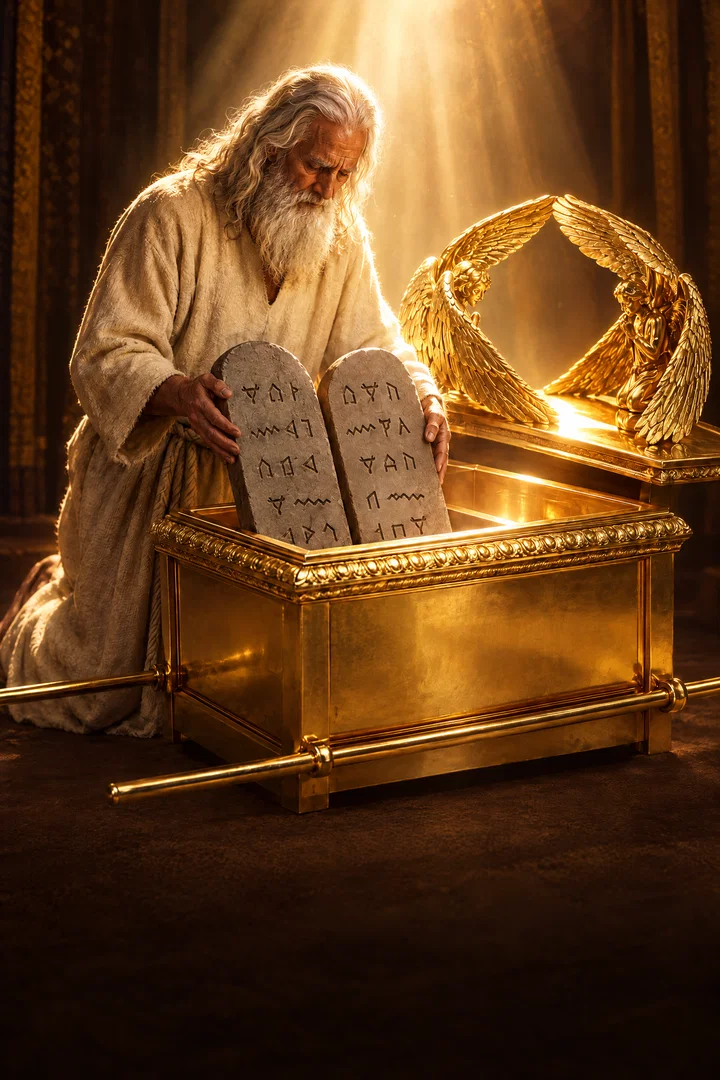
And I made an ark of shittim wood, and hewed two tables of stone like unto the first, and went up into the mount, having the two tables in mine hand.
Translations
And I made an ark of shittim wood, and hewed two tables of stone like to the first, and went up into the mount, having the two tables in my hand.
King James Version, KJV Cambridge Paragraph Bible
And I made an ark of shittim wood, and hewed two tables of stone like unto the first, and went up into the mount, having the two tables in mine hand.
And I made an ark of shittim wood, and hewed two tables of stone like the first, and ascended the mount, having the two tables in my hand.
So I made an ark of acacia wood, and hewed two tables of stone like unto the first, and went up into the mount, having the two tables in mine hand.
So I made an ark of acacia wood, and hewed two tables of stone like unto the first, and went up into the mount, having the two tables in my hand.
and I make an ark of shittim wood, and grave two tables of stone like the first, and go up to the mount, and the two tables in my hand.
And I made an ark of acacia-wood, and hewed two tables of stone like the first, and went up the mountain with the two tables in my hand.
So I made an ark of acacia wood, and cut out two tables of stone like the first,—and went up the mountain, having the two tables in my hand.
Berean Standard Bible, Majority Standard Bible
So I made an ark of acacia wood, chiseled out two stone tablets like the originals, and went up the mountain with the two tablets in my hands.
So I made an ark of acacia wood, and cut two stone tablets like the first, and went up onto the mountain, having the two tablets in my hand.
So I made an ark of hard wood, and had two stones cut like the others, and went up the mountain with the stones in my hands.
And I made an Arke of Shittim wood, and hewed two Tables of stone like vnto the first, and went vp into the Mountaine, and the two Tables in mine hand.
Douay-Rheims (Challoner revision)
And I made an ark of setim wood And when I had hewn two tables of stone like the former, I went up into the mount, having them in my hands.
Pictures
Cross-references 20 of 52
- Exodus 31:18
And he gave unto Moses, when he had made an end of communing with him upon mount Sinai, two tables of testimony, tables of stone, written with the finger of God.
God gives Moses the stone tablets written by his finger.
- Exodus 25:16
And thou shalt put into the ark the testimony which I shall give thee.
Commands that the testimony be placed inside the ark.
- Exodus 34:1-2
And the LORD said unto Moses, Hew thee two tables of stone like unto the first: and I will write upon these tables the words that were in the first tables, which thou brakest.
God commands Moses to prepare replacement tablets like the first and promises to write on them.
- Exodus 32:15-16
And Moses turned, and went down from the mount, and the two tables of the testimony were in his hand: the tables were written on both their sides; on the one side and on the other were they written.
Describes the first stone tablets and their writing as God’s work.
- Exodus 20:1-17
And God spake all these words, saying,
Gives the commandments spoken at Sinai and engraved on stone.
- Deuteronomy 5:22
These words the LORD spake unto all your assembly in the mount out of the midst of the fire, of the cloud, and of the thick darkness, with a great voice: and he added no more. And he wrote them in two tables of stone, and delivered them unto me.
God spoke the commandments and wrote them on two stone tablets.
- Exodus 34:28
And he was there with the LORD forty days and forty nights; he did neither eat bread, nor drink water. And he wrote upon the tables the words of the covenant, the ten commandments.
The account says the Lord wrote the covenant words on the tablets.
- Hebrews 9:4
Which had the golden censer, and the ark of the covenant overlaid round about with gold, where in was the golden pot that had manna, and Aaron’s rod that budded, and the tables of the covenant;
Identifies the covenant tablets as contents of the ark.
- Exodus 24:12
And the LORD said unto Moses, Come up to me into the mount, and be there: and I will give thee tables of stone, and a law, and commandments which I have written; that thou mayest teach them.
God gives Moses stone tablets bearing the law and commandments.
- Revelation 11:19
And the temple of God was opened in heaven, and there was seen in his temple the ark of his testament: and there were lightnings, and voices, and thunderings, and an earthquake, and great hail.
The heavenly temple reveals the ark containing the testimony represented by the tablets.
- Exodus 25:21
And thou shalt put the mercy seat above upon the ark; and in the ark thou shalt put the testimony that I shall give thee.
The testimony tablets are placed inside the ark beneath the mercy seat.
- Deuteronomy 31:26
Take this book of the law, and put it in the side of the ark of the covenant of the LORD your God, that it may be there for a witness against thee.
Contrasts the law book placed beside the ark with the tablets inside it.
- Deuteronomy 4:13
And he declared unto you his covenant, which he commanded you to perform, even ten commandments; and he wrote them upon two tables of stone.
Both identify the covenant commandments as written on stone tablets.
- 1 Kings 8:9
There was nothing in the ark save the two tables of stone, which Moses put there at Horeb, when the LORD made a covenant with the children of Israel, when they came out of the land of Egypt.
Both texts say the stone tablets were placed in the ark.
- Exodus 40:20-21
And he took and put the testimony into the ark, and set the staves on the ark, and put the mercy seat above upon the ark:
The tablets are placed in the ark, which is set in the sanctuary.
- Exodus 32:19
And it came to pass, as soon as he came nigh unto the camp, that he saw the calf, and the dancing: and Moses’ anger waxed hot, and he cast the tables out of his hands, and brake them beneath the mount.
Moses broke the first tablets before making the second set.
- Deuteronomy 9:10
And the LORD delivered unto me two tables of stone written with the finger of God; and on them was written according to all the words, which the LORD spake with you in the mount out of the midst of the fire in the day of the assembly.
The covenant tablets were written by God and received by Moses on the mountain.
- Nehemiah 9:13-14
Thou camest down also upon mount Sinai, and spakest with them from heaven, and gavest them right judgments, and true laws, good statutes and commandments:
God spoke the law from heaven and gave Moses the stone tablets.
- Exodus 25:22
And there I will meet with thee, and I will commune with thee from above the mercy seat, from between the two cherubims which are upon the ark of the testimony, of all things which I will give thee in commandment unto the children of Israel.
God speaks from above the mercy seat over the ark of the testimony.
- Leviticus 16:2
And the LORD said unto Moses, Speak unto Aaron thy brother, that he come not at all times into the holy place within the vail before the mercy seat, which is upon the ark; that he die not: for I will appear in the cloud upon the mercy seat.
God appears above the mercy seat over the law.
Commentary
Each commentary is drawn from primary sources: the writings of Ellen G. White and Adventist pioneers and periodicals. Each commentary is separate. Its own words are not a quotation; follow the references to read the source passages.
Ellen G. White
14 sources
Moses obeyed the command to build a chest of acacia wood, cut two stone tablets like the first ones, and climb the mountain carrying the tablets in his hand.Lt 98, 1900, par. 28–2915MR 40.3–4Ms 63, 1899, par. 37–38 There God Himself wrote on the second tablets the same ten commandments He had spoken amid fire, inscribing them a second time with His own finger precept by precept and giving them to Moses.Lt 98, 1900, par. 28–2915MR 40.3–4Ms 63, 1899, par. 37–38 Moses then came down and placed the tablets in the ark he had made, where they were hidden and preserved as a lasting witness still in the ark when Israel heard the covenant before entering Canaan.Lt 98, 1900, par. 28–29PP 500.419MR 265.3 That ark was made to hold God's law as the depository of the Decalogue, representing God Himself and bearing the token of His presence day and night as the glory and strength of Israel.1SP 398.1PK 453.2PP 584.1–2 That same law remains in the ark in the heavenly sanctuary in its hiding place, to be brought forth when judgment begins to testify to its binding claims, justifying the obedient and condemning the disobedient according to their works.Lt 98, 1900, par. 28–2920MR 221.3–413MR 381.2–382.120MR 68.4Lt 90, 1906, par. 12
The Second Tables Preserved
Moses in obedience to the command made an ark of shittim wood, also called acacia wood, to receive the law.Lt 98, 1900, par. 28–2915MR 40.3–4Ms 63, 1899, par. 37–3819MR 265.320MR 221.3–4 He hewed two tables of stone like unto the first tables and went up into the mount having the two tables in his hand.Lt 98, 1900, par. 28–2915MR 40.3–4Ms 63, 1899, par. 37–3820MR 221.3–413MR 381.2–382.1 This making of the chest and preparing of the stones and ascending with them is what the verse records.Lt 98, 1900, par. 28–2915MR 40.3–4Ms 63, 1899, par. 37–3819MR 265.313MR 381.2–382.1
God came down from the highest heaven to Sinai and wrote upon the second tables the same words that were in the first tables which were broken.Lt 98, 1900, par. 28–2915MR 40.3–4Ms 63, 1899, par. 37–38PP 500.4Ms 187, 1907, par. 22 Those words were the ten commandments which He had spoken out of the mount out of the midst of the fire in the day of the assembly, and He gave them to Moses.Lt 98, 1900, par. 28–29PP 500.4 They were written the second time with His own finger, precept by precept, commandment by commandment.Lt 98, 1900, par. 28–2915MR 40.3–4Ms 63, 1899, par. 37–38PP 500.4Ms 187, 1907, par. 22
Moses came down from the mount and put the tables in the ark which he had made, as commanded.Lt 98, 1900, par. 28–2919MR 265.3Ms 187, 1907, par. 22 There in the ark of the testament they were to be hidden and preserved and immortalized as a lasting witness.Lt 98, 1900, par. 28–2919MR 265.320MR 221.3–4Ms 187, 1907, par. 22 Their sacred precepts were still preserved in the ark when Israel publicly heard the covenant terms before entering Canaan.PP 500.4
The ark constructed in the wilderness remained in the tabernacle and was borne from Horeb to Jerusalem during Israel's forty-year pilgrimage.Ms 23, 1886, par. 1–2 When Jerusalem was about to fall, righteous men still in the city determined to place that sacred ark holding the tables of stone traced with the precepts of the Decalogue beyond the reach of ruthless hands.PK 453.2 With mourning and sadness they secreted it in a cave, hidden from Israel and Judah because of their sins to be no more restored to them.PK 453.2 That sacred ark is yet hidden, never disturbed since it was secreted.PK 453.2
The Ark and God's Presence
The ark made of shittim wood was a sacred chest fashioned to be the depository of the ten commandments, holding the tablets of God's law traced with the precepts of the Decalogue in the ark of the testament.1SP 398.1PK 453.2PP 584.1–220MR 221.3–4 Moses made that ark, hewed two tables of stone like the first, and went up into the mount having the two tables in his hand, and those tablets were then placed in the ark.20MR 221.3–4 The law kept in the ark is the representative of God Himself and a symbol of His presence.1SP 398.1PP 584.1–2 As such the ark was the glory and strength of Israel, with the token of the Divine Presence resting upon it day and night.1SP 398.1
The ark itself had no power to protect or save Israel apart from God.PP 584.1–2 When Israel disobeyed the commandments contained in it, that disobedience separated them from God, so the ark could not give them victory.PP 584.1–2 Even though they looked to it as a sacred object, without obedience and the presence of God it availed them nothing.PP 584.1–2
The commandments written by God and placed in the ark remain there as a lasting witness.19MR 265.313MR 381.2–382.1Ms 187, 1907, par. 22 They are the standard of righteousness, given as counsel precept by precept and commandment by commandment to be immortalized, understood, and obeyed.13MR 381.2–382.1Ms 187, 1907, par. 22 Obedience to that rejected law would have been life itself, preserving happiness and peace and producing sanctified love, beautiful characters, holiness, and purity in the world.13MR 381.2–382.1
Judgment and Call to Obey
The stone tablets of God's law given to Moses and placed in the ark are in the heavenly sanctuary, in the ark in the heavenly temple, where they are now in their hiding place.20MR 221.3–420MR 68.4Lt 90, 1906, par. 12 They will be brought out from that hiding place and be present when judgment begins.20MR 221.3–420MR 68.4Lt 90, 1906, par. 12 Engraved by God's finger, their commandments will then testify to the truth and binding claims of God's law, with people judged by that law and their recorded deeds determining their sentence.20MR 221.3–420MR 68.4 That showing will make plain how indelibly God records His truth when sentence is pronounced against every evil, seducing science produced by the father of lies.Lt 90, 1906, par. 12
Kept in the ark where Moses put them as commanded, hidden and preserved after God wrote on them the same words that were in the first tables which were broken, the ten commandments spoken out of the mount out of the midst of the fire in the day of the assembly, the law justifies the obedient and condemns the disobedient.Lt 98, 1900, par. 28–29 It is the standard of righteousness and will stand before both the obedient and the disobedient at the last judgment.13MR 381.2–382.1 There people are judged by that law according to their works, with their recorded deeds determining their sentence, the wicked convicted, and those who choose to disobey surely receiving sentence according to their works.Lt 98, 1900, par. 28–2913MR 381.2–382.120MR 68.4 Every departure from the counsel God came down from the highest heaven to Sinai to give precept by precept and commandment by commandment, written upon tables of stone and put in the ark of the testimony to be immortalized, is written in the book.Ms 187, 1907, par. 22 It will be brought forth in that great day when sentence is pronounced against every evil, seducing science produced by the father of lies, showing how indelibly God records His truth.Lt 90, 1906, par. 12
The commandments thus preserved, written the second time with His own finger, are to be understood and obeyed, and the promises of God connected with them are to be repeated again and again.Ms 63, 1899, par. 37–38 They are to be set before men with the blessings of obedience and the warnings against disobedience, with more to be said on the subject of transgression and disobedience.Ms 63, 1899, par. 37–38 The law they rejected was their life, for obedience would have preserved happiness and peace and produced sanctified love and beautiful characters, and the world would have been filled with holiness and purity.13MR 381.2–382.1
Families who claim to believe the truth that the Lord is at the door and that the judgments of God are in the world must examine what they are doing and obey that immortalized counsel.Ms 187, 1907, par. 22 They must not let temporal business overwhelm obedience, because the Lord is coming.Ms 187, 1907, par. 22
Sources
Pioneers and periodicals
83 sources
Moses in obedience made an ark of acacia wood, hewed two stone tablets like the first ones he had broken, and went up into the mount carrying them in his hand.RH May 26, 1853ST Aug 21, 1879ST Oct 8, 1885ST Sep 2, 1875ST May 6, 1875 Moses only prepared and carried the stones, for the Lord Himself wrote the Ten Commandments a second time with His own finger as He had promised.RH May 26, 1853ST Aug 21, 1879ST Sep 2, 1875RH Dec 9, 1852RH Dec 23, 1852 Those tablets bore the same words spoken from Sinai in the day of the assembly, the Ten Commandments and them only, and Moses put them in the ark he had made where they remained.ST Oct 8, 1885RH Jan 8, 1861ST Jul 8, 1930ST Jan 14, 1886RH Jan 7, 1862 Their writing on enduring stone by God and their placing inside the ark beneath the mercy-seat set them apart from the ceremonial and civil laws Moses wrote in a book, marking them as the perpetual moral law binding on all.ST May 20, 1875ST Feb 25, 1875ST Jul 12, 1905ST Mar 7, 1906ST Mar 4, 1886 As contained in the ark the law was the basis of Israel's covenant, the foundation of God's throne, and the standard of judgment under the mercy-seat, the same law now written by the Spirit on fleshly tables of the heart.RH Feb 1851ST May 13, 1897ST Nov 11, 1897RH Jul 4, 1854ST Mar 26, 1896
Moses Actions and Setting
In obedience to divine command Moses made an ark of shittim or acacia wood, hewed two tables of stone like the first, and went up into the mount having the two tables in his hand.RH May 26, 1853ST Aug 21, 1879ST Sep 2, 1875RH Apr 22, 1862RH Jan 8, 1861 The tablets he carried up bore the Ten Commandments and were afterward placed in the ark which held the law of God.RH Apr 22, 1862RH Jan 8, 1861ST Jul 8, 1930
The verse belongs to Moses' rehearsal to Israel just before his death before crossing the Jordan, recalling the law already entrusted and enshrined rather than giving it for the first time.ST Jan 14, 1886ST Mar 1, 1910 In that rehearsal he recalled how at the Lord's command he made an ark of wood, hewed two tables like the first broken ones, carried them up in his hand, and how God wrote on them according to the first writing the ten commandments spoken out of the midst of the fire in the day of the assembly and gave them to Moses, who put them in the ark where they remained as commanded.ST Jan 14, 1886ST Mar 1, 1910
The making of the second tables followed Moses breaking the first tables at the foot of the mount in anger at the idolatry of the people when he found Israel worshiping idols in the golden calf.ST Oct 8, 1885ST May 6, 1875ST Sep 23, 1886RH Apr 28, 1874 He acted under divine impulse in breaking them, then caused the leading idolaters to be slain and interceded for pardon.RH Apr 28, 1874 Afterward in obedience to God he hewed two tables like the first and went up carrying them, having also made an ark of wood to hold them, so the Lord could write on them the same matter as before.ST May 6, 1875ST Apr 15, 1886ST Apr 15, 1886
The first tables had been made by God Himself with the testimony graven on them, while the second tables were hewn by Moses.ST Apr 15, 1886RH Jul 25, 1854 Moses did only the preparing of the tables and the carrying, while God alone did the writing.ST Apr 15, 1886RH Jul 25, 1854
God first gave the plan of the sanctuary and the ark and at the end of forty days gave the first tables to be placed in the ark in the most holy place.RH Apr 28, 1874 Then at God's bidding Moses hewed a second set and brought them up with promise to write the law again, and at the end of a second forty days Moses received the second copy.RH Apr 28, 1874
The ark made to receive the tables was a small chest of incorruptible shittim wood about four feet six inches long and about two feet six inches wide and high, overlaid with pure gold within and without with a golden crown around the top, made after the pattern shown in the mount.ST May 13, 1897RH Jan 6, 1853RH Mar 1, 1870RH Jul 4, 1912 It was made for the express purpose of containing God's testament and was placed directly inside the veil in the most holy place.ST May 13, 1897RH Jan 6, 1853RH Mar 1, 1870 The fact that the replacement tablets were like the first supports that the writing was similar and that the first tablets were written on both sides.ST Dec 9, 1908
The ark containing the tablets was removed before Nebuchadnezzar destroyed the temple, hidden in a cave because of Israel's sins, never restored, and remains hidden and undisturbed.
God Himself Wrote Law
Moses made the chest of acacia wood, cut two stones like the first stones, and carried them up the mountain in his hand in obedience to command.RH May 26, 1853ST Aug 21, 1879ST Sep 2, 1875RH Apr 22, 1862ST Sep 2, 1913 He did only the preparing and the carrying, while the Lord Himself, not Moses, wrote the Ten Commandments on the second tablets with His own finger as He had promised when He said I will write.RH May 26, 1853ST Aug 21, 1879ST Sep 2, 1875RH Apr 22, 1862ST Sep 2, 1913 The surrounding account distinguishes the two works, that Moses hewed and brought up the tablets and God wrote on them according to the first writing the ten commandments spoken from the mount out of the fire in the day of assembly and then gave them to Moses to put in the ark.RH May 26, 1853ST Sep 2, 1875RH Apr 22, 1862ST Sep 2, 1913ST Sep 23, 1875
The he who wrote in the next verse is God, not Moses, and this verse together with verses 1-2 and 4 proves that the Decalogue on the second tablets is God's own writing and not Moses' handwriting.RH Dec 9, 1852RH Dec 23, 1852RH Apr 28, 1853 The law of God, or Ten Commandments, called the tables of the covenant, was written by the finger of God on both the first and the second stones.RH May 26, 1853RH Dec 9, 1852RH Dec 23, 1852 Because it is God's own writing it cannot be placed on a level with the handwriting of ordinances nailed to the cross.RH Apr 28, 1853
This account is the parallel to Exodus 34:27-28 that fixes its final pronoun and proves the writer there is God.ST Nov 10, 1898ST Jun 4, 1902 The words Moses was told to write were the instructions God had spoken to him, not the commandments on the tablets.ST Nov 10, 1898ST Jun 4, 1902 The division of work illustrates new covenant ministry, in which ministers only prepare hearts while the Spirit of the living God writes.RH Jul 25, 1854 Under the old covenant the law was written on tables of stone and put in the ark, and stone could receive only the letter, bringing conviction and condemnation, but under the new covenant the same law is written not on stone but on fleshly tables of the heart, enabling service in newness of spirit and fulfillment of its precepts in love with cleansing from past transgression by the blood of Christ.RH Jul 25, 1854
Tables Hold Ten Commandments
The second tablets received the same words as the first, the Ten Commandments written again according to the first writing as an exact copy of the original.RH Jan 8, 1861RH Jan 7, 1862RH Oct 9, 1900ST May 6, 1875ST Sep 30, 1886 After Moses broke the first tablets he prepared a second pair like the first and went up the mountain carrying them in his hand, having at the Lord's command first made an ark of wood to receive them.ST Jan 14, 1886ST May 6, 1875ST Sep 30, 1886 God then wrote on the tablets the ten commandments which He had spoken to the people in the mount out of the midst of the fire in the day of the assembly, and gave them to Moses, who came down and put them in the ark he had made where they remained as commanded.ST Jan 14, 1886ST Sep 30, 1886 This rehearsal was given to Israel just before Moses' death, and the rewriting of the same ten showed God had deliberately selected them above other commandments.ST Jan 14, 1886ST May 6, 1875 It is for this testimony written again and placed in the ark that the ark was called the ark of the testimony or testament.RH Oct 9, 1900
What was spoken from Sinai out of the midst of the fire in the day of the assembly and written on stone is limited to what God spoke with His own voice and wrote with His own finger as found in Exodus 20:3-17, with nothing else added.ST Jan 14, 1886ST Apr 15, 1886RH Mar 26, 1872 The first tables had been made by God Himself with the testimony graven on them, while the second tables were hewn by Moses, but the Lord wrote on them the same matter that was on the first.ST Apr 15, 1886 The moral law thus held was complete, for God added nothing more to it.ST Nov 18, 1903 The same words spoken from heaven are also given in Exodus 20:1-17, and because the book of Exodus was written by Moses the law written on stone was also written in the book, so it was not hidden but made known to be kept and to be written upon doorposts and gates.ST Jul 24, 1907 The tables were kept in the ark in order that they might be preserved.ST Jul 24, 1907
The tablets were thus the tangible form of the commandments spoken by God to Israel.RH Oct 16, 1900 The second tablets were an exact copy of the first, which contained only the Ten Commandments.RH Mar 31, 1863 They held the ten commandments, and them only, separated from all other laws by being declared by God Himself in the hearing of all the people, by being written and them only on the tables of stone, by being put and them only in the ark in the most holy place of the sanctuary, and by having the blood of the sin-offering sprinkled over them and over no other laws.ST Mar 4, 1886
The breaking of the first tables signified Israel breaking the first covenant by making the golden calf.RH Feb 1851 Moses hewing two tables like the first and going up with them, and God writing the same words again, proved their perpetuity.RH Feb 1851 They were spoken by God and written by God on tables of stone as no ceremony ever was.RH Feb 1851 These commandments alone of all the laws were put into the ark, so that when the ark stood in its proper place between the cherubim there was nothing in it but the two tables.RH Feb 1851
Ark Containing the Testimony
The ark was made for the express purpose of containing God's testament, the Ten Commandments written by God Himself.ST Oct 8, 1885ST Jul 8, 1930RH Oct 9, 1900ST May 13, 1897ST Nov 12, 1912 Moses put the tables he had carried up the mount into the ark he had made, where they remained as commanded, holding the law of God.ST Oct 8, 1885ST Jul 8, 1930RH Jul 31, 1900RH Oct 9, 1900ST Nov 12, 1912 It is therefore called the ark of the testimony, testament, or covenant because it contained that law and covenant, the Decalogue declared to Israel as the basis of the covenant made with them.ST Oct 8, 1885RH Jul 31, 1900RH Oct 9, 1900ST May 13, 1897ST Nov 12, 1912 The chest of incorruptible shittim or acacia wood, covered outside and lined inside with pure gold with a golden crown around the top, was made to hold the holy moral law, with the solid gold mercy-seat and cherubim above it and sacrificial blood sprinkled on and before the mercy-seat picturing Christ as sacrifice and mediator between sinners and the law so that through faith sinners receive forgiveness and God's righteousness while the law stands unbroken in the covenant He mediates.ST Oct 8, 1885RH Jul 31, 1900ST May 13, 1897ST Nov 12, 1912ST Aug 10, 1882
When the ark stood in its proper place between the cherubim there was nothing in it but the two tables, as was seen when it was placed in Solomon's temple.RH Feb 1851RH Apr 14, 1863 Those commandments alone of all the laws were put into the ark, the Ten Commandments called God's testimony.RH Feb 1851RH Apr 14, 1863
Those who held that the deposit included other sacred memorials teach that the second tables were laid in the ark of the covenant together with the manna in the golden pot and Aaron's rod that budded, alone placed within the holy of holies inside the mercy-seat that was God's throne, while all ceremonial and judicial laws remained outside.RH Jun 7, 1870
The ark holding the law was placed in the most holy place of the earthly sanctuary, directly inside the veil beneath the mercy-seat of solid gold with the cherubim above it.ST Feb 25, 1875RH Mar 4, 1862ST May 13, 1897ST Aug 10, 1882ST Sep 21, 1876 There the glory was seen, there God dwelt between the cherubim and met, communed and spoke with Israel, and there the high priest ministered before it with the blood of atonement sprinkled so the penitent transgressor could receive pardon.ST Oct 8, 1885RH Jul 31, 1900ST Feb 25, 1875ST Aug 10, 1882ST Sep 21, 1876 The tablets in that earthly ark contained the same law as the commandments in the heavenly ark, including the Sabbath commandment, in contrast to the festival-day regulations written in a book and placed beside the ark.ST Feb 25, 1875RH Mar 4, 1862
The ark that held the tablets became the earthly center of worship for God's people, its cover being the mercy seat.ST Jun 12, 1907RH May 20, 1902 It was the most important article of furniture in the tabernacle because the law of God was deposited in it, first spoken by God's own voice, then written with His own finger upon tables of stone, and by His own instruction placed in the ark built to receive it.ST Jun 12, 1907RH May 20, 1902 All the services of the tabernacle had more or less direct reference to that law and man's relation to it.RH May 20, 1902
God's strict and minute precaution to preserve the law after the first tables were broken, in making the ark and carrying the two new tables up the mount to be carefully deposited for preservation that they might be preserved, would be unaccountable except to impress on men His purpose to repair the dishonor done to His law by exhibiting it as more glorious and highly valued than before.RH Dec 18, 1855ST Jul 24, 1907
Moral Law Separate Perpetual
The stone tablets Moses hewed and carried up were written by God and placed inside the ark, while the ceremonial, civil, sanitary, dietary, sacrificial and festival laws were dictated by the Lord but communicated in private to Moses, written by Moses in a book, and placed by the priests in or beside the ark.ST May 20, 1875ST Feb 25, 1875ST Jul 12, 1905ST Feb 1, 1877ST Mar 20, 1879 The tablets containing God's law were put in the ark in the most holy place, in contrast to the festival-day regulations written in a book and placed beside the ark.ST May 20, 1875ST Feb 25, 1875ST Mar 20, 1879 The law within the ark made specifically to hold it was the moral law that had been broken and demanded atonement.ST Jan 6, 1881
Their location in the ark proves a plain difference in origin, form, object, location, and application between the fundamental commandments and the subsidiary laws, leaving without excuse those who combine the temporal and the eternal.ST Mar 7, 1906ST Mar 4, 1886 The Ten Commandments alone were spoken by the lips of the Lord Himself in the hearing of all the people and written by Him, separate from the sacrificial, ceremonial, sanitary, dietary, and civil statutes communicated to Moses in private and written by him in a book.ST Mar 7, 1906 God separated the Ten Commandments and them only by declaring them Himself in the hearing of all the people, by writing them and them only on tables of stone, by putting them and them only in the ark in the most holy place as His throne, and by having the blood of the sin-offering sprinkled over them and over no other laws.ST Mar 4, 1886 This high position above all other laws shows they are God's holy, perfect law set apart above all others, not to be belittled or degraded.ST Mar 4, 1886
That stone writing marks them as the moral law of God, distinct from the ceremonial and civil code dictated by the Lord but written in a book by Moses.ST Jul 12, 1905 The Ten Words are an all-inclusive code of moral principles prohibiting sin and governing relation between man and God and between man and his fellows, with nothing ceremonial or temporary in any precept.ST Sep 26, 1906 God Himself spoke them from heaven with His own voice, wrote them with His own finger upon tables of enduring rock, and ordered them deposited in the holiest place of the sanctuary, while the rest of the laws Moses wrote in a book.ST Sep 26, 1906 As the moral law they are perpetual, binding and unchangeable, the true indicator of sin and the holy law that makes sin known which Christ said would not pass away, while the typical ordinances, the law of commandments contained in ordinances that was contrary, a yoke, and weak and beggarly elements, came to an end and were taken out of the way at the cross.ST Jul 12, 1905 The manner of giving and the position occupied distinguish the law engraved on stone and placed inside the ark from the law written by Moses and placed by the priests in or beside the ark.
The tablets held the Ten Commandments which God had written again according to the first writing, and their placement in the ark underscores the law's enduring, unchangeable character.ST Jan 21, 1913 The engraving on tables of enduring rock shows its enduring and unchangeable nature, unlike laws for other holy days written by men on parchment to show they would soon pass away.RH Mar 18, 1875 The ark of incorruptible wood overlaid with gold sheltered them beneath the cherubim and the Shekinah, and their careful keeping marks the Ten Commandments as uniquely sacred, unlike the laws of the temporary polity and ritual which Moses wrote and which were stored beside the ark.RH Jul 4, 1912 The stone tablets signify that the moral law is supreme and enduring, unlike ritual and ceremonial laws, no more and no less than the same ten commandments.RH Mar 26, 1872
Because what was deposited in the ark continues, the continuance of the whole ten proves the continuance of each one, including the fourth commandment, and that deposited law is sacred and unchangeable as the constitution of the Father, the commandments of God, the ten words of Jehovah.RH Jul 22, 1852 The Sabbath commandment was deposited in the ark of the testimony in the holy of holies under the wings of the cherubim together with the rest of the Ten Commandments spoken by God from Sinai amid blackness and darkness and tempest and terrors.RH Sep 17, 1872 This honored placement in the middle of a code whose other precepts are acknowledged as binding proves the fourth commandment is still in force, because no ceremonial or repealable law given to the Jews ever received these marks of honor.RH Sep 17, 1872
The moral law containing the seventh-day Sabbath was placed inside the ark in the most holy place, which honored it above the law regulating the festival days, since that festival law was only written in a book and placed by the side of the ark.ST Feb 25, 1875RH Mar 18, 1875 The tables of stone holding the Sabbath commandment, engraved by God with the fourth commandment among them and preserved in the ark, honor the Sabbath above all other holy days.ST Jan 6, 1881RH Jun 16, 1874RH Aug 13, 1857 The second giving of the seventh-day Sabbath law, when the two tables like the first were carried up to be twice written by the finger of the living God, was never done for any other holy day.RH Mar 18, 1875
The tablets held the Decalogue, which served as Israel's fundamental constitution: it recognized Jehovah as the people's King, guided rulers and priests in governing, and guided the people's conduct, and deposited in the ark it made the constitution central to national life and covenant with its invisible King.ST Jan 16, 1907 The Decalogue written on stone tablets by God and written a second time is a summary of religion and morality and the foundation of God's system.ST Nov 29, 1883 The two tables of stone and the ark of shittim wood made to hold them were set apart with peculiar regard above all other ordinances because they contained the covenant of the Lord, the ten commandments, given particularly to the Jews yet requiring what bound all mankind from the beginning, and though the Mosaic dispensation has ended these moral precepts remain in force.ST Feb 28, 1884
Covenant Throne and Judgment
The ark made to hold the tables was a chest of shittim wood covered outside and lined inside with pure gold with a golden crown around the top, placed directly inside the veil in the most holy place, and inside it were placed the two tables of stone bearing God's sacred law written by His own finger.ST Mar 21, 1911ST May 13, 1897 It was called the ark of the covenant, the ark of the testament, and the ark of the testimony because it contained the tables of the covenant, for the Ten Commandments are God's covenant declared to Israel and the basis of the covenant He made with them.ST Mar 21, 1911ST May 13, 1897ST Sep 23, 1886ST Apr 15, 1886 They are called the words of the covenant and the ten words of the covenant because Israel's covenant was made in respect to them in that Israel promised to keep the Decalogue.ST Nov 11, 1897 The ten commandments with their preface were thus the basis of the Sinai covenant, declared by God's own voice in the hearing of about two millions at Horeb and given in His own handwriting on two tables to be placed in the ark, forming the earliest writing in existence and the only complete code of moral precepts ever given to man.RH Jul 4, 1854RH Oct 27, 1868 The most sacred portion of the tabernacle was this ark forming the very heart of all its services as the symbol of the covenant presence and faithfulness, with above it the throne where He sat as king, made on purpose to contain the tables while the book of the law was placed at the side, and this place assigned to them establishes that the ten commandments alone properly constitute the terms of the covenant and contain in themselves the sum and substance of what in righteousness was strictly required.ST Apr 15, 1886
The covenant Israel entered depends on the Decalogue and not the Decalogue on the covenant, so the agreement could be broken a thousand times without abolishing or affecting God's law, which stands whether it is kept or not.ST Nov 11, 1897 The moral precepts stand at the foundation of that Sinai covenant, which itself rests on the oath and promises concerning the seed made to Abraham, Isaac and Jacob.RH Jul 4, 1854 The ark of the testament with its mercy-seat was a representation of the throne of God, so as the Ten Commandments were in the ark in the earthly tabernacle they are the very foundation of the throne of God in heaven.ST Mar 26, 1896 Since the earthly tabernacle was a figure of the true tabernacle in heaven, the law as it stands in heaven in the throne of God is identical with the law as spoken from Sinai and written on the tables placed in the ark.ST Mar 26, 1896 The earthly ark and law were copies while the original remained in heaven, for Moses made an earthly copy of the ark of God's covenant and the tablets bore the Decalogue.RH Mar 4, 1862ST Apr 11, 1911
The tablets in that earthly ark beneath the mercy seat contained the same law as the commandments in the heavenly ark, to which the earthly ark is linked.RH Mar 4, 1862ST Sep 23, 1886 After Moses broke the first tablets upon finding Israel worshiping idols, God wrote the same commandments on the new tablets which Moses placed in the ark, and because the tablets contained God's ten commandments called the testimony they gave the ark its name.ST Sep 23, 1886 The law lay beneath the mercy seat while God's presence rested above it in the Shekinah glory where He spoke to the people, showing that His government rests on the commandments and that mercy and forgiveness are offered to those who repent of breaking them.RH Jul 27, 1916ST Mar 26, 1896ST Feb 4, 1886 The Sabbath with the other precepts was once publicly proclaimed by the voice of God and twice written on stone by the finger of the Lawgiver, then brought down and placed beneath the mercy-seat in the ark of God's testament, to which the whole work of atonement and sin-offering related, the Sabbath forming one-tenth part of that law.RH Apr 28, 1874 The law spoken by God's own mouth and written by God's own hand was finally placed underneath the mercy-seat where sprinkled blood could atone for breaking it, and this keeping forever shows its divine source and God's care that it be obeyed, setting it above all other laws and widely separate from civil laws and rituals only heard and recorded by Moses.ST Feb 4, 1886
This arrangement with the ark holding the law and the mercy-seat above it where sacrificial blood was sprinkled on and before it pictured Christ as the sacrifice and mediator between sinners and the law, through whom by faith sinners receive forgiveness and God's righteousness while the law stands unbroken in the covenant He mediates.RH Jul 31, 1900 The stone tablets kept in the ark are the rule of righteousness, defining sin when transgressed, for breaking any precept is sin and requires an offering.ST Sep 9, 1930ST They are the standard by which character is tested in the judgment and by which every case is decided, condemning sin and showing righteousness and peace to the obedient.ST Sep 9, 1930ST Jul 20, 1904ST May 6, 1913 On the Day of Atonement atonement was made over this law.ST Sep 9, 1930 Placing the two tables in the ark and the ark in the Most Holy Place of the typical sanctuary commenced a ministration carried forward through the entire Old Testament period, in which the Levitical priesthood ministered before that ark and abode many generations as long as the typical sanctuary continued.RH Dec 12, 1854RH Jul 8, 1852
The tables themselves are not a ministration or service but the just and righteous law showing the condemnation and sentence of death resting upon every one of Adam's fallen race.RH Jul 8, 1852 In its own nature the law on the tables is moral and not typical, kept completely distinct from ceremonial and judicial laws which remained outside, while the second tables were deposited alone within the holy of holies inside the mercy-seat that was God's throne together with the manna in the golden pot and Aaron's rod that budded.RH Jun 7, 1870 Its deposit in the ark gave it a temporary typical purpose as a symbol of the law as a broken covenant of works, teaching that man cannot approach God by law but only by mercy on the basis of law.RH Jun 7, 1870 That typical use is abolished, while the commandments existed before they were made types and continue after they ceased to be types.RH Jun 7, 1870 God's condescension and mercy in writing the ten commandments a second time after the first were broken is shown by more of the Bible being given to placing the tables in the ark than to creation, to show its pre-eminence.RH Jun 7, 1870
Heart Obedience and Victory
Under the new covenant the same law once written on stone is written not on stone but on fleshly tables of the heart.RH Feb 1851RH Jul 25, 1854 Stone could receive only the letter, bringing conviction and condemnation, but written on the heart it enables service in newness of spirit and fulfillment of its precepts in love with cleansing from past transgression by the blood of Christ.RH Jul 25, 1854 Ministers do only the preparing of the hearts while the Spirit of the living God writes, as Moses did only the preparing and carrying of the tables while God alone did the writing.RH Jul 25, 1854 Man's heart is the tables and God Himself is the writer and the law is the matter written, as commanded to be written on the table of the heart.RH Feb 1851 This is the law promised to be put in the inward parts and written in the heart when the law of sacrifice is abolished, the law of the mind in which delight is found after the inward man, proper and suitable for the believer's heart.RH Feb 1851 It is the same words spoken by God and written by God on tables of stone as no ceremony ever was, written again after the first tables were broken when the first covenant was broken by making the golden calf, proving their perpetuity, and alone put into the ark so that when the ark stood in its proper place between the cherubim there was nothing in it but the two tables.RH Feb 1851RH Jul 25, 1854
The stone-table law kept in the ark was the ground of ancient victory, for when the people of God had the ark they prevailed and triumphed over their enemies.RH Jun 24, 1852 That victory guarantees still more certain victory for the people in whose hearts that same law is now written by the Spirit of the living God.RH Jun 24, 1852 God's strict and minute precaution to preserve the law after the first tables were broken, in making the ark of shittim wood and carrying the two new tables of stone up the mount to be carefully deposited for preservation, would be unaccountable except to impress on minds His purpose to repair the dishonor done to His law by exhibiting it as more glorious and more highly valued than before.RH Dec 18, 1855 The law's signal distinction in promulgation and careful preservation proves the permanent, everlasting and universal obligation of the whole Decalogue, including the fourth commandment, which does not belong to Israel only and cannot be separated, blotted out, and reduced to nine.RH Dec 18, 1855 It is the law the Redeemer fulfilled for the justification of His people, and by which justified people are bound in all its parts to obey.RH Dec 18, 1855
The Sabbath with the other precepts was once publicly proclaimed by the voice of God and twice written on stone by the finger of the Lawgiver, then brought down and placed beneath the mercy-seat in the ark of God's testament, to which the whole work of atonement and sin-offering related, the Sabbath forming one-tenth part of that law.RH Apr 28, 1874 The plan of the sanctuary and the ark was first given, and at the end of forty days the first tables were given to be placed in the ark in the most holy place; they were broken under divine impulse upon finding idolatry, the leading idolaters were slain, intercession for pardon was made, then at God's bidding a second set was hewn and brought up with promise to write the law again, and at the end of a second forty days the second copy was received.RH Apr 28, 1874 Their careful keeping beneath the cherubim and the Shekinah, in an ark of incorruptible wood overlaid with gold, marks the Ten Commandments as uniquely sacred, unlike the laws of the temporary polity and ritual which were written by Moses and stored beside the ark.RH Jul 4, 1912 The Sabbath commandment shared the honor given to the whole Decalogue, showing it was not merely a Jewish rite belonging to a passing covenant.RH Apr 28, 1874RH Jul 4, 1912
God's condescension and mercy in writing the Ten Commandments a second time on two tables of stone after the first were broken shows their pre-eminence, divine source, and His care that they be obeyed.RH Jun 7, 1870ST Feb 4, 1886 More of the Bible is given to placing the tables in the ark than to creation, and the Decalogue alone was written by God and kept completely distinct from the ceremonial and judicial laws.RH Jun 7, 1870 The solemn majesty of how the Ten Commandments were announced and kept sets them above all other laws and separates them widely from the civil laws and rituals later given through Moses, which were not written by God's finger nor spoken to the people by God's voice but were only heard and recorded by Moses.ST Feb 4, 1886 The law spoken by God's own mouth and written by God's own hand was finally placed in the ark of the covenant underneath the mercy-seat, where sprinkled blood could atone for breaking it, and beneath the flaming presence of God in the Shekinah glory.ST Feb 4, 1886 The second tables were deposited in the ark of the covenant together with the manna in the golden pot and Aaron's rod that budded, alone placed within the holy of holies inside the mercy-seat that was God's throne, while all ceremonial and judicial laws remained outside.RH Jun 7, 1870
In its own nature the law on the tables is moral and not typical, but its deposit in the ark gave it a temporary typical purpose as a symbol of the law as a broken covenant of works, teaching that man cannot approach God by law but only by mercy on the basis of law.RH Jun 7, 1870 That typical use is abolished, while the commandments existed before they were made types and continue after they ceased to be types.RH Jun 7, 1870 The stone tablets bearing God's law were placed in an ark made specifically to hold them, and the law within the ark was the moral law that had been broken and demanded atonement.ST Jan 6, 1881 These tables contain the moral law deposited in the ark; the law is real, not a shadow, and the atonement for its transgressors must therefore relate to that law.ST Jan 6, 1881RH Mar 17, 1863
Sources