Exodus 1:12
But the more they afflicted them, the more they multiplied and grew. And they were grieved because of the children of Israel.
Translations
American King James Version, King James Version, KJV Cambridge Paragraph Bible, Webster Bible
But the more they afflicted them, the more they multiplied and grew. And they were grieved because of the children of Israel.
Revised Version, American Standard Version
But the more they afflicted them, the more they multiplied and the more they spread abroad. And they were grieved because of the children of Israel.
and as they afflict it, so it multiplieth, and so it breaketh forth, and they are vexed because of the sons of Israel;
But the more they afflicted them, the more they multiplied and spread; and they were distressed because of the children of Israel.
But the more they were humiliating them, the more, were they multiplying, and, the more, were they breaking forth, so they were filled with alarm because of the sons of Israel.
Berean Standard Bible, Majority Standard Bible
But the more they were oppressed, the more they multiplied and flourished; so the Egyptians came to dread the Israelites.
But the more they afflicted them, the more they multiplied and the more they spread out. They started to dread the children of Israel.
But the more cruel they were to them, the more their number increased, till all the land was full of them. And the children of Israel were hated by the Egyptians.
But the more they vexed them, the more they multiplied and grewe: therefore they were more grieued against the children of Israel.
Douay-Rheims (Challoner revision)
But the more they oppressed them, the more they were multiplied, and increased:
Pictures
Cross-references
- Genesis 15:13-16
And he said unto Abram, Know of a surety that thy seed shall be a stranger in a land that is not theirs, and shall serve them; and they shall afflict them four hundred years;
Foretells Israel’s affliction in a foreign land and return to Canaan.
- Exodus 1:7
And the children of Israel were fruitful, and increased abundantly, and multiplied, and waxed exceeding mighty; and the land was filled with them.
Israel multiplied and filled the land in Egypt, provoking oppression.
- Exodus 3:7-10
And the LORD said, I have surely seen the affliction of my people which are in Egypt, and have heard their cry by reason of their taskmasters; for I know their sorrows;
God sees and hears Israel’s affliction and sends Moses to lead them out.
- Exodus 1:22
And Pharaoh charged all his people, saying, Every son that is born ye shall cast into the river, and every daughter ye shall save alive.
Pharaoh orders every newborn son cast into the river.
- Exodus 2:24
And God heard their groaning, and God remembered his covenant with Abraham, with Isaac, and with Jacob.
God hears Israel’s groaning and remembers his covenant amid their oppression.
- Exodus 1:8
Now there arose up a new king over Egypt, which knew not Joseph.
new king who knew not Joseph
- Exodus 1:16
And he said, When ye do the office of a midwife to the Hebrew women, and see them upon the stools; if it be a son, then ye shall kill him: but if it be a daughter, then she shall live.
next attempt to cut numbers by killing male children
- Deuteronomy 4:20
But the LORD hath taken you, and brought you forth out of the iron furnace, even out of Egypt, to be unto him a people of inheritance, as ye are this day.
calls Egypt the iron furnace
- Genesis 46:27
And the sons of Joseph, which were born him in Egypt, were two souls: all the souls of the house of Jacob, which came into Egypt, were threescore and ten.
Counts the 75 people who entered Egypt.
- Acts 7:18
Till another king arose, which knew not Joseph.
Stephen recounts the same incident
- Exodus 1:17
But the midwives feared God, and did not as the king of Egypt commanded them, but saved the men children alive.
women feared God and saved the children alive
- Exodus 5:6-19
And Pharaoh commanded the same day the taskmasters of the people, and their officers, saying,
Describes taskmasters and the Israelites’ brick-making labor.
- Exodus 12:37
And the children of Israel journeyed from Rameses to Succoth, about six hundred thousand on foot that were men, beside children.
Gives the number of Israelites who left Egypt.
Commentary
Each commentary is drawn from primary sources: the writings of Ellen G. White and Adventist pioneers and periodicals. Each commentary is separate. Its own words are not a quotation; follow the references to read the source passages.
Ellen G. White
3 sources
The new king needed Israel's labor because they were able workmen, yet he feared them because they were more and mightier than his people and might join his enemies in war and then leave the land.1SP 160.2–162.1 To hold them he ranked the Israelites with the slaves who had sold their flocks and herds and lands and themselves.1SP 160.2–162.1 He set taskmasters over them to afflict them with burdens, and under that affliction they built the treasure-cities Pithom and Rameses.SG3 178.31SP 160.2–162.1 The affliction was service with rigor that made their lives bitter with hard bondage in mortar and in brick and in all manner of service in the field.SG3 178.31SP 160.2–162.1 Even their women were compelled to work in the fields as slaves, and the king and his rulers imposed a daily quota of work to subdue them, to decrease their numbers and to crush their independent spirit.SG3 178.31SP 160.2–162.1
The plan to weaken Israel by oppression failed to reduce their numbers, for the more the Egyptians afflicted them the more they multiplied and grew, continually increasing until they were larger and stronger.SG3 178.3PP 241.3–41SP 160.2–162.1 This grieved and angered the Egyptians, because they could not decrease Israel's numbers or crush their independent spirit.SG3 178.31SP 160.2–162.1 Because the hard labor failed, the king hardened his heart to go further and destroy the male children.1SP 160.2–162.1
Sources
Pioneers and periodicals
63 sources
The verse describes Israel in Egypt after prosperity turned to cruel bondage under a new king who knew not Joseph, set taskmasters over them to afflict them with burdens in building the store-cities Pithom and Raamses and in making bricks without straw while decreeing death for their sons.RH Jun 25, 1901ST Apr 30, 1894RH Mar 9, 1869RH May 14, 1901RH Aug 11, 1863 The more they were oppressed the more they multiplied and spread abroad, so the attempt to weaken and diminish them failed and only increased them.ST Nov 14, 1906ST Apr 30, 1894ST Nov 6, 1901ST Apr 30, 1894ST Nov 6, 1901 Their growth grieved and alarmed the Egyptians, who feared them as more and mightier and as a people who might join enemies or depart, yet desired to retain their labor.ST Nov 6, 1901ST Nov 6, 1901 Their preservation and increase under great trial manifested God's hand with them, so that Pharaoh's power could not prevent His promise to Abraham from being fulfilled or keep Israel from leaving Egypt.ST Jun 11, 1894ST Dec 22, 1898ST Apr 30, 1894ST Nov 6, 1901RH Mar 2, 1916 That hatred seeking to destroy them was Satan's plan to destroy the promised Seed and frustrate God's promise, while God used the oppression to make them unwilling to remain in Egypt, to turn to Him in distress, and to set them on the way toward Canaan.RH Mar 9, 1869ST Dec 22, 1898RH Mar 9, 1869ST Apr 30, 1894ST Nov 7, 1906
Opening Oppression in Egypt
Exodus 1:12 belongs to the opening oppression of Israel in Egypt that begins the first, mainly historical division of Exodus covering chapters 1-18, leading to the birth and upbringing of Moses until he is called to be the deliverer of his people. It marks the turn from Hebrew prosperity in Egypt to cruel oppression after Joseph and his service were forgotten and a new king and unfavorable dynasty arose who knew not Joseph.RH Mar 9, 1869ST Jul 21, 1881ST Jan 23, 1912 Under favorable kings who knew the good Joseph had done for Egypt, God blessed the children of Israel wonderfully, and after the seven-year famine had left the Egyptians themselves in slavery to Pharaoh, Israel had been nourished by Joseph and given a possession in the best of the land and had become fruitful and increased abundantly and multiplied and waxed exceeding mighty until the land was filled with them.RH May 14, 1901ST Jan 23, 1912 The Hebrews went into Egypt regarded with great favor by the authorities, and only by a long system of gradually increasing oppression were brought into the ignorance and degradation in which their deliverance found them.RH Oct 21, 1862
The dreadful change came when the new king looked with jealousy on that mighty increase and reasoned that Israel was likely to become more powerful than the Egyptians unless something was done to check their increase, so he said to his people to deal wisely with them and set over them taskmasters to afflict them with burdens and made the Egyptians make the children of Israel serve with vigor and made their lives bitter with hard bondage, even charging all his people that every son born be cast into the river and every daughter saved alive.RH May 14, 1901 Yet Egyptian oppression did not diminish Israel, for the more the people were afflicted the more they multiplied and grew and provoked the Egyptians' resentment, showing a clear and decided transformation under the new unfavorable dynasty could not stop their increase.ST Jul 21, 1881ST Jan 23, 1912 That harsh treatment was part of the wicked king's effort to keep the Hebrews from leaving, but God used that oppression to make them unwilling to remain amid Egypt's comforts and to set them on the way toward Canaan.RH Mar 9, 1869
The oppressing Pharaoh was the long-reigning king Rameses II of the nineteenth dynasty, whose oppression aimed both to use Hebrew labor and to break their spirit.ST Apr 14, 1887ST Aug 11, 1909 He is not Herod, who lived nearly fifteen centuries later and ruled in Syria. Under Rameses II they were forced to enlarge the treasure cities of Pithom and Rameses, laboring in brick-yards and suffering beatings from taskmasters, with their oppression connected also with an insurrection intensified by denial of religious privileges.ST Aug 11, 1909 The Israelites in Goshen were part of the foreigners left in Egypt after the fall of Khu-n-Aten, and with the rise of the nineteenth dynasty and the national cry of Egypt for the Egyptians, the foreigners were driven out or massacred and those who remained were reduced to the condition of public slaves and further decimated by destruction of their male offspring.
The slavery under the new king who knew not Joseph began in 1573 B.C., three hundred forty-eight years after Abraham left his father's house in 1921 B.C. and two years before Moses was born, and lasted only eighty-two years until Moses led Israel out in 1491 B.C., four hundred thirty years after Abraham's departure.RH May 14, 1901 In the fuller reckoning Israel gave 215 years of labor and service in Egypt and received nothing in return except bread, with no lands or cities, while Egypt owed its existence, laws, policy and opulence to Joseph yet did not even furnish him a grave, and the affliction included double work when Pharaoh refused to furnish materials so Israel had to supply them, so that the jewels of silver and gold and costly vessels taken at departure were demanded as a small installment of just wages long due.RH Mar 17, 1874 About 1400 B.C., when the Hebrews were captives in Egypt, Palestine was tributary to Egypt after long being a province of Babylonia and was in a greatly disturbed state, and among the enemies of the Canaanites then was a people called Khabiri, probably the Babylonian equivalent of Hebrew, showing some part of the Hebrew race present in the land, a disturbed condition that made the country far more easily taken afterward by the Hebrews under Joshua, with the name Jerusalem already in use at that early date.ST Aug 12, 1913
The family had to go down to Egypt because they could not yet possess the promised land until the iniquity of the Amorites was full, and after brief prosperity came long and terrible oppression in which the bitter servitude and iron furnace was foreshadowed by the horror of great darkness and the smoking furnace seen by Abraham in vision.RH Dec 17, 1861 Israel had to wait in slavery until the appointed time when the Amorites' iniquity was full, then God brought the people out by His power, so grievous oppression did not prevent God's promise to Abraham from being fulfilled.ST Dec 28, 1876 Despite hardships and oppression Israel continued to multiply and grow, and the small group of 75 who had entered had grown to about three million by the exodus.ST Aug 9, 1910ST Dec 28, 1876 The verse stands at the time of that affliction and tyranny when Moses was born, when a law demanded his immediate death as a newborn child. Even at birth he was the special object of providential care, and loving God-fearing parents were the instruments to preserve him from the king, leading to the ark of bulrushes, adoption by Pharaoh's daughter, and early instruction by his faithful mother before he was taken into the king's family.
Bricks Store-Cities and Taskmasters
The affliction was forced labor to build Pharaoh's storage or treasure cities of Pithom and Raamses.ST Apr 30, 1894RH Apr 23, 1908ST Nov 6, 1901ST Nov 6, 1901 The work included the city of Raamses-Mera-Amen on the eastern delta of the Nile, built by Israelite Semites gathered by Rameses II.ST Oct 21, 1930 That service was compulsory labor imposed because the government feared Israel's growing power might aid enemies or lead to departure in war, yet still wanted to keep their valuable labor.ST Nov 6, 1901 The more they were afflicted in that building work, the more they multiplied and spread abroad, so that their increase grieved the Egyptians.ST Apr 30, 1894ST Nov 6, 1901ST Nov 6, 1901 The burdens imposed in this record included making bricks and erecting buildings.ST Dec 14, 1915
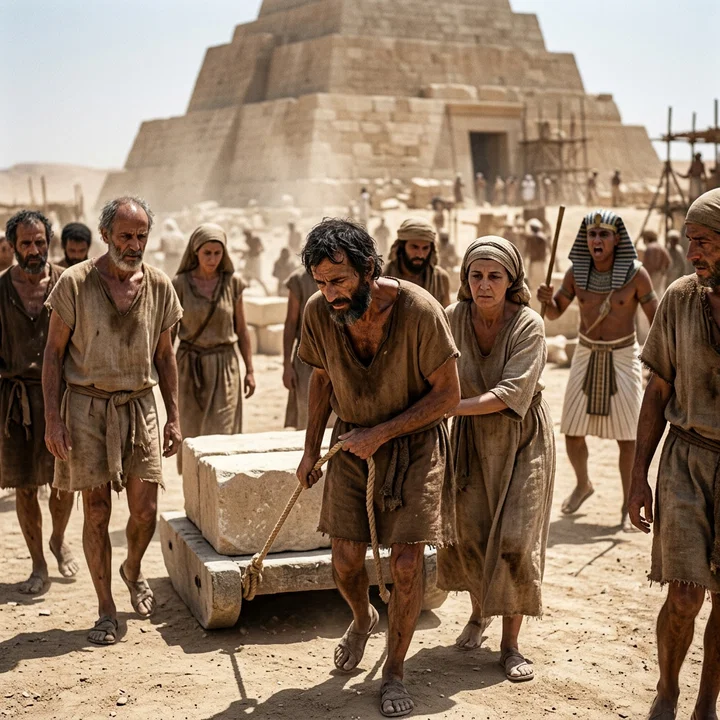
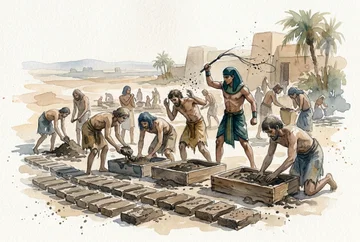
They were principally employed in making bricks of mud mixed with straw and in mortar.ST Oct 21, 1930RH Apr 23, 1908 Their toil also extended to stone-cutting, dragging blocks from the quarries, and erecting edifices.RH Apr 23, 1908 They were driven to labor in the brickfield, the quarry, and the temple precincts.ST Apr 14, 1887 Bricks at Pithom generally contain straw, while some tiers are destitute of it and houses there are built with strawless bricks, matching the withholding of straw, and the name Raamses is stamped on bricks there.RH Jun 25, 1901ST Oct 21, 1930RH Apr 23, 1908
The work followed Egyptian custom for subjecting prisoners of war to forced labor under the monarchs, especially Seti I and Rameses II.RH Apr 23, 1908 Laborers were organized in gangs under an overseer armed with a stick used freely on naked backs and shoulders, with a definite daily task required in brick-making and building.RH Apr 23, 1908 This matches pictures from the time of Thothmes III showing Asiatic captives making bricks and working at buildings under the rod of taskmasters.RH Apr 23, 1908 Food was supplied by the government and was not insufficient, but hard work and exposure to the burning sun made life bitter, and under Rameses II the unprecedented growth of architectural works made the fatigue overwhelming.RH Apr 23, 1908
The demand for labor on innumerable works throughout Egypt and Nubia was greater than prisoners of war could supply, especially after the close of the Syrian wars.ST Apr 14, 1887 Slave-hunting raids were therefore organized to Ethiopia to drag off thousands in chains, and all foreign tribes of Semitic origin settled in the Delta were oppressed by forced labor, the Hebrews among them.ST Apr 14, 1887 They toiled under the blows of drivers and under privations and toil too great for human endurance, so that thousands died.ST Apr 14, 1887
Taskmasters were set over Israel to afflict them with burdens in building Pithom and Raamses after a new king arose who feared them as more and mightier.ST Apr 30, 1894RH May 14, 1901 Those burdens were increased almost daily.RH Aug 11, 1863 Necessary straw was refused while the full tale of bricks was still required, compelling them to make bricks without straw and to supply the materials themselves, which was double work leaving unpaid labor long due.ST Oct 21, 1930RH Aug 11, 1863RH Mar 17, 1874 Along with forced labor and bitter bondage with vigor, there were decrees to murder infants and put male children to death by casting every son born into the river while saving every daughter alive.RH May 14, 1901RH Aug 11, 1863
Archaeology and Egyptian Silence
Excavations at Pithom uncovered the storage chambers built by Israel's forced labor, laid almost entirely of brick with mortar in regular tiers.RH Jun 25, 1901ST Oct 21, 1930RH Apr 23, 1908 The bricks were made of mud mixed with straw and generally contain straw, but some tiers are destitute of it, and houses at Pithom are built with strawless bricks, matching the making of bricks with straw until straw was withheld.RH Jun 25, 1901ST Oct 21, 1930RH Apr 23, 1908 The name Raamses is stamped on bricks at Pithom, and the afflicted slaves were Israelite Semites collected by Rameses II to build the city of Raamses-Mera-Amen on the eastern delta of the Nile as well as the store-cities Pithom and Raamses.ST Oct 21, 1930RH Apr 23, 1908 They were principally employed in brick-making, with work also in mortar, and when their oppression was made still more rigorous they were compelled to make bricks without straw.ST Oct 21, 1930RH Apr 23, 1908
Egyptian public monuments and court records would not directly mention the history told in Exodus 1-14, because nothing was ever registered there except successes and triumphs.RH Apr 23, 1908 Court historians omitted the year of terrible plagues suffered in Egypt and the disaster of the Red Sea, and the king inscribed no account of them on his buildings.RH Apr 23, 1908 Comparison with the records remains possible on forced labor and its methods, the Hebrews among the laborers, the store-cities and their names, the military organization, the untimely loss of the king's son, and the exhaustion and weakness following these events.RH Apr 23, 1908
The conduct of the king which knew not Joseph is true history, and its accuracy is confirmed because Stephen tells of the same incident.ST Apr 13, 1904 Israel's slavery in Egypt in Exodus 1:8-14 and their deliverance were literal historical events, real and not merely spiritual figures.ST Jan 3, 1884 The Pentateuch's account of the exodus is corroborated by inscriptions on Egyptian monuments.ST Jul 30, 1885
Growth Despite Affliction
The more Egypt afflicted Israel, the more Israel multiplied and grew and spread abroad and prospered.ST Nov 14, 1906ST Apr 30, 1894ST Nov 6, 1901ST Nov 6, 1901 Oppression did not stop or diminish or destroy that growth, and persecution could not overcome the prospering hand that was upon them.ST Dec 25, 1901RH Jan 20, 1916ST Jan 28, 1913 The attempt to weaken them by affliction failed, and the policy of oppression intensified rather than achieved its purpose.ST Nov 14, 1906ST Apr 30, 1894ST Nov 6, 1901ST Nov 6, 1901RH Jan 20, 1916 It belonged to the building of the store cities Pithom and Raamses under taskmasters set over them to afflict them with burdens, yet affliction increased their growth.ST Nov 14, 1906ST Apr 30, 1894ST Nov 6, 1901
Their increase grieved the Egyptians and left them distressed and troubled and alarmed.ST Nov 6, 1901ST Nov 6, 1901ST Dec 25, 1901RH Jan 20, 1916ST Jan 28, 1913 The Egyptians resented and feared Israel as more and mightier than themselves, as a potential threat that might aid enemies or leave in war, yet still wanted to retain their valuable labor.ST Apr 30, 1894ST Nov 6, 1901ST Nov 6, 1901 That distress grew as Israel multiplied, so that their oppressors were increasingly troubled by the very people they sought to hold down.ST Dec 25, 1901RH Jan 20, 1916ST Jan 28, 1913 To persecute the chosen people in this way was to turn against God Himself, despite the good He had done for Egypt and the evidence of His power.ST Dec 25, 1901
The verse belongs to the effort to destroy the promised seed through oppression and the killing of the male children.ST Dec 22, 1898 That attack, with its decree of death, sought to prevent the seed from returning to the promised land and thereby to frustrate the promise.ST Dec 22, 1898 God overruled it to preserve them, and His protecting power kept them alive.ST Jun 11, 1894ST Dec 22, 1898 Though they seemed forgotten in bondage, the Lord's hand was especially manifested in the increase of their number and the preservation of their lives under great trial.ST Jun 11, 1894ST Dec 22, 1898
Divine Purpose and Providence
God was with His people in Egypt so that tribulation worked out salvation for them.ST Apr 30, 1894 Their growth under bondage showed that Pharaoh's power could not prevent the fulfillment of the promise to Abraham nor keep Israel from eventually leaving Egypt.ST Nov 6, 1901RH Mar 2, 1916 The more they were afflicted the more they multiplied and grew, and the failure of the scheme to weaken them showed that human power could not thwart God's purposes.ST Apr 30, 1894ST Nov 6, 1901RH Mar 2, 1916
The harsh treatment belonged to the wicked king's effort to keep the Hebrews from leaving after the prosperity under Joseph was forgotten.RH Mar 9, 1869 God used that oppression to make them unwilling to remain amid Egypt's comforts and to set them on the way toward Canaan, turning hostility into the means of deliverance and the journey to the promised land.RH Mar 9, 1869RH Mar 9, 1869 He allowed them to be oppressed so that in distress they would turn to Him, choose His righteous and merciful rule, and obey His requirements, while He remained mindful of His covenant with Abraham and had not forsaken them.ST Jun 10, 1880
The setting of taskmasters over them was a shrewd and wicked but unwise policy that fought against God.ST Apr 30, 1894 The Egyptians feared the children would multiply and become more powerful and join enemies against them, so they resolved to deal wisely by afflicting them with the hardest labor, thinking hard work was the surest way to cause physical degeneracy and weaken the race.RH Feb 17, 1903 They were disappointed, for the very hardships made Israel stronger physically while the Lord used them as a means of increasing their numbers.ST Apr 30, 1894RH Feb 17, 1903
The affliction fulfilled the word to Abraham that his seed would be strangers in a land not theirs and afflicted four hundred years before inheriting Canaan.RH Aug 11, 1863 The family had to go down to Egypt because they could not yet possess the promised land until the iniquity of the Amorites was full, and after brief prosperity there followed long and terrible oppression.RH Dec 17, 1861 That bitter servitude and iron furnace was foreshadowed by the horror of great darkness and the smoking furnace seen by Abraham in vision.RH Dec 17, 1861 The oppression continued with cruel taskmasters almost daily increasing burdens, refusing necessary straw yet still requiring the full tale of bricks, with decrees to put male children to death, until God declared He had surely seen the affliction of His people and heard their cry by reason of their taskmasters, for He knew their sorrows.RH Aug 11, 1863
Egyptian hatred seeking to destroy Israel was Satan's plan to destroy the promised Seed and defer the plan of salvation.ST Apr 30, 1894 The attack through oppression and the decree of death against the male children, the promised seed of Abraham, sought to prevent the seed from returning to the promised land and thereby frustrate God's promise, but God's protecting power preserved them.ST Dec 22, 1898ST Apr 30, 1894 The attempt to destroy the people through whom the promise would come instead left them numerous and distinct, to the grief of the Egyptians.ST Dec 22, 1898ST Nov 7, 1906
Bondage Deliverance and Doctrine
Israel's bondage in Egypt and deliverance from it are typical of events to transpire either under the gospel or at the close of this dispensation, and the story of Moses coming out of that oppression gives the pattern for Matthias being saved as a child from the sword of Herod the Great.ST Sep 27, 1910RH Sep 17, 1872 God used Israel, a nation of slaves, to preserve His truth for the world.ST Feb 20, 1907 Their enslavement humbled them and prepared them to receive the law and build the sanctuary.RH Oct 17, 1854 Yet hundreds of years of slavery had left the people unprepared to comprehend God's salvation and the character He required. Abraham's descendants had come under Egypt's heathen worship and lost much of their knowledge of God and Christ during their affliction and multiplication there, so after bringing them out God needed to teach them again the principles of the atonement that they might know Him and be reconciled to Him.ST Mar 3, 1898
The severe oppression that made Israel multiply and grow while distressing their oppressors made it difficult for Israel to keep the Sabbath while in bondage.RH May 16, 1854 Only by a long system of gradually increasing oppression were the Hebrews, who entered Egypt in great favor, brought into the ignorance and degradation in which their deliverance found them, so their continuance under oppression is no parallel for Sabbath-keepers who with the clear light of present truth that war violates God's law would enter the army and violate the Sabbath and take life, unless the Sabbath-keeper was converted after joining and cannot get an honorable discharge.RH Oct 21, 1862 During that enslavement the Sabbath ordinance, like the other divine ordinances, had almost or altogether fallen into disuse, which does not mean God repealed the Sabbath or formally allowed it to be set aside.RH Dec 11, 1856
The Israelites suffering under Egyptian oppression were reduced to a servile condition which God allowed for a time but did not sanction, for He later demanded their release, judged their oppressors when they refused, and led them out of Egypt.RH Oct 1, 1861 Their multiplying and growing more under affliction to the resentment of the Egyptians undercuts the claim that the Bible supports slavery, since the people enslaved there ultimately escaped with divine aid while Egypt's attempt to keep them in bondage brought judgment.RH Oct 1, 1861RH Oct 13, 1859
Israel's dependence on laboring for others in Egypt hardened into tyrannical slavery, and that oppression set the stage for the Lord to deliver them and uphold their right to leave that work and return to the land promised to them.ST Nov 23, 1904 They gave 215 years of labor and service in Egypt and received nothing in return except bread, with no lands or cities, while Egypt owed its existence, laws, policy and opulence to Joseph yet did not even furnish him a grave.RH Mar 17, 1874 The affliction included double work when Pharaoh refused to furnish materials so that Israel had to supply them, so that even at very low wages with interest the unpaid labor leaves Egypt immensely in debt, and the jewels of silver and gold and costly vessels taken at departure were not borrowed but demanded as a small installment of just wages long due.RH Mar 17, 1874
The Egyptians' harsh treatment was carried out as enforcement of law, an example of persecution imposed under legal authority and of Pharaoh's oppressive rule as despotism.RH Sep 23, 1862 Egyptian oppression did not stop Israel from multiplying and growing but made the Egyptians more distressed, belonging to Pharaoh's hardened resistance to letting Israel go, a pattern later marked by judgments and plagues showing how oppressive power can persist even as God's people continue to grow.RH May 1, 1866 Pharaohs stood against God's plans and precepts, but their opposition did not overthrow the enduring word of God, and they are remembered in infamy while the word stands.ST Jul 15, 1908 The seed of Abraham lived as subjects under Pharaoh, but long subjection did not make Pharaoh's religion the source or authority of their faith.ST May 28, 1912 The account of an oppressing Pharaoh who afflicted Israel belongs to the only history of the world in that early period contained in the five books of Moses, which is not done away.RH Nov 26, 1861
Parallels and Present Applications
Oppression did not stop multiplication and growth, and the more affliction was laid on, the more increase followed, just as opposition and persecution did not suppress the advocates or the message of the Reformation but their numbers and influence grew.ST Nov 1, 1883 Persecution of the chosen people turns against God Himself, despite the good He had given Egypt and the evidence of His power, and that same spirit of persecution remains in those who have received greater light.ST Dec 25, 1901 Trials can accompany Christian growth, for when His hand is recognized in what He permits, affliction helps develop character rather than preventing spiritual growth, while bondage under taskmasters pictures people living in misery and needing liberation.RH Oct 8, 1903RH May 12, 1903
The Egyptians feared the children of Israel would multiply and become more powerful and join enemies and fight against them, so the counsel was to deal wisely with them by setting taskmasters over them and afflicting them with the hardest labor.RH Feb 17, 1903 Hard work was thought to be the surest way to cause physical degeneracy and weaken the race, but the planners were disappointed because the more they afflicted them the more they multiplied and grew until the oppressors were grieved because of them.RH Feb 17, 1903 This proves that hard physical labor builds up and strengthens instead of weakening, and is a blessing and not a curse.RH Feb 17, 1903
Pharaoh's despotism in Egypt is an example of a ruler trying to impose his authority on God's people, against which individual integrity was maintained and God upheld the cause and delivered His people. That oppression is compared with the enslavement of Black people in the United States, with the deliverer's role compared to Abraham Lincoln's role as deliverer of the slaves, and with the later forced labor under the Khedive in Egypt, including the same cruel imposition of labor such as making bricks.RH May 10, 1864RH May 1, 1879 The Egyptians persecuted the Hebrews who worshiped the true God, yet their distress at Israel's growth could not overcome the prospering hand of God, for the more they afflicted them the more they multiplied and grew.RH Jun 8, 1916 The oppression belonged to the reign of Pharaoh Rameses II in forcing enlargement of the treasure cities of Pithom and Rameses through labor in brick-yards and beatings from taskmasters, and it is connected with an insurrection intensified by denial of religious privileges.ST Aug 11, 1909
Sources