Exodus 29:39
The one lamb thou shalt offer in the morning; and the other lamb thou shalt offer at even:
Translations
The one lamb you shall offer in the morning; and the other lamb you shall offer at even:
King James Version, KJV Cambridge Paragraph Bible, Revised Version, American Standard Version
The one lamb thou shalt offer in the morning; and the other lamb thou shalt offer at even:
The one lamb thou shalt offer in the morning; and the other lamb thou shalt offer at evening.
the one lamb thou dost prepare in the morning, and the second lamb thou dost prepare between the evenings;
The one lamb thou shalt offer in the morning; and the other lamb thou shalt offer between the two evenings.
The one lamb, shalt thou offer in the morning, and the second lamb, shalt thou offer between the evenings;
Berean Standard Bible, Majority Standard Bible
Offer one lamb in the morning and the other at twilight.
The one lamb you shall offer in the morning; and the other lamb you shall offer at evening;
One lamb is to be offered in the morning and the other in the evening:
The one lambe thou shalt present in the morning, and the other lambe thou shalt present at euen.
Douay-Rheims (Challoner revision)
One lamb in the morning and another in the evening.
Pictures
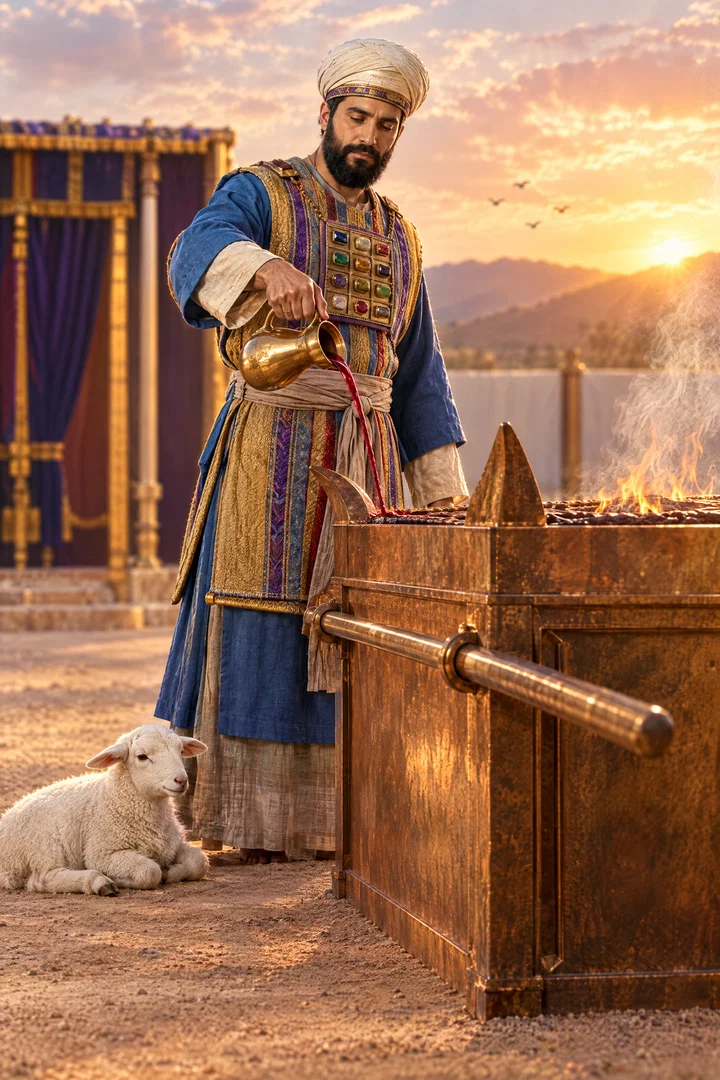
Cross-references 20 of 34
- Exodus 30:7-8
And Aaron shall burn thereon sweet incense every morning: when he dresseth the lamps, he shall burn incense upon it.
Morning and evening incense accompanied the lamb offerings as part of the daily sanctuary service.
- Numbers 28:3-4
And thou shalt say unto them, This is the offering made by fire which ye shall offer unto the LORD; two lambs of the first year without spot day by day, for a continual burnt offering.
Prescribes the regular morning and evening lamb offerings.
- Hebrews 8:4-5
For if he were on earth, he should not be a priest, seeing that there are priests that offer gifts according to the law:
Earthly sanctuary service is a copy and shadow of heavenly service.
- John 1:29
The next day John seeth Jesus coming unto him, and saith, Behold the Lamb of God, which taketh away the sin of the world.
Jesus is identified as the Lamb who takes away the world’s sin.
- Hebrews 10:11-12
And every priest standeth daily ministering and offering oftentimes the same sacrifices, which can never take away sins:
Daily priestly sacrifices are contrasted with Christ’s one sacrifice for sins.
- Numbers 28:9-10
And on the sabbath day two lambs of the first year without spot, and two tenth deals of flour for a meat offering, mingled with oil, and the drink offering thereof:
Sabbath offerings are prescribed beside the continual burnt offering.
- Psalms 141:2
Let my prayer be set forth before thee as incense; and the lifting up of my hands as the evening sacrifice.
Prayer is compared with incense and the evening sacrifice.
- Hebrews 10:4
For it is not possible that the blood of bulls and of goats should take away sins.
Animal blood could not take away sin, unlike Christ’s sacrifice for sin.
- 1 Peter 1:19
But with the precious blood of Christ, as of a lamb without blemish and without spot:
The unblemished lamb prefigures Christ, the spotless Lamb.
- Hebrews 10:10
By the which will we are sanctified through the offering of the body of Jesus Christ once for all.
Christ’s once-for-all offering ends the daily sacrifices.
- Hebrews 9:26
For then must he often have suffered since the foundation of the world: but now once in the end of the world hath he appeared to put away sin by the sacrifice of himself.
Christ’s once-for-all sacrifice fulfills the offerings’ pattern and puts away sin.
- Hebrews 7:27
Who needeth not daily, as those high priests, to offer up sacrifice, first for his own sins, and then for the people’s: for this he did once, when he offered up himself.
Contrasts the priests’ daily sacrifices with Christ’s once-for-all offering.
- Hebrews 9:22-23
And almost all things are by the law purged with blood; and without shedding of blood is no remission.
blood offerings point to cleansing of the heavenly things
- Romans 12:1
I beseech you therefore, brethren, by the mercies of God, that ye present your bodies a living sacrifice, holy, acceptable unto God, which is your reasonable service.
Applies the offerings’ purpose to presenting one’s life to God.
- Hebrews 9:6
Now when these things were thus ordained, the priests went always into the first tabernacle, accomplishing the service of God.
The priests continually performed the service in the first tabernacle.
- 2 Chronicles 2:4
Behold, I build an house to the name of the LORD my God, to dedicate it to him, and to burn before him sweet incense, and for the continual shewbread, and for the burnt offerings morning and evening, on the sabbaths, and on the new moons, and on the solemn feasts of the LORD our God. This is an ordinance for ever to Israel.
Both describe the regular offerings made morning and evening.
- Leviticus 6:12-13
And the fire upon the altar shall be burning in it; it shall not be put out: and the priest shall burn wood on it every morning, and lay the burnt offering in order upon it; and he shall burn thereon the fat of the peace offerings.
Requires continual altar fire and describes the morning offering.
- 1 Corinthians 5:7
Purge out therefore the old leaven, that ye may be a new lump, as ye are unleavened. For even Christ our passover is sacrificed for us:
Christ is identified as the Passover Lamb.
- Hebrews 10:14
For by one offering he hath perfected for ever them that are sanctified.
sacrifices ended by one offering
- 1 Kings 18:36
And it came to pass at the time of the offering of the evening sacrifice, that Elijah the prophet came near, and said, LORD God of Abraham, Isaac, and of Israel, let it be known this day that thou art God in Israel, and that I am thy servant, and that I have done all these things at thy word.
Elijah prays at the time of the evening offering.
Commentary
Each commentary is drawn from primary sources: the writings of Ellen G. White and Adventist pioneers and periodicals. Each commentary is separate. Its own words are not a quotation; follow the references to read the source passages.
Ellen G. White
15 sources
The verse commands a daily burnt offering of one lamb in the morning and another in the evening upon the altar, as part of the sanctuary daily service with its grain offering and incense.PP 352.3PP 352.2 The lambs were offered while the priests ministered with incense in the holy place, making morning and evening the set time for worship when the people searched their hearts, confessed sin, and united in prayer toward the sanctuary.PP 353.3 The unblemished lambs symbolized daily consecration to God and constant dependence on atoning blood, with blood and incense together pointing to the great Mediator, and the lamb itself represented the death of the Saviour as the Lamb of God for human sin.COS 32.1–2PP 352.3PP 353.2 The morning and evening lambs establish the pattern for honoring God at the opening and close of each day in every house, with the father as priest leading wife and children in prayer and praise.MYP 325.1–3CT 110.17T 44.2 Where this morning and evening worship is kept, prayer ascends as sweet incense, mercies and blessings descend, Jesus loves to tarry, and true prayer takes hold upon Omnipotence and gives victory over temptation.MYP 325.1–3PP 353.3RH Feb 1, 1912
Daily Sacrifice and Meaning
The verse commands a daily burnt offering of one lamb in the morning and another in the evening on the altar in the court.PP 352.3PP 352.2 That morning and evening offering belonged to the daily service of the sanctuary, which also included a grain offering accompanying the regular sacrifices, the offering of sweet incense on the golden altar, and special offerings for individual sins.PP 352.3PP 352.2 Additional offerings were made for sabbaths, new moons, and special feasts.PP 352.2
The lambs were offered at the same time the priests entered the holy place to offer incense.PP 353.3 Those hours were sacred and became the set time for worship throughout the nation.PP 353.3 At that time worshipers assembled, searched their hearts, confessed sin, and united in silent prayer with faces toward the holy place.PP 353.3 Their petitions ascended with the incense while faith laid hold on the merits of the promised Saviour prefigured by the atoning sacrifice.PP 353.3 Even when scattered as captives in distant lands the people kept the appointed hour, turning toward Jerusalem to pray.PP 353.3
The regular sacrifices with their grain offering symbolized daily consecration to God and constant dependence on atoning blood.PP 352.3 The lambs had to be without blemish, representing perfect purity.PP 352.3 Sacrifice and incense together accompanied approach to God, and the sacrificial blood and incense symbolized the great Mediator through whom alone repentant believers may receive mercy and salvation.PP 352.3PP 353.2
The lamb represented the Saviour's death.COS 32.1–2 Seeing the innocent victim offered in the temple, Jesus understood that He Himself as the Lamb of God must die for human sin.COS 32.1–2 The morning and evening sacrifices continued during the Passover Sabbath when Jesus lay in the tomb as the antitypical Lamb prefigured by the Passover.ST Aug 8, 1878 His death fulfilled the symbolism of the sacrificial service.ST Aug 8, 1878
Pattern for Daily Worship
The morning and evening lambs establish the pattern for honoring God at the start and close of each day in every house through sacrifices of prayer and praise.MYP 325.1–3CT 110.1ST Apr 17, 18841T 546.2–547.1MH 392.2–393.1 The father acts as priest of the household, laying the morning and evening sacrifice and leading while wife and children unite with him in prayer and praise.MYP 325.1–3ST Apr 17, 18841T 546.2–547.1MH 392.2–393.1PP 143.3–144.1 In the Christian home those daily offerings are expressed through prayer in the morning and grateful prayer and praise in the evening, with parents praying earnestly and faithfully for their children.MYP 325.1–3CT 110.1MH 392.2–393.1
The patriarchs exemplify this regular worship by erecting an altar to the Lord wherever they pitched their tent and offering the morning and evening sacrifice.MYP 325.1–37T 44.2ST Aug 7, 1884 At Abraham's family altar each member of the household was called to worship God.7T 44.2ST Aug 7, 1884 Abraham's morning and evening sacrifices exemplified regular worship of the living God, and his altars also served as a visible witness so that even the Canaanites recognized who had worshiped there.MYP 325.1–37T 44.2
Household worship is thanksgiving to God for abundant mercies, for sunshine and rain that cause vegetation to flourish and for the guardianship of holy angels.MYP 325.1–3PP 143.3–144.1 It is earnest prayer for divine help and guidance and for the abiding presence of Jesus in the household.RH Feb 1, 1912PP 143.3–144.1 For Christians generally the daily sacrifice gives an example for morning and evening prayer to seek pardon for sins committed and to ask for needed blessings.CT 110.1PP 353.3RH Feb 1, 1912
Where morning and evening prayer is kept, Jesus loves to tarry, prayer ascends to God as sweet incense, and His mercies and blessings descend upon the suppliants like the morning dew, making the well-ordered household a visible proof that God is with them.MYP 325.1–3PP 143.3–144.1 The Lord will not pass by such homes and leave no blessing there, for angels hear the offering of praise and the prayer of faith and bear the petitions to Him who ministers in the sanctuary for His people and pleads His merits in their behalf.MYP 325.1–3RH Feb 1, 1912 True prayer takes hold upon Omnipotence and gives victory, and upon his knees the Christian obtains strength to resist temptation.RH Feb 1, 1912 God condemns mere ceremony without the spirit of worship but looks with great pleasure on those who love Him and bow morning and evening.PP 353.3 To neglect worship for lack of time and go forth to labor without thought of God shows little appreciation for the life given to ransom souls, and if ever every house should be a house of prayer, it is now.PP 143.3–144.1
Sources
Pioneers and periodicals
69 sources
Exodus 29:39 commands the continual daily burnt offering of two first-year lambs without blemish, one offered in the morning and the other at evening with flour, oil and wine upon the altar before the tabernacle door.ST May 20, 1880ST Jun 26, 1901ST Jun 26, 1901ST Feb 17, 1890ST Apr 22, 1889 It belongs to the consecration of Aaron and his sons and to the minute pattern of the wilderness tabernacle where God met Israel at the sanctuary door to dwell among them.ST Oct 29, 1894ST Jan 29, 1908ST Mar 3, 1914RH Sep 8, 1904RH May 5, 1851 The two lambs symbolized Israel's daily consecration to Jehovah and constant dependence on atoning blood, prefiguring the perfect purity and once-for-all sacrifice of Christ the Lamb of God.ST Nov 19, 1902ST May 29, 1901ST Jan 24, 1911ST Nov 19, 1894ST Jun 27, 1911 Their morning and evening hours became sacred appointed times when priests interceded with sacrifice and incense while the people searched their hearts, confessed sin and united in prayer, giving the pattern for Christian morning and evening prayer.RH Sep 12, 1871ST Jul 8, 1930RH Feb 19, 1901RH Jul 2, 1914ST Nov 19, 1894 That same regularity applies as the family altar, where the household gathers morning and evening for praise, Scripture, confession of sin and prayer, with the father as priest of the home, or the mother when he is absent, laying the day upon God's altar.ST Apr 17, 1884RH Sep 12, 1871ST May 21, 1912RH Jun 22, 1916RH Nov 15, 1864
Setting in Exodus
The verse belongs to the very minute description of the sanctuary built in the days of Moses given in Exodus 25 to 40, which Moses was instructed to make exactly according to the pattern shown him in the mount.ST Oct 29, 1894ST Dec 10, 1896 It belongs to the sanctuary instructions God gave Moses on the mountain.ST Dec 10, 1896
It belongs to the story of the inner tabernacle erected by Israel at the command of God in the wilderness, which is what is generally meant by sanctuary.ST Jun 19, 1907 That portable tabernacle was afterward replaced by Solomon's temple.ST Jun 19, 1907 In both buildings the worship of God upon the earth centered, and all the earthly worship and service revolved around the holy of holies where the law of God rested with the mercy-seat over it.ST Jun 19, 1907
It is part of the chapter describing the ceremony for consecrating the priests.ST Jan 29, 1908 It belongs to the directions for the priestly service committed to Aaron and his sons, showing that priestly rites were not for others to perform unless the Lord specially directed them.ST Mar 3, 1914
It belongs to the sanctuary instructions God gave Moses during his forty days and nights on the mountain at Sinai.ST Mar 25, 1889 These instructions show that God was particular about worship, and the sanctuary services were meant to bring people into harmony with his holy law.ST Mar 25, 1889 It falls within the account of God's presence at Sinai, where he gave Israel his law.RH Dec 24, 1861
It is part of the law of ordinances written out after the moral law.ST May 6, 1875 It is among the ceremonial instructions concerning sacrifices given to Moses, requiring one lamb to be offered in the morning and another at evening.ST Apr 15, 1886 It is part of the burdensome ceremonies imposed until the time of reformation.ST Apr 15, 1886 It is part of the ordinances of divine service connected with the first covenant, prescribing a lamb offering in the morning and another at evening.ST Aug 5, 1889
It belongs to the instructions for preparing the sanctuary and its services, which present God's plan for salvation from sin and show how he deals with sinners. It belongs to the directions for building and the description of the marvelously beautiful sanctuary structure that God gave to Moses after redeeming Israel from Egyptian bondage. That sanctuary was a great multiple object-lesson by forms and rites to teach the great plan of salvation to a people unfitted by slavery to comprehend God's salvation and required character. It was built from free-will offerings by workmen specially endowed by God according to a divine pattern.
The verse shows God is a personal being dwelling somewhere in particular in a sanctuary, and that he appointed the door of the sanctuary as the place where he would meet his people when they brought their offerings there.RH Sep 8, 1904 Recognizing God's personal presence in that particular place was an essential feature of worship, and failure to bring offerings to that meeting place was evidence of idol worship.RH Sep 8, 1904 God met his people at the tabernacle entrance at the morning and evening sacrifices, while his special presence was in the Most Holy Place on the mercy seat between the cherubim.RH May 5, 1851
Details of Daily Offering
The verse commands the continual daily burnt offering of the earthly sanctuary, two lambs offered day by day continually as the regular morning and evening burnt offering of the daily ministration.ST Jun 26, 1901ST Feb 17, 1890ST Apr 22, 1889RH Feb 25, 1858 One lamb was to be offered in the morning and the other lamb at evening as part of the priests' continual service and the transfer of sins in Israel's sanctuary service.ST Jun 26, 1901ST Feb 17, 1890ST Apr 22, 1889RH Feb 25, 1858RH Mar 8, 1870
The lambs were first-year, year-old lambs offered day by day continually on the altar before the tabernacle door at the door of the tent of meeting.ST May 20, 1880ST Jun 26, 1901ST Jan 14, 1886ST Jan 21, 1886 Each lamb was accompanied morning and evening in the same way by a grain offering of fine flour mingled with oil and a wine drink offering, for a sweet savor made by fire unto the Lord as a continual burnt offering throughout generations.ST Jun 26, 1901ST Jan 14, 1886ST Jan 21, 1886RH Sep 16, 1852ST Feb 17, 1890 Flour, oil, and wine accompanied each lamb, and the priests' daily service of these offerings was continual intercession.ST May 20, 1880RH Sep 16, 1852ST Feb 17, 1890
The daily offering was joined with perpetual service of burning sweet incense on the golden altar every morning when dressing the lamps and every evening when lighting them before the Lord.ST Jan 14, 1886 The regular morning and evening burnt offering was carried forward day after day through the year together with additional work appointed for the Sabbaths, annual sabbaths, new moons and feasts, and particular work for individuals presenting their offerings through the year.ST Jan 14, 1886
The daily service was performed continually in the court and the first apartment, or holy place, of the worldly sanctuary, which was a figure and pattern of the true tabernacle in heaven.RH Jun 21, 1864RH Mar 28, 1854ST Jun 26, 1901ST Jun 26, 1901 That daily service consisted of the morning and evening burnt offering with its sweet incense on the golden altar, together with special offerings for individual sins and additional offerings for sabbaths, new moons, and special feasts.ST Jun 26, 1901ST Jun 26, 1901 In those sin offerings for the people a victim bore confessed guilt, and its blood was carried by the priest into the sanctuary and sprinkled before the veil.RH Jun 21, 1864 The earthly ministration served unto the example and shadow of heavenly things, so the work carried on on earth reveals the work carried on in heaven.RH Mar 28, 1854ST Jun 26, 1901
The evening lamb began the offering for the night and the morning lamb began the offering for the day, with the altar fire kept burning continually and their accompanying grain and drink offerings.RH Aug 15, 1865 This regular offering continued on the Day of Atonement alongside its special sacrifices, with the evening lamb offered at the start of the day and the morning lamb afterward.RH Aug 15, 1865 The lamb of the continual burnt offering was to burn all day, with the ram also burning at the same time, even while the high priest offered the blood of the goat to blot out sins, proving that mercy and pardon for sins could be found during the entire Day of Atonement while the blotting out of sins was going on.RH Aug 15, 1865RH Aug 15, 1865 The evening sacrifice was offered during the closing hours of the same day, before the second evening began at sunset.RH Mar 19, 1861
Meaning of the Lambs
The morning and evening burnt offering was the nation's daily consecration to Jehovah and its constant dependence on the atoning blood of Christ.ST Nov 19, 1902ST May 29, 1901ST Jun 27, 1911 The lamb was a year old and without blemish, burned whole on the brazen altar each morning and evening, and its freedom from blemish prefigured the perfect purity of Christ as a Lamb without blemish and without spot.ST Nov 19, 1894 That daily burning symbolized the consecration of the whole nation to Jehovah and unbroken reliance on Christ's atoning blood.ST Nov 19, 1894
The morning and evening lamb was a sin offering and atoning sacrifice for the people, made for the sanctification of the congregation, the priests, and the tabernacle so that God might dwell among Israel.RH Feb 19, 1901ST May 29, 1901 It stood as proof of the deep conviction that shedding of blood is necessary to expiate sin and that without shedding of blood there is no remission. The twice-daily sacrifice expressed a renewed consecration of life to God, offered through Christ's merit, with Christ's life within the worshipers making them able to present it.ST Sep 12, 1900 That presented life was renewed by His power and poured out in His service.ST Sep 12, 1900
No one conscious of trespass shared in this common offering until confession had been made and the personal sin offering or trespass offering brought; only after acceptance and pardon could the worshiper join in consecrating renewed life to God's service and find peace.ST Sep 12, 1900ST Sep 19, 1900 The incense offered alongside the lamb represented the righteousness of the coming Messiah imputed to the people by faith.ST Apr 1, 1913 The brazen altar in the court was an altar of continual atonement, representing the putting away and destruction of sin, the only thing that separates from God and hinders prayer, while the golden altar was an altar of continual intercession, representing the prayers of God's people coming up before Him continually.ST Nov 26, 1912
The offering therefore showed the desire to put away sin and to consecrate the self to the Lord so that prayer could ascend with the fragrant incense.ST Nov 26, 1912 The continual burnt offering symbolized the ongoing life union and service between God and His people as the channel of life, light, power, and service, a bond that transgression could break and remove.ST Mar 12, 1912 In itself the Levitical ministration brought to a sinful people only condemnation and death, showing guilt and exposure to the just penalty of the holy law with no promise of pardon in itself.RH Dec 12, 1854 Its ceremonial sacrifices found fulfillment in Christ's sacrifice and could not themselves take away sin, but could only point penitent sinners forward to the great Sacrifice to be offered for the sins of men.ST Jul 8, 1886RH Dec 12, 1854
The offerings and consecration prescribed for the high priest, including the morning and evening lamb, are the same offerings and consecration required of the cleansed leper, so that the humblest child of God must be as devoted and consecrated as Christ was.
Type and Fulfillment in Christ
The tabernacle built by Moses was made for sacrificial ministry as a copy, figure, pattern, example and shadow of the true tabernacle in heaven, with its daily ministration in the court and in the first apartment or holy place of the worldly sanctuary revealing by illustration the services of the heavenly sanctuary and the work of the great High Priest.ST Jun 26, 1907RH Mar 28, 1854RH Nov 6, 1900ST Jun 26, 1901RH Dec 12, 1912 Its appointed schedule of one lamb in the morning and another at evening, with perpetual incense on the golden altar and special offerings for individual sins besides added offerings for Sabbaths, new moons and feasts, was an object lesson whose significance and power to forgive sin and transform character lay in Christ.ST Jan 24, 1911ST Jun 26, 1907ST Jun 26, 1901 The earthly type shadowed forth God's throne and Him that sat upon it, and the real work now carried forward in heaven for man's physical and spiritual nature carries on regeneration in the heart to make believers the temple of God and fit them for a habitation of God through the Spirit.RH Nov 6, 1900 That heavenly work is where Jesus now ministers as merciful and faithful High Priest to make propitiation, where cleansing is by blood.ST Jan 24, 1911RH Mar 28, 1854
These repeated morning and evening offerings belonged to the typical service of the laws of Moses concerning sacrifices and offerings, through which the substance of the new dispensation is traced from the shadows of the old.RH Nov 25, 1909 They foreshadowed Christ's sacrifice made once for all and fulfilled what the repeated offerings represented, for their power lay in Him.RH Nov 25, 1909ST Jun 26, 1907 When He died the animal sacrifices passed away, ending the days of burnt offerings for sin.ST Jan 24, 1911
The morning lamb and the evening lamb represent the Lamb of God which takes away the sin of the world, pointing to the work of Christ in the heavenly sanctuary and not to a new earthly ritual of morning and evening altar service by the church on earth.RH Dec 12, 1912 The regular lamb each morning and evening continued during the Passover Sabbath while Jesus, the antitypical Lamb prefigured by the Passover, lay in the tomb, and His death fulfilled the symbolism of the sacrificial service.ST Aug 8, 1878
The continual temple service of regular sacrifice, together with continual showbread, incense, priesthood, and glory over the mercy seat, taught of the true offering for sin, the Bread from heaven, everlasting righteousness, forgiveness, and God's presence in His people.RH Aug 27, 1908 As that temple service continued, those who are temples of the living God must serve Him continually and Him alone.RH Aug 27, 1908
Hours of Prayer and Worship
The morning lamb and the evening lamb fixed sacred appointed hours when the pious prayed while the priests interceded for the people through sacrifice and incense.RH Sep 12, 1871ST Jul 8, 1930RH Feb 19, 1901ST Sep 12, 1900ST Oct 24, 1900 At those times the people prayed, incense was placed on its altar and the burnt offering was consumed, and their rising smoke represented prayers offered to God.RH Feb 19, 1901ST Sep 12, 1900ST Oct 24, 1900 The time of the daily offerings was the time of the daily burning of incense, so lamb, incense, and the prayers of the whole multitude without were associated together.ST Jul 8, 1930RH Feb 19, 1901 The daily temple service at those hours acknowledged Jehovah as Israel's covenant God.ST Oct 24, 1900
At the hour of incense the priests entered the holy place while the daily atoning sacrifice was ready to be offered upon the altar in the court.RH Jul 2, 1914ST Nov 19, 1894 It was a time of intense interest to the worshipers assembled at the tabernacle, who before drawing near through the priest's ministration engaged in earnest searching of heart and confession of sin.RH Jul 2, 1914ST Nov 19, 1894 They united in silent prayer with faces toward the holy place, so that petitions ascended with the cloud of incense while faith laid hold upon the merits of the promised Saviour prefigured by the atoning sacrifice.RH Jul 2, 1914ST Nov 19, 1894
The hours appointed for the morning and the evening sacrifice were regarded as sacred and came to be observed as the set time for worship throughout the nation.RH Jul 2, 1914ST Nov 19, 1894 When in later times the Jews were scattered as captives in distant lands they still at the appointed hour turned their faces toward Jerusalem and offered petitions to the God of Israel.RH Jul 2, 1914ST Nov 19, 1894 They give Christians an example for morning and evening prayer to seek pardon for sins committed and to present requests for needed blessings.RH Jul 2, 1914ST Nov 19, 1894
The church's daily morning and evening services were understood to correspond to slaying and offering the lamb, and the evening service also to Aaron's lighting of the lamps.RH Apr 17, 1879ST Apr 24, 1879 Worshipers turned their hearts toward the temple at those hours with prayers and thanks accompanying the incense and sacrificial offering.ST Oct 24, 1900
The service was ordered as example and shadow of heavenly things, and the antitype far surpasses the type.ST Nov 26, 1912 In the heavenly sanctuary there is an inexhaustible supply of Christ's righteousness, and the always-ascending incense means that any time day or night a struggling soul crying for help or giving thanks is heard.ST Nov 26, 1912 Fresh help is claimed in the name of Jesus in the morning for the day's duties and burdens, and in the evening when the day's work is found marred by sin there is comfort in confessing, knowing Christ's righteousness added to prayer will cover the mistakes of the day as the cloud of incense shielded the priest.ST Nov 26, 1912 Every prayer to which Christ's righteousness has been added is lodged on heaven's altar and will be answered in God's good time even when not answered immediately.ST Nov 26, 1912
Call to Continual Consecration
The continual burnt offering of one lamb in the morning and another at evening means the service carried forward in the temple of God and finding its center in Jesus Christ must be a continual service.RH Nov 25, 1902 Through this typical ministry provision is made for the individual Christian to render continual service to God by the indwelling presence of the eternal Son of God who continues.RH Nov 25, 1902 When Christ dwells in the heart by faith man is restored to being the temple of the living God, and the continual service is carried forward in that temple.RH Nov 25, 1902 That regular sacrifice, together with the continual showbread, incense, priesthood, and glory over the mercy seat, taught of the true offering for sin, the Bread from heaven, everlasting righteousness, forgiveness, and God's presence in his people.RH Aug 27, 1908 As the temple service continued, those who are temples of the living God must serve him continually and him alone.RH Aug 27, 1908
The daily burnt offering of two lambs was made for the sanctification of the whole congregation, the priests, and the tabernacle, so that God might dwell among Israel.ST May 29, 1901 Its typical purpose is fulfilled in presenting the body as a holy, living sacrifice to God for sanctification and as a dwelling place for him.ST May 29, 1901RH Oct 23, 1913 This means denying every harmful thing to present the body as a living sacrifice so God can make it acceptable, which is necessary to being transformed by the renewing of the mind to prove what is the good and acceptable and perfect will of God.RH Oct 23, 1913 It must be made now before the coming gathering of the saints that have made a covenant by sacrifice, not made once for all time but offered every morning and evening in dying daily through absolute surrender of all.RH Oct 23, 1913 Those who are bought with a price are not their own, and in sacrificing only return to God what already belongs to him.RH Oct 23, 1913
The morning and evening offering was Israel's shared worship, but participation in it followed confession and the sin offering or trespass offering.ST Sep 12, 1900 The burnt offering represented a life presented in Christ's merit, renewed by his power, and poured out in his service.ST Sep 12, 1900 Only after acceptance and pardon could the conscious trespasser share in the common offering and find peace.ST Sep 12, 1900
Pattern for Family Worship
The morning lamb and the evening lamb set the hours for prayer, when the pious prayed while sacrifice and incense interceded for the people, and though the days of animal burnt-offerings for sin are gone by Christ's one offering and there is no holy temple for such worship, the same order remains the pattern for morning and evening family worship.RH Sep 12, 1871RH Nov 15, 1864 The whole household gathers around the family altar with grateful praise and earnest supplication, with prayer and Bible study and communion with God, and with morning songs of praise and the evening oblation.RH Sep 12, 1871ST May 21, 1912RH Nov 15, 1864 What rises there comes before the throne of mercy sweeter than any offering made by fire, and there the Lord meets His children even as He met Israel before the door of the tabernacle.RH Sep 12, 1871 The daily offering with flour mingled with oil and wine poured out for a sweet savor by fire day by day continually thus becomes the regular morning and evening worship of the home.RH Sep 12, 1871ST May 21, 1912
That morning and evening service gives the example for family worship through Scripture reading, praise, and prayer, and its unbroken regularity illustrates the equally regular morning and evening worship required of students.ST Apr 1, 1913ST Aug 16, 1883 The father as priest of the household leads in prayer and praise and lays the morning and evening sacrifice upon God's altar, cultivating home religion and setting an example of faith before his family.ST Apr 17, 1884RH Jun 22, 1916RH Nov 25, 1902 God honored the patriarchs who did this by causing the fear of the Lord to pervade their households, and Abraham's family altar with each member of the household called to worship shows the same daily order of one lamb in the morning and another in the evening.ST Aug 7, 1884RH Jun 22, 1916 The wife and children are to unite in the prayer and join in the song of praise, and the entire household is to be present because the service is as much for the children as for the parents to teach them of their Creator in youth.RH Nov 25, 1902 When the father is present he leads, and when he is absent the mother carries out the duty.RH Nov 25, 1902
The home sacrifice includes confession morning and evening by the father when present, or by the mother when he is absent, confessing to God the sins committed through the day by himself and his children.RH Jul 2, 1914RH Nov 25, 1902 Both sins that have come to knowledge and secret sins of which God's eye alone has taken cognizance are to be confessed, with sufficient time and zeal given to the duty.RH Jul 2, 1914RH Nov 25, 1902 Such worship brings blessings to the family, with children thus dedicated to God protected in the hour of temptation.RH Jul 2, 1914RH Nov 25, 1902
God is to be honored in every Christian home by morning and evening sacrifices of praise and prayer, with earnest prayers ascending every morning and evening for His blessing and guidance, and the Lord of heaven will not pass by such homes and leave no blessing there.RH Feb 1, 1912 Angels hear the offering of praise and the prayer of faith and bear the petitions to Him who ministers in the sanctuary for His people and pleads His merits in their behalf.RH Feb 1, 1912 True prayer takes hold upon Omnipotence and gives the victory, and upon his knees the Christian obtains strength to resist temptation.RH Feb 1, 1912 Morning and evening as the hour of sacrifice are also set times for a father to pray for a son away at college or school, for good success and growth in grace and keeping in temptation, telling the son of those prayers and of pride and hope that he is preparing for the work longed for, and writing the details of home life to make home nearer and dearer.RH Oct 7, 1915
Sources