Genesis 22:13
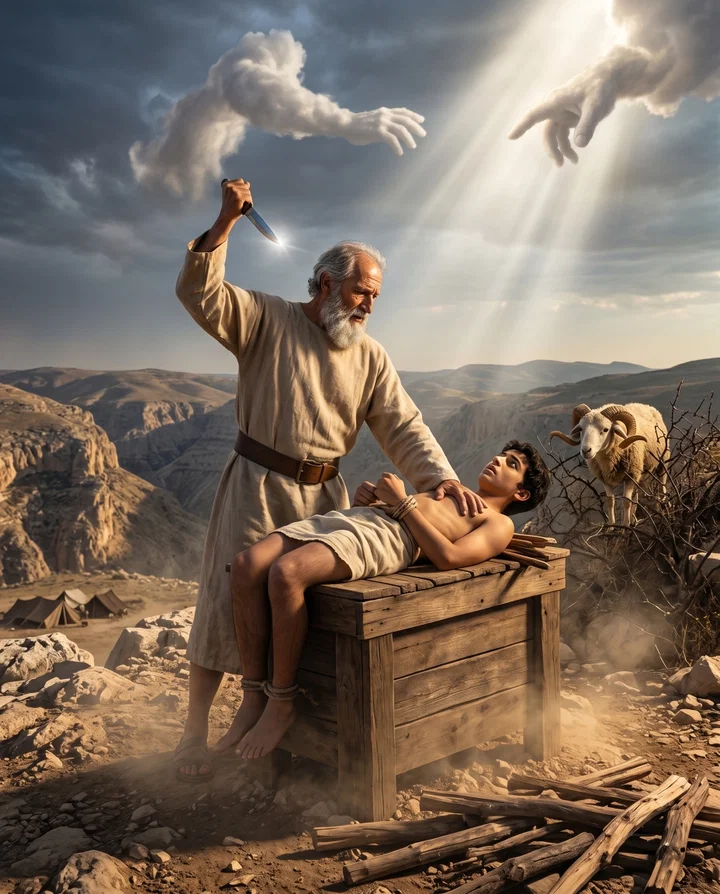
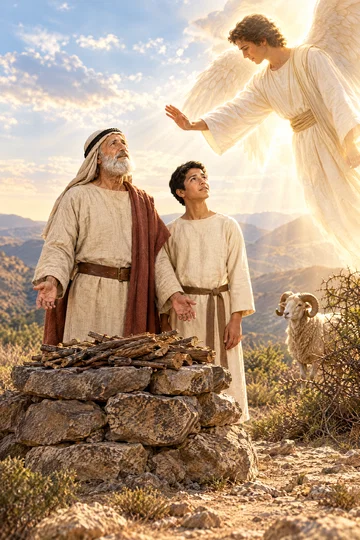
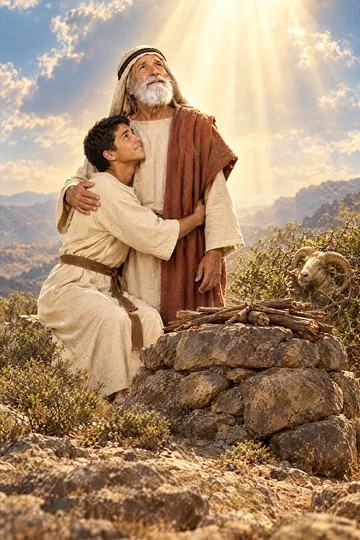
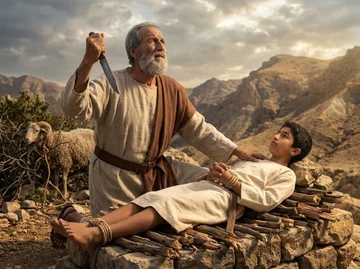
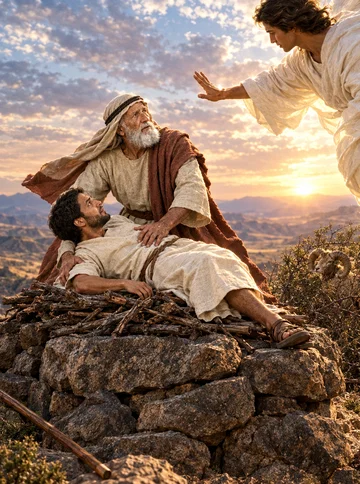
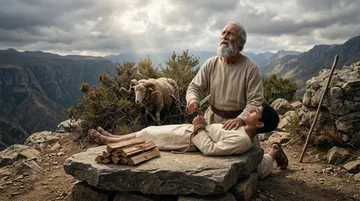
And Abraham lifted up his eyes, and looked, and behold behind him a ram caught in a thicket by his horns: and Abraham went and took the ram, and offered him up for a burnt offering in the stead of his son.
Translations
American King James Version, King James Version, KJV Cambridge Paragraph Bible
And Abraham lifted up his eyes, and looked, and behold behind him a ram caught in a thicket by his horns: and Abraham went and took the ram, and offered him up for a burnt offering in the stead of his son.
And Abraham lifted up his eyes, and looked, and behold, behind him a ram caught in a thicket by his horns: And Abraham went and took the ram, and offered him for a burnt-offering in the stead of his son.
And Abraham lifted up his eyes, and looked, and behold, behind him a ram caught in the thicket by his horns: and Abraham went and took the ram, and offered him up for a burnt offering in the stead of his son.
And Abraham lifted up his eyes, and looked, and, behold, behind him a ram caught in the thicket by his horns: and Abraham went and took the ram, and offered him up for a burnt-offering in the stead of his son.
And Abraham lifteth up his eyes, and looketh, and lo, a ram behind, seized in a thicket by its horns; and Abraham goeth, and taketh the ram, and causeth it to ascend for a burnt-offering instead of his son;
And Abraham lifted up his eyes, and looked, and behold, behind was a ram caught in the thicket by its horns; and Abraham went and took the ram, and offered it up for a burnt-offering instead of his son.
And Abraham lifted up his eyes and looked, and lo! a ram, behind, caught in a thicket by his horns, and Abraham went, and took the ram, and caused him to ascend as an ascending-sacrifice instead of his son.
Berean Standard Bible, Majority Standard Bible
Then Abraham looked up and saw behind him a ram in a thicket, caught by its horns. So he went and took the ram and offered it as a burnt offering in place of his son.
Abraham lifted up his eyes, and looked, and saw that behind him was a ram caught in the thicket by his horns. Abraham went and took the ram, and offered him up for a burnt offering instead of his son.
And lifting up his eyes, Abraham saw a sheep fixed by its horns in the brushwood: and Abraham took the sheep and made a burned offering of it in place of his son.
And Abraham lifting vp his eyes, looked: and behold, there was a ramme behind him caught by the hornes in a bush. then Abraham went and tooke the ramme, and offered him vp for a burnt offering in the steade of his sonne.
Douay-Rheims (Challoner revision)
Abraham lifted up his eyes, and saw behind his back a ram amongst the briers sticking fast by the horns, which he took and offered for a holocaust instead of his son.
Pictures
Cross-references 20 of 36
- Hebrews 11:19
Accounting that God was able to raise him up, even from the dead; from whence also he received him in a figure.
Abraham trusted God to raise Isaac and received him back in figure from the dead.
- Genesis 22:8
And Abraham said, My son, God will provide himself a lamb for a burnt offering: so they went both of them together.
Abraham’s promise that God would provide an offering is fulfilled by the ram offered in Isaac’s place.
- John 1:29
The next day John seeth Jesus coming unto him, and saith, Behold the Lamb of God, which taketh away the sin of the world.
The ram offered in Isaac’s place points to Christ, the Lamb who takes away the world’s sin.
- Romans 8:32
He that spared not his own Son, but delivered him up for us all, how shall he not with him also freely give us all things?
God’s gift of his Son fulfills the sacrifice foreshadowed by the ram in Isaac’s place.
- James 2:21-23
Was not Abraham our father justified by works, when he had offered Isaac his son upon the altar?
Abraham’s offering of Isaac shows faith acting through obedience.
- John 3:16
For God so loved the world, that he gave his only begotten Son, that whosoever believeth in him should not perish, but have everlasting life.
The ram offered in Isaac’s place foreshadows God giving his Son to save the world.
- Genesis 22:2
And he said, Take now thy son, thine only son Isaac, whom thou lovest, and get thee into the land of Moriah; and offer him there for a burnt offering upon one of the mountains which I will tell thee of.
The command to offer Isaac sets the scene for the ram’s substitution.
- John 8:56
Your father Abraham rejoiced to see my day: and he saw it, and was glad.
Abraham’s offering of the ram foreshadows Christ’s day, which Abraham saw and rejoiced in.
- 2 Chronicles 3:1
Then Solomon began to build the house of the LORD at Jerusalem in mount Moriah, where the Lord appeared unto David his father, in the place that David had prepared in the threshingfloor of Ornan the Jebusite.
Identifies Mount Moriah as the place associated with Abraham’s offering and the temple site.
- Revelation 13:8
And all that dwell upon the earth shall worship him, whose names are not written in the book of life of the Lamb slain from the foundation of the world.
The ram offered in place of Isaac points to Christ, the Lamb slain from the foundation of the world.
- Hebrews 11:17
By faith Abraham, when he was tried, offered up Isaac: and he that had received the promises offered up his only begotten son,
Abraham’s willingness to offer Isaac is identified as an act of faith under trial.
- James 2:21-22
Was not Abraham our father justified by works, when he had offered Isaac his son upon the altar?
Abraham’s obedience exemplifies faith shown by his actions.
- Isaiah 53:5
But he was wounded for our transgressions, he was bruised for our iniquities: the chastisement of our peace was upon him; and with his stripes we are healed.
The suffering servant bears punishment for human sin in a substitutionary sacrifice.
- Hebrews 10:1-4
For the law having a shadow of good things to come, and not the very image of the things, can never with those sacrifices which they offered year by year continually make the comers thereunto perfect.
Repeated animal sacrifices recalled sin and foreshadowed Christ’s sacrifice.
- John 8:39
They answered and said unto him, Abraham is our father. Jesus saith unto them, If ye were Abraham’s children, ye would do the works of Abraham.
Abraham’s children are identified by doing his works, as Abraham obeyed.
- Romans 4:20-21
He staggered not at the promise of God through unbelief; but was strong in faith, giving glory to God;
Abraham trusts God to provide the promised substitute and fulfill his promise.
- Galatians 4:22-31
For it is written, that Abraham had two sons, the one by a bondmaid, the other by a freewoman.
The provided ram on Moriah connects with the covenant contrast between bondage and freedom.
- Genesis 22:9
And they came to the place which God had told him of; and Abraham built an altar there, and laid the wood in order, and bound Isaac his son, and laid him on the altar upon the wood.
same Moriah offering proves place uninhabited
- Revelation 5:6
And I beheld, and, lo, in the midst of the throne and of the four beasts, and in the midst of the elders, stood a Lamb as it had been slain, having seven horns and seven eyes, which are the seven Spirits of God sent forth into all the earth.
Christ is seen as a Lamb that had been slain.
- 2 Corinthians 5:21
For he hath made him to be sin for us, who knew no sin; that we might be made the righteousness of God in him.
Christ is made sin for others.
Commentary
Each commentary is drawn from primary sources: the writings of Ellen G. White and Adventist pioneers and periodicals. Each commentary is separate. Its own words are not a quotation; follow the references to read the source passages.
Ellen G. White
25 sources
God provided a ram held by its horns in the thicket, and Abraham took it and offered it as a burnt offering in place of his son, so Isaac was spared after Abraham had shown himself willing to obey.SG3 106.3–108.11SP 99.4–101.1PP 152.3–153.1 The command was a severe test in his old age to offer his only promised son, which he met with unquestioning trust and exact obedience though it seemed terrible and contrary to the promise.ST Oct 25, 1910PP 153.3Ms 149, 1898, par. 18 His willingness was as complete in heart purpose as if he had taken his son's life, for he believed God was just and righteous and could even raise Isaac from the dead.ST Feb 22, 189910MR 119.2Ms 41, 1898, par. 4–6 The ram caught and slain in Isaac's stead is a figure of Christ the Son of God given and sacrificed for the sins of the world, the guiltless suffering for the guilty so condemned sinners may live.STSE 41.2–42.1ST Apr 3, 1879PP 154.1–2 Through his own anguish in consenting to give his son, Abraham was taught the self-denial of God in giving His Son to die for a guilty and rebellious race, only unlike Isaac God's Son was not spared.STSE 41.2–42.13T 368.1–369.1PP 154.1–2
The Ram Provided
God provided a ram caught in the thicket by its horns, which Abraham took and offered as a burnt offering in the stead of his son.SG3 106.3–108.11SP 99.4–101.1PP 152.3–153.1ST Apr 3, 1879STSE 41.1 In this way Isaac was spared, with the ram becoming the substitute sacrifice in his place.SG3 106.3–108.11SP 99.4–101.1ST Apr 3, 1879STSE 41.1PP 154.3–155.2 The substitute was given after Abraham had shown his willingness to obey God.SG3 106.3–108.1ST Apr 3, 1879STSE 41.1
Abraham named the place Jehovah-jireh, meaning the Lord will provide.PP 152.3–153.1 The offering took place near Salem, the site later chosen as the capital of Israel and called Jerusalem, and the offering of the ram in the stead of Isaac there proved Abraham's loyalty to God.PP 703.1 This belongs to the account where God commanded Abraham to offer his son Isaac as a burnt offering, and Abraham woke Isaac to go in obedience to that command.Lt 144, 1896, par. 20
Abraham's Obedient Faith
Genesis 22:13 belongs to Abraham's severe test in old age, which he met with implicit trust, obeying without questioning the command though it seemed terrible and conflicted with the promises concerning his son.ST Oct 25, 1910 He obeyed the command exactly without using the three-day journey to excuse himself or question how God's promise could be fulfilled if Isaac died, and though human and deeply attached to his son, he trusted that God was just and righteous.PP 153.3 His willingness was as complete in his heart purpose as if he had by his own hand taken his son's life, having in his heart already made the sacrifice.ST Feb 22, 1899Ms 41, 1898, par. 4–6 He believed God could raise Isaac from the dead and knew the end from the beginning, his faith was counted to him for righteousness, and his experience shows God's people can trust Him through severe trials.10MR 119.2
The test concerned his only son, the promised son who was to become a great nation, whom Abraham obeyed God's command to offer without hesitating until he could reason the matter out, at once beginning the long, painful journey, with the substitute offering completing that unquestioning obedience by which he was called the friend of God.Ms 149, 1898, par. 18 Commanded to offer his only son, he could not reason out the command, but because he believed God and delighted to obey Him he stopped reasoning and obeyed, and God gave the test for his present and eternal good, so that by obeying he came off conqueror.Ms 147, 1899, par. 9 The same testing comes to God's people today, when the Lord sets aside their devising and puts His purposes in their place, often contrary to human desires and inclinations and contrary to the dictates of the flesh.Ms 147, 1899, par. 9
His faith teaches confidence in God's requirements even when painful, with obedience and complete surrender to God, showing that nothing a person possesses is too precious to give to God, while Isaac's willingness to be offered shows yielding to God can be regarded as a privilege and honor.ST Apr 3, 1879STSE 41.1 His willingness to sacrifice his only son illustrates that obedience and devotion to God must outweigh attachment to earthly possessions, since he could give up the child of promise more readily than many people will part with even some of their wealth.SG4 266.2–3 His genuine faith and willingness to surrender what he loved in obedience applies to surrendering possessions and self to God and to sharing in sacrifice for the work of saving souls.ST Apr 3, 1879 His willingness shows true faith that is not bare belief but trust producing fruits, for he obeyed because he knew the voice commanding the offering was the same voice that had told him to leave his country for a land God would show him, and his obedience proves he was saved by faith in Christ just as verily as the sinner today is saved by faith in Christ.Ms 46, 1891, par. 5 He passed the test through faithfulness and obedience, with the knife raised to slay Isaac until the angel stayed his hand to show his perfect obedience, and after the test God renewed His promise to bless Abraham and multiply his descendants.1SP 101.2ST Jun 25, 1874
A Figure of Christ
The ram caught in the thicket and offered in Isaac's stead is a figure, type and symbol of Christ, the Son of God given and sacrificed for the sins of the world.STSE 41.2–42.1ST Apr 3, 1879PP 154.1–2DA 112.5–113.1 Its substitution pictures Christ taking the sinner's place, the guiltless suffering for the guilty.Ms 41, 1898, par. 4–6 Isaac himself, in being offered, is a figure of God's Son offered as a sacrifice for the sins of the world.3T 368.1–369.1
Abraham's anguish and willingness to give his son impressed upon him the plan of redemption and the self-denial of God in giving His own Son to die to save humanity.STSE 41.2–42.13T 368.1–369.1ST Apr 3, 1879 Through the test he learned something of that great sacrifice in which God gave His Son to save a guilty and rebellious race.STSE 41.2–42.1ST Feb 22, 1899 Unlike Isaac who was spared, God's Son was not spared from death.PP 154.1–2 The substitution illustrates that sinners condemned to death for breaking God's law may live because God provides a ransom.PP 154.1–2 Reconciliation comes from the gift of God's own love and not from people offering gifts to win favor, since man could never rescue and restore himself, and ransom could be obtained only by an immeasurable sacrifice, the gift of God's beloved Son moved by infinite compassion and desire to restore fallen man.PP 154.1–2Ms 41, 1898, par. 4–6DA 112.5–113.1
The substitute offering made the provision of salvation clearer to the heavenly beings who witnessed the test and helped them understand the mystery of redemption.PP 154.3–155.2 As Abraham prepared to obey in faith, the test revealed to him the coming Christ, the Lamb who would die for humanity's sins. By faith he grasped God's promise, saw the incarnate Saviour, and rejoiced. In his own experience Abraham was permitted to know something of the Father's sacrifice in accepting the death of His Son to save a guilty, rebellious race.Ms 41, 1898, par. 4–6
Christ in the wilderness faced the same kind of test to set His feet in the blood-stained path and prove His willingness to endure self-denial and suffering.ST Jun 25, 1874 There Satan falsely claimed to be the angel who had stayed Abraham's hand.ST Jun 25, 1874 He claimed to have come in mercy to save Christ's life, saying God only designed to prove willingness and it was not necessary to travel the path fully through painful hunger and death.ST Jun 25, 1874
Sources
Pioneers and periodicals
92 sources
Abraham looked and found a ram held by its horns in the thicket behind him, and he took it and offered it as a burnt offering in place of his son.ST Apr 1, 1875ST Aug 21, 1901ST Feb 12, 1894 This was his supreme and severest test in old age, when he was commanded to offer his beloved only son Isaac, the promised heir in whom all the promises centered.ST Oct 25, 1910ST Jul 26, 1905RH Dec 2, 1915 God stayed his hand and provided the ram as a substitute so Isaac was spared, revealing Himself as Jehovah-jireh, the Lord who provides.ST Feb 1, 1905ST Sep 8, 1898ST Sep 8, 1898ST Mar 26, 1894 The ram offered in the son's place points to Christ, the Lamb God provides, prefiguring how God would give His own Son to die for guilty humanity, only that Jesus would not be spared.ST Apr 3, 1879ST Apr 1, 1875ST Jun 3, 1908ST Sep 8, 1898ST Sep 8, 1898 Abraham's willing obedience perfected his faith, which trusted God's promise even unto death and was counted for righteousness, calling for complete surrender in which nothing possessed is too precious to give to God.ST Apr 3, 1879ST Apr 1, 1875ST Mar 1, 1905ST Aug 30, 1877RH Jan 14, 1904
Text and Setting
Abraham lifted his eyes and saw behind him a ram caught in the thicket by its horns, and he went and took the ram and offered him up for a burnt offering in the stead of his son Isaac, an act done by faith when he was tried, so that the son was spared and did not die.ST Apr 1, 1875ST Aug 21, 1901ST Feb 12, 1894ST Aug 30, 1877 After Abraham obeyed and prepared to offer Isaac, the ram was supplied in Isaac's place, and the provision answered Abraham's faith when he was willing to yield his promised son in obedience.ST Feb 12, 1894ST Dec 9, 1889 In this the ram fulfilled Abraham's words that God would provide a lamb, for God provided the ram for Abraham to offer as a burnt offering in place of Isaac.ST Mar 23, 1888 God had the ram already provided before Abraham reached the place of sacrifice.ST May 27, 1897
The event took place in the land of Moriah on the mountain God chose, at the site identified with Jerusalem, while noting uncertainty over whether it was Mount Moriah near Jerusalem or Moreh near Shechem and favoring Jerusalem.RH Jul 21, 1868 Isaac was offered on Mount Moriah, the site later chosen for the temple about 860 years afterward, where Jerusalem was later built. God guarded the place where Abraham offered his son and chose it as the site of His temple, and there on Mount Moriah Abraham gained a clearer and broader view of God's love, sacrifice, and care and received his crowning blessing.ST Oct 31, 1906RH Sep 12, 1912ST Sep 20, 1899 The chosen mountain was the very spot later occupied by Ornan the Jebusite's threshing floor, David's altar, and Solomon's temple built without sound of hammer, and in the future God's glorious everlasting city with His sanctuary set in the midst forevermore, nevermore to fall into the hands of the enemy.ST Nov 5, 1912
In Abraham's day Moriah was destitute of inhabitants, so Salem as Jerusalem, the city of God, did not yet have an existence except at most as a very small fortified threshing-floor one-third of a mile from the summit.ST Aug 30, 1905 Therefore Melchizedek was not a local king by that name but a temporary visitor by that title, king of peace, greater than Abraham, whom Abraham recognized as God's representative and to whom he rendered a tenth of the spoils.ST Aug 30, 1905 The offering shows patriarchal sacrifice before a formal sanctuary or priesthood, when sacrificial service was practiced before the exodus and the father as family head served as priest of his family.RH Aug 31, 1911RH Aug 3, 1916
Isaac was about twenty years old, more cautiously between twenty and twenty-five, with one estimate of twenty-three years.ST Jul 15, 1913 He submitted to his father on Mount Moriah, a submission connected with steady instruction at home and in daily life, and he was willingly obedient, confident with his father that all would be right in the end.RH Mar 11, 1873RH Apr 17, 1900 The history was not recorded to teach sacrifice of children as the Ammonites sacrificed to Moloch, but to teach a substantial lesson in faith, confidence, and obedience through historic narrative.RH Mar 11, 1873 God would not have parents take their children's lives as offerings to Him, and Abraham received both the direction to offer Isaac and its reversal releasing him from that duty from God's own word.ST May 3, 1899ST Dec 7, 1882 The offering is pictured as a sacrifice whose smoke rises toward heaven in obedience, giving the dearest thing he had.RH Nov 19, 1857
Trial of Faith
This was Abraham's supreme, severe, and greatest test in old age, when he was commanded to offer his beloved only son Isaac, the promised heir in whom the promises centered.ST Oct 25, 1910ST Jul 26, 1905RH Dec 2, 1915ST Apr 20, 1915RH Mar 26, 1901 He met it without question until the hand raised to slay was restrained and a ram was furnished as sacrifice in place of the son.ST Oct 25, 1910ST Jul 26, 1905RH Dec 2, 1915ST Apr 20, 1915RH Mar 26, 1901 His faithfulness in that greatest test made him the father of all the faithful and an encouragement to aged Christians to trust God even without an acceptable substitute.ST Apr 20, 1915RH Mar 26, 1901
He obeyed without hesitation or fear of deception, rising early in the morning and not consulting Sarah or minister or flesh and blood, bringing parental affection under God's higher law.ST Oct 25, 1910ST Aug 22, 1878RH Mar 26, 1901 His obedience showed implicit trust even though the command seemed terrible and conflicted with the promises concerning his son.ST Oct 25, 1910ST Aug 22, 1878 He was willing to own his faith even before a scoffing multitude, acting on what God commanded while looking toward the promised reward.ST Mar 7, 1878RH Nov 26, 1861ST Mar 7, 1878 After the three days' journey he reared the altar of rude stone and in unmurmuring obedience lifted the knife over Isaac, until the angel stayed his arm and the ram caught in the thicket was offered in his son's stead.ST Jun 25, 1874ST Feb 26, 1894ST Mar 26, 1894
Though obedience seemed to end all hope and make fulfillment impossible by human reasoning, he trusted God's promise rather than Isaac's visible physical existence, leaving fulfillment wholly to God who was able to do what He promised.ST Apr 11, 1900RH Jan 14, 1904ST Sep 4, 1901 Even after Isaac was born as the child of promise, faith had to rest on the promise and not on the son's presence in the flesh, with the promised Redeemer still future and held in promise.ST Apr 11, 1900RH Jan 14, 1904 He believed God could raise his son from the dead if the offering took place, trusting God's promise that Isaac would live and become father of many nations even if resurrection were necessary.ST Sep 22, 1909 So he received Isaac back in figure as though alive from the dead, demonstrating that the promised seed and salvation come by God's power and not by human schemes.ST Apr 11, 1900ST Mar 1, 1905RH Jan 14, 1904 The ram was not a substitute he expected God to provide; his faith rested instead on God's power to raise Isaac.ST Jul 7, 1890
The trial perfected and completed his faith, which grew and developed as he believed and obeyed until he could obey without wavering in mighty supernatural faith with childlike simplicity of trust.ST Mar 1, 1905ST Aug 30, 1877RH Mar 26, 1901 His actions demonstrated faith through obedience and brought faith to completion, establishing him as an example of faithfulness for later generations.ST Aug 30, 1877RH Mar 19, 1861ST Mar 7, 1878 That obedience was visible proof of faith and performance of duty in which promise was fulfilled, not a price for salvation or a merit but a privilege arising from dependence on God and gratitude for His free gifts, testifying to faith's perfection after preparation and revelation of the gospel.RH Mar 19, 1861ST Mar 7, 1878 He is therefore cited as the strong faith needed to follow God through a severe test and numbered among faithful people tested in loyalty, having gained through the ordeal a victory that earned him the name father of the faithful and showing complete consecration even at the cost of life's dearest hope.ST Aug 22, 1878RH Feb 15, 1912RH Jul 13, 1916ST Sep 17, 1896RH Aug 27, 1914
The chapter presents a culminating lesson after progressive dealings in which God bore patiently with his sins, infirmities, idiosyncrasies and stupidity through repeated lessons until he fully trusted God.ST Dec 20, 1910ST Jan 9, 1912ST Feb 26, 1894ST Jun 15, 1904 After separation from Lot and after barren Sarah bore the child of promise, the offering of the only son rehearsed the lesson of faith at last matured.ST Feb 26, 1894ST Jun 15, 1904RH Apr 8, 1875 It canceled earlier weakness and unbelief in expecting the promise through his servant Eliezer or through Hagar the Egyptian bondmaid, which had cost years of trouble, bickering, jealousy and heartache.ST Jun 15, 1904RH Apr 8, 1875 When his choicest hope was shattered and his sweetest expectation felt the rod of death, he endured crushing darkness and woe of riven hopes rather than mere inexperienced profession.ST Feb 26, 1894
Divine Provision
God furnished a ram caught in the thicket to be offered as a burnt offering in place of the son, so that Isaac was spared and did not die at his father's hand.ST Apr 3, 1879ST Feb 1, 1905ST Sep 8, 1898ST Sep 8, 1898ST Sep 20, 1883 The ram died in the beloved son's stead, an innocent victim given in place of one who would otherwise have died.ST Sep 8, 1898ST Sep 8, 1898ST Sep 20, 1883RH Oct 31, 1854 That substitution illustrates the purpose of animal sacrifices, in which an innocent victim was offered in the sinner's stead, pointing forward to Christ's death as the substitute sin offering for those who have Abraham's faith.ST Apr 3, 1879RH Oct 31, 1854 The ram points to the Lamb God provides, Christ the Lamb slain from the foundation of the world, and Abraham's offering of Isaac was designed to prefigure God giving His Son to die for guilty humanity.ST Apr 3, 1879ST Sep 8, 1898ST Sep 8, 1898ST Sep 20, 1883
In that substitution God revealed Himself to Abraham in a new light under the new name Jehovah-jireh, meaning Jehovah will provide or the Lord will provide.ST Feb 1, 1905ST Sep 8, 1898ST Mar 26, 1894ST Jul 26, 1905 The provision teaches trust in God and gives the meaning of Moriah as provided by Jehovah.ST Feb 1, 1905ST Sep 8, 1898ST Sep 22, 1909 The ram's provision answered Abraham's faith and showed God's providence, that God provides what is needed when His people trust and obey Him.ST Sep 22, 1909ST Dec 9, 1889
God met the need as a present provider in the direst hour, at the moment the knife was raised over Isaac the promised heir and hope of posterity, after the three days' journey and the building of the altar of rude stone.ST Mar 26, 1894ST Jul 26, 1905 The command to stay Abraham's hand did not end the sacrifice, for God had a substitute at hand in the ram caught in the thicket by his horns.ST Mar 26, 1894ST Jul 26, 1905 This is a lesson for the ages about God's tender love and faithful watchcare, and belongs to a chapter that presents a culminating lesson of faith and shows God's special providence over the ancestors of the promised Seed, confirmed by God's unchangeable promise and oath through progressive dealings by which Abraham came fully to trust God.ST Dec 20, 1910ST Jan 9, 1912ST Mar 26, 1894
The provision came when Abraham was willing to give his son back to God and yield his promised son in obedience, and it resolved the apparent difficulty to his satisfaction.ST Dec 11, 1901ST Jul 8, 1880ST Dec 11, 1901 It showed that God is able to fulfill His promise without human planning or schemes or aid beyond the obedience He requires.ST Dec 11, 1901ST Dec 11, 1901 God provides what is needed when His people trust and obey Him, and His gift of His Son secures all that His people need.ST Dec 9, 1889ST Dec 11, 1901
When Abraham in unmurmuring obedience reared the altar and lifted the knife, the angel stayed his arm and the ram was offered in his son's stead, proving that God requires not sacrifice but consecration and withholds the sacrifice when consecration is given.ST Feb 26, 1894 The provision of the animal in place of what was expected stands as an example of God providing something in place of what believers had expected.RH Dec 1850 The provided ram points to God's greater uncommon unique gift bound up with all common blessings of life, the sacrifice and life of the Son of God's love, Jesus Christ, by whose blood the world is redeemed and whose cross is the climax of sacrifice, so that all things used to sustain life are blood-bought gifts from His hand.ST Jul 26, 1905
Type of Christ
The ram caught and offered in place of the son points to the Lamb God provides, Christ, the Lamb slain from the foundation of the world.ST Sep 8, 1898ST Sep 8, 1898ST Sep 20, 1883 The innocent animal dying in Isaac's stead saved the beloved son from death and stands as a type of Christ, the Lamb of God offered as a sin offering for those who have Abraham's faith.ST Sep 20, 1883RH Oct 31, 1854 Such faithful offerings expressed faith in God's power to save and served as a symbol of Christ's death, looking forward to Jesus and teaching of His sacrifice for humanity as the saving Seed, God manifest in the flesh.ST Sep 9, 1913ST Apr 2, 1912 The purpose shown is that of all animal sacrifices, that an innocent victim was offered in the sinner's stead, pointing forward to Christ's death as our substitute.RH Oct 31, 1854
No other sacrifice in Genesis comes nearer to the great antitypical offering of Christ.ST Nov 5, 1912 Through the fearful experience of offering Isaac, Abraham learned something of the profound significance of the Lamb of God, whose antitype is an only Son.ST Nov 5, 1912ST Oct 25, 1905 Abraham's offering of his only legitimate son, through whose posterity the long-promised Messiah was to come, was designed to prefigure God giving His Son to die for guilty humanity.ST Apr 3, 1879ST Apr 1, 1875ST Apr 1, 1875 Unlike Isaac, who was spared because God provided a ram to be offered in his place, Jesus was not spared, for when He died as man's ransom the stroke of wrath would not be turned away.ST Apr 3, 1879ST Apr 1, 1875ST Jun 3, 1908 The sacrifice provided in place of the son shows in small degree God's love and regard for His people and their salvation, pointing to the Father consenting to the sacrifice of His Son and to the Son's willing, patient suffering for humanity.RH Jun 10, 1875
The parallel between Abraham and Isaac and the Father and Son at Calvary connects this substitution with Christ's sacrifice.ST Sep 8, 1898 The ram offered as substitute on Mount Moriah, where Jerusalem was later built, was a type of the true offering provided centuries later in that same place. Through the test Abraham learned the price paid for salvation, grasped the promise by faith, saw the incarnate Saviour and rejoiced, and came to understand what it cost the Father and the Son to save a rebellious race.ST Feb 22, 1899ST Aug 2, 1910ST Mar 11, 1897 His willingness was as complete in heart as if he had taken his son's life, and the near-sacrifice showed Isaac the voluntary offering of God's Son to save the human race.ST Feb 22, 1899ST Aug 2, 1910 The scene also helped heaven understand God's purpose for humanity.ST Mar 11, 1897
The Son of God, as the angel of Jehovah, watched over Abraham during the test, called to him from heaven when he raised the knife, declared that he feared God, and made his faith and love known to the universe.ST Jun 3, 1908 Isaac's willingness to yield his life is a type of God's Son, who freely gave Himself for humanity, God intending to save Isaac after Abraham had shown obedience.AUST Jun 14, 1920 Christ in the wilderness faced the same kind of test to set His feet in the blood-stained path and prove His willingness to endure self-denial and suffering.ST Jun 25, 1874 There Satan falsely claimed to be the angel who stayed Abraham's hand and to have come in mercy to save Christ's life, saying God only designed to prove willingness and it was not necessary to travel the path fully through painful hunger and death.ST Jun 25, 1874
Promise and Doctrine
Genesis 22 belongs to the culminating lesson of faith, confirmed by God's unchangeable promise and oath, with special providence over the ancestors of the promised Seed.ST Jan 9, 1912 That oath stands as part of the covenant promise to Abraham, which included the inheritance of the whole world and the promise of a restored earth to Abraham and his children through Christ, the promised Seed.ST Jan 28, 1903
Even after Isaac was born as the child of promise, faith had to rest on God's promise rather than on Isaac's visible physical existence, leaving fulfillment wholly to God who was able to do what He had promised when obedience seemed to end all hope.RH Jan 14, 1904 The promised Redeemer was still future, held in promise rather than present in the flesh, and faith in God's promise was counted for righteousness.RH Jan 14, 1904 Through faith in God's gift of His only-begotten Son, Abraham had come to know Jesus as Saviour from sin and sinning and had entered into covenant with Him, making the offering of Isaac possible.ST Jun 3, 1908
Because Abraham gave Isaac fully to God trusting that God could raise him from the dead, and received him back as though raised from the dead in figure, the offering taught that death and resurrection would precede his descendants' inheritance.ST Jun 2, 1881GSAM 42.3RH Aug 28, 1900 Isaac was the promised seed through whom the inheritance would come, so the experience taught that the inheritance would come through the resurrection of the dead.RH Aug 28, 1900 The ram provided in place of Isaac shows the innocent victim prefiguring the death of the Son of God, and the whole experience teaches the resurrection of the dead.
The ram provided as substitute for Isaac and offered as a burnt offering in his place makes it a type of Christ, the Lamb of God, offered as a sin offering for those who have Abraham's faith.RH Oct 31, 1854 It illustrates the purpose of animal sacrifices, that an innocent victim was offered in the sinner's stead, pointing forward to Christ's death as our substitute.RH Oct 31, 1854 The account is evidence that early believers were taught the worship and sacrificial practices essential to atonement for sin and faith.RH Aug 17, 1876
Such faithful offerings expressed faith through sacrifice, pointed forward to Jesus, and taught about His sacrifice for humanity.ST Sep 9, 1913 The innocent animal sacrifice expressed faith in God's power to save and served as a symbol of Christ's death, looking forward like other sacrifices to the saving Seed, God manifest in the flesh.ST Apr 2, 1912 The willingness to offer a son expressed the conviction that blood must be shed to expiate sin, as evidence of the human conviction that blood sacrifice is necessary for forgiveness.
Genesis 22 belongs with Genesis 15 and Genesis 16 as the record of attempting through human weakness and temporary lack of faith to do in one's own way what God had promised to do, which Paul compares with the old covenant and the new covenant in Galatians 4:22-31.ST Sep 23, 1913 The great trial of faith perfected faith and showed that God's promise, not human effort, brings forth the promised heir, with Isaac received back in figure from the dead.ST Mar 1, 1905
Call to Consecration
The offering of Isaac teaches implicit confidence in God, perfect obedience, and complete surrender to His will, for nothing possessed is too precious to give to Him.ST Apr 3, 1879ST Apr 1, 1875 Sanctified love can give up even a dearest friend or possession with a submissive heart, recognizing every earthly good as lent by God and subject to recall.RH Dec 29, 1868 This willingness to surrender what is loved applies to surrendering possessions and self to God and to sharing in sacrifice for the work of saving souls, while Isaac's own willingness shows yielding to God to be a privilege and an honor.ST Apr 3, 1879ST Apr 3, 1879 The account was designed to prefigure God's sacrifice of His Son for guilty humanity.ST Apr 1, 1875
Every person must likewise lay a cherished Isaac on the altar, enduring the anguish of putting base ambitions beneath the feet and subordinating everything to progress of character.ST Feb 26, 1894 God requires not sacrifice but consecration, and withholds the sacrifice when consecration is given, as when the angel stayed Abraham's arm in unmurmuring obedience and a ram was offered in his son's stead.ST Feb 26, 1894 Abraham's faithfulness won perfection on that summit like his Saviour's on Calvary, followed by a rush of glory and joyful promise.ST Feb 26, 1894 The death of self is succeeded by heaven dawning on the weary spirit and the rapture of entire redemption crowning later days.ST Feb 26, 1894
Abraham passed the greatest test of all in the offering of beloved Isaac, and his faith grew as he believed and obeyed until he could obey without wavering in mighty supernatural faith with childlike simplicity.RH Mar 26, 1901 When commanded to take his only son for a burnt offering he did not hesitate or fear deception, nor consult Sarah or flesh and blood, but rose early in the morning and did what he was told.RH Mar 26, 1901 The voice of God is known by living in daily secret communion with Him as a most real intimate friend, yielding all without reservation and coming into the conditions of discipleship, so that one knows the leadings of the Holy Ghost and is led continually.RH Mar 26, 1901 Victory over besetment comes by prizing victory above every earthly tie or treasure and by keeping the petition before God in persevering prayer and sweet secret communion, giving daily victory that culminates in glorious rest, as Abraham gained the great victory of his life upon Mount Moriah in offering Isaac, the dearest idol of his heart.ST Apr 7, 1914 God will not try anyone beyond strength.ST Nov 5, 1894
On Moriah Abraham gained a clearer and broader view of God's love, sacrifice, and care, where God provided a ram to offer in place of Isaac.ST Oct 31, 1906 His willingness to obey despite the unseen outcome brought parental affection under God's higher law and was an act of faith and a triumph for God's glory, greater than worldly achievements in war or learning.ST Aug 22, 1878 Through this obedience he became the father of the faithful.ST Aug 22, 1878 Right giving is painful self-sacrifice, as seen in the anguish on Abraham's face as he gave what was most costly until God provided the ram in his son's stead.RH Dec 9, 1873 It lends and spends freely without note, security, or interest for the good of the needy, even when tortured by fear of loss and poverty.RH Dec 9, 1873
Willingness like Abraham's to give what is treasured, trusting God without thought for what will happen, is illustrated when a gift is accepted and returned, as when a crutch given up is returned.ST Jan 10, 1900ST Jan 10, 1900 In contrast to the ram provided on Moriah, people may find no ram and are called to bear a cross and give themselves in faith.RH Apr 30, 1914 Abraham's willingness to give up his only son exemplifies the sacrifice parents may be called to make for God.RH Dec 2, 1915 His greatest test in old age, when commanded to offer Isaac his only son and chief earthly dependence without an acceptable substitute, ended well and encourages aged Christians to trust God even at the cost of life's dearest hope.ST Apr 20, 1915RH Aug 27, 1914
Abraham's journey and trial represent the Christian's journey toward the heavenly Canaan, as a type of the travels and trials of the church.RH May 14, 1867 His faith and sacrifice and power of intercession show a cross-bearing and scrupulous godliness. That pattern stands in unfavorable contrast to the young Christian wearying himself in worldly pleasure and in opposite contrast to Lot's dubious godliness in the plains of Sodom, rebuking a modern Christianity that with gained breadth but lost depth is losing Abraham's pattern and taking on Lot's.ST Feb 1, 1877
Sources