Genesis 22:9
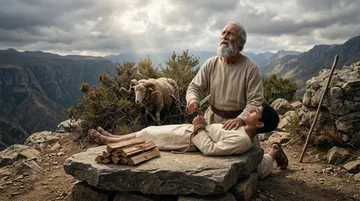
And they came to the place which God had told him of; and Abraham built an altar there, and laid the wood in order, and bound Isaac his son, and laid him on the altar upon the wood.
Translations
And they came to the place which God had told him of; and Abraham built an altar there, and laid the wood in order, and bound Isaac his son, and laid him on the altar on the wood.
King James Version, KJV Cambridge Paragraph Bible
And they came to the place which God had told him of; and Abraham built an altar there, and laid the wood in order, and bound Isaac his son, and laid him on the altar upon the wood.
And they came to the place which God had named to him; and Abraham built an altar there, and laid the wood in order; and bound Isaac his son, and laid him on the altar upon the wood.
Revised Version, American Standard Version
And they came to the place which God had told him of; and Abraham built the altar there, and laid the wood in order, and bound Isaac his son, and laid him on the altar, upon the wood.
And they come in unto the place of which God hath spoken to him, and there Abraham buildeth the altar, and arrangeth the wood, and bindeth Isaac his son, and placeth him upon the altar above the wood;
And they came to the place of which God had told him. And Abraham built the altar there, and piled the wood; and he bound Isaac his son, and laid him on the altar upon the wood.
Then came they into the place which God had named to him, and Abraham built there the altar, and laid in order the pieces of wood, and bound Isaac his son, and laid him on the altar, above the pieces of wood.
Berean Standard Bible, Majority Standard Bible
When they arrived at the place God had designated, Abraham built the altar there and arranged the wood. He bound his son Isaac and placed him on the altar, atop the wood.
They came to the place which God had told him of. Abraham built the altar there, and laid the wood in order, bound Isaac his son, and laid him on the altar, on the wood.
And they came to the place of which God had given him knowledge; and there Abraham made the altar and put the wood in place on it, and having made tight the bands round Isaac his son, he put him on the wood on the altar.
And when they came to the place which God had shewed him, Abraham builded an altar there, and couched ye wood, and bound Izhak his sonne and laid him on the altar vpon the wood.
Douay-Rheims (Challoner revision)
And they came to the place which God had shown him, where he built an altar, and laid the wood in order upon it: and when he had bound Isaac his son, he laid him on the altar upon the pile of wood.
Pictures

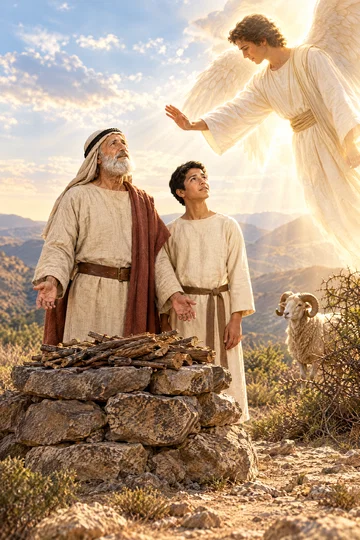
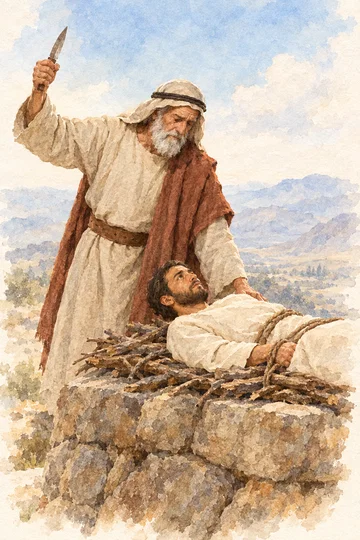
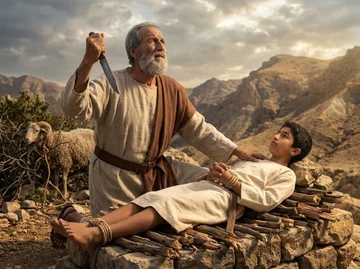
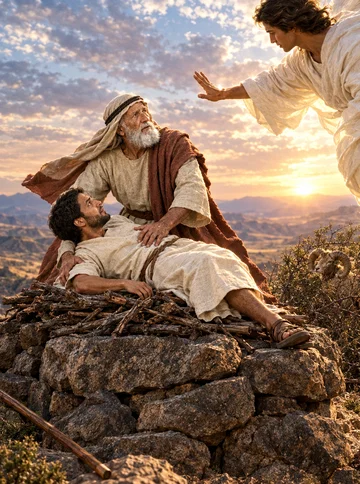
Cross-references 20 of 48
- Hebrews 11:17-19
By faith Abraham, when he was tried, offered up Isaac: and he that had received the promises offered up his only begotten son,
Abraham offered Isaac in faith, trusting God could raise him from the dead.
- James 2:21-22
Was not Abraham our father justified by works, when he had offered Isaac his son upon the altar?
Abraham’s obedient offering of Isaac shows faith working through action.
- John 3:16
For God so loved the world, that he gave his only begotten Son, that whosoever believeth in him should not perish, but have everlasting life.
Isaac’s offering foreshadows God giving his Son so people may live.
- Romans 8:32
He that spared not his own Son, but delivered him up for us all, how shall he not with him also freely give us all things?
Isaac’s offering prefigures God giving his own Son for humanity.
- Genesis 22:16-18
And said, By myself have I sworn, saith the LORD, for because thou hast done this thing, and hast not withheld thy son, thine only son:
God renews his covenant promises to Abraham because he obeyed.
- Genesis 21:12
And God said unto Abraham, Let it not be grievous in thy sight because of the lad, and because of thy bondwoman; in all that Sarah hath said unto thee, hearken unto her voice; for in Isaac shall thy seed be called.
God declares that Abraham’s promised line will continue through Isaac.
- Genesis 22:2
And he said, Take now thy son, thine only son Isaac, whom thou lovest, and get thee into the land of Moriah; and offer him there for a burnt offering upon one of the mountains which I will tell thee of.
God commands Abraham to offer Isaac on Moriah.
- Genesis 22:13
And Abraham lifted up his eyes, and looked, and behold behind him a ram caught in a thicket by his horns: and Abraham went and took the ram, and offered him up for a burnt offering in the stead of his son.
A ram is offered in Isaac’s place as God’s provision.
- Genesis 15:6
And he believed in the LORD; and he counted it to him for righteousness.
Abraham’s belief was counted as righteousness and shown in his faithful action.
- 2 Chronicles 3:1
Then Solomon began to build the house of the LORD at Jerusalem in mount Moriah, where the Lord appeared unto David his father, in the place that David had prepared in the threshingfloor of Ornan the Jebusite.
Solomon’s temple was built on Mount Moriah, where Abraham offered Isaac.
- Romans 4:20-22
He staggered not at the promise of God through unbelief; but was strong in faith, giving glory to God;
Abraham trusted God’s promise and power, and his faith was counted for righteousness.
- Hebrews 11:19
Accounting that God was able to raise him up, even from the dead; from whence also he received him in a figure.
Abraham believed God could raise Isaac from the dead and received him back figuratively.
- James 2:23
And the scripture was fulfilled which saith, Abraham believed God, and it was imputed unto him for righteousness: and he was called the Friend of God.
Abraham’s obedience in offering Isaac showed his faith and earned him the title Friend of God.
- Galatians 3:7
Know ye therefore that they which are of faith, the same are the children of Abraham.
Those who have faith are identified as Abraham’s children.
- Galatians 4:22-31
For it is written, that Abraham had two sons, the one by a bondmaid, the other by a freewoman.
Paul compares Abraham's experience to the covenants
- Romans 4:3
For what saith the scripture? Abraham believed God, and it was counted unto him for righteousness.
Abraham’s belief was counted to him for righteousness.
- Galatians 3:29
And if ye be Christ’s, then are ye Abraham’s seed, and heirs according to the promise.
Those who belong to Christ are Abraham’s seed and heirs of the promise.
- Genesis 22:14
And Abraham called the name of that place Jehovah-jireh: as it is said to this day, In the mount of the LORD it shall be seen.
The Moriah experience reveals God as Provider.
- Genesis 21:2
For Sarah conceived, and bare Abraham a son in his old age, at the set time of which God had spoken to him.
Isaac’s birth fulfills the promise of the son Abraham was willing to yield.
- John 1:29
The next day John seeth Jesus coming unto him, and saith, Behold the Lamb of God, which taketh away the sin of the world.
Isaac prefigures God’s Son, the Lamb provided for sacrifice.
Commentary
Each commentary is drawn from primary sources: the writings of Ellen G. White and Adventist pioneers and periodicals. Each commentary is separate. Its own words are not a quotation; follow the references to read the source passages.
Ellen G. White
46 sources
They reached the exact place God had appointed, where Abraham built an altar, arranged the wood, tied up his son Isaac and placed him on the wood.SG3 106.3–108.14T 144.1–145.13T 368.1–369.1ST Apr 3, 1879STSE 39.2 That place was Mount Moriah near Salem, the consecrated ground where Jerusalem and later Solomon's temple would stand, on the threshing-floor of Ornan where David offered to stay the pestilence.PK 37.2ST Apr 3, 1879GW92 68.2PP 748.4–5 Abraham acted in prompt, complete obedience without questioning or turning back, believing God could still fulfill His promise through Isaac even by raising him from the dead, so that in purpose he had already offered him.SG3 106.3–108.14T 144.1–145.1ST May 11, 1876ST Apr 3, 1879ST Nov 17, 1881 Isaac was not a small child but a full-grown young man who willingly submitted in shared faith with his father, and his binding was appointed as a figure of the Father giving His own beloved Son as a sacrifice for the sins of the world.GC88 18.2GC 18.23T 368.1–369.1ST Apr 3, 1879STSE 39.2 The act therefore calls for perfect obedience and entire surrender to God, withholding nothing however precious, doing His will without reasoning or delay as true children of Abraham.STSE 41.1ST Apr 3, 1879ST Oct 25, 1910ST Feb 22, 1899Ms 149, 1898, par. 18
Place and Sacred History
They came to the exact place God had told of and named for the sacrifice, and there Abraham built an altar and laid the wood in order upon it.SG3 106.3–108.13T 368.1–369.1ST Apr 3, 18791SP 99.4–101.1PP 152.1–2 It was the appointed place God had directed him to, reached together with Isaac for the preparing of the offering.3T 368.1–369.1ST Apr 3, 1879PP 152.1–2
That place was Mount Moriah near Salem, the site afterward chosen for Jerusalem.PK 37.2ST Apr 3, 1879GW92 68.2PP 703.1RH Dec 15, 1874 It was the very spot where Solomon's temple was later built, ground long regarded as consecrated.PK 37.2PP 748.4–5 It was afterward identified as the threshing-floor of Ornan the Jebusite, made holy by David's altar and burnt-offerings that stayed the pestilence before it was chosen as the site of the temple.PP 748.4–5
There God renewed with Abraham the covenant of blessing, including deliverance through the sacrifice of the Son of the Most High.PK 37.2 Because Abraham obeyed God's voice in giving up his beloved son, God commended his obedience and promised that in his seed all the nations of the earth would be blessed, showing that obedience to God's law is essential to receiving God's favor and blessing.PK 37.2Lt 82, 1895, par. 25
Abraham's Tested Obedience
Abraham carried out the command at the appointed place by building the altar, laying the wood in order, binding Isaac his son and laying him on the altar upon the wood, with trembling yet loving hands, ready to give him up.4T 144.1–145.1STSE 39.2PP 154.3–155.2PP 152.1–2Ms 41, 1898, par. 4–6 Isaac willingly submitted as an offering in obedience to God and in faith shared with his father, trusting that his father would not make this sacrifice unless God had commanded it.ST Apr 3, 1879STSE 39.2PP 152.1–2 The act was done in purpose and in the heart as fully as if Abraham had taken his life.ST Feb 22, 1899Ms 41, 1898, par. 4–6
He acted in prompt, complete obedience without delay, questioning, hesitation, murmuring, complaint, protest, or turning back.4T 144.1–145.1ST May 11, 1876ST Nov 17, 18814T 145.2ST Oct 25, 1910 Though he had time to doubt and felt the pain of sacrificing his son, he carried God's just and righteous requirement out to the very letter, even as he was about to strike when God stopped him.4T 144.1–145.1PP 153.3 His obedience rested on implicit trust in God and fear of God.ST May 11, 1876ST Oct 25, 1910
He obeyed despite grief, doubts, anguish, love for Isaac, old age, weakness, and hardship, and even when the command seemed to conflict with God's promises concerning his son.ST May 11, 1876ST Mar 27, 18791T 453.2–454.1ST Nov 17, 1881ST Oct 25, 1910 He let duty and faith in God govern rather than feeling.1T 453.2–454.1 He held to the promise that his descendants would be called through Isaac rather than Ishmael.ST Apr 3, 1879ST Mar 27, 1879
He believed God could still fulfill the promise through Isaac by raising him from the dead, telling Isaac so before binding him.SG3 106.3–108.1ST Apr 3, 18791SP 99.4–101.1 He trusted God's wisdom and care at every step and counted the sacrifice as already made in his heart.10MR 119.2 His faith was counted to him for righteousness as the fruit of believing God.10MR 119.2Ms 46, 1891, par. 5 His faithfulness in this test redeemed his earlier lack of perfect trust that had led him to take Hagar as wife.1SP 101.2 The command to offer Isaac came from the same voice that had told him to leave his country and go into a land God would show him, and he was saved by faith in Christ just as the sinner today is saved.Ms 46, 1891, par. 5
The episode tested whether he feared God and would withhold nothing from Him, testing his faith and Isaac's submission before the heavenly beings.4T 144.1–145.1PP 154.3–155.2 It disproved the charge that he was unfaithful and displayed that God requires perfect obedience.PP 154.3–155.2 When God stopped Abraham and provided a ram in Isaac's place, the angels saw more clearly God's provision for humanity's salvation.PP 154.3–155.2
Isaac's Willing Submission
Isaac stands in the verse as the son of promise, the only son, bound and laid upon the altar as an unresisting victim.GC88 18.2GC 18.2 He was not a small child but a full-grown young man, strong enough to have resisted if he had chosen to do so.3T 368.1–369.1STSE 39.2
His submission was willing, rendered in obedience to God and in a faith he shared with his father.SG3 106.3–108.1ST Apr 3, 1879 Having been told that God Himself had commanded the offering and could raise him from the dead to fulfill the promise that descendants would be called through him, he yielded to be bound and laid upon the wood.SG3 106.3–108.1ST Apr 3, 18791SP 99.4–101.1 He trusted God's command, revered his father, and trusted his father's integrity, believing Abraham would never make such a sacrifice unless God had required it.3T 368.1–369.1STSE 39.21SP 99.4–101.1 He accepted being offered as an honor and a privilege rather than shrinking from it as mere loss.ST Apr 3, 1879ST Apr 3, 1879
That readiness had been formed by training to love obedience.MYP 465.3 The father's authority over his children rested on love and concern for their welfare and happiness, not on selfish or arbitrary control, and the son's yielding on Moriah grew out of that nurture.MYP 465.3
Foreshadowing Christ's Sacrifice
Isaac bound and laid unresisting upon the altar on Mount Moriah was set by God as an emblem and figure of the offering of His own Son as a sacrifice for the sins of the world.GC88 18.2GC 18.2ST Apr 3, 1879STSE 41.2–42.1ST Apr 3, 1879 He was the son of promise, the beloved only son, prepared by his father in complete obedience with altar built, wood arranged, son bound and laid upon it, and submitting willingly as to an honor and privilege.GC88 18.2GC 18.2STSE 41.2–42.1ST Apr 3, 1879 Through the anguish of giving up that beloved son Abraham was taught the plan of redemption and given a measure and glimpse of the Father's self-denial in giving His beloved Son to die to save guilty, rebellious humanity.3T 368.1–369.1ST Apr 3, 1879STSE 41.2–42.1ST Feb 22, 1899Ms 41, 1898, par. 4–6 He completed the sacrifice in purpose and in his heart as fully as if he had taken Isaac's life, and his experience opened the cost of the sacrifice in which God accepted the death of His Son to save a rebellious race.ST Feb 22, 1899Ms 41, 1898, par. 4–6 The Father suffered with His Son in that giving, and Abraham's anguish makes real the reality of that self-denial.ST Apr 3, 1879ST Feb 22, 1899 Yet Isaac was spared when God stopped Abraham, while God's own Son was not spared from crucifixion, with no voice to stop that sacrifice.ST Apr 3, 1879
Through faith in the promise at that time Abraham was shown the coming of Christ, the Just One and incarnate Saviour, the Lamb slain for the sins of humanity, and he rejoiced. The test required only that he set his feet in the blood-stained path and prove willingness, not that he travel it to the end, for the angel stayed his hand as the knife was raised to slay Isaac.RH Aug 4, 1874ST Jun 25, 1874 That pattern was twisted to claim Christ likewise needed only to show willingness to endure self-denial and suffering and was not required to endure painful hunger, starvation and death to carry out in every particular the plan devised for the redemption of the fallen race.RH Aug 4, 1874ST Jun 25, 1874 Satan pressed the comparison, claiming that Christ like Abraham was being tested only to prove obedience, and falsely claiming to be the angel who had stopped Abraham from killing Isaac, to persuade Him He need not endure the suffering ahead.RH Aug 4, 1874 But Christ rejected the temptation and remained faithful to the plan of redemption.RH Aug 4, 1874
Call to Surrender Today
The binding and laying of Isaac on the altar teaches implicit trust in God, the fear of God, and perfect, complete obedience that surrenders even what is most precious.STSE 41.1ST Apr 3, 1879ST Oct 25, 1910 Nothing is too precious to give to God, and obedience to the whole will of God places a person by faith under the protection of Jehovah through entire surrender of the whole will in everlasting strength, saying I am Thine, I am not my own, I am bought with a price, holding no Isaacs too precious to sacrifice though the test tries sorely.STSE 41.1ST Apr 3, 1879Lt 136a, 1898, par. 18–20 That obedience rested on implicit trust and did not question God's justice or protest, even when the requirement was painful and the son was the father's joy.STSE 41.1ST Apr 3, 1879ST Oct 25, 1910
Age, weakness, hardship, and deep personal attachment do not excuse anyone from duty.ST May 11, 18764T 145.2ST Oct 25, 1910 Old age did not excuse Abraham, but he acted in faith without delay, without questioning, murmuring, or turning back, with cheerful and complete obedience to every divine requirement even when obedience was difficult.ST May 11, 18764T 145.2ST Oct 25, 1910 His prompt, unreasoning obedience, starting at once on the long painful journey to offer his only son Isaac, the son promised to become a great nation, is the example and pattern for God's people today, who will be tested and tried as the Lord puts His purposes in place of their devising, often contrary to human desires and inclinations and contrary to the dictates of the flesh.ST Oct 25, 1910Ms 149, 1898, par. 18Ms 147, 1899, par. 9
Willingness to sacrifice his only son, the child of promise, exposes how reluctant many are to give up even earthly possessions for God's cause or to help the poor.CET 165.2–3SG4 266.2–3RH May 20, 1862 In contrast with those who cling to earthly possessions rather than sacrifice for the poor, God's cause, or the heavenly inheritance and eternal life, Abraham was ready to give up what was most precious to him for God.SG4 266.2–3RH May 20, 18623T 406.1–2 The surrender of the son he loved is a test of love for God and genuine faith, calling people to be willing to surrender what they value to God and to do His work with undaunted courage and living faith.ST Apr 3, 18793T 406.1–2RH Dec 15, 1874
Mere descent from Abraham and possession of the law of God is nothing; true children of Abraham do Abraham's works of immediate obedience without hesitating to reason the matter out.Ms 149, 1898, par. 18Ms 147, 1899, par. 9 Abraham is called the friend of God and the father of the faithful because he bore the fearful test and came off conqueror, completing the sacrifice in his heart as fully as if he had taken Isaac's life.ST Feb 22, 1899Ms 149, 1898, par. 18 His obedience was the fruit of believing God that was imputed to him for righteousness, coming from the same voice that had told him to leave his country for a land God would show him, and he was saved by faith in Christ just as the sinner today is saved by faith in Christ.ST Feb 22, 1899Ms 46, 1891, par. 5
The binding of Isaac is an image of parents binding their children to God by earnest prayer and living faith, dedicating them and placing them under His care.ST Feb 26, 18801T 397.1–2 God's guiding hand and guardian angels will then protect them through the perils of the last days and lead them to victory over every foe.ST Feb 26, 18801T 397.1–2 Laying a child on the altar can mean, after many prayers, tears, and severe soul conflict with a heart bound up with the child, giving even a one-year-old child into another's care so as to give oneself fully and unreservedly to God's work, refusing to excuse oneself on account of the child.Ms 5, 1863, par. 8–10 Done for Jesus in return for what He has done, it brings tears yet peace and rest in Jesus and firm confidence that He who called to the work will accept the child and guard and love him as a lamb of His fold.Ms 5, 1863, par. 8–10 The same example is held up to brethren and sisters to do God's work with undaunted courage and living faith, sowing beside all waters despite opposition from selfish motives, bigotry and prejudice, not confining labor to their own country because the field is the world and the harvest is ripe.RH Dec 15, 1874
Sources
Pioneers and periodicals
121 sources
The verse records Abraham coming to the appointed place in Moriah that God had shown him and there building an altar, laying the wood in order, binding Isaac his son and laying him on the altar upon the wood to carry out the commanded burnt offering.ST Feb 1, 1905ST Feb 12, 1894ST Sep 8, 1898ST Aug 30, 1905
It stands at the crisis and severest test of his faith, which he met with immediate obedience without question, delay or hesitation, though the command seemed to cut off the promise through his long-promised only son.ST May 11, 1876ST Mar 27, 1879ST Jun 3, 1908ST Feb 1, 1905ST Dec 20, 1910
His obedience was real and complete in purpose, for he expected to slay Isaac and raised the knife until God stayed his hand.ST Mar 26, 1894ST Feb 26, 1894RH Mar 16, 1869
He trusted that the God who had miraculously given Isaac could raise him from the dead to fulfill the promise, and so in figure received him back alive from the dead.ST Nov 5, 1912ST Apr 11, 1900ST Mar 1, 1905
Isaac shared that obedience, yielding willingly though strong enough to have resisted, and in his willing submission bound and laid upon the wood he is a type of Christ the beloved Son freely giving Himself.ST Apr 3, 1879ST Apr 1, 1875ST Apr 1, 1875ST Sep 8, 1898ST Sep 8, 1898
The offering was designed to prefigure the Father giving His only Son as the Lamb, with the ram caught in the thicket offered in Isaac's place representing Christ sacrificed in humanity's place, and it shows faith made complete and visible through works.ST Apr 3, 1879ST Jun 3, 1908ST Oct 25, 1905RH May 6, 1858ST Mar 26, 1894
Place and Actions Described
They came to the place God had told him of, and there Abraham built an altar, laid the wood in order, bound Isaac his son, and laid him on the altar upon the wood, in full obedience to carry out the commanded burnt offering.ST Feb 1, 1905ST Feb 12, 1894ST Sep 8, 1898RH Aug 17, 1876ST Jan 6, 1909 Reaching the appointed place he prepared altar and wood and bound Isaac to lay him upon it, displaying readiness to offer his only son when faith was tested to the uttermost.ST Feb 1, 1905ST Feb 12, 1894ST Sep 8, 1898ST Jan 6, 1909 These actions show Abraham carrying out the test in faith and obedience, with Isaac's role in carrying the wood and being laid in order ready for a burnt offering presenting him as a type of Christ, the beloved Son, compared also with Christ in the garden.ST Sep 8, 1898ST Sep 8, 1898ST Jan 6, 1909 God stopped the sacrifice and provided a lamb in Isaac's place, teaching trust in God's provision.ST Feb 1, 1905ST Jan 6, 1909
The place was the appointed, chosen spot in the land of Moriah, reached after a three days' journey to the place God pointed out.RH Jul 21, 1868ST Mar 26, 1894ST Feb 26, 1894 There he reared an altar of rude stone, laid the wood in order, bound Isaac his son upon the altar, and raised the knife to take his life until God commanded him to stay his hand.ST Mar 26, 1894ST Feb 26, 1894 It is identified with Mount Moriah at Jerusalem near the later temple area in the lower part of the city, the site later chosen for the temple where Isaac was offered and a lamb provided in his place, then apparently uninhabited in Abraham's time.ST Aug 30, 1905ST Oct 31, 1906 One account weighs Moriah near Jerusalem against Moreh near Shechem as proposed locations and judges the evidence to favor Jerusalem.RH Jul 21, 1868 The ram caught in the thicket was provided instead as sacrifice, typifying the only-begotten Son of God given as substitute and revealing Jehovah-jireh, the Lord provides, as a lesson for the ages, followed by glory and joyful promise.ST Mar 26, 1894ST Feb 26, 1894
The altars Abraham built were erected for presenting offerings to the Lord, and on the place God told him of he built an altar and laid the wood in order to make a burnt offering.ST Jul 30, 1912RH Aug 17, 1876 Burnt offerings were part of the worship God had taught in early times, obeyed here in Abraham's instruction to offer a burnt offering by building an altar, arranging the wood, binding Isaac, and placing him on the altar.RH Aug 17, 1876 The ram caught in the thicket was then offered up for a burnt offering in the stead of his son.ST Jul 30, 1912
The account is true history of a real event, not merely a dream about offering his son, though some interpreters claimed Abraham only dreamed that he must offer his son.RH Mar 11, 1873ST Feb 15, 1877 The command was from the highest authority, and Abraham had faith in that authority and was confident that all would be right in the end, while Isaac was willingly obedient in being bound and laid on the altar.RH Mar 11, 1873 The narrative was given not to teach sacrifice of children as the Ammonites sacrificed to Moloch, but to teach by historic example a substantial lesson in faith, confidence, and obedience to guide acts through life.RH Mar 11, 1873 Isaac at the time was a young man about twenty to twenty-five years old, strong enough to have resisted his aged father, so the binding happened without struggle because Isaac had faith in his father and in his father's God.ST Feb 12, 1894ST Jul 15, 1913
Abraham's Obedient Faith Tested
Genesis 22:9 stands at the crisis of Abraham's faith, the climax and culminating lesson of God's progressive dealings with him through repeated lessons in trust. ST Jun 3, 1908ST Dec 20, 1910ST Jan 9, 1912ST Sep 25, 1901ST Jul 22, 1908 It was his severest and most fearful test, testing his faith to the uttermost as he bound Isaac and laid him on the altar ready to offer his beloved only son. ST Feb 22, 1899ST Feb 1, 1905ST Sep 25, 1901ST Jul 22, 1908 After years of growing stronger in trust his character was prepared to meet this trial, and the victory of faith there was afterward confirmed by God's unchanging promise and oath for the sake of later heirs. ST Jan 9, 1912ST Sep 25, 1901ST Jul 22, 1908
He carried out the command without delay, question, complaint, hesitation, protest, or conferring with others, not questioning God's justice even when the command seemed to conflict with the promise concerning his son. ST May 11, 1876ST Nov 17, 1881ST Oct 25, 1910ST Jul 8, 1880 Despite old age, weakness, grief, anguish, and deep love for Isaac as his joy, age and hardship and personal attachment did not excuse him from duty. ST May 11, 1876ST Mar 27, 1879ST Nov 17, 1881ST Oct 25, 1910 His duty to God was dearer than every earthly tie, and he trusted God's word completely while holding to the promise that descendants would come through Isaac rather than Ishmael. ST Mar 27, 1879AUST Jun 14, 1920 His obedience rested on implicit trust and fear of God, an example of cheerful and complete obedience to every divine requirement even when obedience is difficult. ST May 11, 1876ST Oct 25, 1910
His obedience was real and not pretense, staged act, or inward agreement only, for he expected to slay Isaac and raised the knife to take his life-blood until God commanded him to stay his hand. ST Mar 26, 1894ST Feb 26, 1894RH Mar 16, 1869RH Mar 19, 1861 He completed the sacrifice in his heart and purpose as fully as if he had taken Isaac's life, regarding him as already slain so that his rescue was like a resurrection. ST Feb 22, 1899ST Jun 2, 1881 The performance of that duty was connected with the fulfillment of the promise, providing visible proof of faith and an occasion for God to reveal His presence, yet not earning salvation by merit but depending on God's free gift. RH Mar 19, 1861
He believed that the same God who had miraculously given him a son through barren Sarah could bring him back from the dead to fulfill the promise that descendants would be called through Isaac. ST Apr 3, 1879ST Apr 1, 1875ST Nov 5, 1912RH Mar 16, 1869 In offering Isaac he was by human reckoning cutting off his own hope of salvation as well as that of the world, since the long-promised Messiah was to come through Isaac's posterity, yet his faith did not waver. ST Nov 5, 1912ST Apr 11, 1900 In figure he received Isaac back alive from the dead, demonstrating that the promised seed and salvation come by God's power and not by human schemes or human effort. ST Apr 3, 1879ST Apr 1, 1875ST Apr 11, 1900ST Mar 1, 1905
His response grew from a life of trust, after learning to believe God's promise, after separation from Lot, and after his barren wife bore the child of promise, recalling evidence of God's goodness and faithfulness even when appearances made the trial difficult to understand. ST Jul 22, 1908ST Jun 15, 1904RH Jun 7, 1906 It stands as one costly step in God's long, patient, generous education of Abraham by an object lesson stronger than words, after slowness, mistakes, and clinging to kindred. ST Jun 15, 1904 Through human weakness and temporary lack of faith he had attempted to do for himself in his own way what God had promised, wanting his servant Eliezer to be his heir and marrying Hagar, and by grace this severe trial canceled that earlier weakness and unbelief and brought him to a truly wonderful degree of faith. ST Sep 23, 1913RH Apr 8, 1875RH Jun 7, 1906
The trial proved his love and fear of God, that his heart was true, his consecration complete, and his faith triumphant and victorious over anguish, parental affection, and unknown outcome. RH Dec 2, 1915ST Dec 28, 1888ST Aug 22, 1878ST His willingness to give up the son through whom the promises centered, dearer than life, brought the natural bond of parent and child under God's higher law as an act of moral courage for God's glory. RH Dec 2, 1915ST Aug 22, 1878ST He is therefore called the father of the faithful and the father of all who believe, prepared to become so by this act, and his example has encouraged God's people through the ages to trust and obey in their own trials and to turn serious failures and obstacles into victory. ST Feb 22, 1899ST Mar 26, 1894ST Dec 28, 1888ST Aug 22, 1878RH Apr 8, 1875
Isaac's Willing Submission
Isaac willingly submitted and shared Abraham's obedience at the appointed place where the altar was built and the wood arranged, trusting both God and his father as he was bound and laid upon the altar.ST Apr 3, 1879ST Apr 1, 1875ST Apr 1, 1875ST Apr 3, 1879RH Mar 2, 1905 He accepted the offering as an honor and privilege and as a sign of God's love, regarding it as an honor to give his life to God.ST Apr 3, 1879ST Apr 1, 1875ST Apr 1, 1875ST Apr 3, 1879RH Mar 2, 1905 He could have resisted or escaped, yet he did not strive but yielded, and he sought to ease his father's grief by encouraging him as he bound him.RH Mar 2, 1905ST Dec 22, 1914 His obedience reflected the reverence and willing respect he had been taught toward his father.ST Dec 22, 1914
His faith was tested as well as Abraham's, when the promise of a multitude of descendants was placed in the balance and their trial ended in the victory of faith.ST Sep 25, 1901ST Jan 6, 1909 His training in trusting obedience led him to accept the purpose of God as it was explained to him, sharing Abraham's faith in the face of the sacrifice Abraham believed God required.ST Jan 6, 1909RH Mar 2, 1905 That submission was linked to Abraham's steady instruction of his son in the home and in daily life, and to how faithfully Abraham had taught him.RH Jun 6, 1907RH Apr 17, 1900 Parents are thus to keep God's standard before their children and take an active part in their upbringing.RH Apr 17, 1900
Isaac, the child of promise and beloved son who carried the wood and was bound and laid in order upon it ready for a burnt offering, is a type of Christ, the beloved Son freely giving himself.ST Sep 8, 1898 His role in the sacrifice is presented as parallel to Christ's sacrifice, compared with the Father and Son before and at Calvary.ST Sep 8, 1898ST Sep 8, 1898 The scene is also compared with Christ in the garden.ST Sep 8, 1898 His willing laying of himself upon the altar is the picture of standing fast in the faith, firm and unmovable like an oak on the mountain, with the same steadfast loyalty as Daniel and the three who would not bow to other gods.RH May 23, 1871 It illustrates the Christian resting in submission to God rather than resisting how God chooses to use him, offering the whole self to God as a willing sacrifice with confidence in God's love and wisdom.RH May 23, 1871RH Dec 3, 1901
Promise Resurrection and Provision
Isaac was the only legitimate, long-promised son and the sole heir through whom the covenant promise was to be fulfilled, Ishmael having been rejected as co-heir, so that no reliance could be placed on him if Isaac were lost.ST Mar 27, 1879ST Jun 2, 1881ST Jun 1, 1882 The promises given to Abraham extended to Isaac as the head of the family line through whom the Seed was to come.ST Jan 14, 1913ST Jan 28, 1903 That Seed was Christ, and through Him the blessing of the Messiah, the kingdom unfolding through the ages, and the inheritance of the whole world promised to Abraham and his children were to continue to all who belong to Christ by faith.ST Nov 5, 1912ST Jan 28, 1903ST Jun 1, 1882 Abraham understood that the long-promised Messiah was to come through Isaac's posterity, so that in offering Isaac he was by human reasoning cutting off his own hope of salvation as well as that of the world and ending all hope that God's promises would be fulfilled.ST Nov 5, 1912ST Jun 2, 1881ST Sep 4, 1901
Abraham was willing to yield Isaac, the child of promise in whom his hopes rested both for this life and as ancestor of the coming Saviour, leaving himself without human support to lean wholly upon God.ST Dec 11, 1901ST Feb 7, 1911ST Dec 11, 1901 His faith rested on God's promise and power, not on Isaac's visible existence or any outward circumstance, and he trusted that God could fulfill His promises without human planning.ST Dec 11, 1901RH Jan 14, 1904ST Dec 11, 1901 Isaac's birth had already shown that the promise depended on God's power, and the promised Redeemer was still held in the promise rather than present in Isaac's flesh, so Abraham left fulfillment entirely to God and his faith was counted for righteousness.RH Jan 14, 1904ST Sep 4, 1901
God stopped the sacrifice, restrained Abraham's hand when his faith was tested to the uttermost, declared he had not withheld his only son, and provided a sacrifice in Isaac's place.ST Jun 3, 1908ST Feb 1, 1905ST Jul 26, 1905 The provision was a ram caught in the thicket, described as a lamb given instead of Isaac, typifying the only-begotten Son of God given as substitute.ST Mar 26, 1894ST Dec 11, 1901RH Jun 8, 1916 In this direst hour, after a three days' journey to the appointed place where Abraham had built an altar of rude stone, laid the wood in order, bound Isaac upon it and raised the knife, God revealed Himself as Jehovah-jireh, the Lord will provide, as a lesson for the ages.ST Feb 1, 1905ST Mar 26, 1894ST Jul 26, 1905 Isaac was thus spared and restored alive from the dead, with the ram offered as substitute sacrifice.ST Jun 3, 1908RH Jun 8, 1916
Abraham had fully given his son to God and regarded Isaac as already slain, so that his rescue was like a resurrection and in figure he received him back from the dead.ST Apr 11, 1900ST Jun 2, 1881RH Aug 28, 1900 Through this trial he learned that death and resurrection would precede his descendants' possession of the promised inheritance, and that he himself would receive the promised inheritance through the resurrection of the dead.ST Jun 2, 1881RH Aug 28, 1900ST Jun 30, 1881 The same figure demonstrated that the promised seed and salvation come by God's power, not by human schemes or human effort.ST Apr 11, 1900ST Mar 1, 1905 In like manner the promised seed, Christ the true heir, would be offered in sacrifice with death and resurrection coming before the inheritance of the promises, and the saints must suffer and await the resurrection before they can inherit the holy, eternal kingdom.ST Jun 30, 1881
Type of Christ's Sacrifice
The binding on Moriah was appointed to foreshadow the offering of God’s own Son, giving a glimpse of what it cost the heart of divine love to give an only Son as the Lamb.ST Apr 3, 1879ST Apr 1, 1875ST Jun 3, 1908ST Oct 25, 1905 Abraham’s anguish in preparing to slay Isaac reveals the reality of the Father’s self-denial in giving His beloved to die for guilty sinners, and the Father suffered with His Son in accepting the death of His Son to save a rebellious race.ST Apr 3, 1879ST Apr 1, 1875ST Feb 22, 1899 Abraham completed the sacrifice in heart and purpose as fully as if he had taken Isaac’s life, and through that sorrow both he and Isaac understood more fully the price of salvation and the voluntary offering of God’s Son for an ungrateful race.ST Feb 22, 1899ST Aug 2, 1910 Isaac was spared, but God’s Son was not spared from crucifixion, for no voice stopped that sacrifice when the stroke was not turned away from Him as the ransom for humanity.ST Apr 3, 1879ST Jun 3, 1908 He was permitted to suffer separation from God because of sin, which the binding and placing on the altar pointed toward in the Father’s pain in offering His Son.ST Jun 3, 1908ST Apr 14, 1914
The ram caught in the thicket and offered instead typifies the only-begotten Son of God given as substitute, the only sufficient sacrifice offered in humanity’s place.ST Mar 26, 1894ST Mar 11, 1897 Isaac, the beloved promised heir and hope of posterity, was restored alive from the dead in figure when the angel stayed the knife, while the ram was slain in his place.ST Mar 26, 1894RH Jun 8, 1916 Through the ordeal Abraham gained a bond of sympathy with God and a truer appreciation of the love involved in giving a beloved Son to die, which he had not understood so deeply before.AUST Jun 14, 1920ST Aug 22, 1911 The test gave him clearer, grander, broader views of God’s love, sacrifice and care, and faith in God’s gift of His only-begotten Son enabled him to offer his own only son.ST Oct 31, 1906ST Feb 2, 1915ST Jun 3, 1908 During the three days in which Isaac seemed as good as dead, Abraham was led to appreciate God’s sacrifice of His Son for human sin, and Isaac’s offering points to Jesus, the promised Seed, who was slain and raised in reality.AUST Jun 14, 1920ST Feb 2, 1915
The Angel of Jehovah who watched over Abraham and stayed his hand is the Son of God, and the Father-sent trial ended once obedience was proved and Abraham was known to be obedient.ST Jun 3, 1908ST Jul 12, 1910 That pattern was twisted in the wilderness temptation, where Satan falsely claimed to be the angel who stopped Abraham from killing Isaac and claimed to be sent now with a commission from the Father.RH Aug 4, 1874ST Jun 25, 1874ST Jul 12, 1910 By that claim Christ was urged to prove He was the Son of God by commanding a stone to be made bread and eating to be strengthened, as if, like Abraham, He need only show willingness to endure self-denial and suffering and was not required to endure painful hunger, starvation and death.ST Jun 25, 1874ST Jul 12, 1910 Christ rejected the temptation and remained faithful to carry out in every particular the plan devised for the redemption of the fallen race.RH Aug 4, 1874ST Jun 25, 1874 Through faith in the promise Abraham was shown the coming of Christ, the Just One and the incarnate Saviour, the Lamb slain for the sins of humanity, and he saw Him and rejoiced.ST Feb 26, 1894 Like his Saviour winning perfection on Calvary, Abraham won it on the summit of sacrifice.ST Feb 26, 1894
Sanctuary Priesthood and History
Abraham built the altar and laid Isaac upon it acting as priest for his own family, under the patriarchal system in which the head of each family, or in some cases the head of each tribe, offered sacrifices and presided over religious rites and the worship of God.RH Aug 31, 1911RH Aug 3, 1916 From the fall of man until Moses erected the sanctuary in B.C. 1491, about twenty-five hundred years, there was no temple building on earth, no sanctuary of worship, and no order of priesthood among men except this patriarchal order.RH Aug 31, 1911 Patriarchal families thus practiced sacrificial service before the exodus, with the father serving as priest of the family, of which Abraham's offering is one instance of the constant custom of all who feared God during that long period.RH Aug 31, 1911RH Aug 3, 1916
God Himself chose the place in the land of Moriah where Abraham built the altar, and guarded that place for His later purpose.ST Nov 5, 1912RH Sep 12, 1912 That very spot later became the threshing floor of Ornan where David built an altar, the plot where Solomon's temple was built without sound of hammer, and Mount Zion.ST Nov 5, 1912 The offering of Isaac on Mount Moriah therefore stood on the site later chosen for the temple, where Isaac was offered and a lamb was provided in his place.ST Nov 5, 1912 That guarded place was chosen as the site of the temple, the place where the promised heavenly Jerusalem would cover it and where God's glorious everlasting city and sanctuary will stand forevermore.ST Nov 5, 1912RH Sep 12, 1912
Abraham's meeting with God on Mount Moriah brought his crowning blessing.ST Apr 7, 1914ST Sep 20, 1899 His offering of Isaac there was the great victory of his life, won by surrendering the dearest idol of his heart.ST Apr 7, 1914 He prized victory with God above every earthly tie and treasure, and the same daily victory is obtained through sweet secret communion with God in prayer and will culminate in glorious rest.ST Apr 7, 1914
Doctrine Proved by Offering
The binding and laying of Isaac upon the altar with the wood in order shows faith expressed and completed through obedience, not by inward agreement only but by going forward and doing what was required.RH May 6, 1858ST Aug 30, 1877RH Mar 19, 1861ST May 13, 1897ST Aug 23, 1877 Faith worked together with the act and was made perfect by it, and the act measured the strength of the faith, bringing it to maturity.RH May 6, 1858ST Aug 30, 1877ST May 13, 1897ST Aug 23, 1877RH Sep 22, 1904 Such performance of duty was connected with the fulfillment of the promise and became the visible proof of trust, the occasion for the revelation of divine presence, undertaken as privilege in dependence on free gift and not as merit earning salvation.ST Aug 30, 1877RH Mar 19, 1861 This is the faith that prepares for translation, in which belief and obedience belong together and justification stands with both.ST Aug 23, 1877ST Oct 31, 1878
That faith is reckoned for righteousness, for trust that God could restore life even from death received Isaac back from the dead in confidence that the promise would stand though obedience seemed to end all hope.RH Apr 9, 1908RH Jan 14, 1904RH Aug 28, 1900 The trust rested on promise and power rather than on visible existence or outward circumstance, as the birth itself had already shown the promise to depend on divine power, with the promised Redeemer still held in the promise rather than present in Isaac's flesh.RH Jan 14, 1904 Righteousness had already been pronounced upon belief, when the inward disposition was seen, and the outward work on the altar made that righteous character visible to others and made the faith acceptable, without earning salvation by works.RH Mar 19, 1861ST Nov 10, 1914ST Sep 12, 1878 Through that receiving back as from the dead the doctrine of the resurrection of the dead is taught, namely that the promised seed is received in figure from death and that the promised inheritance is received through resurrection.RH Aug 28, 1900
The binding and laying on the altar expresses conviction that blood must be shed to expiate sin and that a vicarious sacrifice was necessary, pointing to the agony of Christ's sacrifice and the Father's suffering in permitting the Son to suffer separation because of sin.ST Apr 14, 1914 Release from the commanded duty came only from the same divine authority that gave it, showing that a divine command must not be set aside without an equally clear word.ST Dec 7, 1882 Had the requirement been carried out it would not have been murder, just as enduring death rather than disobeying would not be suicide.RH Oct 30, 1855 The trial shows that fathers and mothers are never called to take their children's lives as offerings, and as Isaac was delivered so the coming test of faith under a death decree will be just as severe and God will keep the faithful through it.ST May 3, 1899RH Mar 28, 1854
The offering stands as the result and evidence of faith made complete through preparation, the sacrifice necessary to become a tried father of the faithful.ST Dec 2, 1880 Sacrifice disciplines character, hardship develops it, and venturing in obedience greatly strengthens trust.ST Dec 2, 1880ST Aug 8, 1906ST Sep 17, 1896 Willingness to meet the set condition demonstrates that genuine faith leads to obedience, works testifying that faith is real and bringing it to maturity in fulfillment of the statement that Abraham believed God, without earning righteousness by works, and winning the name father of the faithful.RH Sep 22, 1904ST Sep 17, 1896
Call to Trust and Surrender
Isaac stands for whatever is dearest, and every believer must lay a cherished Isaac on the altar as Abraham laid his son there.RH Sep 11, 1856RH Aug 18, 1868 The cherished Isaac to be laid there is self and base ambition, with life, appetites, passions, wealth, talents, plans, possessions, loved ones, affections and influence all entrusted to God and nothing held back.ST Apr 1, 1875ST Feb 26, 1894 Surrendering them recognizes that they belong to God, that nothing possessed is too precious to give Him, and that everything must be subordinated to character.ST Apr 1, 1875ST Apr 1, 1875ST Feb 26, 1894 When consecration is given the sacrifice is withheld, for God requires not sacrifice but consecration, followed by glory and joyful promise.ST Feb 26, 1894 Death of self must come before entire redemption and heaven dawning on the weary spirit, and yielding one's life to God is an honor and privilege like Isaac's willing submission.ST Apr 1, 1875ST Feb 26, 1894RH Aug 18, 1868
Sanctified, unselfish love enables a person to offer up even a dearest friend or possession for Christ with a submissive heart.RH Dec 29, 1868ST Sep 13, 1877 Such love submits to God's right to reclaim what He has entrusted, recognizing that every earthly good is lent by God and may be recalled.RH Dec 29, 1868ST Sep 13, 1877 By contrast inordinate, selfish affection makes earthly things idols.RH Dec 29, 1868ST Sep 13, 1877
The verse teaches prompt, unquestioning, childlike trust and obedience in mighty supernatural faith, without wavering, hesitation, or conferring with flesh and blood.RH Mar 26, 1901ST Apr 7, 1914 When the command came Abraham did not suspect deception, did not consult Sarah or a minister, but rose up early in the morning and did exactly what he was told, journeying on and rearing the altar and lifting the knife toward heaven.ST Feb 26, 1894RH Mar 26, 1901 The voice of the Lord is known the way the voice of father or mother or dearest friend is known, by living with Him in daily secret communion as the most real intimate friend.RH Mar 26, 1901 Yielding all to God without one reservation enters the conditions of discipleship and so brings knowledge of the continual leadings of the Holy Spirit, for to know Him is eternal life and this life is in His Son.RH Mar 26, 1901 The same daily victory obtained through sweet secret communion with God in prayer will culminate in glorious rest, won by surrendering the dearest idol of the heart and prizing victory with God above every earthly tie and treasure.ST Apr 7, 1914
Abraham's severe trial, obeyed despite the anguish a loving father would feel, has encouraged God's people through the ages to trust and obey God in their own trials.ST Nov 5, 1894ST Dec 28, 1888 Hardship develops character, and his faith triumphed over the trial as an example of how to endure.ST Dec 28, 1888ST Aug 8, 1906 The Father will not try anyone beyond strength, even when the sacrifice seems so severe it can hardly be believed.ST Nov 5, 1894 A person cannot know in advance how firmly faith will stand when a cherished hope is shattered, and confidence in enduring such crushing sorrow with bravery should wait until it comes.ST Feb 26, 1894 His willingness to obey at great personal cost is the model of the strong faith needed to venture on God's truth and endure a severe test.RH Feb 15, 1912
By the grace of God this trial canceled earlier weakness and unbelief in wanting the servant Eliezer to be heir and in marrying Hagar, and brought Abraham to a truly wonderful degree of faith, proving that serious failures and obstacles can be turned into victory.RH Apr 8, 1875 His obedience was a real test, not a staged act or pretense, for he expected to slay Isaac and trusted that God could raise him from the dead.RH Mar 16, 1869RH Mar 16, 1869 By faith he passed the test and stood approved by God, redeeming the stain of earlier failure.RH Mar 16, 1869RH Mar 16, 1869 As he took an extreme stand against his earlier failure, those who have loved money, neglected the poor, or pursued pride, dress and folly are to take a decisive stand in the opposite direction, proving turning from those sins.RH Mar 16, 1869
Isaac's obedience in helping Abraham bind him and submitting without resistance reflects how faithfully Abraham had taught his son, with steady instruction in the home and in daily life in reverence and willing respect.RH Jun 6, 1907ST Dec 22, 1914RH Apr 17, 1900 Parents should keep God's standard before their children and take an active part in their upbringing.RH Apr 17, 1900 The binding of the child upon the altar is the image of parents dedicating their children to God through earnest prayer and persevering faith, asking for the Lord's care and angelic protection.RH Nov 28, 1912 Through consecration to God's will and living, active faith parents commit their children to God, and God will save those children and lead them to service and victory. Abraham's example shows that parents may be called to sacrifice what is dearest to them and must not withhold from God what belongs to Him.RH Dec 2, 1915
That same complete surrender illustrates the blind faith of giving all to God, as when willingness to give up a crutch is compared to Abraham binding Isaac and laying him on the altar.ST Jan 10, 1900 It is an example of depth and cross-bearing, scrupulous devotion in contrast to dubious godliness and to breadth-seeking, pleasure-loving Christianity. It is the complete trust required to act on the message that Christ would soon come, despite the risk of being mocked or thought foolish, to venture on truth at great cost, to proclaim the 1844 time message and the Lord's coming, and to maintain faith under scoffing.RH Feb 15, 1912RH Apr 21, 1868 It calls brethren and sisters to do God's work with undaunted courage and living faith, sowing beside all waters despite opposition from selfish motives, bigotry and prejudice, and not confining labor to their own country because the field is the world and the harvest is ripe.RH Dec 15, 1874 It is also pictured in laying all plans before God in counsel in faith, that if they are right God can restore them and if they are consumed that is best, so truth comes to light, and in parting with a large sum amid anguish on Moriah with depth and cross-bearing generosity.RH May 26, 1904 Carrying out God's command to the utmost stands as a contrast to rejection of God and the Saviour.RH Dec 15, 1868
Abraham acted on what God had said despite the danger that others might discover his actions and condemn him as a murderer.RH Feb 10, 1874 Bearing the sacrificial knife is presented as an example of faithfulness linked with sharing eternal life.RH Feb 21, 1856 His journey to the appointed place and the offering of his beloved son are presented as types of the church's travels and trials.RH May 14, 1867
Sources