Genesis 25:30
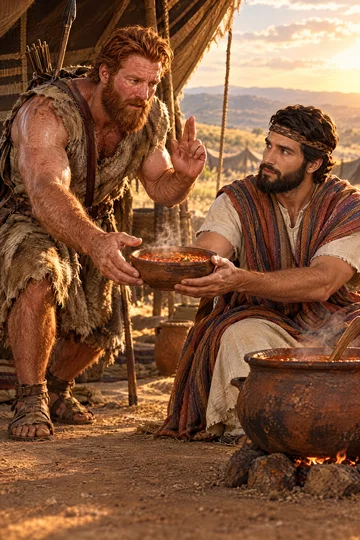
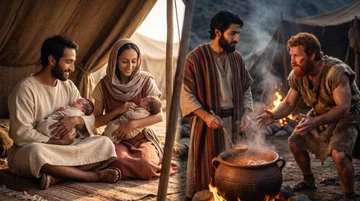
And Esau said to Jacob, Feed me, I pray thee, with that same red pottage; for I am faint: therefore was his name called Edom.
Translations
And Esau said to Jacob, Feed me, I pray you, with that same red pottage; for I am faint: therefore was his name called Edom.
King James Version, Webster Bible
And Esau said to Jacob, Feed me, I pray thee, with that same red pottage; for I am faint: therefore was his name called Edom.
KJV Cambridge Paragraph Bible, Revised Version, American Standard Version
and Esau said to Jacob, Feed me, I pray thee, with that same red pottage; for I am faint: therefore was his name called Edom.
and Esau saith unto Jacob, 'Let me eat, I pray thee, some of this red red thing, for I [am] weary;' therefore hath [one] called his name Edom [Red];
And Esau said to Jacob, Feed me, I pray thee, with the red — the red thing there, for I am faint. Therefore was his name called Edom.
So Esau said unto Jacob. Do let me devour some of the red—this red, for, famished, I am. For this cause, was his name called Edom.
Berean Standard Bible, Majority Standard Bible
He said to Jacob, “ Let me eat some of that red stew, for I am famished.” ( That is why he was also called Edom.)
Esau said to Jacob, “ Please feed me with some of that red stew, for I am famished.” Therefore his name was called Edom.
And Esau said to Jacob, Give me a full meal of that red soup, for I am overcome with need for food: for this reason he was named Edom.
Then Esau sayd to Iaakob, Let me eate, I pray thee, of that pottage so red, for I am wearie. Therefore was his name called Edom.
Douay-Rheims (Challoner revision)
Said: Give me of this red pottage, for I am exceeding faint. For which reason his name was called Edom.
Pictures

Cross-references
- Hebrews 12:16
Lest there be any fornicator, or profane person, as Esau, who for one morsel of meat sold his birthright.
Esau traded his birthright for a meal, despising his sacred inheritance for immediate desire.
- Genesis 27:1-29
And it came to pass, that when Isaac was old, and his eyes were dim, so that he could not see, he called Esau his eldest son, and said unto him, My son: and he said unto him, Behold, here am I.
Jacob deceives Isaac to obtain the blessing intended for Esau.
- Genesis 25:23
And the LORD said unto her, Two nations are in thy womb, and two manner of people shall be separated from thy bowels; and the one people shall be stronger than the other people; and the elder shall serve the younger.
The prophecy that the elder would serve the younger frames Esau’s sale of his birthright.
- Genesis 27:41
And Esau hated Jacob because of the blessing wherewith his father blessed him: and Esau said in his heart, The days of mourning for my father are at hand; then will I slay my brother Jacob.
Esau’s hostility toward Jacob leads him to plan his brother’s death.
- Romans 9:13
As it is written, Jacob have I loved, but Esau have I hated.
Explains God’s love for Jacob and rejection of Esau.
- Hebrews 12:17
For ye know how that afterward, when he would have inherited the blessing, he was rejected: for he found no place of repentance, though he sought it carefully with tears.
Esau later sought the lost blessing with tears.
- Genesis 27:36
And he said, Is not he rightly named Jacob? for he hath supplanted me these two times: he took away my birthright; and, behold, now he hath taken away my blessing. And he said, Hast thou not reserved a blessing for me?
Esau recalls losing his birthright and blessing to Jacob.
- Genesis 33:3-4
And he passed over before them, and bowed himself to the ground seven times, until he came near to his brother.
After Jacob’s long exile, the brothers meet, embrace, and weep in reconciliation.
- Malachi 1:2-4
I have loved you, saith the LORD. Yet ye say, Wherein hast thou loved us? Was not Esau Jacob’s brother? saith the LORD: yet I loved Jacob,
Jacob and Esau represent opposing characters, and Edom faces hostility and downfall.
- 2 Samuel 8:14
And he put garrisons in Edom; throughout all Edom put he garrisons, and all they of Edom became David’s servants. And the LORD preserved David whithersoever he went.
Israel later subdued Edom by war
- Joshua 24:4
And I gave unto Isaac Jacob and Esau: and I gave unto Esau mount Seir, to possess it; but Jacob and his children went down into Egypt.
God gave Esau Mount Seir and Jacob went down to Egypt.
- Genesis 32:6
And the messengers returned to Jacob, saying, We came to thy brother Esau, and also he cometh to meet thee, and four hundred men with him.
Esau approaches Jacob with four hundred men.
- Numbers 20:14-21
And Moses sent messengers from Kadesh unto the king of Edom, Thus saith thy brother Israel, Thou knowest all the travail that hath befallen us:
lasting enmity refused Israel passage
- Matthew 1:2
Abraham begat Isaac; and Isaac begat Jacob; and Jacob begat Judas and his brethren;
Jesus’ genealogy traces his descent through Jacob.
- Genesis 36:6-7
And Esau took his wives, and his sons, and his daughters, and all the persons of his house, and his cattle, and all his beasts, and all his substance, which he had got in the land of Canaan; and went into the country from the face of his brother Jacob.
The brothers part because their possessions are too great to dwell together.
- Genesis 35:29
And Isaac gave up the ghost, and died, and was gathered unto his people, being old and full of days: and his sons Esau and Jacob buried him.
Esau and Jacob unite in grief at their father’s death.
- 1 Chronicles 5:1-2
Now the sons of Reuben the firstborn of Israel, (for he was the firstborn; but, forasmuch as he defiled his father’s bed, his birthright was given unto the sons of Joseph the son of Israel: and the genealogy is not to be reckoned after the birthright.
It describes the transfer and division of the birthright.
- Galatians 6:8
For he that soweth to his flesh shall of the flesh reap corruption; but he that soweth to the Spirit shall of the Spirit reap life everlasting.
Sowing to the flesh reaps corruption, like selling life for pottage.
- 2 Chronicles 25:11-14
And Amaziah strengthened himself, and led forth his people, and went to the valley of salt, and smote of the children of Seir ten thousand.
Amaziah later subdued Edom by war
Commentary
Each commentary is drawn from primary sources: the writings of Ellen G. White and Adventist pioneers and periodicals. Each commentary is separate. Its own words are not a quotation; follow the references to read the source passages.
Ellen G. White
48 sources
Faint from the field, Esau asked for the red pottage and Jacob bargained his urgent hunger for the birthright, which Esau sold to him, and from that red dish he demanded he was called Edom.2T 37.3–38.2SG3 113.21SP 106.1ST Feb 24, 1887 His craving for that one dish grew as he dwelt on it until appetite overcame every other consideration, so that he lightly despised and treated as worthless the sacred birthright with its honor, priesthood and double portion.CH 110.22T 37.3–38.2CTBH 43.1–44.2SG3 116.1–117.12SP 205.2–206.1 Jacob at the same time sinfully grasped what God had already promised him instead of waiting in faith for God to fulfill it, obtaining by fraud what brought lasting painful fruit even though God in mercy did not utterly forsake him.ST Jul 31, 1884ST Nov 17, 1909PP 201.3–202.2 The loss was final and could not be regained even at great cost with bitter tears, for his later grief was over the consequences of his sin and not godly sorrow or true repentance.CH 110.2ST Apr 24, 1879CTBH 43.1–44.22SP 205.2–206.1ST Apr 19, 1877 That exchange represents all who count redemption and the heavenly inheritance as of little value and sell eternal life for present self-indulgence, and it stands as a warning that indulged appetite weakens the power to value eternal blessings until the loss cannot be recovered.2T 37.3–38.21SP 108.1–2ST Apr 24, 1879SG3 116.1–117.14T 31.2–32.1
Setting and Wording
Esau came in from the field faint with hunger and asked Jacob for the red pottage to eat.SG3 113.21SP 106.1ST Feb 24, 1887 Jacob seized on his brother's urgent need as an opportunity to bargain for the birthright.SG3 113.21SP 106.1ST Feb 24, 1887 Esau sold his birthright to Jacob for the food.SG3 113.21SP 106.1ST Feb 24, 1887
It was because of that demanded red pottage that his name was called Edom.2T 37.3–38.2 The birthright at stake carried honor and authority in the family and tribe, consecration to God, the office of priest, and a double portion of goods.ST Apr 17, 1879 Jacob had learned from his mother that God had said the elder would serve the younger, and he reasoned that this could not happen while Esau kept the rights of the firstborn.ST Apr 17, 1879 He therefore offered to feed his faint brother only if Esau would renounce all claim to the birthright.ST Apr 17, 1879
Esau bound the reckless sale with a solemn oath.ST Apr 24, 1879SG3 114.1 He afterward concealed that sale from Isaac while seeking his father's blessing.SG3 114.1 Jacob later became wealthy and returned that material blessing of possession to Esau.ST Dec 4, 1879 By that restoration the enmity, jealousy and hatred over the stolen paternal blessing was ended, so the brothers could meet without revenge at their father's deathbed and then part to live apart peacefully because of their great possessions and because their religious faith was unlike.ST Dec 4, 1879
Motives and Faults
Esau's craving for that particular dish grew as he dwelt upon it until appetite overcame every other consideration.CH 110.22T 37.3–38.2CTBH 43.1–44.2 He imagined he would suffer greatly without it, even that he might die without it.2T 37.3–38.2CTBH 43.1–44.2 What he regarded as scarcely worth thought was the crisis of his life, and he passed it without knowing it.Lt 5, 1877, par. 16 That choice revealed the prevailing traits of his character and his true estimate of what was sacred and should have been sacredly cherished.Lt 5, 1877, par. 16 He valued a morsel of meat more than the service of his Master, and that choice determined the aftercourse of his life.Lt 5, 1877, par. 16
His demand showed indifference to divine blessings and requirements that made him a profane person.PP 181.3–182.1 He lightly regarded, despised, and treated his birthright and heirship as worthless and expendable.SG3 116.1–117.12SP 205.2–206.1PP 181.3–182.118MR 245.3–247.2 Jacob for his part sinfully grasped the birthright God had already promised him.ST Jul 31, 1884 God would have fulfilled the promise in good time if Jacob had been willing to wait, but Jacob lacked faith and thought he must do something himself instead of submissively leaving the matter in the Lord's hands.ST Jul 31, 1884
In the bargain over the red pottage and the blessing that followed, Jacob obtained by fraud what was designed for his brother.ST Jul 31, 1884ST Nov 17, 1909 By that he sinned against his father, his brother, his own soul, and against God.ST Jul 31, 1884 His deception brought lasting consequences, making him a fugitive hurrying for fear of his life from Esau's rage and hatred.ST Jul 31, 1884ST Nov 17, 1909 He was later wronged and defrauded himself, showing that wrongdoing bears painful fruit.ST Nov 17, 1909 God did not utterly forsake His erring, distrustful servant but still extended mercy to him, permitting afflictions to come upon him until he should learn patient submission, and graciously revealing to him a Saviour by whom he could be restored to favor.ST Jul 31, 1884 Because Jacob afterward repented of that sin, God could hear his prayer and mercifully preserve his life when Esau came against him, which without that previous repentance God could not have done.ST Jul 31, 1884PP 201.3–202.2
Loss Beyond Recovery
Esau treated his birthright as worthless in the urgency of faintness and hunger, selling it for the particular red dish he craved, because he assumed he could get it back afterward, but the surrender was final and could not be undone.CH 110.2CTBH 43.1–44.2Lt 98a, 1897, par. 1–6 When he afterward understood that the blessing was lost, he was greatly distressed and sought it earnestly and at great cost, with bitter regret and tears, yet too late to remedy what his solemn bargain had bound.CH 110.2ST Apr 24, 1879CTBH 43.1–44.2Lt 98a, 1897, par. 1–6 His mourning and grief over despising and selling his inheritance sprang from the unexpected consequences that fell upon him, not from godly sorrow or true repentance.2SP 205.2–206.1ST Apr 19, 1877
His course stands as the pattern of all who value redemption and their promised heirship to heaven lightly and sacrifice them for perishable pleasure, selfish gratification and hurtful lusts.1SP 108.1–2ST Apr 24, 1879SG3 116.1–117.1PP 181.3–182.1 Like him they may repent when the consequences become clear, only to find regret follows gratified desire when the blessing would be inherited but is rejected.1SP 108.1–2SG3 116.1–117.1Lt 47, 1894, par. 41–42 In the day of God they will awake too late to see the folly of the rash exchange when loss cannot be recovered, finding no place for repentance though they seek it carefully and with tears.ST Apr 24, 1879PP 181.3–182.1Lt 23, 1890, par. 6–7Lt 47, 1894, par. 41–42
Spiritual Meaning and Warning
Esau's bargain over the red pottage was despising God and heaven for self-gratification, and it represents all who count the redemption purchased by Christ as of little value and value that redemption and their inheritance in heaven lightly.1SP 108.1–2ST Apr 24, 1879SG3 116.1–117.1PP 181.3–182.1 It represents those who choose worldly pleasure and immediate self-indulgence as more desirable than the heavenly birthright, who live only for the present, and who are controlled by inclination rather than practice self-denial.1SP 108.1–2ST Apr 24, 1879ST Jun 20, 1900PP 181.3–182.1 Like him they sacrifice heirship to heaven for perishable treasures and pleasures and selfish gratification, trading what is promised for appetite and harmful lusts.1SP 108.1–2ST Apr 24, 1879SG3 116.1–117.1
When clamoring appetite contends against the high heavenly blessings promised only to the self-denying and God-fearing, appetite generally prevails.ST Apr 24, 1879PP 181.3–182.1 Health is sacrificed, mental faculties are enfeebled, the soul is benumbed, and heaven is sold for mere temporary weakening and debasing pleasure.ST Apr 24, 1879PP 181.3–182.1 That includes benumbing and health-destroying indulgences such as tea, coffee, snuff, tobacco and spirits, and corrupt passions.ST Apr 24, 1879PP 181.3–182.1 Even professed Christians cling to such indulgences that enfeeble mind and benumb the soul, and when urged to cleanse flesh and spirit and perfect holiness in the fear of God they refuse because the way to eternal life is too strait.ST Apr 24, 1879PP 181.3–182.1
Selling the birthright for a mess of pottage means sacrificing spirituality, integrity, peace, soul and eternal life for something cheap, worldly and temporary.Lt 25, 1873, par. 4–5Lt 7, 1864, par. 10–12Lt 17a, 1891, par. 25–26Ms 5, 1897, par. 16–2018MR 245.3–247.2 It is trading an eternal interest for a cheap price, trading eternal life and right principles for material gain and money, though the soul and the hope of heaven are worth far more than money or any earthly transaction.Lt 17a, 1891, par. 25–26Ms 5, 1897, par. 16–2018MR 245.3–247.2 Those fascinated by honor and anxious to exalt self are in danger of making this exchange for position, worldly honor and the praise of men, giving up durable honor, enduring riches and everlasting life for temporary gratification.Lt 25, 1873, par. 4–5 Eternal life is worth everything and can be had by willingness to make any and every sacrifice for it, while infinite sacrifice has been made that those who comply with the conditions may be exalted to honor and glory and immortal riches.Lt 25, 1873, par. 4–5
The case stands on record as a warning that indulged appetites and passions weaken the ability to value eternal blessings and lead to irreversible loss.2T 37.3–38.24T 31.2–32.1Ms 2, 1871, par. 13–15 Giving in to appetite is selling one's birthright and godlike manhood for temporary indulgence, and resisting it requires moral courage and self-denial.4T 31.2–32.1Ms 2, 1871, par. 13–15Ms 34, 1902, par. 9–12 No selfish act is safe from that same danger of selling the birthright for a mess of pottage, sacrificing integrity for some selfish advantage, gratifying carnal desires, walking unguarded into snares, and selling peace and soul.Lt 47, 1894, par. 41–42Ms 34, 1902, par. 9–12 His example warns against sacrificing spiritual interests and future blessings to follow immediate appetite or inclination instead of duty.2T 37.3–38.24T 31.2–32.1Ms 2, 1871, par. 13–15
Present Day Applications
The phrase a mess of pottage warns against nearly giving up a God-given birthright and its privileges for immediate concerns.Lt 111, 1899, par. 6Ms 14a, 1897, par. 13–14Lt 83, 1897, par. 17–20Lt 117, 1897, par. 8–10 One who knows the truth yet neglects growth and faithful service has nearly forfeited that spiritual privilege.Lt 111, 1899, par. 6 Yielding to appetite can lead to wasting a God-given inheritance and betraying sacred interests entrusted for the good of others.Ms 14a, 1897, par. 13–14 The young can waste the inheritance God has given them, betraying sacred interests for a fleeting desire, as Esau sold his birthright for a meal.Lt 83, 1897, par. 17–20 Like Esau, a person must not trade what is spiritually precious for an immediate desire or a higher position.Lt 117, 1897, par. 8–10
The same exchange happens when people hold fast to earthly treasures and withhold from God His own in tithes and offerings for worldly advantage, selling their birthright to eternal life.5T 274.3 The work to be done is to labor for others to weaken their hold on earthly things and encourage them to lay up treasure in heaven and return to God in full in harmony with Him.5T 274.3 Esau giving up his birthright to satisfy present hunger illustrates how a person can give up something valuable for immediate material gain.Lt 110, 1897, par. 36Lt 15, 1898, par. 17–19 His choice makes him an example of selling a birthright for temporary appetite or gain, and people will continue to give up their birthright for temporary gain.Lt 15, 1898, par. 17–19Lt 13, 1900, par. 7–8 The mess of pottage warns against trading eternal life and right principles for material gain, for a person's soul and the hope of heaven are worth far more than money or any earthly transaction.Ms 5, 1897, par. 16–20
Selling the birthright for a mess of pottage means sacrificing spirituality and eternal life for position, worldly honor and the praise of men.Lt 25, 1873, par. 4–5 Those fascinated by Satan's tempting bribe of honor and anxious to exalt self are in danger of making this exchange, giving up durable honor, enduring riches and everlasting life for temporary gratification.Lt 25, 1873, par. 4–5 Eternal life is worth everything and can be had by willingness to make any and every sacrifice for it, while infinite sacrifice has been made that those who comply with the conditions may be exalted to honor and glory and immortal riches.Lt 25, 1873, par. 4–5 Like Esau exchanging his birthright for food, a person who commits a betrayal to escape financial trouble barters soul and loyalty to God for immediate financial relief and risks consequences that reach into eternal life.Lt 15, 1898, par. 1–5 Esau despising his birthright and selling it for a meal warns that people should not disregard their own stewardship by handing large sums to one person to use solely according to that person's judgment.Lt 170, 1899, par. 28–30
Students who become so absorbed in education that they neglect prayer and religious duties are selling their birthright for a mess of pottage, giving up a lasting inheritance to satisfy an immediate appetite.CE 246.1–2 Selling the birthright for a mess of pottage is also giving up the Lord's friendship for friendship with His enemies, trading a lasting spiritual privilege for a passing appetite.Lt 1, 1880, par. 14 Love of dress and display can cause people to sacrifice a lasting spiritual inheritance for temporary desires and so keep themselves from entering the strait gate.6MR 160.3 Desire for outward display can lead people foolishly to give up what is spiritually precious for a meal.6MR 160.3Ms 56, 1900, par. 16–17 Choosing marriage on condition of abandoning the Sabbath is like trading something of lasting value for a small, immediate gain.Lt 17, 1896, par. 8–9 That cheap exchange shows disloyalty to God and brings unhappiness into family life, just as the man who gave up loyalty to God to obtain a wife traded his spiritual birthright for a mess of pottage, choosing self-gratification over obedience.Lt 17, 1896, par. 8–910MR 190.1–194.1
To hold to worldly mindedness and wrong and thoughtless words and temper and passion instead of reforming and overcoming by the grace of God and the blood of Christ is to make the same trade.Lt 7, 1864, par. 10–12 It is selling everlasting life for a mess of pottage, sacrificing heaven for something cheap, worldly and temporary.Lt 7, 1864, par. 10–12 It throws away purification, preparation to be hid in the day of trouble, and fitness for society with the angels of God and Jesus.Lt 7, 1864, par. 10–12 Many trade eternal interests for momentary, worldly gain by taking daily steps that lose their souls through bitter jealousy and decisions that involve a brother in distress, perplexity, or poverty.Lt 63, 1896, par. 16 Losing the soul means more than personal ruin, for words, example, and evil theories draw others away from Christ to rank under the prince of darkness, making the loser a soul-slayer who destroys souls Christ came to save when the result of life day by day should be to heal, not bruise, and to save, not destroy.Lt 63, 1896, par. 16
No selfish act is safe from that same danger of selling the birthright for a mess of pottage, sacrificing integrity for some selfish advantage, gratifying carnal desires, walking unguarded into snares, and selling peace and soul.Lt 47, 1894, par. 41–42 After desire is gratified comes regret when the blessing would be inherited but is rejected, with no place of repentance though sought with tears.Lt 47, 1894, par. 41–42 Those who know present truth and whose names are registered on church books must look diligently, inspect motives and actions and daily influence, follow peace and holiness of service, make straight paths, and depart from all iniquity.Lt 47, 1894, par. 41–42
Sources
Pioneers and periodicals
115 sources
Esau came in faint from the field and urgently asked Jacob for the red boiled lentil stew he had prepared.ST Feb 19, 1894ST Sep 22, 1898RH Jun 10, 1902ST Apr 30, 1902ST Feb 19, 1894 He was therefore called Edom, meaning Red, after the red food he craved, a name marking his character and deed.ST Feb 19, 1894ST Sep 22, 1898RH Jun 10, 1902RH Nov 19, 1861ST Jul 16, 1902 For that single meal he voluntarily gave up his birthright as first-born heir, with its double portion, priestly office, and claim to the promises made to Abraham and Isaac including Canaan and the heavenly inheritance.ST Apr 17, 1879RH Sep 21, 1911ST Mar 24, 1898RH May 15, 1866ST Oct 6, 1914 His plea that he was about to die was foolish haste, for he could have waited or found other food, yet he despised spiritual blessing for present appetite and could never buy it back afterward though he sought it with tears.ST Sep 22, 1898ST Oct 21, 1886RH May 15, 1866RH Nov 24, 1859RH Aug 27, 1901 Messiah was to descend from Jacob and not from Esau, for Jacob longed for God and the promise while Esau was satisfied with things of time and sense.RH Nov 18, 1862ST Jan 30, 1907ST Dec 8, 1914 The verse therefore warns never to barter eternal inheritance and God's promises for temporary relief, pleasure, wealth, or appetite.ST Feb 19, 1894ST Aug 26, 1889ST Mar 14, 1906
Scene and Wording
Esau came in faint from the field and from hunting, weary and hungry, and urgently asked Jacob for the red pottage.ST Apr 17, 1879ST Feb 19, 1894ST Sep 22, 1898RH Jun 10, 1902ST Feb 19, 1894 The circumstance of asking for the red food gave rise to the name Edom, which is associated with the red color of the lentil stew.ST Feb 19, 1894ST Sep 22, 1898RH Jun 10, 1902ST Feb 19, 1894ST Feb 19, 1894 His urgent request led into Jacob's demand that Esau sell him the birthright, with Jacob offering to feed him only if he would renounce all claim to it, and Esau sold it to him.ST Apr 17, 1879ST Sep 22, 1898ST Mar 31, 1881 Jacob had learned from his mother that the elder would serve the younger and reasoned that this could not happen while Esau kept the rights of the first-born, which carried honor and authority in family and tribe, consecration to God, the office of priest, and a double portion of goods, so he used Esau's hunger to his own advantage.ST Apr 17, 1879 Hunger ruled by appetite thus became the occasion for exchanging the birthright, and with it the covenant promise of Canaan and the heavenly inheritance it represented, for immediate gratification.ST Mar 31, 1881
The pottage was a boiled dish made from lentils, a yellowish-red pulse similar to peas, identified as lentils split or a mess of pottage illustrating the kinds of plants and foods mentioned in the Bible.ST Apr 30, 1902ST Feb 19, 1894 Its name explains why Esau was called Edom.ST Feb 19, 1894 It was red dahl, the red lentil dish still eaten as a simple staple with rice and wheat in India, food that many foreigners do not find palatable at first but become fond of after a time.ST Mar 14, 1906
The verse belongs to a chapter that forecasts the characters of Esau and Jacob, with the account of Esau and the red pottage contributing to that forecast.ST Jan 9, 1912 The later story shows Jacob's selfish plotting bringing him suffering, as he overreaches and is himself overreached, and God's providence brings retribution sooner or later.ST Jan 9, 1912 The account in Genesis 25:29-34 of Esau selling his birthright to Jacob is the preceding event that leads into Jacob's journey to Padan-aram, and belongs to the story of the squandered birthright.ST Feb 26, 1894ST Jun 30, 1898
Esau was the older brother, though being older did not always make someone first in pre-eminence.ST Jan 11, 1905 He was a skilled hunter who prepared savory food that appealed to his father's appetite.ST He had already sold his birthright, which he did not value, but hoped that pleasing his father through food would help him obtain the blessing.ST
Name Edom Explained
Esau came in faint from the field and from hunting and urgently asked Jacob for the red pottage, and that asking for the red food gave rise to his being called Edom.ST Feb 19, 1894ST Sep 22, 1898RH Jun 10, 1902ST Feb 19, 1894ST Feb 19, 1894 The dish was a boiled red lentil stew, made from a yellowish-red pulse similar to peas, and its redness and red color explain the name.ST Feb 19, 1894ST Sep 22, 1898RH Jun 10, 1902ST Sep 22, 1898ST Feb 19, 1894 His urgent request for the stew to relieve faint hunger led directly into Jacob's demand that he sell the birthright for food.ST Sep 22, 1898ST Sep 22, 1898 His giving up of the birthright in that exchange was voluntary and not the result of an arbitrary divine exclusion from salvation, and Jacob's later deception did not take away his opportunity to seek God's blessing.ST Sep 22, 1898
Edom means Red, given because he sold the birthright for red pottage.RH Nov 19, 1861ST Jul 16, 1902 It was imposed to mark his character and deed, showing that a name in the Bible sense does more than distinguish one person from another.RH Nov 19, 1861 A name marked a descriptive feature or event associated with the person, and Esau itself also means hairy man.RH Nov 19, 1861ST Jul 16, 1902
Birthright Traded for Food
Esau gave up his birthright to satisfy faintness and appetite for one meal, treating immediate food as worth more than the birthright itself.RH Sep 21, 1911ST Mar 24, 1898ST Oct 6, 1914ST May 17, 1910RH May 29, 1900 Faint with hunger he urgently demanded the red stew, and that temporary gratification was what he was willing to sell the birthright for, choosing immediate self-indulgence and worldly pleasure over the heavenly birthright as more desirable than what he stood to inherit.ST Jun 20, 1900ST Mar 24, 1898ST Oct 6, 1914ST May 17, 1910RH May 29, 1900 His choice was voluntary and not the result of an arbitrary divine exclusion, for Jacob's later fraud did not take away his opportunity to seek God's blessing.ST Sep 22, 1898ST Sep 22, 1898 It was foolish because he was not so close to death that he could not have waited or prepared food himself, yet reasoning that he was about to die and the birthright would do him no good, he agreed that day in hasty words to sell it for gratification of appetite.ST Oct 21, 1886RH Aug 27, 1901 He was a passionate man without self-control, determined to have what he wanted at any cost, losing all reason except the desire of the moment.ST Oct 21, 1886RH Aug 27, 1901
The birthright denoted the lasting privileges belonging to the first-born as Isaac's heir: title to the inheritance and heritage, a double portion of goods, succession to his father's position with honor and authority in family and tribe, consecration to God, the office of priest, special spiritual blessings, and claim to the promises made to Abraham and Isaac and afterward to Jacob, including the covenant promise of Canaan and the heavenly inheritance.ST Apr 17, 1879RH May 15, 1866ST Mar 30, 1888ST Apr 11, 1906 The first-born was especially devoted to God at a time when God's chosen people were the church of that time.ST Mar 30, 1888 The bargain therefore exchanged a priceless lasting inheritance for an hour's gratification, a piece of bread and a few beans or lentils longed for, enjoyed, and gone, selling very cheaply for a single meal.RH May 15, 1866RH Jul 24, 1855RH Jan 10, 1871ST Aug 22, 1878 It stands as the pattern of foolish bargains where lasting valuable inheritance is given up to satisfy immediate hunger and appetite, trading birthrights for innumerable messes of pottage piping hot, selling anything valuable for a song and ending a loser in the long run, with a choice made in an hour of sensual passion costing the inheritance of God's children.RH Jul 24, 1855RH May 15, 1866
By the sale Esau deliberately sold all claim to the promises, despised God and Heaven for self-gratification, and showed unbelief, lack of faith, and contempt for God's blessing.ST Apr 24, 1879ST Mar 30, 1888ST Nov 18, 1897ST Sep 1, 1909ST Apr 11, 1906 He represents people without faith marked by unbelief and disobedience who give up spiritual blessings that perish not for temporal gain, lightly esteeming the birthright that Jacob valued for its spiritual blessing, because he could not grasp its future value by faith and counted the redemption purchased by Christ as of little value.ST Apr 24, 1879ST Mar 30, 1888ST Nov 18, 1897ST Sep 1, 1909RH Dec 30, 1915 When appetite clamors against the high heavenly blessings promised only to the self-denying and God-fearing, appetite generally prevails, with health sacrificed, mental faculties enfeebled, and Heaven sold for pleasure.ST Apr 24, 1879 The loss was permanent and irreversible on earth, and birthrights sold for pottage are never redeemed on earth.RH May 15, 1866RH Nov 24, 1859RH Nov 19, 1857RH Oct 8, 1857 Afterward he bitterly regretted the act and sought to undo it with tears, but could not change its settled consequence, for later savory venison could not buy it back or restore the blessing he had forfeited, and sorrow over consequences without true repentance, weeping when it is too late, finds no more chance of repentance.RH May 15, 1866RH Nov 24, 1859RH Nov 19, 1857ST Mar 31, 1881RH Dec 2, 1862
Jacob Family and Aftermath
Jacob had learned from his mother that God had said the elder would serve the younger, and he reasoned that this could not happen while Esau kept the rights of the first-born, which carried honor and authority in family and tribe, consecration to God, the office of priest, and a double portion of goods.ST Apr 17, 1879 When Esau came in faint with hunger from the field and from hunting and asked for the red pottage, his urgent need gave Jacob an opportunity to bargain, and Jacob used that hunger to his own advantage by offering to feed him only if he would renounce all claim to the birthright.ST Apr 17, 1879ST Feb 24, 1887ST Jun 12, 1884 In doing so Jacob impatiently tried by scheming, craft, and human works to secure at once what God had ordained and promised, taking advantage of his brother's weakness, hunger, and reckless character over the pottage.ST Nov 21, 1906ST Oct 1, 1902RH Jan 7, 1915ST Jul 27, 1904 His dealing was selfish and sinful even though he was better than Esau in principle, for he was taking advantage of immediate need to buy the birthright for food and for a paltry mess of pottage.ST Oct 4, 1905RH Jan 7, 1915ST Jul 27, 1904
His overreaching, mercenary, covetous conduct fits his name Jacob, supplanter.ST Apr 1, 1897 That taking of advantage was despicable from a generous social standpoint, violated God's law against stealing and coveting, with covetousness as idolatry against the first and second commandments, and God could not approve the method even though He knew Jacob's desire for the promise.ST Apr 1, 1897ST Oct 4, 1905ST Jun 6, 1906 Jacob sinfully grasped what God had already promised and would have fulfilled in good time if he had been willing to wait and submissively leave the matter in the Lord's hands, but lacking faith he thought he must do something himself, and his overweening desire coveted the family birthright and blessing not for spiritual ends but for temporal ends.ST Jul 31, 1884ST Oct 4, 1905 Yet his heart was better than the heart of his sport-loving, appetite-loving brother, for he regarded God's promise and blessing more than all else, believed God, and remembered the predictions upon the seed of Abraham and Isaac, and God honored that desire and regarded his repentance.ST Oct 4, 1905 The verse falls in his early unsatisfactory experience shaped by division in the family, with his aged father's overfond affection for Esau and his mother's stronger sympathy and favoritism for her neglected child keeping before him the importance of the Seed in a material way without the fullest appreciation of the spiritual blessings, and the account shows trickery, fraud, duplicity, deception, and disobedience manifested again and again even among the chosen people of God.ST Feb 28, 1906ST Jan 14, 1913
Together with deceiving blind Isaac through his mother's connivance to get the blessing and steal what was designed for his brother, sinning against father, brother, his own soul, and God, the bargain provoked Esau's hot wrath and vow of vengeance.ST Jul 31, 1884ST Oct 4, 1905ST Jul 27, 1904 That hatred threatened Jacob's life and made him a fugitive hurrying for fear of his life, forcing him to flee far in haste to distant Padan-aram and to Haran when he vowed to God, guilty before God and left to stand alone in darkness with heavy despairing heart, lonely and feeling utterly forsaken of God and man as one whose sins had separated him from Heaven.ST Jul 31, 1884ST Oct 4, 1905ST Jul 27, 1904ST Sep 6, 1883 Supplementing the Lord's promise in this way brought disaster to the whole family and lasting painful fruit, for Rebecca never saw her favorite son again and even a formal reconciliation took over twenty years, while Jacob himself was later wronged and defrauded.ST Nov 17, 1909ST Oct 1, 1902 God did not utterly forsake His erring, distrustful servant but still extended mercy, permitting afflictions until he should learn patient submission and graciously revealing a Saviour by whom he could be restored to favor.ST Jul 31, 1884ST Jul 27, 1904
His purchase nevertheless gave him a rightful claim to succeed as heir of the sacred covenant, so when Isaac as high priest of his household prepared to consecrate the heir, God allowed Jacob to receive the priestly blessing and approved and sanctified the consecration because of that long-since purchased claim, while Rebekah's intrigues and falsehoods used to bring it about were despised and abhorred as unnecessary since a fair statement of proper claims was all that was needed.ST Mar 31, 1881 His selfish plotting brought suffering and retribution sooner or later, for he overreached and was himself overreached, his evil smote his conscience sorely, and his deceit brought trouble and delay instead of success.ST Jan 9, 1912ST Nov 21, 1906ST Oct 4, 1905 The animosity continued for hundreds of years in his descendants, so Edom refused to let Israel pass through their land on the journey from Egypt to Canaan, Israel could only subdue Edom by warfare under David and Amaziah, and Israel never wielded any moral influence upon them.ST Oct 1, 1902 Later Jacob became wealthy and returned the material blessing of possession to Esau, and by that restoration the enmity, jealousy, and hatred over the stolen paternal blessing was ended, so the brothers could meet without revenge at their father's death-bed and then part to live apart peacefully because of great possessions and unlike religious faith.ST Dec 4, 1879 The episode stands as part of Esau persecuting Jacob, who was loyal to God, and as a source of suffering for the patriarch when a son threw away his birthright for a meal.RH Jun 8, 1916ST Mar 18, 1897
Covenant Line and Election
The request for red stew falls within God's providential dealings with Abraham's family, the family chosen as the line through which the promised Seed would come.ST It belongs to the continuing story after the call of Abraham, showing his gradual growth in faith and the defects of Isaac and his two sons on the way to Jacob's victory that made him Israel, meaning prevailer with God.ST Jan 6, 1909 In that account the promises extend from Abraham to Isaac and from Isaac to Jacob, and the verse falls in Jacob's early unsatisfactory experience shaped by division in the family, with an aged father's overfond affection for Esau and a mother's stronger sympathy for her neglected child Jacob keeping the importance of the Seed before Jacob in a material way without fullest appreciation of the spiritual blessings, producing material overreaching that fits his name Jacob, supplanter, until God in mercy brings a change.ST Jan 14, 1913
Messiah was to be the Son of Jacob and not of Esau, fulfilled when Jesus Christ descended from Jacob and not from his brother.RH Nov 18, 1862 Jacob is chosen as the line through whom God's promise to Abraham will be fulfilled, belonging to a different spiritual realm from Esau as from Cain.ST Dec 8, 1914 Jacob regarded God's promise and blessing more than all else, believed God, and remembered the predictions upon the seed of Abraham and of Isaac, and his heart was better than the heart of his sport-loving brother.ST Oct 4, 1905 Jacob is one who longed for God and desired the better things, while his appetite-loving, lust-loving, wild-hunter brother was satisfied with things of time and sense and rejected God.ST Jan 30, 1907ST Oct 4, 1905 God's call of the poor, miserable, unpresentable Hebrews repeats that same choice, for He did not call them because they were the greatest, wisest, most learned, refined or cultured of peoples, but because they still longed for God while the rest of the world was satisfied without Him, and so they were God's remnant in the earth.ST Jan 30, 1907
Jacob's taking advantage of Esau when he came faint and hungry from hunting was despicable from a generous social standpoint and God could not approve his method, yet God knew Jacob's desire for the promise and honored that desire and regarded his repentance.ST Oct 4, 1905 Together with deceitfully taking his father's blessing it provoked Esau's hot wrath and vow of vengeance, forcing Jacob to flee far in haste.ST Oct 4, 1905 Thousands today stand where Esau stood, ready to barter all the promises of God for lust, pleasure, power, wealth, or fame.ST Oct 4, 1905 God speaks of Jacob and Esau not merely as individual men but as characters to a greater or less extent perpetuated in their descendants, loving the character that would do anything to obtain God's birthright and blessing in contrast to Esau's contempt for the birthright revealing the character He hated, and on that ground choosing Jacob as progenitor of those through whom His truth was to be given to the world and setting Esau aside from that office as with Abraham and Isaac over Ishmael and Esau.ST Apr 11, 1906
That election to be the channel of the chosen seed did not forbid Esau's own salvation if he would seek God in His appointed way.ST Apr 11, 1906 His choice to give up the birthright for food was voluntary, not the result of an arbitrary divine exclusion from salvation, and Jacob's later deception did not prevent Esau from seeking God's blessing.ST Sep 22, 1898 God's grace through Christ is freely offered to all, and the responsibility rested with Esau, since people turn from God and not God from them, and God's hatred of Esau means His hatred of sin.ST Sep 22, 1898 Esau called Edom became father of the Edomites, literal descendants of Abraham through Isaac as his other son, who like the Arabs descended from Ishmael and from Keturah's sons are not reckoned as Israel entitled to the promises, proving that fleshly descent from Abraham does not make one an Israelite and that some other principle besides lineal descent decides who is Israel.RH Jan 16, 1872 Esau's preference for immediate food and earthly advantage and for what he could possess at once led to his receiving Mount Seir, whereas the promise passed through the generations to Jacob, teaching that a mess of pottage and real estate are a poorer portion than an inheritance in God's promises and that people may receive what they choose.ST Aug 21, 1884
Parallels With Other Scripture
Adam likewise sold his birthright and heritage through disobedience, bringing bondage upon himself and his descendants and leaving his children without an estate through him.ST Sep 24, 1894ST Oct 13, 1898 The sale of Esau for food belongs to the same pattern as Adam's fall, in which a God-given inheritance was thrown away by a single act of disobedience.ST Sep 24, 1894ST Oct 13, 1898
Esau trading his birthright for food pictures the human condition in sin, where the right to life is forfeited and the inheritance in the earth is sold for a mess of pottage.RH Aug 17, 1911 In that condition humanity stands lost and undone with no hope in itself, yet God in pity looked upon that dismal self-made ruin and made possible a way of escape.RH Aug 17, 1911
Satan draws God's children away little by little in the same way Esau gave up his hope of heaven for a morsel of meat when faint.ST Apr 8, 1875 He does not begin by tempting to great sins like stealing or murder or lying, which would fail like trying to burn a green log with a candle, but by a small indulgence that leads step by step to ruin.ST Apr 8, 1875 His bargains are bad and the goods he delivers prove mean and worthless, for he breaks all his own pledges while making men fulfill all of theirs, so that to trade a birthright for them is folly and they would not be worth taking even as a gift.RH Jun 18, 1872 It is far better to yield wholly to the Lord for time and for eternity than to accept such terms.RH Jun 18, 1872
To sell the birthright for a mess of pottage is to refuse self-denial and to throw away eternal life for present gratification, the course of professed followers wrapped in self-righteousness who expect to merit eternal life by good deeds yet cling to idols and would surrender the heavenly inheritance as cheaply as Esau if tested today.RH Jan 12, 1864 The Christian's whole life is self-denial and cross-bearing, and no other path reaches heaven.RH Jan 12, 1864 Sin deceives in this manner, exchanging great spiritual blessings and privileges for apparent benefits that do not satisfy, because future value not grasped by faith is traded for immediate temporary gratification.RH Jun 10, 1902 Gratification of unsanctified appetite can therefore cost eternal life and its blessings, as Esau's appetite led him to sell his birthright for a single meal.RH Aug 23, 1864 Health reform helps guard against that exchange in the time of trouble, enabling faithfulness rather than trading the birthright for a morsel of meat, and simple habits that support self-control and bodily health protect what is spiritually valuable against the folly of gratifying appetite.
Warning Against Selling Inheritance
Esau's faint cry for red pottage warns not to barter an eternal inheritance, heavenly birthright and God's promises for temporary earthly relief, worldly ambition, pleasure, power, wealth, fame or the bitter passing pleasure of sin.ST Feb 19, 1894ST Aug 26, 1889ST Mar 14, 1906RH Jul 13, 1905 His valuing immediate satisfaction of appetite above lasting blessing shows a heart that despises the heavenly birthright, trading what is precious for a small immediate worldly benefit longed for, enjoyed and gone.ST Feb 19, 1894ST Mar 14, 1906RH Sep 30, 1852 To make that exchange is to give up God's purpose and die with the world instead of accepting God and living.ST Feb 19, 1894ST Aug 26, 1889RH Jul 13, 1905
The same bargain is repeated when men barter away manhood, honesty, truthfulness, nobility, purity of soul, fellowship with God, the heavenly hope, the eternal inheritance and unspeakable joy for Satan's savory pottages of wealth, luxury, strong drink and sexual sin.ST Apr 24, 1879RH May 15, 1866RH Nov 29, 1864 Making a god of the belly for a piece of bread and a few beans or lentils, for an hour's gratification, sells a priceless lasting inheritance permanently, with innocence, purity, peace and honor gone and loathing taking the place of lust.ST Apr 24, 1879RH May 15, 1866 Appetite clamoring against high heavenly blessings promised only to the self-denying and God-fearing generally prevails, sacrificing health, enfeebling mental faculties, and bringing disease into the body, rottenness into the bones, remorse into the heart, enslavement to habit, wretched hopeless uselessness, and death and perdition for the portion.ST Apr 24, 1879RH May 15, 1866ST May 2, 1878 That includes benumbing indulgences such as tea, coffee, snuff, tobacco and spirits and corrupt passions controlled by inclination, and selling the birthright of health, mind, position, usefulness and hope for a glass of liquor or even more cheaply for tobacco persisted in to injury.ST Apr 24, 1879ST May 2, 1878ST Feb 10, 1881RH Aug 25, 1859 Esau acted recklessly yet bound himself by solemn oath, and when he learned the blessing was lost he was greatly distressed and repented too late to remedy it, so sinners in the day of God who have bartered heaven for selfish gratifications and hurtful lusts will find no place for repentance though they seek it carefully and with tears.ST Apr 24, 1879
People repeat the exchange when they relax hold on truth to gratify appetite with tobacco and whisky or refuse to give the tithe of income to the Lord, until a little darkness spreads in the mind till the whole light goes out.ST Feb 10, 1881 Neglect of God-given capital and resources can give away a valuable inheritance for immediate need or gain and leave laborers dependent and enslaved.STST Bending the faculties God gave toward selfish ends, especially amassing wealth for own gratification or turning the faculty for acquiring knowledge into unsanctified channels for selfish interest and gain, sells the soul for gold, defeats God's purpose in endowing it, works toward final ruin, and crushes out all desire for the things of God and participation in His work and promised blessings.RH Nov 23, 1911ST May 24, 1905 The pottage means Mammon, momentary material gain taken in place of a higher inheritance from insatiable cupidity, which is civic corruption and moral debauchery, and selling souls for worldly desires, fashion and demands of the world is selling for even less than Esau sold.ST Feb 10, 1881ST May 24, 1905ST Aug 22, 1916
The same argument is reproduced when a man convinced that the seventh day is the Sabbath refuses to keep it because obedience would cost him his living, exalting the law of bread and butter above the fourth commandment.ST Feb 14, 1884ST Jul 5, 1910 Trading an enduring spiritual good for temporary bread and livelihood is gaining the world while losing the soul.ST Jul 5, 1910RH Apr 18, 1871ST Jul 4, 1878 Giving up the chance to meet Jesus at the meeting in order to do an evening's paid work and gain a new hat is being just as bad as Esau, choosing immediate relief from hunger over lasting value.RH Apr 18, 1871ST Jul 4, 1878
By silence and sanction of the sin of slavery men sold their moral birthright like Esau, and that sale is irreversible and ends in desolation under God, with no place for repentance though sought carefully with tears and with repentance driven only by terror not availing.RH Nov 24, 1859RH Sep 2, 1862 Trading real and eternal riches for immediate worldly gain means sacrificing conscience for gold and trampling God's laws of justice, equity, impartial liberty and obeying God rather than man in order to make money, keep Southern trade and secure prosperity.RH Sep 2, 1862 Money-loving merchants, newspapers, ministers, capitalists and others who upheld slavery and built the nation on injustice lose even what they gain, reaping bankruptcy, millions spent and lost, bloodshed in defense of liberty and mourning in thousands of households, whereas doing right as business and seeking prosperity founded on equity pays a hundredfold in this life and secures an eternal inheritance in the life to come.RH Sep 2, 1862 So also trading away individual liberty for temporary advantage, and sacrificing the nation's liberties for personal ambition or material profit, puts the liberties of others and of future generations at risk, unlike Esau whose loss chiefly harmed himself.ST Sep 4, 1893ST Sep 9, 1886
Ministers sell their divine birthright for a mess of pottage when they abandon their God-given calling to keep the church a place of worship where souls receive divine influence, to preach the Gospel of Christ Jesus and to pray.ST Sep 20, 1905 That trade is turning the church into a social center, lectureship, school, college, literary society, place of amusement, bazaar, library, institution of philanthropy, nursery, kindergarten, soup kitchen, employment bureau or political caucus, and running after every scheme to save the world by fiat, vote, purchase, organization or institution.ST Sep 20, 1905 It is knowing ten times as much about the Bible without knowing as much Bible, knowing all the theories of prayer without praying, quoting Browning rather than Jesus Christ, lecturing on the North Pole rather than preaching the Gospel, writing a popular novel rather than a sermon, riding hobbies, getting up excursions, giving entertainments, taking up an agency or running a hotel, anything and everything except sticking to the calling to which God called them.ST Sep 20, 1905 Believers likewise surrender truth, religious independence and the gains of the Reformation for cooperation with other denominations, for secular favor and political schemes in discreditable surrender of resisting secular power, and for evolution lifted from scientific hypothesis into master key of mind and spirit hastily agreed with to appear up-to-date and not old-fashioned, slow or sleepy.RH Apr 25, 1871
Worldly human unions make the same bargain, selling the birthright of eternity for a mess of pottage to serve selfish ends.RH Jul 25, 1912RH Oct 7, 1909 Such union lasts only briefly, even only for a fragment of time, and yields transient, insignificant worthless fruits, while struggling for self, fighting for self and exalting self to be its god, with class arrayed against class and man against man to force the coffers of other men.RH Jul 25, 1912RH Oct 7, 1909 Those who make self their god lose what they might have received eternally, lying down in the ashes of their idol to wake no more forever with the full coffers of eternity bolted and barred against them.RH Jul 25, 1912RH Oct 7, 1909
Undervaluing a God-given heritage for present trifles belongs to mothers who, troubled and careful about many things like Martha of old, sell their heritage of children for worldliness, dress, entertaining and housework, forgetting that the Father above knows all needs and has pledged to be with them even unto the end of the world.ST Mar 7, 1906 Esau in unreasoning folly traded his priceless inheritance to satisfy immediate hunger without stopping to consider that his father would give him all the food he needed, though he well knew his father's tender love from many manifestations.ST Mar 7, 1906 Youth likewise sell the birthright for fashions and pleasures of this life, grieving the Holy Spirit and bartering away conscience little by little for what the world offers until its hold is so strong they never break away.ST Mar 25, 1880 Selling oneself for a mess of pottage also means selling body and soul for the price of shame from laziness and lack of proper home training, taking Babylonian garments as pay and flaunting them before the world, and it warns against sacrificing honor and principle for another person's favor, showing how cheaply a person may trade something valuable.ST Feb 18, 1913RH Dec 6, 1870
Esau in his strait let the present outweigh the future, seemingly not wanting to lose all in the future and perhaps thinking he might get the future good in some other way than through the birthright, but he lost it.RH Nov 19, 1857 Trying to enjoy the present life and everlasting life too while neglecting the case in the court of heaven to amuse oneself with toys of earth leaves thousands of careless souls flattering themselves with hope of everlasting life while unwilling to give up this or that comfort or make any great sacrifice, to be engulfed in ruin and cast into outer darkness forever separated from God and His people with no more chance of repentance than Esau had, weeping when too late.RH Nov 19, 1857 For when God calls for His people to assemble it will be those who have made a covenant with Him by sacrifice, and knowing the truth yet refusing obedience because it requires sacrifice trades a heavenly birthright for earthly satisfaction.RH Nov 19, 1857RH Jul 13, 1905 Gadara made an even worse wrong choice than Esau when they begged the great Redeemer to depart out of their land rather than risk further loss of a few thousand swine, setting detested property against salvation, teaching not to turn Christ away from town or home for fear of what His blessing and saving will cost.RH Jan 8, 1875 Daniel's lifelong faithfulness to God and temperance show the opposite, that he would not trade principles for food or security even under threat of death.ST Oct 19, 1904
Esau demanding the red pottage because he was faint reveals a passionate man without self-control determined to have what he wanted at any cost, losing all reason except desire of the moment and reasoning he was about to die and the birthright would do him no good.RH Aug 27, 1901 His hasty words and bargain illustrate falling from the grace of God when bitterness is permitted in the heart, resulting in entire separation from God as an illustration of sinning against the Holy Ghost, and the same determination to have what pleases fancy for appetite or other passionate lust irrespective of what the Lord says sells the birthright today and will seal the doom of many.RH Aug 27, 1901 God gives a spirit of power and love as a birthright, and selling it for a mess of pottage as Esau did desecrates the divine gift and sins against the Giver.RH Nov 16, 1911 As Esau exchanged his birthright for a meal of pottage, the Christless sinner gives up the crown and joys of the kingdom for present earthly things over the offered gift of eternal life. When trial cuts to the quick some sell the birthright for immediate food and relief by giving up faith and steadfastness under poverty, privation, contempt and homelessness, murmuring under the burden God lays on and longing for former comfort like the flesh-pots of Egypt, gaining nothing but grief to soul and body, while those who fight valiantly and bear the burden are helped to bear it.RH Apr 18, 1912
Jacob taking advantage of Esau's hunger to buy the birthright for food shows impatience to secure at once the benefits of the position God had ordained, trying to obtain them by scheming, and his deceit brought trouble and delay instead of success.ST Nov 21, 1906 God would have fulfilled the promise in good time if Jacob had been willing to wait and submissively leave the matter in the Lord's hands, but lacking faith he thought he must do something himself, and in the bargain over the red pottage and the blessing that followed he obtained by fraud the blessing designed for his brother, sinning against father, brother, his own soul and God.ST Jul 31, 1884 As a result he became a fugitive hurrying for fear of his life from Esau's rage, yet God did not utterly forsake His erring distrustful servant but extended mercy, permitting afflictions until he should learn patient submission and graciously revealing a Saviour by whom he could be restored to favor.ST Jul 31, 1884 Wrongdoing bears painful fruit, for Jacob's deception brought lasting consequences including Esau's hatred and Jacob's later experience of being wronged and defrauded, so people should trust God to carry out His purpose rather than use guile to hasten it.ST Jul 31, 1884ST Nov 17, 1909ST Nov 21, 1906
Doctrinal Use Defended
Esau treated his birthright as worth less than immediate relief from hunger, trading it for a meal, and the red pottage gave him the name Edom.ST Dec 16, 1903RH Sep 15, 1874ST Mar 24, 1898 His choice was an unprofitable trade, an exchange of something of lasting value for a temporary gain.RH Sep 15, 1874ST Mar 24, 1898 The same folly is seen whenever a God-given standing is disposed of for worthless temporary advantage, whether in national liberties bartered away, in church standing surrendered to have one's own way, or in the loss of the soul itself, and the birthright of eternity thus sold for transient, self-serving pleasure like a mess of pottage cannot be compensated for or repaired.ST Dec 16, 1903RH Sep 15, 1874ST Mar 24, 1898
Esau in selling his birthright for food chose a passing temporal benefit over a spiritual inheritance, even a meal that perishes over spiritual blessings.ST Nov 18, 1897ST Sep 1, 1909 He thereby revealed a selfish character that despised God's blessings.ST Feb 27, 1901 He stands for people without faith, marked by unbelief and disobedience, who give up spiritual blessings for temporal gain and by rejecting God's character identify themselves with sin, in contrast to Jacob's faith.ST Nov 18, 1897ST Sep 1, 1909ST Feb 27, 1901
Sources