Genesis 41:43
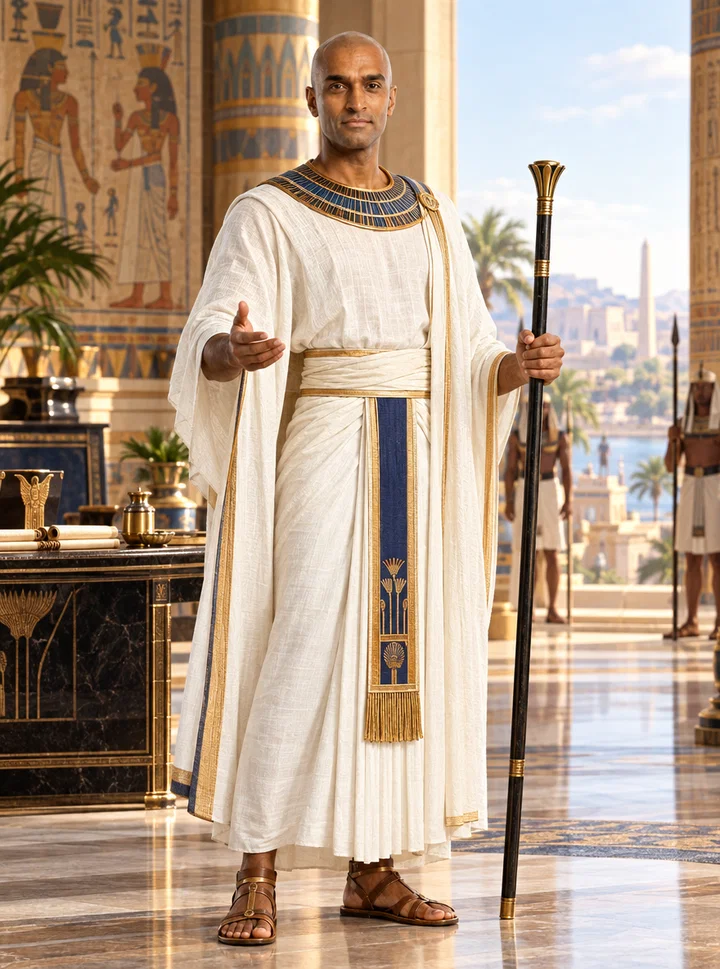
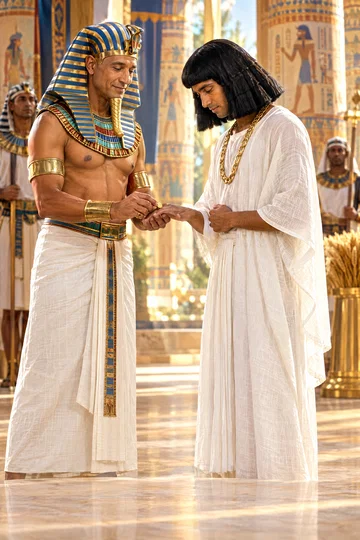
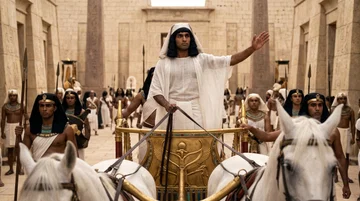
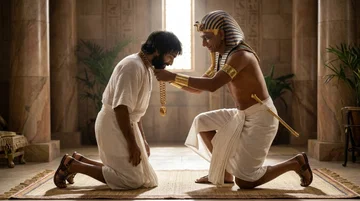
And he made him to ride in the second chariot which he had; and they cried before him, Bow the knee: and he made him ruler over all the land of Egypt.
Translations
American King James Version, King James Version
And he made him to ride in the second chariot which he had; and they cried before him, Bow the knee: and he made him ruler over all the land of Egypt.
and he made him to ride in the second chariot which he had; and they cried before him, Bow the knee: and he made him ruler over all the land of Egypt.
And he made him to ride in the second chariot which he had: and they cried before him, Bow the knee: and he made him ruler over all the land of Egypt.
Revised Version, American Standard Version
and he made him to ride in the second chariot which he had; and they cried before him, Bow the knee: and he set him over all the land of Egypt.
and causeth him to ride in the second chariot which he hath, and they proclaim before him, 'Bow the knee!' and — to put him over all the land of Egypt.
And he caused him to ride in the second chariot that he had; and they cried before him, Bow the knee! and he set him over all the land of Egypt.
and made him ride in the second chariot which belonged to him, and they cried out before him. Bow the knee! thus setting him over all the land of Egypt.
Berean Standard Bible, Majority Standard Bible
He had Joseph ride in his second chariot, with men calling out before him, “Bow the knee!” So he placed him over all the land of Egypt.
He made him ride in the second chariot which he had. They cried before him, “Bow the knee!” He set him over all the land of Egypt.
And he made him take his seat in the second of his carriages; and they went before him crying, Make way! So he made him ruler over all the land of Egypt.
So he set him vpon the best charet that hee had, saue one: and they cryed before him, Abrech, and placed him ouer all the land of Egypt.
Douay-Rheims (Challoner revision)
And he made him go up into his second chariot, the crier proclaiming that all should bow their knee before him, and that they should know he was made governor over the whole land of Egypt.
Pictures
Cross-references 20 of 28
- Psalms 105:21-22
He made him lord of his house, and ruler of all his substance:
Joseph is made ruler over Pharaoh’s house and teaches his officials wisdom.
- Genesis 39:20
And Joseph’s master took him, and put him into the prison, a place where the king’s prisoners were bound: and he was there in the prison.
contrasts prison cell with standing next to throne
- Genesis 37:5-11
And Joseph dreamed a dream, and he told it his brethren: and they hated him yet the more.
Joseph’s dreams foretold his future greatness.
- Genesis 40:12-20
And Joseph said unto him, This is the interpretation of it: The three branches are three days:
The dreams’ events occur within the stated three days, as foretold.
- Genesis 42:6
And Joseph was the governor over the land, and he it was that sold to all the people of the land: and Joseph’s brethren came, and bowed down themselves before him with their faces to the earth.
brothers unknowingly bow before him
- Genesis 39:4
And Joseph found grace in his sight, and he served him: and he made him overseer over his house, and all that he had he put into his hand.
Joseph is entrusted with authority in Potiphar’s house before ruling Egypt.
- Genesis 37:28
Then there passed by Midianites merchantmen; and they drew and lifted up Joseph out of the pit, and sold Joseph to the Ishmeelites for twenty pieces of silver: and they brought Joseph into Egypt.
weeping ride into slavery led to rulership
- Genesis 41:29-30
Behold, there come seven years of great plenty throughout all the land of Egypt:
Joseph foretells seven years of plenty followed by seven years of famine.
- Psalms 105:17
He sent a man before them, even Joseph, who was sold for a servant:
Both recount God sending Joseph ahead of his people.
- Genesis 41:16
And Joseph answered Pharaoh, saying, It is not in me: God shall give Pharaoh an answer of peace.
Joseph credits God with providing Pharaoh’s answer.
- Genesis 45:5-7
Now therefore be not grieved, nor angry with yourselves, that ye sold me hither: for God did send me before you to preserve life.
Joseph recognizes God sent him ahead to preserve lives during the famine.
- Genesis 50:20
But as for you, ye thought evil against me; but God meant it unto good, to bring to pass, as it is this day, to save much people alive.
God turned the brothers’ evil intent toward good.
- Genesis 41:1-7
And it came to pass at the end of two full years, that Pharaoh dreamed: and, behold, he stood by the river.
Both texts concern Joseph’s rise in Egypt following Pharaoh’s dreams.
- Genesis 42:2
And he said, Behold, I have heard that there is corn in Egypt: get you down thither, and buy for us from thence; that we may live, and not die.
grouped together in same prison-to-provision story
- Genesis 40:10-11
And in the vine were three branches: and it was as though it budded, and her blossoms shot forth; and the clusters thereof brought forth ripe grapes:
The dream’s grape harvest answers the objection about grape cultivation in Joseph’s time.
- Genesis 37:4
And when his brethren saw that their father loved him more than all his brethren, they hated him, and could not speak peaceably unto him.
Joseph was hated by his brethren before his exaltation.
- Psalms 105:18
Whose feet they hurt with fetters: he was laid in iron:
Joseph suffers in captivity before his elevation.
- Daniel 2:48
Then the king made Daniel a great man, and gave him many great gifts, and made him ruler over the whole province of Babylon, and chief of the governors over all the wise men of Babylon.
shares same second-rank position under Nebuchadnezzar
- Genesis 37:3
Now Israel loved Joseph more than all his children, because he was the son of his old age: and he made him a coat of many colours.
Joseph’s distinctive garment marked his favored status and heirship.
- Genesis 39:7-12
And it came to pass after these things, that his master’s wife cast her eyes upon Joseph; and she said, Lie with me.
Both accounts of Joseph’s life are challenged and confirmed by records.
Commentary
Each commentary is drawn from primary sources: the writings of Ellen G. White and Adventist pioneers and periodicals. Each commentary is separate. Its own words are not a quotation; follow the references to read the source passages.
Ellen G. White
16 sources
Pharaoh publicly invested Joseph as ruler over all Egypt next only to himself, setting him to ride in the royal second chariot while heralds called for all to kneel before him.PP 221.1–2Ms 18, 1897, par. 10 In a single sudden step he was lifted from a prison cell under false accusation and humiliation to stand beside the throne of the world's greatest empire in great honor and wealth.4T 544.1–26T 219.35T 124.1–2 He had been fitted for that trust by discipline in hardship and temptation, by humbling himself and learning obedience before receiving authority, while God overruled the designs of his enemies to exalt him in due time.1SP 133.2ST Jan 8, 1880Lt 28, 1909, par. 10 His sudden honor tested him by prosperity without lessening his regard for God's will, for he remained as faithful in the palace as in the prison, with his eye single to God's glory and his religion giving tone to all he did amid danger that exaltation breeds pride and self-sufficiency.4T 544.1–25T 124.1–2ED 51.3–41SP 138.2–139.1Ms 14, 1889, par. 13–14 He was entrusted there to carry out the plan that would preserve the nation and to shine as a light-bearer and representative of Christ, so that idolatrous Egypt and the nations connected with it would behold God's wisdom, justice, purity and love, and his elevation in fulfillment of the predicted years of plenty and famine shows that revealed times extending to Christ's coming can be trusted.GC 323.2–324.2GC88 323.2PP 221.1–26T 219.3Ms 18, 1897, par. 10
Elevation to Rule Egypt
Pharaoh set Joseph in public honor by having him ride in the second chariot and having a call to bow the knee go before him, and by that investiture made him ruler over all the land of Egypt in place just below Pharaoh himself.PP 221.1–2Ms 18, 1897, par. 10 The ride, the proclamation, and the rulership belong together as one open elevation to authority over the country.PP 221.1–2Ms 18, 1897, par. 10
That elevation came suddenly, lifting Joseph out of a prisoner's cell and dungeon and out of humiliation under false accusation to stand next to the throne of the world's greatest empire as second only to the king.4T 544.1–26T 219.35T 124.1–2ST Jan 8, 1880Ms 59, 1897, par. 11–14 With the change came great honor and wealth, raising a condemned prisoner to the ruler next to the throne.4T 544.1–26T 219.35T 124.1–2Ms 59, 1897, par. 11–14Ms 14, 1889, par. 13–14
The appointment put into his hands the carrying out of the plan that would preserve the nation.PP 221.1–2 It placed him where he could serve God's purpose by making the knowledge of God shine in an idolatrous nation.Ms 18, 1897, par. 10
He was fitted for that exalted position by what he passed through beforehand, obtaining experience by temptations, adversity, and hardships in the gloomy prison to prepare him to fill it.1SP 133.2ST Jan 8, 1880 Prison discipline taught him to govern and serve with responsibility, for he first humbled himself and learned obedience before authority over others was given to him.ST Jan 8, 1880Lt 58, 1880, par. 18 His education and abilities also prepared him for positions of trust, while God overruled the plans of his enemies for good and exalted him in due time.ST Jan 8, 1880Lt 28, 1909, par. 10
Faithfulness Tested by Prosperity
Genesis 41:43 is a test of prosperity, for Joseph's sudden elevation to great wealth and honor as ruler next to the king did not diminish his regard for God's will.4T 544.1–2Ms 59, 1897, par. 11–14Ms 14, 1889, par. 13–14 Lifted from the prisoner's cell to stand next to the throne as ruler over all Egypt, he showed the same fidelity in Pharaoh's palace as in the prisoner's cell.5T 124.1–2ED 51.3–4Ms 14, 1889, par. 13–14 He bore alike the test of adversity and the test of prosperity, preserving his integrity under exaltation just as in prison.5T 124.1–2ED 51.3–4Ms 59, 1897, par. 11–14 Though separated from his family and often saddened as a stranger in a foreign land, he trusted that God had guided his course and placed him there.1SP 138.2–139.1 Depending continually on God, he carried out his duties as ruler faithfully.5T 124.1–21SP 138.2–139.1
He was one of the few who could withstand temptation, keeping his eye single to the glory of God and showing a lofty regard for God's will in exaltation.5T 124.1–2 The love and fear of God kept him pure, so his high position did not stain his character.Ms 14, 1889, par. 13–14 He carried his religion with him into his high place, letting it give tone to everything he did and faithfully discharging the duties belonging to the situation where God had placed him.5T 124.1–2
The lofty height of success and honor over Egypt brings danger, where great changes of fortune test character.ED 51.3–4 Fierce temptations that leave the lowly untouched assail those in honor.ED 51.3–4 His example shows the danger of becoming proud and self-sufficient when exalted to power next to the throne.Ms 14, 1889, par. 13–14
Prophecy Fulfilled and Witness
The chariot ride belongs to the foretelling of Pharaoh's seven years of plenty followed by seven years of famine.GC 323.2–324.2GC88 323.2 Those years were once only a matter of prophecy and then came to pass in accordance with the prediction.GC 323.2–324.2GC88 323.2 Fulfilled in this way, they prove that predicted events often occur within a given time.GC88 323.2 As one of those fulfilled time prophecies, the elevation shows that chronological periods in the Bible extending to the second coming of Christ are revealed times that can be trusted.GC 323.2–324.2
God placed Joseph next to the throne of the world's greatest empire after calling him from affliction and the dungeon, where he had proved true to his allegiance to the God of heaven as a servant of captives and a prey of ingratitude and malice.6T 219.3Ms 18, 1897, par. 10 His rise with public honor in Pharaoh's second chariot to rule over the land put him where he could serve God's purpose by making the knowledge of God shine in an idolatrous nation, and he remained faithful to that trust.6T 219.3Ms 18, 1897, par. 10 He was set there to be a light-bearer not to Egypt alone but to all the nations connected with that powerful kingdom, so that heavenly illumination might extend far and near.6T 219.3 All Egypt marveled at the wisdom God taught him, and by his wisdom and justice, by the purity and benevolence and devotion of his daily life and his devotion to the interests of the people, though idolaters, he displayed God's character.6T 219.3
By that life he was a representative of Christ, so that in their benefactor to whom all Egypt turned with gratitude and praise the heathen people, and through them all connected nations, would behold the love of their Creator and Redeemer.6T 219.3 The public honoring and authority given over all Egypt thus presents him as a public example of fruitful character for faith institutions to represent their faith to the world.HPMMW 6.2–3 His education and abilities fitting him for trust and his appointment as ruler support training workers and ministers in both physical and mental powers.Lt 28, 1909, par. 10 The fruits of character in his life stand in contrast to the unfruitfulness of the Jewish nation in Christ's day.
Sources
Pioneers and periodicals
71 sources
Pharaoh set Joseph to ride as the highest subject in the kingdom, with public command for all to bow before him as ruler over the whole land under Pharaoh alone, who remained greater only in the throne.RH May 5, 1859ST Oct 16, 1901RH May 5, 1859 The honor lifted him in a single day from unjust imprisonment to the throne's side, after slavery, fetters and the dungeon had humbled and proved him innocent.ST Jan 3, 1911ST Jul 28, 1881RH Aug 3, 1916ST Dec 16, 1880 His rise came by God's providence through interpreting Pharaoh's dreams of plenty and famine and giving counsel to store food, so that Egypt and Jacob's house were preserved alive.ST May 9, 1878ST Jan 21, 1913ST Oct 16, 1901RH Jul 30, 1908ST Mar 11, 1913 His exaltation after suffering shows Christ's exaltation after death to rule with the Father while the Father remains above Him, whom all must bow to and confess as Lord.RH May 5, 1859RH May 5, 1859RH May 5, 1859 He was honored because he remained faithful and humble under trial, proving that loyalty to God comes before honor and fits the lowly for high trust.ST Jun 11, 1894ST Dec 25, 1901ST Jul 28, 1881ST Dec 8, 1881RH Jun 17, 1902
Words and Public Honors
The second chariot, the commanded homage, and the appointment as ruler over all Egypt display supreme and unlimited delegated authority, publicly confirming the appointment under Pharaoh, with Pharaoh remaining greater only in the throne.RH May 5, 1859ST Oct 16, 1901RH May 5, 1859 The elevation to second place was the highest honor to which a subject could be raised next to the king, parallel to the place afterward given to Daniel and to Mordecai.RH Jul 6, 1868 The herald cry before him is a call for reverence at the sight of an important person, commanded to be given as he rode in the second chariot as ruler over the land.ST May 20, 1880ST Dec 22, 1898
The words rendered Bow the knee are Egyptian words meaning Rejoice, so that the proclamation cried before him is rejoicing that the bread of life is coming.ST Jan 1, 1885 The fine linen garment given with the promotion marks great dignity and honor, and the public setting in the second chariot with proclamation of elevated rank confirms authority as ruler over Egypt.RH Dec 15, 1910 The ring placed upon him signified power and position entrusted to him, and as the ring given to the returning prodigal signified acceptance and restoration to the father's household, so the ring marked acceptance and authority.ST Oct 17, 1900ST Oct 17, 1900 The gold collar bestowed at the promotion was one of the marks of distinction among the Egyptians.ST Dec 14, 1915
Pharaoh was a title borne by successive kings of Egypt, not a personal name belonging only to the king who commended and exalted Joseph.RH Nov 12, 1861 The rule thus conferred began during the seven years of plenty.ST Apr 16, 1894 It was absolute over all the land, and the great emphasis laid upon the elevation was needed because many would receive the interpretation with hesitancy, and also to impress Joseph himself with his new position, since the humbleness of mind he had learned made him slow to assume the authority the position required.ST Oct 16, 1901
The promotion with its Egyptian honors is historically real and Egyptian in origin, not fiction or sun-deity myth, betrayed as Egyptian by the dreams of the Nile, kine, grain and sacred seven, the Egyptian words, the butler's duty over grape juice, the beheading of the baker, Joseph's shaving before Pharaoh, and the gold collar.ST Dec 14, 1915 A young Hebrew's rise to prime minister, once dismissed as romance, is supported by the monuments and depicted also in Egyptian literature. A foreigner elevated to ruler over all Egypt with high court honor, once objected to as unparalleled, is illustrated and confirmed by Egyptian monuments, and two letters found at Tell el-Amarna in 1887-88 from a Semite named Dudu show a Semite holding a court position similar to Joseph's, while the customs, manners, and history in the account prove remarkably accurate in every detail.RH Nov 9, 1916 That advancement made Joseph the highest Israelite ever to reach such a position in Egypt, with none reaching so high again until history repeated itself when the Khedive raised Julius Blum to Pasha and Assistant Secretary of State.ST Mar 11, 1880
From Prison to Ruler
Genesis 41:43 lifts Joseph from prison to rule over all Egypt after two years there humbling him though innocent of crime, so that present imprisonment prepared for a future throne, with pain today leading to pleasure tomorrow and crosses now leading to crowns soon.ST Jan 3, 1911RH Aug 3, 1916 Only after he was sold for a servant and thrown into the dungeon, with feet hurt with fetters and laid in iron until his word came and the word of the Lord tried him, did the king send and loose him and let him go free to make him lord of his house and ruler of all his substance, to bind princes at pleasure and teach senators wisdom.ST Jul 28, 1881ST Dec 16, 1880 From a boy sold into slavery, even a mere lad sold by his older brothers, he became many years afterward governor over all Egypt and the greatest man in the land.ST
The elevation came after he interpreted Pharaoh's dreams and advised storing food during seven years of plenty for seven years of famine, and he was then publicly honored and made ruler over the land.ST Oct 16, 1901RH Jul 30, 1908 His prophetic gift brought the honor, which he credited to God and not himself, with Pharaoh recognizing that God had shown what was coming and that God's Spirit gave wisdom to govern.ST Oct 16, 1901 That advancement through dream-interpretation belonged to God's providence to prepare for famine, to show Egypt that God directs destinies of nations, and to enable him to help companions in hardship and rescue Jacob's household.ST Oct 16, 1901ST Mar 11, 1913 God did not leave Joseph to go into Egypt alone, and angels prepared the way for his reception.ST Mar 24, 1887 The Lord was with him and prospered him and gave him favor with Potiphar, Pharaoh's officer and captain of the guard who bought him from the Ishmaelites, so that Potiphar entrusted all he had to Joseph's care and knew nothing except the bread he ate, since it was an abomination for a Hebrew to prepare food for an Egyptian.ST Mar 24, 1887
The elevation from prison to share the throne was ordered by Providence and not accident, with God's eye upon him and a divine hand leading him, and his earlier hardships belonged to God's plan though their purpose could not be seen as events unfolded.ST Nov 29, 1905 It came after varied experiences testing courage and uprightness to the fullest, being favored and entrusted with great responsibilities, then without fault unjustly accused and cast into prison, yet not discouraged because he trusted God, with purpose of heart and purity of motive made manifest. His brothers' casting him into a pit out of hatred to prevent his rise became the first step toward it.ST Nov 29, 1905 God turned their evil actions into providence for Joseph and blessing for them by sending him ahead to prepare the way for Abraham's descendants to go to Egypt, fulfilling the dreams in which his family bowed before him.ST Nov 29, 1905RH Nov 17, 1910
Up from the pit of death and out of the king's dungeon God brought the innocent victim of his brothers' cruel vindictiveness and a designing woman's caprice and revenge, exchanging brass fetters for gold jewels and foul prison alleys for the corridors of Egypt's proudest palace.ST Dec 23, 1913 The outcome shows God guiding and saving Joseph in his youth, with the unchanging God of Noah, Abraham, and Daniel keeping him.RH Nov 24, 1874 Angels encamped around and delivered him in trouble because he feared God, trusted Him, and had the God of Israel for his friend.RH Nov 24, 1874 He reached the position destined from his visit to his brothers at Dothan to inquire of their welfare, for God had a work for him and led him by painful and slow degrees to Egypt as the field of future greatness.ST Nov 29, 1905 By doing with his might whatever his hands found to do each day where he was, he was promoted in due time until he became ruler over all Egypt, with even wicked persons used as steps and free transportation to his appointed place.ST Nov 29, 1905 God's judgment thus overturned man's judgment, for man's judgment censured him as chief of sinners, cast him low, and sent the just man to prison, while God's judgment waited long to prove the winners of glory, then spoke and lifted the fallen Joseph to the height of power.RH Dec 24, 1867
God's Providence in Events
The history shows that God can guide a person to His intended end by a winding path and still bring him to the right end.RH Jan 19, 1860 From imprisonment and distress God by providence brought Joseph to a position of authority next to the king, where he could preserve Egypt and his family, bringing deliverance and light out of hardship.RH Aug 21, 1856 Through Pharaoh's dream and Joseph's interpretation God raised him from captivity to authority over Egypt to help his family and others during famine, bringing deliverance and blessing through circumstances that appear insignificant or harmful.ST Jan 21, 1889 After suffering and imprisonment his rise from affliction shows that God does not forsake His own and can bring joy and comfort out of deep sorrow.ST Feb 18, 1913
God turned adversity into wonderful blessing, for the boy whose plans and ambitions were blighted when he wept riding under a hot sun into slavery in a strange land became from the dungeon the greatest man in Egypt, a statesman of note greater in reality than Pharaoh who sat on the throne.RH May 25, 1916 The things that seemed to be against him were for him, because in the midst of temptation and sin he remained true to God, and when the fountains of comfort and hope had dried up the springs of God's salvation flowed fullest and freshest.RH May 25, 1916
God revealed the coming famine to Joseph, and that famine brought Jacob and his family to Egypt.ST May 9, 1878 The Lord was preparing Joseph to preserve the holy Seed.ST Jan 21, 1913 After interpreting Pharaoh's dreams and advising him to store food during seven years of plenty for seven years of famine, Joseph was made ruler over all Egypt, and his prophetic gift brought him this honor, which he credited to God and not to himself, while Pharaoh recognized that God had shown Joseph what was coming and that God's Spirit gave him wisdom to govern, so that the appointment both prepared for the famine and showed Egypt that God directs the destinies of nations.ST Oct 16, 1901 His promotion from slavery and prison to the second chariot and rulership over the land gave him a wider field of usefulness, enabling him to be a great blessing to his father's household and all Israel.ST Feb 17, 1909 After affliction and imprisonment he was made ruler by a turn God had chosen for a wise and beneficent purpose, preserving Jacob's family through the seven years of famine and making the true God known to an idolatrous nation. Elevated to authority in Egypt, he became the means by which Israel and his family, with the people of Egypt and other countries, survived the seven-year famine, for his brothers' sale of him into slavery was overruled so that their family, and thus the line through which the promised Seed would come, was preserved and given a place of safety.RH Nov 28, 1912
His captivity was God's providence preparing him for rulership over Egypt and for the relief of his own people, placing him where he could wield influence for the furtherance of God's cause in the earth and for the honor of God's name.ST Nov 18, 1897 His wise counsel and vigorous action during famine preserved the Egyptians from perishing, so that the Egyptians owed the Hebrews whom Joseph had saved a debt of gratitude.ST Feb 4, 1889 God rules in the kingdoms of men and is not confined to His own people in His workings, yet does nothing with which His people are not concerned and directly connected.RH Mar 14, 1865 To Pharaoh, a heathen ruler, God gave revelation about the future, but Joseph must give the explanation and be exalted to high authority, for the rise through Pharaoh's dream is God's casting down and setting up to open a way for His people, imparting instruction through His servants even when revelation is given to the heathen, going before His church to pilot it through its journey in a world blighted by sin.RH Mar 14, 1865 The bringing of Joseph before the king and making him ruler over all the land belongs to God's plan of missionary work to set truth before those of great influence, for God will have His name and truth brought to kings and others in authority even if His children must be forced through oppression or chastisement to bear the message, using them to make His power known to a whole nation, since if those of great influence accept the truth their endorsement goes far toward making a favorable impression upon the lower classes.ST Oct 12, 1904
Prophecy and Fulfillment
The lifting from prison to rule over Egypt after two years of humbling though innocent of crime brought the dreams that had stirred envy to fulfillment when the brothers came without knowing him and bowed low before him.ST Jan 3, 1911ST The rise from slavery to authority as a mighty statesman fulfilled the dreams given about the future, and the brothers' later submission during the famine was part of that fulfillment.RH Mar 2, 1916RH Nov 17, 1910 The land where he had seemed destined to die unknown became the setting in which the purpose was carried out, with evil actions turned into providence for him and blessing for them by sending him ahead to prepare the way for Abraham's descendants to go to Egypt.RH Mar 2, 1916RH Nov 17, 1910
The account belongs to the revealing through Pharaoh's dream and interpretation that seven years of plenty would be followed by seven years of famine, showing advance notice given before events took place.RH Jul 25, 1854ST Mar 23, 1882 The warning came in time for provisions to be stored during the plentiful years, saving multitudes in Egypt, Canaan, and other lands from starvation.ST Mar 23, 1882 Those predicted years occurred within the given time exactly as foretold, showing that events once only a matter of prophecy are fulfilled in accordance with the predictions.RH Apr 18, 1854RH Mar 31, 1868 This exact fulfillment gives ground for trusting chronological periods extending to the coming of the Saviour.RH Mar 31, 1868
Through the Spirit of prophecy the servant was brought into favor with the king, and the prophetic gift brought the honor of rulership over all the land.ST Dec 25, 1901ST Oct 16, 1901 Interpretation of the dreams was joined with wise counsel for the affairs of the kingdom to store food during the seven years of plenty for the seven years of famine, with credit given to the God of heaven and not to self for the wisdom shown.ST Dec 25, 1901ST Oct 16, 1901 The king saw the need to place a discreet and wise man over the kingdom, and the one best qualified was chosen, for those who honor God He will honor.ST Dec 25, 1901 It was recognized that God had shown what was coming and that God's Spirit gave the wisdom to govern, and the appointment served both to prepare for the famine and to show Egypt that God directs the destinies of nations.ST Oct 16, 1901
Christ and Other Parallels
Joseph's lifting from captivity and suffering to ride honored in public under authority and rule over all Egypt portrays the position of Christ in the present age after suffering and death, set down with the Father in the Father's throne and ruling the Father's kingdom by His word while the Father remains greater only in the throne.RH May 5, 1859RH May 5, 1859 The second chariot, the commanded homage, and the rulership over the land signify supreme and unlimited delegated authority under Pharaoh, even as authority over the kingdom was given to Jesus while the Father stayed superior to Him in the throne.RH May 5, 1859RH May 5, 1859
As Pharaoh highly exalted Joseph and commanded all to bow the knee before him, so after voluntary humiliation and shameful death God highly exalted Jesus to supreme ruler on God's throne with universal sway and requires all in heaven and on earth and under the earth to bow to Him and confess Him Lord to the glory of the Father.RH May 5, 1859 Refusal of this homage is rebellion against God deserving death, while sincere, deep and unreserved humiliation and great honor given to Jesus bring eternal life and partnership with Christ on His own throne when He takes possession of it.RH May 5, 1859 As Joseph's brethren humbled themselves before him, so sinners who by sin have crucified Jesus afresh must hasten to humble themselves and honor the exalted Jesus as Lord of all who loved them unto death.RH May 5, 1859
Because Pharaoh saw in Joseph a wisdom that would be the life of all the land after he had been sold by his brothers, taken to Egypt, kept in prison for years, and taught elders wisdom, a persecuted messenger carrying a life-saving message is to be honored and enthroned and sent quickly to deliver his message to the people, not jailed.RH Nov 30, 1905 He is to be met with kindness, patience, endurance, and blessing toward officers rather than harsh words, for jailing him cuts off the ruler's own life and dooms the people who need the message, while receiving him gives life to the ruler and to all the people.RH Nov 30, 1905 Joseph's authority over the kingdom and skillful management during the famine present a pattern of Joseph, Mary's husband, as guardian and protector of the church, God's kingdom on earth.ST Sep 30, 1889 Being raised to second place under Pharaoh was the highest honor to which a subject could be elevated next to the king, parallel to Daniel's place under Nebuchadnezzar and Mordecai's place under Ahasuerus.RH Jul 6, 1868 His elevation as prime minister over the leading government of his time shows that a prime minister may be a servant of God, for as a slave he was put in office by his master not through politics but through ability and personal integrity gained through faith in his God.ST Jun 21, 1905
Though unpopular and rejected among his brethren, Joseph was afterward exalted to reign over all the land riding in the second chariot, teaching that present unpopularity may precede future reign.ST Jan 20, 1881 As youthful ruler he is pictured casting wheat daily upon the yellow Nile to float down to his father, the sad old patriarch who believed him dead, as a sign that there was bread in Egypt to lure him past desert sands and scant oasis fringed with thirsty green toward love yearning for him unseen.ST Feb 10, 1881 This pictures missionary work in which small tokens are flung and scattered by dear hands on a swift rushing invisible tide from far fair lands to those abiding in the desert, telling the athirst that there are sheaves to bind and fullness to find if they follow on.ST Feb 10, 1881 The public honor and authority given over all Egypt point to fruits of character in Joseph's life in contrast to the unfruitfulness of the Jewish nation in Christ's day. His raising to high authority proves that God leads His workers individually in fulfillment of the new covenant promise and exemplifies what He wants His workers to be in the closing act of the world, with knowledge of His leadings bringing pleasure and inspiration to more and better work in medical missionary lines among those perishing spiritually and physically.RH Dec 20, 1906
Faithfulness and Present Application
Joseph was taken from jail and made ruler over all Egypt because he did his duty faithfully in prison and honored God in time of trial, for faithfulness comes before honor and those who honor God He will honor.ST Jun 11, 1894ST Dec 25, 1901 His exaltation came because he honored God, interpreted Pharaoh's dreams and gave wise counsel for the kingdom while giving the God of heaven credit for the wisdom shown, so that when a discreet and wise man was needed he was best qualified and chosen.ST Dec 25, 1901 Loyalty is highly honored in God's kingdom, and enduring rebuke and suffering affliction for Christ brings high favors from the King of kings, just as earthly governments reward loyalty in trying positions with special favors.RH Jun 17, 1902 The high position as prime minister and ruler over all the land was the reward of growing from a willing and helpful child into a trustworthy manager, for even though his brothers hated him with cruelty and jealousy he did not complain on the errand that led to betrayal, and that faithful helpfulness fitted him to bear grave responsibility.ST Apr 29, 1908
The hardships of slavery and imprisonment taught him patience, humility, and submission, and he ruled with humility and in the fear of God, faithfully exercising the trust given him.RH Mar 9, 1869 His hardships and temptations prepared him for that high position after false accusation and humiliation, and God overruled his enemies' plans for good to exalt him in due time.ST Jan 8, 1880RH Mar 9, 1869 That humiliation prepared him for the work of his high office, so that without first being made slave and prisoner he could never have done it.ST Dec 8, 1881 This teaches humility before glory: those seeking honor from God must live in profound humility before Him, for God exalts those who humble themselves and brings low those who exalt themselves, elevating the humble to sit with Christ on His throne and abasing the proud to reproach and dishonor.ST Jul 28, 1881ST Dec 8, 1881
His record of firmness of character, uprightness, and wisdom was the result of careful training in early years consulting duty rather than inclination, so that the purity and simple trust of the boy bore fruit in the deeds of the man after varied experiences testing courage and uprightness to the fullest, from being sold into Egypt and favored with great responsibilities to being unjustly accused without fault and cast into prison yet not discouraged because he trusted God with purpose of heart and purity of motive manifest. His life so teaches youth today to gain solidity of character to be fitted for usefulness and to share in the earnest work to be done in this age, since the elevation was not accident but ordered of Providence with God's eye upon him and a divine hand leading him. Neither hardship nor prosperity turned him from faithfulness in Potiphar's house and in prison and in honor, so God could use him for great things after proving faithful and dependable.RH Nov 27, 1913 Those honors as second under Pharaoh with authority over Egypt did not lessen devotion to God any more than imprisonment and separation had diminished it, showing faithfulness depends on the heart and not on whether one is in hardship or in honor.RH Jul 11, 1871RH Nov 27, 1913
After imprisonment he shone out on all Egypt, cloudless as the sky where rain never falls, with glory from within like the sun which God has given light in itself and therefore cannot but shine, not like the moon glittering with borrowed light.RH Jul 24, 1856 Put where he will, even in prison, he shines, and confinement only makes his light more intense, so that honored throughout Egypt and made its ruler his influence could shine across the land.RH Jul 24, 1856RH Mar 27, 1856 Up from the pit of death and out of the king's dungeon God brought the innocent victim of his brothers' cruel vindictiveness and a designing woman's caprice and revenge, exchanging brass fetters for gold jewels and foul prison alleys for the corridors of Egypt's proudest palace to make him ruler over all the land.ST Dec 23, 1913 No pit is so deep and no dungeon so black that the eye of the Eternal cannot pierce it, and light arising in darkness to the upright who hold fast integrity brings courage, cheer, hope, and happiness to the weakest, humblest, faint-hearted, and most despondent children of God.ST Dec 23, 1913 His youth as ruler over all the land proves that little children and youth called to Jesus who seek Him early will find Him and be guarded by angels in trouble, for the unchanging God of Noah, Abraham, and Daniel kept him because he feared God, trusted Him, and had the God of Israel for his friend.RH Nov 24, 1874 Sold as a mere lad into slavery by his older brothers, he many years afterward became governor and prime minister over all Egypt, the great world kingdom, and that exaltation came through faithfulness to God.STST Dec 14, 1915
Sources