John 18:34
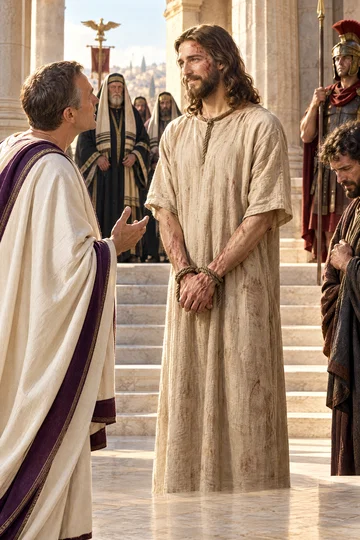
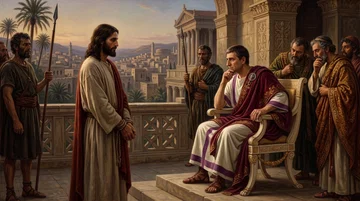
Jesus answered him, Sayest thou this thing of thyself, or did others tell it thee of me?
Translations
Jesus answered him, Say you this thing of yourself, or did others tell it you of me?
King James Version, KJV Cambridge Paragraph Bible
Jesus answered him, Sayest thou this thing of thyself, or did others tell it thee of me?
Jesus answered him, Sayest thou this thing from thyself, or did others tell it thee concerning me?
Revised Version, American Standard Version
Jesus answered, Sayest thou this of thyself, or did others tell it thee concerning me?
Jesus answered him, 'From thyself dost thou say this? or did others say it to thee about me?'
Jesus answered [ him], Dost thou say this of thyself, or have others said it to thee concerning me?
Jesus answered—Of thyself, art, thou, this thing saying; or did, others, tell thee concerning me?
“ Are you saying this on your own,” Jesus asked, “ or did others tell you about Me?”
“ Are you saying this on your own,” Jesus asked him, “ or did others tell you about Me?”
Jesus answered him, “ Do you say this by yourself, or did others tell you about me?”
Jesus made answer, Do you say this of yourself, or did others say it about me?
Iesus answered him, Saiest thou that of thy selfe, or did other tell it thee of me?
Douay-Rheims (Challoner revision)
Jesus answered: Sayest thou this thing of thyself, or have others told it thee of me?
Pictures

Cross-references
- Matthew 27:11-14
And Jesus stood before the governor: and the governor asked him, saying, Art thou the King of the Jews? And Jesus said unto him, Thou sayest.
Jesus answers Pilate about being King of the Jews, then remains silent under accusation.
- Luke 23:1-3
And the whole multitude of them arose, and led him unto Pilate.
Jesus is accused of claiming kingship, prompting Pilate to question him.
- Mark 15:2
And Pilate asked him, Art thou the King of the Jews? And he answering said unto him, Thou sayest it.
Jesus and Pilate exchange words about Jesus being King of the Jews.
- John 19:1-16
Then Pilate therefore took Jesus, and scourged him.
Continues Jesus’ hearing before Pilate, including his scourging and mockery.
- John 19:7
The Jews answered him, We have a law, and by our law he ought to die, because he made himself the Son of God.
gives blasphemy charge Pilate faced
- Luke 23:3
And Pilate asked him, saying, Art thou the King of the Jews? And he answered him and said, Thou sayest it.
Pilate questions Jesus about being king of the Jews.
- John 19:9-11
And went again into the judgment hall, and saith unto Jesus, Whence art thou? But Jesus gave him no answer.
Cited when asking why Jesus answered some questions and refused others.
Commentary
Each commentary is drawn from primary sources: the writings of Ellen G. White and Adventist pioneers and periodicals. Each commentary is separate. Its own words are not a quotation; follow the references to read the source passages.
Ellen G. White
12 sources
Jesus stands bound as a prisoner in Pilate's judgment hall after the Sanhedrin has condemned Him and brought Him to Pilate for legal judgment, while the Jewish authorities press to have their sentence carried out and Pilate investigates the charges instead of merely accepting their demand for condemnation.DA 723.1–724.1Ms 72, 1902, par. 15Ms 107, 1893, par. 2 The questioning to which John 18:34 belongs is part of that examination, and after asking what truth is Pilate leaves without waiting for an answer and declares that he finds no fault in Jesus.COS 140.1–5Ms 107, 1893, par. 2 Behind what transpires in the judgment hall lies a larger conflict, for Jesus is in the hands of a lawless mob whose hearts are filled with a violence that only Satan can inspire.Ms 72, 1902, par. 15 That violence flows from Satan's hatred for Christ because of His position in the courts of God, a hatred increased when Satan was dethroned and when Christ pledged Himself to redeem sinners, pursued from the manger to the cross in a constant striving to gain the mastery over Him, filling priests and rulers with hatred and joining his agents disguised in the robes of priests and rulers with the lowest and most degraded to take the life of the Son of God.Ms 72, 1902, par. 15
By His question Jesus asks Pilate whether his inquiry about kingship, Art Thou the King of the Jews, comes from Pilate's own judgment, inquiry, conviction and desire to know or only from what others have told him and from the accusations brought by others.ST Jan 24, 1900Lt 100, 1910, par. 12–15Ms 51, 1897, par. 29–30Lt 290, 1906, par. 6–73SP 130.2–131.2 The question thus distinguishes Pilate's personal understanding from the charge and turns him toward the source and meaning of the accusation.ST Jan 24, 1900Lt 100, 1910, par. 12–15 It is purposeful, meant to reveal to Pilate how his mind has been influenced, to learn whether he wants to receive light, to lead him to examine his own heart, and to give him opportunity to recognize the conviction stirring in him.ST Jan 24, 19003SP 130.2–131.25RED 50.2–51.1COS 139.1–6ST Jul 4, 1878 Pilate's reply shows that the charge came from Jesus' own nation and its chief priests while Pilate weighs what they brought against Him.Ms 51, 1897, par. 29–30
Pilate is inwardly moved at the time, for though his mind is confused he longs to know the truth.COS 140.1–55RED 50.2–51.1 Jesus' dignified bearing and calm self-control have won his respect and awakened a desire for clearer faith, while the Spirit of God strives with him so that he feels conviction and sees his heart opened.5RED 50.2–51.1COS 139.1–6ST Jul 4, 1878 Pride overpowers that work of the Spirit, so instead of responding Pilate turns the question back to Jesus.5RED 50.2–51.1COS 139.1–6ST Jul 4, 1878 His evasion leaves unanswered the opportunity to respond to the conviction stirring in him.3SP 130.2–131.25RED 50.2–51.1ST Jul 4, 1878
Jesus then explains that His kingdom is not worldly and that His servants do not fight to prevent His delivery, and that He was born and came into the world to bear witness to the truth which all who are of the truth hear.ST Jan 24, 1900Lt 290, 1906, par. 6–7 To this Pilate answers by asking what truth is and then leaves without waiting for an answer.COS 140.1–5Lt 290, 1906, par. 6–7 The accusations rest on testimony that contradicts itself and has no value, so Pilate declares Jesus faultless and finds no fault in Him, yet offers to release Him at the Passover and yields when the crowd cries out for Barabbas the robber instead.COS 140.1–5Lt 290, 1906, par. 6–7Ms 107, 1893, par. 2 This trial foreshadows the very experience God's people will have to pass through, watched by Christ who sees every circumstance of life with all things open before Him, who will sustain those who brace up for His sake as they stand on the elevated platform of eternal truth while every false platform is shaken to pieces, refuse to trust in man or afflict their souls over men's words, cling to the mighty One and lean wholly on Jesus, walk humbly before God, and grow strong by ever repeating how sure and steadfast is the truth as it is in Jesus, whose word is truth and power to every believing soul.Lt 290, 1906, par. 6–7
Sources
Pioneers and periodicals
22 sources
Inside the palace during the Roman civil trial, in private answer to Pilate's question whether He is the King of the Jews, Jesus asks whether Pilate speaks from his own judgment, concern and desire to learn or only repeats the charge and accusation others have told him.ST Jan 24, 1900ST May 6, 1897ST Oct 31, 1916ST Dec 1, 1898 The question turns Pilate back upon the source and meaning of the accusation to uncover how far he has been influenced toward the truth, giving him opportunity to recognize that influence, acknowledge conviction, and seek light from Christ.ST Jan 24, 1900ST May 10, 1905ST Sep 30, 1886 When plainly questioned He does not deny His relationship and mission but affirms He is a King, born and come into the world to bear witness to the truth, yet His kingdom is not of this world and not from hence, for otherwise His servants would fight so He would not be delivered to death.ST Jan 24, 1900ST May 25, 1904ST Jun 7, 1899RH Jul 31, 1900ST Sep 30, 1886 His calm self-control and utter lack of defense or resistance under threat and insult show absolute submission to undeserved injury in trust toward the Father's purpose that the success of Messiah's kingdom depends upon the death of the King, setting an example of patience for all His followers.ST Jun 18, 1912ST May 25, 1904ST Jun 7, 1899RH Aug 25, 1859
Trial Before Pilate
The saying was spoken inside the palace during the civil trial before the Roman governor, in private answer to his question whether the prisoner was King of the Jews.ST May 6, 1897ST Dec 1, 1898ST Oct 18, 1905 It belongs to the account of being brought before Pilate as part of the trial that precedes the sentence of crucifixion.ST Oct 31, 1916ST Oct 18, 1905 That trial stands amid abuse by the crowd and rulers, before condemnation and being led to Calvary.ST Oct 31, 1916 When questioned privately about the charges, the answer candidly stated who he was and what his mission to earth was.ST Dec 1, 1898
By the question he asks Pilate whether he calls him King of the Jews from his own judgment, concern, and desire to learn, or because others have told him the charge and accusation concerning him.ST Jan 24, 1900ST May 6, 1897ST May 10, 1905ST Jun 14, 1905 The inquiry presses for clarification whether the charge comes from Pilate's own inquiry or from what others reported about him.ST May 10, 1905ST Jun 14, 1905ST May 10, 1905 It turns him toward the source and meaning of the accusation, and is followed by explanation that the kingdom is not worldly and that he came to bear witness to the truth.ST Jan 24, 1900
The question seeks to uncover how far he has been influenced toward the truth.ST Jul 4, 1878ST Sep 30, 1886ST Oct 26, 1882 It gives opportunity to recognize that influence, to acknowledge it, to seek light from Christ, and to respond to conviction and receive light.ST Jul 4, 1878ST May 10, 1905ST Sep 30, 1886ST May 10, 1905ST Oct 26, 1882 It probes whether the question about kingship came from his own desire to know and genuine wish to learn from the prisoner, or only from the accusations the Jews had made.ST May 10, 1905ST Sep 30, 1886ST May 10, 1905
The respectful form of Pilate's question showed conviction had already stirred him.ST Oct 26, 1882 The dignified bearing and calm self-control of the prisoner had won his respect and awakened desire for clearer faith.ST Jul 4, 1878ST Oct 26, 1882 But pride overpowered the Spirit of God and overcame that conviction.ST Jul 4, 1878ST Oct 26, 1882 His reply that he was not a Jew showed he had no personal concern with the Jewish claim to a king, but was addressing the accusation brought by the prisoner's own people.ST Jun 18, 1912
The direct exchange with the Roman governor shows the two could communicate in a language both knew, likely the Greek spoken in their period, illustrating the use of a common language across different peoples.RH May 20, 1915 While west-Aramaic, the tongue of the common people, was the language in which he thought and commonly spoke, he had sufficient acquaintance with the other current tongues to hold conversation with the governor.ST Mar 10, 1881 Those tongues were Latin, the language of official life, and Greek, the medium of polite intercourse.ST Mar 10, 1881
Kingdom and Witness to Truth
When plainly questioned in private about the charges, Jesus spoke candidly and did not deny His relationship and mission, stating openly who He was and what His mission to earth was.ST May 25, 1904ST Sep 30, 1886ST Dec 1, 1898 His answer, Thou sayest, was equivalent to an affirmative, yet He did not claim to be King in the sense His accusers inferred.ST May 25, 1904RH Mar 25, 1875 He affirmed that He is a king, born and come into the world to bear witness to the truth, while declaring that His kingdom is not of this world.ST May 25, 1904RH Jul 31, 1900RH Mar 25, 1875 That truth is the truth as it is in Him, the power of God unto salvation to everyone that believes it, which drew Pilate's astonished question, What is truth.RH Jul 31, 1900RH Mar 25, 1875 Even when confessing His relationship with God put Him at risk of death, He would not deny it.ST Sep 30, 1886ST Dec 1, 1898
Pilate's question, Art Thou the King of the Jews, arose out of the Jewish charge that Jesus was perverting the nation, forbidding tribute to Caesar, and saying He Himself is Christ a King.ST May 25, 1904ST Oct 4, 1910 That charge presented Him as a rival to Pilate and to Caesar, setting up a kingdom and civil government for Himself.ST May 25, 1904ST Oct 4, 1910 It was false, because Jesus had plainly taught to give Caesar all that was due to him.ST May 25, 1904
He explained the nature of His kingdom, that it is not of this world and not from hence, for if it were of this world His servants would fight so He would not be delivered to the Jews.ST May 25, 1904RH Mar 25, 1875ST Oct 4, 1910 Neither He nor His subjects offered resistance, and His lack of defense showed absolute submission to undeserved injury and insult.ST May 25, 1904ST Jun 7, 1899 One whose kingdom was of this world would not suffer himself to be put to death when it was in his power to prevent it.ST May 25, 1904 The success of Messiah's kingdom depended upon the death of the King, and in wholly indifferent attitude under threatening circumstances Jesus was simply trusting in the fulfilment of the Father's purpose regardless of what man could do to Him.ST Jan 24, 1900ST May 25, 1904
He answered frankly for Himself and for His church, His body, for all time, that His kingdom is not of this world.ST Oct 4, 1910 The kingdoms of this world can never come to Jesus Christ through the gateway of politics, never by force of civil power, law and law enforcement, sword as well as statute, bullet as with ballot.ST Oct 4, 1910 With composed and noble bearing despite abuse, His real suffering and humiliation were not an idle spectacle, for the Son of God came in human nature to rescue His chosen people and make possible the destruction of Satan and his followers.ST May 25, 1904RH Aug 25, 1859 In that trust He sets an example of patience for all His followers.ST May 25, 1904ST Jun 7, 1899
Sources