John 19:9
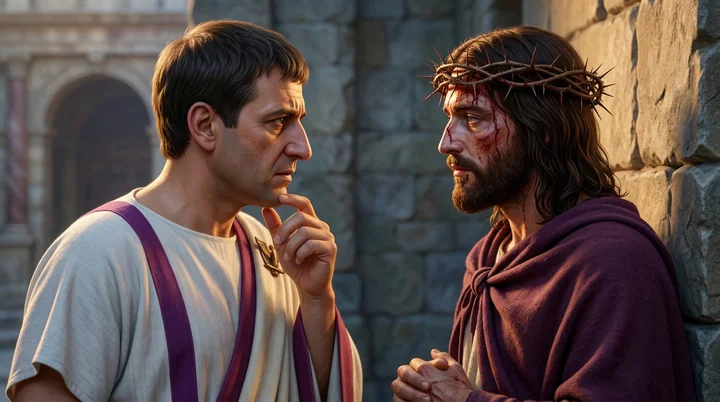
And went again into the judgment hall, and saith unto Jesus, Whence art thou? But Jesus gave him no answer.
Translations
And went again into the judgment hall, and says to Jesus, From where are you? But Jesus gave him no answer.
And went again into the judgment hall, and saith unto Jesus, Whence art thou? But Jesus gave him no answer.
and went again into the judgment hall, and saith unto Jesus, Whence art thou? But Jesus gave him no answer.
And went again into the judgment-hall, and saith to Jesus, Whence art thou? But Jesus gave him no answer.
and he entered into the palace again, and saith unto Jesus, Whence art thou? But Jesus gave him no answer.
and he entered into the Prætorium again, and saith unto Jesus, Whence art thou? But Jesus gave him no answer.
and entered again to the praetorium, and saith to Jesus, 'Whence art thou?' and Jesus gave him no answer.
and went into the praetorium again and says to Jesus, Whence art thou? But Jesus gave him no answer.
and entered into the judgment-hall again, and saith unto Jesus—Whence, art, thou? But, Jesus, gave him no, answer.
Berean Standard Bible, Majority Standard Bible
and he went back into the Praetorium. “ Where are You from?” he asked.But Jesus gave no answer.
He entered into the Praetorium again, and said to Jesus, “ Where are you from?” But Jesus gave him no answer.
And he went again into the Praetorium and said to Jesus, Where do you come from? But Jesus gave him no answer.
And went againe into the common hall, and saide vnto Iesus, Whence art thou? But Iesus gaue him none answere.
Douay-Rheims (Challoner revision)
And he entered into the hall again, and he said to Jesus: Whence art thou? But Jesus gave him no answer.
Pictures
Cross-references
- John 18:37
Pilate therefore said unto him, Art thou a king then? Jesus answered, Thou sayest that I am a king. To this end was I born, and for this cause came I into the world, that I should bear witness unto the truth. Every one that is of the truth heareth my voice.
Jesus had already told Pilate his identity and mission.
- Matthew 27:24
When Pilate saw that he could prevail nothing, but that rather a tumult was made, he took water, and washed his hands before the multitude, saying, I am innocent of the blood of this just person: see ye to it.
Pilate declares Jesus innocent yet hands Him over to be crucified.
- Matthew 27:14
And he answered him to never a word; insomuch that the governor marvelled greatly.
Jesus remains silent when questioned by Pilate.
- John 18:28
Then led they Jesus from Caiaphas unto the hall of judgment: and it was early; and they themselves went not into the judgment hall, lest they should be defiled; but that they might eat the passover.
The trial unfolds in the Passover setting, establishing the timing of Christ’s sacrifice.
- John 18:36
Jesus answered, My kingdom is not of this world: if my kingdom were of this world, then would my servants fight, that I should not be delivered to the Jews: but now is my kingdom not from hence.
Jesus had told Pilate his kingdom was not of this world.
- Isaiah 53:7
He was oppressed, and he was afflicted, yet he opened not his mouth: he is brought as a lamb to the slaughter, and as a sheep before her shearers is dumb, so he openeth not his mouth.
Both texts show Jesus enduring accusers in silence.
- Mark 15:1-20
And straightway in the morning the chief priests held a consultation with the elders and scribes and the whole council, and bound Jesus, and carried him away, and delivered him to Pilate.
Cited as a parallel account of Jesus before Pilate and the events leading to crucifixion.
- Mark 14:60-62
And the high priest stood up in the midst, and asked Jesus, saying, Answerest thou nothing? what is it which these witness against thee?
Contrasts Jesus' silence with his answer to the high priest.
- Luke 23:1-25
And the whole multitude of them arose, and led him unto Pilate.
Cited as a parallel account of Jesus’ trial and condemnation.
- Matthew 27:2
And when they had bound him, they led him away, and delivered him to Pontius Pilate the governor.
Both describe events during Jesus’ trial before his crucifixion.
- John 18:38-40
Pilate saith unto him, What is truth? And when he had said this, he went out again unto the Jews, and saith unto them, I find in him no fault at all.
The passage groups this account with the Son’s rejection.
- Matthew 27:19
When he was set down on the judgment seat, his wife sent unto him, saying, Have thou nothing to do with that just man: for I have suffered many things this day in a dream because of him.
Pilate’s wife warns him about the innocent Jesus before the sentence.
Commentary
Each commentary is drawn from primary sources: the writings of Ellen G. White and Adventist pioneers and periodicals. Each commentary is separate. Its own words are not a quotation; follow the references to read the source passages.
Ellen G. White
11 sources
When the Jews charged that Jesus had made Himself the Son of God, Pilate was made more afraid and went back again into the judgment hall to ask Him whence He was.5RED 64.2–65.1ST Jul 11, 1878ST Nov 2, 1882RH Jan 23, 1900ST Jun 3, 1889 In asking where He came from, Pilate suspected that He might be a divine person.ST Jul 11, 1878 When Pilate asked, Jesus gave him no answer and remained silent.3SP 145.1–25RED 64.2–65.1ST Jul 11, 1878ST Nov 2, 1882RH Jan 23, 1900
His silence was because He had already told Pilate that He was the Messiah.3SP 145.1–25RED 64.2–65.1ST Jul 11, 1878ST Nov 2, 1882ST Jun 3, 1889 He had also already told Pilate that His kingdom was not of this world.3SP 145.1–25RED 64.2–65.1ST Jul 11, 1878ST Jun 3, 1889 He had no further words for a judge who abused his office and authority as judge by yielding his principles and authority to a bloodthirsty crowd and its demands.3SP 145.1–25RED 64.2–65.1ST Jul 11, 1878ST Nov 2, 1882ST Jun 3, 1889
Pilate had disregarded the light Jesus had given about His mission, so Jesus' silence meant there was no further light for Pilate.DA 736.1–737.1 That abuse of authority by yielding to the mob is why no further answer was given.3SP 145.1–25RED 64.2–65.1ST Jul 11, 1878ST Nov 2, 1882DA 736.1–737.1 In the surrounding exchange Pilate's claim to power made him responsible for condemning Jesus, whom he knew to be innocent.Ms 40, 1897, par. 7–10
Although Pilate declared that he found no fault in Jesus, he surrendered the innocent Son of God to be crucified in order to protect his own position, choosing his office over Jesus.Ms 74, 1911, par. 17 Jesus' silence was part of His calm submission under humiliation and insult, in which He did not retaliate or use His divine power to escape, despite Satan's effort to provoke Him into doing so.Lt 12, 1911, par. 8–11 The questioning took place during His condemnation in the judgment hall, when the multitude would revile Him and call for His crucifixion.4RED 102.2–103.1 His disciples had been prepared for this trial by seeing the fickleness of those who had once followed Him, so that their faith would not rest on the crowd's changing opinions or be overwhelmed when their Master was betrayed and humiliated.4RED 102.2–103.1
Sources
Pioneers and periodicals
21 sources
Alarmed by the charge that Jesus had made Himself the Son of God, Pilate went back into the judgment hall and asked Him where He came from, and Jesus gave him no answer.ST Jul 11, 1878ST May 13, 1897ST May 13, 1897 He was silent because He had already told Pilate that He was the Messiah whose kingdom is not of this world, and He had no further words for a judge who abused his high office by yielding principle to the demands of a bloodthirsty mob.ST Jul 11, 1878ST Nov 2, 1882ST Jun 3, 1889 His silence was both judicial and merciful, for Pilate had no ears to hear Him, so further words would have been wasted and would only have increased his guilt.ST May 13, 1897ST Feb 6, 1907 Though repeatedly declaring Jesus innocent, Pilate acted with weakness and cowardice from self-interest, and when the Jews threatened that releasing Him would prove him no friend of Caesar, fear of ruin under a jealous emperor overcame him and he yielded to the crowd.RH Dec 9, 1858 Yet Pilate's power over Him existed only because it had been permitted from above, teaching that no power can act against God's cause or people unless God permits it for their good, which gives comfort in persecution.ST May 13, 1897
Pilate's Question and Context
When Pilate heard the charge that Jesus had made Himself the Son of God he was made more afraid, and he went back again into the judgment hall and asked Jesus whence He was, from where He had come, but Jesus gave him no answer.ST Jul 11, 1878ST Nov 2, 1882RH Jan 23, 1900ST May 13, 1897ST May 13, 1897 The question was asked because Pilate was alarmed by the claim to divine sonship and suspected Jesus might be a divine person.ST Jul 11, 1878ST Nov 2, 1882ST Jun 3, 1889 The exchange belongs to the events leading to the crucifixion, following a further private talk inside the hall after which Pilate, having no doubt of His innocence, was confirmed in his purpose and determined to let Him go and release Him.ST Jul 14, 1881RH Dec 9, 1858ST Nov 9, 1882 His silence amid abuse astonished Pilate, who had repeatedly declared Him innocent and was troubled by the claim that He was the Son of God.ST Nov 9, 1882RH Jun 15, 1911
Beforehand Pilate had ordered Jesus scourged as a first step toward execution.RH Dec 9, 1858 Roman soldiers mocked Him as a king with an old royal-colored robe, a crown of thorns, a reed for a scepter, bowing and hailing Him, spitting on Him and beating Him on the head so the thorns pierced Him.RH Dec 9, 1858 Pilate brought Him out exhausted, torn and bloody, hoping the sight would move the people to pity and consent to His release, but priests and people cried with unrelenting rage for Him to be crucified.RH Dec 9, 1858 After unmerited torture and mockery He was handed over to His persecutors to be crucified.RH Dec 9, 1858ST Mar 13, 1901
Although he declared Jesus innocent, Pilate revealed weakness and cowardice, letting self-interest keep him from defending Jesus.RH Dec 9, 1858 He acted with inconsistency by persistently appealing to the people to consent to his plain duty and by offering to cruelly scourge an innocent man to appease their unreasoning wrath.ST Mar 13, 1901 When he still sought to release Him the Jews threatened that letting Him go would prove him no friend of Caesar, and fear overcame him.RH Dec 9, 1858 Tiberius Caesar was a suspicious and jealous emperor ready to hear charges of treason against lesser rulers, so an accusation carried to Rome could ruin Pilate.RH Dec 9, 1858 For the sake of worldly interest he resisted conscience and ordered the execution to go forward under pressure from the crowd, facing the choice whether to condemn One whom he recognized as innocent.RH Dec 9, 1858
Meaning of Jesus' Silence
Alarmed by the charge that Jesus had made Himself the Son of God, Pilate went back into the judgment hall to ask where He came from, and Jesus gave him no answer.ST Jul 11, 1878ST Nov 2, 1882ST Jun 3, 1889ST Oct 7, 1886 He was silent because He had already told Pilate that He was the Messiah whose kingdom is not of this world.ST Jul 11, 1878ST Nov 2, 1882ST Jun 3, 1889ST Oct 7, 1886 He had no further words for a judge who abused his high office and authority by yielding principle to the demands of a bloodthirsty mob.ST Jul 11, 1878ST Nov 2, 1882ST Jun 3, 1889ST Oct 7, 1886 His silence vexed Pilate and drew a haughty rebuke.ST Oct 7, 1886
His silence was judicial, for Pilate had no ears to hear Him, so that speaking would have wasted words and increased Pilate's guilt.ST May 13, 1897ST Feb 6, 1907 It was merciful, withholding words Pilate would not receive and sparing Pilate blame as far as possible.ST May 13, 1897ST Feb 6, 1907 By contrast the Jewish judges who had rejected clear evidence of His divinity bore greater guilt.ST May 13, 1897 The refusal stands as an example of Jesus refusing some questions during His trial, in contrast with questions He answered.ST May 6, 1897
Silent before inquisitive Pilate amid scoffing and jeers and taunts, He opened not His mouth and kept a silence broken only on the cross to bestow benediction and blessing.ST Apr 7, 1881 His silence bespeaks reserve power, conscious strength, dignity, self-command and greatness.ST Apr 7, 1881 It shows that enduring reproach silently is right, and that silence is at times the best and most effective reply to empty babbling.ST Apr 7, 1881 There is a time to be silent as well as to talk, a habit to be cultivated before the lips nevermore speak.ST Apr 7, 1881
Prophecy Doctrine and Application
The trial before Pilate to which the going back into the judgment hall and the unanswered question of origin belong identifies the death of Christ as the fulfillment of the Passover on the fourteenth day of the first month.RH Oct 30, 1855RH Dec 15, 1868 His sacrifice is the Passover fulfilled on that appointed day, and this verse stands within the account of that fulfillment.RH Oct 30, 1855RH Dec 15, 1868
The same account shows Israel's rejection of the Son.ST Feb 5, 1902 The leaders of the professed church hated His teachings, demanded His death, and appealed to civil authority, whose power made His death possible.ST Oct 2, 1893 They accused Him of claiming to be the Son of God and of not keeping the Sabbath according to their customs, and Pilate sentenced Him to death, so that His execution on Calvary was that of a victim of religious legislation.ST May 19, 1914
His life was sacrificed in this cruel manner that our lives might be saved, while Barabbas, convicted of practically the same crime charged against Jesus, was cried for to be released.ST Mar 13, 1901
Jesus afterward explained that Pilate's power over Him existed only because it had been permitted from above.ST May 13, 1897 No power can therefore act against God's cause or people unless God permits it, and He permits only what will serve the good of those who love Him.ST May 13, 1897 This gives comfort to God's people when they face temptation and persecution.ST May 13, 1897
The sufferings of Christ set forth in this chapter can subdue pride and cast out discontent when read by fretful or gloomy Christians.ST Apr 17, 1879
Sources