Mark 15:2
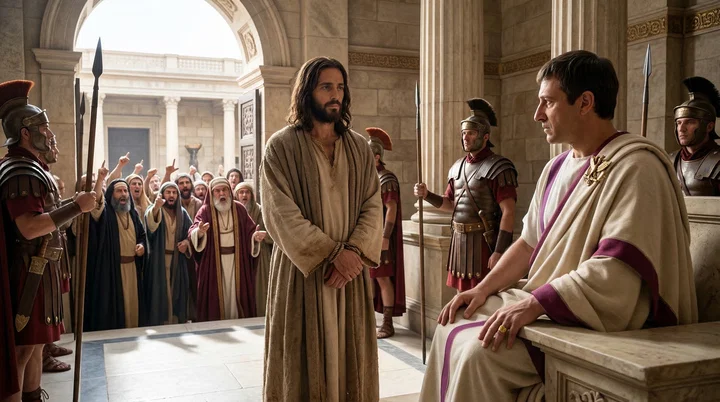
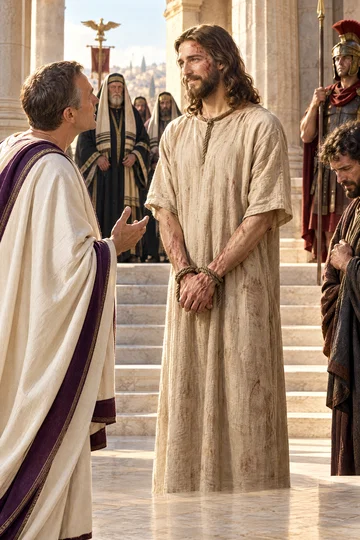
And Pilate asked him, Art thou the King of the Jews? And he answering said unto him, Thou sayest it.
Translations
And Pilate asked him, Are you the King of the Jews? And he answering said to them, You say it.
King James Version, KJV Cambridge Paragraph Bible
And Pilate asked him, Art thou the King of the Jews? And he answering said unto him, Thou sayest it.
And Pilate asked him, Art thou the King of the Jews? And he answering, said to him, Thou sayest it.
Revised Version, American Standard Version
And Pilate asked him, Art thou the King of the Jews? And he answering saith unto him, Thou sayest.
and Pilate questioned him, 'Art thou the king of the Jews?' and he answering said to him, 'Thou dost say [it].'
And Pilate asked him, Art thou the King of the Jews? And he answered and said to him, Thou sayest.
And Pilate questioned him—Art, thou, the king of the Jews? And, he, answering him, saith—Thou, sayest.
Berean Standard Bible, Majority Standard Bible
So Pilate questioned Him, “ Are You the King of the Jews?”“ You have said so,” Jesus replied.
Pilate asked him, “ Are you the King of the Jews?”He answered, “ So you say.”
And Pilate put a question to him, Are you the King of the Jews? And he, answering, said to him, You say so.
Then Pilate asked him, Art thou the King of the Iewes? And hee answered, and sayde vnto him, Thou sayest it.
Douay-Rheims (Challoner revision)
And Pilate asked him: Art thou the king of the Jews? But he answering, saith to him: Thou sayest it.
Pictures
Cross-references
- Matthew 27:11
And Jesus stood before the governor: and the governor asked him, saying, Art thou the King of the Jews? And Jesus said unto him, Thou sayest.
Pilate asks Jesus whether he is King of the Jews, and Jesus answers.
- Luke 23:3
And Pilate asked him, saying, Art thou the King of the Jews? And he answered him and said, Thou sayest it.
Jesus answers Pilate’s question about whether he is King of the Jews.
- John 18:33-37
Then Pilate entered into the judgment hall again, and called Jesus, and said unto him, Art thou the King of the Jews?
Pilate questions Jesus about his kingship, and Jesus explains the nature of his kingdom.
- Luke 23:4
Then said Pilate to the chief priests and to the people, I find no fault in this man.
Pilate declares Jesus innocent.
- Luke 23:8-11
And when Herod saw Jesus, he was exceeding glad: for he was desirous to see him of a long season, because he had heard many things of him; and he hoped to have seen some miracle done by him.
Herod questions Jesus, who remains silent before his accusers, and sends him back to Pilate.
- Luke 23:13-25
And Pilate, when he had called together the chief priests and the rulers and the people,
Pilate’s trial of Jesus leads to the crowd choosing Barabbas.
- Matthew 27:19
When he was set down on the judgment seat, his wife sent unto him, saying, Have thou nothing to do with that just man: for I have suffered many things this day in a dream because of him.
Pilate’s wife warns him against condemning Jesus after suffering in a dream.
- John 18:28
Then led they Jesus from Caiaphas unto the hall of judgment: and it was early; and they themselves went not into the judgment hall, lest they should be defiled; but that they might eat the passover.
Jesus is brought before the judgment hall for trial.
- John 18:37
Pilate therefore said unto him, Art thou a king then? Jesus answered, Thou sayest that I am a king. To this end was I born, and for this cause came I into the world, that I should bear witness unto the truth. Every one that is of the truth heareth my voice.
Jesus affirms to Pilate that he is a king.
- John 19:1-16
Then Pilate therefore took Jesus, and scourged him.
Continues Pilate’s judgment of Jesus, including the question of his kingship.
- Luke 23:2
And they began to accuse him, saying, We found this fellow perverting the nation, and forbidding to give tribute to Cæsar, saying that he himself is Christ a King.
The leaders accuse Jesus of claiming to be a king.
- Isaiah 53:7
He was oppressed, and he was afflicted, yet he opened not his mouth: he is brought as a lamb to the slaughter, and as a sheep before her shearers is dumb, so he openeth not his mouth.
His restrained answer fulfills the prophecy of the suffering servant’s silence.
- Matthew 26:62-63
And the high priest arose, and said unto him, Answerest thou nothing? what is it which these witness against thee?
Jesus answers Pilate while remaining silent before his accusers.
- Matthew 27:24
When Pilate saw that he could prevail nothing, but that rather a tumult was made, he took water, and washed his hands before the multitude, saying, I am innocent of the blood of this just person: see ye to it.
Pilate washes his hands to evade responsibility.
- John 12:13
Took branches of palm trees, and went forth to meet him, and cried, Hosanna: Blessed is the King of Israel that cometh in the name of the Lord.
The crowd had hailed Jesus as king.
- Mark 15:13
And they cried out again, Crucify him.
The crowd calls for Jesus to be crucified after his trial.
Commentary
Each commentary is drawn from primary sources: the writings of Ellen G. White and Adventist pioneers and periodicals. Each commentary is separate. Its own words are not a quotation; follow the references to read the source passages.
Ellen G. White
7 sources
This questioning belongs to the trial that followed the betrayal and the appearance before Herod, when Jesus was condemned and humiliated.ST Jun 3, 18894RED 102.2–103.1 He stood bound as a prisoner in the judgment hall of Pilate, the Roman governor, with a guard of soldiers around him and the hall filling with spectators, after the Jewish leaders had condemned him and come to have the sentence confirmed and executed.DA 723.1–724.1 The judges of the Sanhedrin, priests, rulers, elders, and mob stayed outside and refused to enter for fear that contact with Romans would defile them and keep them from the Passover, blind to how murderous hatred was defiling their hearts and to how Christ as the real Passover lamb made their rejection empty the feast of meaning.DA 723.1–724.1
Pilate was called in haste from his bedchamber at an early hour and first looked on Jesus without friendliness, determined to finish quickly and to deal with magisterial severity with one the Jewish authorities were anxious to try and punish in haste.DA 723.1–724.1 Jesus showed calm dignity under indignity, with no sign of guilt or fear and no boldness or defiance; his goodness, nobility, calm and dignified bearing, and heaven-marked countenance were unlike any other prisoner Pilate had seen, made a favorable impression, and roused Pilate's better nature.DA 723.1–724.1ST Jun 3, 1889 What Pilate had heard of Jesus and his works, what his wife had told him of the Galilean prophet who cured the sick and raised the dead, and rumors from several sources returning like a dream led him to resolve to demand the Jews' charges against the prisoner.DA 723.1–724.1
Pilate asked Jesus whether he was the King of the Jews, and Jesus answered that Pilate had said so.ST Jun 3, 1889ST Jul 4, 18785RED 50.2–51.1 The answer affirmed his kingship without directly explaining it, and it did not mean he was leading a revolt, seeking an earthly kingdom, or seeking earthly kingly honors, for his kingdom was not of this world.3SP 130.2–131.2ST Jul 4, 1878 Caiaphas, the priests, and the other accusers treated the answer as an admission that he sought to establish a throne in Judah in opposition to Caesar.ST Jun 3, 18893SP 130.2–131.2ST Jul 4, 18785RED 50.2–51.1
Jesus stood before Pilate as an innocent man, and Pilate, along with Herod, recognized that the accusations were unsupported and that he was innocent, viewing the charge as part of a plot to destroy him.ST Jun 3, 18895RED 50.2–51.1ST Jun 3, 1889 In private Pilate asked the question again, and Jesus asked whether Pilate spoke of himself or had heard it from others, giving him a chance to examine his own conviction.5RED 50.2–51.1 Though the multitude had once hailed him as king, he was now condemned and humiliated, and the reversal shows how fickle public favor is, preparing the disciples not to base their faith on the crowd's opinion of him.4RED 102.2–103.1
Sources
Pioneers and periodicals
13 sources
In his final trial in the morning before the Roman governor whose sentence was required for execution, after the chief priests had bound him and delivered him up following his appearance before Herod, Pilate asked whether he was the King of the Jews and he answered affirming that he was.ST Jun 3, 1889ST Jun 3, 1889ST May 25, 1904ST Oct 26, 1882RH Feb 11, 1862 His brief reply affirmed the title without explaining the nature of his kingship, and his accusers seized it as an admission that he sought to set up a throne in Judah against Caesar.ST Jun 3, 1889ST Jul 4, 1878ST Oct 26, 1882ST Oct 26, 1882 He sought no earthly kingly honors because his kingdom is not of this world, and both Pilate upon examination and Herod found in him no fault, no evidence of crime, and nothing worthy of death.ST Jun 3, 1889ST Jul 4, 1878ST Mar 13, 1901ST Oct 26, 1882 He met indignity with a meekness greater than that of Moses, answering only briefly and then remaining silent and unresentful under false charges, scourging and insult, like a lamb brought to the slaughter fulfilling Isaiah 53:7.ST Jun 3, 1889ST Oct 12, 1904ST Oct 27, 1898 Pilate's declaration that he found no fault in him stands as the world's official testimony that the just suffered once for sins for the unjust to bring sinners to God, yet after seeking to release him Pilate at last gave sentence to crucify him while still finding no fault in him.ST Jun 15, 1904ST Oct 12, 1904ST Mar 13, 1901
Trial Setting and Exchange
Pilate put to Jesus the question whether he was the King of the Jews, and Jesus replied to the effect, you say it.ST Jun 3, 1889ST May 25, 1904ST Oct 26, 1882ST Oct 26, 1882 That reply affirms the title but does not directly explain his kingship.ST Jul 4, 1878ST Oct 26, 1882 The priests with the high priest and the other accusers treated the reply as an admission that he sought to establish a throne in Judah against Caesar.ST Jun 3, 1889ST Jul 4, 1878ST Oct 26, 1882 Pilate was not persuaded that Jesus was guilty, but regarded him as innocent and the charge as part of a plot to destroy him.ST Jun 3, 1889ST Oct 26, 1882
The exchange belongs to Christ's trial before Pontius Pilate, the Roman governor whose sentence was required for an execution.ST May 25, 1904RH Feb 11, 1862 It came after the chief priests bound Jesus in the morning and delivered him up to Pilate.ST May 25, 1904 It followed his appearance before Herod.ST Jun 3, 1889 It stands in the final scene of his earthly life leading to his crucifixion.RH Jun 10, 1862
Jesus and Pilate conversed in a language they both understood, which shows he could speak the Greek of his period.RH May 20, 1915
Innocence and Meek Witness
Pilate examined Jesus and found no fault in him, no evidence of crime, and nothing worthy of death, and he was not persuaded that he was guilty of seeking to establish a throne against Caesar.ST Jun 3, 1889ST Mar 13, 1901ST Oct 26, 1882ST Oct 27, 1898 Herod likewise recognized that the accusations were unsupported and that Jesus was innocent.ST Jun 3, 1889 Pilate regarded the charge as part of a plot to destroy Jesus.ST Jun 3, 1889
Pilate's declaration that he found no fault in him was the world's official testimony that Christ was unjustly put to death.ST Jun 15, 1904 It proves that Christ suffered once for sins, the just for the unjust, to bring sinners to God, being put to death in the flesh but quickened by the Spirit.ST Jun 15, 1904 That a heathen judge could see Christ's innocence exposes the darkness of God's apostate people, who could not see it, showing how great is the darkness when the light within is darkness.ST Jun 15, 1904
Jesus showed flawless meekness greater than that of Moses, enduring indignity with calm dignity and trusting in a higher power.ST Jun 3, 1889ST Oct 12, 1904ST Oct 27, 1898 He answered Pilate only briefly and then remained silent and unresentful and unresisting under false charges, malignity, scourging, and insult, like a lamb brought to the slaughter and a sheep dumb before her shearers, literally fulfilling Isaiah 53:7.ST Oct 12, 1904ST Oct 27, 1898 Yet this meekness brought him no inheritance of the earth during his earthly pilgrimage.ST Oct 12, 1904 He was innocent of seeking a throne against Caesar because he was not seeking earthly kingly honors, for his kingdom is not of this world.ST Jul 4, 1878
The examination was God's presentation of the Gospel in glorious perfection before great Rome, with Pilate standing for Rome and Jesus standing for the Gospel.ST Oct 27, 1898 Christ's dignified bearing, unlike the criminals Pilate knew, convinced Pilate that he was more than man and appealed to his heart to do right whatever the consequences.ST Oct 27, 1898 Yet Pilate remained undecided because he feared the Jews, refused to identify himself with the suffering Innocent One, and sought to escape responsibility.ST Oct 27, 1898
Though Pilate sought to chastise and release Jesus, he was met with the united cry to away with Jesus and release Barabbas the insurrectionist and murderer.ST Mar 13, 1901 After appealing again with desire to release Jesus and being answered with crucify him, he at last gave sentence that what the people asked should be done.ST Mar 13, 1901 He thus passed sentence of death while finding no fault in him.ST Oct 12, 1904ST Mar 13, 1901
Sources