John 18:35
Pilate answered, Am I a Jew? Thine own nation and the chief priests have delivered thee unto me: what hast thou done?
Translations
Pilate answered, Am I a Jew? Your own nation and the chief priests have delivered you to me: what have you done?
King James Version, KJV Cambridge Paragraph Bible
Pilate answered, Am I a Jew? Thine own nation and the chief priests have delivered thee unto me: what hast thou done?
Pilate answered, Am I a Jew? Thy own nation, and the chief priests, have delivered thee to me: What hast thou done?
Revised Version, American Standard Version
Pilate answered, Am I a Jew? Thine own nation and the chief priests delivered thee unto me: what hast thou done?
Pilate answered, 'Am I a Jew? thy nation, and the chief priests did deliver thee up to me; what didst thou?'
Pilate answered, Am I a Jew? Thy nation and the chief priests have delivered thee up to me: what hast thou done?
Pilate answered—Am, I, a Jew? Thine own nation, and the High-priests, delivered thee up, unto me! What, hast thou done?
Berean Standard Bible, Majority Standard Bible
“ Am I a Jew?” Pilate replied. “ Your own people and chief priests handed You over to me. What have You done?”
Pilate answered, “ I’m not a Jew, am I? Your own nation and the chief priests delivered you to me. What have you done?”
Pilate said, Am I a Jew? Your nation and the chief priests have given you into my hands: what have you done?
Pilate answered, Am I a Iewe? Thine owne nation, and the hie Priestes haue deliuered thee vnto me. What hast thou done?
Douay-Rheims (Challoner revision)
Pilate answered: Am I a Jew? Thy own nation, and the chief priests, have delivered thee up to me: what hast thou done?
Pictures

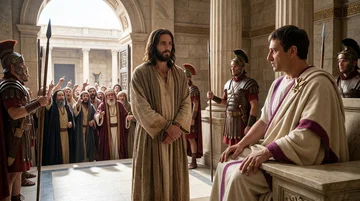
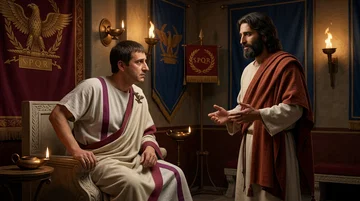
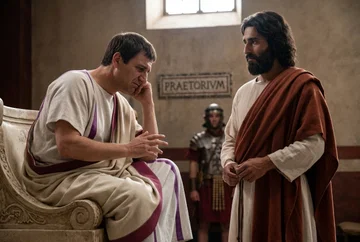
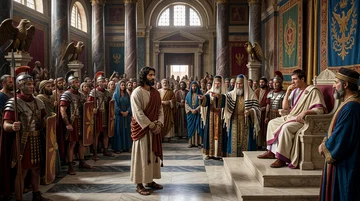
Cross-references
- Luke 23:2
And they began to accuse him, saying, We found this fellow perverting the nation, and forbidding to give tribute to Cæsar, saying that he himself is Christ a King.
The leaders accuse Jesus of opposing Caesar and claiming to be king.
- John 19:6-7
When the chief priests therefore and officers saw him, they cried out, saying, Crucify him, crucify him. Pilate saith unto them, Take ye him, and crucify him: for I find no fault in him.
The leaders demand Jesus’ death despite Pilate’s declaration of innocence, citing His claim to be the Son of God.
- Matthew 27:11-14
And Jesus stood before the governor: and the governor asked him, saying, Art thou the King of the Jews? And Jesus said unto him, Thou sayest.
Both describe Jesus before Pilate and his response during the hearing.
- Mark 15:1-5
And straightway in the morning the chief priests held a consultation with the elders and scribes and the whole council, and bound Jesus, and carried him away, and delivered him to Pilate.
Both recount Jesus before Pilate and the accusations against him.
- John 18:39-40
But ye have a custom, that I should release unto you one at the passover: will ye therefore that I release unto you the King of the Jews?
The crowd chooses Barabbas instead of Jesus, whom Pilate finds without fault.
- John 19:12
And from thenceforth Pilate sought to release him: but the Jews cried out, saying, If thou let this man go, thou art not Cæsar’s friend: whosoever maketh himself a king speaketh against Cæsar.
Jesus’ accusers pressure Pilate by framing his release as disloyalty to Caesar.
- Matthew 27:18
For he knew that for envy they had delivered him.
Pilate recognized that the leaders delivered Jesus out of envy.
- Matthew 27:2
And when they had bound him, they led him away, and delivered him to Pontius Pilate the governor.
A parallel account of Pilate’s hearing and sentence.
- Matthew 27:22-23
Pilate saith unto them, What shall I do then with Jesus which is called Christ? They all say unto him, Let him be crucified.
Pilate questions the crowd as they demand Jesus’ crucifixion.
- John 19:4
Pilate therefore went forth again, and saith unto them, Behold, I bring him forth to you, that ye may know that I find no fault in him.
Pilate declares that he finds no fault in Jesus.
- John 19:10-11
Then saith Pilate unto him, Speakest thou not unto me? knowest thou not that I have power to crucify thee, and have power to release thee?
Pilate questions Jesus about his authority, and Jesus says his power was given from above.
- Luke 23:4
Then said Pilate to the chief priests and to the people, I find no fault in this man.
Pilate declares that he finds no fault in Jesus.
- Mark 14:53-65
And they led Jesus away to the high priest: and with him were assembled all the chief priests and the elders and the scribes.
Jesus is condemned by the council before being delivered to Pilate.
- John 19:1-3
Then Pilate therefore took Jesus, and scourged him.
Jesus is scourged and mocked before His crucifixion.
- John 19:14-16
And it was the preparation of the passover, and about the sixth hour: and he saith unto the Jews, Behold your King!
The preparation of Passover leads to Jesus being delivered for crucifixion.
- Luke 20:20
And they watched him, and sent forth spies, which should feign themselves just men, that they might take hold of his words, that so they might deliver him unto the power and authority of the governor.
Religious leaders use agents to entrap Jesus before the authorities.
Commentary
Each commentary is drawn from primary sources: the writings of Ellen G. White and Adventist pioneers and periodicals. Each commentary is separate. Its own words are not a quotation; follow the references to read the source passages.
Ellen G. White
13 sources
Jesus stands before the Roman governor after His own nation and chief priests handed Him over for Roman confirmation of a death sentence, and Pilate distances himself from the Jewish people while demanding to know what specific wrong justifies the arrest.ST Jan 24, 1900COS 140.1–53SP 130.2–131.2DA 723.1–724.14RED 102.2–103.1 The case against Him is empty, with contradictory accusations that prove no sin, yet priests and rulers driven by hatred join a clamorous mob to demand condemnation and crucifixion.ST Jan 24, 1900COS 140.1–5Lt 100, 1910, par. 12–15 His calm bearing stirs Pilate's conscience and conviction of His innocence, but pride leads Pilate to evade inward examination, even as he declares he finds no fault in Him while Jesus submits to unjust death as humanity's substitute and surety.COS 140.1–5Ms 51, 1897, par. 29–303SP 130.2–131.2ST Jul 4, 1878Ms 107, 1893, par. 2 That handing over by His own leaders is the very trial His followers will themselves have to pass through, and He stands where every circumstance of life is open before Him to sustain them in it.Lt 290, 1906, par. 6–74RED 102.2–103.1 The call is therefore to stand on the elevated platform of eternal truth, trusting no man and not afflicting the soul over men's words, but clinging to the mighty One and leaning in humble faith upon Jesus.Lt 290, 1906, par. 6–7
Words and Trial Setting
Pilate's retort, Am I a Jew, is a denial that he himself is a Jew and a deliberate distancing of himself from the Jewish people.3SP 130.2–131.2DA 723.1–724.15RED 50.2–51.1COS 139.1–6ST Jul 4, 1878 By it he disclaims any personal involvement in the case against Jesus, treating the matter as one belonging to others and not to himself.5RED 50.2–51.1COS 139.1–6ST Jul 4, 1878 At the same time he points out that it is Jesus' own nation and its chief priests who have handed Him over, shifting responsibility for the arrest onto them.3SP 130.2–131.2DA 723.1–724.15RED 50.2–51.1COS 139.1–6ST Jul 4, 1878
The words place Jesus at His hearing before the Roman governor, brought into Roman custody after being delivered up by His own nation and its chief priests.ST Jan 24, 1900COS 140.1–54RED 102.2–103.1Ms 107, 1893, par. 2Ms 72, 1902, par. 15 It is the Jewish leaders who have delivered Him to Pilate, and the governor's confirmation is what is needed for the death sentence to be carried out.COS 140.1–5Ms 107, 1893, par. 2 There the demand is pressed that Pilate himself judge Him.Ms 107, 1893, par. 2
With the question, what hast thou done, Pilate seeks to learn the charge against Jesus and what justified the arrest.ST Jan 24, 1900Ms 51, 1897, par. 29–30Lt 100, 1910, par. 12–153SP 130.2–131.25RED 50.2–51.1 He wants a specific offense stated before he judges Him, asking what offense Jesus committed.ST Jan 24, 1900DA 723.1–724.1 The question thus contrasts the leaders' act of delivering Jesus to him with their failure to state what He had done.ST Jan 24, 1900
The setting is hostile and the case against Jesus is empty.ST Jan 24, 1900COS 140.1–5Lt 100, 1910, par. 12–15Ms 107, 1893, par. 2 The accusations contradict one another, have no value, and prove no sin against Him.Lt 100, 1910, par. 12–15Ms 107, 1893, par. 2 Priests and rulers, driven by hatred, join a clamorous crowd and violent mob in demanding that Pilate judge Him and in seeking His death.COS 140.1–5Ms 107, 1893, par. 2Ms 72, 1902, par. 15 That pressure leads to condemnation and humiliation, until the crowd calls for His crucifixion.4RED 102.2–103.1
Pilate's Conviction and Verdict
Pilate respectfully sought to know the truth about the charge that Jesus was king, trying to learn whether it came from himself or from the accusers.ST Jul 4, 1878 The uproar of the crowd and the demands of the priests drew him away before he could hear Jesus' answer.COS 140.1–5ST Jul 4, 1878 Jesus' bearing and calmness had awakened conviction in him, and Jesus' prior question had stirred his conscience and led him to examine his own heart.3SP 130.2–131.2COS 139.1–6ST Jul 4, 1878
Pride overcame that conviction, so by answering that he was not a Jew and that Jesus' own nation and chief priests had handed Him over, Pilate deflected from inward examination and avoided facing what he felt.3SP 130.2–131.2COS 139.1–6ST Jul 4, 1878 He distanced himself from the Jewish people and disclaimed personal involvement in the case.3SP 130.2–131.2ST Jul 4, 1878 His question about what Jesus had done came as he sought to understand the charge and what justified the arrest.3SP 130.2–131.25RED 50.2–51.1
He knew Jesus was innocent and that hatred and prejudice had brought the accusation.Ms 51, 1897, par. 29–30 His words show the accusation came from Jesus' own leaders, not from his own judgment that Jesus was guilty.Ms 51, 1897, par. 29–305RED 50.2–51.1 Yet he was perplexed and feared a tumult if he failed to yield to the priests.Ms 51, 1897, par. 29–30 He then declared that he found no fault in Jesus and pronounced Him faultless, thereby rebuking the false accusations of Israel's rulers.COS 140.1–5Lt 100, 1910, par. 12–15Ms 107, 1893, par. 2 Despite no sin being proved against Him, with contradictory accusations of no value, Jesus was treated unjustly and submitted to death by crucifixion as humanity's substitute and surety.COS 140.1–5Lt 100, 1910, par. 12–15Ms 107, 1893, par. 2
Warning and Strength for Followers
Christ's trial before Pilate, where His own nation and the chief priests delivered Him up, is the very experience His followers will have to pass through.Lt 290, 1906, par. 6–7 The disciples were prepared for that hour by their earlier experience of seeing followers turn away from Jesus, so that they would not be overwhelmed when He was betrayed and condemned and faced humiliation before the crowd called for His crucifixion.4RED 102.2–103.1 The priests and rulers, driven by hatred against Christ, joined a violent mob in seeking His death after He had been delivered into Roman custody, and their conduct shows how far people can sink in opposing the Son of God.Ms 72, 1902, par. 15
Christ is now where He takes a view of all these things, with every circumstance of life open before Him with whom all have to do.Lt 290, 1906, par. 6–7 From that place He will sustain those who go through this trial.Lt 290, 1906, par. 6–7
The verse calls for standing on the elevated platform of eternal truth while every false platform is shaken to pieces.Lt 290, 1906, par. 6–7 No man is to be trusted, men's words are not to be thought too much of, and the soul is not to be afflicted over them.Lt 290, 1906, par. 6–7 Instead there is to be clinging to the mighty One and leaning with all faith and assurance upon Jesus.Lt 290, 1906, par. 6–7 His Word is truth and is power to every soul that walks humbly before God, and strength comes by repeating without tiring how sure and steadfast is the truth as it is in Jesus.Lt 290, 1906, par. 6–7
Sources
Pioneers and periodicals
23 sources
Pilate disowned any personal stake in the dispute over kingship, threw the case back on Jesus' own nation and chief priests who had handed him over, and demanded to know what offense lay behind their charge.ST Jan 24, 1900ST May 10, 1905ST Jun 18, 1912ST May 6, 1897 The charge he was probing was the false claim that Jesus set up a rival earthly kingdom against Caesar, though he had taught giving Caesar his due.ST Jun 14, 1905ST May 25, 1904ST Oct 4, 1910 Jesus affirmed that he was born to be a king, yet made clear his kingdom is not of this world, proved by his servants not fighting to keep him from being delivered and by his suffering death when he could have prevented it.ST Jun 14, 1905ST May 25, 1904ST Jun 7, 1899RH Mar 25, 1875 His hearing before the Roman governor belongs to his death as the true Passover sacrificed at its appointed time, when the innocent one was condemned to please the rulers and gave his life for the world.ST Sep 24, 1912RH Oct 30, 1855ST Jun 7, 1899 Pilate was convicted by Jesus' bearing and turned aside through pride and lost his opportunity, while Jesus made no defense but endured insult with noble submission, and by refusing to deny his relation to God though it made his death certain left the pattern of faithfulness under suffering.ST May 10, 1905ST Jun 7, 1899ST Sep 30, 1886ST Sep 30, 1886ST Oct 31, 1916
Trial Setting and Question
John 18:35 belongs to the morning proceedings before Pilate after the chief priests and elders had condemned Jesus the night before.ST Oct 26, 1882 It is part of the trials before the high priest and Pilate in which Pilate sought to release him.ST Sep 24, 1912 The morning hearing was staged to appear to follow the rule requiring judicial proceedings by day, but it violated the rule against pronouncing sentence in a capital case on the same day as the trial.ST Oct 26, 1882
With Am I a Jew Pilate disclaimed any personal interest in the question of who is King of the Jews because he was not a Jew.ST Jun 18, 1912 He distanced himself from the Jewish accusation and from the Jewish people.ST May 10, 1905ST Sep 30, 1886ST Oct 26, 1882 He pointed out that Jesus' own nation and its chief priests had handed him over and had made the charge against him.ST Jan 24, 1900ST May 10, 1905ST Jun 18, 1912ST Sep 30, 1886ST Oct 26, 1882
With what hast thou done he sought the charge or offense behind the accusation.ST Jan 24, 1900ST May 10, 1905 His question contrasted the leaders' act of delivering Jesus to him with their failure to state what offense Jesus had committed, and thus questioned the accusers' case.ST Jan 24, 1900ST May 6, 1897 Under Roman law a charge was required for condemnation, Pilate recognized that envy lay behind the accusation, found no fault in him, and was inclined to release him.ST Dec 1, 1898 Jesus did not try to defend himself against the charges.ST Dec 1, 1898
The charge Pilate was probing was the false accusation that Jesus claimed kingship as a rival earthly kingdom and civil government against Pilate and Caesar.ST Jun 14, 1905ST Oct 4, 1910 The Jews falsely charged that he perverted the nation and forbade tribute to Caesar while claiming himself Christ a king, though he had plainly taught giving Caesar all that was due him.ST May 25, 1904 Pilate met that charge squarely by asking if Jesus was the King of the Jews.ST May 25, 1904ST Oct 4, 1910
Kingdom and Passover Sacrifice
Jesus did not deny that He was born heir to a throne when Pilate questioned Him about the charge that He claimed kingship, for He had been falsely accused of seeking to establish a rival earthly kingdom.ST Jun 14, 1905ST May 25, 1904RH Mar 25, 1875 His answer Thou sayest is equivalent to an affirmative answer, yet He did not claim kingship in the sense His accusers meant.ST May 25, 1904 He declared that His kingdom is not of this world and not from hence.ST Jun 14, 1905ST May 25, 1904RH Mar 25, 1875 This is proved by His servants not fighting to keep Him from being delivered to the Jews and by His suffering Himself to be put to death when it was in His power to prevent it, which one whose kingdom was of this world would not do.ST May 25, 1904RH Mar 25, 1875 His and His subjects' refusal to resist shows the same.ST Jun 7, 1899
When asked further if He was a king then, He answered that Pilate said He is a king, and that to this end He was born and for this cause He came into the world, to bear witness to the truth.RH Mar 25, 1875 The verse belongs to the account of Jesus' trials before the high priest and Pilate, during which Pilate sought to release Him.ST Sep 24, 1912 It is part of the New Testament account of Christ's death as the fulfillment of the Passover sacrifice, with Christ the Passover sacrificed on the fourteenth day of the first month as the Passover lamb was killed on that date.RH Oct 30, 1855RH Dec 15, 1868 This sacrifice fulfilled the Passover type at its appointed time.RH Dec 15, 1868
It belongs to the events leading through questioning before the Roman governor to condemnation and crucifixion.ST Oct 31, 1916 The innocent Jesus was condemned by the Roman governor despite being innocent, to please the Jewish officials, and He made no defense.ST Jun 7, 1899ST Oct 31, 1916 He endured the rulers' abuse and the crowd's mockery before giving His life for the world's salvation.ST Oct 31, 1916 His conversation with Pilate in John 18:33-38 shows sufficient acquaintance with the other current tongues to speak with Pilate.ST Mar 10, 1881 West-Aramaic was the tongue of the common people in which He thought and commonly spoke, while Latin was the language of official life and Greek the medium of polite intercourse, and His talk with Pilate demonstrates His ability to use those official tongues.ST Mar 10, 1881
The examination on the accusation brought to the Roman governor that Jesus was a rival to Pilate and to Caesar by setting up a kingdom, a civil government for Himself, was met squarely by asking if Jesus was the King of the Jews.ST Oct 4, 1910 That examination still stands as the teaching of Christ for His church, His body, for all time on the Christian relation to civil government.ST Oct 4, 1910
Conviction and Faithful Example
Jesus' question and bearing had awakened conviction in Pilate, who respected Jesus and wanted the truth.ST Jul 4, 1878ST Sep 30, 1886ST Oct 26, 1882 He had respectfully tried to learn whether the charge that Jesus was king came from himself or from the accusers.ST Jul 4, 1878 Pilate's abrupt, disinterested reply, distancing himself from the Jewish people and pointing out that Jesus' own nation and chief priests had handed Him over before asking what He had done, avoided facing that conviction.ST Jul 4, 1878ST May 10, 1905ST Sep 30, 1886ST Oct 26, 1882
Pride overpowered the conviction stirred in him and the Spirit of God's effort to convict him.ST Jul 4, 1878ST May 10, 1905ST Sep 30, 1886ST May 10, 1905ST Oct 26, 1882 Pride led him to act as if disinterested and to turn aside from growing conviction.ST Jul 4, 1878ST May 10, 1905ST May 10, 1905 He rejected the Spirit and lost his opportunity.ST May 10, 1905ST Sep 30, 1886ST May 10, 1905
Jesus made no defense but showed complete submission to undeserved injury and insult.ST Jun 7, 1899ST Dec 1, 1898 Handed over by His own nation and its chief priests and condemned though innocent, He stood with noble bearing, composed and cheerful while others heaped abuse and disgrace upon Him.ST Jun 7, 1899ST Dec 1, 1898RH Aug 25, 1859 He endured the rulers' abuse and the crowd's mockery before giving His life.ST Oct 31, 1916
When plainly questioned about His relationship with God He did not deny it, even though affirming it made His death certain.ST Sep 30, 1886 He thereby left an example of remaining faithful rather than denying one's faith to escape suffering or death.ST Sep 30, 1886
Sources